Brookings Institution finds that 82% of American families live within five miles of a private school

April 10, 2017

(Guest Post by Matthew Ladner)

Arizona lawmakers passed a broad expansion of the state’s ESA program last week, meaning that we got treated to every anti-choice talking point you can imagine during the debate, some far more dubious than others. One opponent for instance asserted that the ESA program was reminiscent of a very unfortunate history decades ago when officials kidnapped Native American children from reservation lands and forced them to attend schools in Phoenix, breaking their families up.  As you might imagine, this level of overconfident paternalism bears a scar to this day. Parental choice would of course bring this history to mind if not for the fact that it is in fact the polar freaking opposite of having some idiotic government official decide where your child was going to go to school whether you like it or not.

But I digress…

Transportation lies more in the realm of worthwhile discussion- parents can only choose between schools within transport range. Private schools engage in a variety of formal and informal transportation efforts- including carpools and buses, but the lack of tightly packed attendance boundaries presents challenges as choice schools tend to draw from large areas for students. Brookings has produced a very helpful study finding that 82% of American families live within five miles of one or more private schools.

So let’s take a real world example. A few years ago I blogged on the University of Notre Dame’s Alliance for Catholic Education program having partnered with a group of South Tucson Catholic schools. South Tucson has many low-income students and a sadly large number of low-rated public schools, but it also has a number of private schools within walking distance. Transportation is not the main issue in South Tucson- the ability of families to cover the modest tuition costs remain the main obstacle.

The complexity of the ESA program eligibility requirements were another obstacle, although one that has been overcome. This is a Powerpoint slide that ACE used to explain how they went about attempting to qualify children for Arizona choice programs under the formerly Byzantine rules of AZESA:

Having said all of this, not every child will have the same proximity to private schools as the kids in South Tucson. We can hope that additional private schools will open to meet demand, and the ESA does provide options outside of attending private schools. I am also hopeful that the Nevada ESA program will be funded this year, and we can see how including transportation as an allowable account expense works out in practice.


Governor Doug Ducey signs AZ Empowerment Scholarship Account expansion

April 7, 2017

(Guest Post by Matthew Ladner)

Arizona Governor Doug Ducey signed the expansion of the ESA program into law, becoming the first Governor to deliver on a sizable expansion of parental choice during the 2017 legislative sessions. The torch has been passed to a new generation of governors.

The other states are invited to hop on in-the water is fine!


BOOM! Arizona lawmakers pass broad ESA expansion

April 6, 2017

(Guest Post by Matthew Ladner)

Arizona lawmakers passed legislation tonight that will phase in near universal eligibility for ESA program. This will start with public school students in kindergarten and 1st grade, 6th grade and 9th grade in 2017-18, and then add grades from the on ramps (K,1,2 and 6,7 and 9-10 in year 2 and the next year K,1,2,3 and 6,7,8,9,10,11). The bill will also increase academic transparency and improve administration of the program.

Governor Doug Ducey’s stalwart support of expanding options proved crucial to this victory. Huge kudos to the bill sponsor Senator Lesko and Rep. Allen as well legislative leadership in both chambers and the members who took a tough vote in the face of determined opposition. Groups including the American Federation for Children, Americans for Prosperity Arizona, the Arizona Catholic Conference, the Arizona Chamber, the Center for Arizona Policy, Ed Choice, Excel in Ed and the Goldwater Institute all made vital contributions. Senator Worsley also deserves recognition as someone who played the role of honest broker in crafting a compromise that a winning coalition in each chamber supported. We’d all like to live in a world where there was no need to compromise, but that world is not the one we find ourselves in.

The Census Bureau recently announced that Maricopa County (Phoenix metro) as the fastest growing county in the nation-nudging out the Houston area. Enrollment growth is firing up again and the expanded ESA will give parents a broadening array of private educational choices to consider in what is already a robust public choice market. ESAs are an unfolding experiment in liberty, and future legislatures will debate further refinements and improvements, but this is the first big private choice victory of 2017, so…


Size Does Matter Visual Aid Followup

April 5, 2017

(Guest Post by Matthew Ladner)

I posed the question a couple of weeks ago as to why the National Association of Charter School Authorizers would score the charter school law of Nevada three times higher than those of Arizona and Colorado. The Arizona and Colorado charter laws after all have a delightful record of actually producing charter school seats, and both states rocked the NAEP like:

I, ah, have yet to receive anything approaching a coherent response. So I thought I would create a little visual on seat creation. The below chart shows charter schools opening in NACSA’s second rated state (NV) and also Arizona (which had a 9/33 score for most of this period) for the period Nevada has had charter schools (Arizona got a five-year head start). Just to practice my chart making skills, I inserted the flags of each state as the chart filler.

What is that you say? No Nevada is in there– it is just a little hard to spot. See that slightly different color blue smidge at the bottom of the Arizona flag? That is the Nevada flag. Here-let me give you a better look:

I think you have a good idea of what the Arizona flag looks like. This is similar to the NAEP data explorer not being able to give us academic scores for charter school students in Nevada because, well, like the visual the sector is just too small. In fact, when you examine NACSA’s top 10 ranked charter school laws, the list correlates strongly with small sectors, weakly with impressive results.

I want to make sure that my friends in the Silver State understand that I do not want to be understood to be critical of their efforts-I want nothing but the best for Nevada charters. Rather I want to not set the bar too low on defining charter school success, nor to misunderstand what actual success in charter schooling looks like. Hint: success looks a lot like Arizona and Colorado.

The comment section as always remains open if someone would like to explain why a rational person would score Nevada’s charter law three times higher than Arizona and Colorado. And by “any rational person” I mean “any rational person who supports charter schools” as obviously lots of people who do not support charters would have ample reason to rank Nevada’s law three times higher than Arizona or Colorado’s- as from that perspective delightfully contained.


We’re Going STREAKING! Down to the Federal School Choice Quad!

March 30, 2017

“It is just you Frank!” “There is more coming…”

(Guest Post by Matthew Ladner)

The American film classic Old School features a scene in which Frank the Tank (Will Ferrell) believes himself to be leading a streaking crowd. Frank learns in an awkward fashion that there is no crowd following him when his wife and her friends spot him on the road. The relationship between that scene and this Greg Toppo article should be readily apparent when you read it. 


Quotes of the Day-Colorado Charter Schools

March 29, 2017

(Guest Post by Matthew Ladner)

The Denver Post ran a story about charter schools flourishing in Colorado. Money quote on the blessings of creative destruction:

“Take the roughly 1,700 public schools in Colorado, multiply that by 20 years, and the odds of a district-run public school being shut down by the state is 34,000 to one,” said Alex Medler, a Boulder-based consultant who worked for six years as vice president for policy at the National Association of Charter School Authorizers. “Compare that to one in 10 charters closing — one in five for Colorado — and you’ll see the imbalance.”

“The lopsidedness of district-run school versus charter public school accountability is striking,” Medler said.

Quite right- Colorado charters face real accountability conducted frontier justice style by parents with charter schools facing a one in five shot of being closed. District schools meanwhile face faux accountability (mere bureaucratic compliance) and a 1/34,000 danger of being closed.

That was the great quote in the article. The unintentionally humorous quote:

Rico Munn, a former state board member and now superintendent of Aurora Public Schools, said the board was fairly balanced in the past when it came to charter appeals. But lately, the board appears to believe charters should “rise and fall only on parental choice” and not any other factors.

Hmm, rising and falling only on parental choice. That would be consistent with the NACSA 9/33 score for Colorado on their recent rankings. I wonder how all this letting things rise and fall only on parental choice business works out academically. Oh, that’s right we actually have scores:


Bring out your Dead!

March 28, 2017

(Guest Post by Matthew Ladner)

Ed Next has a new forum out titled “Is Test-Based Accountability Dead?“that includes Kevin Huffman, Morgan Polikoff and our very own Jay Greene. The crux of the argument (although all the authors make points worthy of consideration) in my view lies between Greene’s political analysis of the situation (school folks + disenchanted parents >> technocrats) and Huffman’s acknowledgement of the difficulties but enduring belief that the old system worked and could yet work if only…

This is where leadership must come into play. It is imperative that governors, state chiefs of education, and other local leaders vocally advocate for the potent change shaper of accountability and convince the public of that power. I am optimistic that state education leaders are availing themselves of the chance to draft stronger, multifaceted measurement systems under ESSA. If voters and parents get behind these systems, and we implement them with fidelity, we will be able to use test results—and other measures—to dramatically improve our public schools.

In my mind this statement recalls the scene in Henry V when the Battle of Agincourt turns decisively against the French. The French noble Orleans exclaims:

We are enough yet living in the field
To smother up the English in our throngs,
If any order might be thought upon.
Go see the play if you need a refresher on how that plan works out for the French. The Huffman piece merits careful examination regardless, as it is actually a good example of how K-12 policy discussions actually occur. Huffman presents evidence on national NAEP scores and attributes a positive trend to testing. Huffman then makes the case that test based accountability systems especially drove improvement in the District of Columbia and Tennessee. Ergo test based systems can drive public school improvement, therefore we must summon up the blood and make them work.

Huffman did not invent this type of reasoning. In the beginning there was Massachusetts-and a nation that strangely lacked curiosity about large package of reforms passed in 1993-It was the testing! Next came North Carolina and Texas to justify NCLB. And then Finland (?!?) and then Florida. Huffman proposes to add DC and Tennessee to the list to make the case for test based improvement strategies “I’m not dead yet!”

Properly trained social scientists of course will pull their hair out and mutter “wacky sassafras!” at such violence being done to the proper ascribing of causality. Given that this is how such conversations take place, we can at a minimum look under the hood of such claims-do they square with more rigorous empirical evidence? Has there been any effort made to explore alternative explanations or look at subgroup trends? Usually not-most often this is “tell me a story and let’s run with it!” So let’s turn some (minimal) attention towards the DC and Tennessee examples.

As has been discussed previously here at Jayblog, DC represents a complex case involving multiple powerful factors other than test based accountability- including massive gentrification and a powerful amount of parental choice. The only positive trend above and beyond the national average for low-income children in DC locates itself in the charter sector. Ergo it is hard to make the case that DC’s testing system is doing something especially impressive in my book.

So let’s consider Tennessee, and a non-tested area of Science under the theory that character is about what you do when you think no one is looking:

And…

Tennessee fares quite well in progress on NAEP Science. Tennessee also scored near the top on 4th to 8th grade Math and Reading cohort gains between 2011 and 2015. Unlike DC, neither a massive dose of gentrification or parental choice has yet made it to Tennessee, so let’s acknowledge that Tennessee students have displayed positive gains on the NAEP, including in areas outside of accountability testing. Tennessee seems to be a case worthy of examination (i.e. closer examination than I can provide in my pajamas) but let’s assume for the moment that Huffman is correct that the test based policies have been driving Tennessee improvement. What then?

Greene’s constituency politics analysis still likely prevails in the medium term. The lack of a “test my child more!” constituency added to the overt hostility of public school employees almost certainly places this strategy on borrowed time. Now if someone made me the Baron of Arizona and the federal government sent down a diktat that we were going to do testings and ratings, I would happily study what TN did and consider imposing it. “You have to have some kind of tests and ratings, why not ones that seem to have driven improvements?” would be a phrase likely to fall from Baron von Arizona’s lips. We however do not live in an imperial system, but rather in a democracy. This makes securing the consent of the governed necessary. Even in an imperial system, the peasants will stage frequent uprisings if and when they are sufficiently motivated.

The title of the Ed Next forum pretty much answers its own question. Whether or not such improvement strategies are “dead” we have reason to suspect have practical limits and constraints and that we have likely hit the ceiling.


The Accidental Superpower

March 27, 2017

(Guest Post by Matthew Ladner)

Peter Zeihan manages to build incredibly optimistic and pessimistic visions of the immediate future into a single book. Let’s start with the good news: Zeihan builds a compelling case that the United States has been and will continue to be the most incredibly advantaged nation on the planet. This owes both to geography and other factors. In terms of geography, the United States contains both the largest navigable river system (the Mississippi and six tributaries) that delightfully sits right next to the world’s largest bloc of temperate zone arable land (the Midwest). Add to that a presence on both the Atlantic and Pacific, an abundance of world-class harbors and then a free-wheeling economic culture in which the industrial revolution took root and flourished. Add all of this up, and the United States was in a position to make an incredibly generous offer to most of the rest of the planet towards the end of World War II. The United States offered to secure global maritime shipping and grant access to sell in American market in return for approximately nothing, with approximately nothing quickly morphing into “joining the global military alliance aimed at containing the Soviet Union.”

All in all Pax Americana proved to be a smashing success- the world recovered and prospered. Global poverty dropped, and the number of nations wanting in on the deal steadily grew. Eventually even China wanted in, and then in the early 1990s the Soviet Union collapsed. The end of history!

Not so fast…the story continues.

The end of the Cold War obviously raised questions regarding the United States continuing to bear the imperial burden. Zeihan notes that the United States is actually one of the world’s least internationalized economies- selling and buying in large volumes, but as a relatively small portion of the total economy. Outside the odd BMW most everything you want is available here, especially if you consider Canada and Mexico “here.” A continuing motivation for the United States continuing Pax Americana however had been the importation of oil. Somewhere along the way the United States had switched from being the world’s largest oil exporter to the largest importer. The United States thus had an incentive to secure oil supplies, primarily in the Middle East.

Two things intrude into this state of affairs. First, the United States created entitlement programs that are badly underfunded vis-a-vis the ongoing retirement of the Baby Boom generation, likely impacting both our ability and willingness to bear the imperial burden. Second, the advent of fracking has put the United States in a position to feel rather indifferent about Persian Gulf Oil. Zeihan’s conclusion of the optimistic portion of his book is that while tough days lay ahead, the United States is going to get through it in the end smelling like a rose.

The rest of the world not so much.

The remainder of the book looks at a number of different countries and their challenges, and how they might fare outside of Pax Americana. It’s not pretty. No countries have all of America’s advantages and many countries have age demography challenges more severe than the United States- including Canada, China, most of Western Europe, Japan and Russia. Other regions, like the Middle East, have already begun wars that won’t likely stop anytime soon. If you posit a return to a dog-eats-dog world that existed for most of human history before the imposition of Pax Americana (Zeihan does) the possibilities for armed conflicts are almost limitless. The United States, a defacto continental sized island of prosperity, need not involve itself.

A few years ago I would have thought Zeihan’s global pessimism overwrought. Now I can hope that this is the case, but I am not so sure. A few years ago I would have also thought that it was highly unlikely that the United States would have drawn a “red-line” in a Syrian civil war only to change our minds, and then watch a massive refugee crisis strain European unity and contribute to the departure of the United Kingdom. Or that Russia would start the process of reacquiring their Soviet era buffer states. Or that the United States would effectively abandon the interests of their long-time Middle Eastern allies like Saudi Arabia and Israel in favor of Iran.

All of these things however happened, and it seems to be a good bet that there is more global chaos on the way. Whether or not it unfolds as Zeihan foresaw writing back in 2014 or not remains highly speculative, and there are some more optimistic scenarios than a fast return to international anarchy. Since 2014, American oilmen decisively defeated the OPEC attempt to crush fracking by adopting new technologies and practices that decisively lowered the extraction costs of American tight oil. It’s not going anywhere.

Written in 2014, many things about the Accidental Superpower seem to foreshadow Trump. Trump claims that the United States has signed a huge number of “stupid” deals and that he will strike better deals. While I’m not saying I agree with this sentiment at all, Zeihan’s book does add a new perspective, at least for me. It also makes the choice of the former CEO of the world’s largest oil company to lead American diplomacy even more interesting.

I hope that Zeihan’s global pessimism proves over done. Take the Trump administration’s reading the riot act to our NATO allies regarding their defense spending for instance. If the hobbits of euroshire don’t toughen up pretty quickly, they are going to find themselves unprepared to deal with the legions of orcs heading their way as a fading but desperate Russia grasps at lost buffer zones. Of course this is easier said than done on a continent of stagnant growth, debt crisis and aging populations but failing to deter Russia could prove far more costly. Half of the American Baby Boomers will have reached retirement age by 2020, the United States may soon as Zeihan postulates view this as someone else’s problem. A German army with 63,000 people in uniform does not seem likely to get the deterrence job done, and if you were a Baltic state or Poland you should have your alarm set at “Red Alert.” If the United States can avoid a precipitous cut off, it may be possible for the Europeans to deter aggression on their own.

Similar transitions may be possible elsewhere, but a Saudi-Iranian barely cold war seems already locked in to consume the Middle East for a long time to come. The Congress lifted the ban on oil exports in 2015, and the United States already exports a million barrels of oil per day. Reading Zeihan raises the question of just how long the United States Navy will be protecting the shipping of foreign firms in direct competition with American firms for market share. Indefinitely? Friendly tip- if I were Europe or Japan I would start signing long-term oil and gas contracts with American firms like yesterday. The United States is going to have an interest in protecting its own shipping even in the Zeihan return to anarchy scenario, and other suppliers lack the political and military stability of a Texas or North Dakota.


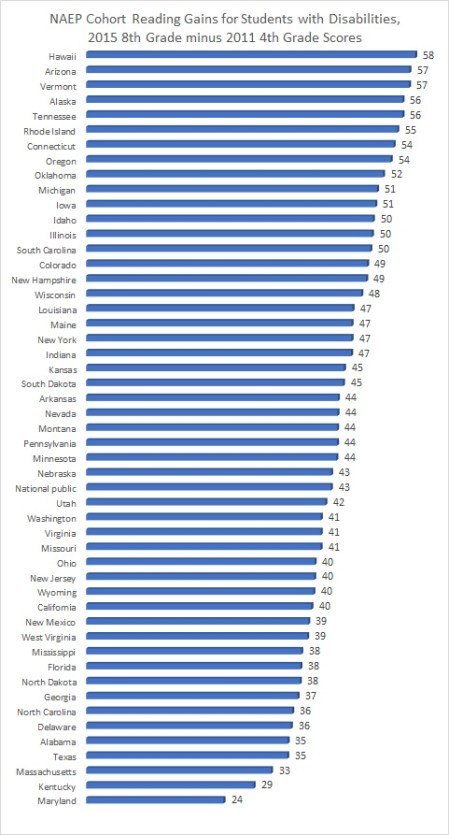
NAEP Cohort Gains for Students with Disabilities, 2011 to 2015

March 22, 2017

(Guest Post by Matthew Ladner)

Which states had the most success teaching math and reading to their students between grades 4 and 8 on the most recent NAEP exams?

Quick (really boring) caveat section- tracking NAEP cohort gains gets more inexact due to the larger standard error of estimate when examining subgroup scores- which exists in both the 4th and 8th grade scores. Accordingly, don’t get too excited if your arch-rival Idaho edges you out by a point, because if we knew a true population score rather than sampled estimate it could easily be the other way around. It is more appropriate to look to see whether the state nearest and dearest to your heart landed near the top, or near the bottom of the list than to obsess about their ranking. Moreover, given the possible role sampling error, it is probably best to consider looking at the math and reading scores together. If a state rocks one of the tests and performs not so great on the other, you may have gotten a lucky sampling error bounce on one test, or a bad bounce on the other, or maybe your state is just better at teaching one of these subjects than the other. You would have to consult other sources of data to figure that out. Conversely, if a state does well on both reading and math it is unlikely that sampling error is driving the result in both cases, assuming randomly distributed error.

Ok so on with the show:

Top ranked Hawaii had gains more than twice as large as bottom ranked Maryland. Note that both of the bottom states (MD and KY) have a noted prior history of high exclusion rates for special needs children in NAEP. If they excluded a high percentage of kids in 2011 4th grade testing but not in 2015 8th grade testing, an appearance of catastrophe could sneak in. I am happy to note that my patch of cactus lies near the top. What about math?

Note that the overall gains for math are smaller than for reading. Also Hawaii is again at the top, and Arizona is near the top. Again Maryland appears to have taught a little more than one year’s worth of math to special needs students in four years, but I suspect that strange things are afoot at the MD Circle K on that one. I could dig into NAEP pdf files to check on exclusion rates but alas it is time for me to get out of my pajamas, so I will leave that to whatever you call people from Maryland. Marylanders?


Pssst…NACSA…Size DOES matter

March 16, 2017

(Guest Post by Matthew Ladner)

I was looking at NACSA’s 2014 ratings for state charter school laws, as these would have been the most relevant before the most recent NAEP. Hailing from the out west, I noticed that Nevada had a score (26) nearly three times the score of both Arizona (9) and Colorado (9).

Longtime readers of JPGB of course will be aware that charter school students in both Arizona and Colorado rocked the 2015 NAEP exams like nobody’s business. Nevada on the other hand has had a very difficult experience with charter schooling. A decade ago or so ago I wrote a study for the Nevada Policy Research Institute that basically concluded that Nevada was missing out on high quality schools and the opportunity to relieve overcrowding in the public schools, and so should follow the example of their Arizona neighbor and get in the game. I wrote one of the earliest Jayblog posts on the subject called Fear and Loathing in Carson City:

Nevada, by comparison, has been hesitant in expanding parental options. In the five states surround Nevada (Arizona, California, Idaho, Oregon and Utah) and these states have 482, 710, 30, 81 and 60 charter schools respectively, collectively educating hundreds of thousands of students. With only 22 charter schools, Nevada is the tortoise of the region.

On November 30 of 2007, the Nevada Board of Education voted 8-0 to impose a moratorium on the approval of new charter schools. Board members told the press that the freeze was necessary because the state Education Department is being “overwhelmed” by 11 charter applications.

Arizona’s State Board for Charter Schools oversees 482 Arizona charter schools with a staff of 8. Nevada’s board overseeing cosmetology currently has 14 full-time employees.

The fear and loathing in this case referred to the sad fact that many in Carson City obviously feared and loathed charter schools. Imagine then my surprise to see a national charter school organization rank the same law a few years later as nearly three times higher than laws in nearby Western states that had produced far more opportunities for kids. Out of curiosity, I decided to check the 2015 NAEP scores for Nevada charter students.

NAEP yielded no information: the Nevada charter sector remains too small to reliably sample.

Now to give you some perspective on this, NAEP lists 5.6% of students in Nevada as Asians, and the data explorer will give you a number for male Asian students taking the 8th grade math exam in 2015 (Nevada’s Asian males did well on 8th grade math btw) but nothing for charter students of all sorts. NAEP cannot reliably sample charter students in Nevada because in 2013-14 they still only had 34 charter schools according to the National Alliance for Public Charter Schools. Those numbers for Arizona and Colorado btw were 605 and 197 respectively. Presumably the Nevada law would eventually like to have some “charter schools” result from their “charter school” law?

Next I decided to check out the 2015 rankings. The top 10 state charter sectors did not exactly cover themselves in 2015 NAEP glory. Indiana and Nevada tied for first place in their rankings, but neither state would yield NAEP estimates for performance. Alas Indiana’s 75 charter schools were not yet getting the job done in terms of scaling into the NAEP. The Nevada law passed in 1997 and Indiana in 2001. Hopefully this will get better in the future but for now:

The third ranked state (Ohio) has scores reported but those scores are consistently low, but Ohio’s NACSA score only recently increased. NACSA gets a Mulligan on that one, but continuing down the top 10 list however one fails to gain confidence regarding Ohio’s future prospects. Alabama ranks fourth, but is a relative newcomer to charter schooling so also cannot report scores. The Texas charter law ranks fifth on the NACSA 2015 list but has charter scores on NAEP that have yet to impress. I am a Texan who became an Arizonan and I would not swap charter laws with Texas even if they threw a shale formation into the bargain. In the vast majority of Texas schooling is still “take it or leave it” from the districts, whereas in Arizona even our Beverly Hills type districts are anxious for you to open enroll from outside the boundaries.

The same applies to seventh ranked Minnesota- the nation’s oldest charter law. You can get NAEP scores in MN, and I can’t thank them enough for inventing charter schools, but the feeling I get from MN charters is that they are safely contained rather than dynamic. The last three states in NACSA’s top 10-Mississippi, Missouri and South Carolina- all lack enough charter students to meet the minimum NAEP reporting requirements as well. Louisiana comes in 10th.

If you are scoring at home, NACSA’s top 10 is composed of six states with charter sectors that can charitably be described as “wee-tiny” and three others that have yet to flourish like an Arizona or Colorado, and then Louisiana. Tenth rated Louisiana’s charter sector does well in the NAEP, so bully for them, but they obviously have a unique charter history. Notably absent from NACSA’s top 10- very healthy charter sectors like Florida and Washington D.C.

Not to jump to any premature conclusions, but it appears that NACSA’s rating may be overly concerned with bureaucratic compliance rather than performance- either of the academic sort, or the “actually produces charter schools” kind. Arizona and Colorado produced hundreds of charter schools with NAEP scores that compare favorably to New Hampshire (and sometimes Massachusetts) with a 9 score from NACSA. I for one would like to see what they could do with, say, a five score from NACSA. What’s that you say? Three? Ok fine let’s try it out if you insist!

Now maybe I am missing something here, and that is why the comment section is open. I’ll leave you with the following question to consider- Nevada public schools suffer from catastrophic overcrowding. Public education in Las Vegas for a great many students involves sitting in a portable trailer being taught by yet another long-term substitute teacher. Clark County starts each school year with thousands of open teaching spots they are desperate to fill, and their officials told the New York Times they could build 23 new elementary campuses and they would be overcrowded on day one. The United States Census Bureau sees no end in sight for enrollment growth.

Please tell me why any Nevadan in their right mind would prefer Nevada’s charter law to what we see in Arizona and Colorado. I mean maybe scale and great results is not everyone’s cup of tea, but any port in a storm right?