The Way of the Happy Warrior

May 30, 2008

(Guest Post by Matthew Ladner)

Last week, I gave a commencement speech for the BASIS middle school. Newsweek recently named the BASIS Tucson the nation’s top high school. Charter schools took 10 out of the top 100 spots, which is far out of proportion with their numbers.

I had no idea of what to talk about, so I researched commencement speeches on the internet. There seemed to be two models: first you can quote a philosopher and give advice. Second, you can talk about whatever happens to be on your mind.

I chose model 1. For my philosopher quote, I used this nugget that I have seen attributed to Zen Buddhism:

The Master in the Art of Living makes little distinction between his work and his play, his labor and his leisure, his mind and his body, his education and his recreation, his love and his religion.

He hardly knows which is which.

He simply pursues his vision of excellence at whatever he does, leaving others to decide whether he is working or playing.

To him he’s always doing both.

When I first saw that quote, I said to myself “WOW- that’s what I want to be when I grow up!”

Let’s face it though, I’m not in much danger of growing up, so it remains only an aspiration for me.

The quote however perfectly describes my colleague at the Goldwater Institute Clint Bolick. The magazine Legal Times recently honored Clint in compiling “The 90 Greatest Washington Lawyers of the Last 30 Years” to mark the magazine’s 30th anniversary. The list honored attorneys for upholding the legal profession’s core values and “fighting to expand liberties and protect civil rights.”

Congratulations to Michael and Olga Block and their BASIS team, and the other charter schools making the list. Congratulations also to Clint, the only person I know getting lifetime achievement awards at the age of 39 (Ok, 39ish) and happily spending his time doing what he loves- suing bureaucrats.


What’s the Matter with Oregon?

May 28, 2008

(Guest Post by Matthew Ladner)


So, true story, last year I turned 40 near the end of a Phoenix summer. My fantastic wife, who I don’t deserve, told me that she had bought me a mystery trip for my birthday. “You’re leaving Thursday, I’m not telling you where you are going, but the high temperature there is around 78 degrees. You will be staying in a nice hotel and meeting an old buddy. Your pal has all sorts of fun things on the agenda.”


I said, “You had me at 78 degrees!”


So that Thursday I got on a plane for Oregon. I met my old pal Kevin, my partner in crime from my hipster-doofus days in Austin. We hit the Northwest Music Fest and sampled the local cuisine. We rented a car in downtown, and the kid behind the desk informed us that they only had a Jaguar.


Kevin and I looked at each other, and said “Usually we hate Jaguars, but if it the only one you’ve got…”


Twenty minutes later we were going 100 miles per hour headed out of Portland to see the wine country. I told Kevin “You can hit on the Asian women, I’ll be neurotic about merlots…”


Anyway- I noticed two things about Oregon while I was out there. First- the kids all have tattoos. Second, the place is very Anglo.


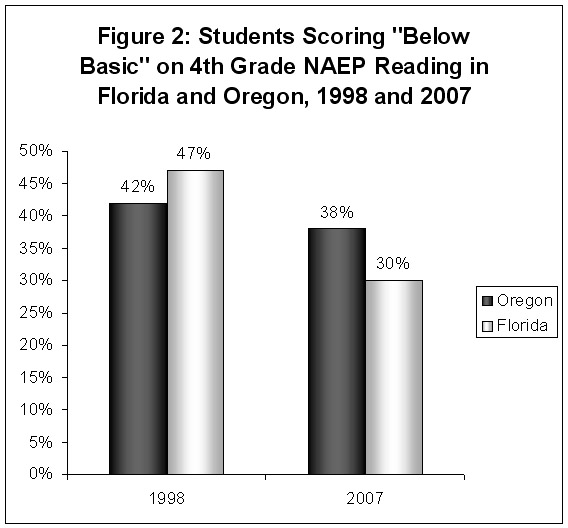
All of this is a prologue to wondering: why is a place as well to do as Oregon score so poorly on the NAEP?

Florida’s K-12 population is majority minority (50.4%) while Oregon is not (26.4%). According to the Census Bureau, they spend about the same amount per pupil.

One of these states is making substantial progress, and one of them is not. So, what’s going on Oregon? Where is the progress part of being progressive?


You’re on Notice!

May 22, 2008

(Guest Post by Matthew Ladner)

Last year, Steven Colbert had a segment on college rankings. Colbert expressed disappointment that his alma mater, Dartmouth, did not rank well in the Washington Monthly rankings of college effectiveness. Washington Monthly focuses on the graduation rates of low-income students. Colbert protested that Dartmouth has plenty of social mobility, as you could enter a plutocrat and graduate an oligarch.

Despite the lighthearted treatment, a serious issue surrounds the issue of the perverse incentives created by the U.S. News and World Report (USNWR) rankings. Inputs dominate the USNWR rankings–how much money the universities have, and the SAT scores of incoming students, etc.

But a more appropriate ranking system would focus on outputs, not inputs. Student learning gains should be the focus of judging the effectiveness of colleges. The University of Texas System pioneered the use and publication of such gain scores on a broad test of cognitive skills. The results: the value added champions were UT-San Antonio, which sits at the bottom of the USNWR rankings. Strangely enough, the highest rated university according to USNWR, my alma mater of UT-Austin, does not do as well in the value added department.

Have-not universities have every incentive to adopt a similar system. Harvards by the Highway will never buy their way to the top of the heap, but they might be able to teach their way there, given the proper incentives.


Carey vs. Coulson

May 20, 2008

(Guest Post by Matthew Ladner)

Education Sector’s Kevin Carey has been going after the Cato Institute’s Andrew Coulson with hammer and tongs. Read the back and forth here, here and here.

Even though Carey is on the other side of the ideological fence from me, I am a big fan of his higher education writing. The story here is that center-left Carey receives mail from the Cato Institute (intended for a previous resident) and is more than a little freaked out by them. Carey writes:

The struggle for a single-perspective organization like Cato is staying principled while retaining efficacy and legitimacy. In other words, while it’s all well and good in theory to stick to your intellectual and ideological guns, as a rule most people don’t like being objects of scorn and ridicule, or (if they’re in the think tank business) having the doors to the corridors of power slammed in their face. So they make compromises to stay part of mainstream conversation. Cato’s education policy proposals reflect this.

I gather from this that Carey believes that what the Coulson really wants to do is to abolish public schools, and have only adopted the mantra of tax credits as a fig-leaf of respectability for Cato. This clearly isn’t the case however, as Coulson laid out his vision of private education years before going to work for the Cato Institute in his book Market Education.

The Cato Institute, of all the right of center Washington think-tanks, clearly has a high tolerance threshold for scorn and derision. Sticking to your guns also has its uses. Cato, for instance, didn’t jump aboard the NCLB or the Iraq War bandwagons even when they were all the rage in right of center circles. I’m guessing they are pretty comfortable with those decisions now, regardless of what I or anyone else thought/thinks.

Carey asserts that Coulson’s ideal system of schooling is “un-American and basically absurd.” It would certainly seem that way to a man of the left. It’s good to debate what an ideal system of schooling would look like, as we can all agree that the one that we have now is far from ideal.

The use of the term un-American goes off the rails in my opinion. It seems like an attempt to ideologically dismiss an opponent without actually considering their perspective or evidence.

It’s also worth noting that Americans paid some of the lowest taxes in the world in the 1770s, but that didn’t stop them from fighting a bloody Revolution in order to secure their freedom. The Founding Fathers weren’t terribly pragmatic. I don’t recall demands for seats in Parliament as a reasonable solution to the “No Taxation without Representation” problem.

We can argue about whether or not the Cato Institute puts out absurd proposals. As a “small l” libertarian, I certainly don’t always agree with them. I exclusively attended public schools, my mother taught in a public school, my sons attend a public school, and I am proud to serve on the board of a public charter school. I’m not against public schools, but I am fiercely opposed to dysfunctional public schooling. Like Carey, I believe that public schools are permanent and I hope we make them work better for kids. We should all be members of the Joe Williams anti-crappy schools coalition.

The Cato Institute can be accused of being fundamentally opposed to public schooling. I’d guess that they would happily plead guilty to that, but un-American? That’s a bridge too far.


I’ll Have What Florida is Having

May 18, 2008

(Guest Post by Matthew Ladner)

In a recent article for the Goldwater Institute, I found that Florida’s Hispanic students outscore Arizona’s statewide average on fourth grade reading exams. Some readers emailed and wanted to know if this could be attributed to the fact that Florida’s Hispanic population is predominantly Cuban. The short answer is no, because the Hispanic population was also predominantly Cuban in the 1990s when scores were much, much lower.

Other inquiries involved questions about student poverty. Statewide averages for low-income students for Arizona and Florida are broadly similar, but I decided to investigate using the NAEP data. What I found was extraordinary.

Using the data analysis features on the NAEP website, you can get fourth grade reading scores broken down by both race and income. It is not only the case that Florida’s Hispanic students outscore the statewide average in Arizona, Florida’s low-income Hispanic students outscore the average Arizona student.

Arizona is not alone in this. Florida’s Free and Reduced lunch Hispanics also outscored the statewide average for all students on 4th grade reading of California, Hawaii, Louisiana, Mississippi, Nevada and New Mexico. They tied the statewide average for Alaska and South Carolina, and fell one scale point below Oregon and West Virginia.

In 2007, a family of four needed to earn $20,650 to qualify for a free lunch, $38,203 for a reduced price lunch. Nationwide, approximately 80 percent of free or reduced lunch children qualify for a free lunch.

Median family income in California, by comparison, is $64,563.

I appeared on a conference panel recently, and a fellow panelist noted the difference between a problem and a condition. A problem, she said, was something you tried to fix. A condition was something you had given up on and just grown to accept.

Low academic achievement for low-income and minority children is a problem not a condition. Florida under Jeb Bush put in testing and accountability with real consequences, implemented parental choice, reformed reading instruction, curtailed social promotion, liberalized teacher certification, and put in merit pay.

The results speak for themselves. To paraphrase that famous line from When Harry Met Sally: I’ll have what Florida is having.

UPDATE: The Wall Street Journal weighs in on the historic vote by Florida Democrats to expand the Step Up for Students tax-credit program.


Catholic Schools Can Survive

May 15, 2008

(Guest Post by Matthew Ladner)

The Thomas B. Fordham Foundation recent presented a study of the future of inner city Catholic schools reached mostly dreary conclusions. Catholic schools face a number of problems, but there is a bright spot that Fordham missed where Catholic schools are flourishing, even the inner city schools: Arizona.

I began to investigate the state of Catholic schools in Arizona when Education Next published the article “Can Catholic Schools Be Saved?” This article posed the provocative question: Will charter schools finish off inner city Catholic private schools? Preliminary evidence suggests that charter schools are actually threatening to help close inner city Catholic schools. A RAND Corporation study focusing on the impact of charter schools in Michigan found that private schools were taking a bigger hit from charter school competition than public schools on a student for student basis. “Private schools will lose one student for every three students gained in the charter schools,” the study concluded.

Ronald Nuzzi, director of the Alliance for Catholic Education Leadership Program at the University of Notre Dame asserted that charter schools “are one of the biggest threats to Catholic schools in the inner city, hands down. How do you compete with an alternative that doesn’t cost anything?” Inner-city Catholic schools are in a deep and tragic crisis, especially in Michigan. Sadly, Michigan’s constitution essentially forbids private school choice of any sort, and the Diocese of Detroit has witnessed a 20 percent decline in enrollment since 2002 and currently faces another round of school closures. Overall, 29 Diocese of Detroit schools have already closed.

A fully scaled system of charter schools for inner-city areas may represent an existential threat to inner-city Catholic schools already struggling with the loss of religious staff and the movement of parishioners to the suburbs. In many inner city areas, Catholic schools have been the only high performing schools for decades. Catholic schools have an especially strong record in successfully educating disadvantaged students and sending them on to college. It would be tragic and absurd to help drive these schools out of business by publicly funding student attendance to both public and charter schools, but not to private schools.

Writing in the Journal of Catholic Education, I detailed a more hopeful example than Michigan: Arizona. Total charter school enrollment is 12.5 percent higher in Arizona than in Michigan, despite the fact that Michigan’s population is far larger than Arizona’s. Arizona, however, has two factors working for it that Michigan does not. Arizona has both a growing student population and private school choice programs (two tax credit programs and two voucher programs).

Catholic education is anything but wilting in Arizona. Between 2004 and 2006, schools in the Diocese of Phoenix saw a two percent increase in enrollment against a national decline. Two new Catholic schools opened in the 2006-2007 school year, with four more scheduled to open. Marybeth Mueller, superintendent of Catholic schools for the Diocese of Phoenix stated that the tax credit program has been “critical to keeping financially struggling families in the Catholic school system.” The tax credit programs provide about half of the states Catholic school students limited financial assistance.

Arizona private school attendance has increased outside of the Catholic schools as well. Despite the opening of hundreds of charter schools, the percentage of Arizona children attending private schools increased by 23 percent between 1991 and 2003, according to the National Center for Education Statistics.

Parents must pay public school taxes even if they do their fellow taxpayers the service of placing them in a private school at their own expense. If parents decide to seek an education they find a private for their children, they effectively pay twice- once when they pay taxes, another when they pay tuition and fees. Both tax credits and school vouchers can reduce this double payment penalty, expanding access to private schooling. In the process, competition will improve the performance of public schools by expanding competition for students, and (in states like Arizona) reduce public school overcrowding.

Arizona and Michigan have both enjoyed the large benefits of charter schools. The starkly different trends in private schooling suggest strongly that choice supporters must redouble their efforts on the private choice side.


School Choice Dead?

May 14, 2008

(Guest Post by Matthew Ladner)

A couple of weeks after Greg Anrig proclaimed the death of the school choice movement we see an expansion of the Step Up for Students program pass with strong Democratic support in Florida, and today, the Governor of Georgia signed a similar tax credit into law, and a voucher program for New Orleans passes with a large bipartisan majority 60-42 in the LA House.

Don’t look now, but a choice bill is out of committee in New Jersey.

Andy Rotherham predicted that Anrig would regret writing the article. Let none doubt the prophetic powers of the Eduwonk.


Hans Brix? Oh no!

May 14, 2008

(Guest Post by Matthew Ladner)

In Team America: World Police Hans Blix shows up at the palace of Kim Jong Il. Blix demands to inspect North Korean nuclear facilities, “or else.” Kim Jong Il asks or else what, and Blix threatens to send “a very angry letter” from the United Nations. Kim proceeds to open a trap door, dropping Blix into a shark tank.

I would include a youtube link, but this is a family blog.

So just to sum up what I have gathered on Reading First: we have decades worth of high quality evidence showing that public schools are using terribly ineffective reading methods. When the Bush administration finally tries to do something about it, with serious money involved, lobbyists water down the bill language and the program administrator is subjected to a witch hunt. Essentially the schools take the billions and barely implement the program. When the program is evaluated, it “doesn’t work.”

The next time one of my fellow reformers suggests that they can fix things once they get to be the ones with their firm grip on the ship wheel, I’ll humbly suggest that they have the phrase “READING FIRST” tattooed to their forehead to serve as a constant reminder of how education policy actually works. Meaningful education reform can be done, but it works best when there is pressure from both the top down and the bottom up.


Marion Barry endorses D.C. Opportunity Scholarships

May 13, 2008

(Guest Post by Matthew Ladner)

Former mayor and current D.C. Councilman Marion Barry endorsed the school voucher program today in the Washington Post:

I was fortunate that I could afford the right school for my son. As I have been in years past, I am focused today on those who most need help. We need to give the same opportunity to the District’s low-income parents, and this package would help ensure that all parents in our city have choices about where their children attend school.


Charles Murray vs. Michael Oher

May 10, 2008

(Guest Post by Matthew Ladner)

Michael Lewis’ book The Blind Side tells a fascinating story about poverty and education through the lens of football. Lewis focuses on two main stories. First, on the legendary coach Bill Walsh’s struggles in the 1980s to overcome the most fearsome defensive force of the era. Second, on an incredibly disadvantaged young man who beat the odds.

As head coach of the San Francisco 49ers Bill Walsh had one big problem: New York Giants linebacker Lawrence Taylor (LT). Attacking from the left–the blind side of a right-handed quarterback–LT humiliated linemen and punished quarterbacks with bone-crushing sacks.

Lewis’ tale becomes truly fascinating when he goes inside the world of the NFL’s talent search for born left tackles–a rare combination of size, speed and agility. These rare men would rise to become the second highest paid positions in professional football for their ability to protect the quarterback from men like LT. This is where the story intersects with education.

Michael Oher grew up in inner-city Memphis. In and out of foster care, Michael’s lucky break came when his dying grandmother extracted a promise from a family friend to get Michael into a private school.

Michael was enrolled in a private Christian school called Briarcrest. On a cold day, a parent of another Briarcrest student found Michael breaking into the school to stay warm. The parent, Leah Anne Tuohy, a successful interior designer and wife of a Memphis businessman, took Michael in. Despite the fact that Michael scarcely spoke, a bond developed between the Tuohys and Michael and they eventually adopted him.

Although he had never played sports Michael was a natural athlete and was identified immediately by college scouts as a potential NFL left tackle. If Michael could get to college and play football, he was very likely to win a multimillion dollar contract to protect a quarterback’s blind side.

The Tuohys and the faculty at Briarcrest engaged in a Herculean effort to make Michael eligible for college. When Michael came to Briarcrest he had only erratically attended school, could scarcely read and knew little about anything.

Lewis skillfully explains the role of poverty in education, writing, “Michael wasn’t stupid. He was ignorant, but a lot of people mistook ignorance for stupidity, and knowingness for intelligence. He’d been denied the life experience that led to knowingness, which every other kid at Briarcrest took for granted.”

Michael was not unintelligent, but he was profoundly uneducated. Leah Anne would, for example, take Michael to an Italian restaurant and order multiple meals in order teach him the difference between different types of pasta dishes.

The implications of Michael’s story for public policy are profound as well. Lewis writes, “Michael Oher was in possession of what had to be among the more conspicuous athletic gifts…and yet, without outside intervention even his talent would likely have been thrown away…If Michael Oher’s talent could be missed, whose couldn’t? Those poor black kids [in the inner-city] were like left tackles: people whose values were hidden in plain sight.”

With a committed family, school, and private tutors, Michael was accepted to college.

Today he is approaching his senior year at the University of Mississippi, made all-conference as a sophomore and junior, and carries a 3.7 grade point average.

Michael made it. But he is very much the exception. For every six inner-city Memphis public school kids with the athletic ability to play college sports, only one qualifies academically to attend college. This says something about the state of inner-city public education.

“Pity the kid inside Hurt Village [in Memphis] who was born to play the piano, or manage people, or trade bonds,” Lewis wrote. The success of Briarcrest in helping Michael exemplifies the hope that school choice can give to troubled youngsters.

The hole Michael dug himself out of might not have been so deep if not for the dysfunctional Memphis public school system. One cannot help but wonder if Memphis public schools would be so completely indifferent if every student had the opportunity to attend private schools.

Our current education system limits school choice to parents who can afford to buy homes in good neighborhoods or pay private school tuition. Our best teachers often flee the classroom in frustration, or cluster in suburbs far from the students who need them most.

Kids should not require Michael Oher’s incredible luck to make it. Neither should they be stuck in inner-city schools run for the benefit of the adults rather than the kids in the system.

So how does Charles Murray fit into this?

Murray knows far more about IQ testing than I do. I know next to nothing. From what I’ve read of Murray’s works, it does seem obvious that everyone has an upper threshold for academic achievement, a ceiling if you will, and that those ceiling vary from person to person.

It also seems obvious to me, however, that these ceilings are of little practical importance for many inner city children who have never attended a decent school, and who often have parents and grandparents who have never attended a decent school.

In other words, children like Michael Oher have been operating so far below their ceilings that we have every reason to radically improve our education system, especially in the inner cities. I’d even be willing to bet, despite Murray’s characterization of the academic literature on the subject, that if we had before and after adoption IQ tests on Oher, that there would have been substantial growth. I could be wrong about this, and I’d welcome correction, but Michael Oher’s experience begs the question in my mind exactly what it is that IQ tests are actually measuring.

Regardless of such concerns, however, it seems clear to me that efforts to make much more effective use of the huge and tragically mismanaged resources put into inner city schooling should be accelerated.