(Guest Post by Matthew Ladner)


(Guest Post by Matthew Ladner)
 7 Comments |
  college sports | Tagged: Longhorns vs. Razorbacks |
  Permalink
 Posted by matthewladner
(Guest Post by Matthew Ladner)


So kids, the time has come to choose: what is the greatest really bad movie of all time? Number one seeds: Xanadu, Starship Troopers, Urban Cowboy and Point Break.
The floor is also open for nominations.
One movie I’ve had nominated, but haven’t had the chance to see yet: Congo.
Have your voice heard by voting in the comment section.
24 Comments | Pass the Popcorn | Tagged: Point Break, Starship Troopers, Urban Cowboy, Xanadu | Permalink
Posted by matthewladner
(Guest Post by Matthew Ladner)
J. Patrick Rooney passed away recently, leaving behind a remarkable legacy.
The Los Angeles Times once described Rooney as “a wealthy man and politically eccentric conservative who also had championed civil rights throughout his life.” An Indianapolis insurance executive, Rooney fought racial discrimination in the insurance market and launched the nation’s first privately financed school voucher program.
Rooney told the Wall Street Journal “When all families, no matter how poor, have the freedom to walk away from bad schools, competition will force the public schools to improve.”
Rooney’s privately funded programs were the precursor to the creation of scholarship tax credits, originating in Arizona. Jack and Isabel McVaugh created the Arizona School Choice Trust, inspired by Rooney’s philanthropy. In 1997, the Arizona legislature created the nation’s first scholarship tax credit program in order to augment these efforts.
Today, there are seven scholarship tax credit programs in Arizona, Florida, Georgia, Iowa, Pennsylvania, and Rhode Island helping thousands of parents to choose the best school for their child.
Rooney’s impact stretches beyond these impressive education achievements. He is also known as “the Father of Medical Savings Accounts,” the precursor to today’s Health Savings Accounts. HSAs represent the most effective heath reform option on the table today, as they uniquely address the underlying problem of out of control costs.
Rooney left the world a better place than he found it, and it falls to us to see that his great legacy of progress continues to grow.
Leave a Comment » | tributes | Tagged: Health Savings Accounts, J. Patrick Rooney, Private Scholarship Programs | Permalink
Posted by matthewladner
(Guest Post by Matthew Ladner)
Both Eduwonk and Charlie Barone are ga-ga for Delaware’s education reform results, and with good reason. Delaware has high-scoring minority students on NAEP, and have an admirable system of student testing that other states should study carefully.
I decided to run Delaware’s numbers against my favorite reform state, Florida, by comparing progress by low-income children on NAEP’s 4th grade reading exam.

And down the stretch they come! It’s Delaware by a nose!
Now, Delaware spends $11,633 per pupil in the public schools in 2006, while Florida was only at $7,759, which is 49% higher. However, these days, you don’t look the progress gift-horse in the mouth, even if it comes at a hefty price.
One could argue that Delaware shows that with the right kind of investment and commitment to standards, that you can improve student achievement without any of that messy school choice business.
Not so fast my friend!
It turns out that Delaware is discretely a haven for parental choice. Delaware has the nation’s 7th ranked charter school law according to the Center for Education Reform, and active inter and intra district choice programs. Add all of those up, and 15.5% of all K-12 students in Delaware are exercising choice through public options.
Delaware also has a large number of students attending private schools, and a little less than 2% home-schooling. Combine those, and you get over 20 percent of students exercising private choice.
If you add it all together, 35.7% of Delaware students are attending schools other than their assigned district school.
It just goes to show- standards and parental choice are two great tastes that taste great together.
4 Comments | competitive effects, instructional reform | Tagged: Delaware education reform, Lee Corso, Longhorns vs. Razorbacks | Permalink
Posted by matthewladner

Like Trick or Treat Banker Dudes!
(Guest Post by Matthew Ladner)
Number one seed in the west so bad they’re good movies tournament: Point Break.
Point Break is a sublimely absurd action flick starring Keanu Reeves, Patrick Swayze and Gary Busey.
So, Keanu Reeves plays FBI Special Agent Johnny Utah (no, I’m not making that up), a former all Big 10 defensive back who didn’t make the pros due to a knee injury. Gary Busey plays the plantonic ideal of the grizzled-veteran-who’s-upset-to-have-to-train-a-damn-rookie stereotypical cop character.
If you guessed that Johnny Utah’s knee injury reappears at an inopportune moment, you’ve been watching too many bad movies. Give yourself a gold star.
Bank-robbers known as the Ex-Presidents are giving our FBI heroes fits. Barging into banks wearing rubber masks of Nixon, Carter, Reagan etc, the Ex-Presidents have pulled off a series of heists.
Busey notices that one of the ex-Presidents has a tan line, leading Johhny Utah to go undercover as a (real stretch here) surfer to find them out, leading to the following confrontation:
In this scene, Johnny Utah chases Ronald Reagan after a robbery. Unfortunately, this clip starts after Ronald Reagan (Swayze) has used a cigarette lighter and a gas pump as a flamethrower, and has some random song imposed on it. Nevertheless, you will see what has got to be the greatest a pied chase scene ever:
Point Break has Johnny Utah jumping out of a plane without a parachute in a fit of rage and even Ronald Reagan throwing a bulldog in anger, and the authorities killing the lead singer of the Red Hot Chili Peppers. But most of all, it has the best Keanu-rific line delivered line of all time.
Now, in most Keanu Reeves movies, there is at least one line delivered with laughter inducing awkwardness. One of the brilliant things about The Matrix was that the Wachowski brothers made no effort to suppress the insuppressable, and instead brought on the Keanurific moment on purpose: I KNOW KUNG FU.
Sure, there are other candidates for greatly awful Keanu lines. In Something’s Got to Give for instance, Keanu tells Diane Keaton You smell good. I knew you’d smell good!
Point Break however takes the prize. In the priceless finale Swayze is captured by Johnny Utah, handcuffed on the beach, preventing him from going out to commit surfer suicide on the most bitchin’ wave of all time. Johnny explains:
YOU’RE GOING DOWN!!! IT’S GOTTA BE THAT WAY!!!!!!!!!!!!!!!!!!!!
Swayze then begs Utah into letting him off himself like a true SURFER-ZEN-DOOFUS, crushed by the super tsumami. Johnny’s FBI badge washes away in the tide, roll credits.
But did Swayze actually die? Believe it or not- there is a sequel planned.
4 Comments | Pass the Popcorn | Tagged: Keanu Reeves, Patrick Swayze, Point Break | Permalink
Posted by matthewladner

(Guest Post by Matthew Ladner)
Literature contains any number examples of the “magic child” myth- the one with mystical abilities that will become a great leader. Paul Atreides, Luke Skywalker and Thomas “Neo” Anderson are recent examples from science fiction, but there are many others.
For some reason, we tend to buy into the messianic myth with school leaders as well.
The oddest thing (to me) about the back and forth we’ve had here and elsewhere about instructional versus incentive based reform seems to center around Joel Klein’s tenure in NYC. I think Klein will ultimately be seen as a fairly inconsequential figure.
Let me hasten to say that I briefly met Klein at a conference a few months ago, and he seemed like a good guy, so this is nothing personal. He seems to have good intentions. Some have lauded his reforms; others have indicted him for making poor instructional choices. It seems perfectly plausible to me that Klein deserves praise for some things and criticism for others.
In my book, however, there are usually only two types of urban superintendents: those that have failed, and those that will fail. Rick Hess’ Spinning Wheels made this case convincingly- school systems cycle through superintendents as pseudo-messiahs as a method for kicking the can down the road. New savior arrives, tries to implement reforms, and receives a pink slip about three years later.
The new-new savior finds a group of half implemented reforms lying around, discards them to put in his or her own new program. Repeat process indefinitely. Longtime teachers learn to ignore the flailing at the top, knowing that “this too shall pass.”
Klein obviously departs from this model. He has a legal rather than an education background, and assumed control under the auspices of Mayor Bloomberg taking over the schools. His tenure has already lasted far longer than average.
It has never been a tenet of those of us in the choice movement that a gigantic schooling system would substantially improve if only they had the right superintendent. We emphasize market mechanisms, not benevolent dictatorships. In fact, we’ve seen some celebrity superintendents in the past: Roy Roemer in Los Angeles, Mike Moses (former state Education Commissioner) in Dallas.
No revolutionary improvement there, either.
Don’t get me wrong: I’m hoping for the best with people like Rhee and Klein. One might think that, for instance, that it shouldn’t be inconceivable for Rhee to improve the governance of the DCPS, but the track record here is not awe-inspiring.
If the critique of Klein is that he received a huge windfall of money but has failed so far to produce big results, what can one say other than: why would you expect anything else? Surely hope cannot have so completely triumphed over experience.
We should be persuaded by the evidence that instructional choices are very important. Incentive based reforms are also important. If a NYC chancellor does a little bit of one and none of the other, the results are likely to be underwhelming.
In other words-this too shall pass. Wake me up if and when Klein does anything truly radical- like a Jack Welch program for firing the bottom 10% of teachers and bureaucrats each year or widespread parental choice. Until then, I’ll hope for the best but not expect too much.
2 Comments | competitive effects, instructional reform | Tagged: Joel Klein, Rick Hess, Sol Stern | Permalink
Posted by matthewladner
(Guest Post by Matthew Ladner)
In the New York Times campaign blog, Cal-Berkley education professor Bruce Fuller makes some wildly inaccurate assertions.
Fuller asserts:
Yet only three publicly financed voucher programs — Cleveland, Milwaukee and Washington — have survived since the early 1990s.
Fuller needs to check his facts. There are three voucher programs in Ohio alone. Two more in Arizona. Oh, and then there are voucher programs in Utah, Georgia and Louisiana. Oh, and Maine and Vermont. Also Florida. And of course this ignores the nation’s tax credit programs.
Worse still, Fuller writes:
On early education, Republican leaders have been silent, even though quality preschools pack a strong punch in boosting young children’s learning.
This is an artfully written sentence indeed. The phrase “boosting young children’s learning” deftly avoids the question as to whether these gains are ultimately sustained. Fuller himself however wrote the following in opposing Hillary Clinton’s preschool plan:
Three recent studies, conducted with national data on more than 22,000 young children, have shown significant benefits from preschool for poor students, especially those who find their way into higher quality elementary schools. But cognitive gains from preschool quickly fade out for middle-class children; social development slows for those spending long days in centers.
I am reading Fuller’s book Standardized Childhood and must say I’m finding him more credible as a scholar than as a proponent of the Obama campaign.
1 Comment | instructional reform, politics, vouchers | Tagged: Bruce Fuller, New York Times campaign blog, preschool | Permalink
Posted by matthewladner
(Guest Post by Matthew Ladner)
The Nashville y’alternative band BR549 wrote a great song about a woman who used to be a punk rocker, but changes into a hardcore country and western enthusiast. The lyrics describe the conversion:
She done traded in her Doc’s for kicker boots
Safety-pinned tee shirts for Manuel Suits
Her hair’s grown out and it’s piled up high
She only shows her tattoos one at a time
She ain’t ashamed of the way she was
She hears old Hank, she can’t get enough
Her punk rock records are gathering dust
‘Cos little Ramona’s gone hillbilly nuts
This song involuntarily comes to mind every time I read a blog post by Diane Ravitch like this one. It could just be me, but Ravitch’s dislike for NYC Chancellor Joel Klein seems to have gone beyond the pale.
Let’s assume that Klein has spent gobs more money without getting much in the way of results. That is a matter of dispute, and I don’t have a dog in that fight. But even if it were true, Klein would have plenty of company: spending more money with flat academic achievement is about par for the course of American education over the last thirty plus years. For instance, the NAEP long term reading scale score for 17 year olds was precisely the same in 1971 and 2004.
Nationally, real spending per pupil doubled during that same period. As sorry as that record is, you could be rightly dismissed as nuts if you tried to argue that the nation’s public school leaders were out to destroy public education. Klein doesn’t support vouchers-so there’s no story there, even for inhabitants of the anti-voucher fever swamps. He does support charter schools, but charter schools are public schools and support for charters is well within the mainstream of the Democratic Party. And yet Ms. Ravitch writes:
So this is the strange new era we are embarked upon, in which the mantle of “reformer” has passed to those who would dismantle public education, piece by piece.
What seems strange to me is making such a charge against Klein, Booker, Rhee and Fenty without presenting a scintilla of supporting evidence. Stranger still to see someone accused of spending too much money on public schools and of seeking to dismantle public education in a single post.
25 Comments | politics, teacher union | Tagged: BR549, Diane Ravitch, Joel Klein, Little Ramona's Gone Hillbilly Nuts | Permalink
Posted by matthewladner
(Guest Post by Matthew Ladner)
I have several times noted the vast improvement in Florida’s 4th Grade Reading NAEP scores on this blog. Figure 1 below demonstrates just how large that improvement has been between 1998 and 2007. For those who don’t have an excel spreadsheet open, that is a 32% increase in students scoring Basic or above, a 54% increase in those scoring Proficient or better, and a 100% increase in the percent scoring at the advanced level.
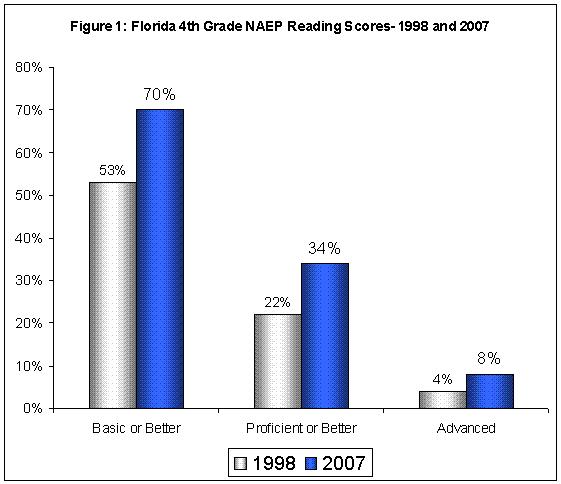
These results make the so-called “Broader and Bolder” approach seem all the more absurd. There hasn’t been any outbreak of “Socialism for the Children” in Republican dominated Florida, but there has been substantial improvement in the percentage of children learning to read.
Lucky thing too, as state budgets are being consumed by out of control Medicaid spending that it taking an increasingly large bite. Society has several other priorities besides K-12 education, such as criminal justice, higher education, transportation and social welfare. Bottom line: there isn’t the money for the Broader and Bolder approach anyway. This is just as well, as the track record on spending increases fueling academic gains stands as a dismal failure.
Given that we can’t spend our way out of our K-12 problems (and it wouldn’t work if we tried) we should instead seek ways to improve the bang we get for our existing bucks. Fortunately, Florida shows that it can be done.
3 Comments | competitive effects, instructional reform | Tagged: Florida education reform | Permalink
Posted by matthewladner

(Guest Post by Matthew Ladner)
Judging from the 96 comments in this Washington Post story, Democrats were more than a little angered by Senator Lieberman’s speech last night. As Francis Urquart would say, Lieberman gave them something to cry about:
Senator Barack Obama is a gifted and eloquent young man who I think can do great things for our country in the years ahead.
But my friends, eloquence is no substitute for a record, not in these tough times for America.
In the — in the Senate, during the three-and-a-half years that Senator Obama’s been a member, he has not reached across party lines to accomplish anything significant, nor has he been willing to take on powerful interest groups in the Democratic Party to get something done. And I just ask you to contrast that with John McCain’s record of independence and bipartisanship.
But let me go one further — and this may make history here at this Republican Convention. Let me contrast Barack Obama’s record to the record of the last Democratic president, Bill Clinton, who stood up to some of those same Democratic interest groups, worked with Republicans, and got some important things done like welfare reform, free trade agreements and a balanced budget.
So translating from politicalese: Obama is not ready to be President, Obama hasn’t accomplished much of anything, Obama isn’t tough enough to take on vested interests in his own party, Obama is no John McCain, nor a Bill Clinton.
There’s an old expression used in Texas politics that says you don’t scratch the king unless you are going to kill the king. In his own calm and dignified way, the Democrat’s 2000 Vice Presidential nominee went for the rhetorical kill last night.
Conventions have become stale, staged events, but you still get some drama here and there.
5 Comments | politics | Tagged: 2008 Republican Convention, Senator Joesph Lieberman | Permalink
Posted by matthewladner

 Jay P. Greene's Blog