USDoE Yanks Opportunity From DC Children

April 11, 2009

democrats-block-school-choice

(Guest Post by Matthew Ladner

Rotherham’s cynical take looks a little more on target this morning, while my own optimism looks a bit more naive. This morning the Washington Post ran an editorial blasting the United States Department of education for their latest attack on the DC Opportunity Scholarship program.

EDUCATION SECRETARY Arne Duncan has decided not to admit any new students to the D.C. voucher program, which allows low-income children to attend private schools. The abrupt decision — made a week after 200 families had been told that their children were being awarded scholarships for the coming fall — comes despite a new study showing some initial good results for students in the program and before the Senate has had a chance to hold promised hearings. For all the talk about putting children first, it’s clear that the special interests that have long opposed vouchers are getting their way.

Secretary Duncan seems to be taking this action simply to create, as the WaPo describes, a presumption of death about the program in advance of next year’s reauthorization effort. The decision, as the WaPo describes, is extremely disruptive to lives of many families:

It’s a choice President Obama made when he enrolled his two children in the elite Sidwell Friends School. It’s a choice Mr. Duncan had when, after looking at the D.C. schools, he ended up buying a house in Arlington, where good schools are assumed. And it’s a choice taken away this week from LaTasha Bennett, a single mother who had planned to start her daughter in the same private school that her son attends and where he is excelling. Her desperation is heartbreaking as she talks about her daughter not getting the same opportunities her son has and of the hardship of having to shuttle between two schools.

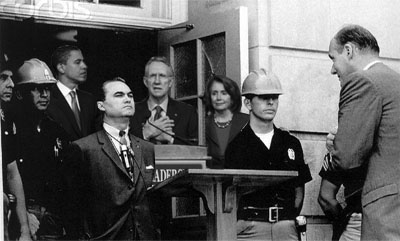
Sadly for LaTasha Bennett and her children the above photo is increasingly becoming less of a pointed joke and more of a reality.  How can anyone feel anything other than dismay to watch the nation’s first African American President, himself a product of private education, enroll his own daughters in an elite private institution and then rip that same opportunity away from people like LaTasha Bennett?

This action is in stark contrast with everything for which the left allegedly stands. As George Orwell once wrote: Four legs good, two legs better! The Washington Post makes it clear why the administration is behaving so disgracefully:

It’s clear, though, from how the destruction of the program is being orchestrated, that issues such as parents’ needs, student performance and program effectiveness don’t matter next to the political demands of teachers’ unions. Congressional Democrats who receive ample campaign contributions from the National Education Association and the American Federation of Teachers laid the trap with budget language that placed the program on the block. And now comes Mr. Duncan with the sword.

Duncan and Obama should both be ashamed of themselves.


Murdock on DC Vouchers

April 10, 2009

(Guest Post by Matthew Ladner)

In what might be the best overall indictment I’ve seen yet, Deroy Murdock brings it:

Follow the money: Teachers’ unions’ paid $55,794,440 in political donations between 1990 and 2008, 96 percent of it to Democrats. Senator John Ensign’s (R – Nevada) March 10 amendment to rescue DC’s vouchers failed 39-58. Among 57 Democrats voting, 54 (or 95 percent) opposed DC vouchers.

As the late Albert Shanker, former American Federation of Teachers president, once said: “When school children start paying union dues, that’s when I’ll start representing the interests of school children.”

When poor, black school kids start making political donations, Democratic politicians will start fighting for them.


DC Voucher Buzz Part Trois

April 9, 2009

(Guest Post by Matthew Ladner)
U.S. News and World Report’s story on the evaluation managed not to swallow the press release spin.

Over at the evangelical anti-religionists site, they’re celebrating their victory but warning their followers that the voucher boogey man might still arise

Over at Cato @ Liberty, Cato Vice President David Boaz makes the point that Secretary Duncan has claimed that vouchers can only help about 1% of DC kids, but that this is a supply side (funding) rather than a demand side issue. Boaz also notes that for all of Secretary Duncan’s talk of making “all the schools better” that he ran Chicago public schools for 7 years, and none of them were good enough for Barack and Michelle Obama’s children.

Also from Cato, Neal McCluskey makes the case that the bloom is off the rose of Duncan as a reformer. The Center for Education reform reaches a similar conclusion in Pay No Attention to the Man Behind the Curtain.

At Flypaper, Andy Smarick makes the point not to automatically assume that Secretary Duncan knew about the results of the program before Congress voted to kill it. Ed is Watching however responds with a number of questions about the conduct of the Department

UPDATE: Russ Whitehurst writes for Brookings that he finds it likely that Secretary Duncan did not sit on the results of the evaluation given the procedures in place. Fair enough. Whitehurst goes on to note that some procedures from how the Department conducted such business changed after he left in November 2008. His concluding paragraphs:

There is, however, substantial reason to believe that the secretary didn’t want to draw attention to the report. It was released on a Friday, whereas IES stopped releasing reports on Fridays several years ago when an important report just happened to come out on that day and critics accused the agency of trying to bury it. And there was no department press release or press briefing, which typically occur for important reports, including previous annual reports from this evaluation.

The future of the DC Opportunity Scholarship Program is far more important than the contretemps over when the secretary knew what. Many in Congress are on the record that their support of the program in the future would be contingent on findings from the evaluation. Many cited the results from last year’s evaluation, which found no effects on academic achievement, as the basis for voting to terminate the program. Was that a smoke screen to cover their real concerns – separation of church and state, opposition by teachers unions, whatever – or did they really mean that they would be guided by evidence on the program’s effectiveness? The 2009 Appropriations Act provides that funding for the program will end next year UNLESS Congress votes to reauthorize it. There is plenty of time for Congress to hold hearings, deliberate, and make a decision that is informed by the most recent results from the evaluation.

If I were the Denver Post and Secretary Duncan claimed that the Wall Street Journal made no attempt to contact him, and then had that assertion promptly refuted by my own lying eyes, I’d be more than a little suspicious. Nor does it help much that they tried to deep six the report on a Friday afternoon. Nor as the Denver Post columnist noted, does what Duncan had to say about the program make a whole lot of sense. Furthermore, the Department may have sat on the report even if Secretary Duncan really didn’t know anything about it. It’s also possible that the results leaked, leading to a rushed effort to kill the program.

It is also possible that it really just does take 4 or 5 months to process a study, and that the unions issued their kill order and Congress moved quickly to comply. If Russ Whitehurst and Andy Smarick say that it is likely that this is what happened, I can accept that as a very real possibility and even as a probability.

None of this can possibly excuse however the shameful attempt to bury and spin the report, or the glaring difference between the rhetoric and reality on education policy emerging from this administration. If the administration is going to talk the talk on evidence based reform, they need to walk the walk.


The Democratic Party of Story, Myth and Song

April 8, 2009

 (Guest Post by Matthew Ladner)

Shakespeare’s Henry V is a great play because, among many other reasons, it is deeply revealing about the national ideals of the British. Henry, pressed onto the throne at a young age after a checkered youth, rises the occasion when the odds are deeply against him. Shakespeare’s Henry is at once brave, inspiring, fierce, merciful, eloquent, God-fearing and even multi-ethnic (Shakespeare emphasized Henry’s Welsh lineage for contemporaneous political reasons).

Now of course the real Henry V didn’t begin to live up to these noble ideals. In fact, he ordered a group of French prisoners executed during the Battle of Agincourt. When his knights refused to murder, he had to order his archers to do the butchery.

Why let the truth get in the way of a good story? Shakespeare’s plays tell us about the aspirational ideals of the British- how they wanted to see themselves.

Democrats, before and after the creation of the New Deal coalition, have long seen themselves as champions of the little guy. The reality, of course, is that as a broad tent party, the Democrats have not always lived up to this ideal. Over the years some rather unsavory factions have drifted into and out of the Democratic coalition. The Democratic Party I know however-from books-deserves some credit for real moral courage. Sometimes.

In 1910, a group of Progressive Republicans teamed with Democrats to strip the Speaker of the House of power, including the power to appoint committee chairmen. Chairmen came to be appointed by seniority, which not only decentralized power in the House, but enormously empowered Democrats from the old Confederacy. The Republican Party was the party of Lincoln, you see. After southern racists saw to it that former Slaves couldn’t vote, Republicans were no threat to win an election in the south.

The Old Bulls, as the committee chairmen came to be known, ruled their fiefdoms with an iron fist. They decided which bills would get hearings, and which would die. They said jump, and the rest of the committee said “how high?” Disproportionately, the Old Bulls were southern segregationists.

So just for example, any change in American tax policy had to begin in the House Ways and Means committee, and there was the Right Honorable Bubba Klan serving in his 5th term as chairman. If you guessed that the Right Honorable Darrell T. Klux was biding his time waiting to replace Bubba when he finally went to pick cotton in Hell’s sharecropping plantation, give yourself a gold-star.

Think that might give Bubba and Darrell a little leverage in keeping African Americans down? You bet. The Old Bulls ran the House for a mere 60 years and change.

This however is not the Democratic Party of today. The Democratic Party of today was forged in opposition to these bigots, fought them, and finally defeated them at great cost through the prolonged application of blood, sweat, tears and moral courage.

In the Shakespearean telling, liberal Democrats grew to hate the oppression of Southern Democrats. The United States Supreme Court began chipping away at Jim Crow in the 1940s. Harry Truman integrated the military unilaterally. Martin Luther King’s voice sent the English language into battle, and his courage and conviction galvanized the conscience of the nation. Finally, when John F. Kennedy was struck down by an assassin’s bullet, Lyndon Baines Johnson, himself a southerner, defeated the Old Bulls by building the greatest tribute possible to the fallen President by passing the key elements of his previously stalled agenda-including (amazingly) the Civil Rights Act. Finally, in the wake of Watergate, progressives overthrew the Old Bulls by eliminating seniority.

Much is true about this story. Of course, like Henry V, much has been air-brushed out- like a series of Democratic Presidents including Woodrow Wilson and Franklin Roosevelt who failed to do so much as to raise a finger to aid disenfranchised African Americans. The Old Bulls were powerful, you see, and to get along you had to go along with some things, even if they were shameful. You can learn to live with that, in return for power.

I’ve argued previously that today’s alliance between progressives and education reactionaries will not and cannot last, because the ideals of progressives are so completely at odds with today’s status-quo. It could however last a good long while- the call of cynicism is strong. It whispers in your ear that you have to accept certain things in order to do good things.

This much is certain- the cynics are going to have a hard time convincing anyone they are doing the right thing by throwing 1,700 DC kids under the bus simply to keep their reactionaries happy. When it comes to reauthorizing the DC program, which Democratic Party will show up- a group living up to their ideals or to their short term interests?

 Why do I think there is still a chance for DC Opportunity Scholarships? Because of people like Diane Feinstein. Read her quote again:

Why should the poor child not have the same access as the wealthy child does? That is all he is asking for. He is saying let’s try it for 5 years, and then let’s compare progress and let’s see if this model can work for these District youngsters…I have gotten a lot of flak because I am supporting it. And guess what. I do not care. I have finally reached the stage in my career, I do not care. I am going to do what I sincerely believe is right.

These are not the words of a cynic, or a stary-eyed naif, but rather someone who knows that she has a limited time in this world, and wants to do what is right.  In the end, I believe many Democrats will find moral courage to match that of Feinstein, but it is going to be a hell of fight to get there.


James Tooley to Unveil Book at Cato

April 8, 2009

(Guest Post by Matthew Ladner)

Next Wednesday at noon, James Tooley will be at Cato’s DC headquarters to launch his book The Beautiful Tree: A Personal Journey into how the World’s Poorest People Are Educating Themselves.

I’ve previously written on Tooley and coauthor Pauline Dixon’s amazing research on high-quality and low-cost private schools in the third world. It is really, really an amazing eye opener. Private schooling is pervasive in low-income areas of very poor third world countries, and Tooley and Dixon document that they outscore students at much better funded public schools.

Do yourself a favor and attend if you can.


Harsanyi: Duncan’s Fundamental Dishonesty

April 8, 2009

(Guest Post by Matthew Ladner)

Denver Post columnist David Harsanyi met with Secretary of Education Arne Duncan yesterday. The encounter did not go well for Secretary Duncan. He claimed that the Wall Street Journal editorial was “fundamentally dishonest” and maintained that no one had even tried to contact him, despite the newspaper’s contention that it did, repeatedly.

The Wall Street Journal, however, provided Harsanyi with evidence of extensive contacts with high level high ranking Duncan subordinates. Harsanyi wrote:

When I called the Wall Street Journal, I discovered a different — that is, meticulously sourced and exceedingly convincing — story, including documented e-mail conversations between the author and higher-ups in Duncan’s office. The voucher study — which showed progress compounding yearly — had been around since November and its existence is mandated by law. So at best, Duncan was willfully ignorant.

So let’s review. Harasanyi essentially asks Joanne Jacob’s question “What did Arne Duncan know and when did he know it?” directly to Secretary Duncan. His response: I KNEW NOTHING!


It looks as though the very next thing out of Secretary Duncan’s mouth was a denunciation of the Wall Street Journal and then a claim that they had made no effort to contact him. Given that this is empirically falsifiable, it certainly doesn’t add much to the Sergeant Schulz routine on his knowledge regarding the study.

Harsanyi goes on to discuss the incoherence of what Duncan had to say about the program:

But the most “fundamentally dishonest” aspect of the affair was Duncan’s feeble argument against the program. First, he strongly intimated that since only 1 percent of children were able to “escape” (and, boy, that’s some admission) from D.C. public schools through this program, it was not worth saving.

So, you may ask, why not allow the 1 percent to turn into 2 percent or 10 percent, instead of scrapping the program? After all, only moments earlier, Duncan claimed that there was no magic reform bullet and it would take a multitude of innovations to fix education.

Then, Duncan, after thrashing the scholarship program and study, emphasized that he was opposed to “pulling kids out of a program” in which they were “learning.” Geez. If they’re learning in this program, why kill it? And if the program was insignificant, as Duncan claimed, why keep these kids in it? Are these students worse off? Or are they just inconveniencing the rich kids?

Duncan can’t be honest, of course. Not when it’s about politics and paybacks to unions who are about as interested in reforming education as teenagers are in calculus.

Again with the magic bullet! The question isn’t whether vouchers are a magic bullet or not, but whether they help disadvantaged children learn better. The evidence is clear- THEY DO.

UPDATE: Mark Hemingway weighs in on the Denver Post column at NRO’s the Corner.


Whitney Tilson: First They Came for Vouchers…

April 7, 2009

(Guest Post by Matthew Ladner)

Whitney Tilson of Democrats for Education Reform weighed in this morning in his email blast:

I think Duncan is doing a great job overall — but am still glad that the WSJ editorial page is holding his feet to the fire on renewing the DC voucher program:

“Education Secretary Arne Duncan did a public service last week when he visited New York City and spoke up for charter schools and mayoral control of education. That was the reformer talking. The status quo Mr. Duncan was on display last month when he let Congress kill a District of Columbia voucher program even as he was sitting on evidence of its success.”

Here are John Kirtley’s comments:

“Democrat reformers really need to think about the last sentence of this article. I know they think ‘we can let vouchers go undefended, and we’ll just defend and advance charters’.

If those who wish to kill reform are successful in killing off private school choice, trust me–they will redouble their considerable efforts to kill charters.

You had better hope you are invincible by then.”

To paraphrase the poem by Martin Niemoller:

“First they came for the vouchers. I remained silent because I was not for vouchers….”

Let the record show that Whitney Tilson was the first prominent Democrat in what we have to hope will be a growing number of Democrats who stood up for what is right on this issue.

(edited for clarity)


Rotherham Seems to Take a Dim View of the Intellectual Honesty and Courage of Democrats

April 6, 2009

(Guest Post by Matthew Ladner)

Over at Eduwonk, Andy describes the gains among D.C. Opportunity Scholarships as “modest” and says he doesn’t think this evaluation will change many minds.

Oi vey

On this blog, I’ve previously complained about what I viewed as an inappropriately high bar as the focus on the evaluation in an Intention to Treat model. Some of you disagree, but my view is that the question that most people want to know is whether the kids who used a voucher have improved performance, or not. The second year evaluation found that the answer to this question was yes.

Because some kids won the voucher lottery but then didn’t find a spot in a private school, under the high bar evaluation they went into the experimental group. Other kids who lost a lottery but wound up going to private school anyway went into the control group.

So basically, the kids who actually did receive a voucher and used it had to make gains large enough to drag these other kids as a group over the level of statistical significance.

I’ll be damned if they didn’t do it in the third year of the program. Modest? You can’t possibly be serious.

Andy doesn’t think that evidence is going to sway anyone. Really? Why did the President say:

Secretary Duncan will use only one test when deciding what ideas to support with your precious tax dollars: It’s not whether an idea is liberal or conservative, but whether it works.”

Why did Senator Durbin say “Allowing the program to continue through end of next school year (2009–2010) will give Congress a chance to examine all the evidence to determine whether or not this program works.”

Why did Senator Feinstein say “Why should the poor child not have the same access as the wealthy child does? That is all he is asking for. He is saying let’s try it for 5 years, and then let’s compare progress and let’s see if this model can work for these District youngsters.”

Senator Feinstein went on “I have gotten a lot of flak because I am supporting it. And guess what. I do not care. I have finally reached the stage in my career, I do not care. I am going to do what I sincerely believe is right. I have spent the time. I have gone to the schools, I have seen what works, I have seen what does not work. Believe it or not, I have always been sort of a political figure for the streets as opposed to the policy wonks. I know different things work on the streets that often do not work on the bookshelves. So we will see.”

Indeed we will, and now we have seen. Senator Feinstein should be applauded for her courage. It’s too bad she didn’t get to see this report before Congress voted to require reauthorization.

Perhaps Andy thinks that evidence won’t change minds because of this letter sent by the NEA demanding that Congress kill the DC program. Perhaps Feinstein’s courage really is in short supply.

There are 1,700 kids that just surmounted a very high bar that really hope that this is not the case.


DoE agency attempts to Bury the Third Year DC Evaluation

April 3, 2009

DoE to DC kids

(Guest Post byMatthew Ladner)

The third year evaluation of the DC Opportunity Scholarship Program is out, and the results are POSITIVE.

I’ll leave a discussion of the results to others. I’m feeling more than a little perturbed by the blatant Machiavellian politics surrounding the use of the report. 

The Department of Education released this report today, on a Friday afternoon. This constitutes a completely obvious attempt to draw as little media attention as possible.

Worse still: WHERE WAS THIS REPORT DURING THE DEBATE ON THE FUTURE OF THE PROGRAM?

Let’s review: the Congress essentially voted to kill the program a few weeks ago, this report must have been sitting on some bureaucrat’s desk in the department of education. A number of Democrats, including President Obama by the way, have stated that they are open to the school vouchers depending upon the results of research.

A few weeks later, the Department releases the study in a way obviously calculated to draw the least amount of attention. I’m starting to read the report, but the press release looks to contain some negative spin as well.

The future of 1,700 students at stake, after all, and such attempts at manipulation are simply sickening.


Quality not Qualified!

April 2, 2009


gordon-1-7398851


(Guest Post by Matthew Ladner)

The Wall Street Journal reports that Education Secretary Arne Duncan is planning on leveraging stimulus money for states to improve their collection and use of data demonstrating progress on student achievement and teacher quality.

How well states collect — and act upon — that data will determine whether they qualify for money, Mr. Duncan said. “In order for us to improve, we must be much more open and honest about what works in the classroom and what doesn’t,” he said in a conference call with reporters. Mr. Duncan added that the funding would be carried out with “absolute transparency and accountability.”

So far so good.

However, the article then says it wants states to track qualifications, especially in high-poverty schools.

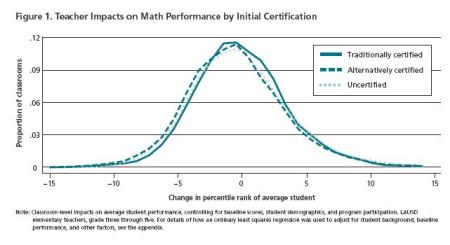
There is of course a very large problem with that. Low-income students with high quality but “poorly qualified” teachers are lucky to have them. Far luckier than those with low quality but highly qualified teachers.

Overall, however, I like the direction they are going. If you are going to be doling out an absurd amount of money, you may as well try to get something in return for it. Participation is voluntary, and competitive, which is also good.