WSJ Op-Ed — We Don’t Need More Teachers

October 9, 2012

image

I have a piece in today’s Wall Street Journal about how the solution to our education problems can’t be found by hiring more teachers.  We need quality over quantity, for which we will have to pay the teachers we do have more.  And more importantly, we need to substitute technology for labor in education like we have in almost every other industry to improve productivity.  But in public education we have been doing the reverse, hiring more, lower quality teachers and failing to develop and implement cost-effective technology.

I know all of this is well-worn territory, but given that both presidential candidates endorsed the idea of hiring more teachers the editors at the WSJ thought it was important to emphasize the point.


The Best Group You’ve Never Heard Of — The Vulgar Boatmen

October 7, 2012

The late 1980s/early 1990s band, the Vulgar Boatmen, had a very small cult following — so small that I’ll bet you’ve never heard of them.  Why they never became better known and more successful is a mystery that is part of their attraction and was even the subject of a documentary film. But once you listen to the clips in this post, I challenge you to name a better band that no one else on this blog has ever heard of.

Here is the Vulgar Boatmen’s title song from their 1989 album of the same name — You and Your Sister

The story of the Vulgar Boatmen is as odd as their inexplicable lack of broader success.  The core of the band were Robert Ray, an English professor at the University of Florida, and his former graduate student at Indiana University, Dale Lawrence.  Ray “holds a PhD from Indiana University, an MBA from Harvard, a JD from the University of Virginia, and an AB from Princeton” and is the author of four books on film studies.  Lawrence was once a member of the punk band, Gizmos, and has since headed the touring wing of the Vulgar Boatmen.  Ray and Lawrence composed their songs in the 80s and 90s by mailing audio cassettes to each other between Indiana and Florida.  It all sounds crazy, but the results are beautiful, like this classic — Drive Somewhere

This is like most Vulgar Boatmen songs.  It’s about driving, girls or some other everyday activity.  It’s simple and repetitive, almost to the point of absurdity.  But the tiny variations, layered guitars, and occasional viola make the Vulgar Boatmen a worthy successor to the Dadaist composer, Erik Satie. One critic captured the group’s sound well, saying:

the nebulous group’s ability to grasp and shape simple elements into three-chord (often two-chord) songs of delicate grandeur is unmatched by any of the countless groups that have attempted the same feat. With Lawrence and Ray’s high, clear voices singing intimately unrevealing lyrics about people and places, always raising more questions than they answer, the Vulgar Boatmen are as American as an Andrew Wyeth painting and as evocative as a Robert Frost poem.

They’re also pretty awesome live.  Here are they are in a 1992 concert singing Wide Awake:

And here is a live performance of Katie.  All I know is that it curves and shakes.

But don’t despair.  The Vulgar Boatmen are still out there, at least with Dale Lawrence at the helm, with the very occasional performance.  Here they are in Chicago last year singing Wide Awake.  Notice that these lyrics are different from the earlier live version I clipped but the same as those on the studio album version.

Enjoy.


What happens when we can’t give people choice?

October 1, 2012

(Guest Post by Mike McShane)

Over the weekend, Washington Post education writer Jay Matthews posed a great question on his Class Struggle blog.  He asks, in not so many words: why do education reformers fight so hard for test-based accountability systems that the charter schools they also support do not use?  If these systems are so great, the argument goes, why don’t charter schools use them?

The best way I can think to respond is to put it in terms of college football.

As a diehard Notre Dame fan I cheer for two teams every weekend, the Fighting Irish and whoever is playing Michigan.  I share the same view as an education reformer who most directly supports school choice as the means for reforming the system.  I like charters, vouchers, tuition tax credits and anything that works to dislodge the entrenched interests that prevent leaders from giving people choice.

As I have written elsewhere, the American education system has seen decades of middling performance at ever increasing cost because of the reform-resisting iron triangle formed between teachers unions, the state and local bureaucrats charged with their oversight, and the elected officials that are supposed to represent the interests of the community.  To meaningfully reform the system, we need to disrupt this power structure.

To borrow from Paul Manna’s insightful 2006 book School’s in: Federalism and the National Education Agenda, if you want to upset the power of an interest group, you can either decrease its license or its capacity.  A group’s license is its argument for action.   A group’s capacity is its ability to act.

Teachers have traditionally enjoyed substantial license.  In fact, in the recent Phi Delta Kappan/Gallup Poll, 71% of Americans had “trust and confidence in the men and women who are teaching children in the public schools”.

Why are teachers so popular?  There are many reasons, but it doesn’t hurt that when evaluated under current systems 99% of them are rated as satisfactory.  Informally, parents might have an understanding of whose classroom they would like their child in, but they lack any kind of systematic performance evidence to make their case.

When teachers are more accurately evaluated and parents are made aware that their children will be assigned to that school or classroom regardless of their wishes, it should encourage them, and the greater public, to demand more options for students.    To put a finer point on it, more accurate evaluation decreases the iron triangle’s license.  Does it decrease license as well as choice does?  Not at all.  Does the iron triangle have ample opportunity to water-down or co-opt it?  Absolutely.  But it is a step in the right direction.

Look, I’m no great fan of the one-size fits all accountability systems that many urban school reformers are implementing, but I’m not a fan of Ohio State either.  However, on that Saturday in November when the Buckeyes take on the Wolverines in the Horseshoe, you can believe that I’ll answer “–IO” to anyone that starts “OH-“, because cheering for the Buckeyes (like supporting evaluation systems) is better than the alternative.


Hot Off the Press — New Report on ESAs

September 27, 2012

Our very own Matt Ladner has a new report out with the Friedman Foundation on Education Savings Accounts (ESAs).  Here’s the summary:

Education savings accounts are the way of the future. Under such accounts—managed by parents with state supervision to ensure accountability—parents can use their children’s education funding to choose among public and private schools, online education programs, certified private tutors, community colleges, and even universities. Education savings accounts bring Milton Friedman’s original school voucher idea into the 21st century.

Arizona lawmakers were the first to create such a program, called Empowerment Scholarship Accounts (ESAs). Through that program, the state of Arizona deposits 90 percent of the funds for a participating child into an account, which can cover multiple educational services through use-restricted debit cards. Parents can choose to use all of their funds on a single method—like private school tuition—or they can employ a customized strategy using multiple methods (e.g., online programs and community college classes). Critically, parents can save some of the money for future higher education expenses through a 529 college savings program. That feature creates an incentive for parents to judge all K-12 service providers not only on quality but also on cost.

A fully realized system of ESAs would create powerful incentives for innovation in schooling practices seeking better outcomes for lower costs. Also, the broader use of funds may help to immunize choice programs against court challenges in some states. Policymakers must fashion their system of accounts to provide reasonable state oversight, fraud prevention, academic transparency, and equity.

If Milton Friedman were alive today, he likely would agree that education savings accounts represent a critical refinement of his school voucher concept. Existing voucher programs create healthy competition between public and private schools, but ESAs can create a much deeper level of systemic improvement. ESAs would allow parents to build a customized education to match the individual needs of every child, thus transforming education for the better.


Rob Pondiscio on Writing

September 25, 2012

Rob Pondiscio has a great piece about how we teach writing in The Atlantic.  It’s worth reading the whole thing, but here are some tasty bites:

Every decent human impulse we have as teachers shouts in favor of not imposing rules and discipline on students, but liberating them to discover the power of their voice by sharing their stories. Of course children will be become better writers if they write personal narratives instead of book reports. Obviously children will be more engaged and motivated if they can write from the heart about what they know best, rather that trudge through turgid English essays and research papers.

Grammar? Mechanics? Correcting errors? Please. Great writing is discovery. It is the intoxicating power of words and our own stories, writing for an audience and making things happen in the world. We know this works. We all saw the movie Freedom Writers, didn’t we?

Like so many of our earnest and most deeply humane ideas about educating children in general, and poor, urban children in particular, this impulse toward authenticity is profoundly idealistic, seductive, and wrong. I should know. I used to damage children for a living with that idealism….

Every day, for two hours a day, I led my young students through Reader’s and Writer’s Workshop. I was trained not to address my kids as “students” or “class” but as “authors” and “readers.” We gathered “seed ideas” in our Writer’s Notebooks. We crafted “small moment” stories, personal narratives, and memoirs. We peer edited. We “shared out.” Gathered with them on the rug, I explained to my 10-year-olds that “good writers find ideas from things that happened in their lives.” That stories have “big ideas.” That good writers “add detail,” “stretch their words,” and “spell the best they can.”

Teach grammar, sentence structure, and mechanics? I barely even taught. I “modeled” the habits of good readers and “coached” my students. What I called “teaching,” my staff developer from Teacher’s College dismissed as merely “giving directions.” My job was to demonstrate what good readers and writers do and encourage my students to imitate and adopt those behaviors….

“When our students resist writing, it is usually because writing has been treated as little more than a place to expose all they do not know about spelling, penmanship and grammar,” observes Lucy Calkins, probably the workshop model’s premier guru. She is almost certainly correct.

This leaves exactly two options: The first is to de-emphasize spelling and grammar. The other is to teach spelling and grammar. But at too many schools, it’s more important for a child to unburden her 10-year-old soul writing personal essays about the day she went to the hospital, dropped an ice cream cone on a sidewalk, or shopped for new sneakers. It’s more important to write a “personal response” to literature than engage with the content. This is supposed to be “authentic” writing. There is nothing inherently inauthentic about research papers and English essays.

Earlier this year, David Coleman, the principal architect of the widely adopted Common Core Standards, infamously told a group of educators, “As you grow up in this world, you realize people really don’t give a shit about what you feel or what you think.” His bluntness made me wince, but his impulse is correct. We have overvalued personal expression. The unlived life is not worth examining. The pendulum has swung too far.


This is How You Pay for That 16% Pay Raise

September 25, 2012

How will virtually bankrupt Chicago pay for the 16% pay raise over 4 years that is in the new teacher contract?

As I suggested last week, this headline in the Chicago Tribune answers the question:

Pushing the charter school agenda

With the CTU strike over, Mayor Rahm Emanuel pushes to grow charter schools
If you reduce the unionized teacher work force by 20% over the next four years by continuing to open new charter schools and close under-enrolled traditional public schools, the city might even come out ahead.  The new contract does nothing to stop this process from continuing and yet the unions are crowing like they scored a major victory.

In Chicago — Phony Merit Pay is Dead, Long Live True Merit Pay

September 19, 2012

The dust hasn’t yet settled from the resolution of the Chicago teacher strike, but it appears that the reforms the city were able to retain will result in a better “true” merit pay system than the “phony” merit pay plan they were forced to concede.

Let me explain the difference between true and phony merit pay.  True merit pay — the kind of compensation for job performance found in most industries — provides effective employees with continued employment and regular raises while ineffective workers lose their jobs.  If you do a good job you get to keep getting a pay check and if you don’t you have to look for work somewhere else.  That’s true payment for merit because un-meritorious workers stop getting paid altogether.

In phony merit pay — the kind that hardly exists in any industry — there is a mechanistic calculation of performance that determines the size of a small bonus that is provided in addition to a base salary that is essentially guaranteed regardless of performance.  You can stink and still keep your job and pay.  The worst that can happen is you miss out on some or all of a modest bonus.  To make it even more phony, in the few cases where this kind of phony merit pay has been tried, the game is often rigged so that virtually all employees are deemed meritorious and get at least some of the bonus.

According to the initial reports, the city of Chicago abandoned its efforts to institute this latter, phony merit pay.  As the Chicago Teachers Union put it: “The Board agreed to move away from ‘Differentiated Compensation,’ which would have allowed them to pay one set of teachers (based on unknown criteria) one set of pay versus another set of pay for others.”

But the city preserved key provisions that result in at least some amount of true merit pay.  Specifically, the city preserved the ability to continue opening new, non-unionized charter schools at a rapid clip.  It is already the case that almost 50,000 of the 400,000 students in Chicago’s public schools attend charter schools.  As students migrate from traditional to charter schools, enrollment in the unionized sector has plummeted, causing 86 traditional public school closures over the last decade.  Enrollment is so low in many existing traditional public schools that 120 additional schools are eligible for closure next year.  As long as the city can continue to open charter schools and as long as there is demand by students to leave for charters, traditional public schools will continue to be closed in large numbers.

When Chicago closes a traditional public school for low enrollment the teachers are laid off.  The new contract appears to place some limits on this, but the practice has generally been preserved.  In addition, unlike in some other big cities, principals in Chicago are free to hire teachers as they see fit and are not forced to take teachers laid off from school closures.  The new contract does require that half of all newly hired teachers come from those laid off and guarantees re-hiring only for the highest rated teachers, but according to the city’s summary of the agreement: “Principals maintain full authority to hire whichever teacher they deem best.”

The net effect of growing charter schools, closing under-enrolled traditional public schools, and only hiring back the best and most desired teachers from those schools is a true merit pay system.  Bad teachers are let go.  Good teachers not only get their job back, but they also get an extremely generous pay raise over the next four years for staying and being good.  That’s real merit pay.

The Gates Foundation, Michelle Rhee, and various other reform groups have pressed ahead with efforts to build a machinery to rate teachers and provide bonuses to the ones that have higher ratings.  They’ve pulled out the stops, devoted millions of dollars, and even twisted the truth to advance these merit pay systems because they are convinced that this is the most politically feasible and effective way forward.  Choice, especially vouchers, holds little appeal to them because they see it as a political dead-end.

As I think the events in Chicago help demonstrate and as I had feared in the Ed Next piece I wrote with Stuart Buck, the political calculations of these reformers are entirely mistaken.  Building reform around a top-down system of teacher evaluations and merit pay is too easily blocked, diluted, or co-opted.  But expanding choice continues to be a political winner and will result in real merit pay… and I believe real progress in student learning.


Diane Ravitch, Historian Who Changes History

September 18, 2012

Diane Ravitch continues to provide considerable comic relief.  I noted last week that she has adopted the role of super-villain by declaring that she, personally, can control the outcome of the presidential election and that President Obama should “heed my advice.”

Well, now the world’s most over-rated historian has decided to change history by erasing her blog post as if she never said those things.  This is not only very un-scholarly, but it is also a major internet no-no.  You can’t just erase a blog post if you are now embarrassed by what you wrote.  You can’t un-say something that you’ve said.  You can apologize, you can amend, you can elaborate, but you can’t just make it as if it never happened.

But the most over-rated historian appears to have simply tried to change history and erase her blog post.  If you click on  my old link, you just get a message that the page cannot be found.   And if you try to find the post by going through the chronology of September posts for September 9 (the date on which it was originally posted), you just won’t see her megalomaniac declaration: “I can determine the winner of the presidency.”  It’s gone.  Erased.

Except that the Internet Archive Wayback Machine happens to keep track of old web sites and you can still see her post here in the web cache.  If only, Ravitch could employ her own Winston from 1984, whose job was to alter and erase history so that the Party was never wrong.  As Orwell writes:

This process of continuous alteration was applied not only to newspapers, but to books, periodicals, pamphlets, posters, leaflets, films, sound-tracks, cartoons, photographs — to every kind of literature or documentation which might conceivably hold any political or ideological significance. Day by day and almost minute by minute the past was brought up to date. In this way every prediction made by the Party could be shown by documentary evidence to have been correct, nor was any item of news, or any expression of opinion, which conflicted with the needs of the moment, ever allowed to remain on record. All history was a palimpsest, scraped clean and reinscribed exactly as often as was necessary.

Unlike Ravitch whose own historical record is thankfully preserved by the WayBack Machine despite efforts to the contrary, Winston only had to take the offending writings and then he “dropped them into the memory hole to be devoured by the flames.”  As the 1984 Party slogan goes: “”Who controls the past controls the future; who controls the present controls the past.”

All of this would be hilarious if it weren’t so pathetically sad.

[Edited for a typo and to update link to old web page]


Diane Ravitch, Super-Villain…. And Related News

September 10, 2012

I’ve avoided writing about Diane Ravitch recently because I think it’s now clear to all sensible people that she has gone completely nuts, lacks credibility, and was probably never much of a scholar.  But I just couldn’t resist noting that in addition to all of her previous vices, Ravitch is now seeking to play the part of a super-villain.  She always had the megalomaniac dimension of a super-villain, but has now added the dimension of making threats if her demands are not met.  In a recent post [UPDATED], she declared:

The election, I hear, will be decided in Ohio and Michigan.  As it happens, I have a very large following of teachers and principals in both states.  My decision could swing several thousand votes in both of these key states.  I hold the election in my hands.  Bwahahahaha! And if my demands are not met within 24 hours I will reverse the Earth’s gravitational pull and everything will go flying into space. Bwahahaha!

Actually she didn’t say the last bit, but she did say that President Obama should “read this and heed my advice… while you still can, puny Earthling.”  Again, she didn’t actually say the last bit, but I think you get the picture.

And in related news… The Chicago Teachers Union has decided to go on strike.  In their own effort to play the part of a super-villain, they are demanding that virtually bankrupt Chicago and its Democratic mayor Rahm Emanuel transform all matter in the universe into currency to pay for increased teacher salaries,  gold-plated pension and health benefits, and a hot tub for each teacher filled with KFC gravy.

And in related news… the Chicago Tribune has reacted to the demands of these super-villains by calling for vouchers for Chicago students.


If Teachers are Underpaid, Why Don’t They Earn More When They Move to Other Professions?

September 4, 2012

[Note — AEI’s Jason Richwine noticed my post urging people to read the debate in Education Next over how to assess teacher compensation.  He asked if he could submit this post to address an argument raised by Mishel and Roy that he did not have the space to respond to in Ed Next.]

(Guest Post by Jason Richwine)

The fall issue of Education Next features a debate: “Are Public School Teachers Underpaid?” Andrew Biggs and I contributed an argument based on our report released last year, while Lawrence Mishel and Joydeep Roy from the Economic Policy Institute (EPI) offer a rebuttal. Unfortunately, Andrew and I had only 300 words for our subsequent rejoinder, so much of their critique went unaddressed.

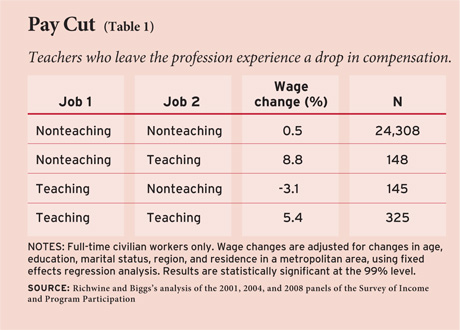
One of the points we made in our original piece is that EPI’s underpaid-teacher hypothesis generates a testable prediction: If teachers are underpaid relative to their skills, teachers who leave the profession should, on average, earn more in their new jobs. Likewise, new workers coming into teaching should, on average, take a pay cut from their previous jobs.

Andrew and I showed that, if anything, the opposite is true: Individuals get an average salary increase of 8.8 percent when they enter the teaching profession and a pay cut of around 3.1 percent when they leave.

Mishel and Roy confirm our empirical finding. In fact, they add that ex-teachers typically do not become engineers or chemists—they often become “librarians, cashiers, secretaries, and clergy.”

This would seem to cast strong doubt on the underpaid-teacher hypothesis, but Mishel and Roy don’t interpret it that way. They point out that just 1 percent of teachers actually leave for a different profession each year, and those who do leave tend to be making the lowest salaries. Therefore, they argue, we can hardly make inferences about the skill level of the average teacher based on this tiny, unrepresentative fraction. They don’t explicitly say that leavers have below-average skills, but the implication is needed for their argument to make sense.

I agree that teachers who stay could be more skilled than teachers who leave, but possessing these allegedly greater skills clearly does not compel them to seek higher salaries in the private sector. That was our point. If teachers are insufficiently compensated for their skills, we would observe teachers – particularly those with greater skills – leaving for higher-paying jobs. But despite all the anecdotes, the data just don’t show that happening.

In fact, Mishel and Roy’s response to us on job switchers is something of an own-goal. They are saying that, despite their own claims about teaching being underpaid relative to other professions, just 1 percent of teachers actually leave for a different profession each year. And that 1 percent may be made up of the least-skilled teachers. So tell me again why we need to raise teacher pay across-the-board…