Grading New York

November 13, 2008

(Guest post by Greg Forster)

Our old friend and colleague Marcus Winters has just released a study on New York City’s school grading program:

In 2006-07, New York City, the largest school district in the United States, decided it would follow several other school systems in adopting a progress report program. Under its program, the city grades schools from A to F according to an accumulating point system based on the weighted average of measurements of school environment, students’ performance, and students’ academic progress.

The implementation of these progress reports has not been without controversy. While many argue that they inform parents about public school quality and encourage schools to improve, others contend that grades lower morale at low-performing schools. To date there has been too little empirical information about the program’s effectiveness to settle these questions.

Schools that recieve D and F grades repeatedly are subject to takeover by the city. A previous study (Rockoff and Turner 2008) found positive results from the program but lacked student-level data. Marcus’s study has got student-level data, regression discontinuity – the whole smash. Tale of the tape:

Students in schools earning an F grade made overall improvements in math the following year, though these improvements occurred primarily among fifth-graders.

Students in F-graded schools did no better or worse in English than students in schools that were not graded F.

Whatever problems NCLB may have, school accountability does work in places where state and local government have the political will to do it seriously. Even in places where the problems seem intractible, like New York City.

EMTs are standing by in case certain people’s heads explode.


More Quantification of Greatness

November 12, 2008

(Guest post by Greg Forster)

I was so excited by my effort at quantifying greatness yesterday – well, okay, I was testing Alex Beam’s assertion that Great Books tend to be prohibitively long – anyway, I was so excited I couldn’t resist counting the pages in the Great Books I had at home to add to the data set I acquired in my office yesterday.

I had thought that the books at home would be shorter since I keep some of them there for regular reading, and the ones I read regularly tend to be shorter (for obvious reasons). I forgot, however, that some of them I keep there simply because I don’t read them very often at all, and those books tend to be longer (for obvious reasons). The books in my office represent the middle of the spectrum in terms of how often I read them.

Anyway, here’s what I came up with at home. Remember, our test case is Beam’s book, a history of the Great Books movement that claims Great Books are too long to be easily accessible and that clocks in at 245 pages:

Machiavelli, The Prince: 78 pages

Havel, The Power of the Powerless: 87 pages

Lewis, Mere Christianity: 113 pages

Mill, On Liberty: 113 pages

Bunyan, The Pilgrim’s Progress*: 154 pages

Orwell, 1984: 240 pages

Chesteron, The Everlasting Man: 254 pages

Aristotle, Rhetoric: 257 pages

Dante, Inferno: 260 pages

Swift, Gulliver’s Travels: 293 pages

Augustine, Confessions: 305 pages

Pascal, Reflections: 329 pages

Marsilius of Padua, Defender of the Peace: 432 pages

Kant, Critique of Pure Reason: 628 pages

Smith, The Wealth of Nations: 1,028 pages

*I include only the original Pilgrim’s Progress, not the “second part” that he wrote years later.

Again, Beam is clearly on the shorter side of the halfway mark, but the original finding is confirmed: the broad generalization that Great Books are prohibitively long has been falsified.

Moreover, the distribution of page lengths isn’t a bell curve. It’s clustered – and Beam’s book is right smack dab in the biggest cluster:

great-book-page-lengths

Coming next: a comprehensive set of metrics that quantifies all the qualities that make a book “great,” thus allowing greatness to be expressed mathematically – just like Dr. J. Evans Prichard, Ph.D. did for poetry in Dead Poets Society.


The Misunderstood Greatness of “Great” Books

November 11, 2008

great_books

(Guest post by Greg Forster)

Yesterday’s Wall Street Journal carried a review of Alex Beam’s new history of the great books movement, A Great Idea at the Time. The reviewer, Robert Landers, approvingly quotes Beam’s statement that he wanted his history of the GB movement to be “brief, engaging, and undidactic . . . as different from the ponderous and forbidding Great Books as it could be.”

The GB movement has touched all levels of post-primary education – secondary, collegiate, and “continuing” – and it has come in for a lot of criticism, some of it justified, particularly as regards the pomposity and the (really surprising) intellectual vacuity of Mortimer Adler. Much that was written about the Great Books by some of their most prominent self-appointed champions was indeed prolix, unengaging, and didactic.

With some shame, I confess that in my excitement about great ideas during my intellectual youth, I was suckered into paying $50 for Adler’s useless cinder block of a book, the “syntopicon.” Adler’s ambition was to create a reference that would point you to everything that the great thinkers had ever thought about each of a hundred “great ideas.” Alas, the real content of the Great Books failed to line up with Adler’s preconcieved notions about what constitues a great idea, and Adler failed to realize this; consequently the book is as useless as it is long. Fortunately, thanks to the miracle of the Internet, I was able to find another sucker willing to pay me $50 to take the embarrassing thing off my hands.

But anyone who thinks the Great Books themselves are prolix, unengaging, and didactic has obviously never read one – or if he has, all the more shame on him that he didn’t pay attention to what he read.

Indeed, the greatness of Great Books consists precisely in the authors’ gift for communicating large ideas in a clear, easily understood, engaging, and undidactic way so that everyone – everyone – can benefit from them. People think that the greatness of Great Books consists in the greatness of the ideas, but this is false. Any fool can write a book about great ideas, as Mortimer Adler proved so conclusively. What takes greatness is to write a book about a great idea that makes those ideas accissible and exciting to all readers.

The issue here really goes to the heart of how we understand education when it comes to ideas as opposed to skills (like reading and math). What is the best way for people who are not themselves great philosophers to learn about great ideas? For a long time the nation’s educators have set themselves up as a parasitical priesthood class, arguing that the ordinary person lacks the capacity to recieve these things directly from the sources; they need priests to interpret for them. The GB movement argued that the great philosophers themselves were much better teachers of ordinary people than the educational priests – that is precisely what makes them so great.

C.S. Lewis – who wrote extensively about the purpose, methods, and philosophy of education – put it very concisely in an introductory essay he wrote to be included in a new edition of an old book (Athanasius’s On the Incarnation), which was subsequently published separately under the title “On the Reading of Old Books”:

I have found as a tutor in English Literature that if the average student wants to find out something about Platonism, the very last thing he thinks of doing is to take a translation of Plato off the library shelf and read the Symposium. He would rather read some dreary modern book ten times as long, all about “isms” and influences and only once in twelve pages telling him what Plato actually said. The error is rather an amiable one, for it springs from humility. The student is half afraid to meet one of the great philosophers face to face. He feels himself inadequate and thinks he will not understand him.

But if he only knew, the great man, just because of his greatness, is much more intelligible than his modern commentator. The simplest student will be able to understand, if not all, yet a very great deal of what Plato said; but hardly anyone can understand some modern books on Platonism.

It has always therefore been one of my main endeavours as a teacher to persuade the young that firsthand knowledge is not only more worth acquiring than secondhand knowledge, but is usually much easier and more delightful to acquire.

The whole essay is well worth reading for anyone who wants to think about how great ideas are communicated to ordinary people who want to know about them.

And for those of a more quantitative bent, I can’t resist examining the one quantitative claim implied by Beam’s comment – that his book, unlike the Great Books, is “brief.”

The Journal lists Beam’s book at 245 pages. I went to my office shelf and took down all the books that could be considered Great, and checked the page numbers – excluding introductions, interpretive essays, appendixes and the like (some of which occupy hundreds of pages in the volumes I have). Where I had multiple editions I picked the edition that I used regularly. I suspect the selection may be biased toward longer works because the books I keep at work as opposed to what I keep at home for regular reading are probably longer. One could argue that the selection is biased in the other direction because some books are so long that I don’t even bother to own a hard copy, and access them electronically (e.g. Aquinas’s Summa Theologica and Calvin’s Institutes). But I would argue that those longer works are not really Great Books at all, but reference works. Aquinas and Calvin never meant for anyone to sit down and read their works cover to cover; the idea was to provide a useful reference so that if you need help with some specific problem, you know where to look it up. (They’re kind of like Adler’s syntopicon that way, except they’re actually useful.)

Here’s what I came up with:

Plato, Apology of Socrates: 21 pages

Locke, A Letter Concerning Toleration: 49 pages

Rousseau, Discourse on the Origin of Inequality: 97 pages

Rousseau, The Social Contract: 144 pages

Locke, The Reasonableness of Christianity: 195 pages

Locke, Two Treatises of Government: 240 pages

Treatment case: Alex Beam, A Great Idea at the Time: 245 pages

Aristotle, Ethics: 276 pages

Niebuhr, Moral Man and Immoral Society: 285 pages

Burke, Reflections on the Revolution in France: 292 pages

Plato, Republic: 300 pages

Aristotle, Politics: 425 pages

Rousseau, Emile or On Education: 447 pages

Hobbes, Leviathan: 482 pages

Hamilton, Madison & Jay, The Federalist Papers: 494 pages

Locke, Essay Concerning Human Understanding: 678 pages

Tocqueville, Democracy in America: 705 pages

Montesquieu, The Spirit of the Laws: 722 pages

Augustine, The City of God: 1,086 pages

So it does seem fair to say that Beam’s book is on the shorter end of the distribution – but the generalization that Great Books are not “brief” is patently false. And that’s before we even get into the qualitative dimension; the Apology is more or less the Original Great Book (the educational equivalent of an OG, if you will) and in length it barely rises to the level of a pamphlet.

Bottom line: before you complain about the GB movement, try picking up a Great Book and reading it.

UPDATE: See additional data and discussion in my follow-up post.


Pass the Clicker: The Genius of Firefly

November 7, 2008

(Guest post by Greg Forster)

For years – six of them, to be exact – mankind has pondered the question: Just what is it that makes Firefly the greatest TV series of all time?

I think I have the answer.

The concept of Firefly in the conventional sense is as follows: It’s the future. Six years ago, there was a big horrible war and the good guys lost. A single central government called The Alliance, formed by the unification of the governments of the United States and China, decided to bring all humanity on all planets under its control. The Independents, who sought to resist annexation, fought back just hard enough to get a lot of people killed, but not hard enough to win. Now the remnants of the Independents – the “browncoats” – are adrift on the edges of civilization, forced to scavenge for work where they can get it and constantly hounded by a tyrannical government that’s always itching for an excuse to lock them up. One of the most bitter and disillusioned of these former soldiers, Mal Reynolds, has managed to scrape together a ship and a crew. To keep the ship fueled and flying, he takes on illegal salvage, smuggling, theft of government supplies, etc. The government is after him, and his business partners are all either betraying him or open to doing so if the opportunity arises. So every week there’s a fresh adventure waiting for him and his crew – daring heists, double and triple crosses, espionage, and always the constant struggle to keep fueled and keep flying.

The genius of Firefly is: that stuff isn’t what Firefly is really about.

firefly_cast2

I said I was giving you “the concept of Firefly in the conventional sense.” If the network suits ask for a precis of the show, that’s what you give them. But series creator Joss Whedon made up all that stuff strictly to provide a backdrop to the real story: the story of nine people thrown together by forces outside their control and forced to find a way to live with each other and with the choices that their need for intimate coexistence foists upon them.

Here’s the thing: if you watch the whole series from start to finish, afterwards you will not know much more about the show’s fictional universe and backstory than what I’ve already told you above. But you will know these nine extraordinary (and yet, in other ways, very ordinary) people as though you had lived with them.

mal1

zoe

kayleewash

jayneinara

book

riversimon1

The genius of Firefly is that the characters are at once so real as individuals, and yet at the same time so perfectly crafted to drive the necessary interactions between them that create the plot. It must be really difficult to make both of those happen at the same time, since the former requires their personalities to seem spontaneous and undesigned, but the latter requires that they really be calculated and artificial.

I mean this. On the one hand, you can easily imagine what it would be like to meet any of these characters in isolation from the rest of the show. If Simon Tam walked into my office right now, I can picture exactly how he would act. I would love to talk theology with Shepherd Book, but if Kaylee Frye came in I would introduce her to the engineers in my office and then find an excuse to slip away. On the other hand, all nine characters are perfectly designed such that if you put any two of them together, their personalities and backstories will immediately start generating plot opportunities. And if you stick any three of them together, you can just sit there and write a whole episode in five minutes based solely on how those three people would mesh or clash when forced to confront some difficult situation together.

In a sense, then, once Whedon had created these people, all he had to do was stick them together on a small ship where they’re always bumping into each other. And in fact, a lot of the really golden moments on the show arise without the need for any outside force like evil governments and backstabbing business partners (although those do keep things interesting).

The first time the crew has dinner together, it quickly becomes apparent that Kaylee has a crush on Simon, the ship’s doctor. She asks what kind of doctor he is and he says he’s a trauma surgeon. Jayne snorts, “Kaylee’s just sorry you ain’t a gynecologist.” Captain Mal: “Jayne, you will keep a civil tongue in that mouth or I will sew it shut, is that understood?” Jayne: “You don’t pay me to talk pretty. Just because Kaylee gets all…” Mal: “Walk away from this table. Right now.” Silence. Jayne is a violent man – that’s why he’s on the crew, because he likes to fight and he isn’t too scrupulous about the when, where and who – and no one is sure what he’ll do. But after a moment he gets up, slops an extra helping of potatoes onto his plate and stomps off to his quarters.

Simon: “What do you pay him for?” Mal: “What?” Simon: “I was just wondering what his job on the ship is.” Mal: “Public relations.”

These people haven’t known each other an hour, and already they’re off to the races.

Of course, I’m not saying this is the only reason Firefly is the greatest show ever. The dialogue is top-notch, the directors keep things pitched just right between comedy and drama, the cinemetography is boldly innovative (in a good way), and things are set up so that over time the crew is gradually being set on a collision course with that tyrannical government – adding just the right level of epic struggle to what is essentially an ensemble drama.

The Fox network infamously screwed everything up because some empty suit – or, more precisely, a suit that should have been empty – didn’t like the lack of lasers and explosions in the pilot. So the second episode was aired first and the pilot wasn’t aired until halfway through the season. Way to start the series off on the right foot! The show never found an audience beyond the Joss Whedon fan core, and was cancelled. But that’s the way things go in a spoiled world.

Fox retained the TV rights and wouldn’t let Whedon take the series elsewhere at a price that other networks were willing to pay. Great story: Somebody asked Whedon at a convention whether he had talked to the Sci-Fi network. This was just after Sci-Fi had cancelled the incomparable Farscape while retaining that show with the real-life “psychic” – not a fictional show about a psychic but an actual con artist playing his cruel hoax for a studio audience – and other, similarly un-sci-fi fare. Whedon responded that he had called the Sci-Fi Network about Firefly but they had told him it was too science-fictiony for them.

Whedon somehow managed to persuade Universal (bless them!) to make a movie, Serenity. The movie isn’t as good as the show – there are just too many difficult balancing acts going on, as Whedon tries to make things accessible to newcomers while providing big payoffs to fans of the show, and also tries to get through the entire epic confrontation with the government that he had planned for the show’s finale, and resolve all the interpersonal plotlines as well. But saying that it’s not as good as the greatest TV series of all time is not saying much against it – it’s still very good.

Unfortunately, the movie opened in the low-traffic month of September, opposite some trifle starring Jessica Alba – prominently featured in a bikini in all the publicity. (On opening day Whedon was telling interviewers: “I’ve seen that other movie. The ads are a total fraud. She wears a parka the whole time.”) Once again, Firefly just couldn’t find its audience.

Of course, as I’ve recently observed, artistic excellence isn’t subject to democracy. It’s just sad that the mass audience never got to experience the greatest TV show in history. But, like I said, it’s a spoiled world. And thanks to the miracle of technology, the show lives forever on DVD, or you can watch the whole series and the movie for free on Hulu. This is why God made the Internet.


Looking Abroad for Hope

November 5, 2008

hope

HT despair.com. Looking for a Christmas idea to suit the new reality? Why not a despair.com gift certificate – “For the person who has everything, but still isn’t happy.”

(Guest post by Greg Forster)

Looking around for something to give me hope this morning, I find the best place to turn (for today, at least) is outside the U.S. Specifically, I turn to the recently released study in Education Next by Martin West and Ludger Woessmann finding that around the world, private school enrollment is associated with improved educational outcomes in both public and private schools, as well as lower costs.

Well-informed education wonks will say, “duh.” A large body of empirical research has long since shown, consistently, that competition improves both public school and private school outcomes here in the U.S., while lowering costs. And the U.S. has long been far, far behind the rest of the world in its largely idiosyncratic, and entirely irrational, belief that there’s somthing magical about a government school monopoly.

And private school enrollment is an imperfect proxy for competition. It’s OK to use it when it’s the best you’ve got. I’ve overseen production of some studies at the Friedman Foundation that used it this way, and I wouldn’t have done that if I didn’t think the method were acceptable. However, that said, it should be remembered that some “private schools” are more private than others. In many countries, private school curricula are controlled – sometimes almost totally so – by government. And the barriers to entry for private schools that aren’t part of a government-favored “private” school system can be extraordinary.

That said, this is yet another piece of important evidence pointing to the value of competition in education, recently affirmed (in the context of charter schools, but still) by Barack Obama. Who I understand is about to resign his Senate seat – I guess all those scandals and embarrasing Chicago machine connections the MSM kept refusing to cover finally caught up with him.


PJM on Candidates’ Education Flip-Flops

November 3, 2008

(Guest post by Greg Forster)

Over the weekend Pajamas Media carried my column on how Obama and Palin have flip-flopped on education:

Suppose I told you Candidate A has supported rigorous academic standards, has stood up to the teachers’ unions — even been booed by them at their convention — and proclaimed the free-market principles that schools should compete for students and better teachers should get higher salaries. On the other hand, Candidate B says that competition hurts schools, that kids should be taught a radical left-wing civics curriculum, that we should throw more money at teachers’ unions — excuse me, at schools — and that rigorous academic standards should be replaced with the unions’ old lower-the-bar favorite, “portfolio assessment.”

Candidate A is Barack Obama. So is Candidate B.

Meanwhile, Candidate C has made an alliance with the teachers’ unions, opposed school choice, thrown money at the unions — excuse me, at schools — and even helped undermine a badly needed reform of bloated union pensions. On the other hand, Candidate D has broken with the teachers’ unions, demanded that schools should have to compete for students, and endorsed the most radical federal education reform agenda ever proposed by a national candidate, including a national school choice program for all disabled students.

Candidate C is Sarah Palin. So is Candidate D.

Important disclaimer:

None of this implies anything about the overall merits of any of these candidates. One can love a candidate overall while hating his or her stand on education, and vice versa.


Even I Agree – This Is a Bribe

October 22, 2008

(Guest post by Greg Forster)

Last month I got into a little back-and-forth with Fordham’s Liam Julian after we simultaneously published columns about the practice of financially rewarding students for good performance – mine for and his against.

Well, as a token of goodwill, here’s a form of “performance pay” for students that even I will agree is an impermissible bribe. Baylor has been caught paying students for good SAT scores. The catch: it’s paying them to go back and retake the SAT after they’ve gained admission, so that the statistical profile of incoming freshmen at Baylor will look better.

“I think we goofed on that,” said a spokesman. Gosh, do ya think?

What’s the difference between rewarding student excellence and bribing students? In our exchange last month, Julian tried to outline what he thought was the difference between a legitimate “reward” and an illegitimate “bribe.” I wasn’t buying his definition but offered no alternative of my own (I had been using the word “bribe,” in sarcastic scare quotes, to refer to financial rewards for student performance, so I wasn’t in a good position to make the distinction systematically). I’ll take a crack at it now, and to make things even more fun I’ll add a third category.

I understand a “reward” to be an incentive for a certain activity that arises organically from the nature of the activity itself. An Olympic runner is not “greedy” and “mercenary” for wanting to win the race; victory is the reward for (i.e. the natural fulfillment or fruition of) athletic excellence. Nor is he necessarily greedy for wanting to win a shiny gold medal and stand on the top level of the victor’s podium and thrill to the cheers of the crowd, because the medal and the podium and the cheering are rightly taken as tokens and recognitions of his victory – he can desire them not for their own sake, but as embodiments of the victory. (Of course he may also desire them for their own sake, to gratify his vanity, which is wrong – but that is his fault, not theirs. They remain the natural and proper “rewards” of his excellence even if he doesn’t desire them as such.)

Note that while we usually use the word “reward” only in the context of good behavior, in this sense a “reward” can attach just as easily to bad behavior as to good. For example, those who behave greedily sometimes end up making money as a result, but we don’t call this a “bribe” as such. It’s just the natrual result of his behavior. This is what the New Testament means when it repeatedly emphasizes that those who sin “have already recieved their reward.”

On the other hand, we can provide incentives for behavior that do not arise organically from the nature of the behavior itself. Here I see two categories.

If the act of providing the incentive does not change the nature of the behavior itself, we call that simply “pay.” Managing a business, or laying pipe, or providing heath care, or teaching (or blogging about education reform) is not a different activity simply because one recieves a salary to do it, which is why the salary is called “pay” rather than a bribe. And note that, just as with “rewards” for bad behavior, there is also “pay” for bad behavior; we don’t speak of mobsters “bribing” hit men to kill people.

Whereas if providing the incentive changes the nature of the activity, that incentive is a bribe. Signing a contract with a vendor, supporting a change to government policy, or (in the Baylor case) retaking the SAT becomes a different kind of activity when you’re doing it for money as opposed to when you’re doing it for the right reasons. The corporate officer who steers contracts to a vendor who is giving him kickbacks is not engaged in business for his company, but rather defrauding it. The politician who supports a bill because he’s getting paid under the table is not serving his constituents, but oppressing and exploiting them. And the Baylor student who retakes the SAT because the school pays him is not seeking educational excellence, but collaborating in fraud.

As C.S. Lewis once put it, a man who marries a woman for money is mercenary, but a man who marries a woman because he loves her is not, even though in both cases he is “getting what he wants” by marrying her; marriage is the natural fulfilment of love but it is not the natural fulfilment of acquisitiveness, and marrying someone out of acquisitiveness changes the nature of the act (or so some of us believe).

(One potential weakness of my definition of a “bribe” is that the word implies moral turpitude, and it’s concievable there may be incentives for an activity that change the nature of the activity without creating moral turpitude. I can’t think of any off the top of my head, though. But if there are any such incentives, we would need a different word for them.)

The question before us, then, is whether paying students to learn changes the nature of the activity of learning. I think the answer is no, for the reasons I stated in my Pajamas Media column:

These days, if a child asks why he should care about doing well in school, what kind of answer does he get? He gets the same answer from every source: from parents, teachers, and school administrators; from movies and TV shows; from public service announcements, social service programs, and do-gooder philanthropies; from celebrities, athletes, and actors; from supporters and opponents of education reform; from everybody.

The answer is always some version of: you need to do well in school in order to have prosperity later in life.

Well, if you scrape away the sanctimony, what is this but a “bribe” on a colossal scale? Why is it vulgar and horrible to tell kids that if they pass their APs they’ll get a $500 check, but noble and uplifting to tell kids that if they pass their APs they’ll be able to get a better job five years from now?

Let’s quit kidding ourselves that it’s somehow shocking that somebody would come up with the idea of paying students to do well in school. For at least a decade, money is more or less the only motive we’ve been offering students to do well in school. We’ve just been insisting that the payoff has to come later in life. But morally, the timeline doesn’t make a difference. If it’s OK to pay someone five years from now to do something today, then it’s OK to pay him today, too.

If learning isn’t learning when the student is motivated by his own material well-being, then there probably is no such thing as learning and never has been.

Not that I think that’s the only motive students have, or should have:

Now, as it happens, I would prefer that the cash motive not be the only reason we offer kids to do well in school. I think our culture has been remiss in emphasizing education as an opportunity to become a better person, both morally (through character formation, a concern that the government school system seems to have largely dropped or subordinated, though private schools make it a top concern) and developmentally (because those who learn more and develop their capacities more fully have richer, more blessed lives).

But I also think that denying the presence of a strong financial motive in education is a fool’s errand. Kids will always care about how their education impacts their material well-being. And so they should — looking after one’s own material well-being is a good and natural concern.

Moreover, kids aren’t fully able to appreciate the moral and developmental motives for education until well after their education is complete. The 30-year-old, looking back, may well say, “If I hadn’t worked hard in school and had such great teachers, my personal character and my capacity for a fully human life would have been infinitely poorer.” But try explaining that to a ten-year-old.

Concern for one’s own material well-being is one of the natural motives for education, always has been, and always will be. Admitting this doesn’t negate the other motives.


New Evidence Against the Bailout

October 22, 2008

(Guest post by Greg Forster)

As the evidence piles up, I’m moving closer to abandoning my studied neutrality on the bailout and joining Jay and Matt in opposing it. I still lack the expertise to evaluate the claims that there’s a credit panic, that markets behave irrationally during a panic, that panics turn into crashes, and that it is possible for government to prevent the crash by acting as a sort of substitute rational investor during a panic. But whether or not government intervention can counteract a panic, it’s looking more and more like that isn’t what’s happening.

Today’s datum? GM is buying Chrysler partly so that it will be considered “too big to fail.” (HT Jonah Goldberg)

Since I first saw this in The Corner, I’ve been meaning to post it, but haven’t gotten around to it. Glad I waited – now I can also direct you to America’s MVC (most valuable columnist), Holman Jenkins, whose Wall Street Journal column this morning discusses the case.


Memo to Gadfly: History Failure Is a Historical Problem

October 21, 2008

“Okay, Mr. Hancock, if you’re so smart, how many of the freedoms protected in the Magna Carta can YOU name?”

(Guest post by Greg Forster)

The new Gadfly includes a guest editorial lamenting that our students don’t know civics, history, geography, etc. The editorial claims social studies is being “squeezed out” by accountability programs and that we should be “reinserting history and related subjects back into the curriculum.”

All this assumes that the failure of public schools to teach social studies effectively and the resulting colossal student ignorance of civics is a new phenomenon. Otherwise, the claim that social studies is being “squeezed out” and the call to “reinsert” it would make no sense.

But in fact this is not a new phenomenon. The catastrophic failure of social studies education in public schools is a subject with a long history. So what does that do to the story that social studies is being “squeezed out”?

Let me be clear: if I thought it were true that social studies was being squeezed out, but I also thought this would result in a change to our 70% national graduation rate (50% urban) and rampant illiteracy and innumeracy even among those who “graudate,” I would consider that a price well worth paying – and I say that as a social scientist. But the evidence that social studies is being squeezed out is not in fact convincing.


Pass the Popcorn: All-Time Great Summer Movies

October 16, 2008

epi518

(Guest post by Greg Forster)

Inspired by Matt’s “all time best bad movie” contest, I decided to ask readers to cast their votes on the all-time great summer movies. And, like any good political science geek, I planned to use multiple voting systems. I was going to provide a slate of nominees and ask people to post a list of which nominated movies they thought were among the all-time great summer movies, in order of greatness. Then I was going to count up which movie got the most #1 votes, which movie got the most total votes, and which movie got the most votes if the votes were weighted based on where they fell on people’s lists.

But once I had compiled my list of nominees, I thought: why put it up for a vote? Excellence is not subject to democracy. So instead of being a list of nominees, this is just my list of the all-time great summer movies. (Since excellence is very much subject to freedom of speech even if it isn’t subject to democracy, you are very welcome to post your comments and your own lists!)

My list was selected by the following highly scientific process:

1) There was no such thing as a “summer movie” in the way we now think about that term before the 1980s or so. I chose 1980 as the cutoff date by a highly scientific process of noticing that it was divisible by both four and ten.

2) The definition of “summer” has changed over time. I chose May 1 to September 1 as my cutoff dates by a highly scientific process of deciding that I’m willing to stretch into May, but not April or September. I have manfully resisted the temptation to include as “honorary” summer movies the many excellent films with non-summer release dates (e.g. The Incredibles, November 5, 2004; Serenity, September 30, 2005; Casino Royale, November 17, 2006).

3) I examined the lists of movies first released in the US between May 1 and September 1 in every year from 1980 forward (that’s why God made IMDB) and chose the best nominees, selecting them by the highly scientific standard of whether or not I thought they were plausbile candidates for being an all-time great summer movie. After 2001 the IMDB lists get too long (they include not only the rapidly expanding straight-to-video market, but also a lot of miscellaneous media like video games) so for 2002 to 2008 I switched to using the list of the top 100 grossing movies and then seeing which of the plausible candidates was released in the summer. The dropoff in nominees after 2002 may be due to this methodology change, but I’m inclined to think not; rather while the quality of movies in general has not (I think) gone down, the rate of production for all-time great summer movies has.

After prolonged, highly scientific consideration, I decided to exclude small-budget comedies, even the major classics, on grounds that a movie needs a big budget to be a “summer movie.” Exceptions were made where I felt that a movie was striving for a big-budget, summer-movie “feel” even if the budget wasn’t actually big (e.g. the many big-name guest stars and over-the-top musical numbers in The Blues Brothers make it feel like a summer movie even though it probably didn’t cost summer-movie money; I got a similarly “summery” vibe from Ferris Bueller’s Day Off).

Likewise, dramas with a strongly “gritty” and/or “realistic” tone (e.g. Untouchables, June 3, 1987; Unforgiven, August 7, 1992; 28 Days Later, June 27, 2003) and movies intended to be accessible to younger children (e.g. E.T., June 11, 1982; Labyrinth, June 27, 1986; Finding Nemo, May 30, 2003) were excluded as not fitting the genre.

On the other hand, I strove to include movies that we might not immediately think of as “summer movies,” but which, upon reflection, might be considered within that category. And I did make allowances where I felt that a franchise was “owed” a place on the list, as you’ll see from my comments.

The Empire Strikes Back

May 21, 1980

luke_vs__vader_morph_by_joew771-d5u7bwn

From Leia’s anguished confession as Han goes into the carbonite to Luke’s heroic-cum-suicidal showdown with the Dark Lord, this movie was a high point not only for the franchise, but for science fiction generally and for film generally.

The Blues Brothers

June 20, 1980

BluesBrothers

It’s big, it’s in your face, it has musical numbers and a finale where a SWAT team storms the building – it’s a summer movie. For me the most memorable line is during that final sequence when the police are closing in as the brothers are about to make the orphanage’s mortgage payment, and a police dispatcher, in a totally calm, monotone nasal voice, says: “The use of unnecessary violence in the apprehension of the Blues brothers has been approved.”

Raiders of the Lost Ark

June 21, 1981

indy1_zps00e1566e

In film as in all other occupations, the first step to doing great work is to do what you love. Spielberg loved 1930s cliffhanger serials and knew them well enough to bring them up to date, preserving what made them great in their own time while translating them into the (vastly superior) narrative idiom of modern film.

Star Trek II: The Wrath of Khan

June 4, 1982
kobayashi_maru

On this list, The Wrath of Khan stands as representative of the Star Trek franchise, not all of which were summer movies, but which cumulatively deserve representation. (Group rights are no good in politics but they have their place in “all-time greatest” lists.) But it’s convenient that one of the best of the series happens to have been a summer movie (two of them, actually – Insurrection was released in summer as well). Do you recognize the graphic above? The Kobayashi Maru is so widely referenced among sci-fi geeks that it’s a cliche, but there’s a reason it resonates so widely; it’s one of the best (in the sense of most fitting and most revealing) character backstories on film.

WarGames

June 3, 1983
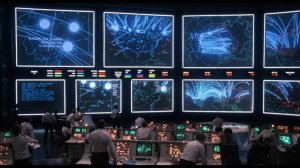
6568_1

Remember this? Laugh if you will, but I think there’s a reason everyone from my generation remembers this movie. Has there ever been a more tense opening scene? “Turn your key, sir. TURN YOUR KEY.”

Krull

July 29, 1983

krull_cyclops

Also in the “laugh if you will” department, this odd but oddly gripping sci-fi/fantasy hybrid stretched your imagination. If you could get past the “Huh?” factor, the film clearly knows how to tap into the vein of epic drama even with a story that doesn’t follow the standard genre conventions.

Ghost Busters

June 8, 1984

Ghostbusters-Screencaps-ghostbusters-29592124-1920-1080

What makes this movie so surpassingly great is that all the little things are consistently right. You remember all the really great moments, of course, but think about some of the ones you don’t usually remember, like Annie Potts trying to handle the sudden surge of business (“I’ve quit better jobs than this.” [Picks up the phone] “Ghostbusters! Whaddaya want!”). These fully-drawn characters are why the movie succeeds when it reaches for something more than just comedy – like near the end, when the boys crawl back out of the broken street and the crowd goes wild, chanting “Ghost busters!” “Ghost busters!” and Venkman brags, “That’s all right, we can take it. We can take it. They wanna play rough!” It’s not a gag; it’s played straight, as heroism, offered for our admiration. And it works.

Back to the Future

July 3, 1985

89ce8721-43e0-487b-82e7-27c53dc6d61d

Behold the man, Christopher Lloyd. He’s spent decades doing nothing but crap, yet for just a couple of brief, shining moments, he was brilliant – so brilliant that no amount of subsequently produced crap can ever move us to regret his career.

Top Gun

May 16, 1986

untitled

Yes, the silliness quotient is getting a little high here. But this is the movie that set the standard for macho cool. (“We were inverted.”) And as Harvey Mansfield has recently demonstrated, machismo is not in itself a silly thing; in a dangerous world, the culture of machismo is serious business.

Ferris Bueller’s Day Off

June 11, 1986

ferris_buellers_day_off

Contains just enough “bigness” (the parade, “Save Ferris” on the stadium’s electronic billboard) and summer-ness to bump up from the “comedy” category to the “summer movie” category in my mind. The city itself is as much a character as Ferris and Cameron. Sure, it lacks the drama and epic scope of most summer movies, but Ferris himself is larger than life – more primal force than man, the Iago of slackers.

Big Trouble in Little China

July 2, 1986

Jack_Burton_h3

The Ghost Busters of the kung fu genre. Cheesy over-the-top martial arts thriller (half spoof, half serious) meets super-sharp dialogue and fully drawn characters, again with all the little things done right: “A brave man likes the feel of nature on his back, Jack.” “Yeah, and a wise man has got enough sense to get in out of the rain!

Aliens

July 18, 1986

Ellen-Ripley-Aliens-female-ass-kickers-29685715-1280-688

Continuing a theme, it’s the characters who make this a big cut above the standard action flick – another real high point for sci-fi, and one of the best “straight action” movies ever made (as distinct from movies that are more in the “epic” or “adventure” subgenres). The debate in the APC about whether to nuke the site from orbit (“it’s the only way to be sure”) is one of the most note-perfect scenes I’ve ever seen. It also serves (in a way so subtle that you don’t notice it until it’s all over) as a great character intro for Hicks, who has been silent in the background until now while Apone and Hudson stole the show, but now must lead the unit. “But he’s a grunt! No offense?” “None taken.” And the way he says it, it’s clear that there really was no offense taken. It’s not the standard “call of destiny” scene, like Luke standing over the still-smoldering ruins of his aunt and uncle’s farm. But it serves the same function in the narrative – for both Ripley and Hicks.

Spaceballs

June 24, 1987

spaceballs-06

“Aww, that’s just what we need . . . a Druish princess.”

“Funny – she doesn’t look Druish.”

Robocop

July 17, 1987

robocop-remake

Blends two of the great strengths of sci-fi that rarely go together well, but do so here: super-cool hi-tech action and smart social commentary, including some very clever social satire (“I’d buy that for a dollar!”). Kudos also for the excellent twist ending: The elderly corporation president is held hostage with a gun to his head by his villainous vice president. Robocop can’t save him because the VP has had him programmed to be unable to take action against an officer of the company. Then the old president, who has been mostly a smiling-grandfather figure until now, suddenly shows that he didn’t get to be the president without learning how to think quickly under pressure. “Dick . . YOU’RE FIRED!” Whereupon Robocop blows the VP away.

The Living Daylights

July 31, 1987
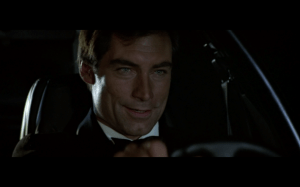
Living Daylights

Just as the Wrath of Khan stands for the Star Trek franchise, this stands for the Bond franchise. But, again as with Wrath of Khan, it’s convenient that one of the franchise’s strongest entries happens to have been a summer movie. Vastly underappreciated due to the juvenile public reaction against the toning down of Bond’s sexual immorality, this complex espionage thriller delivers action, snappy dialogue (targeting recticles appear on the windshield of Bond’s car and he explains to the girl: “I’ve had a few optional extras installed”), and – not least important – marks the start of the series’ deliberate development of Desmond Llewelyn’s comic genius. Bond observes as an MI6 technician carrying a loud stereo on his shoulder flips a few switches and launches an RPG-type rocket out of it. “It’s a little something we’ve worked up for the Americans,” remarks Q with evident delight. “It’s called a Ghetto Blaster.”

Who Framed Roger Rabbit?

June 22, 1988

vlcsnap-3434311

One of those times when a super-clever novelty act turns out to be more than just a novelty act. It does for classic cartoons what Raiders did for 1930s cliffhanger serials – translates it into the idiom of modern film. And see above re: Christopher Lloyd.

Batman

June 23, 1989

batman1_clip03

Remembered, of course, for Jack Nicholson’s Joker – and it still will be, even now that Heath Ledger has reinvented the character in an even more impressive way – it’s hard to remember now that it was this movie that resurrected the then-mostly-defunct genere of comic book movies, which is no small feat given the peculiar imperatives of that type of narrative, and also revolutionized the visual style of movies in related genres. One of the most influential movies of the last generation.

Terminator 2: Judgment Day

July 3, 1991

Terminator2

Noted at the time for its then-record budget, Terminator 2 did for special effects what Tim Burton’s Batman did for comic book narratives – showed the narrative power they were capable of weilding.

A Brief History of Time (Documentary)

August 21, 1992
a-brief-history-of-time

Just kidding! 🙂

But I think his appearances on The Simpsons have shown Stephen Hawking’s potential as an action hero (“If you are looking for trouble, you found it”), and if they made a summer movie starring him, I’d go.

Jurassic Park

June 11, 1993

Jurassic-Park

I suppose I’m including this mostly out of a sense of obligation, given its prominence and influence – although I did decide not to include Rambo 2 in spite of its (probably greater) influence. In this case I think the craftsmanship of the movie is better. (The moment where Sam Neil dismisses Jeff Goldblum as a “rock star” intellectual lightweight, for example, works well.) This is a movie I wouldn’t spontaneously suggest watching, but would happily watch if others in the room wanted it.

Speed

June 10, 1994

speed_1994_blu_ray_movie_review_full

Continuing that theme, here’s another movie that I include largely out of a sense of obligation, yet I wouldn’t include it if I didn’t think it had merits. Craftsmanship again makes the difference.

Apollo 13

June 30, 1995
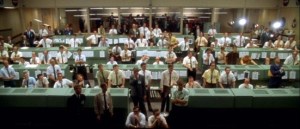
apollo13b

Much more than a nerds-as-heros flick (although it is clearly that), this movie is a triumph of the filmmaker’s craft. Nothing in it is particularly spectacular in itself, but all the pieces click perfectly and the whole is much more than the sum of its parts.

Austin Powers: International Man of Mystery

May 2, 1997

123573

The franchise degenerated so quickly in the subsequent films that I don’t think the full cleverness of the original is still as widely appreciated. The better you know Bond, the more gags you’ll notice here. And maybe it’s just me, but I bust a gut laughing at Austin trying to get the little go-kart turned around in the narrow dead-end hallway. I don’t know why, it just works.

Men in Black

July 2, 1997

men_in_black

If you haven’t seen it in a while, plug it back in. It’s a lot funnier than you remember.

The Mask of Zorro

July 17, 1998

the-mask-of-zorro7

One more for the “laugh if you will” file, but I think this movie stands out from the crowd. Action, comedy, terrific performances, and – in case you haven’t noticed, this is an important mark of a great movie for me – really good dialogue. The aging Zorro (Anthony Hopkins) wants to train a drifter he’s picked up (Antonio Banderas) to replace him. Hopkins points to the sword in Banderas’s hand and asks, “Do you even know how to use that thing?” “Of course I do,” replies Banderas. “The pointy end goes in the other man.”

South Park: Bigger, Longer & Uncut

June 30, 1999

south-park-1

What does one say? If you haven’t seen it, words aren’t going to convey the experience. I’m only about 50% on board for the movie’s agenda, but they do it cleverly so as to avoid turning away people who aren’t ultimately with them – their focus is on the failure of parental responsibility, not on the policy question of what should be allowed on TV.

Shrek

May 18, 2001

shrek-3

It could have been a one-joke movie, but consistent cleverness and Eddie Murphy’s breakout performance made it franchise-worthy.

Spider-Man

May 3, 2002

spider-man-11

What Batman created, Spider-Man recreated. Standing as radiant day to Tim Burton’s somber night, Sam Raimi’s equally powerful vision of the super hero radically broadened the scope of the genre.

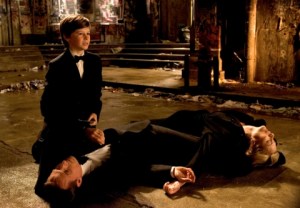
Batman Begins

June 15, 2005
batman-begins-31

And then, of course, the dark night of Batman came roaring back with its own reinvention – this time with subtlety and intellectual heft. Chris Nolan embarks on the novel mission of making a Batman movie that’s all about Batman, and it works on every level.

The Dark Knight

July 18, 2008

dark-knight-3

See here, here, here, here, here, and here. Nuff said.