Symbols Matter

March 11, 2009

wingdings

(Guest post by Greg Forster)

Jay points out that the president’s speech on education yesterday doesn’t resemble his legislative agenda. But it’s worse than that. There are things Obama could do to promose these good reform ideas even without legislation or budget changes, but won’t.

He calls on states to lift their charter caps. But what does he plan to do about charter caps? Even without extending federal authority over the states on charter policy, there’s plenty he could do, as Jay Matthews points out:

Will the Obama Education Department prepare and publicize a list of all the charter school cap laws in the country? Will Duncan call the governors, and legislators and school boards responsible for them and ask them to remove those restrictions on new charters, and find a way to get rid of bad charters?

Is the pope Muslim?

So on pretty much all fronts, the president’s “plan” for education is just symbolism.

But you know what? Symbols matter! The president is using his position in the spotlight to endorse choice and competition (as he did during the campaign) and rewards for performance, the two indispensable principles of sound educational reform. Even if he’s only doing it because Democratic constituencies other than the education unions expect it, it matters that the president has chosen to align himself with those constituencies rather than the unions. He could easily have taken the old line and kowtowed to the unions. But he didn’t, and that counts for something. So let’s give the president his due.

Now if only he had stopped his pals in Congress (who look an awful lot like his bosses these days) from kowtowing to the unions on vouchers.


Get Lost – For the Defense

March 7, 2009

kate_on_trial

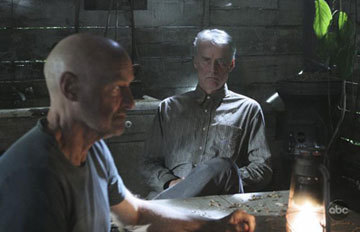
“On the charge of ruining a really cool show, how do you plead?”

(Guest post by . . .

Greg Forster for the defense, your honor.

Ladies and gentlemen of the jury, last week District Attorney Greene read you a very serious and sobering indictment. There is no denying that the charges, if proved, would justify a severe sentence against my client, the television program Lost. But during the forthcoming trial I intend to show you that the prosecutor cannot prove his charges.

The charge, in a nutshell, is this: that with the resurrection of John Locke, my client has 1) irreversably committed itself to containing “fantasy” elements as well as “sci-fi” elements, and 2) that this means the rules of the story’s narrative world are not stable but subject to arbitrary interference, which ruins the drama.

Ladies and gentlemen, there can be no denying the first element of the prosecutor’s theory of the crime. With Locke’s resurrection, my client is irreversably committed to having one foot in the fantasy genre as well as one foot in the sci-fi genre. The possibility that the show might end up with both feet on the sci-fi side of the divide is effectively foreclosed.

And it is also true that stable narrative rules are indispensable to good drama. Drama depends on moral agency, moral agency depends on choice, choice depends on actions having consequences, and actions having consequences depends on events obeying stable rules. In a universe where events were arbitrary, I couldn’t possibly make choices – I would have no way to connect my actions to any consequences. For all intents and purposes, there would be no alternatives to choose from.

But ladies and gentlemen, the prosecutor is wrong – “just plain wrong,” as he himself might put it – to assert that fantasy fiction, which is defined in the relevant statute as fiction containing supernatural elements, must necessarily have narrative rules that are unstable or subject to arbitrary interference.

Not only is this not true, ladies and gentlemen, I submit for your consideration that sci-fi fiction has historically been more guilty than fantasy fiction of presenting us with narrative worlds that have unstable or arbitrarily broken rules. Thus, I submit that when my client, having placed one foot firmly in the sci-fi camp, proceeds to place the other foot firmly in the fantasy camp, it increases rather than decreases the probability that we will ultimately get a narrative universe with stable rules.

No doubt there is much fantasy fiction that lacks stable narrative rules. You will all be familiar with the Harry Potter series, for instance.

But is there not also much fantasy fiction with admirably stable narrative rules? Whatever you may think of the Lord of the Rings, nobody accuses it of taking place in an insufficiently structured narrative universe.

As you will see when we introduce LOTR into evidence during the forthcoming trial, the text of the books is quite clear that Gandalf was not simply in a coma on the mountaintop, but died there, and “returned from death.” Did this leave anyone with the feeling that henceforward anything was possible and there were no rules in the LOTR universe? Was it not just the opposite, ladies and gentlemen – that the resurrection of Gandalf was the highest and most sublime manifestation of the story’s underlying narrative unity? It would be one thing if anyone, under any circumstances, could come back from the dead. But Gandalf’s return from the dead was not like that. It was a unique event, one that could only have happened to that particular character – and for a reason that was not arbitrary, but was clearly an integral part of the narrative universe. And his death and resurrection were connected to a series of consequences – connections which again were an organic part of the narrative.

One may summarzie the case by saying that Gandalf would not be Gandalf if he did not come back from the dead. The perfectly stable and uninterrupted narrative rules of the Tolkien universe demand that Gandalf come back from the dead.

Again, ladies and gentlemen, you may like the LOTR story or hate it. But will anyone really say that J.R.R. Tolkien was insufficiently concerned with the stability of his narrative universe?

One could cite other examples besides LOTR – the fantastic element in Star Wars comes to mind – but this is going to be a long trial with a full-dress media frenzy accompaniment, and I don’t want to make it any longer.

The question is not whether LOTR or Star Wars, or fantasy in general, is good fiction or bad. The question is whether the presence of supernatural powers, including resurrection, implies narrative rules that are unstable or subject to arbitrary interference. It does not.

The reason is simple: supernatural powers, even including power over death itself, may transcend the stable orderliness of nature, but that does not mean they transcend all orderliness. There can be a supernatural order that stands above the natural order. This supernatural order may take many forms, and need not imply anything religious. The only point is that supernature can be just as orderly as nature.

On the other hand, ladies and gentlemen, what has been more common than sci-fi fiction that lacks stable narrative rules? The arbitrariness of the rules of the Star Trek universe has been a running joke for decades. The defense will introduce into evidence several examples of people mocking Star Trek for the cavalier manner in which it disregards its own narrative rules.

For the purposes of narrative, ladies and gentlemen, there is no functional difference between highly advanced technology and supernatural powers. What are “dilithium crystals” if not the Star Trek equivalent of magic? Sci-fi and fantasy are both defined as genres by their reliance on powers – which is another way of saying “technologies” – that are inexplicable. The only thing that separates the two genres is why the powers are held to be inexplicable.

And surely, ladies and gentlemen, that distinction has no relevance for the charge that has been brought against my client. Both sci-fi and fantasy involve inexplicable powers that “do the impossible” from our perspective. Why should one method of doing the impossible still allow for a stable narrative, but not the other?

Here’s another way to put that point. Before Locke’s resurrection, the prosecutor did not bring charges in spite of all sorts of “magic” events that took place in my client. If the prosecutor thought that Locke’s getting up out of a wheelchair was at least potentially reconcilable with a stable narrative universe, why does he not think the same about Locke’s resurrection?

Even now, what is it that the prosecutor wants to see in lieu of resurrections? Time travel. Time travel, ladies and gentlemen! Apparently the prosecution thinks you can travel through time and still be subject to some sort of orderly rules. Well, why can’t resurrection be subject to some sort of orderly rules? Of course, any set of orderly rules governing resurrection would have to be different from the rules of nature that we now live under. But the same is true of time travel!

I would like you to ask yourselves a question during this trial, ladies and gentlemen: Has the prosecutor introduced any actual evidence of narrative arbitrariness on the part of my client? Does my client actually exhibit the breakdown of narrative structure that the prosecution attributes to it?

Surely not. The resurrection of John Locke fits the established narrative seamlessly and perfectly. Of course Locke was resurrected when he returned to the Island. He would not be Locke – and the Island would not be the Island – if it were not so.

The prosecutor also brought a charge of promise-breaking, but on this charge no serious defense is needed, since the prosecutor has failed to introduce any evidence that my client’s creators promised that dead characters would never come back to life. On the evidence so far introduced in this court, they promised only that 1) the characters on the island who appear to be alive are really alive, and 2) when those characters appear to die, they really die. None of this amounts to a promise that dead characters will not be resurrected, ladies and gentlemen. So on this charge we will be submitting a motion for summary judgment.

It is also worth noting, ladies and gentlemen, that the prosecutor confuses the question of genre (sci-fi or fantasy) with the role of faith in the narrative. “Faith” is not necessarily faith in something supernatural. That word means the same thing whether we’re talking about trusting God or trusting in another person, or even a machine. Indeed, the question of whether we should (with John) have faith in the Island, or (with Jack) doubt it was the central plot device on my client long before it was clear whether the Island was supernatural. The whole issue of faith is irrelevant to the prosecutor’s charge; the issue here is whether a narrative world can simultaneously allow for supernatural powers and have stable rules. And on that point I trust you will now see my client’s innocence.

And if all that doesn’t convince you, we have one more argument to offer.

Ladies and gentlemen of the supposed “jury” . . . this is Chewbacca.


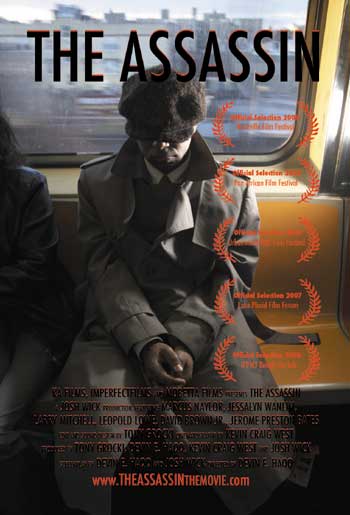
Assassination for D.C. Vouchers?

February 25, 2009

the-assassin

(Guest post by Greg Forster)

In case you haven’t heard, it’s been discovered that the Democrats snuck a provision into the “stimulus” “omnibus”* bill that assassinates the D.C. voucher program.

Dan Lips and Robert Enlow have the story on NRO today; the link on the front page is broken as of this writing, but you can get the story here.

I’m not sure what’s most disgusting – that the Dems are putting union politics ahead of children’s lives, that they’re doing it in this cowardly way, or that the president broke his promise to make the text of the bill available to legislators and the public with plenty of time to review the contents and justified his decision by saying that we had to pass the bill immediately to avert a catastrophe.

What did the president know, and when did he know it? Seems like there’s no answer to that question that makes him look good.

*UPDATE: Thanks to the commenters for correcting my mistake. How could I possibly mix up the “stimulus” bill with the “omnibus” bill? I mean, other than the fact that they’re both nothing but special interest porkapaloozas, they’re so completely different! Even so, I’m leaving in my comment about the president having broken his word on making the text of the stimulus bill available, because he did break his word and it was wrong. And the question of what the president knew about the voucher assassination attempt and when he knew it still seems 1) relevant and 2) not to admit of answers that make him look good.


Evidence Shows Vouchers Are a Win-Win Solution

February 23, 2009

win-win-study-large

(Guest post by Greg Forster)

On Friday, the Friedman Foundation released my new report, “A Win-Win Solution: The Empirical Evidence on How Vouchers Affect Public Schools.” It goes over all the available empirical evidence on . . . well, on how vouchers affect public schools.

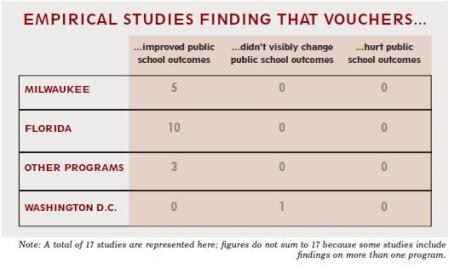
Here’s the supercool graphic:

win-win-study-chart1

Worth a thousand words, isn’t it? I mean, at what point are we allowed to say that people are either lying, or have been hoodwinked by other people’s lies, when they say that the research doesn’t support a positive impact from vouchers on public schools?

There’s always room for more research. What would we all do with our time if there weren’t? But on the question of what the research we now have says, the verdict is not in dispute.

Here’s the executive summary of the report:

This report collects the results of all available empirical studies on how vouchers affect academic achievement in public schools. Contrary to the widespread claim that vouchers hurt public schools, it finds that the empirical evidence consistently supports the conclusion that vouchers improve public schools. No empirical study has ever found that vouchers had a negative impact on public schools.

There are a variety of explanations for why vouchers might improve public schools, the most important being that competition from vouchers introduces healthy incentives for public schools to improve.

The report also considers several alternative explanations, besides the vouchers themselves, that might explain why public schools improve where vouchers are offered to their students. It concludes that none of these alternatives is consistent with the available evidence. Where these claims have been directly tested, the evidence has not borne them out. The only consistent explanation that accounts for all the data is that vouchers improve public schools.

Key findings include:

  • A total of 17 empirical studies have examined how vouchers affect academic achievement in public schools. Of these studies, 16 find that vouchers improved public schools and one finds no visible impact. No empirical studies find that vouchers harm public schools.
  • Vouchers can have a significant positive impact on public schools without necessarily producing visible changes in the overall performance of a large city’s schools. The overall performance of a large school system is subject to countless different influences, and only careful study using sound scientific methods can isolate the impact of vouchers from all other factors so it can be accurately measured. Thus, the absence of dramatic “miracle” results in cities with voucher programs has no bearing on the question of whether vouchers have improved public schools; only scientific analysis can answer that question.
  • Every empirical study ever conducted in Milwaukee, Florida, Ohio, Texas, Maine and Vermont finds that voucher programs in those places improved public schools.
  • The single study conducted in Washington D.C. is the only study that found no visible impact from vouchers. This is not surprising, since the D.C. voucher program is the only one designed to shield public schools from the impact of competition. Thus, the D.C. study does not detract from the research consensus in favor of a positive effect from voucher competition.
  • Alternative explanations such as “stigma effect” and “regression to the mean” do not account for the positive effects identified in these studies. When these alternative explanations have been evaluated empirically, the evidence has not supported them.

Now She Tells Us

February 18, 2009

randi-weingarten-at-obama-rally

(Guest post by Greg Forster)

Randi Weingarten explained this week that, contrary to the outrageous slander that the unions are against education reform, she’s actually in favor of having the federal government create rigorous national academic standards for public schools, and will remain in favor of it as long as the Democrats are in power. (I’m paraphrasing.)

She writes: “Should fate, as determined by a student’s Zip code, dictate how much algebra he or she is taught?”

So the AFT now endorses the principle that a child’s education should not be determined by Zip code? When did that happen?

And if a child’s Zip code shouldn’t determine how much algebra he or she is taught, why should that determination be made in Washington instead? Apparently the amount of algebra you learn should be determined not by your Zip code, but by your international dialing code.

At least with Zip codes, some families can exercise school choice by moving to a different neighborhood. Yes, it’s an unfair system, since not all families are equally mobile; apparently Weingarten thinks the fair thing to do is to take away the freedom now enjoyed by some parents, so that there will be an equality of unfreedom.

Here we see the real modus operandi of the Left – achieve equality by leveling downward.


Onay Ildchay Eftlay Ehindbay

February 18, 2009

dr-evil-zip-it

(Guest post by Greg Forster)

Education Secretary Arne Duncan has signaled he’s open to changing the name of No Child Left Behind. (HT Eduwonk)

Conspiracy theory time! Is this:

1) A cheap way of giving the unions a symbolic victory, to make it easier to deny their more substantial demands?

2) The opening maneuver in the long-awaited rollback of the ridiculous promise to reach 100% student proficiency?

3) A red herring desgined to keep us busy with conspiracy theories and “name that law” contests so no one will notice that the administration isn’t going to do anything substantive on education policy, despite extravagent campaign promises?

4) All of the above?

The betting pool is now open.

But since we have a storied tradition of acronym contests here on JPGB, we can’t pass over the opportunity to come up with a replacement name for NCLB. And of course it has to start with “smart.” Zip it!

How about Smart And Clever Kids, Overcoming Fallacious Canards, Really Achieve Perfection? There’s an acronym for you.


Get Lost 10

February 13, 2009

christian-locke

(Guest post by Greg Forster)

For a while during this week’s episode I was thinking that using the time-travel plot device to go back and fill in all the continuity holes (e.g. what was up with Rousseau and her teammates getting “sick”?) is really, really good for the show – in fact, I started to think that it works a little too well. It’s very convenient that the Island ’s flashes just happen to bring Jin to the right place at the right time to see Rousseau’s team get attacked, and then her later elimination of the “sick” team, and then – supreme convenience! – meet up with the other castaways.

But then it dawned on me that this “too convenient” dynamic isn’t a problem at all – because it returns us to the central theme of the first season, which began to trail off in the second season and has been moved to the background of the show for some time now – the theme of the Island having a plan and a purpose, rather than just being a passive natural phenomenon.

Over time, as we’ve learned more about what’s on the Island and how the Island works, the focus has been on 1) the mechanics of the Island’s power, and 2) the conflict between the various human organizations (Dharma, the Others, Widmore, and now the 1950s U.S. Army) who have striven for control of its power. The mysterious things that happen on the Island have been less and less about the Island ’s purpose and more about powers harnessed by humans for their own purposes. This goes all the way back to the season 2 button-pushing hatch, where the unimaginable power in the hatch was under human control (first by Dharma and then by castaways). Back in season 1, when stuff happened on the Island it wasn’t under the control of anyone that we know of, except the Island itself, and the power of the Island was directed not to human purposes but rather to the Island ’s purpose for the humans – getting them to confront their inner demons. In season 4 there was a little bit of the Island having its own purpose, with John getting his commission from Christian to move the Island, but that was mainly framed as part of the war between the Others and Widmore.

In this season, at long last the Island is once again its own master. Clearly someone or something with a mind of its own wanted Jin to see what he saw and then carry the knowledge back to the rest of the group. And when Christian told John, “I told you that you had to move the Island – I said you had to move it, John,” and all the ramifications of that began to dawn on me, I was overjoyed. The perfect finishing touch was when Christian said he couldn’t help John get up, and John had a moment of – panic? anger? hard to say – but then accepted it and steeled himself to drag himself up with his own strength. Because he doesn’t need to understand. He needs to carry out his orders and trust that they’re right.

And notice that after John promised not to bring Sun back, Christian emphasized to John that his orders are to bring everyone back.

So now that we’re getting answers to the questions about what kind of power the Island has, the show is going back to the questions it raised in season 1 – namely what kind of purpose lies behind that power.

And we don’t have any answers about that yet. Is the Island’s mind independent? Or is “Jacob” some kind of collective projection of the inner desires and fears of the people on the Island, such that their personal demons get reflected back to them in the Island ’s behavior? Or is the Island a gateway to the afterlife? Note that Charlotte ’s statement “the Island is death” was the episode’s title. They’re deliberately dredging up the theory that the Island is really some sort of Purgatory – but they’re not committing themselves to that theory in any way, they’re just reminding us that it’s one possibility.

Final thought: perhaps John’s death was necessary so that Sun could be recruited to return to the Island without John having to break his word. If so, John’s death could be viewed as a poetically just penalty for his making a promise to Jin that he knew he shouldn’t have made. Because he disobeyed his orders, John doesn’t get to come back to the Island – sort of like Moses’ death on the mountain, just before his people enter the promised land, was his punishment for a seemingly trivial disobedience. John’s death being a “sacrifice” doesn’t conflict with its also being a punishment, as any student of theology will tell you.

But if John’s death is arranged in any way by the Island – as a penalty, a sacrifice, whatever – that implies the Island is somehow in control of events not just on the Island, but everywhere. Perhaps through human agents loyal to it or at least under its influence, or perhaps in some other, more disturbing way.

Either way, it’s clear that this season we’re not just out to discover what lies behind the time travel, the cursed numbers, the smoke monster, etc. We’re also – perhaps we’re primarily- out to discover what lies behind the words “Jacob sent me.”


Porkapalooza

February 11, 2009

(Guest post by Greg Forster)

I just got caught up reading the last 24 hours’ worth of Jim Geraghty over on NRO, and it’s a cornucopia of posts that relate directly to a variety of topics we’ve been discussing here on JPGB:

Jim: “Say, fellows . . . when the central argument that the president uses to defend $838 billion or so in new spending is a lie, isn’t that news? Shouldn’t that be something of a big deal?”

In case the president is interested, Jay has proposed an alternative to the stimulus, although he has also noted that even doing nothing would be better than a stimulus bill.

Which I take as evidence that even the bill’s supporters don’t expect it will have a stimulative effect on the economy, as we’ve discussed; they’re supporting it because it’s a forty-year wish list of liberal fantasies and payoffs.

By which time he hopes the economy will have turned around on its own, so that the improvement can be attributed to the “stimulus,” just like Jay has pointed out.

This slander was debunked within days of the collapse, as we’ve noted. The real reason it collapsed is because “infrastructure” spending goes where politics dictates, not where there are real needs for improved infrastructure. So more spending doesn’t produce improved results.

And speaking of how infrastructure spending is really spent…

Jim reminds us that the Post, even while admitting that Murtha was a profound embarrasment, endorsed him on grounds that he delivered “infrastructure” pork to his district.


Buildingpalooza

February 11, 2009

fancy-church  shack

An underfunded regular public school; a money-draining charter school

(Guest post by Greg Forster)

I can see that school buildings are going to be a big topic for us for the foreseeable future. There’s the feds’ desperate need to blow money on something, anything, in the “recovery” bill (they’re no longer even bothering to call it a “stimulus” bill, apparently). And Jay’s post on school construction last week generated some interesting conversation in the comment thread.

Then last week opponents of the bill had a lot of fun spotlighting its provision of $89 million for school construction in Milwaukee, despite the fact that Milwaukee has had major enrollment declines leading to lots of empty and “underused” buildings, its buildings are deemed to be in good condition, the city has no plans for any construction projects, and just last year it had a major scandal centering around the waste of tens of millions of dollars in construction funding.

But here’s something I don’t think anyone outside Milwaukee has highlighted yet. In the Milwaukee Journal Sentinel’s story on the funding, somebody at the paper (presumably a bemused editor) inserted the following subtitle above a section of the story:

What is “Construction”?

Somebody get Socrates on the line, because it’s a good question. As a commenter pointed out on Jay’s post last week, once money goes into the system, we can’t be sure what it really gets spent on. We know how much money was budgeted for “construction,” but typically there’s nobody checking to see what was actually bought with those “construction” funds.

Sure enough, the Journal Sentinel quotes a state Democratic spokesperson saying that all of that yummy yummy swag for “school construction” could legitimately be spent on “school modernization.”

Next month’s headline: “What is ‘School Modernization’?”

Do these sound like conditions under which the money will be spent wisely? And don’t kid yourself that Milwaukee is somehow a special exception, and the stimulus money is going to be well spent elsewhere.

Suppose you don’t believe the vast mountain of empirical research that Jay cited last week. Let’s just drop all that science into the toilet bowl and flush. Even so, can anyone believe that money will be well used when it’s handed over to a system that has no real transparency, much less effective oversight, never mind accountability for results – and that is run by people who also just happen to derive political power by diverting school funding into an enormous gravy train of featherbedding, pork, etc.?

If we’re dumb enough to hand over the money under those circumstances, why would they not divert it to the gravy train? I’m amazed the schools in the government monopoly system aren’t even worse than they are.

But wait. There’s yet another school building story on the horizon. This one broke out in the edreformblogosphere just yesterday.

stlouisarch

They built it with surplus “school construction” money

Like Milwaukee and pretty much every other city, St. Louis has long-term declining enrollment, but that didn’t stop it from pouring tons of money into school construction over the past few decades. Now St. Louis has a bunch of empty school buildings it needs to unload, so it’s going to sell them off.

But not everyone is allowed to bid on the empty school buildings. Joanne Jacobs puts it succinctly: “The school board has banned sales of buildings to liquor stores, landfills, distilleries, sex shops and charter schools.”

Read that again: Liquor stores, landfills, distilleries, sex shops and charter schools.

Not much more to say, is there? Charters are the one sector of the government-owned education system that is 1) growing fast, 2) willing to take on the most disadvantaged, toughest-to-teach kids, and 3) producing improved results, and they do it with less money – especially less construction money! – than the regular system. But they aren’t allowed to buy – not take for free, but buy, as in purchase at market value, by paying actual money – the city’s empty buildings.

drive-thru-liquorlandfill

distilleryPT006149

Some typical St. Louis charter schools

I’m with Matt – if the system’s defenders don’t realize they’re destroying millions of children’s lives in order to funnel money to a corrupt gravy train, it’s only because they don’t want to know.


Jay Praises the Stimulus!

February 4, 2009

billy-bragg-talking-with-the-taxman

(Guest post by Greg Forster)

Don’t miss Jay’s article on NRO this morning praising the stimulus bill – that is, celebrating the fact that the stimulus isn’t even worse than it actually is.

As Jay reminds us, the Democrats made big promises about expanding preschool. The enormous slab of edu-pork in the stimulus bill could easily have been designed to lay the groundwork for fulfilling those promises, but it doesn’t:

Of course, if this money isn’t really going to help children learn, it would be best if we didn’t spend it at all. But Congress seems determined to burn giant piles of cash in the hopes that its warm glow will stimulate us. Given the circumstances, it’s some consolation that the current education stimulus won’t force us to burn larger and larger piles of cash forever into the future.

Burning large piles of cash, eh? Hmm. Sounds familiar.