What If “Program Design” Misses the Point?

March 1, 2016

Bob+the+robber

Hi. My name is Bob. I’ll be your robber.

(Guest post by Greg Forster)

While we’re on the subject of “Overregulation Theory,” what if that’s a misnomer? What if we’re missing the point by drawing the lesson from Louisiana that “program design matters,” because the real problem isn’t design, it’s arbitrary threats by federal and state officials? The kind of thing you can’t stop with better program design?

I can’t seem to shake these possibly heretical thoughts, so I will submit them to my spiritual directors here on JPGB in hopes of recieving guidance.

I took a fresh look recently at one of the loci classicus for Overregulation Theory in Louisiana, Jason’s post “The Folly of Overregulating School Choice.” What struck me is how the “regulations” on the Louisiana program, while they are very bad regulations, are not so different from regulations on other school choice programs that have not failed this miserably. To participate in the voucher program, Louisiana schools give up control over admissions and price – but they do the same in Milwaukee and in other voucher programs. Why is Louisiana such a big loser when other programs operating under similar hindrances have been winners – moderate winners, to be sure, but still?

Then I noticed that in the AEI survey of Louisiana private school officials, the top reason for not participating in the program was not current regulations but “future regulations that might come with participation.” This was also the top concern about the program for school leaders whose schools were participating.

And then I took a fresh look at Lindsey Burke and Jonathan Butcher’s NRO article about Louisiana vouchers, and was reminded of a couple items that helped this all click for me:

  • The federal government attempted to gain sweeping authority over private schools participating in the voucher by manipulating desegregation law.
  • The state superintendent issued vague, arbitrary threats of interference with private schools based on his personal judgment of their performance.

I have not seen as much attention to that second point as I would have expected. Lindsey and Jonathan write:

Schools risk losing access to the Louisiana Scholarship Program if results on state tests “don’t meet expectations,” according to a letter from John White, Louisiana’s state superintendent of education. And, he adds, schools “are not permitted to accept new Scholarship students until their results align with program requirements.”

Now, I don’t think – but I’m open to hearing new information – that the Louisiana voucher program authorizes the state superintendent to swagger around making these kinds of intimidating statements to participating private schools. And that seems to me like a really big deal, much bigger than any aspect of program design as such.

It’s one thing to have a set of clear rules to follow. The rules may be stupid, but if you follow them, you’re safe. It’s quite another thing to be subject to vauge and arbitrary commands from a person in authority – commands that aren’t anchored in any clear set of rules, which could therefore be expected to change at any moment and be enforced based on whim. Or, more likely, malicious design.

As Al Copeland Nominee Charles Montesquieu explains, you cannot have freedom unless you have a well-grounded, reasonable expectation that you will continue to have freedom in the future, indefinitely. If it is even just somewhat possible that your freedom may be taken away tomorrow, you are not free today. You cannot plan your life as a free life; moreover, those who might become your rulers tomorrow can start nudging you to do things their way now. Why do you think some Republicans are selling their souls to Donald Trump?

Comparing the list of formal regulations in the Louisiana program with the federal attempt to gain sweeping power by climbing in the back window of desegregation law, and the vague and arbitrary threats from the state super, I know which would scare me more if I were running a private school.

Am I missing something? Does the state super have some stronger ground in the voucher law than I’m aware of for his threats? Or might these arbitrary intimidation tactics be something we should consider over and above “regulation” and “program design” as a cause of the Louisiana program’s failure?

I leave it to you, my spiritual directors, to guide me.


Great Spoof, Kid!

February 26, 2016

(Guest post by Greg Forster)

If you liked Emo Kylo Ren you’ll love this. You’re welcome.


Public Schools and Religious Hatred

February 6, 2016

image

(Guest Post by Greg Forster)

Choice Remarks carries my article on the government school monopoly and religious hatred:

For decades, we’ve heard opponents of school choice claim that the government school monopoly is our only protection against “jihad schools” that will teach children to hate and kill. In all that time, you know what we haven’t seen? Jihad schools, operating in any of the nation’s 59 private school choice programs across 28 states. In fact, the government school monopoly doesn’t protect us from religious division, and it can’t do so.

Partly we’re talking about good old fashioned bigotry that doesn’t want to believe highly religious minorities can support democracy and pluralism. But there’s more to the story.

We demand that highly secularized institutions should have a monopoly on education because we think such institutions are “neutral” with regard to religion. This fails for two reasons.

First, it incentivizes schools to marginalize and alienate religious minorities in order to legitimize the secular monopoly on education. Religious minorities must be seen as dangerous, or the interests of the monopoly will be threatened.

Second, highly secularized institutions are inherently less effective at inculcating the values and practices essential to democracy and pluralism:

This is because a secular institution can tell you to be good (be tolerant, respect diversity, etc.) but it can’t tell you why. It can’t connect the rules of right behavior to deep sources of meaning, purpose, and identity. It ends up just spewing a lot of sentimental gas, and then wagging its finger at you if that doesn’t work, and then punishing you. Or it offers utilitarian, mercenary reasons to be good. None of that helps students form either a deep attachment to moral rules or the self-discipline to carry them out.

As always, your comments are very welcome!


The New Frontier of School Choice

January 14, 2016

20120206151502

(Guest post by Greg Forster)

OCPA’s Perspective carries my article on ESAs as the new frontier of school choice. I point out how ESAs are an improvement on vouchers:

But vouchers have a hitch. They create a perverse incentive for private schools to jack up tuition to the maximum voucher amount. While they create a marketplace for education, they take out half the equation of any good marketplace. With vouchers, schools compete to attract students, but they compete only on quality, not on price.

That may sound good if you have romantic notions about money having no place in education. But, as Milton Friedman would be the first to tell you, prices are a critical source of information that we need to be good stewards of our resources. They tell us about the scarcity of things relative to the demand for them. High prices cry out to providers, “devote more resources to providing this service!” Low prices say, “this isn’t needed as much.”

Part of me is sad to see Milton’s idea eclipsed by something better. Milton himself, of course, would have been delighted. He knew that he didn’t know everything, and that the whole point of freedom is for better ideas to nudge out worse ones.

Still, it’s important to honor the great men of the past, and so:

It’s not every day someone outsmarts Milton Friedman; indeed, people tangled with his brains at their peril. When he argued against mandatory peacetime military service in a public hearing, he was confronted by a general who said, “I don’t want to command an army of mercenaries.” Quick as a wink, Milton replied, “Would you prefer to command an army of slaves?”

That general’s experience was not unique—in fact, it was the opposite experience that was literally unique. When Milton’s wife, Rose Friedman, died, we at the Friedman Foundation included the following sentence in our list of her accomplishments: “She is the only person ever known to have won an argument with Milton Friedman.” Rose was a formidable economist in her own right, but we all considered this her most impressive achievement.

As always, would love to hear what you think!

PS Proof that Milton would be glad!


Pass the Popcorn: The Belonging We Seek

January 5, 2016

Han Leia

(Guest post by Greg Forster)

My spoiler-laden meditations on Star Wars are fully armed and operational over on Hang Together:

Millennials are destroying the world because narcissistic Boomers broke up the family. That’s The Force Awakens in a nutshell.

Shockingly, I approve of this message! Would love to hear your thoughts, whatever they are, as always.


It Is TOTALLY About the Money

December 30, 2015

image

(Guest post by Greg Forster)

Choice Remarks carries my article on OU President David Boren’s proposal to solve our education problems by throwing money at them – and doing so totally indiscriminately. Here’s one part of the proposal:

Another $125 million would go to higher education to keep down tuition and fees.

Yeah . . . I’ll just leave that there.


The School Choice Information Problem

December 8, 2015

puzzle-pieces-1-1426443

(Guest post by Greg Forster)

OCPA’s Perspective carries my article on the school choice information problem:

“I support school choice,” some education policymakers say, “but we need to make sure parents choose good schools!” In order for parents to choose good schools, of course, they need good information. Not information from government bureaucracies—which have a long track record of measuring the wrong things and deceiving parents—but from emerging resources such as Great Schools, Global Report Card, School Grades, and more. Better information, not tighter regulation, is the best way to let parents improve school quality.

I note a remarkable reversal – the blob used to heap contempt on parents but is now rushing to position itself as allies of beleagured parents against reforms run amok; reformers, meanwhile, who used to champion parents have suddenly begun heaping contempt on parents’ capacities to make good choices for their own children:

There are several reasons for these changes. One is the collapse of the school monopoly’s credibility…

A more important reason is the greatly increased political success and attractiveness of school choice itself…This has brought school choice new allies—allies who aren’t yet completely comfortable with the idea…

It has also meant that the limitations of school choice in its current form are becoming more visible…

Parents need good information to make good choices, and the school choice movement is going to have to take an interest in pushing the existing information structures to the next level if it hopes to make more people comfortable with the idea of parents as the locus of school accountability.

As always, your thoughts and responses are welcome!


Education Paternalists: Choice Is Only for Us

November 10, 2015

ch-4-callahan-academic-paternalism-2-728

Googled “paternalism” and found this – seemed appropriate!

(Guest post by Greg Forster)

Education paternalists are bending over backwards to shame philanthropists who support school choice, and they show their true colors as the new Bull Connor. Check this out:

“Choice makes sense to so many of us in positions of privilege, who direct philanthropic investments and public policy. Markets have worked for us: we have the financial and social capital to choose the supermarket we want to shop in, the kind of work we want to do or where we want to live,” [Lori Bezahler] writes. “However, unless we examine the relationship between privilege and access to markets, we will ignore the constraints that many families face in a market driven education system.”

Therefore, she concludes, those who are not elites should not be given a choice!

If government is going to expand access to services for the poor – as it sometimes should, and education is one of those cases – giving them a subsidy and then sending them into the marketplace is precisely the way to break down “privilege” and elevate the poor to equal standing. The contrasting models here are food stamps or Section 8 housing vouchers (which allow the poor to walk into the same marketplace as everyone else and get served as a customer alongside everyone else) versus public housing or government-run medical “insurance” cartels (which trap the poor in an alternate universe, cut off from the mainstream cultural world within which that precious “social capital” Bezahler claims to be worried about is available).

There is definitely someone who should be ashamed here, but it isn’t philanthropists who support school choice.

HT Jason Bedrick


The For-Profit Boogieman

November 4, 2015

untitled

Check it out, he’s even GREEN! What more proof do you need?

(Guest Post by Greg Forster)

OCPA’s Perspective carries my column on the blob’s hypocritical allergy to profit in education:

A typical post from the blog of the Oklahoma Education Association (OEA) provides a window into this mindset. Posted near Christmas, it darkly warns that instead of Santa, a “sinister sleigh” was approaching Oklahoma, “being pulled by those whose intent is to devalue public education and then turn education into for-profit businesses…Alas, their motives are far from good. The bottom line for them is profit. Profit made at the expense of our children’s education.”

The great irony is that this educational blob is itself dependent upon profit in numerous ways. It’s a story as old as history: “It’s different when we do it.” In fact, the problem is not the existence of profit, but how the profit is made and who – government or parents – has the authority to decide when it’s being made at the expense of education.

I go over the various ways in which the teacher and staff unions are dependent on profit, culminating with this:

My favorite example comes from education labor reporter Mike Antonucci. He pointed out that teacher-union conventions – where rhetoric about the evils of profit is always abundant – are in fact a big business. Any large gathering of people is an advertising opportunity, and the unions have never been in the least shy about monetizing that opportunity. Try to reserve an exhibit booth at the next big union convention by paying only what it costs to provide the booth; if they turn you down, ask them how they justify such profiteering!

As always, your comments are welcome!


For the Al: John Lasseter

November 1, 2015

9b10d385edb7d9ba4d367ed90c2fac45

(Guest post by Greg Forster)

Deserve the Al Copeland Award? John Lasseter practically is the Al Copeland Award.

Improve the human condition? This man has not only reinvented movie animation technology, not to mention Hollywood’s business model. He has proven the superior power of the transcendent – the good, the true and the beautiful – in the marketplace of culture. He beat the purveyors of schlock, and he did it in the only way that really counts – by putting more asses in seats than they could. He didn’t defeat the schlockmeisters by shaming them, but by selling so many tickets that he ran them out of the marketplace. He proved that edifying culture can sell, which is another way of saying it can survive and sustain itself. He and the circle of people clustered around him are almost the only people left in Hollywood who know how to tell an edifying story, and they are literally the only people left who can tell an edifying story that appeals to everyone across all our cultural boundaries.

As I recently argued at some length, they are in the process of saving American civilization.

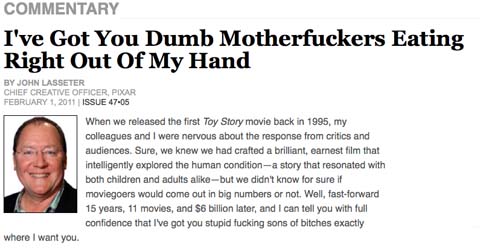
lasseter-onion

Courtesy of the Onion

There are basically two kinds of Al winners – inventor/entrepreneurs and champions of unpopular causes. They’re either David going up against Goliath, or they’re Elijah calling down fire on the lonely altar. Lasseter is both.

Inventor/entrepreneur? Lasseter dreamed for all his boyhood of working for Disney, and by some miracle he got himself chained to a drafting table deep in the bowels of the Disney dungeon, slaving away as the tenth assistant drawer of left pinkies . . . and then promptly got himself fired from his dream job for taking an interest in computer animation just at a moment when (unbeknownst to him) one of his superiors had decided the future lay elsewhere.

Perhaps because computers would eliminate people like him and elevate people like Lasseter? Can’t have that! Just like any good Al winner, John Lasseter saw the future, and he didn’t care whose cushy job was threatened by it.

So, cast out of the only company he ever wanted to work for, Lasseter chased down the future and seized it by the throat, and made it sing so loud and so beautifully that twenty years later, Disney came crawling back to him and begged him not just to come back, but to take over all their animated movie making, oversee design of all their theme park rides, and direct a good chunk of their other stuff to boot.

Disney+Premiere+Incredibles+Arrivals+qQcha6Wgo2ll

Mr. Incredible, second from the right, poses with some less impressive heroes

Now, all that would be Al-worthy if Lasseter’s innovations were merely technical. And it is hard, now, to remember that back in 1995 the thing that everyone thought was revolutionary about Toy Story was the technology.

But Lasseter’s innovation is as much the way his movie studio runs. He has figured out how to run a team of creative people in such a way that it not only produces material that is simultaneously artisitcally and commercially successful, but does so with sufficient regularity and reliability that you can pitch it to investors. He has taken the Muses to the bank.

And they really are the Muses. Lasseter and his people are not just “artistically and commercially successful.” They are bringing the transcendent things – the good, the true and the beautiful – back into the center of American culture.

Lasseter is as much a deserving Al winner as the champion of unpopular causes as he is so as an inventor/entrepreneur.

And what causes they are! If some have won the Al by standing up for this or that cause which is unpopular, but is nonetheless one of the keys to maintaining our justice, virtue and freedom as a people, Lasseter has stood up for just about all of the causes that are unpopular, but necessary for our justice, virtue and freedom:

  • Do not make your own happiness the aim of your life (Inside Out)
  • Love means putting other people’s needs ahead of yours (Frozen)
  • Accept your mortality (Toy Story 2)
  • Honor the superiority of exceptional talent (The Incredibles)
  • Manhood involves fatherhood (UP)
  • Womanhood involves motherhood (Brave)
  • Let your children take risks and grow up (Finding Nemo)
  • Don’t envy your brother (Toy Story)
  • Legitimate government rests on justice and popular consent (Toy Story 3)
  • Those who live for nothing but pleasure are fit for nothing but slavery (WALL-E)
  • Work your ass off, and be content with a family and your daily bread (Princess and the Frog)
  • Beauty transcends both nature and custom (Ratatouille)
  • Technology is for solving problems, not imposing your will on others (Big Hero 6)

No one else teaches these things and is listened to receptively by all sectors of society. Without this man, what hope would there be for these values in the long term? No, seriously, tell me. I’ll wait.

Two more Al-worthy accomplishments:

Lasseter is almost single-handedly responsible for the English language translation of the beautiful works of Hayao Miyazaki, who was practically unknown over here until Lasseter introduced us to him.

laputa_sm08

And Lasseter would be, if he won, the first Al winner to outdo the award’s illustrious namesake in tasteful shirts.

maxresdefault

Lasseter owns over 1,000 Hawaiian shirts and wears one every day.

You can’t ask for a clearer avatar of the Spirit of Al Copeland!