Talking School Choice “Win-Win”

June 1, 2016

2016-5-Win-Win-Solution

(Guest post by Greg Forster)

I’m grateful for the attention to the recently released fourth edition of my report A Win-Win Solution, reviewing the evidence on school choice programs.

You can now hear a podcast of yours truly discussing the report here.

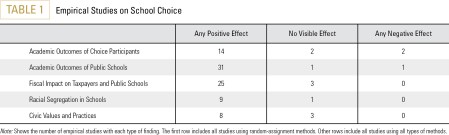
As in past years, the table in the executive summary kind of says it all:

Table 1

If that graphic doesn’t show well on your monitor, here’s the scorecard on what empirical studies have found for school choice programs:

  • Academic Outcomes of Choice Participants: 14-2-2
  • Academic Outcomes of Public Schools: 31-1-1
  • Fiscal Impact on Taxpayers and Public Schools: 25-3-0
  • Racial Segregation in Schools: 9-1-0
  • Civic Values and Practices: 8-3-0

Poor Parents Are Lazy and Shiftless

May 29, 2016

image

(Guest post by Greg Forster)

In OCPA’s Perspective I respond to unions and their allies in Oklahoma spreading myths about school choice – that it’s costly, unproven, etc.

My personal favorite is the guy who argues choice is bad because poor parents are lazy and shiftless:

Those children blessed with engaged and motivated parents will take their public tax dollars to whatever education venue they choose. The exodus of privileged children from the public school system, particularly in urban areas, will exacerbate the growing gap between the haves and have-nots, and restore an era of separate and unequal schools which will do irreparable harm to our nation.

Any similarity to racial stereotypes is no doubt purely coincidental.

But remember, the fact that the technocrats spent the last ten years working to build a coalition with these kind of people in no way reduces Peter Meyer’s moral authority to lecture Jay Greene about the evils of racism to distract from his inability to respond to Jay’s argument!


Education Is Political

May 25, 2016

AM1ONHSI

(Guest post by Greg Forster)

This post on education philanthropy by Megan Tompkins-Stange could give us a lot to discuss, but the most alarming point for me is the total failure of the technocratic people to accept the legitimacy of the political. Of anything political. Of course education is deeply political, since it is (among other things) training for life in the polis. There really is no separating the question “what is a good education?” from “what is a good social order?”; they are distinct but interdependent questions.

But not for some:

For example, when asked about the foundation’s work on the Common Core, Bill Gates told a Washington Post reporter, “These are not political things,” he said. “These are where people are trying to apply expertise to say, ‘Is this a way of making education better?'”

Note he’s not saying that his education philanthropy is not political, which might be taken to mean that it doesn’t arise from a partisan preference – which is probably true. What he’s saying is that education itself is not political.

And of course, as we have known since Plato, the failure to recognize the political nature of political questions is only a way of concealing the tyrannical exercise of power over politics. The tyrannical nature of the action is disguised by defining it as “not political.”

Think I’m exaggerating? Tompkins-Stange draws our attention to this:

In a much-circulated piece in the Wall Street Journal last fall, founding Facebook president Sean Parker described “hacker philanthropy” as “a desire to ‘hack’ complex problems using elegant technological and social solutions, and an almost religious belief in the power of data to aid in solving those problems.” As an example, Parker proposed funding private militias to conduct peacekeeping operations rather than government armies.

She notes that “in response, Princeton historian Stanley Katz wrote: ‘I teach public policy, and I’d be very concerned about a graduate student who told me that he felt confident that private militias should replace government military forces in troubled parts of the world. Wouldn’t you?'”


Commode Core

May 14, 2016

image

(Guest post by Greg Forster)

Okay, with the president implementing his new Commode Core program, now can we finally admit it’s unrealistic to expect the federal government to keep its hands off schools?


Let Families Grade Schools

April 27, 2016

41GLDqdXKpL__SX258_BO1,204,203,200_

(Guest post by Greg Forster)

OCPA’s Perspective carries my article on why we should restore final authority over education to parents, particularly in light of the Louisiana debacle:

Tests are not neutral. If you control the test, you control the curriculum. What gets taught is determined by what gets tested.

Allowing the state to test the schools gave politicians power over the schools, and the schools refused to accept it. Private schools don’t like limitations on what students they can take or what they charge, and rightly so. Such limitations damage education. But schools will typically put up with that to participate in a choice program, because they want to serve kids.

However, most schools absolutely will not allow outsiders to tell them what to teach. That’s surrendering the essence of the school. Admittedly, there are exceptions…Absent such unusual conditions, however, private schools rightly reject the extension of state power into the content of the classroom.

I also enjoyed doing a delightful radio interview this morning on the same subject, focusing more on why parents are the right repository of power over education – not only because they know their children best and are most motivated to seek their good, but also because parental authority is the only way to ground education in a holistic and coherent understanding of what education is for – what is the good life that we want children educated into.

As always, your comments are very welcome!


And the Higgy Goes to… Chris Christie

April 25, 2016

chris-christie-protrump-humiliating-moments

(Guest post by Greg Forster)

Where has the Higgy been? As the traditional nomination date of April 1 and the traditional winner anouncement date of April 15 have come and gone, angry mobs have been gathered around the National Higgy Convention for weeks as the delegate has fruitlessly passed through round after round of voting, trying to find one candidate among this year’s overwhelming bumper crop of potential nominees who can secure a majority vote on the floor. I am now proud to announce, on behalf of the Convention, that the delegate has finally settled on a winner.

The 2016 William Higinbotham Inhumanitarian of the Year is Chris Christie.

Like so many public figures in this remarkable year, Christie exemplifies the spirt of the Higgy and its (un)illustrious namesake:

“The Higgy” will not identify the worst person in the world, just as “The Al” does not recognize the best.  Instead, “The Higgy” will highlight individuals whose arrogant delusions of shaping the world to meet their own will outweigh the positive qualities they possess.

Encapsulating the (de)merits of this year’s winner is a challenging feat. Let me attempt to convey his (un)redeeming qualities through the three lessons all future PLDDs can learn from his example:

1) Despite your arrogant delusions, you will not, in fact, get to shape the world.

Christie go home


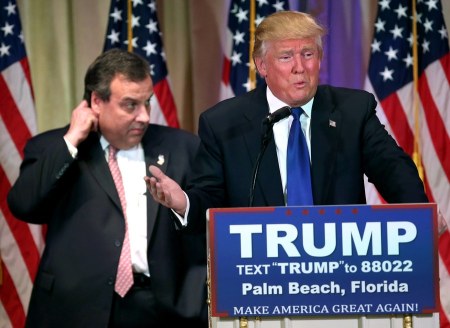
Christie thought that by signing up to campaign for America’s Mussolini, he would gain influence over the budding BSDD’s ambitions.

Yeah, that didn’t work out any better for Christie than it did for any of the other PLDDs who (as all PLDDs eventually do) latch onto a BSDD in hopes of gaining power.

2) People punish arrogance by seizing any opportunity you give them to laugh at you.
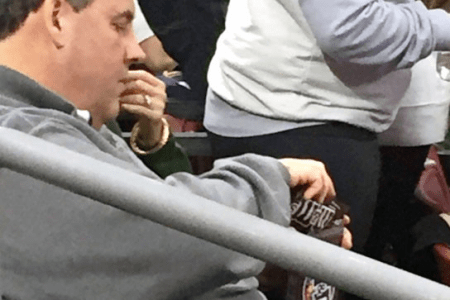
Christie M&Ms

I’m just going to leave this here.

3) You will lose your soul.
Christie soulless stare

Every day from this day until the day the illusion of your existence ends, every moment of every day, you will do nothing but seek out alternatives to distract you from staring into the void of a meaningless world. Eat Arby’s.

Christie joins previous Higgy winners Jonathan Gruber, Paul G. Kirk, Jr. and (the greatest of them all) Pascal Monnet in their fruitless pursuit of identity and purpose.

Talking Churches and Choice

April 14, 2016

41GLDqdXKpL__SX258_BO1,204,203,200_

(Guest post by Greg Forster)

Yesterday I did a short and sweet radio interview in Oklahoma (well, they were in Oklahoma) on my recent article about religious leaders and school choice. Roman Catholics and Jews were praised for maintaining their traditions in the face of great pressure to homogenize; evangelical skepticism of choice as entanglement with the state was both sympathized and respectfully disagreed with. Choice programs, as I pointed out, have actually created political constituencies that turn out and rally at state capitals to defend private school autonomy when it is threatened!

As always, your comments are very welcome.


Where Are the Evangelicals for Choice?

April 1, 2016

imagesF6CRZCR6

(Guest post by Greg Forster)

OCPA’s Perspective carries my article on religious support for school choice:

The government school monopoly promotes a stereotype that school choice is promoted by religious fanatics, but in fact religious leaders have been underrepresented in the school choice coalition. The most likely reason is a fear of compromising the independence of religious schools – but experience doesn’t support those fears, and I hope the time has come to get past them.

Obviously some religious leaders have been very important to the school choice cause – and in many cases they were among the first to sign on, when others stayed on the sidelines. That said, compared to the numbers and importance of religious leaders in society at large, it’s surprising how secular the school choice movement tends to be.

The big missing link here, the dog that isn’t barking, is evangelicals. The general scope of their political beliefs – from religious freedom to concern for the poor – points to school choice. And they would benefit from school choice programs. Yet they’ve been mostly absent from the fight….

Evangelicals have a long history of social activism – dating all the way back to the national controversy over mail delivery on Sunday in 1811, and their widespread opposition to Andrew Jackson’s genocidal “Indian removal” in 1830….There have been two glaring exceptions. White evangelicals mostly missed the boat on the civil rights movement; fifty years later, they regretted it. Today they’re missing the boat on a movment that many of us think will be looked back on fifty or a hundred years from now the same way.

As always, your comments are most welcome!


Fools: How Should We Feel About Them?

March 31, 2016

THE A-TEAM -- Pictured: Mr. T as Sgt. Bosco "B.A." Baracus -- Photo by: Herb Ball/NBCU Photo Bank

(Guest post by Greg Forster)

Some fool at an edu-blog in Oklahoma took a swing at criticizing my Win-Win report, summarizing the research on school choice. How did it go for them? Here’s a choice portion of my reply, now posted in full at Choice Remarks:

The most damning charge in their post is that I “cherry pick” the evidence, leaving out studies I don’t like. That would indeed be grievous, if it were true. They back up this charge by saying that I did not include in my review the official study of the D.C. voucher program, headed by Pat Wolf.

The accusation is clear, emphatic, and misspelled: “Patrick Wolfe’s official (and dismal) report (Wolfe et al 2010) on the program in Washington D.C. is not cited, a serious omission.”

Unfortunately, the charge is also false. I cite Wolf’s 2010 report on pages 8, 29, and 31. Oops!

OERC claims Wolf’s report (excuse me, “Wolfe’s” report) is “dismal” for the voucher program, crowing that “Wolfe” found negatively for the program even though he supports vouchers. But while Wolf found no change in test scores, he also found the following:

The Program significantly improved students’ chances of graduating from high school, according to parent reports. Overall, 82 percent of students offered scholarships received a high school diploma, compared to 70 percent of those who applied but were not offered scholarships. This graduation rate improvement also held for the subgroup of OSP students who came from “schools in need of improvement.”

So the study they characterize as “dismal” actually found that the program dramatically reduces high school dropout rates without any corresponding reduction in standards of academic achievement.

Oops again!

Fun fact: Greene’s Law of Conservation of Es states that every time someone adds an E to the end of Pat’s name, somewhere, somehow, someone drops the E from the end of Jay’s name.

Can any of y’all help me? I’m trying to figure out what emotional response is appropriate to this level of foolishness…


The Race Card Again

March 29, 2016
  • image

(Guest post by Greg Forster)

A gang of the usual suspects has released yet another retread report providing information we already have, dressing it up in shocking language, and using it to play the race card against school choice.

As the Washington Post relates, the study finds – surprise! – private schools are disproportionately white. Obviously this must mean they’re racist and school choice is therefore dangerous.

The Post did quote one sensible fellow who saw through the racket:

Private schools generally want to serve as many students as possible, but they can only serve those who are able to pay….School choice levels the playing field by helping those with lower incomes have access to the choices that others now have and even take for granted. It is not a scandal that those who are able to access better schools choose to do so; it is a scandal that because of the government school monopoly, only some are able to access better schools.

He also pointed out a number of methodological flaws in their work, and cited the body of evidence showing school choice moves students from more-segregated public schools to less-segregated private schools.

Who was that masked man?