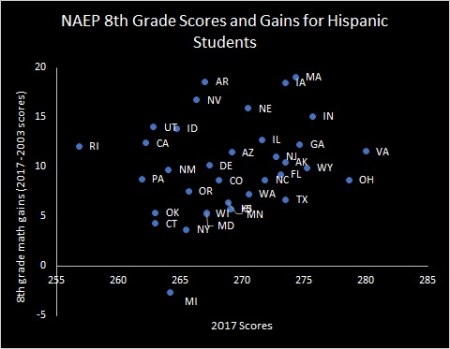
(Guest Post by Matthew Ladner)
A number of state Hispanic sectors closed the gap with the lowest performing statewide Anglo sector (274) in 8th grade math, which is good #MOARRR!
(Guest Post by Matthew Ladner)
A number of state Hispanic sectors closed the gap with the lowest performing statewide Anglo sector (274) in 8th grade math, which is good #MOARRR!
 6 Comments |
  NAEP | Tagged: 2017 NAEP Hispanic Scores |
  Permalink
 Posted by matthewladner

(Guest Post by Matthew Ladner)
A few months ago I speculated that a statewide Black population would catch up to a statewide Anglo NAEP score. It got close in 8th grade math with Arizona’s Black students scoring 272 and the lowest scoring statewide Anglo score coming in at 274. Here’s a chart on 8th grade scores and gains in math since 2003 (Black students did not make the minimum size for NAEP to report scores in several states):

Indiana and Arizona can thumb wrestle later for the championship.
1 Comment | Uncategorized | Tagged: 2017 NAEP, 2017 NAEP Black Scores | Permalink
Posted by matthewladner
(Guest Post by Matthew Ladner)
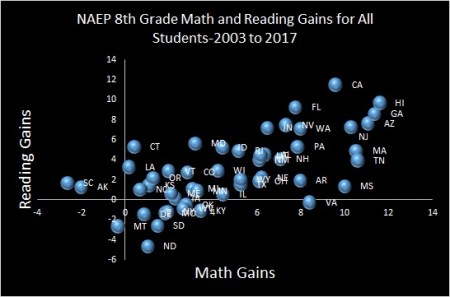
So the data went live at midnight EST. The national data is basically flat on all four tests. Most single cycle differences are not statistically significant, so I’m looking at longer periods of time, but the 2015 to 2017 champ looks to be Florida. More details on this later but I’m resisting the temptation to bring Sally back pending further analysis…but only barely!
The short run (2015 to 2017) state level data doesn’t look terribly exciting. I’m still digesting the longer run state level data, but up top there’s a chart to tide you over. NCLB required all states to take math and reading NAEP starting in 2003, so here is the full period (2003 to 2017) gains for 8th grade math and reading by state. These are numerical gains subtracting 2003 from 2017 scores by state.
The 2003 to 2017 period is a natural one to examine, but so too is the post 2009 period, for a few different reasons. The 2009 NAEP happened both in the early days of the Obama administration and during the outset of the Great Recession. NAEP redid the 4th and 8th grade science exams that year. The inclusion of “non-tested” subjects is healthy in my view given concerns over curriculum narrowing. According to my bleary eyes two states have made statistically significant gains in all six exams for the entire available period- Arizona and Mississippi. For the 2009 to 2015 period it had been AZ alone. Arizona and Mississippi were also the only states to make statistically significant gains on all of the math and reading tests during the 2009 to 2017 period. Several states however had statistically significant gains in 3 out of 4 of the math and reading exams between 2009 and 2017-including California, Hawaii, Indiana and Wyoming. On the downside, I have not yet added up the number of significant statewide declines in scores during this period, but there are many of them.
Arizona had three flat aggregate statewide scores and a decline in 4th grade math between 2015 and 2017. At first blush Arizona and Colorado charter schools crushed the academic ball again in 2017, will dig further into details/subgroups but for now:
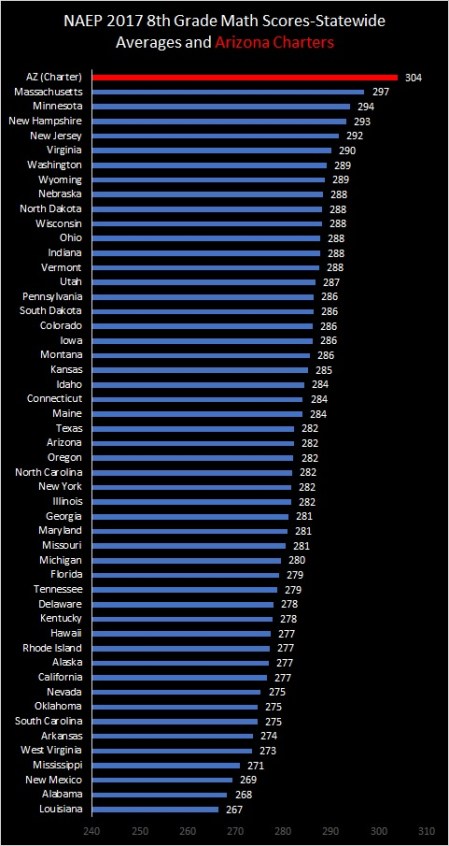
There is more good news in statewide charter sectors, haven’t touched the TUDA yet, stay tuned.
Leave a Comment » | Uncategorized | Tagged: 2017 NAEP, Arizona charter schools, NAEP gains by state | Permalink
Posted by matthewladner

(Guest Post by Matthew Ladner)
Shakespeare’s Henry V includes a scene in the tent of the French nobles in which the Dauphin prattles on an on about how many of the English he plans to slaughter on the following day in the battle of Agincourt. “Will it never be day!?!?!” the Dauphin exclaimed. Careful what you wish for…

NAEP’s 2017 results for Math and Reading for states and select large urban districts will become available tomorrow. I’ve got my basement primed with six laptops and a case of Monster energy drinks. Mrs. Ladner is planning to occasionally open the vault to hurl additional pizza boxes downstairs before quickly re-sealing civilization’s final defense against anarchy. A few notes:
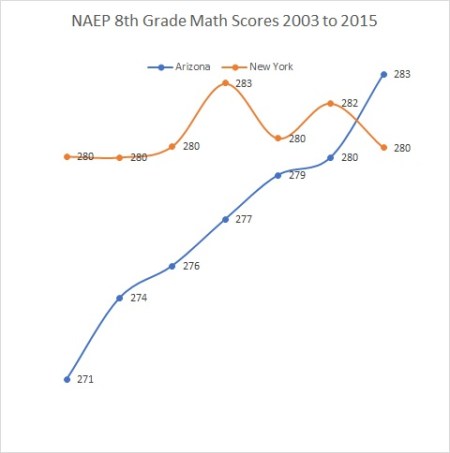
Large score movements either up or down are rare so up is better than down but when examining a statewide average score. On the math and reading tests 10 points roughly equates to an average year worth of progress (e.g. if we did a random assignment exercise and had one group take the 4th grade math test as 4th graders and the other group as 5th graders we would expect the 5th graders to score about 10 points higher). Most gains or declines are of the incremental variety (1-3 points) but they can add up over time like in Arizona, or cancel themselves out like in New York:
Was the 2015 NAEP a disappointing blip or the start of a new trend? A mere quarter century of national math improvement at both the 4th and 8th grade level came to an end in 2015. We’ll find out tomorrow.
If a trend, cry HAVOC and let slip the dogs of spin! Put me down as skeptical on some sort of lagged impact of the great recession given things like:
This will be a big NAEP for the Common Core project. I have not seen any reason to doubt the Tom Loveless analysis that measured the impact as a tiny positive. A tiny positive however was not what was promised. Let’s see what happens next.
Discipline Reform. I’ve been reading the debate on the discipline reform efforts of the Obama administration. I have no idea whether discipline reform had an adverse impact on academic performance, but if we are looking to subject the notion to conjecture and refutation, I would take the most interest in the score trends of low-income students of color in early adopting jurisdictions, and I would take a greater interest in 8th grade scores/trends.
Computerized testing. They piloted it in 2015, and then delayed the release of the 2017 NAEP to further study whether to make additional adjustments. Peggy Carr, the acting commissioner of the National Center for Education Statistics, told reporters last week “We have the full weight of scientific, psychometric evidence behind the release. We are comparing apples to apples. I think we can all be confident without a shadow of a doubt that we are going to be looking at true performance.” Perhaps understandably given the pressures involved some state chiefs took an interest in technical aspects of NAEP testing shortly after being briefed on their state scores, but the National Center for Education Statistics has a head start several years in the running on studying this issue, so I tend to believe them, unless Arizona scores tank, in which case…just kidding.
Stay tuned to this jayblog channel and remember…
7 Comments | Uncategorized | Tagged: 2017 NAEP | Permalink
Posted by matthewladner

It was bad enough that Marlins fans had to suffer under previous team owner Jeff Loria’s inept management of the team (after impressively winning the World Series twice in the first ten years of the team’s existence). And it’s even worse that a new ownership group led by former Yankee star, Derek Jeter, has dismantled what may have been the best outfield in baseball to conserve cash since the new owners seem financially exhausted immediately after having made the purchase. But the action that has significantly detracted from the human condition and made Jeter worthy of a nomination for the William Higinbotham Inhumanitarian Award is his decision to cancel The Great Sea Race.
Since 2012 the Marlins have held a race among mascots dressed in sea creature outfits during the 6th inning of home games. This contest between Bob the Shark, Julio the Octopus, Angel the Stone Crab, and Spike the Sea Dragon, however, has come to a halt under the new ownership led by Jeter. The exact reasons have not been given, but it appears that the new ownership group seems to view baseball as a serious enterprise, deserving of reverence. As one commentator put it: “[Jeter] doesn’t want fans to have anything to smile about this year.”
The late, great Bill Veeck understood what baseball was really about — fun. As owner of the Cleveland Indians, St. Louis Browns, and Chicago White Sox he packed the games with bread and circuses to make the experience entertaining. He hired Max Patkin, the “Clown Price of Baseball,” to coach the Indians. Patkin “had a face seemingly made of rubber that could make many shapes. He was rail thin and wore a baggy uniform with a question mark (?) on the back in place of a number, and a ballcap that was always askew. While some derided his act as corny, he became a beloved figure in baseball circles…”
In St. Louis, “some of Veeck’s most memorable publicity stunts occurred during his tenure with the Browns, including the appearance on August 19, 1951, by Eddie Gaedel, who stood 3 feet 7 inches tall and is the shortest person to appear in a Major League Baseball game. Veeck sent Gaedel to pinch hit in the bottom of the first of the game. Wearing elf like shoes and ‘1/8’ as his uniform number, Gaedel was walked on four straight pitches and then was pulled for a pinch runner. Shortly afterwards ‘Grandstand Manager’s Day’ – involving Veeck, Connie Mack, and thousands of regular fans, enabled the crowd to vote on various in-game strategic decisions by holding up placards: the Browns won, 5–3, snapping a four-game losing streak.”
And in Chicago, Veeck was the first to introduce an electronic scoreboard that lit up, made noises, and shot fireworks when the White Sox hit a home run. And in one of my greatest childhood memories, Veeck organized Disco Demolition Night, in which local DJ, Steve Dahl, dressed in a military uniform, drove a Jeep into center field, and blew up a pile of disco records during the middle of a double-header. Dahl got the crowd so riled up that they stormed the field, causing enough damage that the White Sox had to forfeit the second game. It was hilarious! Veeck was also the one to convince Harry Caray, who was the announcer for the White Sox at that time, to sing “Take Me Out to the Ballgame” to the crowd during the 7th inning stretch. Caray tried to refuse but Veeck said that he had a recording of Caray singing and would play it over the audio if Caray refused to perform it live. Caray continued this practice of singing to the crowd when he moved to the Northside to become the announcer for the Cubs. Thus was a much-loved baseball tradition born.
Veeck’s teams also played very well. Under Veeck’s leadership, the Indians won their first pennant in 20 years in 1948. In 1959, Veeck’s White Sox won their first pennant in 40 years. But Veeck understood that most teams fall short most years, so they have to offer their fans something other than victory to keep everyone entertained. Yes, they should offer quality play, but sometimes even that is beyond the reach of most teams. As we Marlins fans (can I use the plural for that?) wait for the team to rebuild with only moderate chances of being successful for many years, can’t we at least watch some frickin’ fish run around the outfield?
Jeter seems to represent the type of baseball fan who has watched Field of Dreams a few too many times. The game is not a sacred ritual, deserving of church-like propriety. It’s entertainment. It should be fun. For trying to make us all eat our baseball vegetables and taking away The Great Sea Race, Derek Jeter is worthy of The Higgy.
5 Comments | Uncategorized | Permalink
Posted by Jay P. Greene
(Guest post by Greg Forster)
In NRO today, Rick Hess and Sofia Gallo accuse the school choice movement of using “overheated” and “alarmist” rhetoric. They assert that since school choice is the opposite of neighborhood schooling (which all smart people know to be true, since we say it and we’re the smart people), choice advocates need a new, toned-down rhetoric to convince jumpy soccer moms that choice is no big deal and won’t have any big effects on anything.
How is this wrong? Let me count the ways:
1) “School choice advocates are wild-eyed ideological extremists” is a timeworn smear used by the Blob to demonize reformers, and anyone paying attention should have seen through it by now. For Hess and Gallo to resort to this lazy stereotype is offensive. The examples they bring to justify their claim that choice advocates are overheated and alarmist (choice is like Uber for schools!) redefine the whole concept of “weak tea.”
It is Hess and Gallo whose rhetoric is overheated and alarmist, in claiming that choice advocates are overheated and alarmist.
2) Hess and Gallo admit that choice is not only increasingly successful politically, it is growing more popular over time. Their efforts to create the impression that choice has a public perception problem (choice underperforms when compared to pie-in-the-sky hypothetical utopian alternatives in heavily biased survey questions formulated by the servants of the Blob at PDK!) don’t change the basic facts.
By Hess and Gallo’s own showing, choice is winning in statehouses, winning in governors’ mansions, and winning in public opinion polls. No doubt that success will ebb and flow in the future, as it has in the past. But choice has better public perception today than at any time in its history.
3) School choice is not in tension with local control, it is local control. For half a century, governance of district schools has moved further and further out of the local neighborhood and up the bureaucratic ladder, from the building to the district to the state and federal levels. There is no plausible plan for reversing that movement, other than school choice.
The only possible future of “neighborhood schools” is neighborhood schools of choice. Nothing else but choice will return governance of schools to the neighborhood level.
Because guess what neighborhoods are made up of? Parents. And parents who are given school choice exercise that choice as members of their local communities, gathering information and forming relationships in neighborhoods.
4) Parents tend to like their own schools, so Hess and Gallo recommend that choice advocates adopt a message along the lines of “choice won’t change schools.” Because that’s how you sell a reform – argue that it doesn’t matter and won’t change anything.
Or perhaps the message will be, “choice won’t change schools for people like you, it will only change schools for those other people. You know the ones we mean.”
Jay has been pointing out for years that the biggest mistake education reformers have been making is to argue that their policies will benefit a small and relatively powerless portion of the population, and offer no benefits to larger and more powerful constituencies. Hess and Gallo want choice to double down on that strategy.
5) To the extent that choice advocates could do better in framing their rhetoric, the problem is not that choice is percieved as a threat but that choice is percieved as of limited value because it is disconnected from moral imperatives like justice, equal opportunity, diversity and freedom. School choice advocates often assume that when they talk about markets they are affirming those imperatives, but in fact the language of markets does not and will not invoke those commitments for most people. A new language of school accountability through choice is needed to connect school choice to the things that matter most.
We shouldn’t talk as if choice should matter less, but as if it should matter more. Because it does.
3 Comments | Uncategorized | Permalink
Posted by Greg Forster

(Guest Post by Matthew Ladner)
The 2017 NAEP will be released next week, and a few notes seem in order. Over time, the term “mis-NAEPery” has slowly morphed into a catchall phrase to mean “I don’t like your conclusions.” Mis-NAEPery however has an actual meaning- or at least it should- which ought to be something along the lines of “confidently attributing NAEP trends to a particular policy.”
Arne Duncan for instance took to the pages of the Washington Post recently in order to lay claim to all positive NAEP trends since 1990 to his own tribe of reformer (center left):
Lately, a lot of people in Washington are saying that education reform hasn’t worked very well. Don’t believe it.
Since 1971, fourth-grade reading and math scores are up 13 points and 25 points, respectively. Eighth-grade reading and math scores are up eight points and 19 points, respectively. Every 10 points equates to about a year of learning, and much of the gains have been driven by students of color.
Duncan then proceeds to dismiss the possibility that student demographics had anything to do with this improvement, as the American student body has grown “It should be noted that the student population is relatively poorer and considerably more diverse than in 1971.” This is a contention however deserving dispute, given that the inflation adjusted (in constant 2011 dollars) income of the poorest fifth of Americans almost doubled between 1964 and 2011 once various transfers (food stamps, EITC etc.) have been taken into account. Any number of other things could also explain the positive trend, both policy and non-policy related, but never mind any of that, Mr. Duncan lays claim to all that is positive.
Duncan was not finished yet, however, as he was at pains to triangulate himself away from those nasty people who support more choice than just charter schools:
Some have taken the original idea of school choice — as laboratories of innovation that would help all schools improve — and used it to defund education, weaken unions and allow public dollars to fund private schools without accountability.
Well that sounds a bit like how a committed leftist would (unfairly) describe my pleasant patch of cactus. Arizona NAEP scores, could you please stand to acknowledge the cheers of the audience:
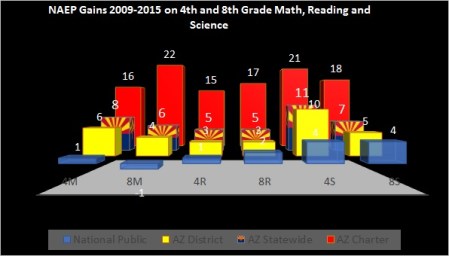
So the big problem in that chart are the blue columns. These charts stretch from the advent of the Obama years until the (until Tuesday) most recently available data. We won’t be getting new science data this year, so ignore the last two blue columns on the right. What we are looking at is changes in scores of 1 point in 4th grade math, -1 point in 8th grade math, 1 point in 4th grade reading and two points in 8th grade reading. There’s only one state that made statistically significant academic gains on all six NAEP tests during the Obama era, but it just so happens to be one of the ones adopting the policies uncharitably characterized by Duncan’s effort at triangulation.
There were some very large initiatives during these years- Common Core standards, teacher evaluation, etc. and we can’t be sure why the national numbers have been so flat, but let’s just say that a net gain of three scale points across four 500 scale point tests fails to make much of an impression. Supporters of the Common Core project for instance performed a bit of a Jedi mind trick around the 2015 NAEP by noting that scores were also meh in states that chose not to adopt, and that 2015 was early yet. Fair enough on the early bit, but the promise of an enormous investment of political capital in the project was not that adopting states would be equally meh, but rather that things would get better.

Where’s the BETTER?!?
Duncan’s misNAEPery however is of the garden variety- there has been far worse. Massachusetts for instance instituted a multi-faceted suite of policy reforms in 1993, and their NAEP scores increased from a bit better than nearby New Hampshire to two bits better than New Hampshire and tops in the country. So far as I can tell, there was approximately zero effort to establish micro-level evidence on any of the multiple reform efforts, or to disentangle to the extent policies were having a positive impact, which policies were doing what. That would be silly- everyone knows that standards and testing propelled MA to the top NAEP scores, and once everyone else does it we will surge towards education Nirvana Canadian PISA scores. Well, I refer the honourable gentleman to tiny blue columns in the chart I referenced some moments ago.
This is not to say that I am confident that testing and standards had nothing to do with MA’s high NAEP scores. I’m inclined to think they probably did, but some actual evidence would be nice before imposing this strategy on everyone. In Campbell and Stanley terms “Great Caesar’s Ghost! Look at those Massachusetts NAEP scores!” lacks evidence of both internal and external validity. In other words, we don’t know what caused MA NAEP scores, nor do we know who if anyone else might be able to pull it off, assuming policy had something to do with it.
So beware of mis-NAEPery my son- the jaws that bite, the claws that catch! Also beware of NAEP nihilism. Taking off my social science cap, I will note that NAEP is an enormous and highly respected project and it is done expressly for the purpose of making comparisons. Yes we should exercise a high level of caution in so doing, and should check any preliminary conclusions reached against other sources of available evidence. The world is a complicated place with an almost infinite number of factors pushing achievement up or down at any point. There is a great deal of noise, and finding the signal is difficult. NAEP alone cannot establish a signal.
The fact that the premature conclusions drawn from the Massachusetts experience lacked evidence of internal and external validity did not mean that those conclusions were wrong but it did make them dangerous. Alas the world does not operate in a random assignment study. Policymakers must make decisions based upon the evidence at hand, NAEP and (hopefully) better than NAEP. The figure at the top of this post makes use of NAEP and there is a whole lot of top map green (early goodness) turning into bottom map purple (later badness) going on. This is a bad look assuming part of what you want out of your support of K-12 education is kids learning about math and reading in elementary and middle school. Let’s be careful, but let’s also see what happens next.
Leave a Comment » | NAEP | Tagged: 2017 NAEP, Arne Duncan, Sean F. Reardon | Permalink
Posted by matthewladner

Museums and theaters should stop telling me what to think about art. I know that the folks who run museums and theaters think they are just providing context and facilitating discussion, but too often they are actually attempting to control what their patrons think about art works and plays with excessive gallery text and after show “talkbacks.”
I have no expertise in curating galleries or presenting plays, but I can speak as a frequent consumer of the arts that this well-intentioned, but ultimately bossy, deluge of information interferes with my direct experience and enjoyment of the art. And I’m not the only one who feels this way. Last year the playwright, David Mamet, forbid talkbacks following his plays. He was mocked by some in the theater community for this, but I understand what drove his action. Too many theaters were hosting talkbacks after his plays in which the theater staff or an expert they selected were obviously steering the audience toward particular and simplified interpretations of his work that might make it less controversial. As another playwright, Christopher Shinn put it: “Broadly speaking, theaters use talkbacks to protect the audience from uncomfortable feelings the play may have aroused.”
I’m all for discussing plays after you see them, but that’s why you should go for dinner or drinks afterwards. When theaters host the discussion they cannot help but use their authority to drive the discussion in certain directions. I don’t want my theater to tell me what to think about the play I just saw. I want to develop my own thoughts and talk to others without the mediation of self-appointed experts on its meaning.
Shaping what people think about a play is especially likely if the theater-facilitated discussion immediately follows the performance. That’s why some theaters hold events at separate time or in separate locations, more clearly demarcating the interpretation from the performance itself. This seems like a reasonable compromise for theaters concerned about expanding audience engagement without being too controlling.
Some art museums have also drifted away from excessive gallery text. The Isabella Stewart Gardner museum in Boston, for example emphasizes: “Isabella created her installations to evoke an emotional response in visitors. That’s why, unlike at other institutions, there aren’t conventional labels in this museum. She wanted you to find your own meanings.” But other museums, while trying to avoid “the priestly voice of absolute authority,” still feel obliged to cover their walls in verbiage about the social and historical context of the works they display.
I sympathize with the impulses of museum staff to try to help their patrons, but I fear that they have too little trust in the ability of the art to communicate without mediation. In addition, social and historical contexts are complicated and often disputed, so when museums try to convey that context they are inevitably making choices about what the correct understanding of history and sociology should be. I am no more interested in having my museum tell me what to think about the world than having it tell me what to think about art.
Also posted on the University of Arkansas’ NEA Research Lab Blog.
3 Comments | Uncategorized | Permalink
Posted by Jay P. Greene

NAEP results are being released next week, but state departments of education have already been briefed on their results. State education officials are leaking like sieves, so many edu-pundits have at least some inkling of what’s coming. Rumors from multiple sources suggest that the results generally look bad — with a decline nationally. Aware that they may be blamed for declines, a number of folks are anticipating the release by placing their own spin on the soon-to-be-released results.
Exhibit A in this pre-spinning is John White, who is the superintendent of education in Lousiana. According to Matt Barnum at Chalkbeat White sent a letter to the U.S. Department of Education on March 23 raising concerns about the comparability of NAEP results over time given the transition to computer-administered testing. Although he acknowledges that NCES made adjustments to ensure the comparability of paper and pencil and computer administered tests and found insignificant differential effects by sub-group, White still raises questions about whether differential effects may distort results for certain states. Barnum notes: “Even though researchers warn that it is inappropriate to judge specific policies by raw NAEP results, if White’s letter is a signal that Louisiana’s scores have fallen, that could deal a blow to his controversial tenure, where he’s pushed for vouchers and charter schools, the Common Core, letter grades for schools, and an overhaul of curriculum. White said his state’s results are not what’s driving his concerns.” Hmmm. Maybe it’s just a remarkable coincidence that White has suddenly developed these technical concerns about the validity of NAEP at about the same time that he was briefed on his state’s results. How much do you want to bet that there is a decline in LA?
Exhibit B is Arne Duncan taking to the pages of the Washington Post to defend the idea that ed reform has contributed to significant improvement. He focuses on trends over the last few decades. That would be a smart move to focus on long-term gains if recent trends — you know, in the wake of Duncan’s tenure as U.S. Secretary of Education — have been taking a nose-dive. NAEP results slipped for the first time when 2015 results were released. How much do you want to bet that national results have declined again?
Barnum is right to warn people away from inferring too much from changes in NAEP as an indicator of the success of any particular policy or education leader, but these folks live in a political, not a research, world. Both White and Duncan’s political standing in education policy was built on over-claiming from NAEP results, and those who live by the NAEP sword may die by it. That’s why they better start spinning.
8 Comments | Uncategorized | Permalink
Posted by Jay P. Greene

(Guest Post by Matthew Ladner)
As a Gen-Xer, some of my fondest memories of childhood involved waking up on Saturday mornings, pouring myself a breakfast of chocolate frosted sugar bombs into a bowl, and then watching a few hours of Saturday morning cartoons. The Warner Brothers were my personal favorites and you can learn a lot by watching these cartoons. I still recognize pieces of classical music that I associate with these cartoons for instance. If you paid attention, Bugs Bunny was actually an outstanding role model: never initiating a conflict, but always finishing them. Wile E. Coyote Supra-Genius has made more than a few appearances here on the JPGB as a symbol of technocratic overreach in K-12. In fact, there is no doubt that education reform would have profited by more viewing of Road Runner cartoons to instruct on the possibilities of unintended consequences to complicated policy efforts:

Alas the institution of Saturday Morning Cartoons itself bit the dust due to social engineering from the federal government. In 1990, our august group of Olympians in Congress took time out of their busy schedules to pass something called the Children’s Television Act. The Children’s Television Act, sponsored by Texas Congressman John W. Bryant, required networks to provide three hours per week of “educational” programming to “meet the needs” of children age 16 and younger.
What unfolded was a slow process of the FCC bureaucrats fumbling over what constitutes “educational” programming, and the steady squeezing out of Saturday morning cartoons. The last minor network holdout gave up the ghost on Saturday morning cartoons in 2014, but the institution had effectively died long ago.
The three Ladner children never once in their lives got up to have breakfast (something at least a bit more nutritionally sound than chocolate frosted sugar bombs btw) and shuffled to the television to watch federally mandated “educational” programming. The federal government is mandating this programming, but I seriously doubt much of anyone is watching it. Meanwhile, an important American cultural institution has been destroyed. Make a reference to “Spear and Magic Helmet” or “Cook-Where’s my Hessenheffer?!?” to younger people and are likely to look at you puzzled.
For pointlessly ruining a revered American cultural practice in pursuit of bossing people around for “their own good” I nominate former Congressman John W. Bryant for the Higgy Inhumanitarian Award. If President Trump wants to “make America great again” he should repeal the Children’s Television Act. Where have you gone Duck Dodgers in the 24th and a half Century? Our nation turns its’ lonely eyes to you. The Children’s Television Act of 1990 is definitely obstructing my view of Venus.
3 Comments | William Higginbotham Inhumanitarian Award | Tagged: Children's Television Act of 1990, John W. Bryant | Permalink
Posted by matthewladner
You are currently browsing the Jay P. Greene's Blog blog archives for April, 2018.

 Jay P. Greene's Blog