Now for people like me who support Arizona developing a set of standards unique to Arizona and replacing the current CC standards and possibly test so long as they are as good or better, the presence of Oklahoma on that last chart is a problem. For anti-CC crusaders, it’s an even a larger problem, unless of course you are just shameless is your support for tests that a chimp could sometimes pass blindfolded. Yes Tex I am looking at you. A constructive vote of no-confidence remains a respectable path to leaving CC in the rear view mirror, so I hope Oklahoma will pull it off in plenty of time for the 2017 NAEP.
Our pal Mike P. may be feeling a bit squeamish about ESAs, but rapper/actor LUDACRIS is ALL IN BABY! From the Atlanta Journal Constitution:
“Regardless to social status, all children should be able to access a great school,” said Ludacris. “Education savings accounts empower all children to be able to access a great education.”
First, as Matt noted, this is not Mike’s first foray into Hemisphere Fallacy territory. (Or the second. Or even the third.) Like the guy who thinks anyone who is more religious is crazy and anyone who is less religious is a heretic, Mike thinks he has found the Perfect Goldilocksian Mean and everyone else is wrong. In Mike’s view, those who support more regulation than he does are paternalist Nannies, and those who support less regulation are utopian Purists, but the temperature of his regulatory porridge is just right.
Second, as I noted on Twitter, it’s adorable that Mike thinks he’s not a Nanny. He decries their “micromanagement” but he supports forcing private schools to administer the state test (de factodetermining what is taught when and even how), as well as price controls that economists will tell you leads to shortages and obliterates the essential price signal (without which we may have competition, but we most certainly do not have a functioning market). He may fancy himself a “Realist” but, if these categories really mean anything, he just has minor disagreements with his fellow Nannies.
I think X is a problem. I believe Solution Y solves X. Group A opposes Solution Y, therefore Group A must not think X is really a problem.
Of course, this is a fallacy because it is entirely possible (as is the case here) that Group A agrees that X is a problem but doesn’t think Solution Y actually solves it. Mike thinks his preferred regulations solve the problem of bad schools, but we think those regulations are more likely to have adverse effects. More on that in a moment.
Mike accuses the “Purists” (those who, like Milton Friedman, conclude based on the evidence from nearly every other industry that markets spur innovation and lead to greater quality and efficiency) of being utopian. He writes:
Start with the Purists. I’m skeptical of all utopian visions, including theirs—one imagining that a full-fledged system of choice (perhaps through universal Education Savings Accounts) will yield greater innovation, productivity, and customer satisfaction—and produce better-educated young people to boot.
But there’s nothing utopian about that. We see that ESAs have already begun to produce greater innovation, productivity, and customer satisfaction. We don’t yet have any data on test scores or graduation rates, but we have no reason to believe that ESAs will underperform the many voucher programs that have produced positive results. No one in the free-market crowd is expecting miracles. We’re expecting the sort of incremental improvement that the market regularly brings about through the process of experimentation, evaluation, and evolution.
(For that matter, the most utopian schemes in education come from the Nannies. Can you imagine a more fantastically utopian scheme than “No Child Left Behind”? Is there a more utopian slogan than that anywhere in education policy? And did anyone in the administration really believe we’d ever achieve 100% proficiency in any state, let alone every state? Either they set up the nation to fail or they were delusional. Or perhaps they just set up the DOE for a naked power grab. But I digress.)
Mike’s central challenge to the Friedmanite crowd is the Payday Lender Problem. What do we do about bad private schools?
First of all, Mike doesn’t have a whole lot of evidence that the government does a better job ensuring quality than the market. Indeed, the Louisiana debacle should give him great pause about that article of faith.
Second, eliminating the least-bad option doesn’t guarantee a better option. Payday lending serves an important function in the market (in the Third World, we call it “microlending,” a concept for which Muhammad Yunus won a Nobel Peace Prize). Poor people who need funds to cover rent or buy food while waiting for payday often turn to payday lenders. If they repay the loan on time, the fees are generally marginal. If they repay late, the interest rates can be exorbitant, especially if (misleadingly) expressed in annual terms. (The interest is so high both because the loans are so small and because the rate of default is so high, which is why banks generally just refuse to lend to the poor.) But eliminating the payday lenders can have serious unintended consequences that make the poor even worse off. The payday lender may charge a steep fee for late payment, but at least Rocky Balboa doesn’t come break your legs.
Kicking a school with poor test scores out of a voucher program doesn’t guarantee those poor kids a seat at a better school. Rather, the state just eliminates that kid’s least-bad alternative. Even in Louisiana, where the voucher schools appear to be doing much worse on the state test than the district school alternatives, the families who chose those schools may well have had good reasons for doing so. Perhaps they were safer. Perhaps they had higher graduation rates. We don’t know. But those families chose them for a reason and they may well be worse off overall if deprived of that choice.
Third, as Michael McShane explained previously, the market process has proven time and again to significantly improve absolute quality (and efficiency) over time:
Cars today are uniformly better than cars in 1950. They are safer. They are faster. They are more comfortable. They are more fuel efficient. But it wasn’t a clear upward-sloping line to get here. People bought Edsel’s in the 50’s, Corvairs in the 60’s, Chevettes in the 70’s, Yugo’s in the 80’s, Suzuki Sidekicks in the 90’s, and Pontiac Aztecs in the 00’s. These were bad cars.
But “bad” has two meanings in this case, an objective one and a relative one. There are relatively bad cars out there today. That is, my hail-damaged ’05 Kia Spectra with no cruise control and a blown-out right front speaker is worse than Jay-Z’s Maybach on almost every calculable measure, relatively speaking. But my Spectra, which is still purring like a kitten after over 100,000 miles with darn near nothing more than oil changes, tires, and brake pads is a helluva lot better than the burn-out-after-five-years cars that automakers made for decades. That’s absolute quality.
Markets work when the spectrum of relative quality drives improvements in absolute quality. Someone sees my little tin can driving down the road and says “I want to buy a car that doesn’t look like it’s going to blow away in a stiff breeze” and cars get less tin-canny. Someone buys a Ford Excursion and then gas prices go up and says, “I’m never doing that again” and cars get more fuel efficient. It’s a slow winnowing process, but over time it is superior to centralized systems, that, for example, made the Trabant in an essentially unchanged manner for over three decades.
Rather than thinking we can regulate bad schools out of existence, a better goal is to develop a system that continuously improves what we think a “bad” school is.
Mike Petrilli is right to be worried about kids who are in bad schools today, but the regulations he proposes to ensure that those students are attending relatively good schools interfere with the market process that could otherwise be driving up absolute quality for everyone (and, as Louisiana has shown, those kids may end up in low-performing schools anyway).
Imagine if government officials, following Mike’s logic, had decided decades ago that every low-income family should have access to a phone. Now, these Realist officials aren’t Nannies — they’re not going to have the government make the phones or micromanage the specs. They’re just going to ensure that everyone has access to a good phone, so they create a phone voucher but prohibit companies selling phones from charging more than the value of the voucher. What would have happened?
Well, there’s the seen and the unseen. We would have seen, perhaps, that everyone would have had access to a phone and many would have applauded that (although given the price controls, it’s likely that supply would not have met demand). But what we wouldn’t have seen was that the iPhone had not been invented. With no way to charge more than the meager voucher, there’d be no market for expensive smartphones. And that wouldn’t just have harmed the wealthy, it would also have harmed the poor. After all, Walmart now sells a $10 smartphone that has better specs that the original iPhone. Innovations that at first benefit the wealthier early adopters tend to benefit even the poor after a while.
In short, Mike’s admirable passion to help the poor immediately through state action may well harm them in the medium-to-long run without any guarantee of actually helping them in the short run. That doesn’t sound very Realist to me.
No drink, drank or drunk…no pointing….and you have to take a shot with each triangulation hemisphere fallacy!
(Guest Post by Matthew Ladner)
Mike Petrilli created a taxonomy of school choice factions which is kind of fun. I agree with a good deal of it, especially the part about the interesting conversations now being between choice supporters rather than between choice supporters and opponents. Some of Mike’s take however strongly evokes Greg’s classic series of Hemisphere Fallacy posts: Faction one claims that the earth is a sphere, faction two insists that the earth is flat, so the real answer is obviously that the world is actually a hemisphere! Somewhere along the way these posts turned into a drinking game.
So in the taxonomy, Mike identifies JPGB as an oasis for “Purists,” identifies a more nebulous group of “Nannies” and then others as “Realists.” Mike identifies himself in the “Realist” camp.
Triangulation nudges one to exaggeration in order to create middle space to inhabit. Mike describes Purists as holding charter schools with suspicion, but a quick search through the JPGB archives will reveal dozens of reviews of charter school research, celeNAEPtion posts etc. for every “get off my lawn kid and take that Recovery School District with you!” post. Mike also describes ESA supporters as “utopian.” Someone put a link in the comments if you have seen otherwise, but I think the consistent theme in the ESA discussion has been their virtues vis a vis older models. I’ve made a consistent effort to describe our unfolding ESA experiment as a learning experience. I see an entirely reasonable path for real benefits, but I have never promised anyone a Workers Paradise or the New Jerusalem.
Or **ahem** “No Child Left Behind.”
I see questions over regulation within a system of parental choice to be an entirely appropriate topic for discussion and debate. It’s worth noting that from the very outset of the parental choice movement Milton Friedman called both for standardized testing and a certain degree of regulation. So in my mind thinking about this as a spectrum would make sense, but if I made a taxonomy it would look like:
Separation of School and State Extremists
Jeffersonian Freedom Fighting Sons of the Great Milton Friedman
Nanny State Busy Bodies
After careful consideration I place myself in the Jeffersonian Freedom Fighting Sons of the Great Milton Friedman…what?!? I did WHAT?!? Oh fine…
Let me take a moment to reiterate that in my home state I’m very comfortable with Governor Ducey’s goal to create a set of high academic standards unique to Arizona. I see little value in “common” standards (NAEP scratches my cross-state comparison itch) but I hate state tests that the Wall Street stock picking chicken could pass on his way to receiving a false state endorsement of “proficiency” with the burning hatred of a thousand suns. I have no idea where this will ultimately wind up and I can easily imagine better strategies than those adopted, etc.
In Washoe County, our crowded schools are about to get worse thanks to the large businesses attracted by the state’s economic development giveaways and their new employees’ thousands of children. As predicted, the committee tasked with choosing which taxes should be raised to build more schools has decided to ask voters to agree to a substantial increase in local sales and/or property tax in November, raising $600-800 million.
Tray Abney, a lobbyist for the Chamber of Commerce, is worried about his son who attends an especially crowded south Reno elementary school. He told KUNR, “We can’t fit the kids we have now, much less the Tesla kids and the Switch kids and the other kids that are coming here.” So much for the arguments that growth pays for itself and that these new subsidized jobs are for people who already live here.
The tax proposal seems unlikely to pass unless the school district’s superintendent, Traci Davis, and the companies most responsible for the sharp uptick in projected students are willing to put their “skin in the game.”
Davis and Tesla could voluntarily offer a “claw-back” on the ridiculously generous taxpayer-funded handouts they demanded and were provided by the school board and the Legislature. Davis could give back her five-month longevity bonus, her attorney fees, and her back-dated extra salary compensation. That gesture might start the healing that is necessary for the taxpayers to regain confidence in the district’s leadership.
Tesla’s billionaire executive, Elon Musk, and his stockholders could offer to build an elementary school or two instead of insulting us with their $37.5 million “donation” to Nevada’s schools, since we’ll have to wait 20 long years before realizing any sales tax from their megafactory.
If they’re not willing to help fund new schools, why should we?
Right, so let me see if I can get this straight. Nevada schools are already overcrowded with many schools surrounded by trailer parks staffed by substitute teachers who often don’t have so much as a BA degree. Check. The willingness of taxpayers to pay billions of dollars for new facilities has limits, including apparently the author who has begun to fantasize about “voluntary claw backs.” Check. The Census Bureau projects continued enrollment growth for as far as the eye can see. Oh and by the way your Baby Boomers are retiring and will need additional health spending and generate less tax revenue. Check, check, check…and check. So obviously a scholarship program that would have allowed 4,000 students to seek an alternative to said overcrowded system this year for less overall money per pupil must therefore be stopped at all cost!
Ground control to Major Kong….you might want to think this over a bit more.
Jason may have not yet developed the shameless self-promotion bug that afflict the rest of us here at JGPB, so I’ll mention for him that he has a new study out along with Jonathan Butcher and Justice Bolick (ah….I just love the sound of that…) on tax-credit ESAs.
The Three Bs make a strong case on the desirability of converting existing tax credit programs over to multiple uses, and also correctly note possible constitutional advantages under some state constitutions for a tax credit approach. The technology for allowing multiple uses for funds looks to be better and cheaper than one might expect (account management/oversight technology is fairly advanced) which may allow for oversight within the admin fees typically allowed by scholarship tax credit programs.
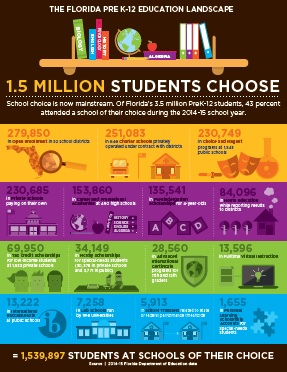
The Three Bs did not directly address the topic of scale. The mighty Florida tax credit program currently looks likely to reach the practical limits of its ability to scholarship children somewhere below 100,000 out of Florida’s 2,500,000 students. This might change if new taxes can be added to credit, but the mechanics of creating a credit against some taxes seems somewhere on the speculative to work-in-progress spectrum at present.
Thus I enthusiastically support conversion of existing tax credit programs to multiple uses, and under some state constitutions, it might be a very good idea to choose this option over a state funded model. Outside of those circumstances, I’d recommend taking your chances with a state funded model if aiming for more than a pilot project.
The Rev.Martin Luther King III, a long-time parental choice supporter, addressed a crowd of 10,000 strong at a rally in Tallahassee yesterday.
“I just find it interesting that in our country we have the gall to debate about how our most precious resource — our children — are treated,” he said.
“My dad, I don’t really know if I can actually speak to what he would speak today, but I can say is that he would always stand up for justice,” he added. “This is about justice.”
Meanwhile the VP of the Florida Education Association, who once referred to children with disabilities and low-income children benefiting from Florida choice programs as “hit dogs” had this to say:
“What are they so afraid of going to the courts to ensure this voucher scheme is legal?” Joanne McCall, the union’s president, asked. “Let’s let the courts decide this once and for all. We’re not dropping our legal challenge.”
Let me get out my Big Chief Tablet and crayons and draw a picture for McCall here really slowly and with bright colors so she can follow along. Why are they so afraid of a judicial assault on their program? That’s easy:
These kids and parents fear losing access to their schools because people like you won’t leave them alone to pursue their dreams.
To Rev. Martin Luther King III this is about justice and the opportunity of children. Joanne McCall says this about adult turf and adult power. If there is a moral difference between redneck governors standing at the school house doors to keep kids out of school with a baseball bat, and union bosses wanting to go into schools to kick kids out of schools with legal baseball bats, the distinction escapes me.
“This is a bill that people come up to us with tears in their eyes and talk about how it’s changed their life,” Gardiner said, calling attention to a girl with special needs who was seated in the back of the chamber.
“She said, ‘I just want to go to college,’” Gardiner said. “Your bill will provide that path, from cradle to career.”
Senate President Gardiner, the original sponsor of the Florida ESA law, follows in the footsteps of former of another special needs father and former Senate President John McKay in crafting an innovative program to serve the needs of Florida’s special needs students. Senator Gardiner is deeply deserving of the honor that the Florida legislature has bestowed upon him, just as Senator McKay was before him.
Greg btw is one signature away from 1 down, 6 to go in piling up yet another victory over Jay Mathews.


 Posted by matthewladner








 Jay P. Greene's Blog