Yo Adrienne! Context is crucial on early NVESA applications

October 30, 2015

(Guest Post by Matthew Ladner)

Early applications for the Nevada ESA program show that a majority of applicants thus far come from well to do areas, and 21% of applicants thus far qualify for the higher amount for low-income families.

Maybe Howard Fuller was right? Nope- at least not yet. Let’s keep clear of the panic button.

The program does not commence until January, and so these applicants represent the earliest of early adopters. Efforts have commenced to raise awareness of the program in low-income areas, but such efforts take time. Nevada’s private school sector has a small footprint and it should not shock anyone that most private schools are located in relatively affluent areas- which will impact interest in the program.

It’s worth noting that many suburban Nevada schools have overcrowding issues, and spots opening in suburban districts create open-enrollment transfer opportunities for non-residents. Most important of all- NVESA is not a fire it and forget it program. We will need the efforts of both philanthropists and innovators in order to increase the supply of private school space in under-served areas. Sadly the two lawsuits attacking the program will likely slow this process to the detriment of low-income families. Moreover parents have the ability to pursue education outside of private schools under NVESA, but again, we should expect this to unfold incrementally over time.

NVESA is not a magic bullet, and it will not instantly transform education, dry every tear or solve every problem. This is a marathon, not a sprint.


Nominated for the Al Copeland Humanitarian Award: Ken M

October 30, 2015

(Guest Post by Mike McShane)

The internet is awesome. From the Marine in Afghanistan who can Skype home to Alabama to help his wife tuck his kids in, to the incredible amount of free, crowd-sourced information on sites like Wikipedia, to the connective power that social media has provided, even to the point of helping taking down unjust dictatorships, it has been an incredible force for good in our world.

But the internet is also terrible. The combination of anonymity, a perceived soapbox, and the belief that there is real connection between opinion makers and mothers’ basement dwellers has surfaced an ugliness that has meted mob justice (sometimes incorrectly), harassed people, hacked into cell phones and shared private photos, and said horrible things that I’m not even going to hyperlink to.

The internet has developed a word for the people who perpetuate such ugliness, trolls.  It is evocative and accurate. Some of these trolls become well known. Others shift from user name to user name and IP address to IP address to guard their secrecy.

By and large, trolls are terrible and most websites are powerless to do anything about them. But, a recent Gizmodo post reminded me of an individual that took on trolling in the only way that might actually work, by trolling the trolls.

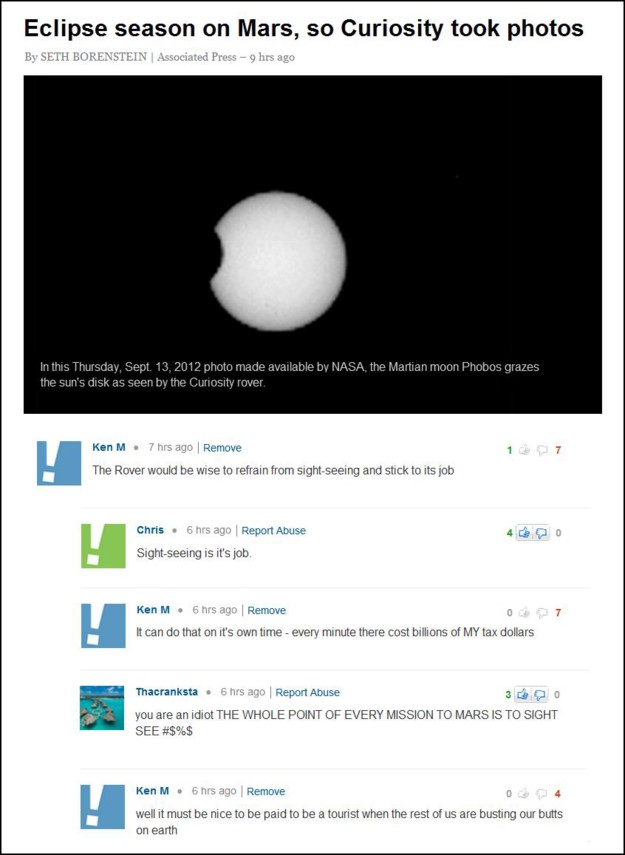
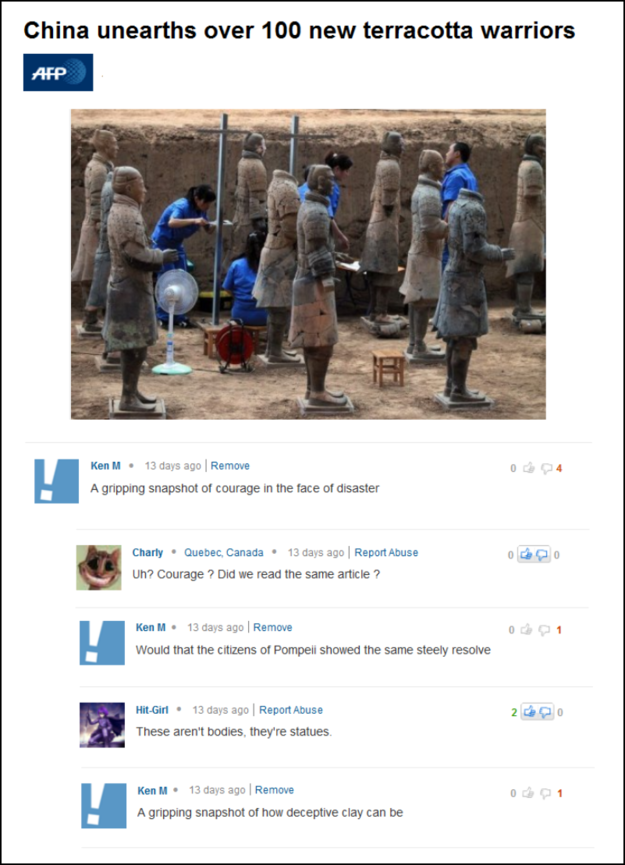
Ken M, the nom-de-plume of comedian Kenneth McCarthy, pops into comment sections with a childlike wonder and an idiocy that is so deep and true that it drives self-righteous and pedantic internet commenters nuts.  Here are a couple of examples:

mchsane2

mcshane3

mcshane4

You tell ’em Ken.

I love Ken M for three reasons. First and foremost, he makes me laugh. Like big dirty, laughs. Second, he’s not mean spirited.  Sure, he’s pulling these folks leg and we’re having a laugh at their expense, but he’s part of the joke too, and there is no nastiness in what he is doing. Finally, like all great comedy, Ken M’s shtick is rooted in something true—it is stupid to argue on the internet.  It is stupid to argue on the internet, and only by watching a stupid person argue on the internet can we fully appreciate just how stupid it is to argue on the internet.

So I’d like to nominate the pedant-baiting, Mars Rover-chastising, Pompeii-defaming, National Geographic-baking, Ken M for the Al. Hope he made you laugh as hard as he made me.


The Mystery of the Math Swoon

October 30, 2015

FL Charter 2015 NAEP 8m

(Guest Post by Matthew Ladner)

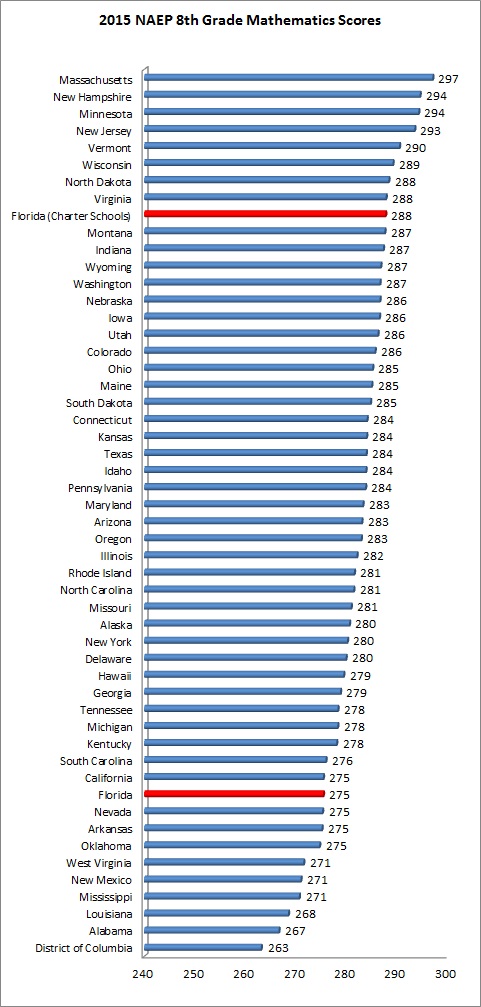
So nationally 8th grade math scores declined by three points. That’s not good but on a 500 scale point test it isn’t clear that it is anything to get too excited about, although it interrupted a long-term positive trend. Florida’s 8th grade math scores however declined by six points. That’s more worrisome.

So digging around in the data reveals that Florida charter schools were unaffected by the swoon- their 8th grade math scores were flat between 2013 and 2015- and delightfully high to boot (see chart).

The Trial Urban District Assessment has information for Miami-Dade and Hillsborough County (Tampa area). Here’s where the mystery deepens- Miami was also unaffected with flat scores between 2013 and 2015. Hillsborough however:

8 point drop in the Tampa area according to TUDA. If there is any rhyme or reason to this I can’t discern it. Some of the national meta-explanations I have seen bandied about don’t seem to work to explain trends in Florida. For instance some have pointed the finger at Obama’s state waivers. There may or may not be something to that nationally, but Florida schools all operated under the same waiver. Standards/testing transition issues likewise impacted all schools-is there some reason why Miami and charter schools should brush this off while the state as a whole did not? Something peculiar may have happened in Hillsborough but Tampa is not big enough to do a huge amount of damage to Florida’s statewide average.

I’m stumped, but always happy to employ the wisdom of the crowd. If you have bright ideas or wild speculation to offer, that’s what the Jayblog comment section was made for!


Arizona charter students ROCK NAEP 4th grade math as well

October 29, 2015

(Guest Post by Matthew Ladner)

Well just to keep anyone from saying “oh yeah- but he didn’t show us 4th grade math!”

AZ charter schools 2015 NAEP 4m

My reaction:

and


Cheeseheaded Arguments Against School Choice

October 29, 2015

Cheesehead Evers

[Guest Post by Jason Bedrick]

Enrollment in Wisconsin’s voucher program doubled for the second year in a row and members of the public education establishment are not happy.

“Private school vouchers aren’t making our kids smarter — but they are spiking our property taxes and siphoning money away from our kids’ public schools,” Mary Young, president of Support Our Schools Wauwatosa, said in a statement.

If the vouchers aren’t making kids smarter, then neither are the district schools. A longitudinal study found that they score about the same on test scores, with advantages for the voucher students in some years. The major difference is that the voucher students graduate at a higher rate and cost about 40 percent less per pupil — important facts that somehow didn’t make it into the Journal-Sentinel‘s coverage.

The Legislative Fiscal Bureau estimated this year that the [school voucher] expansion could shift $600 million to $800 million from public schools over the next decade.

State Schools Superintendent Tony Evers said at the time that the plan would hurt public school budgets and students.

“You lose two or three kids, it doesn’t mean you can lay off five teachers,” Evers said. “It will have major negative impacts.”

First, it must be the case that Evers was misquoted. There’s no way he actually believes that a school losing “two or three kids” will suffer “major negative impacts.” If two or three kids moved out or town or started homeschooling and the resulting fiscal impact was anything approaching “major,” the town should fire the principal and impeach the school board for gross incompetence.

But wait, what about that “$600 to $800 million” that will shift “from public schools over the next decade”? Isn’t that a lot of money?

Well yes… and no. Here the Journal-Sentinel reporter yet again fails to provide the crucial context: how much the state and local governments currently spend on education. According to the latest figures from the National Center for Education Statistics, the Wisconsin public school system cost more than $10.6 billion per year (about half of which is state spending). Even assuming no growth in spending, that’s more than $106 billion over the next decade. In other words, the voucher program expansion is projected to result in a reduction of about 0.56 percent to 0.75 percent of public spending on district schools. (The precise amount may vary slightly depending on the data source and growth assumptions, but we’re still talking about a fraction of one percent.)

Moreover, this calculation does not factor in the reduction in costs associated with students who leave the system. Plus, as Marty Lueken recently detailed at the Friedman Foundation blog, under the current school funding formula, “school districts that lose students to the parental choice program actually end up with more revenue for each student who remains in their schools.”

In summary, the projected fiscal impact of the voucher expansion on district schools is minuscule overall and district schools may even see an increase in their per-student funding. Of course, that’s not the impression that a context-free mention of “$600 to $800 million” gives, which is why providing that context is so essential. Readers who don’t crunch the numbers themselves aren’t just uninformed, they’re misinformed. Failure to provide that context is journalistic malpractice.


So while they were at it Arizona Charter Students Rocked the NAEP 8th grade math exam too

October 29, 2015


(Guest Post by Matthew Ladner)

AZ Charter 2015 NAEP 8m

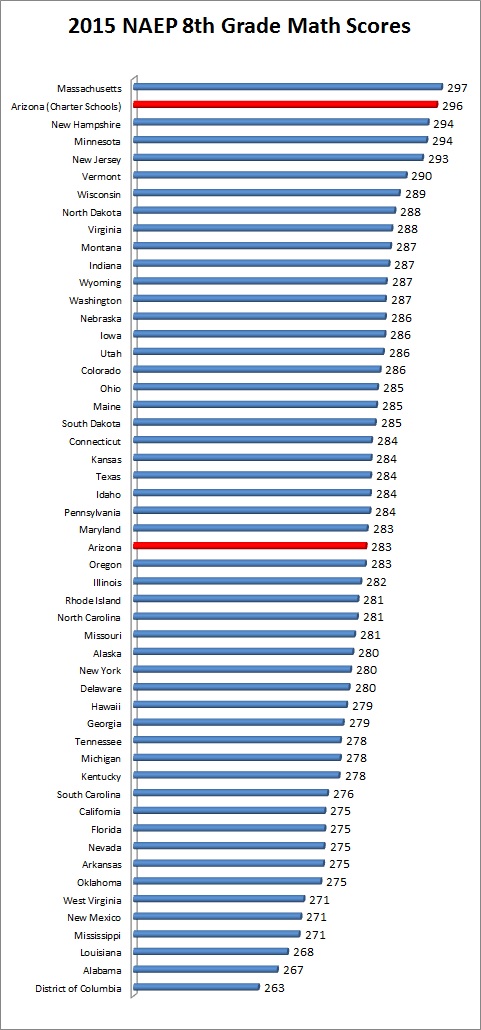
So we may be able to rule out the weird sample theory since NAEP has different random student samples for each test. On 8th grade math AZ charter school students scored in a statistical dead heat with Massachusetts. While there certainly is a self-selection factor in terms of parents applying for charter schools, I can tell you that every way I found to break the above numbers down shows a charter school advantage- charters scored better among low-income kids, and among middle/high income kids. They scored higher among Anglo kids and among Hispanic kids. Because charter school students only make up 17% of the student body, the NAEP data can only go so far in slicing and dicing data.

The point isn’t that self-selection had nothing to do with these results-they obviously did although we have a growing mountain of random assignment data from around the country that shows admission lottery winners outperform lottery losers. The most important points- first tens of thousands of Arizona parents sit on the outside looking in at charter school spots. Second- both district and charter results have improved in Arizona through a very difficult period of funding cuts for both sectors.

Congratulations to all of Arizona’s long suffering educators and leaders. We’re not there yet, but we are on our way.


Arizona Charter Schools Score Like a New England State on 2015 NAEP

October 29, 2015

(Guest Post by Matthew Ladner)

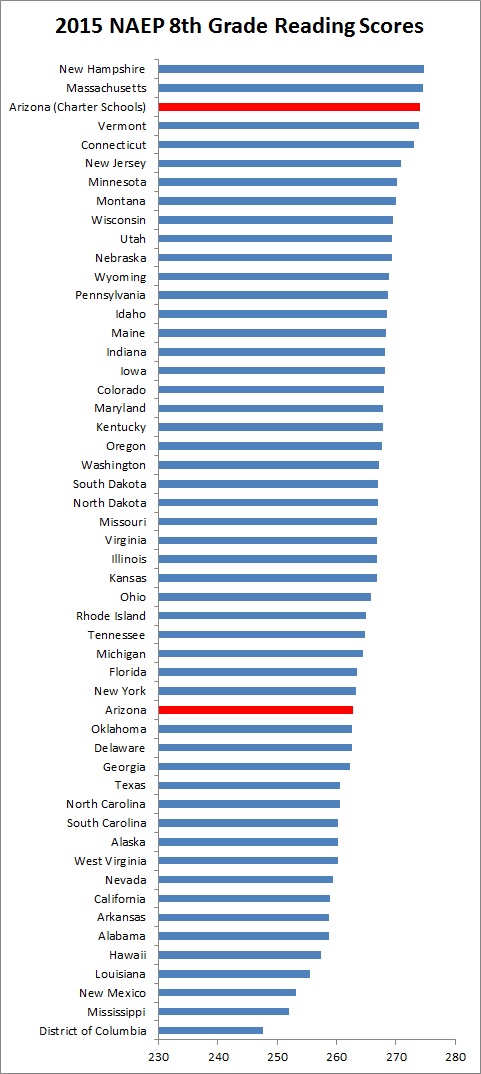
Previously I had shown that if you compare general education low-income students, that Arizona charter schools made very large academic gains on the 2015 NAEP. This morning I woke up and thought: what if we compared Arizona charter school students to other statewide averages as a whole? Arizona has the highest percentage of students attending charter schools of any state. There are more students attending Arizona charter schools than Wyoming public schools after all, so why not?

I ran the numbers for 8th grade reading. Here are the results:

AZ Charter Schools 8th grade reading NAEP

Well how about that? Now before you start babbling conspiracy theories about student demographics let me remind you of a few things. First of all, those states up at the top are all very pale complected, host Ivy League universities and have average family incomes in the six figures. Arizona meanwhile is a relatively poor state with a plurality of Hispanic students and a law which requires random assignment lotteries to charter schools. I don’t have statistics for the percentage of Hispanic students in Arizona charter schools but having visited many of them I can assure you that it will beat the living daylights out of the same figure for New Hampshire. In other words if you want to wildly speculate about student demographics you can lick the strings of Angus’ electric guitar while he has it plugged in to his portable nuclear generator necessary to burst your ear drums and make you love it.

Did I forget to mention that Massachusetts probably spends more than twice the amount per pupil when compared to Arizona charter schools? No? Ok well that too.

Well, maybe the 8th grade reading sample just happened to over-sample the highest performing charters in 2015. Could be-so let’s check the 4th grade reading numbers:

2015 4th grade reading NAEP AZ Charters

So it’s not much of a mystery to see why tens of thousands of Arizona parents sit unhappily on charter school waiting lists- the gap in scores between AZ charter schools and the AZ average is considerable. This is not to say that every Arizona charter school is fantastic (they aren’t) or that every AZ district school is low performing (this is not the case). Moreover Arizona district schools have been improving while dealing while a great deal of adversity since 2007 and in the end this is absolutely crucial. Key to that progress however is a growing little New England scoring school system out here in our delightful patch of cactus.

Arizona Governor Doug Ducey campaigned on funding the wait list- getting more resources out to district and charter schools with long wait lists to get more of them in the door and off the list. I hope the above charts indicate just what a profoundly wonderful idea that would be, so…


NAEP 4th Grade Reading Gains for low-income children, 2003-2015

October 28, 2015

NAEP Reading 2003-2015

(Guest Post by Matthew Ladner)

All states started taking NAEP in 2003. Some jurisdictions (**cough** DC **cough** Florida) scored big gains before 2003, but hey they are near the top anyway. DC is your winner, more to follow.


BOOOOM! AZ charter schools RAWK the 2015 NAEP

October 28, 2015

(Guest Post by Matthew Ladner)

Arizona did well in the 2015 NAEP- up in three of the four tests and notched our first ever above the national average score in any of the four exams. This is all good news, and the gains look more impressive if you compare them to when the economy hummed and spending per pupil was relatively high (2007) to when not so much yet (2015). Sweet are the uses of adversity if surely very difficult for educators and administrators.

I ran numbers for charter vs. non-charter and tried to get closer to apples to apples by examining the scores of general ed students who qualify for a free or reduced lunch. If your story is that the charter schools have a nefarious plot to siphon off all the rich kids from North Scottsdale (good luck btw) these are not those kids.

AZ charter NAEP 2015

Some of the really big gains on the charter side here may be explained by an unusual bad showing for charter schools in 2013-and that could relate to the vagaries of NAEP sampling. Nevertheless they are way up from the good ole days of property bubble prosperity as well as from 2013 among both districts and charters- and the most important gains are the blue ones since they still educate 83% of the kids.

So that’s what you get for you “wild west” charter sector that routinely derided by overly cautious types who have no experience with coping with rapid enrollment growth- rocking academic gains for disadvantaged kids! Arizona still has far to go but…


NAEP releases 2015 scores

October 28, 2015

2015 FRL NAEP 4R

(Guest Post by Matthew Ladner)

Let the fun begin! National aggregate results for all students are flat in 4R, down in the other four subjects. The declines are very small- one point on 4th grade math, two points on 8th grade math, down two points on 8th grade reading. On 500 point scale tests none the national results are not worth getting overly excited about- but why let that stop anyone!

The interesting stuff is also found by digging around.

It looks like Maryland must have finally put a stop their reign of terror against the NAEP inclusion standards for kids with disabilities and ELL because their scores declined substantially.

Good for them for making the move. DC looks to have overtaken a statewide average (New Mexico) after rocking the 4th grade reading NAEP with big gains again (see below). Louisiana, Mississippi and the Carolinas also demonstrated big gains on 4th grade reading.

I will take a close look at DC, but here is a preview looking only at general ed kids who are eligible for a free or reduced price lunch:

DC 4r 2015

26/21 point gains in 12 years among FRL eligible kids is very impressive. I’ll track the numbers by some alternative variables later since the definition of FRL has evolved over time. The last time I did this (by tracking kids by parental education instead of FRL status for instance) it confirmed that disadvantaged kids were making big gains in DC- so I will offer a somewhat premature congratulations.

More later…