(Guest Post by Matthew Ladner)
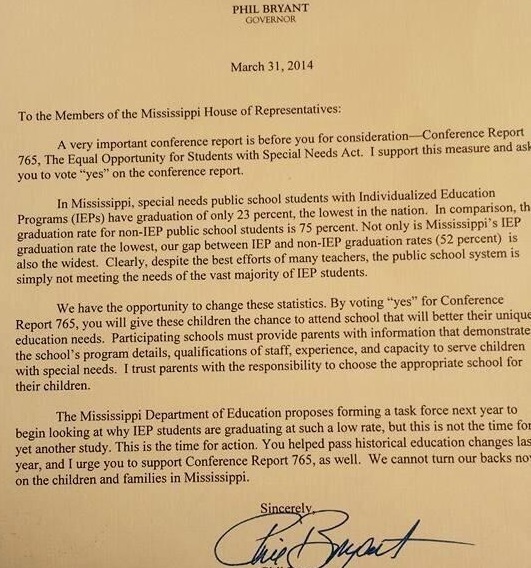
Down the stretch they come in Mississippi, and Governor Phil Bryant weighs in with a powerful case for reform. The bill will pass or die in the next two days, so stay tuned….
(Guest Post by Matthew Ladner)
Down the stretch they come in Mississippi, and Governor Phil Bryant weighs in with a powerful case for reform. The bill will pass or die in the next two days, so stay tuned….
 Leave a Comment » |
  Education Savings Accounts, special ed | Tagged: Education Savings Accounts, Governor Phil Bryant, Mississippi school choice |
  Permalink
 Posted by matthewladner

(Guest Post by Matthew Ladner)
So I tuned into the Fordham Foundation podcast yesterday, only to find that Fordham is stubbornly holding onto a misapprehension that their own research ought to have disabused them of long ago, namely that standardized testing equates to “accountability.”
This came up in a discussion of the Arizona ESA court ruling. Broad misunderstandings of the program were on display, especially regarding the term “accountability.”
Sigh. Let’s start with the basics. The dictionary defines the word accountability as:
the quality or state of being accountable; especially : an obligation or willingness to accept responsibility or to account for one’s actions.
Standardized testing is widespread in education, but “accountability” is scarce indeed. So in my state more or less every public school student takes the AIMS test, but you would struggle to find anyone who is held “accountable” for the results. Forty percent of 4th graders in Arizona scored below basic on the 2013 NAEP reading test, but good luck finding a policymaker, superintendent, teacher or parent who was held “accountable.” Strangely enough, no one accepted responsibility for this sad state of affairs, making this a very unique form of accountability one where no one is ever held responsible.
So what Mike and Michelle seem to actually be talking about is academic transparency to the public. Arizona’s ESA program is indeed lacking in any form of academic transparency to the public. There are a variety of forms this could take, some much more sensible than others, and Arizona policymakers would do well to pick one of them. If they don’t pick one of the reasonable models, one must assume that an unreasonable model will be imposed sooner or later. I’ve testified on a number of occasions at the Arizona legislature that policymakers should embrace transparency in the program. I will keep on doing it in the future.
Now let’s discuss the difference between faux and vrai accountability.
Kathy Visser, the mother of Jordan Visser, an ESA student featured in the above video, testified before the Arizona legislature regarding accountability recently. She more or less noted that for all this shallow talk of “accountability” in this particular hearing (holding the same flawed understanding of the term displayed by Fordham) that there is in fact accountability in the ESA program. Everyone who educates Jordan is directly accountable to her.
Good luck getting that level of accountability in the public school system.
I followed up with Ms. Visser in a subsequent conversation. She experienced a number of difficulties in the public school system that are sadly common for special needs families. She had an open enrollment request denied without explanation with a public school official going so far as to hang up the phone on her. She consulted a specialized attorney who helps special needs families, but found the $15,000 retainer financially out of reach. Fortunately the attorney told her about the ESA program.
Ms. Visser first tried a private school for Jordan. She related that Jordan did not have a terrible experience in the private school, but that she decided to try the customized education approach with private tutors and therapists featured in the video above. Ms. Visser agreed that with a school voucher like the McKay Scholarship Program, she would have been able to hold the public schools accountable for the services they provided Jordan. With an ESA, she can hold all providers accountable private schools, tutors, therapists, you name it.
That my friends is true accountability, you know, the kind where people actually get held responsible for their results. Not the largely phony kind of accountability where states administer dummied down academic exams with massive item exposure, dropping cut scores, and all sorts of statistical games and tricks and other problems that I have read about in Fordham reports with most states obscuring things further behind fuzzy labels whose scale almost no one understands.
The type of “accountability” that Fordham is talking about however has proven to be baloney in most states for decades now. Even in states with the most useful testing systems, like Massachusetts and Florida, you won’t find any parents wielding the type of authority exercised by Kathy Visser. It’s long past time for us to recognize the difference between genuine accountability and mere bullshit accountability.
UPDATE: In the interest of fairness please note that Mike did say he supports the ESA program in the podcast and expressed that we should let this experiment play out. My point is not to claim that the ESA program is perfect (it isn’t) but rather that our notions of what constitutes “accountability” badly need a reboot.
13 Comments | Education Savings Accounts, school accountability | Tagged: Education Savings Accounts, Fordham Foundation, Mike Petrilli | Permalink
Posted by matthewladner
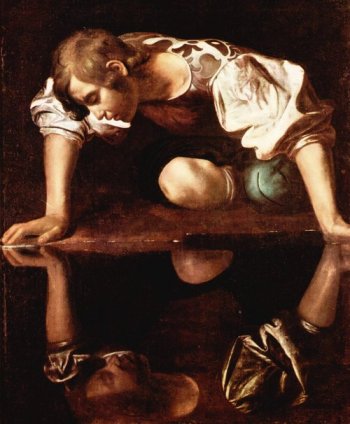
The Edu-Pundit Industry loves faux-business-like measures of their effectiveness, so here’s one for you — the Return on Tweets.
In my first “Narcissus” post about Twitter I suggested that Twitter encourages some people to talk much more than people actually want to listen. So I developed my first faux measure of the ratio of Tweets to Followers to capture that.
In my second “Narcissus” post I suggested that there is perhaps an unhealthy compulsive nature to high-frequency Tweeting. So I developed another faux measure of the number of minutes on average during people’s waking lives between each tweet. I identified “The Lost Threshold” to highlight folks who Tweet more often, on average, than once every 108 minutes of their waking lives. As with the characters in Lost who believe they must enter The Numbers into a computer every 108 minutes, it is ambiguous whether they are engaged in an incredibly important activity (like saving the world) that is worthy of this compulsive behavior or maybe suffering from a manic delusion.
In this third post I calculate how many tweets people have sent between April 2, 2013 and March 27, 2014 as well as the change in “Followers” each person has experienced during that period. Dividing the number of new tweets by the change in followers, I get the Return on Tweets. If tweeting is influencing the world, rather than just enjoying listening to oneself talk, then more people should be attracted to listen, or follow, as people talk, or tweet. People who have to issue more tweets for each new follower have a lower Return on Tweets.
I’m constrained to use the same list of people as I used in my initial post because they are the only ones for whom I have historical information on the number of tweets and followers. The list for the initial post was identified from Mike Petrilli’s ranking of the most influential education policy Tweeters. In addition, recent tweet and follower counts have sometimes become less precise when they are large numbers because Twitter has rounded that information to the closest hundred or thousand. But this is good enough for a faux measure in a dumb blog post about a dumb activity.
| Name | Handle | Tweets Since 4/2/13 | Change in Followers | Tweets / New Follower |
| Sherman Dorn | @shermandorn | 5,642 | 338 | 16.69 |
| Morgan Polikoff | @mpolikoff | 9,024 | 710 | 12.71 |
| RiShawn Biddle | @dropoutnation | 10,486 | 984 | 10.66 |
| Sara Goldrick-Rab | @saragoldrickrab | 18,784 | 2,058 | 9.13 |
| Neal McCluskey | @NealMcCluskey | 4,634 | 651 | 7.12 |
| Matt Williams | @mattawilliams | 1,125 | 176 | 6.39 |
| Marc Porter Magee | @marcportermagee | 3,968 | 677 | 5.86 |
| Deborah M. McGriff | @dmmcgriff | 3,571 | 647 | 5.52 |
| Ashley Inman | @ashleyemilia | 1,098 | 225 | 4.88 |
| Jenna Schuette Talbot | @jennastalbot | 1,935 | 437 | 4.43 |
| Laura Bornfreund | @laurabornfreund | 1,372 | 328 | 4.18 |
| Mike Klonsky | @mikeklonsky | 4,625 | 1,126 | 4.11 |
| Nancy Flanagan | @nancyflanagan | 5,746 | 1,449 | 3.97 |
| Eric Lerum | @ericlerum | 2,452 | 649 | 3.78 |
| Kathleen Porter Magee | @kportermagee | 3,327 | 881 | 3.78 |
| The Frustrated Teacher | @tfteacher | 1,958 | 527 | 3.72 |
| Matthew K. Tabor | @matthewktabor | 119 | 34 | 3.50 |
| Allie Kimmel | @allie_kimmel | 3,694 | 1,106 | 3.34 |
| Matthew Ladner | @matthewladner | 1,004 | 308 | 3.26 |
| Sam Chaltain | @samchaltain | 2,658 | 829 | 3.21 |
| David DeSchryver | @ddeschryver | 570 | 179 | 3.18 |
| Ben Boychuk | @benboychuk | 116 | 39 | 2.97 |
| Andy Smarick | @smarick | 9,160 | 3,257 | 2.81 |
| Rachel Young | @msrachelyoung | 266 | 99 | 2.69 |
| John Bailey | @john_bailey | 3,155 | 1,226 | 2.57 |
| Andrew P. Kelly | @andrewpkelly | 2,560 | 995 | 2.57 |
| Roxanna Elden | @roxannaElden | 407 | 166 | 2.45 |
| Joanne Jacobs | @joanneleejacobs | 1,160 | 477 | 2.43 |
| Gary Rubinstein | @garyrubinstein | 1,791 | 739 | 2.42 |
| Larry Ferlazzo | @larryferlazzo | 23,185 | 9,984 | 2.32 |
| Ben Wildavsky | @wildavsky | 828 | 364 | 2.27 |
| Robert Pondiscio | @rpondiscio | 1,559 | 801 | 1.95 |
| Ulrich Boser | @ulrichboser | 613 | 328 | 1.87 |
| John Nash | @jnash | 800 | 446 | 1.79 |
| Mickey Kaus | @kausmickey | 6,087 | 3,438 | 1.77 |
| Bruce Baker | @schlFinance101 | 2,314 | 1,311 | 1.77 |
| Adam Emerson | @adamjemerson | 370 | 218 | 1.70 |
| Doug Levin | @douglevin | 1,687 | 1,040 | 1.62 |
| Linda Perlstein | @lindaperlstein | 215 | 135 | 1.59 |
| Neerav Kingsland | @neeravkingsland | 1,500 | 972 | 1.54 |
| Terry Stoops | @terrystoops | 384 | 264 | 1.45 |
| Kevin P. Chavous | @kevinpchavous | 831 | 575 | 1.45 |
| Anthony Cody | @anthonycody | 5,441 | 3,836 | 1.42 |
| Patrick Riccards | @Eduflack | 3,344 | 2,429 | 1.38 |
| Randi Weingarten | @rweingarten | 18,247 | 13,329 | 1.37 |
| Heather Higgins | @TheHRH | 482 | 355 | 1.36 |
| Lindsey Burke | @lindseymburke | 441 | 327 | 1.35 |
| Alexander Russo | @alexanderrusso | 6,246 | 4,635 | 1.35 |
| Michael Petrilli | @michaelpetrilli | 6,333 | 5,204 | 1.22 |
| Justin Cohen | @juscohen | 611 | 506 | 1.21 |
| Irvin Scott | @iscott4 | 947 | 821 | 1.15 |
| Mike McShane | @MQ_McShane | 605 | 562 | 1.08 |
| Matt Chingos | @chingos | 772 | 734 | 1.05 |
| Howard Fuller | @howardlfuller | 1,721 | 1,697 | 1.01 |
| Charles Barone | @charlesbarone | 675 | 781 | 0.86 |
| Kevin Carey | @kevincarey1 | 1,275 | 1,660 | 0.77 |
| Jeanne Allen | @jeanneallen | 672 | 945 | 0.71 |
| Andrew Rotherham | @arotherham | 2,546 | 3,975 | 0.64 |
| Richard Lee Colvin | @R_Colvin | 231 | 361 | 0.64 |
| Greg Richmond | @GregRichmond | 200 | 332 | 0.60 |
| Dana Goldstein | @DanaGoldstein | 1,018 | 1,880 | 0.54 |
| Matt Kramer | @kramer_matt | 710 | 1,525 | 0.47 |
| Vicki Davis | @coolcatteacher | 10,491 | 23,600 | 0.44 |
| Michael Barber | @michaelbarber9 | 1,532 | 3,583 | 0.43 |
| Tom Vander Ark | @tvanderark | 3,956 | 9,495 | 0.42 |
| Jay P. Greene | @jaypgreene | 220 | 586 | 0.38 |
| Lisa Duty | @lisaduty1 | 896 | 2,585 | 0.35 |
| Diane Ravitch | @DianeRavitch | 11,102 | 32,944 | 0.34 |
| Sara Mead | @saramead | 404 | 1,851 | 0.22 |
| Wendy Kopp | @wendykopp | 725 | 6,885 | 0.11 |
| Vicki Phillips | @drvickip | 292 | 5,209 | 0.06 |
| Michelle Rhee | @m_rhee | 620 | 14,855 | 0.04 |
| Alfie Kohn | @alfiekohn | 283 | 12,011 | 0.02 |
As you can see, Alfie Kohn, Michelle Rhee, Vicki Phillips, Wendy Kopp, Sara Mead, and Diane Ravitch have a very high Return on Tweets. Kohn gets almost 50 new followers for every tweet. Diane Ravitch may tweet on a near-constant basis, but she attracts new followers even faster — almost three new followers for every one of her 11,102 tweets over the last 359 days.
On the other end of the spectrum are some folks with a very low Return on Tweets. They send many tweets for each new follower. Sherman Dorn issues almost 17 tweets for each new follower; Morgan Polikoff almost 13; RiShawn Biddle almost 11; Sara Goldrick-Rab more than 9; and Neal McClusky more than 7. I actually enjoy “following” many of these folks, but that may be an acquired taste.
It is no accident that “powerful people” with money to dispense or popular programs to trumpet show better Returns on Tweets than do scholars. Maybe Twitter just isn’t the right place for scholarly exchange. It’s fine for telling a joke, sharing a link, or following breaking news, but as a place for serious policy discussion Twitter seems to have a very low return on investment.
11 Comments | Uncategorized | Permalink
Posted by Jay P. Greene
(Guest Post by Matthew Ladner)
In Mediocre May Be Closer than it Appears, Jonathan Butcher cross listed the Arizona Board of Regents Report showing massive, widespread failure of the Arizona High School Class of 2006 to graduate from college by 2012 with the state’s A-F grading system. He found that 75 percent of graduates of A rated schools did not complete a BA in six years.
Outside of a few islands of excellence, how close is mediocre in AZ? Try 2:40 through 2:45 close:
Note for the record that there have been conversations about raising the standards of the grading system, but right at the moment we have no idea even what test the public schools will be using for accountability purposes next year. The AIMS statue is long overdue for demolition so that the townsfolk can beat it with their shoes, but we sadly have a few things to sort out before making adjustments to the grading system.
Meanwhile, T-Rex will continue to feed on T-Gen employees, blood sucking lawyers and unfortunate kids who are not getting the education they need to succeed in life.
The school choice tribe has been getting a great deal of grief in Arizona, as if we were the cause of the funding declines here in our pleasant patch of cactus. Despite rumors to the contrary, we did not induce the housing crash to go on a rampage to gleefully cut public school budgets. Charter schools for instance have never received as much total funding per pupil as the district schools and they have had to suffer along with the districts. Say what you will about Arizona conservatives in the legislature, but it is a simple mathematical fact that last year’s Medicaid expansion will do more to constrain growth in K-12 district spending once the temporary federal bonus money runs out than the ESA program ever will.
It’s also worth noting that public school groups went to the ballot with an initiative that would have prevented cuts. The accounts I have heard of the enterprise had prominent business leaders abandoning the effort in disgust during the formative stage. Various interests, most notably the road construction guys, log-rolled their way into the package and well-meaning but inexperienced people played prominent roles in the campaign. It wasn’t exactly a shock when the voters soundly rejected the measure. A lack of confidence that the money would make it into the classroom seemed decisive.
I can see why people might suspect that school choice sleeper agents infiltrated this effort in order to sabotage it from the inside, but I can assure you that this did not in fact happen.
Meanwhile, second by second by minute by minute Arizona continues to get older, our dependency ratio gets larger, and our prospects for growth dimmer.
A grand bargain might look something like this: a revamp of the state’s tax system to ditch the income tax and replace it with consumption taxes. This would address the fact that two large groups- Snowbirds and undocumented immigrants-have ways of avoiding income taxation but still consume state services. You could hope to get this to be pro-growth and thus pro-revenue. If anyone in Arizona thinks they don’t need a top-notch tax system to compete, look over there, I saw Texas holding hands with your girlfriend. She was gazing admiringly into his eyes with a blissful expression on her face while gently brushing his cowboy hat.
The second part of the grand bargain would be to tie increased funding to quantifiable improvement. Florida’s program to provide a $700 bonus to schools and teachers that get a child to pass an Advanced Placement exam for instance seems like a great idea for a state in which only 19% of the Class of 2006 earned a BA degree. I think many Arizonans would be willing to invest more in public education. I am potentially one of them, and I am potentially willing to pay higher taxes to do it, but many of us are not willing to simply pay more for the same bad results. Some pilot programs that show improvement associated with increased funding could be the only realistic place to start. At the moment, many don’t want to put more water into what they regard as a leaking bucket.
Finally there are some fundamental questions that the public school groups need to confront. Such as: why can charter schools receiving $1600 less per student often crush the results of nearby district schools with more money and similar student demographics? Two main reasons: charter school kids are all there by choice and have bought in to the culture of the school. Second these schools efficiently remove ineffective instructors from the classroom in a way that most district schools do not.
The hour is later than most realize and we do need to embrace improvement strategies beyond expanding choice. Everything should be on the table and we need to get serious.
Leave a Comment » | charter schools | Tagged: Arizona K-12, charter schools, incentive funding, Jonathan Butcher | Permalink
Posted by matthewladner

Dude. You should check out Pat Wolf’s review of Chris and Sarah Lubienki’s new book claiming that public schools academically outperform private schools. Despite decades of research, including rigorous experiments showing the opposite, the Lubienksis discover a public school advantage by 1) restricting their analysis to standardized math scores (reading, graduation rates, college attendance, incomes, etc…don’t fit their story so they ignore those measures), 2) controlling for participation in government programs, like free lunch and special ed, which are not comparable across public and private schools because privates participate and identify students for those programs at much lower rates, even when dealing with the same exact students, 3) arbitrarily excluding from their longitudinal analysis students who switch sectors.
The net effect of these three methodological choices, plus the fact that standardized math results are more closely aligned with how the subject is taught in public than private schools, strongly skew the results in favor of public schools. The beauty of randomized experiments is that their results are not so easily manipulated by bizarre choices of what is controlled. But the Lubienski’s don’t like randomized experiments. Advocates for quack medicine also tend not to like randomized experiments. They don’t let you selectively control for things until you get the answer you want.
Dude, let’s go bowling.
5 Comments | Uncategorized | Permalink
Posted by Jay P. Greene

(Guest Post by Matthew Ladner)
So how do private school students do in Science compared to public school students. I wasn’t sure, so I went to the NAEP data explorer to find out.
Private school students outscore public school students, but private school students tend to be more affluent than public school students, and there can be differences in special need and language profiles. Fortunately the NAEP data explorer allows you to take such factors into account. To maximize the comparison, we will only look at the NAEP science scores of children eligible for a Free or Reduced priced lunch under federal guidelines, and who have neither a special education nor an English Language Learner designation. This is about as close to apples to apples comparison you can hope for in NAEP data.
So NAEP changed the framework of their Science exam in 2009, making the 2009 and later exams incomparable to those given before 2009. The comparison of general education poor children between public and private schools is sporadically available in both NAEP science frameworks. You can’t compare old NAEP science to new NAEP science, but you can compare public and private school scores within each year. So let’s start with 4th grade:

Private school generic poor children outscored their peers in the public schools 2 out of 3 tries. Let’s look at 8th grade scores:

Private school generic poor children outscored their peers three out of four times in 8th grade. Let’s have a look at 12th grade science:

So for those of you scoring at home, in 8 possible comparisons, private school general education poor children outscored six times. It was close (within the margin of sampling error) a few times but every time the result was lopsided it was lopsided in favor of the private school children. Quite frankly science scores should be higher in both public and private schools for low-income kids, but the available evidence does show an overall private school advantage. Unless you happen to be Stephanie Simon working through a sizable case of confirmation bias, in which case this is what you saw:
Taxpayers in 14 states will bankroll nearly $1 billion this year in tuition for private schools, including hundreds of religious schools that teach Earth is less than 10,000 years old, Adam and Eve strolled the garden with dinosaurs, and much of modern biology, geology and cosmology is a web of lies.
Gosh, a billion dollars-that sounds scary! At least until you think of it as less than 80 percent of the Dallas Independent School District’s budget. Still, this is an outrage! We should put a stop to it immediately!
Except…how is it that these kids at hillbilly flat-earther private schools keep managing to score about the same or more often better than their public school peers on the NAEP Science exams? Does the NAEP science framework ask a battery of questions on the Book of Genesis? Does learning how to play Duelling Banjos wire the mind for multiple choice science exams?
Um, no. Not so much. Private schools just do a better job teaching science overall. Ms. Simon has written a hyperbolic story about a crisis that does not exist. The available evidence suggests that if we eliminated all funding for choice programs that it would result in a net decrease in knowledge of science.
If Ms. Simon wants to pull the funding for private schools based on science achievement, the river needs to flow both ways and we will have to pull the funding for an even larger number of public schools on the same basis. In the meantime, if Ms. Simon doesn’t like private schools, she always has the option of not enrolling her children in one. As an added bonus, her kids can learn science on Khan Academy if she happens to choose one of the many that do a poor job of teaching science.
11 Comments | tax-credit scholarships, vouchers | Tagged: Politico, Stephanie Simon | Permalink
Posted by matthewladner
One of my personal heroes, Kinky Friedman, appears poised to win the Democratic nomination to be the party’s candidate for Texas Agriculture Commissioner. According to today’s Wall Street Journal, Friedman knocked out the party establishment’s candidate and is facing a run-off against a little-known cattle rancher who has no plans to raise money or campaign for the office. Kinky’s prospects in the general election may be weak, but it looks like he has a good shot at the nomination. And Texas Agriculture Commissioner is no small job. The WSJ describes it as “a powerful position that oversees an agency with 700 employees and a $550 million annual budget.”
Kinky’s likely nomination warrants national news coverage for two reasons. First and foremost, he’s a very atypical political candidate. He’s primarily known as a musician, comedian, and general rascal. According to Wikipedia, his band, Kinky Friedman and The Texas Jewboys, “toured with Bob Dylan in 1975-6. His repertoire mixed social commentary (“We Reserve the Right to Refuse Service to You”) and maudlin ballads (“Western Union Wire”) with raucous humor (such as “Get Your Biscuits in the Oven and Your Buns in Bed”). His “Ride ‘Em Jewboy” was an extended tribute to the victims of the Holocaust. One of his most famous numbers is “They Ain’t Makin’ Jews Like Jesus Anymore,” a song in which Kinky verbally and physically beats up a drunken white racist who berates blacks, Jews, Greeks, and Sigma Nus in a bar.”
His political views are also eccentric. Again, according to Wikipedia: “On capital punishment, he previously summed up his position, ‘I am not anti-death penalty, but I’m damn sure anti-the-wrong-guy-getting-executed…. The system is not perfect. Until it’s perfect, let’s do away with the death penalty.'” On gay marriage: “I support gay marriage. I believe they have a right to be as miserable as the rest of us.” And: “According to Cigar Aficionado magazine, Friedman plans to roll back ‘any and all smoking bans’ if elected. One of his favorite quotes comes from Mark Twain: ‘If smoking is not allowed in heaven, I shall not go.’ Friedman supports the decriminalization of marijuana, though he doesn’t advocate making its sale legal. ‘I’m not talking about like Amsterdam,’ he noted, ‘We’ve got to clear some of the room out of the prisons so we can put the bad guys in there, like the pedophiles and the politicians.'”
But beneath Kinky’s politically incorrect music and public pronouncements is a serious agenda. Watch the video above and you’ll learn that Kinky was an early Peace Corps volunteer in Indonesia. And he’s concerned about President Obama’s lack of leadership in the Middle East and failure to connect with the “common man.” He admires Winston Churchill and Harry Truman. He’s a champion of the little guy. Sure, his ideas are not carefully crafted, but that’s the point. He’s a Jewish cowboy who pokes fun at everyone, including himself.
The second reason Kinky’s likely nomination is making news is that it’s posing problems for other Democratic candidates in Texas who had hoped to present a unified front in the coming general election. How will they handle a candidate who has used campaign slogans such as “How Hard Could It Be?” and “Why The Hell Not?”
At the very least it will be very entertaining. And if you’d like some entertainment in the meantime, enjoy this live performance from Ireland of Kinky Friedman and The Texas Jewboys performing “They Ain’t Makin’ Jews Like Jesus Anymore.” Remember, he’s joking, but he’s also making a serious attack on racism.
4 Comments | Uncategorized | Permalink
Posted by Jay P. Greene

(Guest Post by Matthew Ladner)
The Arizona Supreme Court has refused to hear the appeal of the Empowerment Scholarship Accounts program, allowing an outstanding Appellate Court decision to stand as binding precedent.
Congratulations to the crack legal eagles at the Goldwater Institute and the Institute for Justice and the State of Arizona for winning the case. It has been a great blessing to work with so many dedicated lawmakers, colleagues, parents and donors in Arizona and across the country that helped to bring this program to life.
To Senator Blaine, the Know Nothings, the KKK and anyone else involved in writing bigoted anti-Catholic language into the Arizona Constitution eat your hearts out. This is a small but crucial victory in a larger struggle against your disgusting legacy.
Most of all congratulations to the participating parents. Their stories can bring even the stoic to tears. The program upon which your family depends is safe from court assault now. Thank you for your unyielding support!
4 Comments | Education Savings Accounts, Uncategorized | Tagged: Arizona Empowerment Savings Accounts, Arizona ESA, Arizona ESA litigation, ESA lawsuit, school choice litigation | Permalink
Posted by matthewladner

(Guest Post by Matthew Ladner)
Voters give de Blasio low marks on his handling of public education. The Mayor’s decision to spend his honeymoon period crushing high performing charter schools for low-income children for no apparent reason is looking worse all the time.
Leave a Comment » | charter schools | Tagged: Andrew Cuomo, Bill de Blasio, NYC charter co-locations, NYC charter schools | Permalink
Posted by matthewladner

“This is my apprentice, Darth de Blasio. He will help you harass poor children in charter schools.” “Yes Lord Weingarten!”
(Guest Post by Matthew Ladner)
Marcus Winters on the Phantom Menace of charter school co-locations in NYC. Punchline: if charter school locations are as awful as Mayor de Blasio claims, it is odd that you can find no trace of it in student test scores.
Leave a Comment » | charter schools | Tagged: Bill de Blasio, Marcus Winters, New York City charter schools. charter school co-locations | Permalink
Posted by matthewladner
You are currently browsing the Jay P. Greene's Blog blog archives for March, 2014.

 Jay P. Greene's Blog