A Good Media Week

March 29, 2013

This week the work of two of my colleagues in the Department of Education Reform was mentioned in national newspapers.  Patrick Wolf’s research finding that the Milwaukee voucher program increased high school graduation rates from 75% to 94% was mentioned in the Wall Street Journal.  And Bob Maranto’s work on the decline in New York City’s murder rate as a result of more effective policing was mentioned in David Brooks’ column in the New York Times.

Way to go!


ESAs in the NYT

March 28, 2013

(Guest Post by Matthew Ladner)

The New York Times has a story on the progress of the school choice movement. Money quote on Arizona’s Empowerment Scholarship Account program:

The Arizona Legislature last May expanded the eligibility criteria for education savings accounts, which are private bank accounts into which the state deposits public money for certain students to use for private school tuition, books, tutoring and other educational services.       

Open only to special-needs students at first, the program has been expanded to include children in failing schools, those whose parents are in active military duty and those who are being adopted. One in five public school students — roughly 220,000 children — will be eligible in the coming school year.       

Some parents of modest means are surprised to discover that the education savings accounts put private school within reach. When Nydia Salazar first dreamed of attending St. Mary’s Catholic High School in Phoenix, for example, her mother, Maria Salazar, a medical receptionist, figured there was no way she could afford it. The family had always struggled financially, and Nydia, 14, had always attended public school.       

But then Ms. Salazar, 37, a single mother who holds two side jobs to make ends meet, heard of a scholarship fund that would allow her to use public dollars to pay the tuition.       

She is now trying to coax other parents into signing up for similar scholarships. “When I tell them about private school, they say I’m crazy,” she said. “They think that’s only for rich people.”

BOOOOOOOOOOOOOOOOOOOOOOOOOOOM


Louis Michael Seidman for William Higinbotham Inhumanitarian

March 26, 2013

My nominee for the William Higinbotham Inhumanitarian Award is Georgetown University law professor, Louis Michael Seidman.  Seidman wrote an op-ed in the New York Times during the midst of the budget and tax battle between the president and Congress in December suggesting that we should no longer think we have an obligation to adhere to the requirements and procedures of the U.S. Constitution.  As Seidman puts it:

Our obsession with the Constitution has saddled us with a dysfunctional political system, kept us from debating the merits of divisive issues and inflamed our public discourse. Instead of arguing about what is to be done, we argue about what James Madison might have wanted done 225 years ago.

Seidman thinks that political leaders should just do what is “best,” not worry themselves with the legal niceties of an archaic document:

Imagine that after careful study a government official — say, the president or one of the party leaders in Congress — reaches a considered judgment that a particular course of action is best for the country. Suddenly, someone bursts into the room with new information: a group of white propertied men who have been dead for two centuries, knew nothing of our present situation, acted illegally under existing law and thought it was fine to own slaves might have disagreed with this course of action. Is it even remotely rational that the official should change his or her mind because of this divination?

Remember this wasn’t a classroom exercise with a group of law students meant to provoke critical discussion.  This was an essay in the house organ of the Democratic Party in the midst of a struggle over budget and tax issues.  The clear implication is that if the president doesn’t get from Congress what he thinks is best for the country, he should ignore them and just do the “right thing” anyway.  I’m not the only one who read the piece this way; here is Paul Peterson’s take:

If a call for constitutional disobedience is openly advocated in the nation’s leading liberal newspaper, one must assume similar arguments, phrased more carefully, are being elaborated by skilled attorneys inside the White House.

Peterson continues, suggesting that the Seidman op-ed was carried by the NYT as  intellectual justification for an executive branch power-grab of enormous proportions:

As the administration begins its second term, it is expressing extreme frustration at the constitutional powers held by the House of Representatives. To counter, the administration is threatening to catapult presidential power to levels attained only by such Machiavellian politicians as Otto von Bismarck, who consolidated executive power vis-a-vis the German parliament and local fiefdoms in the late 19th century.

Peterson lists the president’s threat to ignore the debt ceiling, the Senate use of a simple majority vote to curtail the super-majority barriers to passing legislation particularly threatening to minority interests, the expansive use of regulatory powers to make what are effectively new laws without congressional authorization (with examples from environmental issues, No Child Left Behind, and healthcare), and effectively changing immigration law by publicly announcing that the executive branch will not enforce large portions of the existing law.  Whatever you may think about the merits of each of these issues, this pattern of executive actions represents a remarkable centralization of power and subversion of Constitutional checks and balances.  Peterson warns that the long-term implications are ominous:

Clearly, the president has shown a willingness to interpret his constitutional authority and the laws of the land about as freely as Bismarck did 150 years ago. The German chancellor got away with his power grab for many years, though by so doing he laid the groundwork for 20th century political disasters.

To be fair, it is not just the current president who has been using extra-legal and un-Constitutional means of accumulating more power.  The imperial presidency has been a one-way ratchet of increasing executive power for decades.  But the rate of centralizing power in the president has accelerated in the last two administrations.  Yes, our country faces challenges, like terrorism and financial difficulties, but are these challenges really greater than the Cold War, civil rights, the Great Depression, industrialization, etc…?

Even in the face of great challenges we need our Constitutional system of separation of powers, federalism, and the attending decentralized nature of checks and balances precisely because there are legitimate disagreements about how best to meet those challenges.  Presidents shouldn’t just do the “right thing” regardless of Constitutional procedures, as Seidman suggests, because it isn’t really obvious what the right thing is.  We have to follow Constitutional procedures because they ensure that competing visions of solutions can be heard and compromises achieved.  This often results in improvements in the quality of government solutions as well as protection for minority interests.  And if you think that compromises achieved under Constitutional procedures are lower quality than solutions derived from the best judgment of a central authority, I suggest that you consider North Korea, Syria, Soviet Union, Egypt, etc…

Eventually there will come a day when someone the New York Times hates will be president and perhaps control majorities in both chambers of Congress.  When that day comes, don’t you think it would be wise for them to have preserved the non-majoritarian procedures of our Constitution and political tradition?  I distinctly remember them feeling that way when Bush was president.

What is the origin of this recklessness of wishing to prevail in a current political conflict by destroying the Constitutional procedures that protected us in the past and could again in the future?  Why does the New York Times find a receptive audience to arguments about just doing the “right thing” at the expense of the Constitution?  I suspect, but cannot prove, that it has something to do with the changing nature of social studies in our schools.  Social studies used to consist primarily of civics, with a focus on understanding and appreciating our system of separation of powers, federalism, and the virtue of checks and balances.  That version of social studies has been eclipsed by one focused on social justice.  Students are learning about the importance of doing the “right thing” perhaps “by any means necessary.”  So, it should come as no surprise that there would be a receptive audience to claims that getting the “right” marginal tax rate trumps Constitutional procedures.  That’s how little a growing cadre of elites now think of civics.

There is a name for central authorities doing what they think is best regardless of the law and governmental procedures.  It is fascism.  For contributing to the intellectual defense of this neo-fascism, Louis Michael Seidman is worthy of the William Higinbotham Inhumanitarian Award.  As the criteria for the award require, he displays the arrogant delusion of trying to shape the world to meet his own will.  Let’s hope he really is delusional and we do not see a triumph of his will.


Why Common Core Doesn’t Matter (and Why It Does)

March 25, 2013

I tried taking a break on the blog from writing about Common Core, but the issue keeps popping up.  I tried avoiding writing about Common Core because in most ways it just doesn’t matter.  Let me try to describe why I think this annoying but persistent issue doesn’t matter (and after that I’ll suggest why it still does matter ):

1) Common Core doesn’t matter because standards mostly don’t matter.  Tom Loveless of the Brookings Institution illustrated this point simply and convincingly in the 2012 Brown Center Report on American Education.  Loveless examines variation in the alleged quality of existing state standards to see if higher quality standards are related to academic performance on the NAEP.  They aren’t.  In fact, the correlation between the Fordham Institute’s rating of state standards and NAEP performance is -.06.  Somehow that fact never seems to come up when Fordham is invoked in defense of the quality of Common Core.  Loveless also demonstrates that there is no relationship between “performance standards” (the rigor of cut scores on state tests) and NAEP performance.  Loveless concludes:

Don’t let the ferocity of the oncoming debate fool you. The empirical evidence suggests that the Common Core will have little effect on American students’ achievement. The nation will have to look elsewhere for ways to improve its schools.

Standards mostly don’t matter because they are just a bunch of vague words in a document.  What teachers actually do when they close their classroom door is in no way controlled by those words.  Changing the words in a standards document is very unlikely to dramatically change what teachers do.  As Loveless puts it:

Education leaders often talk about standards as if they are a system of weights and measures—the word “benchmarks” is used promiscuously as a synonym for standards. But the term is misleading by inferring that there is a real, known standard of measurement. Standards in education are best understood as aspirational, and like a strict diet or prudent plan to save money for the future, they represent good intentions that are not often realized….

The intended curriculum is embodied by standards; it is what governments want students to learn. The differences articulated by state governments in this regard are frequently trivial. Bill Gates is right that multiplication is the same in Alabama and New York, but he would have a difficult time showing how those two states—or any other two states—treat multiplication of whole numbers in significantly different ways in their standards documents…. The implemented curriculum is what teachers teach. Whether that  differs from state to state is largely unknown; what is more telling is that it may differ dramatically from classroom to classroom in the same school. Two fourth-grade teachers in classrooms next door to each other may teach multiplication in vastly different ways and with different degrees of effectiveness. State policies rarely touch such differences.

Common Core standards, like other standards reforms, are unlikely to have much of an effect on this enormous variation in what teachers actually teach, how they teach it, and how effective they are.  That variation in actual practice is what causes variation in performance, not a bunch of vague words in a document.

2) The Common Core folks hope to address the ineffectiveness of standards by linking those standards to newly designed assessments and then attaching consequences for individual teachers to those standards-based assessments.  But the level of centralized control over teaching practice to make this work is a political impossibility.  The PLDD crowd  may have gotten almost all states to embrace Common Core standards by dangling federal money and regulatory relief in front  of them in the midst of a financial crisis since, again, those standards are just a bunch of vague words in a document.  But getting states to adopt the newly designed assessments is proving more difficult.  And attaching any meaningful consequences for individual teachers to the results of those new assessments is proving virtually impossible.

The success of Common Core depends on building a centralized machine of assessment and consequences linked to the national standards.  There is no significant political constituency supporting this effort to make sure it is adopted and sustained over time.  Teachers and their unions hate it.  Advantaged parents (the ones with political power) also hate it as they see the the schools and teachers they love lose their autonomy and become cogs in a centralized machine unresponsive to the particular needs and interests of those advantaged parents.  Other than the PLDD crowd in their alphabet soup of reform organizations, who will advocate for and sustain meaningful performance pay for teachers where performance is defined as compliance with centralized mandates?  No one.  And that’s why Common Core will be a political loser.

————————————————————————————

If Common Core is largely unimportant because it is just a bunch of vague words that can never impose the centralized political control to make those words meaningful, why is it still important?

1) Common Core is important because it is a gigantic distraction from other productive reform strategies.  It will probably take about a decade for the failure of Common Core to become obvious to its most important backers.  Until that time Common Core is consuming the lion’s-share of reform oxygen and resources.

2) Common Core is inducing reformers to ignore and even denigrate choice-based reforms because they have to deny one of the central arguments for choice — that there is a legitimate diversity of views on how and what our children should be taught that choice can help address.  If Common Core folks have any support left for choice it is to allow parents to choose the school that can best implement the centrally determined education content.  You can choose which McDonalds franchise you frequent so that they can compete to make the best Big Mac for you, but you are out of luck if you prefer pizza.

3) Common Core enthusiasts support granting dramatically more power to the federal government over education to improve the odds that their centralized machine can be built and implemented.  Even after that fails, the precedence for greater federal involvement will remain, further eroding our decentralized system of education that has long produced benefits through Tiebout choice.

4) Common Core is providing license to all sorts of crazy and contradictory local policies.  Districts are cutting literature, pushing back Algebra, increasing constructivist approaches, reducing constructivist approaches… all in the name of Common Core.  When parents and local voters complain, the schools  dodge accountability by claiming (perhaps falsely) that Common Core made them do it.  A big danger of trying to build a centralized system of controlling schools is that local education leaders will blame the central authority for whatever unpopular thing they choose to do.  It’s like the local Commissar blaming shortages on the central authority rather than his own pilfering.  It shifts the blame.

5) Common Core is bringing out the worst in many of its advocates — people who are not naturally inclined to be hypocrites, sycophants, and dissemblers, but who cannot resist becoming so because of the lure of power, money, and the need to remain relevant.  If you need examples of this, well, you probably haven’t been reading this blog.


Defeated at Wolf 359 but Texas is not completely assimilated yet

March 24, 2013

“The fight does not go well Enterprise…rendezous with fleet remnants at.. !*!Ktzzzzzzzzsszzz!*!”

(Guest Post by Matthew Ladner)

An old joke holds that you should never ask a man where he is from. If he is from Texas he will tell you, and if he is not, you don’t want to embarrass the poor feller.  Texans are famously/infamously proud of their state, and not without cause. Texans have been enjoying their national status as an economic juggernaut. Wildcatter George P. Mitchell is probably the first Texan to transform the economy of the 21st Century profoundly for the better but he won’t be the last.

Progressives will often bemoan the modest size of government in Texas and attempt to throw cold water on the state’s success by citing various statistics heavily influenced by the fact that the state is a huge destination for immigrants. And yet they continue to come on. Texas is an opportunity rather than a welfare magnet. Texas was the only state to gain 4 Congressional seats after the 2010 Census, all of which came from sclerotic regions of the country. Y’all have fun with that nanny state business and we will keep helping ourselves to your electoral votes, companies and jobs is a prevalent attitude in the Lone Star State.

Mitchell’s hometown of Houston, the global center of the oil business, is jumping but the good times extend well beyond the oil patch. Austin, once a smallish but funky university/state government town, now has condo towers dominating the skyline and far more on the way. A stroll through downtown during SXSW proved to be an eye-opening experience for this former Austinite. I’ve been gone for a decade and the city is both transformed and growing at a mind-boggling pace.  Oh sure, an old guard is still around to complain about traffic and the “lost golden age of Austin” back when they shared herbal blends with Willie at Liberty Lunch or whatever but no one seems to be listening much. The city and state is on a monstereous economic roll.

Texas however has an Achilles heel and doesn’t seem to be aware of it: K-12 education. To stretch a metaphor a bit, I would say that Texas is a horned frog boiling in water.

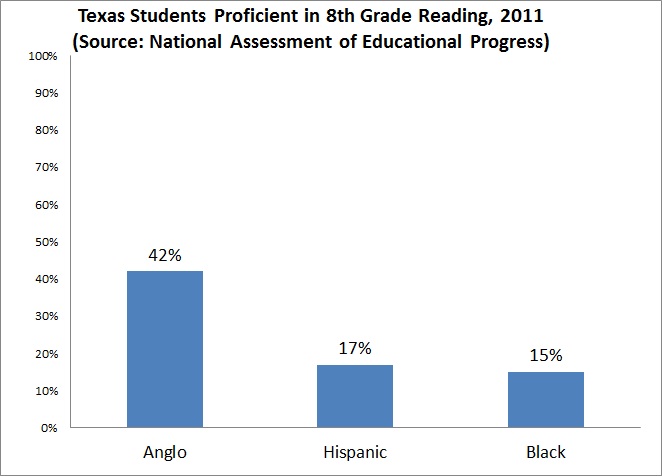
Here is the problem in two simple charts. First Texas 8th graders scoring “Proficient or Better” in 8th Grade Reading:

Texas 8th Grade NAEP ReadingSo let us take 8th Grade Reading Proficiency on NAEP as a rough proxy for solid preparation for college and/or career readiness. The NAEP proficiency standard is a high bar relative to the various state minimal skills tests floating around, but it equates well with international examinations.  The level below Proficient – “Basic” signifies “partial mastery” of grade level skills, so we are looking for full grade level mastery. So what we are looking for here is at least:

Eighth-grade students performing at the Proficient level should be able to provide relevant information and summarize main ideas and themes. They should be able to make and support inferences about a text, connect parts of a text, and analyze text features. Students performing at this level should also be able to fully substantiate judgments about content and presentation of content.

As the figure shows, not very many Texas students can actually do these sorts of things. Only a large minority of Anglo students along with a tiny minority of Hispanic and Black students show this level of reading ability.

Here is the kicker:

Texas K-12 ethnic breakdownNewsflash Tex: that 42% of Anglo kids being ready to face the rigors of the global economy doesn’t go nearly as far as it used to back in the day. Just in case I don’t have your undivided attention yet, check this out:
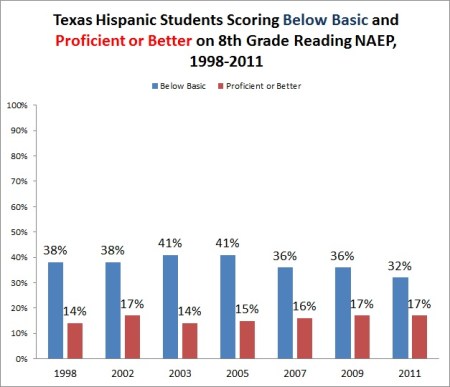
Texas HispanicAmongst Hispanics, the group that constitute a majority of K-12 students in the state, the functionally illiterate outnumber proficient readers by a very wide margin. Texas spent $11,146 per pupil in the public school system in 2010-11, which is an amazing sum when placed in context of just how much enrollment growth the state is attempting to accomodate. Texas has a public school population twice the size of Florida’s (with FL having the nation’s 4th largest btw) and approximately equal in size to the public school systems of the 20 smallest states combined.

The state has been adding around 80,000 students per year, which approximately equals the size of the Wyoming public school system. The public school lobbying groups pretend that any kind of choice program is going to leave the Texas public school system a financial ruin when in fact even the most far-reaching choice programs could at most put a dint in school district enrollment growth. If you waved a magic wand and moved every charter school that has opened west of the Mississippi River since 1990 into Texas, Texas school districts still would have gained hundreds of thousands of students.

Despite all of this, Texas Senate Education Chairman Dan Patrick, a strong supporter of parental choice, announced last week that he would be modifying a bill to eliminate the state’s charter school cap, and to instead raise it by a few dozen schools per year. Senator Patrick did this out of necesssity just to get the bill out of the committee. Worse still, this is happening in a session that seems destined to dummy down the state’s high-school graduation requirements in a major fashion. We have yet to reach the end of the movie, but this is the part where things are looking bleak for the good guys.

Don’t worry Tex…even though I control your K-12 vote I will still let you describe yourself as “conservative”…

Rather than blame the lawmakers, I’ll go ahead and blame people like myself. We reformers have done a poor job thus far in communicating the reality of the Texas situation. Consequently, there is a greatly misplaced complacency with regards to K-12 policy. We must do much better.

The greatest weakness of the powerful Status-Quo Collective that has assimilated many Austin decision makers is that they have no plausible plan for improving the Texas public education system. The problems embodied in the figures above (and others) will continue to go unaddressed while they seek yet more money for an outdated and ineffective system of schooling.

The current Texas public education system is however taking the state in a direction that almost no one will want to go. By educating only a small cadre of students to participate and prosper in the global economy, the future of the state will begin to look like that of Brazil in the late 20th Century, which one of my professors once described to me as “Belgium floating on top of India.”

As a purely economic matter, Texas can continue to import college educated workers from the less dynamic states indefinitely. As a matter of socio-economics however one cannot avoid asking fundamental questions regarding the long-term stability of both the prosperity and even democracy itself.  A public education system with only 17% of Hispanics and 15% of Black students reading proficiently constitutes a foundation of sand for the opportunity society needed to secure the future.

Time to choose…

In short, Texas can either continue to be Texas- a rapidly growing opportunity society, or it can morph into California. From my perspective in the nearby cactus-patch, California looks like a place from which Belgians are fleeing and have been for decades now-a rather loud wake up call. Ironically this leaves “progressive” California as a society increasingly divided by wealth and race. Politically incapable of addressing their education problems, California looks set to become Monaco floating on top of India. Good luck with that.

In the long run, Texans will either embrace their ideals or their education status-quo. It will become increasingly obvious that they cannot do both.


The First Thing We Do, Let’s Close All the Middle Schools

March 22, 2013

(Guest Post by Collin Hitt)

The Chicago board of education has announced that it will close 61 elementary schools at the end of the year. This is the largest number of school closures by a district in a single year in U.S. history, according to some reports. And this is just the beginning. Chicago Public Schools reports that 330 of its schools are underutilized; 129 of those schools were finalists for closure this year.

Under its current enrollment, CPS has more buildings than it needs or can afford. Making matters more complicated, enrollment in district-run schools will continue to drop. The city lost 200,000 people over the last decade , and charter schools become more popular every year with families who stay in Chicago. So for years to come, the district will continually be faced with the need to close additional schools. My advice to the district: close your middle schools, for starters.

Recent research suggests that school districts should move away from middle schools, towards the K through 8 elementary schools that were once the norm across the country. The coming consolidation of CPS facilities would allow the district to go back to this model.

Middle schools became prominent in the 1960s and 70s. There was little academic justification for creating them; most of the middle school pedagogy found today was developed after middle schools were built. There wasn’t much anxiety about comingling adolescents and younger children; that was a post hoc justification. Districts simply built middle schools to house sixth through eighth graders from elementary schools that, after the Baby Boom, were actually overfull. Recent research shows that this was a huge unforced error. Districts should have just built more K-8 schools. For students, the transition from elementary to middle schools has negative, long-term impacts.

A pioneering study of middle schools was published in 2010 by Columbia University researchers Jonah Rockoff and Benjamin Lockwood. They compared New York City students at middle schools and K-8 elementary schools. They found that middle schools had a large negative impact on students test scores. Almost all of the learning losses were suffered by disadvantaged students with lower incoming test scores.

Harvard researchers Marty West and Gino Schwerdt have used the same methods to examine Florida middle schools. They found practically identical, negative effects in urban areas like Miami. These effects persisted into high school. Again, disadvantaged students were the ones who suffered the largest learning losses in middle schools, thus widening achievement gaps that reformers usually hope to close.

Middle schools were a mistake in New York and Miami. We have every reason to think they were a mistake in Chicago, too.

In Chicago, school buildings will be shuttered, an unpleasant fact. But the New York and Florida research suggests that there’s an opportunity at hand for CPS.

Consider a typical cluster of three half-empty elementary schools, all of which feed into a half-empty middle school. It’s unaffordable to keep all four schools open indefinitely. Under the status quo, if CPS was to stick with its current grade configurations at its elementary schools, the only feasible way to consolidate schools would be to close one of the K-5 feeder schools. Students would be forced to transfer to one of the other two feeder schools. Then those same students would soon feed into the middle school, which would remain under-enrolled. Some students at consolidated elementary schools will be forced to switch schools twice in as many years, first when their elementary school was closed, next when it was time to transfer to middle school.

The middle-school research points to a different strategy. The district should stop feeding students into half-empty middle schools. Instead, it should allow kids to stay at their current elementary schools by simply adding an older grade to the school. As elementary schools add one grade per year, they’d eventually become K-8 schools — they certainly have the space to do so. Middle schools would shrink in size and staffing levels, since they’d have no more incoming classes.* Eventually, the middle schools would have no more students left, since all of their present students will graduate to high school. In a couple short years, most underused middle schools could be closed.**

Under this scheme, no student would be forced to leave her current school. The district could close a large number of underused buildings. And student performance would improve.

Closing middle schools is not a cure-all. CPS will need to close more buildings than just its middle schools So goes its budget. And the district will need to pursue more than one reform policy – look at its test scores. But it should start with a no-brainer and phase out its middle schools.

* Jonah Rockoff made an excellent point to me when he visited the University of Arkansas, where I work and study, earlier this month. There are a few under-enrolled middle schools that might be led by a better staff than the elementary schools that feed into it. In that instance, you might consider letting that middle school grow from the bottom up, starting with kindergarten. That middle school’s feeder elementary school(s) would receive no new students, eventually phasing itself out as its kids grew into the rare under-enrolled but good middle schools.

** The question then becomes, what to do with the empty buildings? That’s a matter for a future post, though here are some clues.


David Sarnoff for William Higinbotham Inhumanitarian

March 21, 2013

David Sarnoff

(Guest post by Greg Forster)

Many corporate titans have had the opportunity to ruin the lives of intrepid young inventors and entrepreneurs whose innovations would have upset the apple cart of corporate profits. Few, however, have the unusual distinction of ruining the life of a really world-class inventor whose product revolutionizes an industry. World-tranforming inventions don’t just fall off the tree every day. A greedy fat cat is amazingly lucky if fate grants him the golden opportunity to crush such an extraordinary upstart.

David Sarnoff did it twice.

If you remember that Everclear song from a while back, you know that today, AM radio is remembered as a joke. But there was a time when it was all anyone had. The days of broadcast radio may be coming to close thanks to satellite, but for a long time we were blessed to have the superior-in-every-way technology of FM.

But not long enough a time. Commercialization of FM was delayed by two or three decades, and its inventor driven to suicide, thanks to our illustrious Higgy nominee.

FM radio broadcasting technology was invented by Edwin Armstrong. In the 1910s, Armstrong figured out how to reduce interference between bandwidths. In the 1920s he invented Frequency Modulation (FM), which delivered far superior sound. FM technology is so awesome that it is still the industry standard, almost a century after it was invented. We had to go to outer space to find something better.

In 1937, using his own money, Armstrong built the first ever FM radio station. And then another, and another. By the mid-40s he had a national network of stations, the Yankee Network. Remember, he built the whole thing from scratch to nationwide rollout over more than 30 years, with his own technology, his own work, and risking his own money.

David Sarnoff, head of the Radio Corporation of America, wasn’t having any of that! RCA made its fortune from AM stations – a big enough fortune to buy influence in Washington. So Sarnoff talked the FCC into moving the FM band from 42 to 50 MHz to 88 to 108 MHz.

Armstrong’s stations were all obsolete, overnight. Ruined, he committed suicide in 1954. FM didn’t become industry standard for another 30 years.

Now, one could argue that if FM was such great stuff, why didn’t more investors back Armstrong and keep him going? The answer seems pretty obvious to me. If the FCC is in Sarnoff’s pocket, nobody’s going to invest in technology that Sarnoff doesn’t want to permit.

Seems like this would make Sarnoff eminently qualified for The Higgy. But you know what? Ruining the inventor of FM radio was small potatoes for Sarnoff. By the time he was shutting down Armstrong, he had already ruined the inventor of television.

Philo Farnsworth came up with the basic idea for television at age 14 and demonstrated it at age 21. That was in 1927. Now, if something as revolutionary as TV technology was first demonsrated in 1927, why did it take until the 1950s to spread into homes across America?

Ask David Sarnoff! When Farnsworth filed for a patent in 1926, Sarnoff saw that TV was the future and sprang into action to defend RCA’s broadcasting dominance. At first he signed up another inventor to work for RCA and claimed this other guy had invented the TV, but the Patent Office ruled in Farnsworth’s favor in 1930. So Sarnoff had to make peace with Farnsworth if he wanted to make TVs, right?

Ha ha. Sarnoff went ahead and made TVs without paying Farnsworth. Long after it was too late, the courts forced Sarnoff to pay Farnsworth a measly $1 million. Compare that to the revenue RCA made by positioning itself as a dominant TV provider. The impact of Sarnoff’s theft is even greater because the growth of the TV industry was suddenly put on hold with the advent of WWII; by the time the war was over and the floodgates were open for TV to take over the world, Farnsworth’s patent had expired.

Celebrate innovation and entrepreneurship by supporting David Sarnoff for William Higinbotham Inhumanitarian of the Year.

HT Cracked


Nominations Solicited for William Higinbotham Inhumanitarian of the Year

March 21, 2013

William Higginbotham

(Guest post by Greg Forster)

At last! The time has arrived – time for our first ever William Higinbotham Inhumanitarian of the Year Award. Send in your nominations, by email or in a blog comment!

“The Higgy” will be awarded on April 15 to the nominee who best exemplifies the criteria for the award, as laid out by Jay:

“The Higgy” will not identify the worst person in the world, just as “The Al” does not recognize the best.  Instead, “The Higgy” will highlight individuals whose arrogant delusions of shaping the world to meet their own will outweigh the positive qualities they possess.

That’s “The Al” as in the Al Copeland Humanitarian of the Year Award, which recently concluded its fifth year (including the inaugural award to Copeland himself) by honoring George P. Mitchell.

“Arrogant delusions of shaping the world” perfectly captures the spirit of our new award’s namesake. He invented the video game, which is just about the coolest thing I can imagine anyone putting on his tombstone; yet he lamented, in the words of Wikipedia, “that he would more likely be famous for his invention of a game than for his work on nuclear non-proliferation.” As I said when I first honored him by announcing that he would not be nominated for The Al:

We shall not tarnish the sterling silver of Al Copeland’s reputation by associating it with such filth. Copeland may have offended the delicate sensibilities of many with his penchant for fast cars and boats. He may have annoyed his neighbors to the point of filing lawsuits with his extraordinary Christmas decorations. He may have failed in some busienss ventures. More seriously, he may have had a turbulent family life.

But say this for Al Copeland – he never thought nuclear non-proliferation was more important than videogames.

That’s a stick in the eye to everything the Al Copeland award stands for.

And here is the final humiliation for Higinbotham – unlike Al Copeland, who was the first recipient of the Al Copeland Humanitarian of the Year Award, we are not going to give The Higgy to William Higinbotham. Paradoxically, he deserves it so much that he doesn’t deserve it.

Instead, we’re going to give it to someone nominated between now and April 15, right here on JPGB – maybe your nomination. So nominate early and often!


Constructive Criticism for Common Core Constructivism Deniers

March 21, 2013

(Guest Post by James Shuls)

Let me start by saying that I share most of Jay Greene’s reservations about the Common Core State Standards. Over the past couple of years, I have had the opportunity to discuss these concerns with many Common Core supporters. Although I typically disagree with their conclusions or their logic, I believe Common Core supporters are for the most part sincere in their belief that these standards are rigorous and will improve outcomes for students. However, I find claims that the Common Core State Standards will not influence instructional practices downright disingenuous and obviously false.

In a recent Twitter exchange, the Missouri Department of Elementary and Secondary Education informed me that the CCSS don’t “tell teachers how to teach.” This is a phrase that has been echoing across the country as the Common Core has come under attack from the left and the right.

The fact is that curriculum standards don’t tell teachers how to teach in the same way that a high jump bar doesn’t tell a jumper how to jump. You could theoretically jump over a high jump bar in whatever way you would like; but because of how the jump is structured there is a clear advantage to doing the old Fosbury Flop.

It is clear from documents on the Common Core website and from the discourse throughout the country that these new standards encourage constructivist teaching practices. Take for example these two quotes from a Key Points in Common Core Math document.

  • The standards stress not only procedural skill but also conceptual understanding, to make sure students are learning and absorbing the critical information they need to succeed at higher levels ‐ rather than the current practices by which many students learn enough to get by on the next test, but forget it shortly thereafter, only to review again the following year.
  • Having built a strong foundation K‐5, students can do hands on learning in geometry, algebra and probability and statistics. Students who have completed 7th grade and mastered the content and skills through the 7th grade will be well‐ prepared for algebra in grade 8.

Common Core developers themselves are saying that traditional methods of math instruction aren’t working and students should be learning through “hands on learning.” It is reasonable to assume the tests will likely favor constructivist teaching practices.

I have written extensively about what constructivist teaching looked like in my child’s classroom, where students were supposed to discover how to solve math problems rather than learn to use standard algorithms. My kid’s school is not the exception, it seems to be the rule. Across the country schools are beginning to understand that the Common Core standards will require a more constructivist based form of instruction.

In California, teachers will be “encouraging critical thinking over memorization, focusing on collaboration and integrating technological advances in the classroom.”  We are told that teachers “are attending workshops and training sessions to rethink the way they relay information to students.”

A Virginia newspaper reports, “Discovery, guided math, problem-based learning, project-based learning – call it what you like, it’s here.”

Even in Massachusetts, a state that had arguably better standards than the Common Core, teachers are moving more towards constructivist teaching practices. In the Wrentham School District, “the first and second grade math programs are already implementing new methods for teaching basic math skills that are designed to create deeper understanding of math among the students.” One teacher commented, “Our job as teachers is to guide through questioning.” If that doesn’t sound constructivist, then I don’t know what does.

I am aware that some non-constructivist based curricula, like Saxon Math, are aligning to the Common Core. They are doing so because they have to or they will be at a competitive disadvantage in the marketplace. It remains to be seen if these more traditional models will resist constructivist influences. Much of that depends on how the Common Core assessments are structured.

I am also aware that the standards do not dictate which pedagogical approach a teacher must take. Although, to me it feels a bit like when my mom used to say, “You can do what you want.” Which never really meant that I could do what I wanted.

The bottom line is that the Common Core State Standards are built on constructivist principles and are being implemented, by and large, by constructivist means. If supporters like constructivism, which I suspect most do, then they should just come out and say so. That is not such a difficult position to defend. But don’t attempt to tell me these standards won’t tell teachers how to teach.

———————————-

James Shuls is the education policy analyst at the Show-Me Institute


What’s in a Name? Memphis Edition

March 20, 2013

Memphis City Council member, Lee Harris, stands in front of the statue of Nathan Bedford Forrest

The names we give to public schools, parks, and buildings matter.  Names provide an opportunity for communities to identify what they hold dear and to remind themselves and teach their children about those values.  As Brian Kisida, Jonathan Butcher, and I argued in an analysis we did of trends in school names, school districts nationwide are more and more frequently missing the opportunity to use school names as a means for praising individuals who embody our cherished values.  Instead, we are now more likely to give schools vague nature names that sound more like herbal teas or day spas (Whispering Hills, Hawk’s Bluff, etc…), than people who we think could serve as models for our children.

Because names are important and because they should reflect community values, if communities change their values they also need to consider changing public names.  There is no doubt that Memphis has changed since it originally named three public parks: Confederate Park, Nathan Bedford Forrest Park, and Jefferson Davis Park.  State legislators in Tennessee, however, were considering a law that would prevent certain name changes.  According to the USA Today:

The “Tennessee Heritage Protection Act of 2013” bill, already introduced in the state legislature, would prohibit name changes to any “statue, monument, memorial, nameplate, plaque, historic flag display,school, street, bridge,building, park preserve, or reserve which has been erected for, or named or dedicated in honor of, any historical military figure,historical military event, military organization, or military unit” on public property…

To pre-empt that legislation the Memphis City Council voted 9-0 to temporarily rename these three parks as Memphis Park, Health Sciences Park, and Mississippi River Park.  They’ve also formed a commission to explore what the new names for these three parks should be.  Let’s hope they break the trend and actually identify individuals who embody values that Memphis holds dear after whom they will name the parks.  There are certainly a large number of great people associated with Memphis or who come from elsewhere who could fit the bill.