Tax-Hike-Mike Learns the Meaning of Chutzpah

April 13, 2010

There’s an old joke that illustrates what chutzpah means.  It goes like this… Chutzpah is when a man convicted of killing his parents pleads for mercy because he is an orphan.

This joke came to mind this morning when I read that Janet Huckabee, the wife of former governor, failed presidential candidate, and Fox TV personality, Mike Huckabee, has bought a home and established legal residence in Florida.  The couple will still maintain their house in Arkansas, but establishing legal residency in Florida will help the couple avoid Arkansas’ high personal income and sales taxes. 

Florida has no personal income tax, while Arkansas’ income tax quickly rises to a top marginal rate of 7%.  And state and local sales taxes hover around 10% in Arkansas, compared to 6% in Florida. 

It would be perfectly appropriate and normal for someone to change residences so as to minimize taxes if Huckabee hadn’t been personally responsible for helping raise those taxes, which he and his wife are now seeking to avoid.


Hey, Ed Schools, Leave Those Kids Alone!

April 12, 2010

(Guest Post by Matthew Ladner)

Interesting piece by Jay Schalin on an internal study by the University of North Carolina on teacher preparation. Part of the UNC study involved a comparison of the value added scores of UNC ed school grads compared to those of Teach for America teachers. Money quote:

In some cases, the Teach for America participants’ results were quite dramatic. For instance, middle school math students with Teach for America teachers tested as if they had an additional 90 days of instruction—when the entire school year is only 180 days of instruction.

Let’s just say if Ed Schools were publicly traded companies, I’d raise billions in a hedge fund to short their stock.


Sandy and Jay on National Standards

April 11, 2010

Sandra Stotsky and I have pieces in today’s Arkansas Democrat Gazette on the current national standards push.  We take slightly different approaches — Sandy thinks national standards are a good idea in general but the current draft has bad standards, while I think national standards are a bad idea altogether.  But we end up with the same policy recommendation — the current national standards push should be stopped.  I’ve reproduced both pieces below:

——————————————————————————————–

One Size Fits None

by Jay P. Greene

The Obama administration and Gates Foundation are orchestrating an effort to get every state to adopt a set of national standards for public elementary and secondary schools.

These standards describe what students should learn in each subject in each grade. Eventually these standards can be used to develop national high-stakes tests, which will shape the curriculum in every school.

National standards are a seductive but dangerous idea. People tend to support national standards because they imagine that they will be the ones deciding what everyone else should learn. Dictatorship always sounds more appealing when you fantasize that you will be the dictator.

But the reality is that we are a large, diverse and decentralized country with strong democratic traditions, making national standards-setting a futile task.

Either the standards are too prescriptive and are unable to attract the broad consensus necessary for adoption, or they are vague enough to form a national coalition but so vague that they are entirely useless.

The past two efforts at developing national standards illustrate each type of failure. During the early 1990s, under President George H.W. Bush, an attempt at writing national standards faltered when the history standards were perceived to be prescribing a left-wing agenda. The U.S. Senate actually rejected those standards 99 to 0. Then in the late nineties under President Bill Clinton the national standards push avoided attracting this type of opposition by making the standards very loose and general. The result was that they had no effect. So now we are like Sisyphus, rolling the national standards stone back up the hill yet again.

Even if we could somehow thread the needle and win national adoption of standards that were rigorous and specific, there is no reason to believe that they would stay that way. Once the automobile of national standards is built, eventually someone will gain control of the wheel and drive it in a direction you oppose. And if the entire nation is governed by those standards, there is no hopping out of the car. We’ll all drive over the cliff together.

The virtue of developing standards at the state, district and school level is that it accommodates the legitimate diversity of opinion about how children could best be educated. No one suggests that math is fundamentally different in different places, but whether, for example, all children should be taught long division in 3rd grade is not a settled question. If we adopt national standards, then we destroy the laboratory of the states that might help us learn about which approaches are more effective for which students.

The idea that all students nationwide should be learning the same thing at the same age denies the reality of how diverse our children are. Some of our children are more advanced and would be bored silly if we don’t allow them to progress at a more rapid rate. Other students need more time to master their material. Some students would benefit from a greater emphasis on the arts, while others might thrive with greater emphasis on science. To impose a single curriculum on all students is to build a system where one size fits none.

We don’t need national standards to prevent states from dumbing down their own standards. We already have a national test, the National Assessment of Educational Progress (NAEP) administered by the U.S. Department of Education, to show how states are performing on a common yardstick and to shame those that set the bar too low. Illinois, for example, isn’t fooling anyone when it says that 82% of its 8th graders are proficient in reading because according to NAEP only 30% are proficient. The beauty of NAEP is that it provides information without forcing conformity to a single, national curriculum.

Nor is it the case that adopting national standards would close the achievement gap between the U.S. and our leading economic competitors. Yes, many of the countries that best us on international tests have national standards, but so do many of the countries that lag behind us. If there really were one true way to educate all children, why stop at national standards? Why not have global standards with a global curriculum?

We would oppose global standards for the same reasons we should oppose national standards. Making education uniform at too high of a level of aggregation ignores the diversity of needs of our children as well as the diversity of opinion about how best to serve those needs. And giving people at the national or global level the power to determine what everyone should learn is dangerous because they will someday use that power to promote unproductive or even harmful ideas.

Jay P. Greene is the endowed professor of education reform at the University of Arkansas.

———————————————————————————————

All Need Same Knowledge

by Sandra Stotsky

Many Americans support the idea of common, or national, standards. They believe national K-12 standards would ensure that all students, no matter where they live and what school they attend, are taught a body of common national and world knowledge, acquire a mature understanding and use of the English language, and gain enough mathematical knowledge and skill to participate competitively in the 21st Century global economy. However, we have good reason to be skeptical about this rosy expectation. There is no evidence that national standards by themselves lead to or guarantee high levels of academic achievement. And, the Common Core initiative, a joint project of the National Governors Association and the Council of Chief State School Officers, has yet to come up with first-class standards in mathematics or English/language arts that would make this country competitive.

The U.S. is one of the very few countries in the world without national or regional standards. While some have high-achieving populations, many others do not. In other words, there is no direct relationship between high student achievement and having national standards. What does seem to make a difference in many countries with high-achieving students is the presence of high-stakes tests. Moreover,

many of these countries-Korea, the Netherlands, Japan, for example-test a lot and use multiple-choice tests-tests that entrepreneurial testing experts disdain in favor of portfolios, project-based assessments, and other costly and generally unreliable measures.

Everyone knows that the real spur for higher academic achievement will come from the development of common assessments, funded by the U.S. Department of Education. The catch here is that these assessments are supposed to be based on the standards being developed by Common Core. And a number of significant improvements need to be made, especially at the secondary level, before its mathematics and English standards can be judged as internationally benchmarked and as the basis for reliable and valid grade-level and high school exit level assessments. So, the push from the education department to compel all states to adopt (voluntarily, of course) and implement Common Core’s standards will not in itself raise academic achievement in the 40 or so states with poor or uneven quality in their K-12 standards-the major reason we have been told we need national standards.

A critique I co-authored with Stanford University mathematician R. James Milgram, “Fair to Middling: A National Standards Progress Report,” published by Pioneer Institute, spells out the major deficiencies of Common Core’s draft standards and compares them with those in our top-rated states. As our report notes, the leisurely development of basic arithmetic skills in the upper elementary and middle school grades and the failure to offer an optional pathway to prepare students for an authentic Algebra 1 course in grade 8 mean that its mathematics standards are at a significantly lower level than those in California, Massachusetts, Minnesota and Indiana (the states with the most rigorous mathematics standards) and in the highest-achieving countries.

Similarly, Common Core’s English standards are distinctly inferior to those in California, Indiana, Massachusetts and Texas, all top-rated states. The central problem with Common Core’s English standards is its organizational scheme-a set of generic, content-free, and culture-free skills that are incapable of generating coherent grade-level academic standards. Until an academically sound scheme is used, Common Core’s draft writers will not be able to generate sequences of sound standards through the grades that lead to common curricular expectations-what national standards should give us. Nor will they be able to assure the states that common assessments based on the kind of standards we see in the March draft will lead to reliable and valid assessments of student learning.

The country is well aware by now of the possibility that the U.S. Department of Education will require states to adopt Common Core’s finaldraft if they want their Title I funds in the future. It is not clear why our national standards in English and mathematics cannot be at least as good as those in states that have empirical evidence, within the state, nationally, or internationally, attesting to the effectiveness of their current standards. Why were the most rigorous sets of standards, here and abroad, ignored?

Sandra Stotsky is Professor of Education Reform at the University of Arkansas, holds the 21st Century Chair in Teacher Quality, and is a member of Common Core’s Validation Committee.


Conscience Asks the Question, ‘Is it Right?’

April 9, 2010


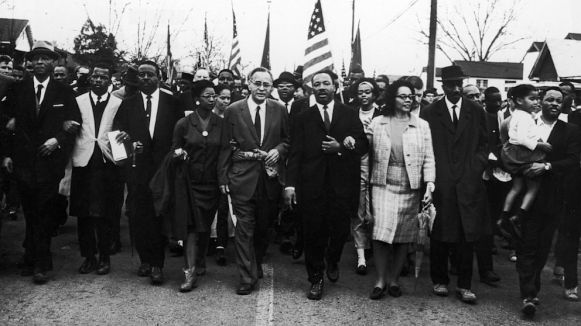
gty_martin_luther_king_nt_130823_16x9_992

(Guest Post by Matthew Ladner)

Charles Miller, former Chairman of the University of Texas Board of Regents, sent out the following email to hundreds of people on Easter Sunday, which was also the 42nd anniversary of the assassination of Rev. Martin Luther King Jr. We reprint the email here with Mr. Miller’s permission:

Early in the Obama administration I was surprised and deeply disappointed by their decision to kill the “DC Voucher” Program.  I wrote most of the piece below at that time and the decision brought me back into the public K-12 debate.  The U.S. Senate recently voted 55-42 to confirm that decision, essentially on a party line vote, so I am sending this to go on record about something I think is horrendously wrong. –Charles Miller
————————————————————————————————————————————————–
April 4, 2010

What Martin Luther King Said About Speaking Out

“Our Lives Begin to End the Day We Become Silent About Things That Matter”
(Martin Luther King)

The Obama administration, through stimulus funding, the Race to the Top program, its presentation of budgets and proposals for reauthorization of NCLB/ESEA , has moved fast and furiously in the public education policy arena.  It seems very unlikely to me that high aspirations—and hasty action— equate to effective public policy.  In fact, these efforts seem to amount quite clearly to an overreach–strategically, systemically, politically, and culturally

However, what bothers me the most personally is what I consider the most unprincipled action in public education policy since the existence of segregated schools:  The willful decision by the Obama administration, supported by the Democrats in Congress, to kill the D.C. Opportunity Scholarship Program, also called “D.C. Vouchers”

The Obama administration has tied its education policy declarations to a mantra of being non-political and non-partisan, choosing instead a policy focus only on “what works”.  This principle has been repeated incessantly.

However, the D.C. Opportunity Scholarship Program (OSP) is a successful program.

The Department of Education’s official evaluation using rigorous “gold standard” experimental evaluations determined that the OSP has produced significant achievement gains.

The OSP is serving those families and children most in need in one of the worst school districts in America.  Average income of participating families  is less than $24,000 annually and more than 85% of participating students would otherwise be attending a failing school under NCLB guidelines.

D.C. residents polled by three unaffiliated firms in ’07, ’08, and ’09 showed between 66 and 75% support for the OSP.  The D.C. superintendent and the Mayor support the program.

The decision to kill the program is contradictory to anything the administration claims to be its guiding principle.   The cost of the successful OSP is financially very small by comparison to any K-12 standard while at the same time there has been a gigantic increase in education spending nationally— to support status quo systems which are widely considered failures. Strong evidence of success, academically and financially, clearly makes the decision to kill OSP unprincipled.

The reason for killing OSP is the intense opposition of national teachers unions to a voucher program of any kind, anywhere, anytime—even if it is academically successful, financially responsible and so popular with the community served that there are long waiting lists.

If this successful program had been able to be replicated—a fear obviously driving the decision to kill OSP—the number of students from the most disadvantaged families whose life prospects could have been enhanced could be quite large.  This consideration makes the decision to kill OSP even more egregious, although even helping a small set of students is the principled thing to do.

Notably, from the Washington Post, “Duncan had the temerity to admit that OSP students ‘were safe and learning and doing well…but we can’t be satisfied with saving 1 or 2 percent of children and letting 98 or 99 percent down’.”

The effect of the decision to kill OSP on the lives of the students who could have benefited from its continuation is extremely negative.  There is no way to avoid this conclusion. If a social scientist extrapolated the trends of two sets of students, one in OSP and one in a typical DC school, the loss of life opportunities would be stark for the typical set of students.

The inescapable conclusion I reach is that killing OSP is a despicable and unconscionable decision made for political purposes and with cynical disregard for the lives of the children affected.  “Obama could have stood up for these children, who only want the same opportunities that he had and that his daughters now have.  Instead his education secretary, Arne Duncan, proffered an argument that would be funny if it weren’t so sad:  Scholarships for poor students aren’t worth supporting because not enough of them are given out” (Washington Post, 3/8/10)

This when joblessness for 16-to-24-year-old black men has reached Great Depression proportions — 34.5 % last October and estimated to having exceeded 50% by last year end.

The other conclusion I reach is that policy advocates or officials who turn their face away or avoid taking a strong stand against the decision to kill OSP because it is not pleasant or not convenient to their own activities have a hand in the ignoble results of the decision.  “In the end, we will remember not the words of our enemies, but the silence of our friends” (Martin Luther King)

So, for me personally, I can’t justify supporting such an administration or its policy makers even if some of their other policy choices are more productive, nor can I see believing anything they say or trusting anything they do.  It can no longer be acceptable to be principled just some of the time.   No Mas.

“Cowardice asks the question, ‘Is it safe?’  Expediency asks the question, ‘Is it politic?’  Vanity asks the question, ‘Is it popular?’  But conscience asks the question,  ‘Is it right?’  And there comes a time when one must take a position that is neither safe, nor politic, nor popular, but one must take it because one’s conscience tells one that it is right.”  (Martin Luther King)

Charles Miller


NJEA Local Prays for Christie’s Death

April 9, 2010

(Guest post by Greg Forster)

The Bergen County Education Association, a local chapter of the NJEA, recently circulated a memo praying for the death of Gov. Chris Christie:

Dear Lord this year you have taken away my favorite actor, Patrick Swayze, my favorite actress, Farrah Fawcett, my favorite singer, Michael Jackson, and my favorite salesman, Billy Mays. I just wanted to let you know that Chris Christie is my favorite governor.

But remember, it’s those horrible tea partiers who are vitriolic, hateful, unstable and potentially violent!

I’m not sure which is more embarrassing for the NJEA, the fact that their local is circulating memos praying for the governor’s death, or the fact that their local is headed by a person whose favorite actor is Patrick Swayze, favorite acress is Farrah Fawcett, and favorite singer is Michael Jackson.

HT Jim Geraghty


Ravitch is Wrong Week, Day #5

April 9, 2010

[Editor’s Note — This is the fifth and final installment in Stuart Buck’s critique of Diane Ravitch’s new book “The Death and Life of the Great American School System: How Testing and Choice Are Undermining Education.”  Below is a list (with hyperlinks) of all five posts for our Ravitch is Wrong Week. 

The only conclusion I can draw after reading Stuart’s critiques is that Diane Ravitch’s new book is not a serious piece of scholarship.  I do not know (and I do not care) why a normally serious education historian would write such a book.  The only thing that matters here is that much of what she has to say is wrong.  Unless and until she or someone on her behalf addresses the issues that Stuart has raised, I think we can dismiss this unserious book and the people who peddle it.]

  1. Ignoring or selectively citing scholarly literature;
  2. Misinterpreting the scholarly literature that she does cite;
  3. Caricaturing her opponents in terms of strawman arguments, rather than taking the best arguments head-on;
  4. Tendering logical fallacies; and
  5. Engaging in a double standard, such as holding a disfavored position to a high burden of proof while blithely accepting more problematic evidence that supports one’s own position (or not looking for evidence at all). ]

(Guest post by Stuart Buck)

DOUBLE STANDARDS:

The final problem endemic to Ravitch’s book is that she engages in a double standard — holding one side to a high burden of proof while putting forth positions or supposed facts that do not meet a high burden of proof (or that are completely unsubstantiated).

A typical pattern throughout Ravitch’s discussion of vouchers and charter schools is that she demands overwhelming proof of astonishing gains. For example, she sneers that vouchers did not produce “dramatic improvement for the neediest students or the public schools they left behind.” (p. 132).

But as for her own affirmative claims, Ravitch often proceeds with little or no empirical evidence, and many of her own policy prescriptions do not come with any proof of improvement, even of the undramatic sort.

For example, Ravitch claims that “most districts . . . relentlessly engage in test-prep activities.” (p. 159). Most? Relentlessly? Ravitch presents no evidence for these claims.

Ravitch claims that “regular public schools are at a huge disadvantage in competition with charter schools,” in part because “charters often get additional financial resources form their corporate sponsors.” (p. 136). Ravitch has no systematic evidence for any claim that charters are financially better off than public schools. Even in New York, which is home to many of the educational philanthropists that Ravitch seems to despise, charter spending in 2008-09 had a citywide average of $14,456 — including private giving. This compares to $16,678 for students in traditional public schools.

To be sure, these two figures aren’t directly comparable — the charter figure included all expenses for all students but without calculating the benefit of free space provided to certain charter schools, while the traditional public school figure came from a report that excluded large categories, such as special education or fringe benefits, but that did include the value of debt service to pay for facilities.

The point, in any event, is that Ravitch makes unsubstantiated and convenient claims about charter school financing without even attempting the difficult work of piecing through educational finance matters like these. Moreover, Ravitch’s claim is wrong as to the country as a whole. Charter schools nationwide receive an average of 61% of the funding given to traditional public schools, mostly because states usually refuse to let charter schools have funds for facilities.

Ravitch says on page 220, “If we are serious about narrowing and closing the achievement gap, then we will make sure that the schools attended by our neediest students have well-educated teachers, small classes, beautiful facilities, and a curriculum rich in the arts and sciences.” To be sure, having “well educated teachers” or “a curriculum rich in the arts and sciences” is common sense. But Ravitch has zero evidence that “beautiful facilities” would do anything about the achievement gap. Nor does she seem familiar with the Jepsen/Rivkin study finding that California’s initiative to lower class size ended up harming minority children (because their teachers find more job opportunities elsewhere and schools fill the gaps by hiring less qualified and more inexperienced teachers).

For another example, Ravitch says (p. 238) that “every state should establish inspection teams to evaluate the physical and educational condition of its schools.” Ravitch offers no evidence that such inspection teams make any difference whatsoever.

For another example, Ravitch says, “If we are willing to learn from top-performing nations, we should establish a substantive national curriculum that declares our intention to educate all children in the full range of liberal arts and sciences . . . .” (pp. 231-232). This sounds fine and well. But Ravitch has no evidence that pushing for a “national curriculum” would accomplish any of her putative goals, rather than being watered down and misdirected by all of the same interest groups that (a) distort the textbook adoption process (as Ravitch herself has documented) and (b) have prevented any such national curriculum from being established to date.

Another double standard lies in Ravitch’s treatment of the scholarly literature. For example, while Ravitch nitpicks to death any study with a pro-charter finding she dislikes (when she bothers to mention such studies at all), she credulously cites the Lubienskis’ study purporting to find that students in public schools do as well or better than those in private schools. (p. 140). She claims that this study “demonstrated the superiority of regular public schools.” It did no such thing: It was merely a cross-sectional snapshot of students in public and private schools, and the authors admitted that “we cannot and do not make causal claims from cross-sectional studies such as NAEP.”

Finally, Ravitch’s rosy depiction of public schools has no evidentiary support. E.g.: “The neighborhood school is the place where parents meet to share concerns about their children and the place where they learn the practice of democracy. . . . As we lose neighborhood public schools, we lose the one local institution where people congregate and mobilize to solve local problems . . . . For more than a century, they have been an essential element of our democratic institutions. We abandon them at our peril.” (pp. 220-21).

It’s hard to fathom how a historian could write such lofty rhetoric about the past century of public schools, while not even giving passing mention to the fact that during much of that century schools were officially segregated by race and steeped in anti-Catholic bigotry, and to this day are often unofficially segregated by class and race. (Ravitch seems to have forgotten all of the historical knowledge on display in this article.)

Of course, Ravitch’s words are literally correct: during the past century, public schools “have been an essential element” of society’s democratic attempt to solve the “local problem” of keeping out black people. If that’s not what Ravitch intends to endorse, then she shouldn’t write such unqualified paeans to schools of a century ago.

Moreover, what exactly does it mean to suggest that people “congregate and mobilize to solve local problems” at the school? That surely isn’t a routine function of the vast majority of public schools; when my kids were at the local public school, the only mobilization I saw was all the minivans accelerating after leaving the car line. In fact, the practice of grouping people into a single public school probably causes more “local problems” than it solves (consider the furious debates that arise over curricular issues alone — evolution, sex ed, phonics and math instruction, etc.).


Florida School Choice Rally

April 8, 2010

(Guest Post by Matthew Ladner)

Another video of the largest parental choice rally in history. A final vote on the Step Up for Students expansion is expected today:

UPDATE The Florida House has passed the tax credit expansion with a strong bipartisan majority, gaining  the support of 20 of the 43 House Democrats present, including the support of the ranking Democrat on the Education Policy Council. It also was supported by 11 of 18 Black Caucus members voting.


Wyoming Kids are Either Going to Be Brain Surgeons, or Movie Stars!

April 8, 2010

(Guest Post by Matthew Ladner)

So back in 2006, I wrote a daily email for the Goldwater Institute commenting on Wyoming’s plan to lavish money on their K-12 schools. Titled “Oil Millions Didn’t Make Jethro Smart” I focused on the following statement from Wyoming State Superintendent of Public Instruction Bill McBride:

Wyoming’s state coffers have been filled by the booming natural gas market. Last year the state had a $1.8 billion surplus. The state government has poured much of this windfall into its public K-12 education system.

Jim McBride, the state’s superintendent of public instruction, has offered some rather startling predictions saying, “We probably will have the nation’s No. 1 graduation rate, maybe college attendance rate. We probably will have the highest NAEP scores.”

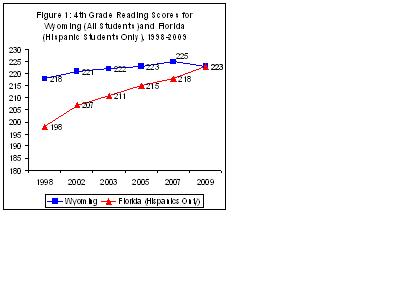
They got the spending part down, spending a cool $16,000 + per student in 2006-07. How is the academic part working out?

Well, not so great actually…So just in case you are reading this on your phone, that would be Wyoming’s statewide average as the flat blue line being all students in Wyoming, and the red line being Hispanics in Florida. Back in 2006, I wrote:

Jethro Bodine of Beverly Hillbillies fame, flush with petrodollars, often predicted he would be either a movie star or a brain surgeon. That never worked out either.

I’d be willing to bet that Mr. McBride is a patriotic American who loves Wyoming and wants what is best for the kids of his great state, so I don’t mean to ridicule him as a person. This idea that we should simply throw money at schools however is demonstrably WRONG and deserving of scorn. If we really want to help children, it means doing the tough work of improving the productivity of the resources in the system.


Ravitch is Wrong Week, Day #4

April 8, 2010

[Editor’s Note — This is the fourth installment in Stuart Buck’s critique of Diane Ravitch’s new book “The Death and Life of the Great American School System: How Testing and Choice Are Undermining Education.”  Earlier this week he documented how Ravitch ignored or selectively cited scholarly literature, misinterpreted the research she did cite, and turned her opponents arguments into strawmen.  Today he focuses on how Ravitch’s book contains a series of logical fallacies.  Below is a guide to what you can expect (with hyperlinks as they become available) for our entire Ravitch is Wrong Week.

  1. Ignoring or selectively citing scholarly literature;
  2. Misinterpreting the scholarly literature that she does cite;
  3. Caricaturing her opponents in terms of strawman arguments, rather than taking the best arguments head-on;
  4. Tendering logical fallacies; and
  5. Engaging in a double standard, such as holding a disfavored position to a high burden of proof while blithely accepting more problematic evidence that supports one’s own position (or not looking for evidence at all). ]

(Guest post by Stuart Buck)

LOGICAL FALLACIES:

Non Sequitur.

Ravitch claims that her “support for NCLB remained strong until November 30, 2006 ,” which is when she attended an AEI conference at which various conservative scholars agreed that NCLB’s choice provisions were “not working.” (p. 100-01). This is because only a small percentage of parents asked to transfer to a different public school — although, as Ravitch herself concedes, this may have been because of the schools’ own failure to let parents know that transfer was an option, the lack of nearby public schools to which to transfer, and/or the pre-existence of generous public school choice programs.

In any event, if one thinks that school choice is generally a good thing — as Ravitch did at one time — it is completely incoherent and illogical to switch to the opposite position based on what Ravitch now claims was her rationale. Based on what Ravitch learned at the 2006 conference, she could logically have concluded that NCLB’s choice provisions were being thwarted by obstreperous school officials, or that NCLB’s choice provisions were not likely to work a revolution in public education. But she could not have logically concluded that choice was actually a bad idea that was undermining education. That belief about choice had to have arisen from other motivations, not the post hoc story that Ravitch puts forth.

The Law of Non-Contradiction

The most pervasive logical fallacy in Ravitch’s book is the self-contradiction. When it comes to curricular issues, Ravitch repeatedly throws out arguments that strongly imply, if not require, support for choice, vouchers, and charter schools — things that Ravitch otherwise tries to paint in a negative light.

For example, Ravitch praises Catholic schools for providing “a better civic education than public schools because of their old-fashioned commitment to American ideals.” As well, she laments the fact that “many Catholic schools have closed,” in part because of “competition from charter schools, which are not only free to families but also subsidized by public and foundation funds.” (p. 221).

So one would think that Ravitch would continue to support voucher programs wholeheartedly, as she so eloquently did in The New Republic once upon a time. Vouchers level the playing field by offering inner city kids the choice of Catholic or other private schools along with charter schools. But Ravitch doesn’t say anything about vouchers other than to credulously report a couple of studies that failed to find test score gains for voucher students while nitpicking over the recent DC voucher study that did find test score gains. Not only does this suspicion of vouchers contradict Ravitch’s claim to support Catholic schools, it more fundamentally contradicts Ravitch’s claim everywhere else that it’s not right to judge policies or schools based on test scores alone.

Another contradiction is in Ravitch’s claim that NCLB’s goal of 100% proficiency by 2014 is a “timetable for the demolition of public education in the United States ,” because “thousands of public schools [are] at risk of being privatized, turned into charters, or closed.” (p. 104). Notably, what little evidence she discusses directly disproves her dire predictions. On page 105, she notes that in a 2007-08 study, more than 3,500 schools were “in the planning or implementation stage of restructuring,” but that “very few schools chose to convert to a charter school or private management,” instead choosing the “ambiguous ‘any-other’ (i.e., ‘do something’) clause in the law.” In other words, thousands of schools are NOT at risk of being privatized or turned into charter schools; as Ravitch’s own meager evidence shows, those thousands of schools will almost all find a way around such a fate.

Another serious contradiction arises from Ravitch’s praise for the Core Knowledge curriculum. She notes that “students who have the benefit of this kind of sequential, knowledge-rich curriculum do very well on the standardized tests that they must take. They do well on tests because they have absorbed the background knowledge to comprehend what they read.” (p. 236). She similarly contends that “ironically, test prep is not always the best preparation for taking tests. Children expand their vocabulary and improve their reading skills when they learn history, science, and literature.” (p. 108).

But this point contradicts more than one of Ravitch’s other arguments. First, if students given a broad and rich curriculum in fact do better on reading and math tests, then it makes no sense to blame accountability (as Ravitch elsewhere does) for supposedly forcing schools to limit the curriculum to just reading and math. If Ravitch is right about Core Knowledge, she should spread the wonderful news that school leaders’ best bet is to adopt a broad and rich curriculum, rather than peddling the misinformation that testing inherently leads to a narrow test-prep curriculum.

Second, Ravitch ignores the fact that charter schools are nearly TWENTY times more like to adopt Core Knowledge as a curriculum than other public schools. (True, the percentage of charter schools that adopt Core Knowledge is still fairly small, but the percentage of public schools that adopt Core Knowledge is barely discernible at all.) Indeed, Ravitch herself previously documented in detail (“The Language Police”), so many entrenched interest groups play tug-of-war over the public schools that textbooks usually end up as the lowest common denominator. Given Ravitch’s previous work here, it’s quite odd for her, of all people, to fall back on the naïve hope that traditional public school systems will suddenly start adopting Core Knowledge or any similarly rigorous curriculum.

In any event, it is incoherent for Ravitch to disdain the one type of school that is most likely to adopt the curriculum she claims to favor. And again, it is an especially bizarre flight of illogic for Ravitch to disdain charter schools based on their test scores, which she elsewhere ridicules as an unfair way to judge the merit of a school.


Vouchers and the Rising Tide

April 7, 2010

“A rising tide lifts all boats.”

(Guest post by Greg Forster)

I haven’t had a chance to read the details yet, but from the executive summary of the new results released today by the School Choice Demonstration Project, it looks like vouchers have done a good job of improving education for all students in the city of Milwaukee.

What? That’s not the way you heard it?

Of course not. Because the new result, taken in isolation from other information, simply says that after two years, the voucher students are making learning improvements about the same as public school students. The scores for the voucher students are higher, but the difference is not statistically certain.

However, let’s plug that into the larger universe of information. We know – from the very same research project – that vouchers are improving education in Milwaukee public schools. The positive incentives of competition and the improved matching of student needs to school strengths are causing public schools to deliver a better education.

So if the voucher students and the public school students are doing about the same, and vouchers are improving results for public school students, it follows that vouchers are improving results for everybody.

That, of course, is the consistent finding of a large body of research. The overwhelming research consensus is that vouchers improve public schools.

Also, let’s not forget that in several previous longitudinal studies, the results from the first one or two years were similar – the voucher students ahead, but the difference not statistically certain – and in those cases, in later years the difference always became statistically certain. It just took the accumulation of more data to reach the high bar of statistical certainty.

So here’s a toast to the great news that vouchers in Milwaukee are making everybody better off!