Pass the Popcorn: Truck Turner

June 20, 2008

(Guest Post by Matthew Ladner)

I haven’t seen any decent movies lately, so this edition of Pass the Popcorn will be opening up the treasure vault of oldies, along the lines of Flix You Should Netflix. Summer means action movies, and one of the most stunningly entertaining action films in my book: Truck Turner.

The great Isaac Hayes stars as Truck Turner, and obviously anything with Isaac Hayes in it is likely to be awesome. Before getting on the specifics of this, perhaps greatest film ever, a few notes on the genre seem appropriate.

It all started before WWII when a young army Colonel was ordered to move a military caravan from one coast to the other, to see how long it would take. Years later this same Colonel became President Eisenhower, who spearheaded the creation of the Interstate Highway system, inspired by his Oregon-trail like ordeal.

The Interstate Highway system has been great for moving goods and services rapidly across the country, but had the unintended consequence of enabling high levels of racial and economic segregation. With these new big highways in place, it became possible to work in big city X, but live in a leafy suburb. James Q. Wilson’s book Thinking about Crime discusses the profound policy consequences of this fundamental change in American life.

The so called Blaxploitation genre of film arose as white flight played itself out. The movie industry had an infrastructure of inner-city movie theaters across the country which now had a primarily African-American audience. Hollywood responded with action films aimed at African American audiences.

The content of these films are stunning in many ways by today’s standards. Filmed in the early to mid 1970s, the clothes in these films are often stunningly outrageous, like something you might see at a costume party. More broadly, these films are chock full of racial stereotypes.

The term politically incorrect doesn’t begin to describe the casual and frequent use of racial typecasts in these films. There has been much bemoaning of the rise of political correctness, but check out one of these flicks and then see what you think. Watching one of them quickly makes apparent just how much our national character has changed for the better.

I’m just old enough to remember the old Rat Pack era comedians as older men in the 1970s. It would be nothing to see a Don Rickles stand up at a Dean Martin Celebrity Roast and casually engage in ethnic humor (e.g. an Italian and a Polish guy walk into a bar…) By today’s standards, such humor is only successfully trafficked in by comedians such as Dave Chappelle, whose skits are so outrageous in part because they are so rare under current sensibilities.

In any case, Blaxploitation cinema is like a pre-political correctness time capsule, and as such very educational. Blaxploitation films usually focus on the exploits of a superhuman killing machine/babe magnet- a sort of urban James Bond fighting the villains of the inner-city instead of the Soviets or SPECTRE. Speaking of James Bond, Live and Let Die could almost be considered a Blaxploitation film, other than the pasty British super-agent.
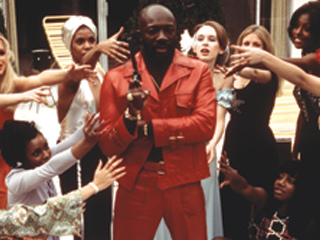
Turner, Truck Turner…

Many of the films of this genre I have seen are impossible to enjoy. Shaft is fairly dull, Superfly was unwatchable. Truck Turner however can be considered a part of an almost subgenre of Comedy Blaxploitation, similar to the Comedy Westerns like the War Wagon or North to Alaska. These films are not comedies per se, but instead contain comedic elements, and do not take themselves seriously at all; much like the knowing twinkle Roger Moore had in his eye as his Bond enjoyed one absurd physical and romantic conquest after another.

Truck Turner has a memorable supporting cast including Star Trek’s Nichelle Nichols as a vengeful madam (check out the white satin bell bottoms!), Yaphet Kotto as the villainous Harvard Blue, and Scatman Crothers as Duke, Truck’s wise old mentor who provides guidance through the “Pimp Civil War.”

Words can scarcely describe how outrageous and funny Truck Turner is, so luckily, youtube has the original Truck Turner trailer. Watch the trailer. You’ll laugh, you’ll cry, Truck will forever be a part of you.

IMDB lists a 2008 Truck Turner project as in development. Color me skeptical- you can’t improve upon perfection.


More Equal and More Excellent? Yes, We Can!

June 19, 2008

(Guest post by Greg Forster)

While I’ve been debating the merits of the DC voucher study with Matt this morning, I’ve also noticed Checker Finn and Mike Petrilli have a colunmn attacking NCLB on NRO. They cite John Gardner’s question “Can we be equal and excellent too?” and argue that NCLB sacrifices excellence for the sake of equality – neglecting education for the top students in order to raise those on the bottom.

Their evidence? Students in the lowest decile have made big gains in the NCLB era, while those at the top have flat achievement scores.

The broader question of the tradeoffs made under NCLB I’ll leave for another day, but it seems worth pointing out that Checker and Mike’s evidence doesn’t back their argument; in fact, it backs the reverse.

Pop quiz!

Question One: If the kids at the bottom are doing better while the kids at the top stay the same, is the whole population getting more equal or less equal?

Question Two: If the kids at the bottom are doing better while the kids at the top stay the same, is the whole population getting more excellent or less excellent?

I’ve always agreed with NCLB critics that universal excellence is an unreasonable goal. But if it’s unreasonable, why are Checker and Mike holding that out as the goal by which NCLB should be judged?

On the other hand, if the current system is badly dysfunctional, then by correcting its worst flaws it may be possible to increase equality while also increasing excellence. Eventually we must reach a point where the two goals will start to diverge and we have to make tradeoffs. But that doesn’t mean we’re already at that point – as Checker and Mike’s evidence suggests.

Can we increase equality while increasing excellence? Yes, we can!


What Does the Red Pill Do If I Don’t Take It?

June 19, 2008


(Guest Post by Matthew Ladner)

The hidden highlight from the Evaluation of the DC Opportunity Scholarship Program: Impacts After Two Years report is buried in the Appendix, pp. E-1 to E-2:

Applying IV analytic methods to the experimental data from the evaluation, we find a statistically significant relationship between enrollment in a private school in year 2 and the following outcomes for groups of students and parents (table E-1):

• Reading achievement for students who applied from non-SINI schools; that is, among students from non-SINI schools, those who were enrolled in private school in year 2 scored 10.73 scale score points higher (ES = .30)^2 than those who were not in private school in year 2.

• Reading achievement for students who applied with relatively higher academic performance; the difference between those who were and were not attending private schools in year 2 was 8.36 scale score points (ES = .24).

• Parents’ perceptions of danger at their child’s school, with those whose children were enrolled in private schools in year 2 reporting 1.53 fewer areas of concern (ES = -.45) than those with children in the public schools.

• Parental satisfaction with schooling, such that, for example, parents are 20 percentage points more likely to give their child’s school a grade of A or B if the child was in a private school in year 2.

• Satisfaction with school for students who applied to the OSP from a SINI school; for example, they were 23 percentage points more likely to give their current school a grade of A or B if it was a private school.

I’m trying to figure out why the impact of actually using the voucher program isn’t actually the focus of this study, and in fact is presented in an appendix. Instead all the “mixed” results are studying the impact of having been offered a scholarship whether the student actually used it or not.

I’m going to walk way out on a limb here and predict that the impact on test scores of being offered but not using a voucher will be indistinguishable from zero. If this were a medical study, we would have a group of patients in a control and experimental group offered a drug, some of them choose not to take it, but we ignore that fact and measure the impact of the drug based on the results of both those who took it and those who didn’t. Holding the pill bottle can’t be presumed to have the same impact as taking the pills.

We’ve all been told that exercise is good for our health. Should we judge the effectiveness of exercise on health outcomes by what happens to those who actually exercise, or by the results for everyone that has been told that it is good for you?

This shortcoming has been corrected in the Appendix, but that is getting very little attention. On page 24 the evaluation reads:

Children in the treatment group who never used the OSP scholarship offered to them, or who did not use the scholarship consistently, could have remained in or transferred to a public charter school or traditional DC public school, or enrolled in a non-OSP-participating private school.

So in the report’s main discussion, the kids actually attending private schools have to make gains big enough to make up for the fact that many “treatment” kids are actually back in DCPS. As it turns out, several subsets of students do make such gains, but that’s not the point. The point is we ought to be primarily concerned with whether actual utilization of the program improves education outcomes and with systemic effects of the program. We should indeed study who actually uses this program, and who chooses not to and the reasons why (very important information), but this sort of analysis seems to belong in the appendix rather than the other way around.

Receiving an offer of a school voucher doesn’t constitute much of an education intervention, and it seems painfully obvious that the discussion around this report is conflating the impact of voucher offers with that of voucher use. The impact of voucher use is clear and positive.


School Choice Wins in 2008; Unrestricted Eligibility in Georgia

June 18, 2008

(Guest post by Greg Forster)

The Washington Post is now reporting that the House Appropriations subcommittee will fund the DC voucher program for another year. People are saying that the future of the program doesn’t look good, because the subcommittee chairman is blustering about how much he doesn’t like it. But read that Post article carefully. He doesn’t say that the program will be killed next year. The Post reports that he says he’s funding the program for another year “to give District leaders a chance to restructure the program.” He is quoted as saying, “I expect that during the next year the District leaders will come forward with a firm plan for either rolling back the program or providing some alternative options.”

That sounds to me like a man who’s looking for a deal. The DC program is already loaded up with monster payoffs to the District’s patronage-bloated public school system. How hard is it to make those payoffs bigger? And maybe the program will have to accept some more politically motivated restrictions on participation, so that critics will have a trophy to hang on their wall.

Whether those tradeoffs are worth it for the school choice movement – there is a real cost, and not just in dollars, associated with them – is a question I leave for another day. And of course this is just the subcommittee; there could still be more trouble ahead. And maybe next year the critics will get a better offer from the unions than the deal they’re apparently angling to get on behalf of the DC patronage machine.

All I want to do is observe that the program’s chances of survival are now looking a lot better than they did yesterday.

As the political season winds to a close, let’s survey the results:

  • A new personal tax credit for private school tuition in Louisiana
  • A new tax-credit scholarship program in Georgia
  • A new voucher program in Louisiana
  • An expansion of Florida’s tax-credit scholarship program, including a $30 million increase in the cap; a bump up in the value of the scholarship and a linking of the scholarship value to state school spending (which always goes up); and a relaxation of the program’s unreasonably stringent accounting rules (which used to allow not one penny of carryover from year to year in the scholarship organizations’ accounts, and not one penny from eligible donations for administrative expenses).
  • A million-dollar funding increase and guaranteed future funding stream for Utah’s voucher program.
  • Preservation (tentatively) of the DC voucher program in a hostile Congress.

That’s three new programs, two expansions of existing programs and an upset victory in DC. Pretty good for a dead movement, wouldn’t you say?

By the way, how did accountability testing do this year? How many new programs? How many existing programs expanded?

How about instructional and curricular reforms? How’s the Massachussetts miracle holding up?

Anyone? . . . Anyone?

Some of these victories did come at a cost. The two programs in Louisiana are going to score poorly when measured against the gold standard of universal choice. The tax credit is limited to a very small amount of money, which means it offers a very small amount of choice. And the new voucher program is only offered to students who are in grades K-3, low-income, and enrolled in public schools (or entering kindergarten) in a chronically failing school district located in a highly populated parish – which currently means only New Orleans. Plus it’s limited by annual appropriations (currently $10 million). A new grade level will become eligible each year (4th grade next year, then 5th grade, etc.) and Baton Rouge may become eligible if its public schools continue to fail. But this is still an inadequate program. And we can also add the prospect of more restrictions in the DC program to the debit column.

But there was also a huge step forward for universal choice. Georgia’s new tax-credit scholarship program offers school choice for all students. It has no demographic restrictions at all. Any public school student can apply. The only limit is the $50 million program cap – and experience in other states pretty consistently shows that dollar caps rise as programs grow to meet them.

Georgia’s new program is basically the same as the Arizona program funded by individual donations, except that Georgia’s program also allows corproate donations. And that makes a big difference, because it greatly expands the pool of available funds – and hence the size of the program.

Come to think of it, Georgia’s program is the first tax-credit scholarship program to include corporate donations and not place demographic restrictions on who can participate. That’s a potentially powerful combination. It will be exciting to see whether Georgia ends up taking school choice to a whole new level.


The SAT and College Grades

June 18, 2008

(Guest post by Larry Bernstein)

Yesterday, the College Board released a study of the predicative power of the SAT to estimate a student’s college freshman year grade point average. A Bloomberg article condemned the results because of the relative ineffectiveness of the new SAT to predict college grades. The predictive power of the SAT is trivially improved by the addition of the new essay exam which adds test time and is costly to grade.

I think this should come as no surprise, and it shows the general limitations of using standardized tests to predict college grades. One of the key points made in the study is that high school grades are a better predictor versus the SAT. High school grades need to be included with the SAT to best estimate GPA. 

In my 1985 Wharton undergraduate statistics class, each student was required to create a regression research project. By chance, I chose to research predicting my classmate’s college GPA. I used 20 variables, including the SAT score, and I found only 5 variables with statistical significance: SAT score, number of hours studied, Jewish or Gentile, Wharton or other school such as the college of arts and sciences, and raised in the Northeast or elsewhere.

Similar to the national studies, in my survey of 100 fraternity brothers the SAT score did a mediocre job of predicting college GPA as a single variable. The key variable in my study was the number of hours studied. You would be surprised by the variance in Ivy Leaguers’ study habits. My survey asked students to estimate the number of hours as 1-10, 10-20, 20-30, or 30-40.  My favorite response was: “Is this per semester?” I assumed the student would realize it was per week! Work habits and effort played a critical role in estimating college GPA. Obviously, the college placement office will have difficulty estimating this variable, though difficulty of course load and number of AP classes might help.

The rest of the variables seem obvious. It is much more difficult to get into Wharton than the other programs at Penn. So it is no surprise that Wharton students were running circles around the non-Wharton students, even adjusting for SAT scores and hours studied. In addition, it is much more difficult to get into Penn from the NE than from other areas of the country.

Very few of the Jews were jocks. Needless to say my college fraternity had plenty of sample problems.


Congressional Subcommittee Hearing on D.C. School Choice Funding

June 17, 2008

(Guest post by Dan Lips)

Today, the House Financial Services and General Government Appropriations Subcommittee will hold a mark-up of the federal government’s budget for the District of Columbia. The panel must decide whether to include President Bush’s proposed funding for continuing the D.C. Opportunity Scholarship program.

As Greg mentioned yesterday, the Department of Education released its second year evaluation of the scholarship program.  Here’s the Department’s basic summary of what the report found:

Reading achievement improved for three large subgroups of students, comprising 88 percent of participating students. In fact, their gains put them about two to four months ahead of their peers who did not receive a scholarship. While the report found no statistically significant difference in test scores overall between students who were offered a scholarship and students who were not offered a scholarship, achievement trends are moving in the right direction. The positive effects found in this year’s report are larger than those in last year’s report, and whenever statistically significant effects were found, they favored students who were offered scholarships.

The report also found that scholarship parents were more satisfied with their children’s schools and they believed their children’s schools to be safer than their previous public school.   So, test scores for participating kids are tilting higher, and families report being happier when they have a choice.   


Of course, these generally positive results won’t be enough to convince some in Congress to support continuing the program.  What strikes me as really odd about this debate is that this program is being held to such a high-bar for proving its effectiveness.  If only Congress were this critical of all government programs.  Every year, the Bush administration tries to terminate as many as 47 federal education programs that have been judged by the federal government to: “have achieved their original purpose, duplicate other programs, are narrowly focused, or unable to demonstrate effectiveness.”  But these programs somehow find a way to live on, supporting Ronald Reagan’s quip: “the closest thing to eternal life on this earth is a government program.” 


For D.C. families, it’s clear that the Opportunity Scholarship program is one worth keeping.  Parent activist Virginia Walden Ford penned a good column for National Review Online on the real impact school choice is having for D.C. families.  For more commentary on D.C. school choice, check out William McGurn’s column for the Wall Street Journal or pieces by Kathryn Lopez and Carrie Lukas for NRO. You can also check out a column I wrote for Heritage


Stay tuned.  I’ll report back when we learn what happens in the House subcommittee mark-up. 


The DC Voucher Evaluation

June 16, 2008

(Guest post by Greg Forster)

Today the U.S. Dept. of Education released the fourth annual report on the random-assignment evaluation of the DC voucher program, including academic results for the first two years of the program’s existence. As with last year’s report, across the whole population the voucher students had higher academic outcomes than the control group, but the positive results just barely fell short of the conventional cutoff for statistical certainty. This means that while the voucher students in fact had higher test scores, we cannot be 95 percent confident that their higher scores are due to vouchers and not a statistical fluke. This year it was the reading results that came close to statistical significance, reaching 91 percent certainty. The study also finds statistically certain positive results for three subgroups, which together comprise 88 percent of the voucher population.

Since the previous year’s results were also not statistically significant, this update of the study doesn’t change the balance of the studies on school choice. As before, there are a total of ten random-assignment studies on school vouchers, all ten of which found that the voucher students had higher academic achievement, with eight studies achieving statistical certainty for the positive finding and two not.

In other words, school vouchers are still better supported by high-quality scientific evidence than any other education policy. If you reject vouchers because this study is only 91 percent sure they produce academic improvements, you have no empirical grounds for supporting any other policy, since all other policies are far less well supported by empirical evidence than vouchers.

In a few minutes you’ll be able to see the Friedman Foundation’s response to the DC study, including details and citations on all ten random-assignment studies of vouchers, here.


The Establishment Mindset

June 16, 2008

(Guest post by Jonathan Butcher)

In education policy, as with any policy area, when discussion turns to reform, there are some basic questions: what are the problems that need fixing?  Who are the interested parties—what is at stake?  Should the change come from the bottom up or from the top down?  Is it raining?  Did I leave my car’s top down?  Do I own a convertible?

Actually, those last few questions only come up if the discussion is taking place inside a government building in Washington because, as everyone knows, there is no place to park in Washington.  So if you left your top down and it starts to rain there is no way you will make it back to your car in time to put it up.  You probably had to park in a metro lot in some swanky Northern Virginia suburb where gas cost $5 before the recent spike in oil prices and there are more Lexus LX’s per capita than any place in the world.  

Change to large systems such as public education can be frightening—but it is often simply because the ideas are misunderstood.  Take a story in the Washington Post last week about charter schools in Louisiana, for example.  New Orleans is now the first city of its size where more than half of the students attend charter schools.  Certainly this is a drastic change: 

“For these new schools with taxpayer funding and independent management, old rules and habits are out. No more standard hours, seniority, union contracts, shared curriculum or common textbooks. In are a crowd of newcomers — critics call them opportunists — seeking to lift standards and achievement. They compete for space, steal each other’s top teachers and wonder how it is all going to work.”  

Hold the phone!  Replacing a system the Post said had a “dismal record and faint prospects of getting better” with new management and scrapping portions of the old system that helped drive it to such a dismal state?  And using public dollars to create this change?  This sort of reform hasn’t happened since…well maybe it was…let me get back to you.

Critics of this change offer a revealing look at the establishment mindset.  One critic charges that “Louisiana school authorities have ‘opened a flea market of entrepreneurial opportunism that is dismantling the institution of public education in New Orleans.’”  Note that this quote uses the word “entrepreneurial” and the idea of taking apart New Orleans’ public education system as though they are bad things.  Well yes, please, bring back union contracts, students sure missed them.  

These charter school operators are “opportunists” in the sense that they are taking advantage of an opportunity to open schools for children whose lives were throttled by Katrina.  One charter school was open for business six weeks after the storm hit, while a public school bureaucracy with more levels than Halo 3 was still looking for its PlayStation.  These charter schools are actually competing for talented teachers in an effort to make the best educational opportunities possible available to students―compare that to an establishment mindset that wistfully refers to the days of payscales.

There are sure to be some challenges for these new charter schools, and as with any change in public policy, the results may be less than perfect.  But students in New Orleans deserve something better than an otherwise “dismal” record.


PJM Column Today

June 16, 2008

(Guest post by Greg Forster)

Jay and I have a column on Pajamas Media this morning with our take on Response to Intervention. A sample: 

Five years ago, we published a study with disturbing implications — literally millions of students may have been labeled as “disabled” and placed into special education when they didn’t really have a disability. Since then, we’ve been struggling to get past the many myths and misconceptions surrounding special education, trying to get people to see the problem.

Now there’s finally been a change, and there’s good news and bad news. The good news is, federal special education authorities have at last acknowledged the problem and adopted a policy designed to address it. The bad news is, the policy is no good.

That’s the way it usually goes in education reform — two steps forward, one step back. And the obstacles to reform in special education are unusually large, so the steps are baby steps.

But you know what they say: the first step is admitting you have a problem. And we’re glad to see that step has been taken.

UPDATE: Whoops, forgot the link.


Jurassic Schools

June 16, 2008


(Guest Post by Matthew Ladner)

The ending sequence of Jurassic Park represents one of the great cinematic thrills of the 1990s. For those of you who couldn’t bear to watch, Drs. Grant and Sadler, et al, found themselves running for their lives inside the Jurassic Park compound, followed by a nasty group of foolishly resurrected velociraptors. The raptors had our heroes surrounded, when suddenly a Tyrannosaurus-Rex appeared to chomp one of the raptors, allowing our human protagonists to slip away. The T-Rex and surviving raptor battled it out. After disposing of the raptor, the triumphant T-Rex bellows out a roar so loud that the overhanging “When Dinosaurs Ruled the Earth” banner to dramatically flutters to the floor.

Now, for you incurable skeptics wondering how the T-Rex got into the building, how it approached with such stealth despite being large enough to shake the ground from far away earlier in the film, etc.- just stop it. It’s a popcorn movie, after all. You didn’t even realize you wanted to see T-Rex vs. velociraptors, but Steven Spielberg did and he delivered the goods.

It’s exciting to watch the future of education unfold, made all the more so by an appreciation of just how dysfunctional our schools are in the present. In 2006, a blue-ribbon panel delivered a scathing indictment of the American public education system. The panel, called the New Commission on the Skills of the American Workforce, included a bipartisan mix of the great and good, including two former secretaries of Education and an assortment of other grandees.

“If we continue on our current course, and the number of nations outpacing us in the education race continues to grow at its current rate,” the report states, “the American standard of living will steadily fall relative to those nations, rich and poor, that are doing a better job.”

The commission has come up with a variety of (IMO) ideas of varying quality, some of which sound misguided (expanding pre-school to 3 year olds) and others that sound outlandish but deserve a hearing, with still others falling into the “no-brainer” category (merit pay).

“We’ve squeezed everything we can out of a system that was designed a century ago,” Marc Tucker, vice chairman of the New Commission on the Skills of the American Workforce told the Christian Science Monitor. “We’ve not only put in lots more money and not gotten significantly better results, we’ve also tried every program we can think of and not gotten significantly better results at scale. This is the sign of a system that has reached its limits.”

“I think we’ve tried to do what we can to improve American schools within the current context,” Jack Jennings told the CSM. “Now we need to think much more daringly.”

The Jurassic angle on all of this has been the reaction of the T-Rex of the education policy world: the teacher unions. T-Rex was none too fond of the report.

Antonia Cortese, executive vice president of the American Federation of Teachers told the New York Times that the report contains “some seriously flawed ideas with faddish allure that won’t produce better academic results.” My favorite line, however, came from Reg Weaver, the president of the National Education Association, who urged “caution in calling for drastic changes.”

Hello failed status-quo, meet my pal- the future!

Given the huge percentage of American 4th graders who can’t read, and the large percentage of high-school students dropping out, by all means, let’s be very, very cautious in making any drastic changes.

Don’t get me wrong: caution in making policy changes is a good idea, an underlying principle of conservative thought. Caution in the face of extreme and blaring need for change, however, moves one from the realm of being a conservative to the realm of being a full blown reactionary. The latest NAEP test of reading shows 59 percent of African American and 56 percent of Hispanic 4th graders scoring “below basic” on reading in 2005. Unable to read their texts, huge numbers of these same students will begin to drop out of school within the next five years. We haven’t exactly achieved great return on investment for spending beyond the dreams of avarice for a school administrator from the 1960s.

Unfortunately, the report did not emphasize school choice. It should have. Chubb and Moe had a pretty decent explanation for the failure of public schools: their monopoly on students promotes and enables them to away with it.

Just for fun, go to http://www.greatschools.net and call up a list of every high school within 30 miles of the 85028 zip code. This zip code is in North Central Phoenix. You’ll get a list of 200 high schools from all over the greater Phoenix area. Next rank the schools according to their performance on the Terra Nova reading exams. Charter schools comprise nine of the top ten schools. Rounding out the top ten is a magnet school. In other words, all of the top ten high schools are schools of choice. Not a single traditional district school makes the list despite the existence of plenty of wealthy suburban schools.

This is progress my friends, and we need much, much more of it. Dinosaurs have ruled the education earth for too long.