Chicken tikka masala is delicious. Al Copeland helped us understand how much better the world could be if someone developed and sold us more delicious food.
Ali Ahmed Aslam may not really have invented chicken tikka masala, just as Al Copeland did not invent spicy fried chicken. And the fact that chicken tikka masala drew influences from South Asia but really came out of Glasgow no more detracts from how wonderful it is than the fact that Al Copeland’s spicy chicken drew influences from black Louisiana cuisine but really came from a boisterous white businessman.
No one “owns” culture or cuisine. The people who tear-up Israeli food festivals or denounce Elvis Presley for “appropriation” are just bullies who wish to worsen the human condition by preventing us from enjoying the fantastic innovations that can occur when people bring together and promote various cultures.
So, tonight I encourage you to drink a Kirin beer (Japanese drawing on German influence) while enjoying a slice of pizza (American drawing upon Italian influence) after giving thanks to a single, loving God (Global drawing upon Jewish influence). And let’s raise a toast to Ali Ahmed Aslam as the newest recipient of the Al Copeland Humanitarian Award.
As elite universities are over-run with mobs of modern-day brown-shirts praising mass slaughter, rape, and kidnapping, I would like to offer a variant on William F. Buckley’s quip that he “would rather be governed by the first 2,000 people in the telephone directory than by the Harvard University faculty.” I would rather be ruled by Chad Kroeger, JT Parr, and their crew than the graduates of elite universities.
For a long time, a dozen highly selective universities prepared a large proportion of the people who held powerful positions in government, business, and culture. That era is coming to an end. The increasingly non-meritorious selection of students for those universities, the declining quality of the research and teaching at those institutions, and their failure to shape the moral character of their students in preparation for assuming leadership positions in society is destroying the brand reputations of these universities. It won’t happen overnight, but expect to see a lot more people from state universities in mid-America in these positions of power and a lot fewer from the Ivies.
The students active in Greek life who cheer on the football team after getting a good buzz at the tailgate with their future spouse are much better qualified to run the world than are majors in decolonial queer studies who march around campus shouting, “Intifada!” The grown-ups in responsible institutions are waking up to this reality.
That’s why we need more role models like Chad and JT to teach young people about how to chill with your bros. In case you are not familiar with Chad and JT, they take advantage of the public comment sessions that virtually all local governments offer to express their views. Their public comments have a lot more wisdom to offer than the average American Studies or Sociology class.
In one of their early efforts, Chad and JT urged the City Council of LA not to ban house parties. Chad testified to “stop this future atroxity.”
In this more recent testimony, Chad and JT reject the despair of the “pessimizers” and offer a plan for how the Casa de la Gente can bounce back. Taylor Swift should date the Speaker of the House.
And in this classic, Chad and JT, along with JT’s mom, ask the City of Laguna Beach to create a Shmole Relocation Program to boke the shmole in their crew. They explain their jargon in this video better than the average ethnic studies professor.
Because Chad and JT are showing the way for young people to take back the country from pampered radicals, I nominate them again for the Al Copeland Humanitarian Award.
While Machen would be an inspired choice in any year, this year is particularly appropriate to recognize his humanitarian contributions as it marks the 100th anniversary of what is widely considered his greatest work. Originally published in 1923, Machen wrote Christianity and Liberalism in response to the growing influence of theological liberalism and modernism in the United States, and in particular the Presbyterian church, of which he was a minister. However, while he was first and foremost a theologian, he wrote and spoke extensively on education. For the purposes of the “Al,” I’ll focus on his humanitarian contributions to education.
Much of modern thought on private school choice traces back to Milton Friedman’s 1955 essay, “The Role of Government in Education,” in which he argued that government could fund education without running schools and that competitive pressures would improve the quality of schools. Notably, his argument emphasized the importance of parents exercising choice for their children.
Two decades before Friedman penned his essay, Machen had already begun articulating the arguments for parental school choice. “A public-school system, in itself, is indeed of enormous benefit to the race,” he wrote in Christianity and Liberalism. “But it is of benefit only if it is kept healthy at every moment by the absolutely free possibility of the competition of private schools… once it becomes monopolistic, it is the most perfect instrument of tyranny which has yet been devised.”
Machen was absolutely opposed to the public school tendency to usurp parents’ authority to oversee their children’s moral education. Since modern education was more interested in process than in knowledge (and modernist teachers more interested in method than in content), modern education attempted to compensate for the lack of moral instruction through the imposition of “morality codes” in Machen’s day. These he found “vicious” as they were both “faulty in detail” and “wrong in principle” (1926, “Shall We Have a Federal Department of Education?”). He opposed the Lusk Laws and other attempts to standardize the teaching profession that emphasized method over content. Modern attempts to infuse morality into education have proven equally disastrous, whether through social and emotional learning or Holocaust education, which has in some cases served to promote anti-Semitism.
In addition to supporting educational liberty, Machen was also a proponent of religious liberty, his second broad humanitarian contribution in education. While it is generally true that Protestants in Machen’s day put their eggs in the public school basket, passing Blaine Amendments and other measures to restrict the religious liberty of Catholics and other groups, Machen serves as a notable example of a Protestant academic who favored religious liberty for all groups. In Christianity and Liberalism, he lamented the treatment of Catholic children in Oregon, many of whom were forced to attend public schools despite the objection of their parents. The publication of Christianity and Liberalism in 1923 predated the conclusion of the Oregon case Pierce v. Society of Sisters, which was decided by the Supreme Court in 1925 in favor of parents. In a 1926 speech, he lauded Justice McReynolds, who delivered the unanimous opinion of the Court, for establishing the “great principle” that the child is not the mere creature of the state.
Machen’s third broad humanitarian contribution to education comes through his opposition to federal power in education. He was an active member of the Sentinels of the Republic, a libertarian organization whose goal was to resist expansion of federal power. Speaking at a gathering of the Sentinels, he warned that the formation of a federal Department of Education “would be the very worst calamity into which this country could fall.” He testified before Congress on behalf of the Sentinels, “I do not believe that the personal, free, individual character of education can be preserved when you have a Federal department laying down standards of education which become more or less mandatory to the whole country.” Machen’s testimony helped defeat the passage of the proposed federal department in 1926.
Would that we had more humanitarians like Machen! Since his death in 1937, many of the modernist reforms he opposed have passed, including teacher certification and the formation of a federal department of education. But the spirit of his core conviction in parental choice lives on in the year of universal choice, one hundred years after the publication of Christianity and Liberalism. For these reasons, I heartily endorse J. Gresham Machen for the Al Copeland Humanitarian Award.
Those who suffer with PLDD, which The Higgy is meant to (dis)honor, try to boss other people with the delusion that doing so benefits those being bossed around. It doesn’t really matter whether the bossing is based on something true or false. It’s all for a good goal, so that justifies everything. This is probably what Peter Daznak was thinking when he organized a group letter of public health experts to The Lancet in February 2020 asserting that considering the possibility that Covid originated from a lab leak was dangerous conspiracy thinking and needed to be squashed. As Matt noted in his nomination, those who signed the letter didn’t know then and probably still don’t know now whether Covid originated from a lab or the wild.
In some ways, they didn’t really care whether it was true or false as long as the letter achieved something that they thought was good. That good might be maintaining positive relations with the Chinese government, getting stronger cooperation from China with global health organizations to combat the virus, avoiding the possibility that people would wrongly blame Chinese individuals for collective responsibility for any leak, avoiding scrutiny of the EcoHealth Alliance’s relationship with the lab in Wuhan, or some other thing they valued. When people do bad things, they can almost always rationalize to themselves that they are doing something good.
But the path to the Higgy is paved with good intentions. Once we abandon standards of truth-telling and acknowledging uncertainty, we develop the over-confidence required to boss others around and are prey to the self-delusion that whatever we want must be good for others. We don’t know Peter Daznak’s heart. But we do know that he organized an effort by self-interested experts to delegitimize reasonable inquiry into the origins of the Covid virus.
We highly doubt that the confident assertion that the lab leak theory was a crazy conspiracy achieved any of the good things Daznak and his colleagues may have imagined. But it is more likely that using their expert status to stymy reasonable inquiry may have made discovering the truth impossible and may have shielded those responsible from accountability. That accountability is not merely a matter of justice, which is important in its own right, but may help avoid future global-level catastrophes through deterrence and improved practices.
For this abuse of expert status to boss around others with recklessness about the truth, Peter Daznak is this year’s recipient of the William Higinbotham Inhumanitarian of the Year Award.
Daznak beat two other worthy nominees: Jennifer Dorow (nominated by Greg) and Yusuke Narita (nominated by me). Dorrow was certainly self-absorbed and destructive in her behavior by refusing to yield to another candidate from her party who stood a better chance of winning. But her self-absorption is not so much derived from the desire to boss around others (like a PLDDer) as from the regular politician desire to be the one receiving attention. It is still blame-worthy but not obviously PLDD to want to win a nomination even when one is not the best candidate for the party.
Narita is more like Daznak in that he uses his expert status to try to boss around others. But unlike Daznak, it is very unlikely that anyone is likely to listen to Narita other than the few dozen grad students in the Yale econ program compelled to take his courses and maintain his favor by agreeing with him. Daznak was more effectively mobilizing government officials to dismiss lab-leak investigations. That effectiveness made Draznak more worthy of The Higgy.
Yusuke Narita is a tenure-track economics professor at Yale with an impressive pedigree. He received his PhD from MIT, where he was mentored by Nobel Prize winner, Josh Angrist, and John Bates Clark Medal winner (which is often seen as a precursor to the Nobel), Parag Pathak. He has also frequently co-authored research with these prize-winning economists as he makes his way toward tenure at an Ivy League institution. But we at JPGB have developed a healthy skepticism of high status prizes, noting for example in our justification for the Al Copeland Humanitarian Award that “the Nobel Peace Prize has too often gone to a motley crew including unrepentant terrorist, Yassir Arafat, and fictional autobiography writer, Rigoberta Menchu.”
In the case of Yusuke Narita, it also appears that his high-status credentials are not consistent with high-level virtue. Narita became infamous earlier this year when it was revealed that he had been advocating for mass suicide among older people in Japan as a solution to their growing demographic problem. According to the Daily Mail:
A Yale University professor has sparked outrage by suggesting the only way to deal with Japan’s rapidly aging population is a mass suicide and disembowelment.
Yusuke Narita, an assistant professor of economics at Yale, defended his views in a New York Times profile this weekend after he made the remarks on a streaming news program in 2021.
‘I feel like the only solution is pretty clear,’ he said at the time. ‘In the end, isn’t it mass suicide and mass ‘seppuku’ of the elderly?’…
Narita told the New York Times he was ‘taken out of context’ but he has also said that euthanasia could become mandatory in the future, his comments forcing a backlash nonetheless.
He claims that this would allow younger generations to make their way in business, politics and other aspects of society that the older generation refuses to leave.
Narita was asked to defend his views in a class earlier this year and did by showing a clip from the 2019 film Midsommar, in which a cult forces an older member to jump off a cliff.
‘Whether that’s a good thing or not, that’s a more difficult question to answer,’ Narita said. ‘So if you think that’s good, then maybe you can work hard toward creating a society like that.’
There’s a term for mandatory euthanasia, and it isn’t mass suicide. It’s mass murder. But when you are a high status researcher, some people feel liberated from the constraints of common morality. These people imagine that they are guided by reason and science, not ignorant moral tradition, so they are free to pursue their “big thoughts” that regular people just aren’t smart enough to appreciate.
If flirting with mass murder was not enough, Narita has a recent paper in which he and a co-author run a series of sophisticated empirical models that “all show that democracy persistently causes worse outcomes in this century. The median estimate among our five IV strategies is that a standard deviation increase in the democracy level causes a 2 percentage point GDP decrease per year in 2001-2019 (50% of the outcome mean) and a 1.8 percentage-point GDP decrease in 2020 (40% of the outcome mean). Democracy also causes more Covid-19 deaths in 2020, with a median estimate of a 350 increase in Covid-19 deaths per million (120% of the outcome mean) per a standard deviation increase in democracy. To facilitate interpretation of the findings, the political-regime difference between China and the US is equivalent to a three standard deviation difference in the democracy index.”
Step aside Thomas Jefferson. Yusuke Narita has put on his lab coat and analyzed the data to show that democracy harms GDP growth and kills people in pandemics. If Narita had a proper education — rather than a narrow training in context-free causal model designing — he might know that democracy has long been denounced as counter-productive for economic growth and hindering effective governance, and those denunciations have been proven mistaken by history (even if not by a 5 IV model). The Soviets claimed to have cracked the code for rapid industrialization and high GDP growth, which helped them recruit many Third World countries to communism. But that rapid industrialization and high GDP growth proved to be grossly over-stated and unsustainable, leading eventually to the collapse of communist economies by the end of the 1980s. A well-educated scholar might suspect that Chinese GDP and Covid data might similarly be unreliable and any short-term advantages are likely to prove unsustainable, but Narita got his doctorate in economics from MIT. And even by the rules of his narrow MIT training, a proper scholar would doubt the exogeneity of his 5 IVs and suspect that his model is not truly causal.
When NYT columnist, Thomas Friedman, tries to shape public policy based on what his taxi driver tells him, it is easy to reject Friedman’s advice because his method of consulting taxi drivers lacks scientific authority. But when Ivy League economists run sophisticated models to tell us that democracy is harmful or that we need to encourage mass suicide among old people, they have cloaked themselves in the authority of science and it gets more difficult for people to reject their advice. No one wants to be accused of being a “science denier.”
Like the eugenicists of the 1920s, falsely invoking science helps spread bad ideas by making them feel modern and fashionable and by making opponents seem backward. Economists are increasingly the priestly class of our modern age, giving them undue influence over policy discussions. Over-claiming based on bad models with bad data has made too many of them PLDDers, bossing everyone else around with their false invocation of science. Yusuke Narita may be a perfectly fine person in other regards. He may be kind to his mother and love his cat, but he sure seems to have a bad case of PLDD and for that he is a worthy nominee for The Higgy.
To defend the good name of someone who has been wrongfully dishonored makes Hunter Scott worthy of the Al Copeland Humanitarian Award. Scott is an example of the heroism required to stand up to “cancel culture.”
To be clear, “cancel culture” is the public dishonoring, shunning, and reduction in economic and social prospects for people improperly accused of wrongdoing. I emphasize “improperly” because people who do engage in egregious wrongdoing demonstrated by a process that meets reasonable standards of evidence deserve to be dishonored, shunned, and have reduced economic and social prospects.
When people lament “cancel culture,” they often fail to make this distinction. While it is amazing how many people have been wrongfully cancelled, it is even more amazing how many high-profile people have engaged in horrible behavior who seem to experience no consequence for doing so.
Al Sharpton fueled the Crown Heights riots — a modern day pogrom — saying “If the Jews want to get it on, tell them to pin their yarmulkes back and come over to my house.” Instead of being cancelled, Sharpton has had his own show on MSNBC for over a decade. Ed Rollins bragged to Time magazine after his work on a 1993 election that “he secretly paid black ministers and Democratic campaign workers in order to suppress voter turnout.” Instead of being cancelled, he became a political commentator for CNN and then Fox as well as the national campaign chairman for Mike Huckabee’s 2008 run for president. Folks like Sharpton and Rollins didn’t seek to make amends or have to spend even a little time in the penalty box.
But Charles McVay III was made a scapegoat by the Navy and was court-martialed without having done anything wrong. Frankly, even if McVay had made some errors, he did not deserve the treatment he received. Remember that Al Copeland was not a paragon of virtue. He and those honored with an award named after him, just like all the rest of us, are flawed human beings. But Copeland and the winners of The Al made significant contributions to improving the human condition despite their flaws.
Hunter Scott improved the human condition by standing up for McVay. And in some sense, Scott represents all of the people who previously attempted to defend McVay, including sailors under his command, who were unsuccessful in their efforts to rehabilitate McVay. The people who stand up to a cancel mob when it is too strong to defeat require more courage than the person who stands up when conditions permit success. So, in honoring Hunter Scott with The Al, we honor even more all who attempted and failed to exonerate McVay.
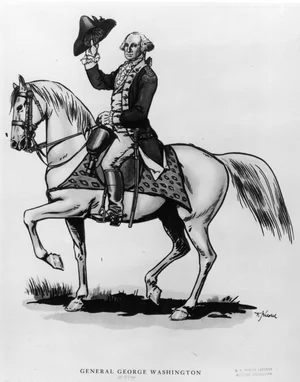
George Washington may not seem like an obvious contender for the Al Copeland Humanitarian Award. The Al normally highlights someone whose contribution to improving the human condition was not previously widely known or properly acknowledged. George Washington is hardly unknown and his contributions are memorialized in the name of our nation’s capital, a state, cities strewn across the country, statues in other towns, the one dollar bill, and several universities. Washington’s image is carved into the side of a mountain. He is about as well known as anyone in the US.
But he is mostly known as the “father” of our country — the general who defeated the British and became the first president of our new nation. He is also increasingly known for his role as a slaveholder. While both these positive and negative accomplishments are important, his biggest contribution to our country is less commonly acknowledged. He didn’t just lead our country, he voluntarily walked away from power to allow someone else to be selected as leader.
The problem of succession has plagued every governmental system, company, religious movement, and family for all of human history. The transfer of power to the next leader has always been problematic. How can we get the current leader to leave before they cease being effective? How do we ensure that the next person will be capable? How do we make the switch without too much disruption or even violence?
Marxists and others convinced that advantage only compounds advantage over time so that inequality becomes severe and unchangeable have never paid close attention to how incredibly hard it is to sustain any endeavor over time. In almost every organization, the quality of leadership has a tendency to fade over time as the attributes required to obtain the position become detached from those required to sustain let alone expand its greatness.
Businesses tend to reach their zenith during or shortly after their founder’s leadership. Great families fade into oblivion in no more than a few generations. Inevitably, a future leader will be a drunk or a fool, squandering the advantages accumulated by their predecessors.
One of the main drivers of this organizational entropy is the inheritance of leadership. Kings typically remain in power until they bequeath that role to a child. To avoid fights over which child, most regimes embrace the principle of primogeniture, where power goes to the oldest son. There have been brief-lived alternative methods of succession, such as in the early Ottoman Empire when whichever of the Sultan’s sons could conspire to outwit and destroy his siblings would become the next Sultan upon the death of the prior one. This process may select for political acumen, but it proved too bloody and chaotic to sustain. Picking the oldest son may be orderly and relatively peaceful but it also unlikely to select the most meritorious.
With the founding of the American Republic, we explored another alternative to primogeniture — selection of leaders by popular election. If, to invert Clausewitz’s maxim, politics is war by other means, then the contest among candidates for election would resemble the violent struggles among the Sultan’s sons in tending to select those with greater political merit. It’s an ingenious and relatively peaceful way to select quality leaders except for one, central weakness.
What makes the person who currently occupies the position accept that there needs to be a new election and then to abide by its results? To say that this is required by the Constitution, fails to understand that legal requirements can be ignored or modified by whoever is in power, if they have enough power and desire to do so. Putin has changed term limits and election laws several times now. Mahmoud Abbas is now in the 18th year of his 4 year term as president of the Palestinian Authority. Having laws requiring elections and the transfer of power is far from a guarantee that power will be transferred as planned.
The most important contribution of George Washington to improving the human condition was in establishing the precedent that a virtuous leader should voluntarily relinquish power. To be sure, this precedent is not always honored. Shortly after Washington set his example, Napoleon was carted away to exile after failing to remain in power for life, saying “They wanted me to be another Washington.” And more recently Xi has violated the precedent set following Mao by seeking and receiving another term as leader of China.
Despite increasingly heated disputes in the United States over elections, it is worth noting that Washington’s example of voluntarily leaving office following elections remains universally practiced in this country. Perhaps by honoring Washington with The Al we can help ensure the continuation of the peaceful and meritorious transfer of power developed and preserved in the American political system.
Last week the Heritage Foundation released my new study on the effect of state policies easing access to puberty blockers and cross-sex hormones on youth suicide rates. The study generated a large amount of attention from policymakers, the traditional media, and on Twitter. Given that the topic is a highly emotional and politicized one and given the low quality of discourse on Twitter, much of the social media response was inaccurate and ad hominem. Fortunately, Twitter is not the real world and the serious response of a number of policymakers with steps they are taking to address the risks posed by these drugs makes responding to Twitter critics pointless.
The reactions of two prominent commentators, Jack Turban and Jesse Singal, however, warrant a response, not for the merit of their criticisms but because they have enough influence outside of Twitter that their mistaken criticisms might undercut the positive policy responses my study has facilitated. Turban is a professor at Stanford Medical School and is the author of two of the three studies claiming that puberty blockers and hormones are protective against suicide and therefore must be made widely and readily availably. Singal is a journalist who has engaged in extensive criticism of Turban’s work and is therefore someone that skeptics of these medical interventions might look to for guidance on what to think about my new study.
Other than dismissive and ad hominem comments, Turban’s main objection to my research is that minors are not supposed to be getting access to these drugs without parental consent so that looking at variation in state policies regarding the ability of minors to access health care without parental consent would be irrelevant. He writes, “One thing to note is that @TheEndoSociety and @wpath guidelines require parental consent to access gender-affirming hormones. This entire report is based on the incorrect assumption that minors can easily access hormones without parental consent.” He adds, “Since trans youth account for about 1.9% of teens, only a fraction of those desire hormones, only a few percent of those are able to access them, and of those even fewer would access without parental consent, the logical jump made by the Heritage people doesn’t make sense.”
I never claim that “minors can easily access hormones without parental consent.” My study is based on the natural policy experiment that results from some states having one fewer barrier to minors getting these drugs by having a provision in law that allows minors to access healthcare without parental consent, at least under some circumstances. It just has to be easier for minors to get these drugs, not that they can do so “easily.”
But Turban seems to suggest on Twitter that this virtually never happens. Where would I get the idea that minors can access these drugs without parental consent? It comes from Turban’s own research. In his 2022 study on the effects of cross-sex hormones on suicidal ideation, he analyzes the results of a survey given to a convenience sample of adults who identify as transgender. In Table 1, he reports that 3.7% of those who say that they received cross-sex hormones between the ages of 14 and 17 are still not “out” to their families as transgender. These respondents must have obtained those drugs without parental consent since their parents do not even know that they identify as transgender. In addition, we see in that same table that only 79.4% of those adults who got hormones between the ages of 14 and 17 say that their families are supportive. We might reasonably assume that unsupportive families would not have given consent to their teenage children getting hormones, especially if they continue to be unsupportive several years later when those children are now adults. Yet somehow, nearly a fifth of those who got the drugs as teenagers did so despite the lack of support from their families.
If we accept Turban’s claim that 1.9% of teenagers identify as transgender, that translates into 1,900 out of every 100,000 teenagers. My finding is that easing access by reducing the parental consent barrier increases youth suicide rates by 1.6 per 100,000 young people. For my result to be plausible, it would only have to be the case that .08% of teenagers who identify as transgender would have to seek these drugs, find that it is easier to access them when states have minor consent provisions, and then kill themselves to result in an additional 1.6 suicides per 100,000 young people. And this assumes that the entirety of the increase in suicides occurs among individuals who identify as transgender and get the drugs, even though we know that there is a contagion effect with suicide so that the 1.6 increase would include young people who did not get the drugs but were influenced by the deaths of others.
The bottom line is that the magnitude of my study’s estimated increase in suicide risk associated with these drugs is entirely plausible given Turban’s own numbers about the frequency with which minors are accessing these drugs without parental consent.
Other than name-calling with words like “misleading,” “crude,” and “shodd[y],” Singal has two seemingly substantive objections to offer. First, he claims “this isn’t even about blocker and hormones — it’s about which states have lower ages of medical consent. Then he says ‘Well, around the time blockers became available, the suicide rates go up.’ This is an exceptionally crude approach.” Second, he embraces a criticism expressed by Elsie Birnbaum that it is ridiculous to describe states like Texas and Utah as having “easier” access to these drugs, adding: “This is a good catch and should immediately cause anyone with any knowledge of this subject to deeply question the study.”
With both of these criticisms, Singal appears to think that the proper way to study the effects of puberty blockers and cross-sex hormones would be to compare the suicide rates in places based on the number of prescriptions being dispensed, the number of clinics offering these treatments, or their state reputation as being more or less permissive on transgender issues. While I understand why it is tempting to think that these direct comparisons would be better, if our goal is obtaining an unbiased, even if imprecise, estimate of causal effects, it is far better to focus on state minor access provisions. Because modern research designs for isolating causal effects are not necessarily intuitive, let me try to offer a brief explanation for readers (and Singal) who are not trained researchers.
The gold-standard research design for isolating causal effects is a randomized controlled trial (RCT), in which a lottery would assign some people to get the drugs and others not to get the drugs. Researchers would then compare the outcomes for the two groups over time. Any significant differences in their outcomes would have to be caused by the drugs and not by some preexisting difference between the treatment and control groups, since the two groups would be identical, on average, at the start of the experiment. Unfortunately, the effects of puberty blockers and cross-sex hormones in treating what is called gender dysphoria has never been studied with an RCT. Turban, the Biden administration, and others claiming with confidence that these drugs save lives should support an RCT to prove what they say, but they do not, and we are left without the kind of rigorous evidence that is normally required for initial approval of drugs by the FDA.
Short of an RCT, there are a number of research designs that have been developed that attempt to imperfectly approximate the causal rigor of a true experiment. They do so by looking for ways in which exposure to treatment is “exogenous.” That is, they look for why some people get the drugs while others do not for reasons that are unrelated to factors that might separately influence the outcomes. A lottery is perfectly exogenous because chance determines who gets the treatment and chance has nothing to do with causing outcomes. If the reasons that some people get the treatment while others are in the control are related to the outcomes, however, then we have an “endogeneity” problem and the results are biased.
It is easy to illustrate this endogeneity problem in Turban’s research on this issue. Turban examines a survey of adults who identify as transgender and compares those who sought and got these drugs to those who sought but did not get the drugs in terms of their more recent thoughts about suicide. One of the reasons some people who sought these drugs would be unable to get them would be if they were not considered psychologically stable, since being psychologically stable at the time is supposed to be a criteria for prescribing the drugs. Rather than being random and unrelated to later outcomes, the reason that some people end up in Turban’s treatment or control groups is caused by their psychological condition when they sought treatment, which would be related to the suicide outcomes being measured — or endogenous. It is obviously biased and unhelpful to compare treatment and control groups that begin with different average psychological health in terms of their later psychological outcomes.
The same endogeneity problem applies to how Singal seems to think this issue should be examined. We know that there is significant comorbidity between gender dysphoria and other challenges that young people have, including depression, anxiety, and autism spectrum disorder. To the extent that demand for puberty blockers and cross-sex hormones is related to people having other psychological challenges, comparing places based on the number of prescriptions or clinics would be endogenous and misleading. It would be biased by the likelihood that places with more of these drugs being dispensed would also be places with a higher prevalence of other psychological challenges, which would be related to suicide rates in those places independent of whether the drugs helped, hurt, or made no difference. Similarly, comparing states based on whether they had reputations for being permissive or “blue” states would be endogenous and misleading. It would be comparing treatment and control groups that differed at the start in ways that are related to suicide outcomes.
To find something closer to the true causal effect, we would need exogenous sources of variation in the treatment other than a lottery. My study takes advantage of plausibly exogenous variation in exposure to treatment with respect to WHERE there is a lower barrier to accessing treatment, WHEN that treatment is available, and WHO is affected by the treatment. States adopted policies about the ability of minors to access healthcare without parental consent for reasons that had nothing to do with, and generally long preceded, the transgender issue. On the margin, parental consent is one additional barrier to minors getting puberty blockers and cross-sex hormones.
Singal believes that it is a defect of my study that this variation in minor consent policies is not “about blocker and hormones,” but he fails to understand this is a virtue of the research design. Because minor consent provisions are a barrier to accessing puberty blockers and cross-sex hormones that is not “about” this issue, variation in the existence of this barrier is exogenous and helps isolate causal effects. It’s true that minor access provisions are not the most important or direct barrier to access, but they help generate unbiased effects. To the extent that these provision are entirely unrelated to the issue, they would be random noise and would bias effects toward zero but would not bias the direction of the results.
In addition to exogenous variation regarding where these drugs could be accessed with or without an extra barrier, we have exogenous variation in when the drugs became available. This is why it is important that we observe that there is no difference in youth suicide rates between states with or without minor access provisions before the drugs are introduced but there is after.
Lastly, we have exogenous variation in who would be affected. If states with a minor access provision began to differ systematically with respect to suicide only after 2010, we should observe this pattern also among a slightly older population that would not be affected by minor consent provisions. The fact that there is no effect for a slightly older population is also important.
Obviously, it would be far better to have an RCT if we wanted to isolate the causal effects of puberty blockers and cross-sex hormones on youth suicide. But absent an RCT, my study uses quasi-experimental research design features that generate credibly causal effects. It’s imperfect, but it is a huge improvement over the obviously endogenous research design that Turban and Green use and much better than the direct but endogenous approaches that Singal criticizes my study for lacking.
Channeling all of his Twitter erudition and a penchant for research nihilism, Singal asserts that my study is no different in its defects from prior ones: “The dude makes perfectly fair comparisons of some of the past work on this subject, most notably Jack Turban’s, and then he reaches into basically the same bag of tricks. It’s SUCH a bad article.” While I like being compared to The Dude, claiming that my study is comparable to those by Turban and Green is just incorrect.
Twitter is a dangerous place for young people with gender dysphoria, but it is also a dangerous place to discuss the merits of different studies. If Turban or Singal were willing, I’d be happy to get together in a public forum to discuss these issues at greater length. An audience would benefit far more from such a discussion than Twitter name-calling and drive-by research critiques.
ADDENDUM
I’ll respond to one more substantive objection that Jesse Singal echoes and that was raised initially by Dave Hewitt, an English substacker. Hewitt claims that my results are sensitive to outlier states, such as Alaska or Wyoming, that have above-average youth suicide rates. He attempts to illustrate this concern by switching whether AK and WY are classified as having a minor access provision or not. He then produces a graph that shows the unadjusted difference in suicide rates between states based on the existence of a minor access provision shrinks to zero if both AK and WY are switched in how they are classified.
Importantly, Hewitt only shows us the unadjusted difference, not the final results adjusting for baseline differences in state suicide rates, as displayed in Chart 3 and Appendix Tables 2-5 in the study. States differ in their average suicide rate across the entire time period studied, including the years before puberty blockers and cross-sex hormones were introduced as a therapy for gender dysphoria around 2010. Hewitt is aware of this fact when he notes, “The suicide rate of this age group in Alaska is far higher than any other state… Wyoming has the highest overall suicide rate in the country across all age groups.”
Because there are time-invariant factors that might make some states have higher or lower youth suicide rates, my analysis controls for each state’s suicide rate at baseline. And to the extent that there are time-variant but age-invariant factors that affect the change in suicide rates over time, I control for the annual suicide rate in each state in each year for a slightly older population that should be unaffected by a minor access provision.
Yes, Alaska and Wyoming have high suicide rates and switching states with high rates from the treatment to the control group would alter the unadjusted difference between those groups of states. But this is irrelevant to the question of whether states experience a change in youth suicide rates when cross-sex treatments become available based on having one fewer exogenous barrier to minors accessing those treatments — especially when we control for time-invariant and age-invariant factors that make the rate higher in some states than in others.
Switching states from one category to the other is also the wrong way to test whether the results are sensitive to one or two states. The proper way to test for sensitivity would be to run the regression with all of the controls and to drop individual states from the analysis to see if the result still holds. If any single state is driving the result, then dropping it from the analysis should substantively change the result.
I’ve done this and Hewitt’s (and Singal’s) concerns about sensitivity to outlier cases are unfounded. If I drop Alaska from the analysis presented in Appendix Table 2, the result remains unchanged. If I drop Wyoming, the result remains unchanged. If I drop Alaska and Wyoming at the same time, the result remains unchanged. In fact, I’ve dropped each of the 50 states and DC one by one and the results remain statistically significant and virtually identical in magnitude across all 51 robustness checks.
I’m working on revising this “working paper” and submitting to a peer-reviewed journal and will comply with the replication data set policies of that journal. In the meantime, Hewitt, Singal, or anyone else interested in replicating my analysis and trying other robustness checks can easily do so by downloading and analyzing the data. The study lists the handful of data sources and provides links. The full model specifications are also provided in the appendix tables.
It was a very light year for Higgy nominations. I suspect that this is not because we have a shortage of (un)worthy nominees. Perhaps instead our team of regular nominators is just a bit worn out by all of the Higginess (to coin a new term) that surrounds us. But we must soldier on.
Greg submitted Steven Novella and David Gorski for consideration. These two academic doctors run a web site that claims to promote science in medicine. Unfortunately, under intense pressure from bullies, they abandoned that mission to erase and repudiate a positive review of Abigail Shrier’s book on the excesses of the transgender craze among young people, Irreversible Damage, that had been published on their web site. These actions by Novella and Gorski were cowardly and intellectually dishonest, making them (un)worthy nominees for The Higgy.
But they are not this year’s recipients for a few reasons. First, there are two of them and the Higgy can only go to one person. if we go down that slippery slope pretty soon we’ll be giving The Higgy to The Guardians, The Silence Breakers, Ebola fighters, The Protester, The Good Samaritans, The American soldier, The Whistleblowers, or even me — each of whom was selected by the parody (?) (check this) magazine, Time, as Person of the Year. Wow, nearly half of the persons chosen by Time in the last two decades weren’t persons at all. In any event, we have to maintain standards and limit the William Higinbotham Inhumanitarian of the Year Award to an individual inhumanitarian.
In addition, while Novella and Gorski’s behavior was deplorable, giving inhumanitarian awards to every academic who displayed cowardice and intellectual dishonesty would be like handing out speeding tickets at the Indianapolis 500. Besides, those who really deserve condemnation in that saga are the bullies who torment people for saying eminently sensible things about the excesses of the transgender craze among young people and the academic institutions and organizations that should be protecting scholars against such abuse.
Joe Nathan also offered Secretary of Education Miguel Cardona as a nominee for The Higgy. Cardona is also a very (un)worthy nominee given his efforts to adopt regulations to strangle charter schools. But U.S. cabinet members destroying liberty by fiat falls more in the category of Big Scary Dictator Disorder (BSDD) than the Petty Little Dictator Disorder (PLDD) The Higgy is meant to recognize.
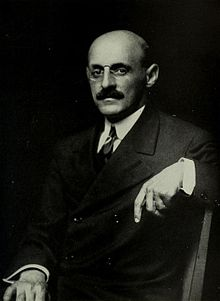
The recipient of this year’s William Higinbotham Inhumanitarian of the Year Award is Abraham Flexner. Flexner’s promotion of the false notion of an expert as someone with a credential is a perfect example of PLDD. He imagined that he could reshape the world for good with his controlling plans, but his righteous good intentions blinded him to the damage that would be done by paving the way for the certification of professions and occupations of almost every sort. This marks the first time that my nominee for The Higgy has been selected.
The announcement of winner (loser) of the William Higinbotham Inhumanitarian of the Year Award has been delayed until Monday, April 18. The Higgy and taxes are due at the same time and both are being extended due to the observance of Holy Week and Passover holidays.
Get your nominations and filings in so that you don’t have to pay a penalty!


 Posted by Jay P. Greene




 Jay P. Greene's Blog