(Guest Post by Matthew Ladner)
 4 Comments |
  tax-credit scholarships |
  Permalink
 Posted by matthewladner

(Guest Post by Matthew Ladner)
Look for the Goldwater Institute study on using Education Savings Accounts as a vehicle for school choice next week. Meanwhile, they are already dueling over the concept in Florida. In this corner, Patricia Levesque from the Foundation for Excellence in Education represents the good guys with Let the Parents Choose.

In the opposing corner, representing the good but misguided faction, Betty Castor with Don’t Endanger Our Schools.

Notice the difference in emphasis regarding students vs. schools.
Those of us who support a fundamental overhaul of our system of schooling have a great deal of work to do to get people to understand that the methods of public schooling are fundamentally at odds with the ideals of public schooling. If you had to start from scratch, who in their right mind would order up the system we have today? Castor is right that Florida public schools have made a great deal of progress, and no one enjoys celebrating it more than me. It bears mentioning however that many of the people working Florida’s public school system fought the changes that produced those gains tooth and nail.
They were **ahem** completely wrong last time, but never mind that, this idea is dangerous so everyone run to your corners and Let’s Do the (2002) Timewarp Again!!!!

A decade ago, Florida’s public school establishment and their many willing accomplices in more than a few Florida newspapers were busily throwing up a firestorm over Governor Jeb Bush’s reforms. We all know how that ended: with Florida’s low-income, Hispanic and Black students outscoring statewide averages on NAEP. Before we give any credence to the Little-Boy-Who-Cried-Wolf crowd, note that Florida has been offering children with disabilities all of their state money in the form of a voucher since 1999. Last year, 5% of children with disabilities utilized the program. That’s right- only 5% after a decade.
What do we know about the program? Participating parents love it and scores for children with disabilities are way up in Florida in part because of competition from the program. Oh, and it helps curb mislabelling of children into special education.
Ummmm…..where is the apocalypse? The mad rush for the exits? The terrible harm to schools and students?
The magic of the McKay program, and choice more generally, is that you don’t actually have to use it to benefit from it. Parents of children with disabilities now have the ability to walk with their feet if they think their school has served their child poorly, or that another school would do a better. The fact that only 5% of parents have actually pulled the trigger doesn’t matter much because all parents have the potential ability to pull the trigger. There are constraints, of course, most notably the availability of private options, but you get the point.
Nationwide, 2% of children with disabilities attend private schools at school district expense. Generally speaking, they were the kids with parents who had the ability to hire fancy attorneys who specialize in federal disability law. Sometimes these kids have successfully sued the district to get to a private school, sometimes a consensual agreement is reached for a private placement. Sometimes it is consensual, and other times it is “consensual” in the sense that districts are pretty good at figuring out when they would lose a lawsuit and cut their losses.
In any case, McKay gives parents who don’t have fancy lawyers power- the power to leave. McKay children stopped being a largely captive audience and became more like a client- a client you can lose if you fail to satisfy them.
This is what the education savings account concept is about: power for parents. The customer is King, and I want to give parents as close to full sovereignty over the education of their child as possible, down to the penny. This goes well beyond whether I should have choice over whether I send my child to a charter or a district school, or a private or district school. The idea is to allow every parent to customize an education for their child based upon their unique needs and interests from as wide an array of education service providers as possible: whether from public schools, private schools, virtual schools, private tutors, trade schools or colleges and university courses. Parents should be able to judge opportunity costs and cost-effectiveness, and save money over time for university expenses.
Would this spell the end of public schools? Hardly- did McKay end public schooling for children with disabilities? Yes but if McKay gave options beyond private schools, maybe 10% of students may have left instead of 5%!

EEEEEEEEEEEEEK!!!!!!!!!!!!!!!!!!!!!!
Would it change education savings accounts change the way schools operate? Yes- for the better.
What about equity concerns? Give disadvantaged children greater funding weights than the current public school funding system. Can anyone seriously justify $1,500 from the feds as making a serious dent in the role poverty plays in education, especially when often only half of it reaches the classroom? Who wants to stand up to defend a system of school funding which covertly gives far more to the children with the most, cleverly disguised in district averages? Can we really go on ignoring the abject failure of state funding equity lawsuits without seriously revamping the broken power structures of urban districts which often absorbed massive amounts of additional funds without producing significant improvement?
We can do much better than this- and putting parents in charge is the right way to do it.
1 Comment | competitive effects, Education Savings Accounts, vouchers | Tagged: Betty Castor, Education Savings Accounts, Patricia Levesque | Permalink
Posted by matthewladner

(Guest post by Greg Forster)
For a while now I’ve anticipated that the next installment of this series would be about power. Since Jay has broached the subject, I guess it’s finally time to get around to writing what I’ve been planning!
A quick review of my Unified Field Theorem of Education Reform:
Part 1: Education reformers shake out into two groups, which I call the “liberal artists” and the “pragmatists.” The liberal artists want to teach first the three Rs, then traditional “academic” content more generally. Their strength is their insistence on tangible accountability for teaching all children; their weakness is their overreliance on standardized testing – now culminating in the current effort to create a government-controlled national testing regime which logically implies the further step of imposing a single curriculum on all schools under the control of a central authority. The pragmatists want to make education in various ways “more relevant to real life.” Their strength is their desire to create new models of education that will prepare students better for life in the (changing) world. Their weakness is their tendency to discount (in practice if not in rhetoric) the value of traditional academics, and especially their fear of accountability systems.
Part 2: Both sides undermine not only education governance (the focus in Part 1) but pedagogy as well. The pragmatists want to abstract “skills” from “content” and focus on teaching the skills; they fail to appreciate that the only way to learn skills is by leaning content. You can never teach “skills” directly. The liberal artists want to abstract “knowledge” from “practice” and focus on teaching the knowledge; they fail to appreciate that all the really important knowledge is intricately bound up with practice, and can only be learned practically.
Part 3: Liberal artists need to get over their testaphilia, and pragmatists need to get over their testaphobia. A vast quantity of what students deperately need to learn must be learned in ways that can’t be tested with the level of objective systematization the liberal artists insist upon. You can “test” practical knowledge but not in the ways the liberal artists want – and not in ways that can be effectively used as the basis of an accountability regime. Yet standardized testing, and more generally the “rote” “regurgitation” of “mere” “facts,” is always going to be a crucial part of good education. In Daniel Willingham’s language, you can’t get to the “deep structure” of problems, which is what the pragmatists want, until you’ve first mastered the “surface structure,” which is the rote facts the pragmatists disdain. You have to walk before you can fly.
Running through all this is the tension between governance and pedagogy. Once we decide what we want schools to do, how do we structure the system to try to get them to do that?
The links beteween each camp’s pedagogy and governance, both in their good and bad aspects, run much deeper than it may at first appear. What’s really at stake is our view of the human person.
An analogy to politics will help here. In modern political philosophy there are basically three anthroplogies on offer. They give rise to different political systems.
The thing to note is that societies cannot be counted on to remain faithful to one model. In particular, the mixed model on which liberal democracy, freedom of religion and entrepreneurial economy are built is really darned difficult to maintain. We are constantly falling away into cynicism on the one side (e.g. Cass Sunstein, Catherine MacKinnon, Saul Alinsky) or naivete on the other (e.g. Michael Lerner, Alan Wolfe, Jim Wallis) with the same disastrous consequences every time.
How does this relate to pedagogy and governance in education? I propose that education needs to be based on a mixed model, but is constantly falling away into one or the other of two truncated models – and that’s why substantive education issues are constantly being hijacked by brute political power.

Look at the liberal artists. How did we get to a point where the people dedicated to the full flowering of human knowledge represented by “traditional academics” are in the process of reducing the content of education to what can be measured by bubble tests – and lining up to create a national dictator that will reach into every school in America and crush everything that isn’t bubble tests?
It’s because their anthropology privileges intellect over action. A human being is a mind that has a body. What they want is to educate the mind. The body is really of no concern to them. Even the mind is only of interest insofar as it knows things – the mind’s ability to do things through the body is not interesting. Re-reading my first post in this series, this is really clear in the exchange between Jay and Checker about whether schools should teach things like “entrepreneurial attitudes.”

Checker Finn’s ideal school
This anthropology implies an aristocracy of intellect. The system should serve the interests of those who are capable of learning. The liberal artists think they’re egalitarians and democratizers because they stick up for the poor black kids who want to learn – and, as I have said over and over, they’ve done us a great service. They have indeed been the great titanic warriors against race and class aristocracies. But there are other kinds of aristocracies as well. The liberal artists only stick up for the kids who want to learn in a certain way: the intellectual way, the bubble test way. They want the whole system to serve only the kids who desire to know for knowledge’s sake – and that’s not most kids. What about the kids who want to invent new things, or acheive greatness in other ways, and who might be willing to learn academics as a stepping stone to that but not for its own sake? They’re chucked into the maw of the intellectual tyranny.
Ken Robinson was wrong (in that video back in Part 1) to attribute this anthropology to the Enlightenment; it is actually far older, and has historically been associated with undemocratic power structures. Mind/body dualism was the philosophy of Greco-Roman aristocracy – Athens was the only democracy of any importance in the ancient world, and it executed the great dualist Socrates. Even during the Enlightenment, those who strongly embraced mind/body dualism (like Descartes) were strong supporters of traditional power structures. It was those who challenged mind/body dualism, like Locke, who ushered in democracy.
What about the pragmatists? It’s tempting to say that they have the opposite problem – they think kids are bodies that have minds. But that’s actually wrong. The strength of the pragmatists is that they’re not plagued by mind/body dualism.
Their problem is egalitarianism. They don’t want education to result in inequalities – no inequalities of life outcomes, but more fundamentally, no inequalities of educational outcomes. To draw a distinction, even in thought, between those who can accomplish more and those who can accomplish less is itself wrong. Anything that tends to reinforce the appearance of such distinctions, or (worse) explicitly assume such distinctions and build on them, is in principle radically evil.
This explains their testaphobia and their general aversion to accountability systems. It also explains why they are de facto but not de jure hostile to traditional academics. They have no objection to academics in principle – provided the illusion of equal outcomes is not punctured. But, of course, it always is. Much safer to stick to content-free, purely “practical” projects that teach “skills.”
The picture offered to us is one of glorious diversity in which every child is radically different, and none of the differences matter.
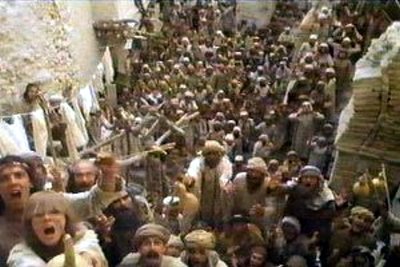
“You can think for yourselves!”
“Yes! We can think for ourselves!”
“You are all individuals!”
“Yes! We are all individuals!”
Naturally, while the liberal artists are striving to build an aristocracy, the pragmatists are striving to build a tyranny of the majority – the mob rule of unlimited democracy. This was their original sin going all the way back to John Dewey, whose perfidy begins right at the beginning when he sets out to redesign the whole educational enterprise to produce, not the fullest possible flourishing of human capacities, but people suited to fit the new, radical political system that early 20th century progressives were working so hard to build. Human beings are little clay figures just waiting for Dewey and his acolytes to mold them into the politically convenient shape. All the worst aspects of educational pragmatism can really be traced back to this original politicization of the project.
So both camps find substantial resistance to their desires – the liberal artists, in children who are capable of achievement but don’t highly value knowledge for its own sake; the pragmatists, in children who are capable of excellence (even the kinds of excellence pragmatists claim to value) and need special nurturing to achieve it.
And both camps, their vision cramped by narrow anthropologies, fail to see the legitimacy of this resistance. To them, the resistance appears to be simply obscurantism. Hence they feel perfectly justified stamping it out by force.
And naturally, when they seek power, they both reach for the strongest of all social weapons in modern culture – science.

Say that you favor a given approach – in education, in politics, in culture – because it is best suited to the nature of the human person, or because it best embodies the principles and historic self-understanding of the American people, and you will struggle even to get a hearing. But if you say that “the science” supports your view, the world will fall at your feet.
Of course, this means powerful interest groups rush in to seize hold of “science,” to trumpet whatever suits their preferences, downplay its limitations, and delegitimize any contrary evidence. If they succeed – which they don’t always, but they do often enough – “the science” quickly ceasees to be science at all. That’s why “scientific” tyrannies like the Soviet Union had to put so many real scientists in jail – or in the ground.
This was, again, the original sin of Dewey and the whole “pragmatist” movement in early 20th century philosophy. The goal of that school was to undermine the philosophical structure of knowledge on which real science depends, so that they would then have a free hand to bend “science” to their will. I believe it was George Orwell who said that philosophical pragmatism amounts to saying that truth is determined by who has more guns.
But the liberal artists are no longer very much better. They didn’t used to flatten their understanding of a good education down to the level that could be measured “scientifically” on tests. But the imperative to seek power and crush resistance has driven them to that point.
How, then, do we escape from both aristocracy and mobocracy, and undo the tyranny of science? Stay tuned.
8 Comments | instructional reform | Tagged: Best of Greg, Greg Forster | Permalink
Posted by Greg Forster

I just wanted to add a few thoughts to my post yesterday. Readers may be wondering what is wrong with using science to identify the best educational practices and then implementing those best practices. If they are best, why wouldn’t we want to do them?
Let me answer by analogy. We could use science to identify where we could get the highest return on capital. If science can tell us where the highest returns can be found, why would we want to let markets allocate capital and potentially make a lot of mistakes? Government could just use science and avoid all of those errors by making sure capital went to where it could best be used.
Of course, we tried this approach in the Soviet Union and it failed miserably. The primary problem is that science is always uncertain and susceptible to corruption. We can run models to measure returns on capital, but we have uncertainty about the models and we have uncertainty about the future. Markets provide a reality test to scientific models by allowing us to choose among competing models and experience the consequences of choosing wisely or not. Science can advise us, but only choice, freedom, and experience permit us to benefit from what science has to offer.
And even more dangerous is that in the absence of choice and competition among scientific models, authorities will allow their own interests or preferences to distort what they claim science has to say. For an excellent example of this, check out the story of Lysenko and Soviet research on genetics. For decades Soviet science was compelled to believe that environmental influences could be inherited.
Science facilitates progress through the crucible of market tests. Science without markets facilitates stronger authoritarianism.
14 Comments | economics, instructional reform, methodology | Tagged: scientific progressivism | Permalink
Posted by Jay P. Greene
In Education Myths I argued that we needed to rely on science rather than our direct experience to identify effective policies. Our eyes can mislead us, while scientific evidence has the systematic rigor to guide us more accurately.
That’s true, but I am now more aware of the opposite failing — believing that we can resolve all policy disputes and identify the “right way” to educate all children solely by relying on science. Science has its limits. Science cannot adjudicate among the competing values that might attract us to one educational approach over another. Science usually tells us about outcomes for the typical or average student and cannot easily tell us about what is most effective for individual students with diverse needs. Science is slow and uncertain, while policy and practice decisions have to be made right now whether a consensus of scientific evidence exists or not. We should rely on science when we can but we also need to be humble about what science can and can’t address.
I was thinking about this while reflecting on the Gates Foundation’s Measuring Effective Teachers Project. The project is an ambitious $45 million enterprise to improve the stability of value-added measures while identifying effective practices that contribute to higher value-added performance. These are worthy goals. The project intends to advance those goals by administering two standardized tests to students in 8 different school systems, surveying the students, and videotaping classroom lessons.
The idea is to see if combining information from the tests, survey, and classroom observations could produce more stable measures of teacher contributions to learning than is possible by just using the state test. And since they are observing classrooms and surveying students, they can also identify certain teacher practices and techniques that might be associated with greater improvement. The Gates folks are using science to improve the measures of student progress and to identify what makes a more effective teacher.
This is a great use of science, but there are limits to what we can expect. When identifying practices that are more effective, we have to remember that this is just more effective for the typical student. Different practices may be more effective for different students. In principle science could help address this also, but even this study, with 3,000 teachers, is not nearly large enough to produce a fine-grained analysis of what kind of approach is most effective for many different kinds of kids.
My fear is that the researchers, their foundation-backers, and most-importantly, the policymaker and educator consumers of the research are insensitive to these limitations of science. I fear that the project will identify the “right” way to teach and then it will be used to enforce that right way on everyone, even though it is highly likely that there are different “right” ways for different kids.
We already have a taste of this from the preliminary report that Gates issued last month. Following its release Vicki Phillips, the head of education at the Gates Foundation, told the New York Times: “Teaching to the test makes your students do worse on the tests.” Science had produced its answer — teachers should stop teaching to the test, stop drill and kill, and stop test prep (which the Gates officials and reporters used as interchangeable terms).
Unfortunately, Vicki Phillips mis-read her own Foundation’s report. On p. 34 the correlation between test prep and value-added is positive, not negative. If the study shows any relationship between test prep and student progress, it is that test prep contributes to higher value-added. Let’s leave aside the fact that these were simply a series of pairwise correlations and not the sort of multivariate analysis that you would expect if you were really trying to identify effective teaching practices. Vicki Phillips was just plain wrong in what she said. Even worse, despite having the error pointed out, neither the Gates Foundation nor the New York Times has considered it worthwhile to post a public correction. Science says what I say it says.
And this is the greatest danger of a lack of humility in the application of science to public policy. Science can be corrupted so that it simply becomes a shield disguising the policy preferences of those in authority. How many times have you heard a school official justify a particular policy by saying that it is supported by research when in fact no such research exists? This (mis)use of science is a way for authority figures to tell their critics, “shut up!”
But even if the Gates report had conducted multivariate analyses on effective teaching practices and even if Vicki Phillips could accurately describe the results of those analyses, the Gates project of using science to identify the “best” practices is doomed to failure. The very nature of education is that different techniques are more effective in different kinds of situations for different kinds of kids. Science can identify the best approach for the average student but it cannot identify the best approach for each individual student. And if students are highly varied in their needs, which I believe they are, this is a major limitation.
But as the Gates Foundation pushes national standards with new national tests, they seem inclined to impose the “best” practices that science identified on all students. The combination of Gates building a national infrastructure for driving educator behavior while launching a gigantic scientific effort to identify the best practices is worrisome.
There is nothing wrong with using science to inform local practice. But science needs markets to keep it honest. If competing educators can be informed by science, then they can pick among competing claims about what science tells us. And they can learn from their experience whether the practices that are recommended for the typical student by science work in the particular circumstances in which they are operating.
But if the science of best educator practice is combined with a national infrastructure of standards and testing, then local actors cannot adjudicate among competing claims about what science says. What the central authorities decide science says will be infused in the national standards and tests and all must adhere to that vision if they wish to excel along these centralized criteria. Even if the central authority completely misunderstands what science has to say, we will all have to accept that interpretation.
I don’t mean to be overly alarmist. Gates has a lot of sensible people working for them and there are many barriers remaining before we fully implement national standards and testing. My concern is that the Gates Foundation is being informed by an incorrect theory of reform. Reform does not come from science identifying the right thing to do and then a centralized authority imposing that right thing on everyone. Progress comes from decentralized decision-makers having the freedom and motivation to choose among competing claims about what is right according to science.
(edited for typos)
12 Comments | instructional reform, methodology | Tagged: gates foundation, Vicki Phillips | Permalink
Posted by Jay P. Greene
(Guest Post by Matthew Ladner)
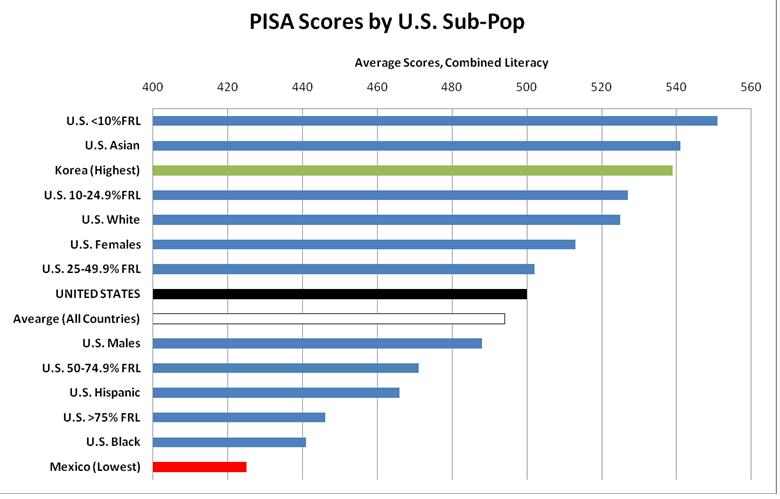 Hat Tip to Whitney Tilson for sending along this fascinating chart in his email blast today. This chart shows PISA data for 15 year olds (10th graders).
This serves as a Rorschach test. The usually reliable Robert Samuelson looks at this and says points out that American Anglos are pretty competitive.
Two problems: first from what we can tell from TIMMS, these numbers would probably look worse if we were examining 17 year olds (the U.S. has a large drop in rank between 8th and 12th grade). Second, we are spending far beyond the OECD average on a per pupil basis, especially in the leafy suburbs, so our cost/achievement ratio still probably stinks, even for wealthy White kids.
The real story here is how much closer Hispanics and Blacks in America are to Mexico, the lowest scoring OECD country, than to an internationally competitive level.
11 Comments | school accountability | Tagged: PISA, Robert Samuelson, Whitney Tilson | Permalink
Posted by matthewladner

Actually it was much more civilized than that. You can see below my discussion with Mike Petrilli on the pros and cons of Common Core (national) standards.
10 Comments | school accountability | Tagged: common core, Mike Petrilli, national standards | Permalink
Posted by Jay P. Greene
 (Guest Post by Matthew Ladner)
NRO’s Reihan Salam on the revolutionary potential of education savings accounts. Goldwater Institute proposal by yours truly and Nick Dranias coming soon…
11 Comments | Education Savings Accounts | Tagged: Education Savings Accounts, National Review Online, Reihan Salam | Permalink
Posted by matthewladner
We are beginning to be envious of all things Chinese. For some indication of this trend see the book on the superiority of Chinese mothers described (and mocked) in yesterday’s post.
I’ve seen this movie before when it was called Gung Ho. And that movie sucked. Is anybody else old enough to remember the late 1980s and early 1990s when media and policy elites were convinced that the Japanese had figured out better ways of doing everything and we needed to imitate them before we were crushed? I specifically remember a bunch of education experts (and you know who you are) telling us that we had to imitate Japanese schools. How did all of that work out?
I expect we are about to hear all of the same stuff, but this time it will be about the Chinese. We need to parent like they do, eat like they do, run the economy like they do, etc… to imitate their success and prevent from being crushed by their superiority.
I don’t even believe the accuracy of the stereotypes we are supposed to emulate. The Japanese were not all working together as if they were the same team. Chinese parents do not all raise their children in the same way (nor do “Western” parents all do something different). This is the worst kind of “pop” social science — incorrectly attributing the success or failure of a society to inaccurate stereotypes.
If you want a more accurate picture of China, see the photo at the top of this post. And over the long run I cannot imagine that a centrally planned economy, like China’s, will be the one we need to emulate to prosper. We have plenty of good social science to tell us that liberty, relatively free markets, and the fair rule of law are much better predictors of economic success.
Yes, China is gaining rapidly, but so did the Soviet Union when it fully mobilized its agrarian workforce into the industrial sector. That type of growth levels off without markets to properly allocate capital, property rights to ensure that entrepreneurs can keep the fruits of their innovation, and liberty to critique the favoritism and corruption that undermine the fair rule of law. China has been making some strides toward market allocations of capital, but remember that most of the banks are government controlled. And property rights in China remain murky, which will hinder innovation. And there isn’t much freedom to critique the government. Without much more progress on these fronts I see little prospect of the Chinese overtaking us economically.
If you want to keep an eye on a rapidly growing developing country, I would look at India. Yes, India is messy, complicated, and often inefficient, but that’s how freedom looks. If they keep liberalizing their economy and politics, I see India growing much more rapidly over the long run.
7 Comments | economics | Permalink
Posted by Jay P. Greene
I have no idea.
But, in a piece in the Wall Street Journal, Yale Law professor and author of a new book on the subject, Amy Chua, extols the virtues of Chinese parenting styles over Western ones. I thought she was describing Jewish mothers, but apparently the Chinese are Jews… or Jews aren’t Western… or something.
And in the wonderful age of auto-animation, someone has already critiqued Chua’s piece with this video:
UPDATE
And here is the comedian, Louis C.K., making an argument similar to Amy Chua’s about effective parenting. Wait a minute. How can he do that? Doesn’t he know that he isn’t Chinese?
3 Comments | myth of helplessness | Tagged: Amy Chua, Chinese mothers | Permalink
Posted by Jay P. Greene
You are currently browsing the Jay P. Greene's Blog blog archives for January, 2011.

 Jay P. Greene's Blog