4 Comments |
  random pop culture |
  Permalink
 Posted by Jay P. Greene

Arkansas basketball was expected to finish last in the SEC this year. But they are off to a 10-1 start and beat #4 ranked Oklahoma last night. Keep an eye on Arkansas point guard Courtney Fortson. Woo pig sooiiee!
Leave a Comment » | college sports | Permalink
Posted by Jay P. Greene

I returned from vacation to learn that one of my graduate advisors, Samuel Huntington, passed away on Christmas eve. Huntington was the type of broad intellectual that has become a vanishing breed in academia. He had a knack for identifying the big themes that were worthy of our attention and had the courage to make bold arguments while always remaining respectful of those with whom he disagreed.
Now we are mostly left with academics who dwell on the latest methodological technique rather than what is substantively important. Just pick up a recent copy of the American Political Science Review and you will search in vain for anything important, useful, and accessible.
And the public intellectuals who still attempt to ask the big questions too often give answers that have all the depth of a self-help book. Has Thomas Friedman ever made an argument that was not already the bland conventional wisdom of the Rotary Club in a small midwestern town?
Josef Joffe said it best: “But who will embark on projects of this kind of sweep, breath and depth? Or write as elegantly as Sam has done? That’s over in American academia, as is that fabulous confluence between America’s rise to world power and the influx of some of Europe’s greatest minds, courtesy of Adolf Hitler. Never before has there been such a perfect match between the demand for and the supply of great talent. One hates to think what would happen to a young Sam today. He might still graduate from Yale at age 18, but would he have become a Harvard professor at age 23? With that independence of mind, that contrarian spirit, that relentless search for conventional notions to be slain? Would a young Sam still be able to ask the Big Questions? And sin against so many idols demanding fealty to contemporary standards of correctness?”
Huntington’s passing isn’t just the personal loss of a wonderful man, teacher, and scholar. It also marks the end of an era.
4 Comments | tributes | Tagged: Jay Greene, Jay P. Greene, Josef Joffe, Samuel Huntington, Thimas Friedman | Permalink
Posted by Jay P. Greene


(Guest post by Greg Forster)
Lots of people are picking up on the temper tantrum about alleged “demonizing of teachers” begun by a Randi Weingarten speech and continued in Bob Herbert’s column on the speech.
Even that notorious right-winger Eduwonk points out that Weingarten and Herbert are hitting a straw man. I think the real problem is not that school reformers demonize teachers but that defenders of the government school monopoly angelize them. When we reformers insist that teachers should be treated as, you know, human beings, who respond to incentives and all that, rather than as some sort of perfect angelic beings who would never ever allow things like absolute job protection to affect their performance, it drives people like Weingarten and Herbert nuts.

A typical teacher, as seen by Randi Weingarten
But what I’d like to pick up on is the question of whether the troubles of the government school system are comparable to the troubles of the auto industry.
Of the alleged demonizing of teachers, Herbert had written:
It reminded me of the way autoworkers have been vilified and blamed by so many for the problems plaguing the Big Three automakers.
Eduwonk points out Herbert’s hypocrisy (though he delicately avoids using that word) on this point, because elsewhere in the column, Herbert praises Weingarten for expressing a willingness to make concessions on issues like tenure and pay scales. Union recalcitrance on these types of reform, Eduwonk points out, is precisely why the auto industry is in so much trouble, and Weingarten has been driven to make noises in favor of reform because a similar dynamic has been at work in the government school system.
On the other hand, Joanne Jacobs thinks the comparison between the AFT and the UAW is inapt:
I don’t think skilled teachers and unskilled auto workers have much in common. Auto unions pushed up costs, especially for retirees, making U.S. cars uncompetitive. In education, the problem isn’t excessive pay, it’s the fact that salaries aren’t linked to teacher effectiveness, the difficulty of their jobs or the market demand for their skills.
But teachers’ unions have pushed up costs – dramatically. In the past 40 years, the cost of the government school system per student has much more than doubled (even after inflation) while outcomes are flat across the board. And this has mainly been caused by a dramatic increase in the number of teachers hired per student – a policy that benefits only the unions.
It’s true that high salaries aren’t the main issue in schools, although teacher salaries are in fact surprisingly high. The disconnect between teacher pay and teacher performance is much more important. But the UAW has the same problem! Their pay scales don’t reward performance, either.
The source of Jacobs’ confusion is her mistaken view that auto workers are “unskilled.” Farm workers are unskilled, but not auto workers. The distinction she’s reaching for is the one between white-collar or “professional” work and blue-collar work. But some blue-collar work is skilled and some is unskilled, and auto workers are in the former category. This matters because with skilled blue-collar workers, as with white-collar workers, there’s a dramatic increase in the importance of incentives as compared with unskilled labor.
In fact, a lot of smart people have been arguing (scroll down to the Dec. 26 post) that exorbitant salaries and benefits aren’t nearly as much of a problem in the auto industry as union work rules – including poor performance due to absolute job protection, pay scales that don’t reward performance, and rigid job descriptions that make process modernization impossible.
Sound familiar?
(Edited)
4 Comments | economics, teacher pay, teacher quality, teacher union | Tagged: AFT, Andy Rotherham, Best of Greg, Bob Herbert, Eduwonk, Greg Forster, Joanne Jacobs, Randi Weingarten, UAW | Permalink
Posted by Greg Forster

(Guest Post by Matthew Ladner)
Matthew Miller writes in the New York Times the federal government should provide a massive new infusion of cash for K-12 schools, but with a group of beneficent strings attached. This time, we’re bound to get it right.
<Insert Einstein’s now cliched definition of insanity about here>
1 Comment | money myth, NCLB | Permalink
Posted by matthewladner

(Guest Post by Matthew Ladner)
Yeeeee Ha…Jester’s dead! Great News from the Goldwater Institute, congratulations to Clint, Carrie Ann and the clients!
Appeals Court Voids CityNorth Subsidy
Court says $97.4 million subsidy violates Arizona ConstitutionPhoenix–Today the Arizona Court of Appeals ruled unanimously in favor of the Goldwater Institute, deciding the $97.4 million taxpayer subsidy given to the developer of the CityNorth shopping mall by the City of Phoenix is unconstitutional.
“Santa got a head start on Christmas this year,” said Goldwater Institute litigation director Clint Bolick. “This ruling is an early present for the citizens of Phoenix.”
In 2007, the City of Phoenix provided the subsidy to the Klutznick Company for its CityNorth retail center in north Phoenix, despite a constitutional prohibition on corporate subsidies in Arizona. The Goldwater Institute’s Scharf-Norton Center for Constitutional Litigation filed suit in July 2007 claiming the agreement violated the Arizona Constitution’s Gift Clause.
Today the three-member Appeals Court agreed. In an opinion written by Judge Patrick Irvine, joined by Judge Winthrop and Judge Hall, the court said, “We think these payments are exactly what the Gift Clause was intended to prohibit.”
The Goldwater Institute represented six small business owners in the lawsuit: Meyer Turken, owner of Turken Industrial Properties, a small real estate development and management company; Kenneth D. Cheuvront, owner of Cheuvront Wine and Cheese Cafe and Cheuvront Construction; Zul Gilliani, who owns an ice cream shop at Paradise Valley Mall; James Iannuzo, who owns Sign-a-Rama; Kathy Rowe who owns Music Together; and Justin Shafer, owner of Hava Java.
“This ruling vindicates this important provision of the Arizona Constitution,” added Bolick. “No longer will cities and towns be able to give away our tax dollars to pay private businesses to pursue a profit. At a time of tight budgets, those tax dollars should be paying for essential services, not for corporate subsidies.”
1 Comment | economics | Tagged: City North lawsuit, corporate welfare | Permalink
Posted by matthewladner

(Guest post by Greg Forster)
Jay Matthews argues that most textbooks don’t serve enough of an educational function to be worth using:
Textbooks still make good dictionaries, with glossaries at the back. They also reassure parents, who don’t get to see teachers in action but are comforted, in a perverse way, that their kids’ schoolbooks seem just as dry and predictable as theirs were. But like the newspapers that have been my life, textbooks are creeping slowly toward obsolescence.
(HT Joanne Jacobs)
I can’t tell whether Matthews thinks textbooks are becoming obsolete simply because books themselves are becoming obsolete – he talks about how some teachers are starting to “write” their own textbooks for their classes by using the internet to gather material, etc. – but it sure looks like he thinks there’ s something especially obsolete about the textbook.
If so, I must strongly demur. Matthews seems to have missed what has always been the primary function of the textbook – to compensate for the teacher’s deficiency. It’s certainly true that some teachers are so on top of their material that they can write their own textbooks, but others are so not on top of their material that they just lean on the textbook as a crutch, teaching everything straight out of the book.
Indeed, who has not heard the frequent complaint about teachers who just teach everything straight out of the book? Welll, where would we be if they couldn’t even do that?
I must confess that looking back on when I first taught my own class at the college level, the biggest weakness of my teaching in that class was that I did too much by rote out of the textbook. But I did it because, as a novice, I lacked the confidence to strike out on my own.
But I have an even more striking example to set before you. When I was in high school, I had a really brilliant physics teacher who didn’t use the textbook at all. He spent the whole class illuminating the subject matter in his own highly motivated way, bringing in unusual examples and exploring subtle nuances.
As a result, his teaching was incredibly engaging to the few students who shared his intense interest in the subject, and completely useless to the majority who did not. They needed to be walked through the basics slowly and carefully – sort of the way a textbook does.
There was one girl in my four-person lab group in that class who was completely lost. She was getting a D and had no idea what was going on. So I started helping her out with her homework.
“Just ignore the teacher,” was my main advice. “Read the textbook and learn what’s in it. Don’t pay attention to anything in class, because almost all of it isn’t going to be on the test and will just distract you from what you really need to be learning.”
She went from a D to an A.
And you know what? I’m married to that girl today.
So don’t tell me textbooks are obsolete.
As a great rumination on the science of physics once put it:
This day and age we’re living in
Gives cause for apprehension,
With speed and new invention,
And things like fourth dimension.
Yet we get a trifle weary
With Mr. Einstein’s theory.
So we must get down to earth at times,
Relax, relieve the tension.
And no matter what the progress
Or what may yet be proved
The simple facts of life are such
They cannot be removed.
You must remember this:
A kiss is just a kiss, a sigh is just a sigh.
The fundamental things apply
As time goes by.
And when two lovers woo,
They still say, “I love you.”
On that you can rely!
No matter what the future brings
As time goes by.
Moonlight and love songs,
Never out of date.
Hearts full of passion,
Jealousy and hate.
Woman needs man,
And man must have his mate –
That no one can deny.
It’s still the same old story,
A fight for love and glory,
A case of do or die.
The world will always welcome lovers
As time goes by.
(Copyright Warner Bros. Music, 1931)
12 Comments | instructional reform, teacher quality | Tagged: Greg Forster, Jay Matthews, textbooks | Permalink
Posted by Greg Forster

The Disturbinator 4000XL, a state-of-the-art disburbance generator.
(Guest post by Greg Forster)
A while back, in his well-read takedown of the “free market” think tanks endorsing the original bailout that got us into the present mess, Jay mentioned that the donors to those think tanks probably didn’t intend for their money to be used to endorse a radical expansion of government intrusion into the economy.
I thought of that post when I opened an e-mail this morning from the Ford Foundation. The e-mail was sent to people (like myself) who work for grantmaking foundations.
To help us “think and talk about” good grantmaking, Ford is distributing a deck of “role cards” representing the roles grantmaking staff play, such as “advocate,” “talent scout,” and “disturbance generator.”
It makes you wonder what life at the Ford Foundation is like. They spend all day inventing decks of cards, apparently.
Not only that, but being insulated from the discipline of the market, it looks like Ford isn’t up with the latest technology. As soon as I arrived at my new workplace in August, I had a state-of-the-art disturbance generator installed in the basement. But at Ford they’re still generating disturbance by hand.
I’m sure this is exactly what Henry Ford had in mind for his money when he gave it to a charitable foundation. On the other hand, given what Ford does with most of its time and money, I suppose we should be glad for every cent and every working hour that gets diverted into activities that are merely useless rather than actively destructive.
2 Comments | economics | Tagged: Ford Foundation, Greg Forster | Permalink
Posted by Greg Forster

(Guest Post by Matthew Ladner)
Mark Steyn doesn’t pull any punches in the Washington Times this morning. Money quote:
General Motors now has a market valuation about a third of Bed, Bath And Beyond, and no one says your Swash 700 Elongated Biscuit Toilet Seat Bidet is too big to fail. GM has a market capitalization of just over $2 billion. For purposes of comparison, Toyota’s market cap is $100 billion and change (the change being bigger than the whole of GM).
Leave a Comment » | economics | Permalink
Posted by matthewladner

(Guest post by Greg Forster)
Last weekend I finally got to see Quantum of Solace. I had heard it wasn’t as good as Casino Royale, so going in, I tried to manage my expectations.
“It doesn’t matter whether it’s as good as Casino Royale,” I told myself. “It’ll be fun, and it’ll probably be better than just fun, and that’s better than most movies. I’ll just enjoy what’s on the screen without worrying about what’s not.” That’s how I try to approach most movies.
It wasn’t enough.
Don’t get me wrong. Quantum of Solace is not a bad movie. I enjoyed most of the two hours I spent watching it. However, not only was there a tremendous amount of lost potential – an approach to the Bond story that could have taken the francise to a whole new level – but there were actually some pretty significant stretches that I couldn’t enjoy even on the level of fun or coolness.

These data over here illustrate the precipitious decline of cool gadgets in James Bond films, as measured by both quality and quantity. I’ll move this electronic display across the tabletop just by moving my hand, so the audience will momentarily forget that this table-computer thingy is not an adequate substitute for a buzzsaw wristwatch.
The lost potential here is pretty darn serious. Casino Royale not only gave us a really cool Bond movie, but the setup for what could have been a two-part (or longer) serious epic story arc- the first real epic storyline in the franchise.

I can’t find it now, but in the runup to the new movie, some fan put together a desktop wallpaper image of Vesper Lynd with the tagline “Payback’s a Bitch.” That got me more excited to see the movie than anything in the official advertising – Bond both loves and hates Vesper (“the bitch is dead”) and thirsts for revenge on her killers even as he hardens his heart against all natural human affection.

Quantum of Solace does try to redeem that promise, and there are some really good moments. The very last thing Bond does before the end credits roll is a really shocking twist – not so much a plot twist as a “character twist” – that works perfectly. It violates our expectations pretty radically, yet resolves the story perfectly, though not in the way we had thought.
And about two-thirds of the way through the movie, there is a scene that pays tribute to a famous moment in an earlier Bond movie that could have been incredibly cheap and derivative, but is pulled off with note-perfect direction and ends up being extremely effective.
There are also a number of great dialogues in the movie. Bond’s intereactions with M at the beginning are great – Judy Dench is finally permitted to do more than scowl at Bond, and her talents unexpectedly provide real depth to the M character here. And there’s a short but really powerful scene between Bond and Felix Leiter, about which more later.
But while there is some good action, some coolness, and several good moments that show us the epic this movie could have been, the movie not only doesn’t fulfill its potential, it frequently doesn’t even work on the level of standard Bond movie.
It wasn’t just the absence of a decent villain – although that flaw alone is more than enough to shame any director who makes a Bond movie.

That guy on the left? Literally the instant he came on the screen I was scared of him. He’s in the movie for about five minutes. The loser on the right is the “villain.”
One does wonder just what has to happen to a man to cause him to make a James Bond movie with a lame villain. All action/adventure movies, but especially Bond movies, depend on the personality of the villain; his cunning is needed to test the hero’s wits, his ruthlessness to test the hero’s courage, his power to test the hero’s strength, his evil to test the hero’s good. The lame villain would have prevented the film from reaching anything like its full potential even if there were no other flaws.

He’s supposed to be scary. I’m told that if you stare long enough you’ll start to see it, like those “magic 3D” posters from the 90s. Anyway, I think they were going for “creepy guy who makes your skin crawl,” but they got “bug-eyed pervy loser.”
It wasn’t just the gaping holes in the plot. In case you’re curious, those holes arise primarily because the filmmakers decided to give the movie an environmental theme. I say “theme” because the movie is not at all didactic about the environment. They were smart enough to avoid that trap. But they wanted the evil scheme to somehow involve the environment, and what they came up with (I won’t spoil it, though really there’s not much to spoil) doesn’t pass the laugh test.
As for the lengthy scene in the middle of the movie that takes place at a radically avant-guarde European opera performance, while many (including my wife) found it annoying, I actually didn’t mind it.

I can see why they put it in – just like they put in that scene at the “dead bodies” museum exhibit in Casino Royale. They’re trying to reintroduce the tone of the older Bond movies that was simultenously highbrow and exotic. Flying off to Brazil (or wherever) used to be something only the rich could do, and for those who couldn’t do it, it was a little like flying to Mars. Today, when the Bond audience is comfortably upper-middle class and airfares to just about everywhere in the world are within their reach, it’s hard to take Bond to esoteric places. While the scene probably doesn’t work as well as the director hoped it would, I think it’s serviceable.
But now back to the flaws.
It wasn’t just the movie’s anti-Americanism. Here the movie is didactic, alas. One winces to hear the mass-murdering psychopath Haitian dictator Aristide discussed (though he is identified by a generic description and not by name) as a saint. And the filmmakers don’t seem to be aware that the Aristide whom they so admire was returned to office by U.S. power after being deposed in a coup.
But the damage here is pretty radically mitigated by several factors. First, it’s obvious that they felt they had to have something left-wing in there to counterbalance the fact that the movie’s villain is a phony environmental philanthropist, which might be taken as a critique of certain real-life phony environmental philanthropists. (“I did learn something about the environment from this movie,” my wife said to me afterward. “I learned not to trust people who claim to be acting on behalf of the environment.”) There’s a sense, or at least I had the sense, that when they denounce American imperialism, they do so out of a sense of obligation. Second, on some occasions America really has been guilty of the kind of evil attributed to it here – although one wonders whether either the filmmakers or the audience are aware of who the real perpetrators of those evils were (and are), and which of the two political parties they tend to be clustered in.
But most importantly, Felix Leiter is given an opportunity to point out that if America has sometimes done nasty things, it is, on balance, not the world’s worst offender. In a Bolivian bar, Bond snorts, “you guys have carved up this place pretty well,” and Leiter spits back, “I’ll take that as a compliment – coming from a Brit.” Even by the standards of civilized nations, America stands up pretty well.

In the Bond films, Felix Leiter has always stood for America. He lacks Bond’s air of elegant sophitication and savior-faire, but also Bond’s arrogance and hard-heartedness. Bond is the advanced-but-decadent Old World, Leiter is the plain-but-decent New.
Watch, for example, the first few minutes of Goldfinger, and see how differently Bond and Leiter treat the girl in the bikini by the poolside. If you’ve studied your Tocqueville, you know how to pick out the American in any crowd of men – he’s the one who talks to women like they’re human beings, not property.
On the subject of Felix Leiter as representative of America, it’s almost amazingly appropriate that the Felix Leiter character has switched races – and not for the first time, if you’re prepared to accept the quasi-official Bond film Never Say Never Again, where Bernie Casey took the role. Race is the most distinctive aspect of the American experience, so it’s fitting that the representative American should be alternately black and white. America is as much the slick East Coast sharpness of Jack Lord in Dr. No as it is the wry “aw shucks” Midwestern charm of Cec Linder in Goldfinger; America is also the simultaneous smoothness and bluntness of Jeffrey Wright.

“Felix Leiter – a brother from Langley.”

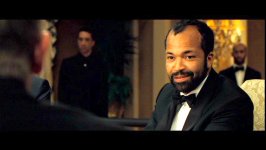
I’ll go out on a limb and say that if Quantum of Solace had to be the first ever anti-American Bond film, it’s appropriate that the task of sticking up for America’s good name should fall to a black Felix Leiter. Those who hold themselves out as representatives of black America often don’t have much good to say about America, but that was not always the case, and if I may trust my personal experience, I find black Americans to be among the most intensely patriotic. Indeed, they’re almost the last sizeable population group among the core politically left groups who obviously mean it with all their hearts when they protest that they, too, love their country. And that’s not at all surprising – around the world, we are discovering that those who have been deprived of their liberties are the ones who cherish them most, while those who have long enjoyed liberty come to take it for granted. Why should we surprised to discover this at home? True, it was against American oppression that American blacks had to fight to gain their liberties, but now that they have liberty, they cherish it, and will not allow it to be lost. And they know that America, even with all it has done wrong, stands for liberty as no other nation does, or ever has.
But now, again, back to the flaws.
I think the main flaw in Quantum of Solace is the mandate that a sequel must be bigger and flashier than the original. Where Casino Royale centered around a card game and gave us intrigue, cunning, dialouge, and character development, Quantum of Solace is nonstop car chases, explosions, etc. Everything has to be bigger and blow up more spectacularly. That just doesn’t leave any time for the revenge plotline to develop properly.
This flaw is badly exacerbated by the poor editing and bad pacing of the action sequences. Each individual camera shot is too short, while each action sequence as a whole is too long. Because of the rapid-fire editing that spoils so much of the action, someone has called this “Bond for the ADD generation.” But I disagree; no one with ADD would have had the patience to sit through these interminably long action sequences. I barely had the patience to sit through them myself.
I wish I could say that this movie is good but not great. As I said, it’s not a bad movie. I enjoyed watching it, for the most part. But I just can’t bring myself to type that it’s a good movie. Looking at my grand unified field theorem of Bond movies, I’d have to say that where Casino Royale was “Reboot Awesomeness,” Quantum of Solace has skipped right past the “Still Good” phase and landed squarely in “Passable,” alongside The Spy Who Loved Me and The World Is Not Enough. That doesn’t bode well for the next one.
But remember the tagline to the end credits of every Bond movie: “James Bond will return.” And so he shall.
5 Comments | Pass the Popcorn | Tagged: Best of Greg, Greg Forster, James Bond, Pass the Popcorn, Quantum of Solace | Permalink
Posted by Greg Forster
You are currently browsing the Jay P. Greene's Blog blog archives for December, 2008.

 Jay P. Greene's Blog