Jules and Ringo on the Week in College Football

October 19, 2014

(Guest Post by Matthew Ladner)

C’mon Yolanda- what is Fonzie like?!?

Cool?

Correcto-mundo! And that’s what we’re gonna be, we’re gonna be cool. Now Ringo, I’m gonna count to three, and when I do, I want you to let go of your gun, lay your palms flat on the table, and then tell me what happened in college football this weekend. But when you do it, do it cool. Ready?

What?

Say what again! I dare you! I spent the weekend detailing a car with a toothbrush, I missed all the college football games and I am NOT IN THE MOOD. One, two, THREE!!!

Alright mate (puts gun down)

Good- now tell me what happened.

So…it breaks down like this- Florida State beat Notre Dame on a controversial late call, but it probably doesn’t matter ’cause the selection committee is going to recognize the fact that the Irish outplayed the Seminoles on their home field. So if the Irish win out, I think they will still make the playoff. IF they do, they might get the chance to play FSU on a neutral field.

I would like to see that! Go on….

Oklahoma got beat by Kansas State, so that’s their second loss and they are out unless things go 2007 levels of weird. Baylor also had their first loss at West Virginia, and they looked bloody sloppy doing it.

Would you say that they are eliminated Ringo?

No I would not say they are eliminated, but they had better get their act figured out quick because TCU and Kansas State will be competing with them for a Big 12 birth, if there is going to be a Big 12 birth. TCU looked really strong beating up on Oklahoma State.

Too bad they blew that huge lead last week. What about the Big 10?

Michigan State, Nebraska and Ohio State all beat middling conference opponents, but that will all sort itself out eventually. They all have lost a game already so no guarantees.

How about the West?

Oregon, Utah and Arizona State are still in the running after victories this weekend. Arizona was off this week but also has only one loss.

What else happened this weekend? Anyone send a message? I mean besides Florida State?

Alabama sent one loud and clear by beating Texas A&M 59-0.

59 to nothing? Just a couple of years ago they were selling t-shirts claiming that A&M was like the moon ’cause they ‘control the Tide.’ Well well well- a’int nobody gonna shepherd them through the valley of SEC West darkness!

They’ve been blown out three weeks in a row…

THREE.WEEKS.IN.A.ROW! That is just inspiring. Now…reach in the bag and hand me my wallet.

How will I know which one it is?

You’ll know it when you see it.

(Finds wallet)


Now this is the situation. Normally both of you would be dead as fried chicken. But you happened to pull this while I’m in a transitional period. I don’t wanna kill ya, I want to help ya.  What’s in my wallet Ringo?

Don’t you mean ‘what’s in your wallet’ mate?

Don’t get cute Ringo- open the wallet!

(Opens wallet)

Two tickets to the college football national championship game in ATT stadium?!?

Correct. Put them in your pocket Ringo-they are yours. Now with the rest of them wallets and the register, that makes this a pretty successful little score. I ain’t just givin’ it to you. I’m buyin’ somethin’ with those tickets. Wanna know what I’m buyin’ Ringo?

What?

I TOLD you NOT to say that!!!!

Sorry!

Your life Ringo. I’m givin’ you those tickets so I don’t have to kill you. You read the Bible?

Not regularly.

There’s a passage I got memorized….nevermind, it’s not a real verse anyway. Take the tickets and get out of here before I change my mind. I’m almost certain that the Tide will be rolling into Jerry-world so you’d best get out of here before I snap out of it.


Pass the Popcorn: The Red Violin

June 26, 2009

Title Screen

(Guest post by Greg Forster)

I don’t get to see many movies anymore – at least, not many by my standards. And when you can only see maybe four to six movies a year in the theater, you’re going to end up seeing the obvious ones – Batman, Star Trek, whatever Pixar does this year, etc.

But there was a time when we used to see a lot of movies. And that meant we had the luxury of picking through the enormous pile of garbage that is the arthouse and finding the few movies that make the arthouse worth going to. So I’m going to start using our Pass the Popcorn feature to show off some of our “finds,” in the hope that they won’t fade too far into obscurity.

The Red Violin

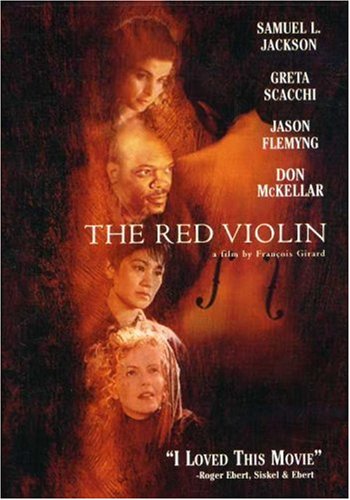
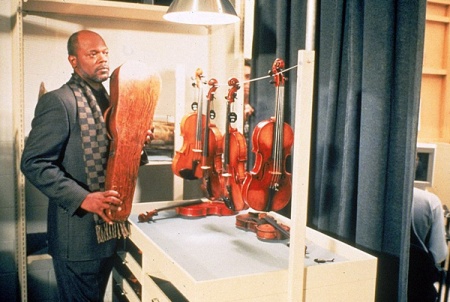
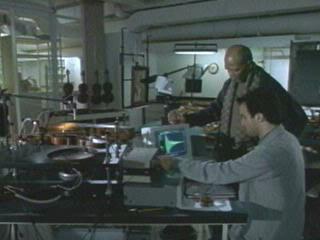
The Red Violin stars Samuel L. Jackson as the most badass professional musical instrument appraiser you will ever see depicted on screen. I’m serious, don’t mess with this guy. At one point a clerk fails to deliver an important package to him promptly, and he tears into the clerk so hard I thought he was about to start reciting passages from Ezekiel.

Jackson & violins

“And you will know my name is the LORD when I lay my violin upon thee!”

OK, now that I’ve sold Matt, here’s what the rest of you need to know.

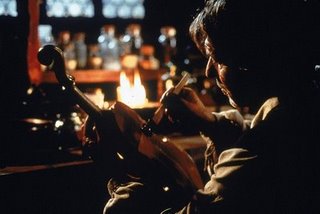
The movie tells the story of a violin that was created by a Renaissance Italian craftsman as his greatest masterwork. Over the course of the movie, the action shifts back and forth between three storylines.

Making the violin 2

In 17th century Italy, we see the craftsman’s initial aspiration – to create an instrument worthy of his love for his unborn child, due to arrive any day, to whom he intends to give the violin as a gift. But in a surprise twist at the end, the violin comes to have a different, but equally profound, significance for him.

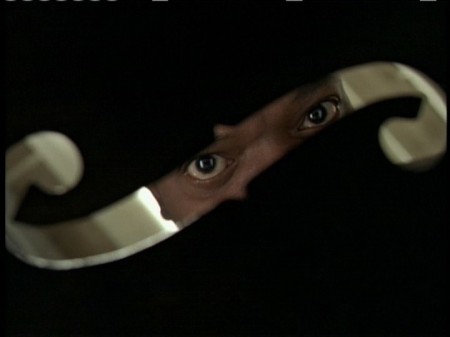
Jackson peeking

In our own time, the violin is going up for auction. Everyone else thinks the violin is nothing special, but badass appraiser Samuel L. Jackson suspects otherwise – that it may be the long-lost “red violin” made by that famous Italian craftsman. Once the truth becomes known, everyone wants the violin – but nobody other than Jackson wants it for the right reason, leading to a surprise twist at the end in which Jackson triumphs over the greed and pride of his adversaries.

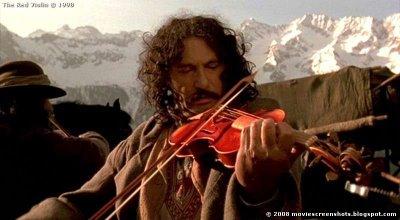
Gypsy

In between, we see what happened to the violin as it travelled around the world between its creation and its eventual rediscovery. Each vignette in this storyline illustrates the characteristic ways in which different civilizations have responded to the mystery of great art.

Kaspar dressed up

18th century Vienna is so obscessed with technical skill that art is reduced to mere performance – the ability to play very complex pieces very fast is valued above beauty. Following this path ultimately leads to the reduction of art into the novelty act of child prodigies – because the younger you are, the more amazing your skill is, and that’s all that counts. Form obliterates matter, and since form can’t exist without matter, it obliterates itself, ending in tragedy.

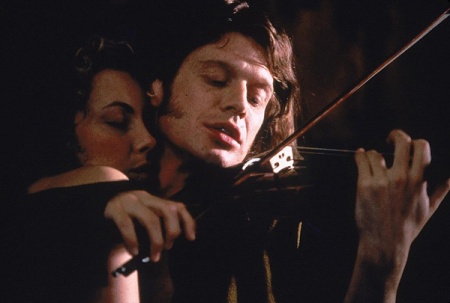
Victorian couple playing violin

In Victorian England, by contrast, “art” is put up on a pedastal and idolized. “Creativity” is fetishized to the point where mere novelty and thrill displace beauty, just as mere technique had displaced it a century earlier. Craftsmanship goes out the window in favor of irresponsible artistic self-indulgence. Matter obliterates form, and since matter can’t exist without form, it obliterates itself, ending in tragedy.

In China with violin

In 20th century China, during the cultural revolution, just to have an interest in art as such is a life-threatening proposition. The state holds that art, like everything else, exists only for political ends, so the desire to make art for the sake of beauty is an act of treason against the people. Far worse to make art that has western origins, given the regime’s awkward attempt to fuse its totalitarian ideology with crude appeals to nationalistic Chinese chauvanism. Yet in the end, the totalitarians prove as incapable of eradicating the desire for beauty as they are at eradicating any of the other fundamental desires of human nature.

Jackson & restorationist

What do we want beauty for? All answers other than “we want it because it’s beautiful” ultimately prove futile. The goodness of beauty, like the goodness of knowledge or the goodness of virtue, is categorical. Make it instrumental towards some other good and you destroy it.

What, then, should we do with beauty when we find it? To that, the movie has a definite answer, and I think it’s exactly the right one. But to find out what it is, you’ll have to see those two surprise twist endings I mentioned earlier – and I’m not spoiling them for you. Go rent it and find out.


Fifteen Years of Pulp Fiction

June 5, 2009

(Guest Post by Matthew Ladner)

This year marks the 15th anniversary of Pulp Fiction. I can’t believe it either.

Pulp Fiction was a pop-culture phenomenon, not only resurrecting the career of John Travolta, but elevating the careers of several others, especially the brilliant Samuel L. Jackson.

I’ve met people who were repulsed by the grisly violence, foul language and drug use of the film. I’ve encountered others who claim that Resevoir Dogs is a better film (nonsense). Others like the film for the grisly violence, foul language and drug use, but I don’t believe they actually appreciate the film to the fullest.

You see, I believe that despite all of the hipster post-modern lingo, heart stabbing injections, Deliverance references, etc. that Pulp Fiction is actually a film about redemption.

Tarrantino used two main devices to tell this story: a fake Bible quote and non-linear storytelling.

Samuel L. Jackson’s hitman character Jules recites a manufactured version of Ezekiel 25:17 before killing people:

Along the way, Jules experiences what he regards as a miracle and decides to abandon the life of a hit man to “walk the earth” in a way that has echoes of the lillies of the field. Vincent Vega, Jules’ partner in crime ridicules him for choosing to become a bum.

The brilliance of the non-linear story telling is that the viewer knows that Vincent will soon be bleeding to death in a bathtub after being shot multiple times. We don’t know what happens to Jules, but we do know what happens to Vincent. The wages of sin, in other words, are death.

This becomes all the more clear when Ringo attempts to rob Jules in the diner:

Jules is trying real hard to be the shepard, and whatever happens to him, it’s better than what happens to Vincent.

This is how I interpreted Pulp Fiction, and I was relieved to see the Thomas Hibbs offer that the film can be interpreted in this way in his brilliant book Shows About Nothing: Nihlism in Popular Culture from the Exorcist to Seinfeld.

Tarrantino seems to be an unlikely source for a covert religious allegory, but there it is, hidden in plain sight.