Pass the Popcorn: Urban Cowboy

August 28, 2008

Mia says there is a twist contest going on down at Jack Rabbit Slim’s. How about we blow this joint?

(Guest Post by Matthew Ladner)

So I grew an hour and a half to the east of Houston in Southeast Texas, near the border of Louisiana. Despite this fact, I had never seen Urban Cowboy well into my late 30s. I suppose I lacked an appreciation for country and western music in my youth, and more or less avoided the film.

In my late 30s however, I chanced upon the flick while flipping channels. A&E had a “Pop Culture Weekend” and had included the John Travolta-Debra Winger masterpiece. The movie was near the end, and I happened into it just as John Travolta told Debra Winger:

“Sissy, I wanna ‘poligize to you clear back to the first time I hitcha!”

My jaw dropped.

I asked Mrs. Ladner, who grew up in the Houston area, had seen the film, and had even rode the mechanical bull at Gilly’s in high school “Did he just say I want to apologize to you clear back to the first time I hit you?”

Mrs. Ladner said yes, indeed, that is exactly what he said.

I was speechless.

Next, A&E ran a commercial: coming up next on A&E Pop Culture Weekend: Urban Cowboy with John Travolta and Debra Winger!

I told Mrs. Ladner “I’m going to make pop-corn- this is a train-wreck I have got to see!”

What can I say? Urban Cowboy did not disappoint.

So, here’s the basic plot: John Travolta plays a small-town Texas good ole boy (Bud) who moves to Houston during the oil boom of the early 1980s to work in a refinery. Bud starts hanging out at the eponymous Gilley’s dance hall. Along the way, Bud meets Sissy, played by Debra Winger. Bud and Sissy get married on the dance floor at Gilley’s and begin a brief period of marital bliss.

Ah, but turmoil soon strikes the House of Bud. A dispute soon ensues over who can ride Gilley’s mechanical bull better. When Sissy claims that she can ride it better, Bud views it as justifiable homicide, but lets Sissy off with a mere beating out of the pure goodness of his heart.

The couple begins a period of estrangement. Bud hooks up with an Oil Princess, Sissy with Bud’s wicked rival, a prison rodeo villain Wes played by the great Scott Glenn (who you will remember as the Captain of the Dallas in The Hunt for Red October).

Despite the fact that they are, well, divorcing, Bud and Sissy both still spend each night at Gilly’s, which seems to have the property of drawing them like moths to a flame, regardless of the situation in their personal lives. This makes for a number of evil glares and dramatic grudge fulfillment episodes on dance floors, bedrooms and mechanical bulls.

In the end, Bud recognizes the error of his way; Wes turns out to be an even bigger woman beating pig than Bud. Bud not only wins the mechanical bull riding contest, but foils his evil rival’s attempt to rob Gilley’s and make off to Mexico with the loot and a kidnapped Sissy.

Bud spits out his regrets, and Sissy says something to the effect of “You had me at ‘pologize!”

Wow. Just Wow.

A few items of note- as a Texan, I can report that Travolta’s accent wanders in and out of authentic. Debra Winger received a Golden Globe nomination, and was in fact pretty convincing as a wild Texas honky-tonk woman.

Overall, this movie is chock full of stereotypes. As The Quiet Man is to the Irish, Truck Turner was to 1970s urban America so too is Urban Cowboy to Texas. Not that there isn’t some fire to that smoke, mind you, but this movie goes waaay over the top.

Urban Cowboy was the last of a string of trend-setting movies for Travolta, with Grease and Saturday Night Fever also inspiring pop-culture fads. Of course, Travolta revived his moribund career from movies about talking babies with Pulp Fiction but sent it back into a funk somewhere around Battlefield Earth.

The time between Urban Cowboy and Pulp Fiction (made in 1980 and 1994, respectively) happens to equal the time between Pulp Fiction and now.

So get ready, America is overdue for another Travolta pop-culture phenomenon. In the meantime, watch Urban Cowboy, the number one seed in South in the “so bad that it is good” tournament.

Careful though: if you suggest that Xanadu or Starship Troopers might be even more delightfully awful, Bud is likely to get medievel redneck on you and beat you to a pulp.


Pass the Popcorn: City of the Dark Knight (Issue #4)

August 22, 2008

(Guest post by Greg Forster)

After my two initial Pass the Popcorn entries on The Dark Knight, outlining what I thought was the main theme of the movie, I decided to let that go for a while rather than harp on it after I had already said my piece. But I always knew that after I had spent a while meandering around other topics, I would circle back around to the heart of the movie – the moral hypocrisy of all human beings and all civilization.

In the interim, the death of Aleksandr Solzhenitsyn has provided a reminder of just how perennially true and relevant the movie’s observations are. If any man of our time was ever entitled to treat his enemies as simply evil and his own side as simply good, surely that man was Solzhenitsyn. But, to the contrary, he made a point of not losing sight of the real basis of evil in the moral corruption that is endemic to our species, and that is one of the reasons his intellectual legacy will live on well beyond the context of the particular historical conflict in which he participated. To say it again, if any man was entitled to treat some people as “basically good” and other people as “basically bad,” he was – but the whole point is that no man is in fact entitled to do so.

Solzhenitsyn expressed the key insight succinctly yet beautifully:

“The line between good and evil passes not through states, nor between classes, nor between political parties either – but right through every human heart.”


I anticipate (without ruling anything out) that this will be my last PTP entry on The Dark Knight, at least for a good while. I’d like to end where the movie ended.

To recap the central point of my first post quickly: All human beings are both good and evil, but it isn’t in their nature to admit this about themselves; hence the ubiquitous fiction that “people are basically good.” People tell themselves this ultimately because it allows them to avert their gaze from their own corruption. The outcome of this is the outrageous extreme of moral hypocrisy that is easily observable (provided we’re willing to look without flinching) both in every individual person (no exceptions) and in society as a whole. In this movie, we see it play out on the individual level with the Joker’s desire to induce Batman to kill him, and at the social level with the fact that the whole restoration of Gotham City rests on the reputation of Harvey Dent – because people need heroes. Why do people need heroes? Because they’re not “basically good.” If people were basically good they wouldn’t make their support for civic justice conditional on the moral purity of some fallen human being. The very fact that people need to be rallied to support justice shows how far from real righteousness they are.

The Joker has our number:

“When the chips are down, these . . . these ‘civilized people’ . . . they’ll eat each other.”

So did Harvey Dent, in his way:

“You either die a hero or you live long enough to see yourself become the villain.”

One thing I didn’t comment on earlier is what Gordon says at Dent’s funeral. I noticed it especially the second time I saw the movie. If memory serves, Gordon says of Dent that “he was the hero we deserved – no more.” No more? Shouldn’t that be no less? Or is Gordon slyly reaching out to the few people in Gotham who know the truth, reassuring them that at least somebody realizes what’s really going on – that Dent was the hero Gotham deserved in the sense that Gotham deserved a man who really, really wanted to be good but ultimately failed to live up to his own standards, because that’s exactly how Gotham itself behaved?

As I wrote before, one of this movie’s biggest strengths is that it doesn’t attempt to convince us that it’s a good thing that people need hypocrisy. It’s a bad thing – it’s a sign of how evil we are – that people need hypocrisy.

But since people do in fact need it, it may not be wrong to supply it.

That last assertion is the thought the movie ends on, and it’s where I stopped my first post, saying “hold that thought.” Well, I’ve been holding that thought for a month and a half now. It’s time to unpack it.

Is it wrong to supply hypocrisy? We might answer by saying that if it is, we’re all totally screwed. On the evidence, it appears that no civil order of any kind can long survive without falling back on collossal heaps of hypocrisy.

I’m not even talking about the kind of rank everyday hypocrisy that hits you in the face every time you pick up a newspaper. Although there’s always plenty of that – obviously. Take the frenzy over the past month against “speculators” who have, according to both presidential candidates and most of our other leaders, driven up the price of gas. It’s an old social science maxim that you should never posit malice if ignorance covers the facts, but can John McCain and Barack Obama and all the rest of them really be as ignorant as all that? As Chrales Krauthammer wrote recently: “Congressional Democrats demand . . . a clampdown on ‘speculators.’ The Democrats proposed this a month ago. In the meantime, ‘speculators’ have driven the price down by $25 a barrel. Still want to stop them? In what universe do traders only bet on the price going up?”

It beggars belief that our leaders don’t know exactly what they’re shoveling here. And this is just one issue out of hundreds where the same dynamic occurs. Is there a single political issue where the public discourse isn’t dominated by claims that can’t possibly be believed by those who make them? Not for nothing did Michael Kinsley define a “gaffe” as when a politician accidentally tells the truth. But Mickey Kaus strikes nearer to the mark when he says that Kinsley’s definition ought to be expanded to include all cases where a politician accidentally says what he really thinks, whether true or not.

But that kind of hypocrisy doesn’t go to the roots of social order. Although its omnipresence would be sufficient to prove the universality of some type of corruption in human nature, from a standpoint of the political system it’s an epiphenomenon.

The real hypocrisy runs deeper. It was well captured a while back by an old college acquaintence of mine who subsequently served for a while as a small-town prosecutor. Please read this brutally honest essay in which he reflects, after having left the job, on the nature of his service representing the people in our courts:

We who deal in the laws of a free people are puppeteers. We must be so . . . because our system works better than any other, and because we have no choice but to make it work. We have to give the appearance that we possess the wisdom and authority needed to make our society function. We have to make believe that our culture possesses an exclamation point as strong and as firm as the question mark of [classical] liberalism. So on with the courtroom pomp and ceremony, on with the bluster and posturing! . . .

Men who doubt themselves need puppet shows. They need little passion plays to affirm the dignity of a frequently silly and corrupt form of governance, lest something more dignified but less humane rise to power. Ours is a system of laws administered by flawed and small-souled lawyers to foolish and wicked men; such a system cannot survive without the pantomimes of solemnity.

And note that he has (as far as I can tell) no regrets about having chosen to serve in this capacity. As he says, our system is better than the alternatives (i.e. “something more dignified but less humane”) and given the realities of fallen human psychology this is what it takes to sustain it.

It was with this in mind that I chose the title “City of the Dark Knight” for my mini-series on this movie. The title is meant as a tribute (an obscure one, no doubt) to Augustine, whose political theory I was reminded of by The Dark Knight’s unflinching meditation on society’s hypocrisy. Augustine works so hard to puncture the Romans’ ridiculous charade of virtue and honor not because he hates them – he loves Rome dearly – but because penetrating the mask of society’s pretense of righteousness is for him (as it was for Plato) the first step to any serious wisdom about justice. The fundamental political reality is that people are neither “basically good” or “basically bad.” We tend to associate the observation that if people were “basically good” there would be no government with Madison’s Federalist #10, but I think (though I’m open to argument) that Augustine is the real source of the insight. And there would equally be no government if people were “basically bad,” since people with no natural idea of justice would never develop a system for enforcing justice (however intellectually impressive Hobbes’s attempt to argue the contrary may be). Though Augustine doesn’t put it in exactly these words (or not that I recall), I think we can say that for him politics is a manifestation of the ongoing tension between the image of God that was planted in all men at creation and the moral corruption that was planted in all men at the fall.

And this, if I may be autobiographical for a moment, is why I fled screaming from Washington after spending a year between college and grad school working there. When people with little experience of academia hear that I have a Ph.D. in political science, about 50% of the time they immediately ask me “so are you going to run for president?” Set aside for a moment the charming naivete that associates the pursuit of a Ph.D. in political science with ambition to public service. More to the point is the fact that I could never serve in public office because I couldn’t practice the hypocrisy that all public servants, seemingly without exception, must practice on a regular basis to do their jobs.

Yet though I am not the man to do it, I can see clearly the necessity of maintaining the hypocrisy. Classically, “prudence” was identified as one of the four cardinal virtues. We have a moral responsibility to consider the outcomes of our choices and act so that we aim for those outcomes to conform to the proper ordering of ends (i.e. goals or purposes). Can it really be our responsibility to rank candor above the preservation of humanity? For a long time I was spellbound by Kant’s iron declaration “let justice be done though the heavens fall.” It would be a worthy resolution if “justice” meant simply “goodness” or “righteousness,” that is, virtue as such – including prudence. But “justice” is not virtue as such, it is only one of the virtues. And as Aristotle observed, only virtue as such can be pursued without limit. You can’t go “too far” in the right direction. But any partial good, as opposed to good as such, can be pursued too far – that is, to the exclusion of other partial goods that ought not to be excluded. Hence Kant was actually driven to the insane extreme of preferring the destruction of the universe to the utterance of a single false statement.

The healthy conscience recoils from Kant’s famous statement that if a man intending to murder your friend asks whether your friend is home, and he is, you should tell the truth. (For a while I wondered whether this claim was misunderstood – in the 18th century, gentlemen were usually armed, so when Kant said that you shouldn’t compromise your honor by lying, was he assuming that you would just shoot the guy instead? But when I shared this speculation with a friend, he pointed out that while gentlemen in 18th century England were usually armed, that wouldn’t have been the case in 18th century Prussia.)

And Kant’s dilemma of whether to lie to the murderer is, ultimately, the choice Batman and Gordon must make at the end of the movie. The “murderer” in this scenario is Gotham City itself – which threatens to give up on its own salvation unless it is told the lie that Batman and Gordon choose to tell it.

With that, I’ve said my piece. (Again.) Next week, on to other movies.

UPDATE: Well, I hadn’t quite said my whole piece. See here for the next chapter.


Pass the Popcorn: Starship Troopers

August 15, 2008

I’ll be redeeming myself in Harold and Kumar. I don’t know about you two.

(Guest Post by Matthew Ladner)

Last week, we had the number one seed in the East for the greatest so-bad-its-good movie: Xanadu.

This week, the number one seed in the North: Starship Troopers.

Starship Troopers was actually an interesting book, written by a libertarian but denounced as totalitarian. The book raises a number of interesting questions about the obligation of the individual to the state and whether citizenship should be earned rather than automatically granted.

Forget all of that in the movie though, this movie should have been called 90210 Pretty Kids vs. The Giant Space Roaches from Hell.

You get it all in this one folks: violence galore, hearbreak and drama, arms and legs chopped off by cgi bug-monsters, casual use of tactical nuclear weapons, Doogie Hauser MD as a pyschic kid who dresses like a Gestapo agent, and more. Did I mention violence?

So the basic plot is that humanity fights a war against a race of killer bugs from outer space. It’s kill or be killed pretty kids, so wipe them all out! The movie is moved along by a series of faux war propaganda pieces. In this one, you more or less get the beginning of the film:

Hollywood cheese galore is worked into the plot, including a romantic triangle or two and a high-school teacher turned psychopath alien killer. Life is too short not to watch movies like this, that is if you like movies about Dawson’s Creek trying to wipe out an entire species with machine guns and nukes.


Pass the Popcorn: City of the Dark Knight (Issue #3)

August 8, 2008

(Guest post by Greg Forster)

We’re now on our fourth issue of the series and we haven’t said anything yet about Heath Ledger. That was intentional, for three reasons.

First and most important, there’s not much interesting to say, or at least not that I can say. It’s obviously a virtuoso performance, and would have been a career-making breakthrough. Ledger was clearly one of the most talented performers of his generation, and it’s a shame he never reached his potential until the end of his abbreviated career.

Beyond that, what’s to say? If I were in the acting business, I could no doubt analyze the performance and say more about what makes it great. But I lack even the rudamentary ability to do so, and I’m not interested in bluffing.

Second, too much of the chatter about Ledger and this performance is shallow and feels exploitative of his death, and I don’t want to contribute to that.

And third, I think Ledger’s masterpiece contribution is overshadowing other contributions. I don’t want to take away any of the honor Ledger has justly earned, but for this movie to be what it is, a whole lot of people had to turn in top-flight performances.

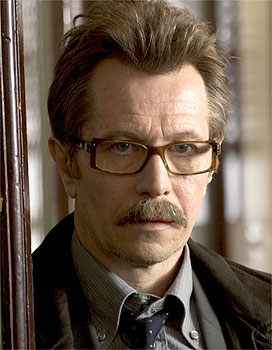
Back in Issue 1, commenter Captain Napalm mentioned Aaron Eckhart and Gary Oldman – both of whom were indeed outstanding. I’ve just praised Morgan Freeman in Issue 2, and Michael Caine’s contribution shouldn’t be overlooked – one of the most important differences between a good film and a great one is that all the little things are done right, as well as the big ones. Caine and Freeman didn’t get the big drama, but they delivered fantastic little gems – “We burned down the forest” is one of the most memorable moments in the movie. So is “You have no idea.”

Everyone – by which I mean the handful of movie geeks whom I personally know – seems to agree that Christian Bale had essentially nothing to do in this movie. The first movie was about Batman, not the villains, so the villains were (as I mentioned last time) unmemorable. This movie was about the Joker, so Batman was unmemorable. But serving as the Joker’s foil is something. The Joker carries the movie, but he can’t do that if Christian Bale doesn’t act well his part, wherein all honor lies. Imagine this movie with Ledger playing opposite George Clooney – or even Michael Keaton, who I thought did surprisingly well as Tim Burton’s Batman, but would have been totally inappropriate as Chris Nolan’s. (And let’s also acknowledge that “I’m not wearing hockey pants” was well delivered.)

And naturally we should be crediting Chris Nolan. Having done a little amateur acting, I know how much a director contributes to an actor’s performance – or doesn’t. When any six actors, even six really good ones, all deliver a top-notch ensemble performance, it’s as much the director’s work as theirs.

Above all, though, we should be thanking the writers. Think about every scene you remember of Ledger. Isn’t it the brilliant lines as much as the brilliant performance that make this movie so amazing? “When you think about it, I knew your friends better than you did. Would you like to know which of them were cowards?” That’s really brave writing. And of course, all those clever one-liners we’ve been taking notice of in this and previous issues had to come out of somebody’s keyboard before they could come out of Morgan Freeman, Michael Caine, etc.

You do know who wrote the movie, don’t you?

Chris Nolan shares the screenplay credit with his brother Jonathan Nolan, and shares the story credit with David Goyer. The Nolan brothers also co-wrote Memento and The Prestige (which came out between Batmans). Goyer has a long track record on comic book movies that includes Blade and co-writing Batman Begins with Chris Nolan, as well as sole story credit on Batman Begins. And of course Frank Miller should get a nod for his influence.

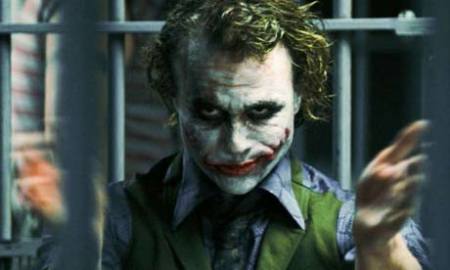
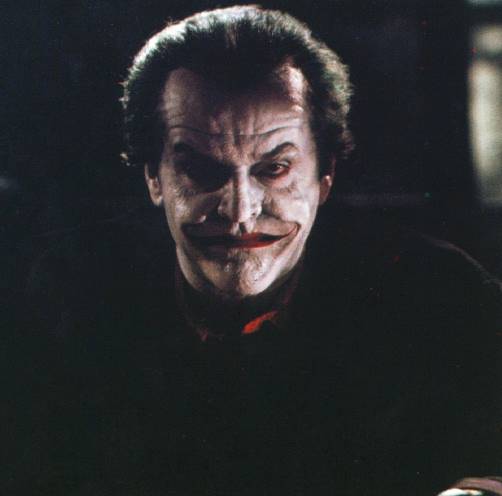
All that said, Ledger did pull off an amazing feat. In addition to what’s on the screen, consider how much prior baggage he had to overcome with the Joker character:

First Appearance!

The Clown Prince of Crime

The Ultimate Psychopath: “Whatever’s in him rattles as it leaves.”

The Outer Edge of Insanity

(Wrong “Joker,” moron!)

A lot of people thought no one could play the Joker after Nicholson, particularly not the star of A Knight’s Tale. Nicholson himself, for one. He said as much, as The Dark Knight was approaching release. I wonder if he repented after he saw the performance.


Pass the Popcorn: Xanadu

August 8, 2008
Nice leg-warmers

Bad movie, but nice leg-warmers

(Guest Post by Matthew Ladner)

So all the movies I’ve seen lately have been in the fair to mediocre or worse categories, so let’s try something different with the greatest they’re so bad that they are great films. Holding down the number one seed in the Eastern bracket: Xanadu.

Where does one even start in describing the horrible greatness of Xanadu? Perhaps with the plot, such as it is? Okay, why not?

So there is this frustrated album cover artist who tears up a sketch and throws it out the window. The wind takes the pieces across town to a mural of the Twelve Muses, who magically come to life to the sounds of the Electric Light Orchestra!

After dancing around a bit, the Olivia Newton John muse roller-skates off to help her frustrated artist find love and set up a roller disco with the help of Gene Kelly. Along the way there are a few dream sequences, random incidences of characters bursting into song and transforming into animated characters, and a confrontation with the gods of the ancient Greek pantheon.

Totally inexplicable animation sequence complete with ELO tune!

Totally inexplicable animation sequence complete with ELO tune!

Okay, so this is my guess on how this movie got made. Grease had just made a fortune, but John Travolta was off making another contender for this category Urban Cowboy. The Hollywood guys said, “okay, get ONJ, make up a plot involving roller-disco, don’t sweat the details. That guy from The Warriors can be the lead. No not the ‘Warrrriors!!! Come out to play-ay!’ guy, the strong silent type lead guy! He’s perrrfect for a musical!”

“Oh, and call Gene Kelly and get him out of retirement! Someone in this movie has to be able to dance!”

Words cannot describe what happened next, but in their place, I offer the super-duper unbelievably something final scene from Xanadu. Enjoy if you dare:


Pass the Popcorn: City of the Dark Knight (Issue #2)

August 3, 2008


(Guest post by Greg Forster)

Okay, and now for something completely different! Today we’re going to talk about Bat Gear.

What was the one thing in The Dark Knight that just didn’t work? So far, everyone I’ve talked to has the same answer, even if you don’t ask them the question – it’s the citywide “sonar.” Lame.

The first time through, it was really obtrusive – for a few minutes. One of the greatest innovations in storytelling in the last ten years is that movie and TV people have learned the value of throwing a lot of story at you and trusting you to keep up; among many other virtues, this means badly done moments in the narrative get left behind more quickly.

The second time through, I didn’t really mind. That was partly because dumb plot elements are always less obtrusive the second time around, because you aren’t being hit with the shock of recognizing their stupidity. This, for example, is why it is possible to watch the Lord of the Rings movies repeatedly without their being spoiled by a bunch of friggin’ elves marching into Helm’s Deep, or the army of the dead effortlessly wiping out the beseiging force at Minas Tirith (which means all those Rohirrim who gave their lives on the Pelannor died for nothing).

But it was also partly because the second time I saw how it was supposed to fit into the movie. Somehow, the first time through, I totally missed the “like a submarine” gag. You remember, when Lucius comes out of the evil corporation’s building in Hong Kong and shows Bruce the sonar readout:

“Sonar? Just like a . . .”

“Like a submarine, Mr. Wayne – just like a submarine.”

It just flew by and I missed it completely. (How am I supposed to catch all these little things when they throw so much at you and expect you to keep up with it all?)

Obviously they were thinking that we would buy the “sonar” because sonar fits with the bat theme. And it’s not a crazy theory. When a plot element fits the theme of the movie, artistic liberties with reality are much less obtrusive (a subject I’ve had occasion to discuss at greater length before).

But it didn’t work. And that got me thinking about the gadgets in this movie. F’rinstance, does the Bat Cycle (apparently to make it seem less fruity they’re telling us to call it a Bat Pod) belong in this movie? I mean, honestly – doesn’t it just look like the suits in the marketing department demanded that they throw in something new that would sell toys? After all, the twelve year old boys of America – who should never be permitted to see this movie under any circumstances whatsoever – are not going to shell out for another Batmobile unless it’s different from the last one.

He’s prob’ly fighting for freedom! Buy all our playsets and toys!

And the skyscraper-assault gadgets (in the Hong Kong scene and again in the assault on Fortress Joker) feel artificial, too.

But that’s not what you’d expect, is it? Gadgets belong in a Batman movie. They’re an integral part of the franchise – even more so than in the James Bond franchise.

Consider the first Batman movie – well, okay, not absolutely the first, but the first one that counts. The Tim Burton one. (The Tim Burton one that counts.) That movie doesn’t get its propers anymore, in large part because we now take for granted so much of what Burton did to define the modern comic book movie. Much of what was radical in Burton’s Batman is now so expected that it’s not even noticed.

It was a much more uneven movie than Nolan’s Batmans are – parts just didn’t work, but parts worked brilliantly. And that movie was just brimming with gadgets. The Batmobile actually did stuff – and no, going really fast and changing the driver position from Standard Seated Position to Lying Down for No Reason Position doesn’t count as doing something. Yes, okay, in the first Nolan movie the Batmobile jumped rooftops. But Burton’s Batmobile did so much more. And Batman himself used gadgets more often and it felt more natural. One of those brilliant moments that really worked was when Batman swooped in, foiled one of the Joker’s plans, and swooped out on one of his flying wires (or something) and the Joker was just so impressed that he didn’t even think about how badly he’d been beaten – he just stood there and asked: “Where does he get those marvellous toys?”

Or consider what must be the best gag ever done in a comic – from the Batman/Planetary crossover.

(If you don’t know what Planetary is . . . well, how are you even alive?)

Anyway, the Planetary crew are in Gotham chasing a man whose mind keeps opening dimensional rifts, and of course they run into Batman, who of course is chasing the same guy. But every time the guy opens a dimensional rift, they shift to an alternate reality where Batman is slightly different:


HT Planetary. How many can you identify? How many will you admit you can identify? (No fair peeking at the URLs!)

Here’s the gadget gag: Jakita Wagner, a superpowered female hero, is about to throw down with one of the badass Batmans. Then a rift opens and suddenly it’s not a badass Batman, it’s the Adam West Batman from the supercamp sixties TV show. And . . . he would never hit a girl!

So when she rushes him, he avoids compromising his honor by whipping a spray can out of his utility belt and dousing her in the face. (I always suspected the Adam West Batman was really a sucker-punching bastard.) She falls back, clutching her eyes, and Batman drops the can and springs away to chase after the rift-opening guy. As she curses him, we see the can roll into the frame.

The label on the can reads: Bat Female Villain Repellent.

I swear I Googled for probably half an hour looking for that panel, so I could share it with you. I guess you’ll have to buy the crossover instead.

But back to our subject. Gadgets not only belong in Batman, they ought to belong in Chris Nolan’s Batman. After all, this is the first movie version to include Batman’s “Q”, and he’s used to outstanding effect in both movies. What are the most memorable moments in the first movie? Liam Neeson blathering on about destroying Gotham? Dr. Crane attacking people with his fear drug? No, that movie had some of the least interesting villains ever to appear in a comic book movie. (Not a criticism – that movie was about Batman, not about them.) What you remember is: “Oh, the tumbler? You wouldn’t be interested in that.” And: “Just don’t think of me as an idiot.”

And Chris Nolan clearly knows how to get the best out of Morgan Freeman, because he’s used just as well in the new one. That “your plan is to blackmail this person?” speech is priceless.

Come to think of it, in the first movie Batman used a “bat caller” gadget to produce a swarm of bats where he needed it. It was ridiculous, of course – but it fit the theme of the movie, especially in that it was trying to explain why Bruce Wayne chose to dress up like a bat when fighting crime. Being attacked by a swarm of bats would tend to put the fear in you.

So why didn’t the gadets work in this one? The first thought to occur to me was that they were trying to force the citywide sonar to perform an awkward plot function – they wanted to abruptly set up a little mini-debate between Batman and Lucius on the whether it’s OK to spy on the whole city. But frankly, I don’t really think that’s it. I think citywide sonar would have failed even without that scene. (Speaking of which, when I first saw it, I thought that Lucius’s position was “This is wrong, but I’ll do it just this once,” which of course is a contemptable position. But that’s not what he says, as I discovered upon seeing the scene a second time. I think his position is really “This is OK as a one-time deal, but it would be wrong to use it on an ongoing basis.” I’m inclined to think that if it’s OK as a one-time deal, it’s hard to justify throwing it away, especially in a city that seems to attract supervillains like a magnet – but it’s not a contemptable position.)

Maybe – and I’m not sure about this – maybe it’s just that they obviously could have accomplished the same thing with less tampering with reality. Batman could have simply set up a computer to scan all phones for the Joker’s voice. And they could still have worked in the bat/sonar theme by equipping the Batsuit with its own sonar, which he could then have used in the Assault on Fortress Joker scene.

Like I said, I’m not sure. Theories?

(Oh, and I’m still hoping somebody can help me with the tally on Dent’s body count. I’m one cop short.)


Pass the Popcorn: City of the Dark Knight (Issue #1)

July 28, 2008

(Guest post by Greg Forster)

Well, it’s not as good the second time you see it. It’s better!

See here for the premiere installment of the PTP: City of the Dark Knight series. Oh, and: Spoiler alert (duh).

This time I caught a lot more of the “moral hypocrisy” theme being set up earlier in the movie. It’s not as clear when you don’t know yet how significant it’s going to be later. But they’re clearly telegraphing that the restoration of moral order in Gotham is requiring some compromises of the rules – for example, this flew by me the first time, but Dent brings that mass prosecution of criminals knowing full well that he can’t make most of the charges stick. He argues to the mayor that they should go forward with prosecution anyway, because most of the bad guys won’t be able to make bail (Batman, Gordon and Dent having taken away most of their money) and thus will have to sit in the slammer while the cases grind through the system. “Think what you could do with eighteen months of clean streets,” Dent tells the mayor. Wrong? Not necessarily. Politics is the art of the possible. But it’s bending the spirit of the law.

Also, notice that Gordon tells his people to lie to the media about Dent’s disappearance. I did notice this the first time, and I thought about it for all of five seconds or so, and then I had to keep up with the movie. The second time, it stands out more as part of the hypocrisy theme.

Perhaps the most important thing I caught this time around is why Dent blames Gordon and Batman for what happens to Rachel. It’s because Gordon built his Major Crimes Unit by including officers who were under a cloud of suspicion. This is another “moral compromise” narrative. Confronted about it at the beginning of the movie, Gordon first insinuates that when Dent was at Internal Affairs he had been bringing bogus corruption cases against clean cops in order to build his career. (At first I thought this might be a signal from Chris Nolan that the movie is right-wing, because prosecuting innocent people to build a career was always the right’s complaint about Eliot Spitzer. But then I remembered that Rudy Giuliani did the same thing.) However, Gordon seems to concede pretty quickly that his MCU does contain some shady characters. He says something like, “I have to do the best with what I have to work with.”

I also caught that they’re telegraphing from early on that Dent is not all he appears to be, morally speaking. The first time I saw the movie I wanted them to do more to establish Dent’s fall – he seems to go over to the dark side pretty quickly. But now I see that he was never really that good to begin with. That, plus it occurred to me that the “Two Face” Dent is still fighting for justice in his twisted way. He’s hunting down the people he blames for Rachel, subjecting each of them one by one to the judgment of the coin.

And now for something completely different: I noticed this time that the guy on the prisoners’ boat who throws the detonator out the window has a damaged right eye (his right, our left). I got really excited by this. I thought, where else in this movie did we see a black criminal have somthing happen to his eye? That’s right: “I’m going to make this pencil disappear!” So I thought: the Joker’s goal is to corrupt everybody. But what if one of his victims found himself forced to reexamine his life while sitting in the prison hospital, and he became good because of the Joker’s actions – and that same person’s goodness was the reason the Joker’s ferry experiment failed? Layers within layers within layers!

But, alas, I was barking up the wrong tree. Somebody has posted the pencil scene on YouTube, and it’s clearly not the same actor. Oh, well.

One more thing: I found an easy way to remember the mobster’s name, the one I couldn’t remember in my previous post. It’s Moroni – the same name as the angel who allegedly revealed the Book of Mormon to Joseph Smith. How’d that happen? Was the entire Warner Brothers marketing department asleep?

Let me close with a bleg: At the end, Gordon says that Dent’s rampage produced “five people dead, two of them cops.” I count Moroni’s driver, Moroni himself (assuming he died in the car crash), the first of the two crooked cops, and Dent himself. But the other cop won the toss and just got knocked unconscious. So that’s four people, one of them a cop. Whom am I missing? Are we supposed to assume Dent found a way to finish off the second cop despite the toss, just like he found a way with Moroni (assuming that’s what happened)? Is this a goof? Or what?


Pass the Popcorn: City of The Dark Knight (Issue #0)

July 25, 2008

New PTP Mini-Series, Issue #0 – Rare Collector’s Item!

Have you been regressing endogenous variables again?

(Guest post by Greg Forster)

It’s too much.

I mean, too much for one blog post. Last Friday I lightheartedly left a comment on Matt’s PTP entry promising to have my Batman post up by Monday. Surely, I thought, I’d be so juiced after the movie that I’d run straight back to my computer and blog until my fingers bled.

But no, this was a very dense movie. Chris Nolan is ambitious, and the movie vindicates his ambition triumphantly. After the movie, I was unable to talk much about it – because there was too much to digest. And by the time I was ready, I had already forgotten half the thoughts I’d had during and right after the movie. Clearly this is a work that’s going to repay a lot of repeat viewing – a hypothesis I intend to test vigorously, hopefully with plenty of checks for the robustness of the finding (e.g. does the movie repay repeat viewing if the repeat views are in a drive-in? In IMAX? With co-workers? In the afternoon? Does it make a difference if I order a soda with my popcorn? How about what kind of soda I order? I’d better try watching it once with each kind, just to be sure).

At this point I just know that any blogging I do is going to be no more than a pale shadow of what I really thought and felt during the movie. So, to assuage my conscience (and save myself from spending all day working on this post, fretting about what I’m forgetting to include) I’m hereby inagurating a special Pass the Popcorn Mini-Series. I’m posting some of my thoughts now, in anticipation of revisiting the subject later. (Don’t worry, not too often. But we are going to have to find something to write about on Fridays after the summer movie season dies down, and this will help fill the gap.)

Oh, before I forget:
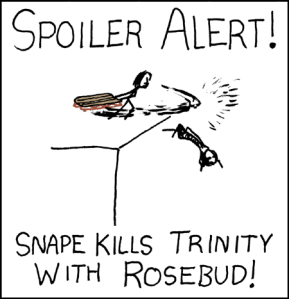
(HT xkcd)

There are already some haters out there, like John Podhoretz in the Weekly Standard, who are offended – nay, outraged – that a comic book movie is getting the kind of praise The Dark Knight is getting. Well, OK, it ain’t Shakespeare, but that’s apples and oranges. Let’s take a similar example – say, a mob movie. Podhoretz never misses an opportunity to share his opinion that The Godfather is the best movie ever made. And I agree that The Godfather deserves to be taken seriously as a great work of art. But it is a mob movie. If The Godfather can be great, why not this?

Unforgivably, Podhoretz works out his anger by spoiling as much of the moive as he can get away with. So don’t read it until after you’ve seen the movie. (Reading the spoilers in this blog entry is of course an entirely different matter.)

It’s readily apparent from Podhoretz’s review what’s really eating him: he loves the old, wild and carefree tradition of superheroes from the Silver Age, recently resurrected so dazzlingly in Iron Man. That tradition got killed off in the 1980s, in large part due to Frank Miller’s amazing work in reinventing Batman, and Podhoretz resents that this type of superhero has crowded his preferences out of the market.

(As an aside, Frank Miller looks to have come way down in the world, artistically speaking; to judge by the preview they ran in front of Dark Knight, Miller’s newest project is to take Will Eisner’s treasure The Spirit and turn it into a porno movie. But all will be forgiven if Holy Terror, Batman! ever actually sees the light of day.)

I sympathize with Podhoretz. One of the best comics ever drawn is Scott McCloud’s ZOT!, which came out when the Dark and Serious school was at its height, as an attempt to rescucitate the wild and carefree hero. (According to McCloud’s introduction, it was especially a reaction against the literally murderous nihilism of Watchmen, which, alas, now looks like it’s finally going to get the movie they’ve been threatening to make of it for decades. Yes, there was a lot of real storytelling genius in Watchmen. That’s what makes it so horrible – to see such genius used to glorify cynicism and murder.)

But while most of the Dark and Serious stuff was crud, let’s face it, most of the Wild and Carefree stuff that preceded it was also crud. ZOT! and the new Iron Man are jewels, but jewels in the rough. So was Miller’s original Dark Knight Returns, and so is the new Dark Knight.

And then there’s the politics. There’s a handy precis of the issues, with links, here if you’re interested. My take: The Dark Knight probably isn’t directly about the war on terror. It’s about things that are universal. (Ever since Frank Miller’s Dark Knight Returns, Batman has periodically been used to explore these issues – meaning we don’t need to bring in the war on terror to explain why these issues are present in a Batman movie.) But of course if these things are universal then they’re as present in the war on terror as everywhere else, so the application of the movie’s subject matter to the war on terror in the viewer’s mind is perfectly valid. 

Having unburdened myself of these reactions to the reactions to the movie, do I have time left today to say anything about the actual movie? Just briefly.

Warning: Believe with Caution

The Dark Knight seems to be primarily about moral hypocrisy. People are not “basically good.” All human beings are both good and evil. However, it’s not in our nature to admit this about ourselves; we have to pretend that we’re good. And the same hypocrisy manifests at the social level – society, being made up of human beings, is not “basically good” but is both good and evil. However, in order to keep from becoming aware of our own evil, lest we should have to admit the truth about ourselves, we also have to sheild ourselves from other people’s evil. If we admitted that everyone else was not “basically good,” it would be really hard to avoid raising the question about ourselves. And so we have to pretend that everybody is “basically good.”

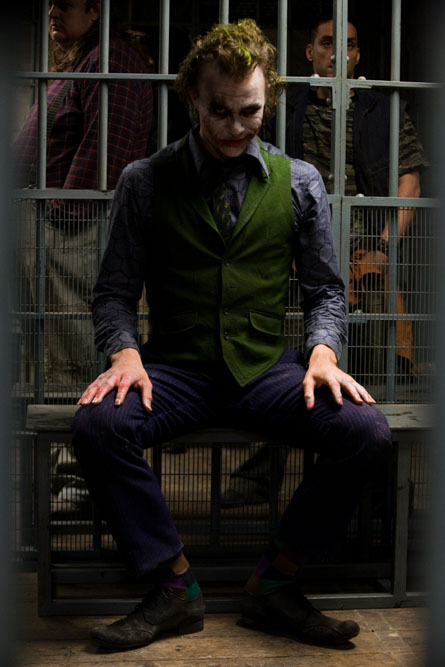
The Joker is out to expose our hypocrisy. His ultimate goal isn’t to kill, it’s to corrupt. He would say that he isn’t out to corrupt us, but to make us admit to the corruption that’s already there in our hearts. But to “admit” to the courrption in the Joker’s sense is really to surrender to it – to become “corrupt” on a whole different level.

This, incidentally, is why it was such a good decision to give the Joker no backstory (and not just by omission but by the Joker’s deliberate obfuscation about his own past). As Chris Nolan has said (I’m paraphrasing), this Joker isn’t a person, he’s a primal force. My hypothesis: the reason this Joker has to be a primal force and not a person is because he has to stand outside of our hypocrisy. The Joker’s place in the narrative requires him to be, not both good and bad, but all bad. And while the Joker is right that all people are bad, it’s also true that all people are good – therefore the Joker, being all bad, can’t be a person.

On the individual level, the Joker’s mission is manifested in the “one rule” dynamic between Batman and the Joker. As all real Batman fans know, Batman’s one rule is that he doesn’t kill people. The Joker’s goal for the Batman is to induce him to break his one rule – thereby proving that his rule is really a construction of self-righteous hypocrisy.

Here the influence of Miller’s Dark Knight Returns is obvious, although Miller’s Joker is primarily motivated by a desire for mass murder and cares about Batman’s one rule only secondarily:
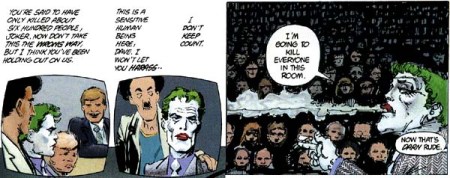
Late Nite Talk Show Host “Dave”: You’re said to have only killed about six hundred people, Joker. Now don’t take this the wrong way, but I think you’ve been holding out on us.

Pansy Liberal Psychologist: This is a sensitive human being here, Dave. I won’t let you harrass-

Joker: I don’t keep count . . . I’m going to kill everyone in this room.

Dave: Now that’s darn rude.

At the social level, the Joker is out to stop Gotham City’s resurgent belief in justice, embodied (in different ways) by Batman and Harvey Dent. I wish there had been an opportunity to establish more tangibly the positive impact that Dent’s mob cleanup was having on the city; it would have made us feel more urgently the real stakes that the Joker was playing for.

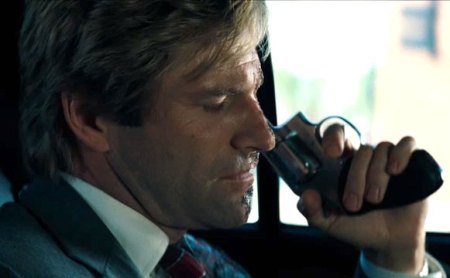
What the heck is this guy’s name again? They said it, like, five times in the movie. You would think I’d remember.

And that leads to the big twist at the end – maybe the best twist I’ve ever seen in a movie: the good guys have to defend hypocrisy. Of course it would be great if society could admit the truth about its own corruption and still strive to uphold justice anyway. But fallen human nature doesn’t work that way.

All my life, I’ve hated those cheesy TV shows where they decide to cover something up because “people need heroes.” Even the Simpsons, when they set out to parody this, couldn’t quite bring themselves to pull the trigger. It’s not done as a parody when Lisa decides not to reveal that Jebediah Springfield was actually a notorious pirate; they play it straight.

But The Dark Knight makes it work. People really do need their heroes, and their heroes really are fallen people. Ergo, people really do need hypocrisy. The reason I buy this in The Dark Knight when I’ve rejected it in all previous incarnations is because The Dark Knight doesn’t try to make it out to be a good thing. It’s wrong that people need hypocrisy – that people need to have heroes before they’ll agree to uphold justice and do good and so forth. It’s ugly and stupid and evil. As Dr. Surridge says in the original V for Vendetta comic (not the dreadful movie version), “There’s something wrong with us.”

Yes, it’s wrong that people need hypocrisy – but since they do need it, it’s not necessarily wrong to supply it.

Hold that thought. More to come. Stay tuned!


Pass the Popcorn: Black Belt Jones

July 18, 2008

(Guest Post by Matthew Ladner)

A few weeks ago, we covered the great cinematic saga of Truck Turner, a multisensory journey through a pimp civil war in 1970s Los Angeles. Your humble correspondent reported that, without a doubt that Truck Turner represented the most delightfully over the top Blaxploitation film.

There is however one contender to the supremacy of Truck. Filmed in the same year (1974) by same filmmakers and using 8 of the same actors as Truck Turner, the film Black Belt Jones is also a cinematic masterpiece of the genre.
The plot of BBJ revolves around an African-American Kung-Fu school in downtown Los Angeles. THE MAN, in this episode portrayed stereotypical Italian mobsters, wants to get their greedy clutches on the kung fu shop so they can destroy it and build a convention center. Remember, no Institute for Justice back in the 1970s.

Scatman Crothers runs the school, and THE MAN begins putting the screws on him to sell his property. Sadly, given his advanced age, years of drinking, gambling and carousing, Scatman’s Kung-Fu powers had grown weak, and he dies during a confrontation with the mob.

Scatman’s death draws the attention of the School of Kung-Fu’s most illustrious alumni, Black Belt Jones, played by the great Jim “Dragon” Kelly. PSSSSRSSST! goes the can of instant whoop-ass that Jones opens up on the spaghetti-eating mobsters.

Now, Black Belt Jones isn’t just about Black empowerment, but also women’s liberation. Jones gets help in his war against THE MAN from the daughter of Scatman, Sydney. Her kung-fu powers are equal those of Jones, and she knows how to put a sexist pig in his place-

Great moments in Women’s Lib

In any event, Netflix BBJ. You’ve never seen fights on a train, the use of undergarments as a weapon in a car chase, or a soap bubble filled climatic battle at a car wash before, but trust me, you need to in order to be that well-rounded highly educated person your mother always wanted you to be.


Pass the Popcorn: Fresh Prince of the Fourth

July 11, 2008

(Guest post by Greg Forster)

Last week’s PTP was preempted by Independence Day, so this week we get a delayed look at the latest Will Smith summer blockbuster, which opened on July 2. As it happens, we went out and saw it last night at the drive-in, so for once I’ll have actually seen the movie I’m reviewing.

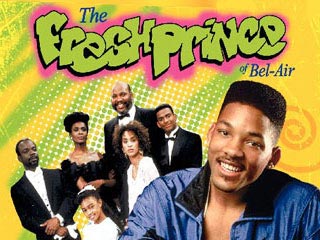
But since our focus around here is generally retrospective, I want to start with a look back at the amazing career of one of the few movie stars of his generation who’s always appealing. But, like Pixar, he wasn’t always what he is now! The Will Smith summer blockbuster machine is so effective that it’s hard to remember a time when he was just the latest fly-by-night novelty act. So join me – won’t you? – in a leisurely stroll down memory lane:

(HT Press Rewind)

Love the hat in that last one!

And who could forget this immortal contribution to the novelty genre? It’s hard for me to believe this now, but when I was 15 years old, that was the funniest thing in the whole history of the world without exception.

While we’re on the subject, is there anything more amazing, and at the same time profoundly disturbing, than the fact that the army of geeks who are the Internet have taken the time and the intelligence and the energy and all the other gifts God gave them and used them all to produce not only a detailed profile of the DJ Jazzy Jeff and the Fresh Prince act, but even one of DJ Jazzy Jeff himself? Jazzy Jeff has apparently gone on to become “an R&B producer of note,” so at least one member of the act managed to save his career after the breakup.

OK, this is all good fun, but we all know how the story ends. The crashed alien ship opens and the hideous monster appears, bent on destroying all human life it can lay its tentacles on, and then the Fresh Prince decks it in one blow, pops a stogie into his mouth and says . . .

“Welcome to Earth!”


In that golden moment, a star was born.

(Too bad the movie in which it occurred was such a comprehensive stinker; of the millions of humor e-mails that used to get circulated back when the Internet was text-based, one of the funniest I ever saw was “40 Things I Learned from Independence Day.”)

Actually, looking the man up on IMDB (carefully avoiding the entries for Will Smith, art director of one TV episode in 1998; Will Smith, writer and actor for obscure cable shows; Will Smith, actor in the 2006 movie Wormwood; William Smith, sound technician on numerous movies and TV shows for 16 years; and Will Smith, frequent appearer as himself on the program “HGTV Design Star”) I am shocked to discover that the movie Bad Boys came out a full year before Independence Day – in other words, at a time when there was no Will Smith, only the Fresh Prince of Bel-Air (which show was still on the air at the time).

The next July 4 weekend came Men in Black, which has worn extremely well and remains one of the all-time best summer movies. Don’t believe me? Get it out and watch it. If you don’t laugh your pants off, I’ll give you your money back on this blog entry.

And then, in a turn of events that has become something of a theme here on Pass the Popcorn, it all started to go wrong. First came Enemy of the State, which must have been a big comedown for Gene Hackman, who starred in The Conversation, the outstanding 1970s movie that Enemy of the State would have been trying to be if it were trying to do anything but milk money from Will Smith. And then there was Wild Wild West, which subject we shall pass by unremarked upon.

But in this case, Smith found redemption. He had always had serious acting chops and the ambition to use them, as he had proved waaaaaaaay back in 1993 with Six Degrees of Separation. So he quit making stupid movies and broadened his horizons, first with The Legend of Bagger Vance and then with Ali. No one mistakes these movies for timeless classics, but for Smith they represent the path back from the brink of the abyss.

Having rescued himself from a fate worse than death, he dove back into blockbuster territory, making Men in Black II (which was fun and did the job of killing two hours pleasantly), Bad Boys II and I, Robot. Then, after a one-year transitional return to comedy with Hitch, it was back to serious acting (this time even more serious) with The Pursuit of Happyness and I Am Legend – the latter clearly with one foot in both worlds, garnering praise for his performance as well as delivering action . . . though the angsty twist ending was changed at the last minute and what they hastily threw together to replace it makes no sense at all, landing the movie alongside Blade Runner, Dawn of the Dead, Superman II and Die Hard 4 on Cracked’s list of “5 Awesome Movies Ruined by Last-Minute Changes.”

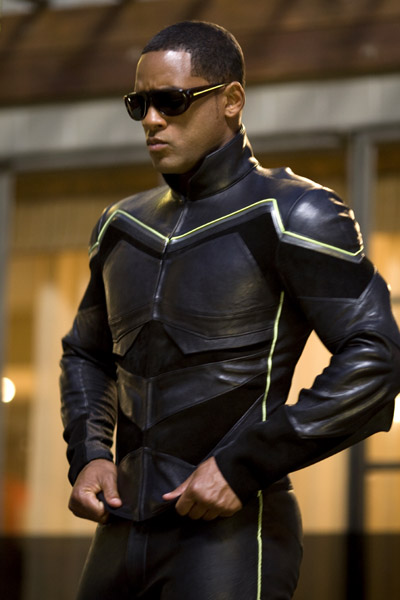
Now we have Hancock. The critics hate it, but what do they know? I had a great time.

Skimming the pans, the main complaints seem to be 1) it contains “treacle,” and 2) it could have been much better than it was. It must be admitted up front that some treacle does occur in the movie. I found that it passed by relatively painlessly. I think that’s because the treacle is just there for setup. In order to communicate the premise in time to move on and do everything this movie wants to do, it has to paint you a psychological portrait of Hancock in double-quick time. This is done by having Hancock encounter a clean-cut do-gooder who rapidly diagnoses Hancock’s dysfunctions and explains to him why he behaves the way he does. And then we’re off to the races! It could certainly have been done with more subtlety, but I found the damage limited.

“I will fight crime . . . . . . . butt . . . naked . . . before I wear that.”

And it’s also true that this movie could have been something much better than it is – again, if it had been done with more subtlety, and if more care had been taken to keep certain plot points a little more logical, particularly in the climax. But while this isn’t the great movie it could have been, it’s still quite good if you take it for what it is. There’s a lot here to enjoy. Some of it is slapstick and bull-in-the-china-shop stuff – Hancock blundering through heroics while drunk, Hancock graphically describing to a seven-year-old (in front of his horrified mother) what he should do to the school bully – and that stuff is good, but there’s also some clever wit, especially when Hancock is trying to clean up his act with the help of a PR consultant, and we watch him walk through the same painfully artificial gestures that the same PR consultants train our business and political leaders to perform in real life, except that Hancock doesn’t have the skill they have at faking sincerity and it all comes off wrong. I doubt I’ll be buying the movie, but I thoroughly enjoyed the two hours I spent watching it.