AFT and UAW – More Alike Than You’d Think

December 30, 2008

aft uaw1

(Guest post by Greg Forster)

Lots of people are picking up on the temper tantrum about alleged “demonizing of teachers” begun by a Randi Weingarten speech and continued in Bob Herbert’s column on the speech.

Even that notorious right-winger Eduwonk points out that Weingarten and Herbert are hitting a straw man. I think the real problem is not that school reformers demonize teachers but that defenders of the government school monopoly angelize them. When we reformers insist that teachers should be treated as, you know, human beings, who respond to incentives and all that, rather than as some sort of perfect angelic beings who would never ever allow things like absolute job protection to affect their performance, it drives people like Weingarten and Herbert nuts.

guardian-angel

A typical teacher, as seen by Randi Weingarten

But what I’d like to pick up on is the question of whether the troubles of the government school system are comparable to the troubles of the auto industry.

Of the alleged demonizing of teachers, Herbert had written:

It reminded me of the way autoworkers have been vilified and blamed by so many for the problems plaguing the Big Three automakers.

Eduwonk points out Herbert’s hypocrisy (though he delicately avoids using that word) on this point, because elsewhere in the column, Herbert praises Weingarten for expressing a willingness to make concessions on issues like tenure and pay scales. Union recalcitrance on these types of reform, Eduwonk points out, is precisely why the auto industry is in so much trouble, and Weingarten has been driven to make noises in favor of reform because a similar dynamic has been at work in the government school system.

On the other hand, Joanne Jacobs thinks the comparison between the AFT and the UAW is inapt:

 I don’t think skilled teachers and unskilled auto workers have much in common.  Auto unions pushed up costs, especially for retirees, making U.S. cars uncompetitive.  In education, the problem isn’t excessive pay, it’s the fact that salaries aren’t linked to teacher effectiveness, the difficulty of their jobs or the market demand for their skills.

But teachers’ unions have pushed up costs – dramatically. In the past 40 years, the cost of the government school system per student has much more than doubled (even after inflation) while outcomes are flat across the board. And this has mainly been caused by a dramatic increase in the number of teachers hired per student – a policy that benefits only the unions.

It’s true that high salaries aren’t the main issue in schools, although teacher salaries are in fact surprisingly high. The disconnect between teacher pay and teacher performance is much more important. But the UAW has the same problem! Their pay scales don’t reward performance, either.

The source of Jacobs’ confusion is her mistaken view that auto workers are “unskilled.” Farm workers are unskilled, but not auto workers. The distinction she’s reaching for is the one between white-collar or “professional” work and blue-collar work. But some blue-collar work is skilled and some is unskilled, and auto workers are in the former category. This matters because with skilled blue-collar workers, as with white-collar workers, there’s a dramatic increase in the importance of incentives as compared with unskilled labor.

In fact, a lot of smart people have been arguing (scroll down to the Dec. 26 post) that exorbitant salaries and benefits aren’t nearly as much of a problem in the auto industry as union work rules – including poor performance due to absolute job protection, pay scales that don’t reward performance, and rigid job descriptions that make process modernization impossible.

Sound familiar?

(Edited)


How a Physics Textbook Changed My Life

December 23, 2008

books

(Guest post by Greg Forster)

Jay Matthews argues that most textbooks don’t serve enough of an educational function to be worth using:

Textbooks still make good dictionaries, with glossaries at the back. They also reassure parents, who don’t get to see teachers in action but are comforted, in a perverse way, that their kids’ schoolbooks seem just as dry and predictable as theirs were. But like the newspapers that have been my life, textbooks are creeping slowly toward obsolescence.

(HT Joanne Jacobs)

I can’t tell whether Matthews thinks textbooks are becoming obsolete simply because books themselves are becoming obsolete – he talks about how some teachers are starting to “write” their own textbooks for their classes by using the internet to gather material, etc. – but it sure looks like he thinks there’ s something especially obsolete about the textbook.

If so, I must strongly demur. Matthews seems to have missed what has always been the primary function of the textbook – to compensate for the teacher’s deficiency. It’s certainly true that some teachers are so on top of their material that they can write their own textbooks, but others are so not on top of their material that they just lean on the textbook as a crutch, teaching everything straight out of the book.

Indeed, who has not heard the frequent complaint about teachers who just teach everything straight out of the book? Welll, where would we be if they couldn’t even do that?

I must confess that looking back on when I first taught my own class at the college level, the biggest weakness of my teaching in that class was that I did too much by rote out of the textbook. But I did it because, as a novice, I lacked the confidence to strike out on my own.

But I have an even more striking example to set before you. When I was in high school, I had a really brilliant physics teacher who didn’t use the textbook at all. He spent the whole class illuminating the subject matter in his own highly motivated way, bringing in unusual examples and exploring subtle nuances.

As a result, his teaching was incredibly engaging to the few students who shared his intense interest in the subject, and completely useless to the majority who did not. They needed to be walked through the basics slowly and carefully – sort of the way a textbook does.

There was one girl in my four-person lab group in that class who was completely lost. She was getting a D and had no idea what was going on. So I started helping her out with her homework.

“Just ignore the teacher,” was my main advice. “Read the textbook and learn what’s in it. Don’t pay attention to anything in class, because almost all of it isn’t going to be on the test and will just distract you from what you really need to be learning.”

She went from a D to an A.

And you know what? I’m married to that girl today.

So don’t tell me textbooks are obsolete.

As a great rumination on the science of physics once put it:

This day and age we’re living in
Gives cause for apprehension,
With speed and new invention,
And things like fourth dimension.

Yet we get a trifle weary
With Mr. Einstein’s theory.
So we must get down to earth at times,
Relax, relieve the tension.

And no matter what the progress
Or what may yet be proved
The simple facts of life are such
They cannot be removed.

You must remember this:
A kiss is just a kiss, a sigh is just a sigh.
The fundamental things apply
As time goes by.

And when two lovers woo,
They still say, “I love you.”
On that you can rely!
No matter what the future brings
As time goes by.

Moonlight and love songs,
Never out of date.
Hearts full of passion,
Jealousy and hate.
Woman needs man,
And man must have his mate – 
That no one can deny.

It’s still the same old story,
A fight for love and glory,
A case of do or die.
The world will always welcome lovers
As time goes by.

(Copyright Warner Bros. Music, 1931)


Ford Foundation Upgraded from “Destructive” to “Useless”

December 22, 2008

generac1

The Disturbinator 4000XL, a state-of-the-art disburbance generator.

(Guest post by Greg Forster)

A while back, in his well-read takedown of the “free market” think tanks endorsing the original bailout that got us into the present mess, Jay mentioned that the donors to those think tanks probably didn’t intend for their money to be used to endorse a radical expansion of government intrusion into the economy.

I thought of that post when I opened an e-mail this morning from the Ford Foundation. The e-mail was sent to people (like myself) who work for grantmaking foundations.

To help us “think and talk about” good grantmaking, Ford is distributing a deck of “role cards” representing the roles grantmaking staff play, such as “advocate,” “talent scout,” and “disturbance generator.”

It makes you wonder what life at the Ford Foundation is like. They spend all day inventing decks of cards, apparently. 

Not only that, but being insulated from the discipline of the market, it looks like Ford isn’t up with the latest technology. As soon as I arrived at my new workplace in August, I had a state-of-the-art disturbance generator installed in the basement. But at Ford they’re still generating disturbance by hand.

I’m sure this is exactly what Henry Ford had in mind for his money when he gave it to a charitable foundation. On the other hand, given what Ford does with most of its time and money, I suppose we should be glad for every cent and every working hour that gets diverted into activities that are merely useless rather than actively destructive.


Pass the Popcorn: Payback’s a Bitch

December 19, 2008

 vesper-1

(Guest post by Greg Forster)

Last weekend I finally got to see Quantum of Solace. I had heard it wasn’t as good as Casino Royale, so going in, I tried to manage my expectations.

“It doesn’t matter whether it’s as good as Casino Royale,” I told myself. “It’ll be fun, and it’ll probably be better than just fun, and that’s better than most movies. I’ll just enjoy what’s on the screen without worrying about what’s not.” That’s how I try to approach most movies.

It wasn’t enough.

Don’t get me wrong. Quantum of Solace is not a bad movie. I enjoyed most of the two hours I spent watching it. However, not only was there a tremendous amount of lost potential – an approach to the Bond story that could have taken the francise to a whole new level – but there were actually some pretty significant stretches that I couldn’t enjoy even on the level of fun or coolness.

quantum_of_solace-table

These data over here illustrate the precipitious decline of cool gadgets in James Bond films, as measured by both quality and quantity. I’ll move this electronic display across the tabletop just by moving my hand, so the audience will momentarily forget that this table-computer thingy is not an adequate substitute for a buzzsaw wristwatch.


The lost potential here is pretty darn serious. Casino Royale not only gave us a really cool  Bond movie, but the setup for what could have been a two-part (or longer) serious epic story arc- the first real epic storyline in the franchise.

vesper-2

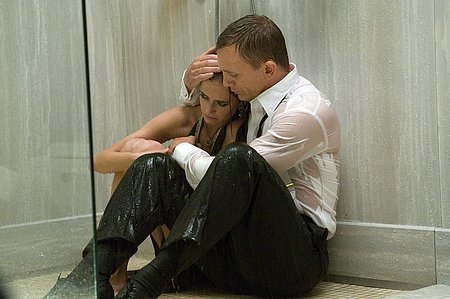
I can’t find it now, but in the runup to the new movie, some fan put together a desktop wallpaper image of Vesper Lynd with the tagline “Payback’s a Bitch.” That got me more excited to see the movie than anything in the official advertising – Bond both loves and hates Vesper (“the bitch is dead”) and thirsts for revenge on her killers even as he hardens his heart against all natural human affection.
bond-and-vesper-shower1

Quantum of Solace does try to redeem that promise, and there are some really good moments. The very last thing Bond does before the end credits roll is a really shocking twist – not so much a plot twist as a “character twist” – that works perfectly. It violates our expectations pretty radically, yet resolves the story perfectly, though not in the way we had thought.

And about two-thirds of the way through the movie, there is a scene that pays tribute to a famous moment in an earlier Bond movie that could have been incredibly cheap and derivative, but is pulled off with note-perfect direction and ends up being extremely effective.

There are also a number of great dialogues in the movie. Bond’s intereactions with M at the beginning are great – Judy Dench is finally permitted to do more than scowl at Bond, and her talents unexpectedly provide real depth to the M character here. And there’s a short but really powerful scene between Bond and Felix Leiter, about which more later.

But while there is some good action, some coolness, and several good moments that show us the epic this movie could have been, the movie not only doesn’t fulfill its potential, it frequently doesn’t even work on the level of standard Bond movie.

It wasn’t just the absence of a decent villain – although that flaw alone is more than enough to shame any director who makes a Bond movie.

 quantum_of_solace-villains

That guy on the left? Literally the instant he came on the screen I was scared of him. He’s in the movie for about five minutes. The loser on the right is the “villain.”

One does wonder just what has to happen to a man to cause him to make a James Bond movie with a lame villain. All action/adventure movies, but especially Bond movies, depend on the personality of the villain; his cunning is needed to test the hero’s wits, his ruthlessness to test the hero’s courage, his power to test the hero’s strength, his evil to test the hero’s good. The lame villain would have prevented the film from reaching anything like its full potential even if there were no other flaws.

quantum_of_solace-villain

He’s supposed to be scary. I’m told that if you stare long enough you’ll start to see it, like those “magic 3D” posters from the 90s. Anyway, I think they were going for “creepy guy who makes your skin crawl,” but they got “bug-eyed pervy loser.”


It wasn’t just the gaping holes in the plot. In case you’re curious, those holes arise primarily because the filmmakers decided to give the movie an environmental theme. I say “theme” because the movie is not at all didactic about the environment. They were smart enough to avoid that trap. But they wanted the evil scheme to somehow involve the environment, and what they came up with (I won’t spoil it, though really there’s not much to spoil) doesn’t pass the laugh test.

As for the lengthy scene in the middle of the movie that takes place at a radically avant-guarde European opera performance, while many (including my wife) found it annoying, I actually didn’t mind it.

quantum_of_solace-opera

I can see why they put it in – just like they put in that scene at the “dead bodies” museum exhibit in Casino Royale. They’re trying to reintroduce the tone of the older Bond movies that was simultenously highbrow and exotic. Flying off to Brazil (or wherever) used to be something only the rich could do, and for those who couldn’t do it, it was a little like flying to Mars. Today, when the Bond audience is comfortably upper-middle class and airfares to just about everywhere in the world are within their reach, it’s hard to take Bond to esoteric places. While the scene probably doesn’t work as well as the director hoped it would, I think it’s serviceable.

But now back to the flaws.

It wasn’t just the movie’s anti-Americanism. Here the movie is didactic, alas. One winces to hear the mass-murdering psychopath Haitian dictator Aristide discussed (though he is identified by a generic description and not by name) as a saint. And the filmmakers don’t seem to be aware that the Aristide whom they so admire was returned to office by U.S. power after being deposed in a coup.

But the damage here is pretty radically mitigated by several factors. First, it’s obvious that they felt they had to have something left-wing in there to counterbalance the fact that the movie’s villain is a phony environmental philanthropist, which might be taken as a critique of certain real-life phony environmental philanthropists. (“I did learn something about the environment from this movie,” my wife said to me afterward.  “I learned not to trust people who claim to be acting on behalf of the environment.”) There’s a sense, or at least I had the sense, that when they denounce American imperialism, they do so out of a sense of obligation. Second, on some occasions America really has been guilty of the kind of evil attributed to it here – although one wonders whether either the filmmakers or the audience are aware of who the real perpetrators of those evils were (and are), and which of the two political parties they tend to be clustered in.

But most importantly, Felix Leiter is given an opportunity to point out that if America has sometimes done nasty things, it is, on balance, not the world’s worst offender. In a Bolivian bar, Bond snorts, “you guys have carved up this place pretty well,” and Leiter spits back, “I’ll take that as a compliment – coming from a Brit.” Even by the standards of civilized nations, America stands up pretty well.

bond-leiter


In the Bond films, Felix Leiter has always stood for America. He lacks Bond’s air of elegant sophitication and savior-faire, but also Bond’s arrogance and hard-heartedness. Bond is the advanced-but-decadent Old World, Leiter is the plain-but-decent New.

Watch, for example, the first few minutes of Goldfinger, and see how differently Bond and Leiter treat the girl in the bikini by the poolside. If you’ve studied your Tocqueville, you know how to pick out the American in any crowd of men – he’s the one who talks to women like they’re human beings, not property.

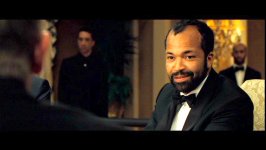
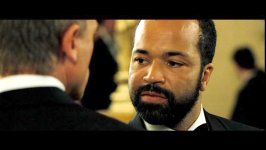
On the subject of Felix Leiter as representative of America, it’s almost amazingly appropriate that the Felix Leiter character has switched races – and not for the first time, if you’re prepared to accept the quasi-official Bond film Never Say Never Again, where Bernie Casey took the role. Race is the most distinctive aspect of the American experience, so it’s fitting that the representative American should be alternately black and white. America is as much the slick East Coast sharpness of Jack Lord in Dr. No as it is the wry “aw shucks” Midwestern charm of Cec Linder in Goldfinger; America is also the simultaneous smoothness and bluntness of Jeffrey Wright.
leiter-1

“Felix Leiter – a brother from Langley.”

leiter-2

leiter-3

I’ll go out on a limb and say that if Quantum of Solace had to be the first ever anti-American Bond film, it’s appropriate that the task of sticking up for America’s good name should fall to a black Felix Leiter. Those who hold themselves out as representatives of black America often don’t have much good to say about America, but that was not always the case, and if I may trust my personal experience, I find black Americans to be among the most intensely patriotic. Indeed, they’re almost the last sizeable population group among the core politically left groups who obviously mean it with all their hearts when they protest that they, too, love their country. And that’s not at all surprising – around the world, we are discovering that those who have been deprived of their liberties are the ones who cherish them most, while those who have long enjoyed liberty come to take it for granted. Why should we surprised to discover this at home? True, it was against American oppression that American blacks had to fight to gain their liberties, but now that they have liberty, they cherish it, and will not allow it to be lost. And they know that America, even with all it has done wrong, stands for liberty as no other nation does, or ever has.

But now, again, back to the flaws.

I think the main flaw in Quantum of Solace is the mandate that a sequel must be bigger and flashier than the original. Where Casino Royale centered around a card game and gave us intrigue, cunning, dialouge, and character development, Quantum of Solace is nonstop car chases, explosions, etc. Everything has to be bigger and blow up more spectacularly. That just doesn’t leave any time for the revenge plotline to develop properly.

This flaw is badly exacerbated by the poor editing and bad pacing of the action sequences. Each individual camera shot is too short, while each action sequence as a whole is too long. Because of the rapid-fire editing that spoils so much of the action, someone has called this “Bond for the ADD generation.” But I disagree; no one with ADD would have had the patience to sit through these interminably long action sequences. I barely had the patience to sit through them myself.

I wish I could say that this movie is good but not great. As I said, it’s not a bad movie. I enjoyed watching it, for the most part. But I just can’t bring myself to type that it’s a good movie. Looking at my grand unified field theorem of Bond movies, I’d have to say that where Casino Royale was “Reboot Awesomeness,” Quantum of Solace has skipped right past the “Still Good” phase and landed squarely in “Passable,” alongside The Spy Who Loved Me and The World Is Not Enough. That doesn’t bode well for the next one.

But remember the tagline to the end credits of every Bond movie: “James Bond will return.” And so he shall.


PJM on the Incredibly Interesting Uninterestingness of Arne Duncan

December 18, 2008

boring-world-of-niels-bohr1

(Guest post by Greg Forster)

This morning, Pajamas Media carries my column on the selection of Arne Duncan as Obama’s education secretary. At first, I agreed with Jay’s assessment that the choice is a boring subject, but after thinking about how boring it is, I now find it fascinating:

It really is amazing how totally uninteresting — how completely devoid of any possible justification for paying attention to it — the choice of Duncan for education secretary is. In fact, the selection has succeeded in fascinating me by achieving such an unprecedented level of anti-fascinatingness. It repels my interest so strongly that I can’t stop thinking about it.

Not that this means I’m wowed by the pick:

If Duncan is acceptable to everybody, that’s another way of saying he’s the lowest common denominator. And as a great education reformer once said: “Woe to you when all men speak well of you.”


School Voucher Mythbusters

December 17, 2008

mythbusters_collection3

(Guest post by Greg Forster)

A while back, I posted this to help people find comprehensive lists of the research on various subjects related to school vouchers. It’s a list of lists – in case you’re looking for a list of all the available research on whether vouchers improve education for the kids who use them, or whether they improve public schools, and so forth. Some of the lists are more scholarly and contain a lot of technical information, while some are presented in a more easily accessible format.

Well, here’s a big update on the list-of-lists front: the Friedman Foundation has released a set of “myth buster” guides to the research on the six most common school choice myths. For each myth they’ve provided a brief, handy reference sheet and a slightly longer, more detailed guide to the research. Even the detailed version of each myth buster is still less technical than the other lists on my “meta-list” page, compiled by Jay and other scholars, but it does go over the most important technical issues (how do we distinguish the impact of vouchers from the impact of other factors like family influence?) and provides the references you’ll need to dig further if you wish.


Myth: Vouchers hurt public schools and take the best and brightest.

Research: Short version, detailed version.


Myth: Private schools aren’t really better than public schools.

Research: Short version, detailed version.


Myth: Vouchers will lead to increased segregation.

Research: Short version, detailed version.


Myth: Private schools are hostile to tolerance and democratic values.

Research: Short version, detailed version.


Myth: Vouchers are costly and drain money from public schools.

Research: Short version, detailed version.


Myth: Private schools exclude difficult students.

Research: Short version, detailed version.


Take note that these are true comprehensive lists, including all high-quality studies on each of these questions. I’ve noticed that it’s always voucher supporters who are willing to discuss all the evidence, while voucher opponents typically cherry-pick the evidence, mischaracterize the evidence they’ve cherry-picked, and then falsely accuse voucher supporters of cherry-picking evidence.

So I would say Jay’s theory about why school vouchers keep winning against impossible odds is well supported by the empirical evidence – although in this case I haven’t compiled a comprehensive list.

What stronger breastplate than a heart untainted!
Thrice is he armed that hath his quarrel just,
And he but naked, though lock’d up in steel
Whose conscience with injustice is corrupted.

Henry VI, Part II, Act 3, Scene 2


Correction on MJS and the “Funding Flaw”

December 12, 2008

white-out

(Guest post by Greg Forster)

Yesterday I posted an analysis of a Milwaukee Journal Sentinel article. The article reported as fact, not opinion, that the Milwaukee voucher program has a “funding flaw” because it fails to pay the Milwaukee public schools to teach students whom the Milwaukee public schools do not teach.

The occasion for the article was a debate over whether it was still true, as it had been in previous years, that the Milwaukee voucher program increases costs for local property taxpayers – this is what people had always meant in the past when they talked about the “funding flaw” in the program.

The claim made by the local voucher movement that the program no longer increased costs for property taxpayers seemed solid to me at the time, and the voucher opponents quoted in the article tacitly accepted it by desperately trying to change the subject. To my knowledge, nobody else had disputed the claim. So I reported the claim as true.

Robert Costrell, who knows more about this than anyone, now says he thinks the claim that vouchers no longer cost extra in local property taxes is incorrect. Apparently it comes down to whether a certain element in the formula varies by enrollment or not.

So I’ve attached a correction to the original post, and I apologize that I didn’t wait longer to hear from more people before reporting the claim as true.

That said, the bulk of my post was on another subject (the attempt by some Milwaukee politicians to use the voucher program to fleece state taxpayers, and MJS’s docility in reporting their obviously specious claims as true) and on that subject I stand by everything I wrote. I only hope my carelessness on this other point doesn’t help get MJS off the hook for its irresponsibility.

(Edited to more clearly differentiate Costrell’s thoughts from my own.)

(UPDATE: Bob Costrell’s new analysis is here.)


MJS: Failure to Steal Money Is a “Funding Flaw”

December 11, 2008

pickpocket

“I beg of you, Monsieur, watch yourself. Be on guard. This place is full of vultures . . . vultures everywhere. Everywhere.”

HT mcgady.net

(Guest post by Greg Forster)

Update: Robert Costrell says he thinks the claim that vouchers are now saving money for local taxpayers is incorrect. Apparently it comes down to a question of whether a certain item in the funding formula varies by enrollment or not. Costrell knows this stuff better than anyone, so I’m happy to defer to him.

At the time I wrote this post, I only had the MJS story to go on, and even the school choice opponents quoted in the article (Mayor Barrett and Superintendent Andrekopoulos) weren’t disputing the savings claim. So I wrote the post as though the savings claim had been implicitly accepted by voucher opponents because it had, in fact, been implicitly accepted by them. But I shouldn’t have actually reported the claim as true just because voucher opponents were implicitly accepting it as true, and I apologize for my carelessness.

That said, the MJS story is still amazingly irresponsible and I don’t regret a word of what I said about its complicity in Barrett and Andrekopoulos’s attmept to fleece Wisconsin taxpayers. I only hope that my own carelessness doesn’t help get MJS off the hook for printing this stuff.

(This update has been edited to more clearly differentiate Costrell’s thoughts from my own.)

For years, the Milwaukee voucher program had what the locals call “the funding flaw,” under which some local Milwaukee property tax revenues were diverted for every student who used the voucher. When the program was first enacted in 1990, there was no “funding flaw,” and it saved money for both the state and local Milwaukee taxpayers, just like most voucher programs. But in 1999 the rules were changed, and the program began diverting property taxes; the state profited handsomly at the expense of the city, using the voucher program as an intermediary. As a result, from 1999 until 2007, the program was a drain on local resources. The school choice movement in Milwaukee never supported this practice and worked to help stop it, but of course state politicians were never interested in helping, and the voucher program was always blamed for the local tax drain.

But now things have changed. This year, the program is once again saving local money – the amount the city loses from the program is now down below what it saves in reduced educational costs because it doesn’t have to teach the students in the program. So there is no more “funding flaw.”

Not so fast! Over the weekend, the Milwaukee Journal Sentinel ran a very strange story claiming, not as opinion but as fact, that the “funding flaw” was never just about property taxes. Another, much more serious “funding flaw” has been lurking unnoticed in the bushes for all these years – namely, that the program fails to steal money from state taxpayers and transfer it to Milwaukee public schools.

I’m not sure anyone had ever heard about this “other” funding flaw before now. Call it the super double secret funding flaw.

1) The article begins by citing an argument between voucher proponents and opponents over whether the “funding flaw” still exists. It evenhandedly reports the claims on both sides: on the one hand, the school choice movement has facts and figures showing that voucher kids are now a net gain, not a net drain, for Milwaukee taxpayers. On the other hand, property taxes are going up and the people who run the public school system “associate a lot of that increase” with the voucher program. Facts and figures on one side versus mere assertion on the other – well, obviously there are two equally valid points of view about this controversial question! Who says the media aren’t evenhanded?


2) The article then lays out the facts: the “funding flaw” was always that a voucher student cost Milwaukee more than a public school student in property taxes. Now that’s not true anymore. The school choice folks are pointing out this inconvenient truth and saying, reasonably enough, that there’s no more funding flaw.

Then we get this: 

[Milwaukee Mayor Tom] Barrett and MPS Superintendent William Andrekopoulos dismiss that notion, saying the amount of property tax dollars per student illustrated only one part of the flaw. It was the main thing they pointed to because, frankly, it was easier to understand than other aspects. But, they say, the other aspects are actually a bigger deal.

So all these years they’ve been making a big deal over less important issues while concealing the real problem, but now, at last, they’re prepared to come clean and talk about the real problem.

Did you catch the casual insertion of the word “frankly” in the second sentence? This is the MJS reporter speaking in his own voice rather than quoting – but he’s such a puppet of the system’s defenders that their “frankly” comes out of his mouth. When Barrett stubs his toe, do MJS reporters say “ouch”?


 3) Then comes the really amazing part. MJS reports, as fact and not opinion, that the funding flaw always consisted of two problems. The first was the property tax issue, which now favors vouchers rather than public school kids – although when the story gets into the details of this, it never directly admits this as fact; it is reported as a claim being made by school choice proponents, and only sophisticated readers will be able to figure out from the reporter’s convoluted words that what the school choice proponents are saying is, in fact, indisputably true.

The alleged other part of the funding flaw, the super double secret one, is that voucher students are not counted as students being educated in Milwaukee public schools for purposes of setting the funding levels for Milwaukee public schools.


Got that? MJS reports as fact, not opinion, that the voucher program is flawed because it fails to force the state to pay Milwaukee public schools to teach kids that Milwaukee public schools do not, in fact, actually teach.


But of course the story doesn’t say this as clearly as I’ve just put it, or it would be obvious that this is sophistry in the service of a naked political agenda. A reader who didn’t already know the ins and outs of school finance would never realize from the article that the supposed other “flaw” is that the program doesn’t pay Milwaukee schools to teach students whom they don’t teach.


4) The article then goes on to note that fixing the super double secret funding “flaw” would be deeply unpopular because it would take money away from other areas of the state. The unstated implication is that it would be much more sensible to scrap the unworkable voucher program altogether.

Well, no kidding it would be unpopular for MPS to try to use the voucher program as an excuse to take money from state taxpayers to teach students that MPS doesn’t teach. Taking money to do something that you don’t do is called stealing.

What’s really galling is that this attempt to steal from state taxpayers is framed (by MJS as well as by Barrett and Andrekopoulos) as an attempt to “fix” an alleged funding “flaw” – the implication being that money is somehow being unfairly withheld from MPS. So the guy warning you about thieves is in fact the thief. I think that may actually be Andrekopoulos’s picture at the top of this post.


5) The article then parades Robert Costrell’s big cost analysis showing that vouchers cost more than they save for local taxpayers. At the very end of the paragraph, it quickly notes that this analysis “does not include figures from this fall.” In other words, the conclusion that the voucher program costs Milwaukee money is out of date because the facts on the ground have changed, and it has no relevance to the story (except by confusing readers who aren’t paying close attention).


6) Finally, at the end, the school choice movement is allowed to come back onstage and point out that Milwaukee public school spending and state aid to Milwaukee have both been growing relentlessly for years. Then we get this:


Andrekopoulos said in an interview that the main point is that something has to be changed, and the state funding system, including how vouchers are paid for, is the place to turn.

He said that Milwaukee residents are facing a 14.6% tax levy increase this year, even though the actual MPS budget went up less than 2%.

“Doesn’t that seem wrong?” Andrekopoulos said. “Something’s not right.”

This, like the previous claims about the super double secret “other funding flaw,” is sophistry pure and simple. Property taxes pay for much more than just schools, and the MPS budget gets a lot of revenue from sources other than property taxes. So these figures are apples and oranges; you can’t compare the two.


It would be like the UAW arguing that Rick Wagoner’s salary costs GM more than the UAW jobs bank, because budget category A (which includes spending on Wagoner’s salary, engine parts, steel bolts, and the company health plan) costs more than budget category B (which includes spending on the jobs bank, tires, car doors, and lunches in GM company cafeterias).


Until you break down the categories and look at what the individual components cost, you’re just blowing smoke. And when you break down the categories, vouchers save Milwaukee money – which is exactly what the MJS article established all the way back at the beginning.

I’ve seen a lot of irresponsible journalism, but this article just leaves me dumbfounded.

(UPDATE: Bob Costrell’s new analysis is here)


Get Lost 6

December 5, 2008

lost-game

HT New York Magazine; photo illustration by Everett Bogue

(Guest post by Greg Forster)

It’s a special “great interregnum” edition of Get Lost!

I figured I would pick up our Lost feature and write about the coming season, what with the recent release of several promo videos for season 5, including this two-minute sneak peek . . .

. . . about which I think the only thing that needs to be said is: you can’t get that kind of court order without disclosing your name, morons. Would it have been so hard to come up with a more plausible way to conceal the identity of the forces behind the order? Maybe have somebody do it under a fake name? This is like last season when Sun supposedly bought her father’s company with the Oceanic court settlement. I know Lost has sometimes been aimless, but when did it get just plain dumb?

But anyway, as I started watching the trailers, which are mostly made up of clips from last season, and as I read over the final installment of our Get Lost feature from last season, especially the discussion in the comment thread, I came to a moment of revelation.

I have no idea what’s been going on on Lost.

And I don’t just mean in the season finale. I have virtually no memory of the entire season 4. Just now, when I mentioned Sun buying her father’s company? I didn’t remember that until I went back and read Jay’s last Get Lost post, where it’s mentioned in the comments. And right now almost the only other things I can remember from season 4 are the ones that were prompted by the season 5 promos I just watched.

This is weird, because I remember season 3 pretty well, even though it’s older, and (like all other sentient life forms) I liked season 4 a lot better than season 3. What gives?

I have a theory, and it’s not a comforting one. Everyone breathed a collective sigh of relief when we saw the last few episodes of season 3 and it became clear that the creators had gotten the message: the plot needs closure. The questions need to be answered. And as season 4 progressed, it seemed ever more clear that the creators were no longer just stringing us along (as I think it’s pretty clear they were in season 3, and probably were by at least season 2) but were moving things toward a satisfying conclusion.

But is it too little, too late? Was season 4 really as good as we thought it was? Or was J.J. Abrams just playing with our heads again?

You know, the more I think about it, the more I’m convined that man has some kind of mind control power. I kept watching Alias all the way to the end of the final season, but in retrospect, I have no idea why. This must be what people feel like on Star Trek after some alien has possessed them and made them sabotage the ship – they stumble around the brig asking “what the heck was I doing?” (So I guess they got the right man to direct the big comeback picture for the Trek franchise, huh?)

During season 4, we thought we had broken Abrams’ evil mind control spell. But was that just what he wanted us to think? (And if so, how could we know?)

By two-thrids of the way through season 3, which is where it started moving back from the brink, this show had accumulated a lot of amorphous mystery. If season 4 was really doing such a great job of pulling it all together, wouldn’t I remember it? Any of it?

So I’m sending out a bleg to all you Lost fans out there. Do you remember season 4, and does it seem as good to you now as it did in May? Is the show really any less aimless now than it was, say, at the end of season 2?

In the meantime, my “we’re all J.J. Abrams’ zombie slaves” theory does give me one reason for hope. Alias may have reeked for two straight seasons, but the big finale did in fact draw together the many loose ends of the convoluted plot in a highly satisfying way. So maybe we have grounds for hope that we’ll get the same from Lost – and clearly we aren’t going through a two-year reekfest on the way there.


PJM on Colleges – and PJM Column Authors – Who Lack the Guts to Punish Cheating

December 3, 2008

(Guest post by Greg Forster)

You may have heard about the Texas prof who was fired for publicly disclosing the names of students he caught cheating. Pajamas Media carries a somewhat confessional column today in which I discuss the role of the Internet (which, contrary to popular opinion, makes cheating harder rather than easier) and the rise of educational lawsuits (which colleges have responded to by abdicating their traditional disciplinary role), but also reflect, without satisfaction, upon my own experience dealing with a cheater:

The fear of lawsuits only compounds the difficulty of what is already a difficult decision. Even with the strongest possible intellectual conviction that it’s the right thing to do, actually imposing a punishment on a fellow human being takes a certain amount of moral courage. It takes some guts.

The isolation of the teacher as the lone defender of honesty in the classroom only makes it much more difficult to do the difficult but necessary thing when the time comes. And this, again, is something I can testify about from personal experience.

I regret to say that when I confronted my cheater, I chickened out.

What I ended up doing in the end, instead of what I had resolved to do and then didn’t have the courage to do, actually might be a good model for how to deal with a cheater. Of course, I’d rather have discovered it through intelligence rather than cowardice. As C.S. Lewis says, only fools learn by experience, but at least they do learn.