UAW Creates Jobs – in Demolition

January 26, 2009

the-homer

HT Liberty Is the Middle Path

(Guest post by Greg Forster)

Last week the president of the UAW claimed that workers at auto companies receiving federal bailout money shouldn’t have to take a wage cut because they already make $2 per hour less than Toyota workers if you include bonuses. I was going to point out everything that’s wrong with his argument, but it looks like the contract for this particular demolition job has already gone to Mickey Kaus (possibly as part of the federal stimulus plan).


Quantifying the Popcorn

January 23, 2009

scores-on-doors

(Guest post by Greg Forster)

No time to write a lengthy discussion of it (why did I waste all that time this morning composing a post on something as useless as education policy?) but don’t miss the fascinating article in today’s Wall Street Journal on the history of, and debates over the merits of, the practice of movie critics assigning stars, letter grades, or “thumbs” to movies as a quick and easily accessible, yet frustratingly reductive, indication of their judgment on a movie.

Among other things, the article asks some prominent movie critics to give a star ranking to the practice of ranking movies by stars. One gives the practice four stars (“It helps the reader, and it helps us”) while another gives it one and a half (“It’s not necessary to film criticism but it’s not something that undermines it”). Some people quoted in the article are actively hostile to the practice, though.

The article is by “The Numbers Guy,” Carl Bialik, who apparently has a blog under that title at the Journal‘s website. Who knew? On the blog he has a follow-up to the story with more quotes and tidbits, including one critic who complains that he doesn’t know how to give an accurate ranking to a movie that he hated, yet enjoyed watching for its awfulness:

“The toughest one for me was Gran Torino, which I think is a terrible film but nonetheless found immensely entertaining in its awfulness,” Las Vegas Weekly film critic Mike D’Angelo told me about his 100-point grading system on his personal Web site. “I wound up giving it 34/100, which includes like 20 bonus points for camp value.”


Jeb for National School Grades

January 23, 2009

BUSH EDUCATION SUMMIT

“Everybody do the FCAT! Yeah!”

HT Orlando Sentinel

(Guest post by Greg Forster)

This morning, Jeb Bush comes out for a national school grading system on NRO.

What he’s proposing is a federal grade A to F for each school, based on both performance level and improvement – kind of the way Florida schools are graded under the A+ system (though Jeb doesn’t propose federal sanctions for poorly performing schools, just a grading system). He justifies the move on grounds that the NCLB system encourages states to lower standards.

Jeb doesn’t discuss this in the article, but readers of JBGB know that a clash has been brewing between Florida’s A+ program and NCLB. Florida, which has had success with the A+ program (where improvement in performance is a factor alongside performance level), is going to run into the 2014 “everybody must be proficient” wall along with everyone else.

No doubt our own Matt Ladner, chronicler of the looming conflict in the posts linked above, will have more to say about this (hopefully including some more classy artistic illustrations), but just to put my own two cents in, I’m not clear on why there needs to be a national grade.

For that matter, I’m not even convinced we need a national test, since that sacrifices the merits of interstate competition. At both the state and federal levels, the test is being developed and implemented by a bureaucracy that is heavily colonized by the defenders of the status quo and thus will be looking for opportunities to dumb down the test or manipulate the scoring to make schools look better. But if one state dumbs down while another (under political pressure from reformers) stays the course and makes real improvement, that creates pressure on the dumb state to get with it.

The impetus for a single national test, it seems to me, is because federal rewards and punishments create an incentive to dumb down. If we’re not going to have rewards and punishments based on the scores, what’s the need for a single national test? Why not just require each state to maintain a transparent testing system of its own devising – or, if that’s not good enough, require each state to purchase and use one of the major privately developed national tests?

But we can leave that aside. Let’s stipulate the case for a national test. Still, if you’re not going to hold schools accountable with rewards and penalties, then why issue grades along with the test scores? Why not just give a test and report the results numerically, and let private organizations put together their own grading systems? That way people can decide for themselves what aspects of performance measurement matter most, rather than turning the job over to a federal bureaucracy that has an incentive to make schools look better.


My Bogus Journey through Airport Security

January 21, 2009

sesame-street-homeland-security

(Guest post by Greg Forster)

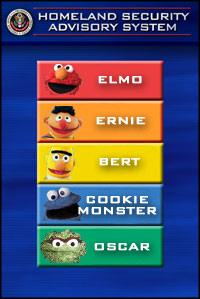
Last week I was on the road, and coming through airport security on my way home Friday I was selected for special scrutiny. It was a truly disheartening experience.

Not because I mind being scrutinized, but because of the amazingly incompetent way it was done. If I’d been carrying any contraband, it would have been ridiculously easy to evade security.

We shouldn’t be surprised, I suppose. Look at the irrationality of the way they screen the general population. They scan our shoes separately because years ago some guy snuck in a bomb in his shoes. I guess there’s no other part of our clothing we could ever use to sneak in a bomb! And they strictly control the liquids we’re allowed to bring on. Unless those liquids are contained in a baby bottle or prescription vial, in which case they’ll be waved through without inspection.

And let’s not forget Danielle Crittenden’s experiment wearing a full burka for a week to see what it was like. In the last of the four installments, she goes to DC’s National Airport wearing the burka and buys a one-way, same-day, refundable ticket to New York, announcing to the ticket agent that she has no luggage. She’s pulled aside for additional screening – but they never look under her burka. She could have had a bomb under there, and nobody would have known. They don’t even feel confident that they have the right to look at her face to confirm that she is the person depicted on her ID:

“Do you have to wear black?”

“No,” I replied. “But black is more traditional, more conservative. You blend more in.”

“Not here.” He laughed. “You stand out.”

The woman began telling me about her religious upbringing. It was at this point I realized my security inspection was over, and I was now conducting an Islamic tutorial: Burkas 101. Other passengers selected for secondary screening came and went. I’d been held back for a good quarter hour.

Then the female guard, growing cautious again, asked if it was “culturally okay” for me to remove my face covering. “When women like you come through, we don’t know what’s ‘correct.’ Like if I want to see that your face matches your ID, can I ask you to show me your face?”

It’s a good thing I was wearing a mask so the guard could not see my astonishment. The security agents at the airport serving the nation’s capital–bare seconds of air distance from Capitol Hill, the Pentagon, the White House–did not feel entitled to check the identities of veiled women. Clearly, they hadn’t even received any special sort of instructions about it.

I assured the security agent that it was indeed okay for a woman officer to ask a veiled woman to show her face. More than okay! I stressed again and again: So long as only women saw my face I’d have no trouble removing my mask if you wanted to check my ID!! Really, it’s fine…!

The guard nodded. “Thank you–you’ve been so helpful,” she said, rising. “We don’t want to keep you. Hey, have a great time in New York!”

And so I passed through security without ever having to show my face.

Fortunately, my ticket was refundable. Just as the friendly Delta agent had promised.

If you want to read the whole thing, here’s parts one, two, and three, along with three subsequent discussions.

Anyway, for what it’s worth, here’s my own excellent adventure:

When the guy at Dulles checking boarding passes looked at my pass, he turned around and shouted, “runner!” Then he turned back and, without a word to me, started checking the next person’s pass.

Let me pause for a moment to note that here in Milwaukee, I’ve seen people selected for extra screening, and they’re politely told that they’ve been selected for extra screening, and the process is then briefly and politely explained to them. And there was almost no line behind us, so he wasn’t rushing to accomodate a crowd.

But the more important point is that, while he was waiting for a “runner” to come and take my boarding pass, the man paid no attention to me whatsoever. My carry-on and my “personal item” (a plastic bag) were sitting on the floor. If either or both had contained contraband, I could have simply left them there and picked up the bags of my associate who was travelling with me, and my associate (who was the next person checked and who therefore knew right away that he had not been selected for additional screening) could have picked up mine. No one would have been the wiser.

Then the “runner” comes and takes my boarding pass, and the guy checking passes grunts that I’m to take my bags (not that he knows which ones are mine) and go through security.

So I take my bags over to the security line and start taking off my coat and shoes, etc. The “runner” has now handed off my boarding pass to the guy on the other side of security and is doing other things. Nobody is watching me as I fiddle with my stuff, open my bag and put my keys and cell phone inside, etc. If I’d wanted to dump something under the table, it would have been easy enough to do – I had a bulky coat that I had to take off and fiddle with, which could have been used to transfer something to the floor while I was bent over to take off my shoes, even if somebody had been watching over my shoulder, which they weren’t.

I go through security, then I’m taken aside and wanded. Then I’m sat down in a chair and my bags are brought over and placed on a table. The guard explains that he’s going to open my bags one by one and inspect them, and it’s important that I not touch my bags until the inspection is complete.

Then he picks up the first bag and moves it over to another table to open it, turning completely around so that his back is toward me as I sit there, unobserved, right next to the bags that I’m not supposed to touch.

He inspects each bag with his back toward me the entire time. Then I’m free to go.

I would feel nervous about revealing these weak points to potential terrorists, but they’re so obvious that anyone who cares to know about them already will. It’s clear that the TSA isn’t anxious to prevent people from circumventing security, and who am I to try to be more TSA than the TSA?

Airport security is a placebo. They knew it was a placebo when they tightened it after 9/11. The goal was to get people feeling like it was safe to fly, so that the economy would come unstuck and grow again. But now, they dare not admit it was a placebo. So the farce rolls on, year after year, getting ever more farcical as new and more ridiculous features are stuck onto a system that does nothing whatsoever to accomplish its ostensible core task.

It’s kind of like how we hold elections whose real outcome is determined by which side is more proficient at vote fraud and judicial manipulation. It’s a collossal lie that the smooth functioning of society requires.


Al Gore, Frozen in Time

January 20, 2009

frozen-gore

(Guest post by Greg Forster)

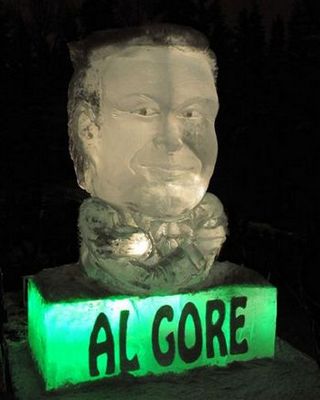
Since we’re on an economics kick today: Craig Compeau of Fairbanks, Alaska has sponsored the creation and display of an 8 1/2 foot tall, five-ton ice sculpture of Al Gore. He has organized a local contest to guess how much colder the winter will be in 2008-09 compared to the winter of 1947-48, the year of Al Gore’s birth, with proceeds going to a local charity. This winter Fairbanks has already hit 47 degrees below zero (as in 79 degrees below the freezing point) so the guesses are going to have to be almost as low as Gore’s credibility.

The Associated Press dryly reports that the ice sculpture will be on display “through March unless it melts before then.”

(edited for typos)


Greg Nails the School Stimulus Proposal

January 18, 2009

Think we should spend $100 billion as part of the new “stimulus” (read: pork) plan on school buildings?  Greg Forster’s piece on Pajamas Media will convince you otherwise.


Simpson’s Paradox — D’oh!

January 12, 2009

When it is pointed out that NAEP scores for 17 year-olds or graduation rates have remained flat for roughly three decades despite a doubling in per pupil spending (adjusted for inflation), I always brace myself for the Simpson’s Paradox response.  I particularly brace for it because its most active (and grating) purveyor is Gerald Bracey — D’oh!

As Bracey explains it, “Simpson’s Paradox occurs whenever the whole group shows one pattern but subgroups show a different pattern. ”  Test scores may rise over time for every ethnic/racial subgroup but the overall average may still decline or remain flat.  “The explanation lies,” Bracey argues, “in the changing makeup of the test taking groups. At Time 1, only 20% of the test takers were minorities. At Time 2, they make up 40% of the group. Their scores are improving, but they are still lower than whites’ so as they become a larger and larger proportion of the total sample of test takers, their improving-but-lower test scores attenuate the overall average or, in this case, actually cause it to fall.”

On the surface this story sounds very appealing.  Even sensible-sounding people like JPGB commentator, Parry, repeat the argument.  But on closer examination, Simpson’s Paradox does not explain away the frustrating lack of education productivity over the last few decades.

If we want to know whether we are receiving returns on our enormous additional investment in education, we want to see progress in the overall picture.  It would provide us with little comfort to see that our investments benefited some students but did not produce an aggregate gain — unless holding steady was actually a victory in the face of significantly more difficult to educate students.

And that is the unstated argument behind the use of Simpson’s Paradox to explain the lack of educational progress: minority students are more difficult to educate and we have more of them, so holding steady is really a gain.

The problem with this is that it only considers one dimension by which students may be more or less difficult to educate — race.  And it assumes that race has the same educational implications over time.  Unless one believes that minority students are more challenging because they are genetically different, which I do not imagine Bracey or Parry believe, we have to think about race/ethnicity differently over time as the host of social and economic factors that race represents changes.  Being African-American in 1975 is very different from being African-American in 2008.  (Was a black president even imaginable back then?)  So, the challenges associated with educating minority students three decades ago were almost certainly different from the challenges today.

If we want to see whether students are more difficult to educate over time, we’d have to consider more than just how many minority students we have.  We’d have to consider a large set of social and economic variables, many of which are associated with race.  Greg Forster and I did this in a report for the Manhattan Institute in which we tracked changes in 16 variables that are generally held to be related to the challenges that students bring to school.  We found that 10 of those 16 factors have improved, so that we would expect students generally to be less difficult to educate.  For example, we observed that students are significantly more likely to attend pre-school and come to the K-12 system with greater academic preparation.  Expansions in higher educational opportunities have significantly improved the average level of parental education, which should contribute to student readiness for K-12.  Median family incomes (adjusted for inflation) have improved and a smaller percentage of children live in poverty.  Children are more likely to come to school with better health and there are fewer teen moms.

Yes, some factors have made things more difficult.  There are more students from homes in which English is not the first language and more children in single-parent households.

And yes, there are more minority students, but those minority students have better incomes, better educated parents, more pre-school, and lower rates of crime in their communities.  Unless one wants to make a genetic argument, it is obviously misleading to say that students in general are more difficult to educate because there are more minority students.

But that is exactly what the purveyors of Simpson’s Paradox are doing.  They focus only on race and act as if it were an immutable influence on academic performance.  Many things have changed over the last few decades and most of them tend to make students better prepared for K-12 school.  Even if you are not completely persuaded by the report that Greg and I produced (and we make no claim to having a definitive analysis), it would be very difficult to suggest that students have become twice as difficult to educate to completely off-set the doubling in resources we have devoted to their education.  Any reasonable examination of the evidence suggests that we have suffered from a serious decline in educational productivity, where we buy significantly less achievement for each additional dollar spent.


A Real Education Bailout

January 8, 2009

(Guest post by Greg Forster)

Over on NRO, Petrilli, Finn and Hess note that yet another radical expansion of federal education funding is reportedly being considered for inclusion in the “stimulus” package, e.g. in addition to building lots of roads and bridges, we’ll build lots of schools.

PFH (as I’ll call them for short) note that more spending has not only proven itself an ineffective way to improve schools, but may actually even harm them:

Naturally, the leaders of any organization would rather sidestep problems than confront them. In good times, budgets expand, payrolls grow, new people come on board, and managers delay difficult decisions. Tough times come to serve as a healthful (if sour) tonic, forcing leaders to identify priorities and giving them political cover to trim the fat.

So instead of more money, they advocate less:

Education, then, cries out for a good belt-tightening. A truly tough budget situation would force and enable administrators to take those steps. They could rethink staffing, take a hard look at class sizes, trim ineffective personnel, shrink payrolls, consolidate tiny school districts, replace some workers with technology, weigh cost-effective alternatives to popular practices, reexamine statutes governing pensions and tenure, and demand concessions from the myriad education unions.

And while we’re at it, I’d like a pony, and a spaceship, and a million dollars.

One thing they don’t point out is that “stimulus” spending, like all pork, is notorious for going to politically useful projects rather than to projects that serve the public interest. Just because you spend more money building bridges doesn’t mean you get the bridges that you actually need. Never mind the “bridge to nowhere” – remember that big bridge collapse in Minneapolis a while back? In the immediate aftermath, some liberals rushed to blame the deaths on hard-hearted budget cutters. But it later came out that plenty of money was being spent on road and bridge repair, but it didn’t go to the bridge that needed it, despite the bridge having been rated “structurally deficient” for two whole years.

PFH then go on to ask:

Is there a way to make the impending bailout actually help those kids as well as the nation? Team Obama and its Congressional allies could take a page out of the Troubled Assets Relief Program playbook and require the various education interest groups to “take a haircut,” just like auto workers, investors, and shareholders have had to do. As the auto bailout required the U.A.W. to forfeit its beloved “jobs bank,” states taking federal dollars could be required to overhaul their tenure laws, ban “last hired, first fired” rules, experiment with pay-for-performance, make life easier for charter schools, and curb unrealistic pension promises.

I’m not in a position to throw stones since I’ve advocated the same thing, but I’m not holding my breath.

Next on their wish list, inexplicably, is a big pile of money for summer programs. If there’s any research showing that summer programs are a good investment, they don’t cite it. To their credit, they insist that solid empirical evaluation should be a condition of the money. But if we want to set up big new federally funded pilot programs for educational innovations, why not do it for an innovation that is solidly proven to work in many limited trials but has never been tried on a larger scale?

They also wish for better data systems (who doesn’t?) and, as always, whether it’s relevant to the topic or not, “national standards.” About the latter, our own Matt Ladner has already given us what I think is really the last word.

(link added)


Charters Work, Unions Don’t

January 7, 2009

building_unions

(Guest post by Greg Forster)

On Monday the Boston Foundation released a study by researchers from Harvard, MIT and Duke, examining Boston’s charter schools and “pilot” schools using a random assignment method (HT Joanne Jacobs).

Pilot schools were created in Massachusetts in 1995 as a union-sponsored alternative to charter schools, which came to the state a year earlier. Pilot schools are owned and operated by the school district. Like charter schools, pilot schools serve students who choose to be there (though it’s easier to get into a charter school than a pilot school; see below). Like charter schools, pilot schools have some autonomy over budget, staffing, governance, curriculum, assessment, and calendar. Like charter schools, pilot schools are regularly reviewed and can be shut down for poor performance.

There are two main differences between charter schools and pilot schools. First, the teachers’ unions. Pilot schools have them, and all the shackles on effective school management that come with them. Charter schools don’t.

Second, some pilot schools are only nominally schools of choice, not real schools of choice like charter schools. Elementary and middle pilot schools – which make up a slender majority of the total – participate in the city’s so-called “choice” program for public schools, and thus have an attendance zone where students are guaranteed admission, and admit by lottery for the spaces left over.  So while on paper everyone who goes to a pilot school “chooses” to be there, some of them will be there only because the city’s so-called “choice” system has frozen them out of other schools. The students compared in the study are all lottery applicants and are thus genuinely “choice students” – they are really there by choice, not because they had no practical alternatives elsewhere. However, the elementary and middle pilot schools are not “choice schools.” (Pilot high schools do not have guaranteed attendance zones and are thus real schools of choice.)

The Boston Foundation examined two treatment groups: students who were admitted by lottery to charter schools and students who were admitted by lottery to pilot schools. The control groups are made up of students who applied to the same schools in the same lotteries, but did not recieve admission and returned to traditional public schools.

As readers of Jay P. Greene’s Blog probably know already, random assignment is the gold standard for empirical research because it ensures that the treatment and control groups are very similar. The impact of the treatment (in this case, charter and pilot schools) is isolated from unobserved variables like family background.

The results? Charter schools produce bigger academic gains than regular public schools, pilot schools don’t.

The two perennial fatal flaws of “public school choice” would both seem to be at work here. First, public school choice is always a choice among schools that all partake of the same systemic deficiencies (read: unions). Choice is not choice if it doesn’t include a real variety of options. And second, public school choice typically offers a theoretical choice but makes it impossible to exercise that choice in practice. In this particular case, if each school has a guaranteed-admission attendance zone, the practical result will be fewer open slots in each school available for choice. (Other kinds of public school choice have other ways of blocking parents from effectively using choice, such as giving districts a veto over transfers.)

Charter schools are only an imperfect improvement on “public school choice” in both of these respects. Charters have more autonomy and thus can offer more variety of choice, but not nearly as much as real freedom of choice would provide. And with charters, as with public school choice, government controls and limits the admissions process.

But charters are an improvement over the status quo, even if only a modest one, as a large body of research has consistently shown.

There are some limitations to the Boston Foundation study, as with all studies. Pilot high schools are not required to admit by lottery if they are oversubscribed, while charter schools are. (Funny how the union-sponsored alternative gets this special treatment – random admission is apparently demanded by the conscience of the community when independent operators are involved, but not for the unions.) Of the city’s pilot high schools, two admit by lottery, five do not, and one admits by lottery for some students but not others. Thus, the lottery comparison doesn’t include five of the pilot high schools. It does include three high schools and all of the elementary and middle schools.

As always, we shouldn’t allow the limitations to negate the evidence we do have. Insofar as we have evidence to address the question, more freedom consistently produces better results, and more unionization consistently doesn’t.


Randi Weingarten Can’t Get No Respect

January 5, 2009

In what the AFT web site described as “her first major speech since being elected AFT president in July,” Randi Weingarten “decried the widespread scapegoating of teachers and teachers unions for public education’s shortcomings.”  Her comments have generated numerous reactions, including from NYT columnist Bob Herbert, Andy Rotherham, Joanne Jacobs, and our own Greg Forster.  They all raised interesting points, but none addressed one of the most curious aspects of Weingarten’s speech:  Why do teachers, perhaps more than other professionals, seek praise for their work (or are particularly sensitive to blame)? 

I don’t think other occupations have produced bumper-stickers that are the equivalent of “If you can read this thank a teacher.”  I can’t imagine plumbers distributing bumper-stickers that said: “If you flushed your toilet thank a plumber.”  Nor can I imagine: “If you still have your teeth thank a dentist.” 

Teachers particularly demand respect — and of course they deserve respect.  But why do they give speeches, print bumper-stickers, write letters, hold rallies, etc… decrying their social status when I am hard pressed to think of other occupations that do the same?

Of course, one important factor is that almost all teachers are public employees.  The demand for respect can be understood as part of the demand for resources.  My plumber doesn’t have to demand my respect to get my resources.  He just has to do a good job to get me to continue paying him for his services. 

But the resources devoted to education are largely unrelated to how well teachers serve their students.  Political popularity largely determines the level of resources available for teachers, so not surprisingly, teachers actively lobby the public to enhance their image.

The problem is that it is hard to sustain political popularity and community respect as results continue to disappoint despite huge increases in resources.  Teachers interpret this disappointment as a lack of respect, when it is really just frustration at being forced to pay for services that are chronically inadequate.  If people could hire teachers like they hire plumbers or dentists, teachers wouldn’t need to demand respect to get resources.  They would earn respect and resources by serving their voluntary customers well.