Have Fun Storming the Castle!

August 6, 2009

Miracle Max & Gilda

(Guest post by Greg Forster)

Checker Finn, just returned from a vacation during which he apparently read something about the Constitutional Convention, writes on NRO today that “we need a revolutionary refounding” in education. Reformers should direct their efforts toward scrapping the existing education system entirely and creating a new one from scratch.

Think it’ll work? It would take a miracle.

“Can we afford not to try?” he asks at the end. Well, in fact, yes.

Checker either does or does not want reformers to divert effort and energy away from goals that are more gradual, more incremental – in other words, more achievable. If he does, he’s urging us to sabatoge efforts that achieve significant tangible results, in order to join him on a fool’s errand with no chance of success. If he doesn’t, he’s wasting our time with a lot of pointless hot air.

Unless, of course, the Fordham Institute has a holocaust cloak.

But if it does, why didn’t he list that among their assets in the first place?


Welfareism + Unionism + Greenism = Hilarity

August 5, 2009

Smart Car tipping

(Guest post by Greg Forster)

The Netherlands’ extremely restrictive labor laws (destroying entry-level jobs) and overgenerous welfare state have given Amsterdam a large population of young people who have nothing to do with their lives but find some way to make their own entertainment. Meanwhile, fanatical greenism has subsidized an explosion of those tiny little Smart Cars parked on Amsterdam’s city streets, many of which just happen to be adjacent to the city’s numerous canals.

Result: Smart Car Tipping.

Welcome to the worker’s paradise!

HT Mickey Kaus


Greg on Voucher PR Gains in PJM

August 4, 2009

Greg has long been arguing that rhetoric matters.  In a column in Pajamas Media today he notes the shift in the political rhetoric and tactics from voucher opponents.  Here’s a highlight:

Because the unions have lost the fight for public opinion, both at large and within the Democratic Party. And they know they’ve lost it. And they’ve apparently decided that they’re OK with that. So they’re just not even bothering to pretend to care about kids anymore.

Let’s not indulge in naïve optimism. Having lost the public relations battle may in some ways makes the teachers’ unions more dangerous, not less. America’s last education labor reporter, Mike Antonucci, offers a sobering observation:

The public perception battle is over, and the teachers’ unions have lost. But will it have any effect on Congress and state legislatures? The NRA, tobacco companies, PETA, the ACLU and Big Oil all have negative public images they can’t shed, yet they are still effective in getting their way. What if NEA and AFT stop caring what other people think?

On the other hand, there is a key difference between the teachers’ unions and the other groups Antonucci mentions here, and that gives us considerable grounds for hope. All of those groups have retained power in spite of their bad public images either because (for the NRA, tobacco, and oil) what they really represent is the desires of consumers who want their products and mostly just want to be left alone and aren’t trying to mess around with other people’s lives; or else because (for PETA and the ACLU) they care very intensely about a narrow set of issues that most Americans just don’t care much about.

The teachers’ unions, by contrast, are fattening themselves by destroying the lives of America’s children. That’s just not in the same ballpark.

Update: Link corrected.


No Jack Jennings Is Not on Fire

July 29, 2009

No two people are not on fire

(Guest post by Greg Forster)

Stop the press! How did I miss this on Eduwonk last week?

At this point if Jack Jennings doused himself in gasoline and set himself ablaze in front of the NEA, would anyone notice?

Hey, that’s what happens when you spend too long peddling political hackery trumped up as research. Sooner or later, people get wise to the con and stop taking you seriously.

Of course, Andy feels the need to call Jennings’ work “important.” But if all the empty, generic words of praise people rotely intone about Jennings doused themselves in gasoline and set themselves ablaze in front of the Merriam-Webster publishing comany, would anyone notice?

In other Eduwonk news, give Andy credit for not drinking too much of the yesterday’s new Race to the Top flavor Kool-Aid; he linked to this item, which helps illustrate just how deep the kabuki goes.


Racial Excuses: What Obama Says v. What DOE Does

July 27, 2009

(Guest post by Greg Forster)

Continuing the theme of Jay’s excellent post this morning on the debauching of the nation’s rhetorical currency, Pajamas Media carries my column on how the president’s denouncing of racial excuses in education to the NAACP stacks up against how the DOE has started making racial excuses that will pave the way for quotas in AP courses. I also had something to say about the NAACP’s own debauching of the currency:

The fact that [the NAACP attendees] feel the need to applaud is a good sign. Hypocrisy really is the tribute that vice pays to virtue — and when do nations make payments of tribute? When they’ve lost a power struggle with a stronger neighbor. The all-excuses culture of the NAACP pays tribute to the “no excuses!” culture of Barack Obama because it knows it has lost the fight for public opinion.

If only the Obama administration lived up to the “no excuses!” culture promoted by its president.

At almost the same time Obama was giving that speech to the NAACP, Russlynn Ali, the new head of the Office of Civil Rights at the Department of Education, gave an interview with Education Daily (subscription only, but you can see coverage here) in which she implicitly signaled that school districts had better make sure they have enough minority students in advanced courses, such as AP courses.

Backfill; HT Mike Petrilli.


A Slam Dunk from Mickey Kaus

July 23, 2009

Slam dunk

(Guest post by Greg Forster)

Kausfiles:

“I would like to see Dems apply Orszag’s logic — that all Medicare expenses can obviously, without sacrifice, be cut to the level of the cheapest provider — to the school system.”


Correcting a WSJ Error

July 23, 2009

White out

(Guest post by Greg Forster)

Today I sent the following letter to the Wall Street Journal:

To the Editor:

I wish to correct a factual error in your otherwise outstanding editorial “Bashing Career Colleges” (July 22). You erroneously state that “Pell grants and other public aid can be used like a voucher for public or private colleges and universities.” In fact, Pell grants and other government-sponsored college scholarships cannot be used “like” school vouchers because they are school vouchers.

As long as we’re asking why school vouchers are wonderful for students at non-profit colleges but deplorable for students at for-profit colleges, let’s also ask why they’re wonderful for students at non-profit colleges but deplorable for students at non-profit high schools!

Greg Forster

Senior Fellow, Friedman Foundation for Educational Choice


More Administration Talk/Walk Disconnect

July 22, 2009


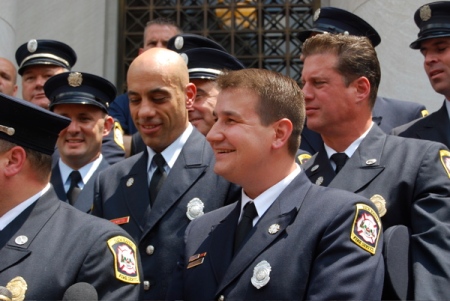
Ricci firefighters

They won their case, but it changes nothing – the administration is now imposing racial quotas that will keep their kids out of AP.

(Guest post by Greg Forster)

In today’s post, the disparity between talking the reform talk and walking the reform walk once again “rises to the top.”

Mike Petrilli has again put on his Pollyanna dress and bought into Hope And Change, praising Obama’s NAACP speech in shockingly hyperbolic terms – “It was transcendent. It was inspirational. It was honest, direct, bold, and, I hope, important, maybe a turning point.”

Look, as has always been the case, Obama says a lot of the right things, and that does matter. But come on, Mike, let’s maintain a grip on reality. Of the descriptors you offer, only “direct” seems plausible. Ask the DC voucher kids how “honest” Obama is being when he poses as a reformer. I’m not sure how you can call him “bold” while simultaneously joining the choruses that endlessly sing his praises everywhere I turn – what would he say if he were a coward? (FWIW, McCain has the exact same issue – he’s a “straight talker” who never tells the public anything it doesn’t love to hear. But that doesn’t excuse Obama.) And while Obama’s choice to talk like a reformer is important, if nothing new emerged in this speech – and it didn’t, unless I’m missing something – then this speech adds nothing “important” to the previously established fact that Obama talks like a reformer. (HT Adam Schaeffer, who got to this party before me.)

As for “maybe a turning point” – only in terms of the channel on my radio.

You know whom you should listen to, Mike? There’s this really great blogger on Flypaper who just did an eye-opening post on the Obama administration’s little-noticed threat to bring race discrimination lawsuits against school districts if they don’t have enough “students of color” in advanced courses. Once the threat has been made, of course, the lawsuit never need be brought – school districts across the country have now recieved the message and will quietly adopt racial quotas to avoid attracting the attention of the people playing with matches near the gas tanks at the DOE’s civil rights office. The threat is the quota.

How does that square with the president’s telling the NAACP that black students shouldn’t use social disadvantages as excuses for slacking in school? What will that do to a couple decades’ worth of work you and Checker and so many others have put into promoting rigorous academic standards against all the charlatanry of the radical left?

If I were you, Mike, I’d start following that blogger’s work on a regular basis. A guy who digs up that kind of shocking story when nobody else found it, and has the guts to broadcast it even if it might get him in trouble with the administration – well, in my book, that’s a guy who’s going places.


The Student Loan Lesson for Health Reform

July 21, 2009

Monopoly - Pennybags

From now on, any time you need care, just come ask my permission!

(Guest post by Greg Forster)

In case you missed it, you’ll definitely want to check out Stephen Spruiell’s NRO column on what we can learn about health care reform from looking at the federal student loan program. “Reform” means irreversible steps that must inevitably end in dictatorial socialization.

It’s important to begin with the understanding that we don’t have a free market in health care as it is. What we have is a government-mandated cartel. Pretty much all the problems people complain about arise from the mandatory cartelization of health care. The question is whether we’re going to stick with this lousy command-economy cartel, or switch to an even worse direct government monopoly.

I’ve noted before how the already-complete monopolization of the education sector provides a general model for the ongoing monopolization of health care. But Spruiell’s article on how government muscled its way to becoming the sole student lender in America demonstrates that the education monopoly provides not only a general model, but a step-by-step tactical plan:

  1. Sponsor a huge, hubristic attempt to monopolize the market.
  2. When you lose that fight, fall back on the comparatively “reasonable” “compromise” of massive subsidies.
  3. Sit back and wait for the massive subsidies to badly distort the market, creating widespread suffering and injustice.
  4. Whip up public anger over the injustices you’ve created, directing blame away from yourself by demonizing the private service providers.
  5. Offer a “public option” as a way to “control costs” and “keep the private sector honest.” Subsidize the public option so it offers a better deal.
  6. Watch the “public option” become the dominant service provider, and then a de facto monopoly.
  7. Demonize the remaining private providers because they’re not as good as the public option.
  8. Outlaw the remaining private providers so everyone must now come to you.
  9. Begin reshaping the government service provider to meet your needs, taking advantage of your complete freedom to order everything however you want, since there are now no alternatives and thus no way for anyone to effectively resist you.
  10. Lie back and enjoy your tyrannical rule over a nation of willing slaves.

On federal student loans Congress is about to take step 8. On schooling generally we’ve long since completed step 6, but the periodic attempts to progress to step 7 have (so far) been successfully repulsed. On health care we are now being invited to take step 5.

The game is pretty simple. Most games are, once you read the box top and know what’s going on.

The only question that matters is: at what point does the progression become irreversible? I suspect that if we ever arrive at step 10, it will be primarily because at some prior stage, the people who were smart enough to see what was going on assured themselves that the point of no return had not yet been reached, when in fact it had.


Pass the Popcorn: We Fly With Our Spirits

July 17, 2009

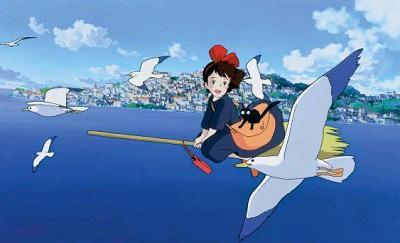
Kiki & birds

(Guest post by Greg Forster)

Last week, for our weekly dose of pop culture, Jay wrote about the rise of mopey, whiny self-pitying youth fiction, and offered some examples of where to look for something better.

Then, yesterday, I noticed the news that next month, after a four-year wait, U.S. audiences are finally going to get another Hayao Miyazaki movie. Ponyo opens Aug. 14. Last July it opened in Japan on 481 screens – a record for a domestic film – and had grossed $153 million by November.

Obviously the blog gods are demanding that I write about Miyazaki for this week’s Pass the Popcorn! Often called “the Japanese Walt Disney,” Miyazaki has produced a series of outstanding animated movies. One of the most amazing things about his work is its incredible range – from delightful family movies that kids and adults can enjoy together (hence the very apt comparison to Disney) to great epics about wars among gods and wizards, in which life ultimately triumphs over death, but not without paying a horrible price (definitely not Disney fare).

This week, continuing Jay’s theme, I’ll stick to the lighter stuff you can watch with your kids. Some other week I’ll write about the more grownup Miyazaki films.

06_my_neighbor_totoro

My Neighbor Totoro, one of his earlier films, is about two young girls who move into a new home and discover forest spirits living nearby. We gradually learn that the girls’ mother has some kind of serious ailment and lives in the hospital, and they get to see her very rarely; their adventures among the forest spirits are a substitute for the normal life they can’t have. Whether you think the spirits are real or imagined – I think the movie pretty clearly indicates that they’re meant to be real – doesn’t really alter the main point; we rely on fantasy to survive reality. (The setup mirrors Miyazaki’s own childhood; for eight years his mother was constantly in the hospital with TB and his family moved around a lot.)

Totoro’s greatest strength is its fantastically original visuals. In what has become the iconic image for fans of this movie, the girls are waiting in the pouring rain at a bus stop by a road that runs through the woods, and then unepectedly turn around and discover a forest spirit standing in the rain next to them – waiting for the forest spirit bus, which apparently uses the same stop as the human bus. Not knowing how to respond to each other, the girls and the spirit just awkwardly keep standing there, waiting for their respective busses.

When the spirit bus comes, in the form of a giant cat, they decide to get on that and see where it goes, rather than wait for the human bus and go where they’re supposed to. The bus bounds off through the forest, running on its cat-feet rather than riding on wheels.

Totoro bus

I’ve started with Totoro because it’s chronologically first (at least, of the Miyazaki films that have gotten wide exposure in the U.S.) and is also the most suitable for even very young children. However, it’s not the best stuff Miyazaki ever did, so unless you have younger kids whom you want to entertain I definitely don’t recommend making this your first Miyazaki movie.

The basic problem is the lack of a significant plot. The movie is really about a mood. For some people this just isn’t a issue; Totoro has a pretty significant fan base. For them, the magic and wonder, the astonishing visuals, and the poiniency of seeing the girls’ lives sliding slowly but surely into this alternate fairy-world in the absence of their mother are enough. But most viewers want a movie to go somewhere, and this one just doesn’t.

Sheeta & Pozu

By contrast, Castle in the Sky has plot coming out of its ears. It’s very much an old-fashioned kids’ adventure story. And like the best old-fashioned adventures – and unlike the insipid, watery gruel kids usually get nowadays – it’s packed with tons of nonstop story and amazing events, but it delivers this rollercoaster ride without ever devolving into mere brainless fighting and running around. At its heart, all the action and adventure are about two young people who have chosen to do their duty in the teeth of all opposition and in spite of hopeless odds, and end up loving every minute of it.
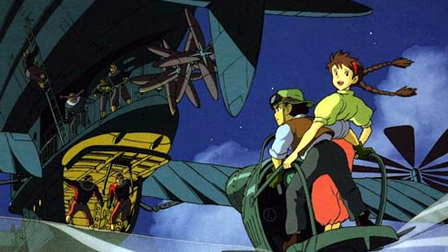
Sky pirates

It’s telling that we have a whole genre of movies called “action” movies. In all but a handful of them, plot and character – traditionally the two great rival suitors to our minds and hearts – are equally sacrificed into the maw of mere frenetic activity. By contrast, the mark of a good “action” story is that all the action is about something – even if it’s something simple, like a boy who’s determined to vindicate the good name of his dead father, and a girl who’s determined to keep a mysterious artifact she’s inherited out of the wrong hands.

Ornithopter battle

The flip side of that is that Castle in the Sky isn’t philosophically deep. I almost wrote that it isn’t about anything important, but that’s not true – a story about two bright, scrappy kids who move heaven and earth against impossible odds for no reason other than to do the right thing is about something very important! But it’s not philosophical or complex; there are no layers of deeper meaning to explicate, as there are in so many of Miyazaki’s other films.

But if you’re just looking for a great fantastic adventure that doesn’t fit the usual Hollywood mold, check this out.
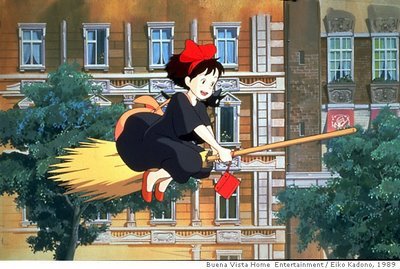
Kiki

I saved the best for last! Kiki’s Delivery Service is a lot like the best Pixar movies – it’s formally a kids’ story, but it’s about something adults care very deeply about, so they can enjoy it just as well as the kids can, if not better.

Kiki is a 13-year-old girl who’s training to become a witch. Following ancient custom, she has to spend a year away from home, and the movie is about Kiki’s struggle to establish herself independently. Witches need to make a living, just like everybody else, and in the movie’s narrative world they support themselves by developing useful skills – potion-making, fortue-telling – and selling their services to customers. 

Kiki needs to develop a skill that she can use to support herself. But her mother (who has trained her to this point) is a little flaky, and hasn’t managed to teach her any useful skills. She can only do the two basic things that all witches can do – fly on her broomstick and talk to her black cat – neither of which seems to promise much hope for independence. And her initial experiences in the big city leave her feeling overwhelmed and discouraged.

Perhaps worse, she’s landed – so to speak – in a city where there are no witches and haven’t been for a long time, so she’s viewed as weird and alien by everyone around her. Required (again by ancient tradition) to wear a distinctive black dress, she sticks out like a sore thumb everywhere she goes. Walking alone down the street, she passes a gaggle of brightly dressed girls, briefly overhears their giggling and gossip, and then catches a glimpse of herself – darkly dressed and alone – reflected in a shop window.

Oh, and of course there’s boy trouble. She knows none of the “cool” boys will be interested in her, which is hard enough, but on top of that, she has managed to catch the attention of a geeky kid who’s fascinated with flying, and hence with her, but not so great at taking the hint that she doesn’t want him around.
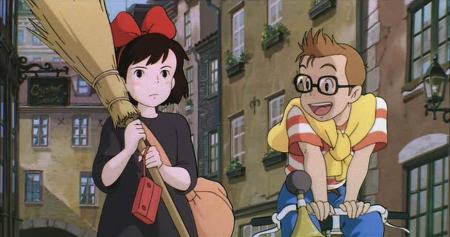
Kiki & Tombo

Her only consolation is Jiji, her supportive but heavily sarcastic black cat – voiced, in a virtuoso comedic triumph, by Phil Hartman. This was one of the very last of his performances; the English-language version of the movie was released on May 23, 1998, five days before Hartman’s death.
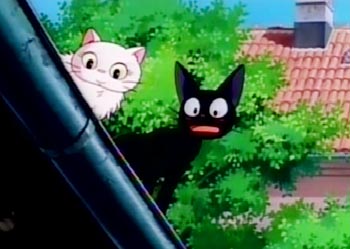
Jiji & Lily

You will have surmised from the title that she takes the only talent life has given her and makes that her calling – being able to fly, she can offer the city’s fastest delivery service.

But that’s just the beginning of the story. Flying becomes a job, and it’s not fun anymore. So she can rely on her flying to become independent, but if she does so, flying can’t be what it used to be to her. Gaining her adult independence through flying means losing her childlike delight in flying – because taking childlike delight in something depends on doing it for its own sake.

And then she wakes up one day and discovers that for some mysterious reason, she’s lost her powers and can’t fly anymore. If she can’t figure out what’s wrong, she’ll have lost both the childlike delight and the adult independence that flying gave her – she’ll have lost everything.

She comes to realize that the problem is precisely that she’s been so anxious to become independent, to fit in and be a normal girl, and all the rest of it. By making these anxieties the center of her attention, she’s lost the love of flying that was powering her talent in the first place.

Kiki & Ursula

“When you fly, you rely on what’s inside you, right?”

“My mother says we fly with our spirits.”

Childhood isn’t enough, so we need to become self-reliant, but self-reliance isn’t enough, either. Self-reliance needs to serve a purpose beyond mere self-reliance, or it becomes devoid of meaning – and as a consequence, the talents that make us self-reliant become corrupt or impotent. The mere enchantment of childhood that naively enjoyed exercising a talent for its own sake can’t be sustained if that talent is going to be what you make your living at. But if you want to keep the talent healthy, you have to have some reason to do it besides merely making a living – as one of Kiki’s older and wiser friends puts it, “we each need to find our own inspiration.”

Kiki recovers her ability to fly when she discovers what flying is really for.

Don’t miss this gem of a movie.