Rock Star Pay for Rock Star Teachers Part Deux

April 29, 2009

(Guest Post by Matthew Ladner)

Last year I was reading the comments section of a newstory online, and came across a comment from a public elementary school teacher. She was complaining that she had 34 students in her classroom.

So let’s do the math. The statewide average spending per pupil in the state: $11,000. Total revenue generated by this classroom = $374,000. Let’s assume the teacher gets a total compensation package of $60,000 including benefits. The question becomes- what did they do with the other $314,000?

Ah, that was what the teacher was really angry about. Her elementary school had 8 teachers in “non-classroom assignments.”

I don’t have a problem with 30 some odd kids in a classroom. It’s been done, and is being done. Remember?


Many insist that the period depicted by this photo constituted the “good ole days” of education. Jay and Greg have felt compelled to dispel the myth of the lost golden age of public education, back in the good ole days, when public schools were far more effective than they are today. The truth, of course, is that NAEP scores for 17 year olds are flat as far back as you can take them.

What has not been flat- public school spending- adjusted for inflation per pupil has steadily increased even while test scores have stagnated, even while Americans have become wealthier and poverty has declined.

Of course, there is no single explanation for this trend, but certainly the national obsession with lowering average class sizes must be viewed to have been an enormously expensive academic failure. Consider the international evidence:


class-size-11

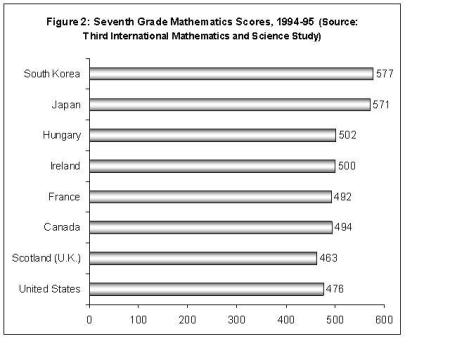
Really big classes in Asia, really small in the United States. However, when it comes to achievement:
class-size-2

The average South Korean seventh-grader scores 21 percent higher than the average American on seventh-grade mathematics, despite having much larger average class sizes. While a variety of factors contribute to the relative deficiency of American public schools, many scholars are beginning to suspect the main factor is the relatively inferior average quality of American teachers.

In How the World’s Best Performing Schools Come Out on Top, the international management consulting firm McKinsey & Company point squarely at teacher quality as a key variable in explaining variation in international academic achievement. In its findings, McKinsey quoted a South Korean policymaker who noted, “The quality of an education system cannot exceed the quality of its teachers.”


McKinsey found that the top-performing school systems around the world recruit their teachers from the top third of each graduating cohort. Moreover, South Korean schools draw from the top 5 percent of college graduates. Larger class sizes create the resources to pay South Korean instructors much higher salaries.


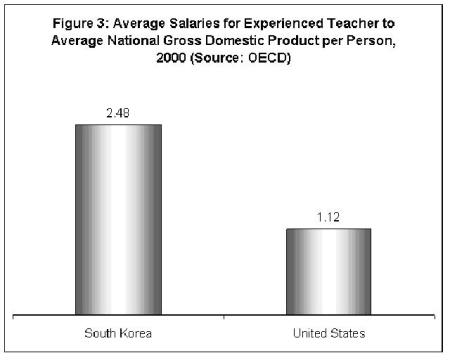
The Organisation of Economic Co-operation and Development measures relative teacher pay by comparing the average salaries of teachers with 15 years of experience with a nation’s gross domestic product (GDP) per capita. A high salary compared with per capita GDP suggests that a country invests more of its financial resources in teachers and suggests a relative prestige of the profession. By definition, the average person in each of these countries will earn a ratio of 1. Figure 3 compares teacher-salary-to-per-capita GDP for the United States and South Korea.
teacher-pay-korea

An experienced South Korean schoolteacher makes a relatively impressive wage compared with teachers in the rest of the world. In South Korea, teaching is an honored profession—not just rhetorically but in compensation as well. In the United States, meanwhile, a teacher with a college degree and 15 years of experience makes a salary relatively close to the average GDP per person. Not surprisingly, there are many qualified applicants for each open teaching position in South Korea.


McKinsey quotes the New Commission on the Skills of the American Workforce to contrast the United States with those countries having more successful education systems: “We are now recruiting our teachers from the bottom third of high-school students going to college…. [I]t is simply not possible for students to graduate [with the skills they will need] unless their teachers have the knowledge and skills we want our children to have.”


Rock Star Pay for Rock Star Teachers!

April 28, 2009

(Guest Post by Matthew Ladner)

The Goldwater Institute released a new study today titled New Millennium Schools: Delivering Six-Figure Teacher Salaries in Return for Outstanding Student Learning Gains. In this report, my coauthors Mark Francis, Greg Stone and I argue that the United States has made a tragic error in emphasizing teacher quantity (through efforts to limit average class size) rather than teacher quality. The growing literature on student learning gains clearly demonstrate that teacher quality trumps the impact of class size variation by a wide margin.

The value added literature has revealed stunning equity issues. We don’t attract enough high ability teachers into the profession, we quickly lose many of those we do to frustration or administration, and we distribute most of the remainder to the leafy suburbs. I don’t have a problem with incentive “combat pay” but let’s face it: it is not enough to simply redistribute the limited number of high quality teachers. We need to attract many more of them.

After exploring foreign and domestic examples of systems that make the opposite choice, we propose a solution: a school model which not only employs value added assessment to identify high achieving teachers, but also splits the additional revenue for students after the 20th with the teacher. We propose a 2/3 teacher, 1/3 school split for the 21st student and beyond. This works out to a $5,200 bonus per child.

With this split, our school delivers a six figure teacher salary at 32 students based upon Arizona’s relatively modest funding for charter schools. A class size of 32 students is hardly outside of the historical practice for American public schools, or even the current practice entirely.

There are many practical issues to consider, and variations on the basic model, so please read the study. I’ll write more about the study in the coming days, but the most important point is this: there is plenty of money in the public school system to treat teachers like true professionals and reward them for excellence.

UPDATE: Education Week’s Stephen Sawchuck points out that principals already covertly increase class sizes for additional pay.


Dubya’s Failure vs. Jeb’s Success

January 8, 2009

(Guest Post by Matthew Ladner)

The Heritage Foundation released a study by Dan Lips and yours truly today making the case that real education reform needs to come up from the states, rather than down from the federal government.  We focus on the success of Florida’s reforms, the disappointment of NCLB, and note that in fact NCLB threatens Florida’s continued success. Now the Bushies are exiting the Washington scene, can we at long last admit that the 2014 requirement is encouraging states to lower their standards?

Dan explains this better than I can, so I’ll just sit back an marvel at the cool graphics that the Heritage folks came up with, like the one above.


Fortune Favors the Bold

July 2, 2008

(Guest Post by Matthew Ladner)

The Goldwater Institute released a new study today co-authored by yours truly titled Fortune Favors the Bold: Reforms for Results in K-12 Education.

The study makes the case for robust education reforms rather than incremental tinkering with a fundamentally broken system. Here in Arizona, for example, inflation adjusted spending per capita in the K-12 schools has tripled since 1960, and 44% of our 4th graders in public schools score “below basic” on the NAEP 2007 4th grade reading exam.

The kids are running around with their hair on fire, while we adults wonder whether to use a cup or a bucket of water to put out the flames. It’s time to use the fire hose.

The four reforms proposed:

  • A universal system of choice, either through vouchers or a universal tax credit. Despite having among the nation’s most robust system of private and public school choice, choice programs have simply absorbed about of the third of the increase in the public school population since the charter law passed in 1994. Arizona could enjoy substantial academic and financial benefits from passing a far bolder choice program than anything currently on the books, and we would still be building new public schools.
  • Reforming Public School Governance. Charter schools make up nine out of the top 10 high schools in the greater Phoenix area, and the 10th is a magnet school. Not a single district school cracks the top 10, with charters enormously overrepresented. The lesson is clear: good schools need a district bureaucracy like a fish needs a bicycle. Schools can and should govern themselves, freeing resources for instructional use.
  • Reform of Testing. Standardized testing has jumped the shark in Arizona and elsewhere. We put forward a proposal on how to preserve the transparency and diagnostic value of testing even when states respond to pressure to dummy down their tests.
  • Measure Teacher Effectiveness on a Value Added Basis. William Sanders’ path-breaking work on value added assessment shows that students learn 50% more over a three year period with highly effective teachers compared to those stuck in classes with the bottom 20%. Dr. Sanders finds that variation attributable to teacher performance is 10 to 20 times greater than that associated with class size. Further, high-quality teachers are too rare and clustered in the leafy suburbs. Value-added measurement serves as a pre-requisite for rational and just treatment of teachers as professionals and improving learning for children.
  • Jeb Bush put in what seemed like a radical set of reforms in Florida in 1999, and they have paid huge dividends. The time has come not only for other states to emulate Florida, but to reach further, and do more. Fortune favors the bold and American education reform dithers between being misguided, pointless, and too timid.