Defeated at Wolf 359 but Texas is not completely assimilated yet

March 24, 2013

“The fight does not go well Enterprise…rendezous with fleet remnants at.. !*!Ktzzzzzzzzsszzz!*!”

(Guest Post by Matthew Ladner)

An old joke holds that you should never ask a man where he is from. If he is from Texas he will tell you, and if he is not, you don’t want to embarrass the poor feller.  Texans are famously/infamously proud of their state, and not without cause. Texans have been enjoying their national status as an economic juggernaut. Wildcatter George P. Mitchell is probably the first Texan to transform the economy of the 21st Century profoundly for the better but he won’t be the last.

Progressives will often bemoan the modest size of government in Texas and attempt to throw cold water on the state’s success by citing various statistics heavily influenced by the fact that the state is a huge destination for immigrants. And yet they continue to come on. Texas is an opportunity rather than a welfare magnet. Texas was the only state to gain 4 Congressional seats after the 2010 Census, all of which came from sclerotic regions of the country. Y’all have fun with that nanny state business and we will keep helping ourselves to your electoral votes, companies and jobs is a prevalent attitude in the Lone Star State.

Mitchell’s hometown of Houston, the global center of the oil business, is jumping but the good times extend well beyond the oil patch. Austin, once a smallish but funky university/state government town, now has condo towers dominating the skyline and far more on the way. A stroll through downtown during SXSW proved to be an eye-opening experience for this former Austinite. I’ve been gone for a decade and the city is both transformed and growing at a mind-boggling pace.  Oh sure, an old guard is still around to complain about traffic and the “lost golden age of Austin” back when they shared herbal blends with Willie at Liberty Lunch or whatever but no one seems to be listening much. The city and state is on a monstereous economic roll.

Texas however has an Achilles heel and doesn’t seem to be aware of it: K-12 education. To stretch a metaphor a bit, I would say that Texas is a horned frog boiling in water.

Here is the problem in two simple charts. First Texas 8th graders scoring “Proficient or Better” in 8th Grade Reading:
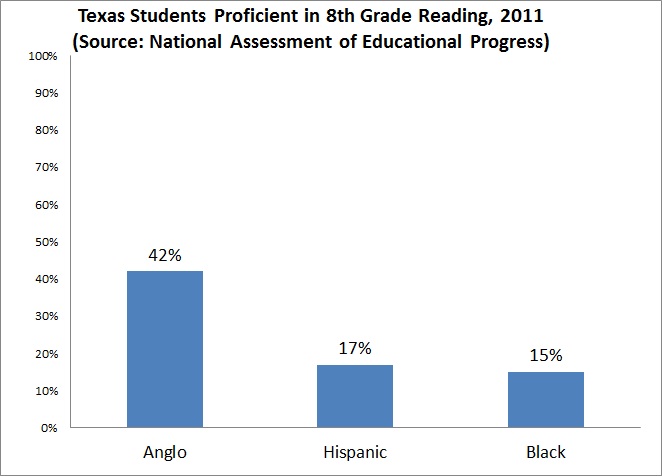
Texas 8th Grade NAEP ReadingSo let us take 8th Grade Reading Proficiency on NAEP as a rough proxy for solid preparation for college and/or career readiness. The NAEP proficiency standard is a high bar relative to the various state minimal skills tests floating around, but it equates well with international examinations.  The level below Proficient – “Basic” signifies “partial mastery” of grade level skills, so we are looking for full grade level mastery. So what we are looking for here is at least:

Eighth-grade students performing at the Proficient level should be able to provide relevant information and summarize main ideas and themes. They should be able to make and support inferences about a text, connect parts of a text, and analyze text features. Students performing at this level should also be able to fully substantiate judgments about content and presentation of content.

As the figure shows, not very many Texas students can actually do these sorts of things. Only a large minority of Anglo students along with a tiny minority of Hispanic and Black students show this level of reading ability.

Here is the kicker:

Texas K-12 ethnic breakdownNewsflash Tex: that 42% of Anglo kids being ready to face the rigors of the global economy doesn’t go nearly as far as it used to back in the day. Just in case I don’t have your undivided attention yet, check this out:

Texas HispanicAmongst Hispanics, the group that constitute a majority of K-12 students in the state, the functionally illiterate outnumber proficient readers by a very wide margin. Texas spent $11,146 per pupil in the public school system in 2010-11, which is an amazing sum when placed in context of just how much enrollment growth the state is attempting to accomodate. Texas has a public school population twice the size of Florida’s (with FL having the nation’s 4th largest btw) and approximately equal in size to the public school systems of the 20 smallest states combined.

The state has been adding around 80,000 students per year, which approximately equals the size of the Wyoming public school system. The public school lobbying groups pretend that any kind of choice program is going to leave the Texas public school system a financial ruin when in fact even the most far-reaching choice programs could at most put a dint in school district enrollment growth. If you waved a magic wand and moved every charter school that has opened west of the Mississippi River since 1990 into Texas, Texas school districts still would have gained hundreds of thousands of students.

Despite all of this, Texas Senate Education Chairman Dan Patrick, a strong supporter of parental choice, announced last week that he would be modifying a bill to eliminate the state’s charter school cap, and to instead raise it by a few dozen schools per year. Senator Patrick did this out of necesssity just to get the bill out of the committee. Worse still, this is happening in a session that seems destined to dummy down the state’s high-school graduation requirements in a major fashion. We have yet to reach the end of the movie, but this is the part where things are looking bleak for the good guys.

Don’t worry Tex…even though I control your K-12 vote I will still let you describe yourself as “conservative”…

Rather than blame the lawmakers, I’ll go ahead and blame people like myself. We reformers have done a poor job thus far in communicating the reality of the Texas situation. Consequently, there is a greatly misplaced complacency with regards to K-12 policy. We must do much better.

The greatest weakness of the powerful Status-Quo Collective that has assimilated many Austin decision makers is that they have no plausible plan for improving the Texas public education system. The problems embodied in the figures above (and others) will continue to go unaddressed while they seek yet more money for an outdated and ineffective system of schooling.

The current Texas public education system is however taking the state in a direction that almost no one will want to go. By educating only a small cadre of students to participate and prosper in the global economy, the future of the state will begin to look like that of Brazil in the late 20th Century, which one of my professors once described to me as “Belgium floating on top of India.”

As a purely economic matter, Texas can continue to import college educated workers from the less dynamic states indefinitely. As a matter of socio-economics however one cannot avoid asking fundamental questions regarding the long-term stability of both the prosperity and even democracy itself.  A public education system with only 17% of Hispanics and 15% of Black students reading proficiently constitutes a foundation of sand for the opportunity society needed to secure the future.

Time to choose…

In short, Texas can either continue to be Texas- a rapidly growing opportunity society, or it can morph into California. From my perspective in the nearby cactus-patch, California looks like a place from which Belgians are fleeing and have been for decades now-a rather loud wake up call. Ironically this leaves “progressive” California as a society increasingly divided by wealth and race. Politically incapable of addressing their education problems, California looks set to become Monaco floating on top of India. Good luck with that.

In the long run, Texans will either embrace their ideals or their education status-quo. It will become increasingly obvious that they cannot do both.


Washington Post on Charter Schools in DC

February 15, 2013

(Guest Post by Matthew Ladner)

Check out this fascinating article in the WaPo regarding the ever growing market share of charter schools in the District of Columbia. Blended learning schools will debut soon, DCPS continues to shrink, making some tetchy. Money quote:

Rocketship’s charter application — which is the largest ever to come before District officials, and which might win approval this month — arrives on the heels of Chancellor Kaya Henderson’s decision to close 15 half-empty city schools, highlighting an intense debate about the future of public education in the nation’s capital.

A growing number of activists have raised concerns that the traditional school system, facing stiffer-than-ever competition from charters, is in danger of being relegated to a permanently shrunken role. And they worry that Washington has yet to confront what that could mean for taxpayers, families and neighborhoods.

“Maybe we need an entire school system full of charters,” said Virginia Spatz, who co-hosts a community-radio talk show on D.C. education. “But we need to have that after public conversation, not by accident.”

With due respect to Ms. Spatz, there doesn’t seem to be anything accidental about this to me- DC parents will ultimately decide how many charter and district schools they want by voting with the feet of their children.


District or Charter Schools in the District of Columbia?

May 18, 2012

(Guest Post by Matthew Ladner)

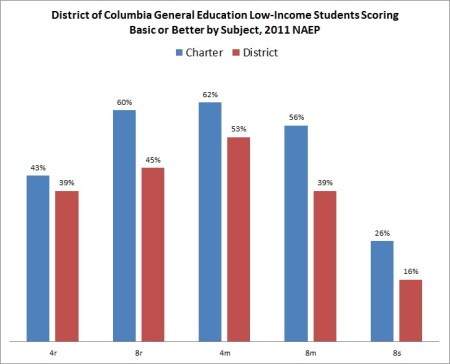
DC’s NAEP numbers allowed for some additional controls to be introduced when comparing charter and district schools than I was able to do with the Milwaukee comparison. The following chart shows the percentage of general education program students who qualify for a free or reduced lunch scoring “Basic or Better” on the 2011 NAEP exams. Special education students, ELL students and middle/high income students are not included in order to get a quick closer to apples to apples comparison.

Now of course for a real apples to apples you need a random assignment study, but those have been done and find results favorable to charter schools. This chart doesn’t address the topic of valid stastical significance, but rather whether the differences are meaningful.

Considering that charters get far less money that DCPS per pupil and show higher levels of academic achievement, this looks to be a success, albeit both the blue and the red columns leave much to be desired. The red columns leave much more to desired however, especially when you consider that that they are wallowing in money.


Charter Benefits Are Proven by the Best Evidence

May 7, 2012

It’s National Charter Schools Week, so here is the post I’ve written for the George W. Bush Institute Blog on the issue:

According to the Global Report Card, more than a third of the 30 school districts with the highest math achievement in the United States are actually charter schools.  This is particularly impressive considering that charters constitute about 5% of all schools and about 3% of all public school students.  And it is even more amazing considering that some of the highest performing charter schools, like Roxbury Prep in Boston or KIPP Infinity in New York City, serve very disadvantaged students.

As impressive and amazing as these results by charter schools may be, it would be wrong to conclude from this that charter schools improve student achievement.  The only way to know with confidence whether charters cause better outcomes is to look at randomized control trials (RCTs) in which students are assigned by lottery to attending a charter school or a traditional public school.  RCTs are like medical experiments where some subjects by chance get the treatment and others by chance do not.  Since the two groups are on average identical, any difference observed in later outcomes can be attributed to the “treatment,” and not to some pre-existing and uncontrolled difference.  We demand this type of evidence before we approve any drug, but the evidence used to justify how our children are educated is usually nowhere near as rigorous.

Happily, we have four RCTs on the effects of charter schools that allow us to know something about the effects of charter schools with high confidence.  Here is what we know:  students in urban areas do significantly better in school if they attend a charter schools than if they attend a traditional public school.  These academic benefits of urban charter schools are quite large.  In Boston, a team of researchers from MIT, Harvard, Duke, and the University of Michigan, conducted a RCT and found:  “The charter school effects reported here are therefore large enough to reduce the black-white reading gap in middle school by two-thirds.”

A RCT of charter schools in New York City by a Stanford researcher found an even larger effect: “On average, a student who attended a charter school for all of grades kindergarten through eight would close about 86 percent of the ‘Scarsdale-Harlem achievement gap’ in math and 66 percent of the achievement gap in English.”

The same Stanford researcher conducted an RCT of charter schools in Chicago and found:  “students in charter schools outperformed a comparable group of lotteried-out students who remained in regular Chicago public schools by 5 to 6 percentile points in math and about 5 percentile points in reading…. To put the gains in perspective, it may help to know that 5 to 6 percentile points is just under half of the gap between the average disadvantaged, minority student in Chicago public schools and the average middle-income, nonminority student in a suburban district.”

And the last RCT was a national study conducted by researchers at Mathematica for the US Department of Education.  It found significant gains for disadvantaged students in charter schools but the opposite for wealthy suburban students in charter schools.  They could not determine why the benefits of charters were found only in urban, disadvantaged settings, but their findings are consistent with the three other RCTs that found significant achievement gains for charter students in Boston, Chicago, and New York City.

When you have four RCTs – studies meeting the gold standard of research design – and all four of them agree that charters are of enormous benefit to urban students, you would think everyone would agree that charters should be expanded and supported, at least in urban areas.  If we found the equivalent of halving the black-white test score gap from RCTs from a new cancer drug, everyone would be jumping for joy – even if the benefits were found only for certain types of cancer.

Unfortunately, many people’s views on charter schools are heavily influenced by their political and financial interests rather than the most rigorous evidence.  They don’t want to believe the findings of the four RCTs, so they simply ignore them or cite studies with inferior research designs in which we should have much less confidence.

Progress will be made in our application of research to charter school policies by encouraging everyone to focus on the most rigorous studies, of which we have several.  To do that, supporters of charter schools also have to refrain from citing weaker evidence, which only serves to legitimize the use of inferior studies by charter opponents.  As exciting as the outstanding performance of charter schools is in my own Global Report Card research, that evidence shouldn’t be used to endorse charter schools.  Supporters don’t need to rely on the Global Report Card to make the case for charter schools because they have four gold-standard RCTs on their side.  Opponents of charter schools have no equally rigorous evidence on their side.  And that’s the point we should all be making.


Review the Charter Research, Don’t Pick the Outlier

November 2, 2011

Julian Betts and Emily Tang at the University of California at San Diego have a new systematic review of the research on charter schools.  They look at more than 30 studies that meet minimal criteria for research quality.  They find that charters have statistically significant positive effects on math and reading achievement in elementary grades and on math in middle school.  There are no significant effects for reading in middle school or for high school student achievement.  The size of the effects are modest, ranging between 2% and 6% of a standard deviation.  (See Table 2)

It’s important to step back and review an entire literature, rather than focus on a single study.  It is sensible to focus on higher quality research, since results are highly sensitive to research design.  But it is completely inappropriate and misleading to pick a single study while ignoring all others of equal or higher quality simply because that one study produces the result you like.

Of course, highlighting the one study she likes is Diane Ravtich’s stock in trade.  All we hear from Ravitch and her Army of Angry Teachers is about the CREDO study.  That’s one study — and not a high quality one.  And even then Ravitch distorts what CREDO finds.

But Betts and Tang’s review includes CREDO and dozens of other studies.  When we look at the full set of research, we see some significant and positive results.  And in Table 4, Betts and Tang show us that if you exclude the CREDO study, the positive effects for charters get stronger so that charters significantly improve math achievement across all grades.

Of course, you shouldn’t exclude that one study, but it is informative that the one study that Ravitch and her Army of Angry Teachers hold up as proof of their view that charters don’t work is clearly an outlier from the full set of research.  And if we focus on the highest quality random-assignment studies of charter schools, the positive results are even stronger.

I wonder if Diane does this in her historical research.  Does she pick the one quotation or document that supports her argument while misleading readers about the entire set of information?  It’s harder to catch Ravitch in this sort of deceptive scholarship in historical work, but in quantitative empirical research, it is the essence of what she does.

(edited for typos)


Peterson and West on the NAACP and Charters

August 3, 2010

Paul Peterson and Marty West have a great piece in today’s WSJ showing how increasingly popular charter schools are among African-Americans.  Despite that fact, the NAACP continues to oppose charters.

Given that 64% of African-Americans surveyed stated that they supported the formation of charter schools (up from 49% last year), Peterson and West remark that: “It’s time civil-rights groups listened to their communities.”

Unfortunately, Peterson and West tell us, the NAACP has picked their political allies in the teacher unions over their constituents:

By casting their lot firmly with teachers unions, the leadership of the NAACP and the Urban League hope to preserve their power and safeguard their traditional sources of financial support. Not only is this is a cynical strategy, it ignores where African-Americans and Hispanics are on the issue. Thankfully, the Obama administration is paying attention to the needs of low-income, minority communities and not to their purported leaders.

You can read more about the survey over at Education Next.


Charter Chatter

February 10, 2010

Readers of JPGB have already seen the working paper, but Education Next now has the peer-reviewed and published version of Booker, Sass, Gill, and Zimmer’s study of the effect of charter high school on graduation and college attendance.  Since you are way ahead of the curve you already knew that attending a charter high school increases the probability that a student will graduate high school and go to college.

The study is so clever because it focuses on students who attended charter middle schools.  Some went on to charter high school and some did not.  By comparing the two groups Booker, et al reduce the selection bias of choice, since all of the students chose charter schools at least for middle school.  But there may still be some selection bias in who chooses to continue in charter high school, so Booker, et al address that with a neato instrumental variable.  Some students don’t go on to charter high school because there isn’t one available nearby.  Their analysis predicts whether students continue to a charter high school based on the availability of nearby charter options.

Check out the highly readable Ed Next article for yourself.  Also watch the podcast interview with Brian Gill.


UCLA Civil Rights Project Gets It Wrong

February 4, 2010

My friends over at Mid-Riffs take apart the new report from Gary Orfield’s UCLA Civil Rights Project claiming that charters produce segregation:

“The report finds:

that charter schools, particularly those in the western United States are havens for white re-segregation from public schools; requirements for providing essential equity data to the federal government go unmet across the nation; and magnet schools are overlooked, in spite of showing greater levels of integration and academic achievement than charters.

It looks like, based on a quick pass through the report, their main finding is based on demographic comparisons  between charter schools and traditional public schools at the state level. This method of comparison likely leads to inaccurate conclusions due to the fact that charter schools are overwhelmingly an urban phenomenon. The correct comparison is between charters and the demographics of their immediate geographic area. We have discussed this topic as it relates to Little Rock at length here.

The Economist’s take on this report is concise, to-the-point, and spot on.

In plain English, there are a lot of black kids in charter schools. This is because charter schools tend to get set up in neighbourhoods where the public schools are terrible, such as south-eastern Washington DC or the rougher parts of New Orleans. These neighbourhoods are disproportionately African-American. Charter schools are popular with poor black parents because their other choices are so awful. There are very few charter schools in rich white suburbs with nice public schools, because there is no call for them.

The important question about charter schools is: do they give kids a better education than they would otherwise have received? The answer is yes. Nothing else matters.”


Cool Charter School Map

December 18, 2009

(Guest Post by Matthew Ladner)

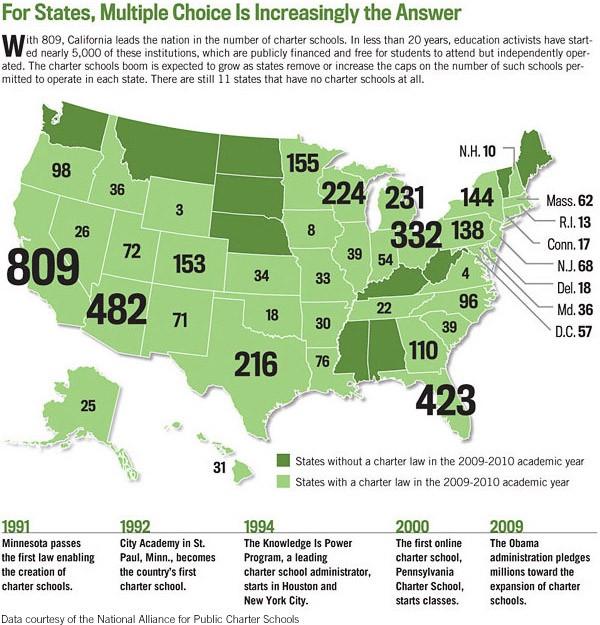
Cool charter school map from U.S. News and World Report.


Coulson Schools LA Times on Charters

December 2, 2009

Andrew Coulson teaches the LA Times a thing or two about charter schools in his post on the Cato blog.  Here’s the meat of it:

Yesterday’s LA Times editorial on charter schools combined errors of fact and omission with a misrepresentation of the economic research on public school spending. First, the Times claims that KIPP charter public schools spend “significantly more per student than the public school system.” Not so, says the KIPP website. But why rely on KIPP’s testimony, when we can look at the raw data? LA’s KIPP Academy of Opportunity, for instance, spent just over $3 million in 2007-08, for 345 students, for a total per pupil expenditure of $8,917. The most recent Dept. of Ed. data for LAUSD (2006-07) put that district’s comparable figure at $13,481 (which, as Cato’s Adam Schaeffer will show in a forthcoming paper, is far below what it currently spends). Nationwide, the median school district spends 24 percent more than the median charter school, according to the National Center for Education Statistics.

Next, in summarizing the charter research, the Times’ editors omitted the most recent and sophisticated study, by Stanford professor Caroline Hoxby. It finds a significant academic advantage to charters using a randomized assignment experimental model that blows the methodological doors off most of the earlier charter research. The Times also neglects to mention Hoxby’s damning critique of the CREDO study it does cite….

There are certainly reasons to lament the performance of the charter sector, and the Times’ editors even came close to citing one of them: its inability to scale up excellence as rapidly and routinely as is the case in virtually every field outside of education. Before getting into such policy issues, however, the Times should make a greater effort to marshal the basic facts.