Jay P. Greene's Blog

With Help From Some Friends
  • Home
  • About
 

AZ District Open Enrollment >> Charters + Private Choice

November 17, 2017

(Guest Post by Matthew Ladner)

From the Center for Student Achievement:
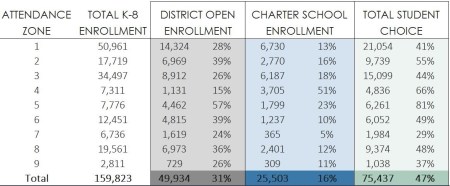
That’s right Ralphie, in an examination of Maricopa County (greater PHX) enrollment patterns it turns out that district open enrollment involves approximately twice as many students as charter schools. Which in turn means that it dwarfs private school choice-as in private school choice and charters combined will still be far smaller than open enrollment. If however we were to include private and home-schooling in this analysis, it would mean that fewer than 50% of students attend their assigned district school.

One can only describe the implications of this as far-reaching. Let’s start with the angst over private choice.
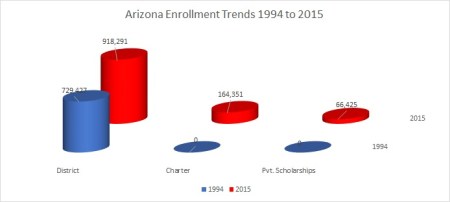
So in the districts examined by the Center, open enrollment dwarfs charter school enrollment, and statewide charter school enrollment dwarfs private choice enrollment. The conclusion inevitably follows that much of the hand-wringing and gnashing of teeth over charters and private choice in the state has been misplaced. If one views families exercising choice as “draining money from public schools” it is primarily other district schools that have been doing most of the draining!

Curses! They’ve discovered that I am the real vampire!

Now of course it is deeply misguided to view students attending a non-zoned school as “draining money” in the first place. It is the child’s money for families to direct, not the entitlement of a particular school. Just in the districts examined there are more than 10 times the number of students using open enrollment as there are ESA students statewide. Let that sink in for a moment. To the extent that choice is causing budget problems in district schools (it’s worth it, but we’ll get to that below) let the record show that it is result of district competition far more than private choice.

Next- why do we see stuff like this?
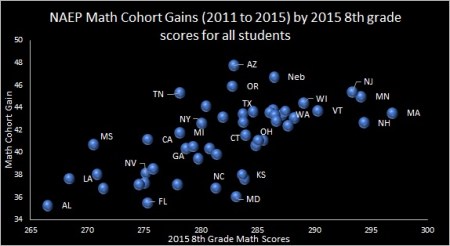
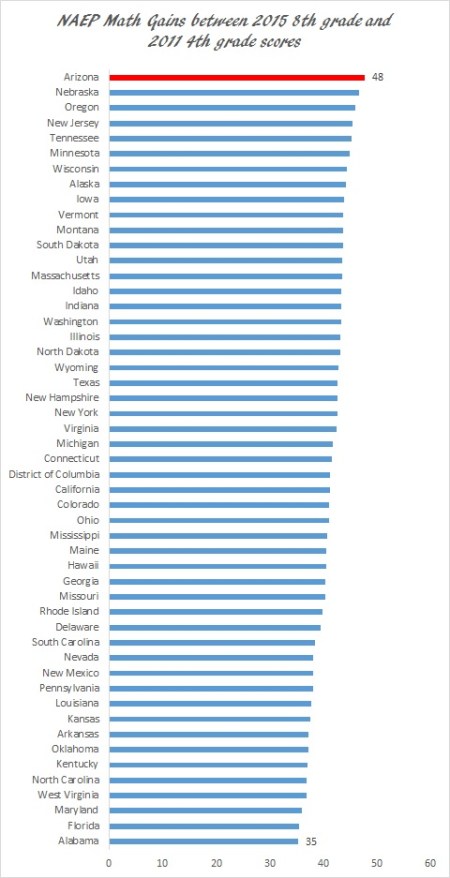
Arizona is an unlikely jurisdiction to have been leading the nation in NAEP gains since 2009. We’re not a wealthy state (yet), we have a small working age population, our citizenry has not exhibited a preference for high taxes over the last 30 years. Just last week a sales tax increase for preschool got voted down by the voters in the “People’s Republic of Tucson” almost two to one. Five years ago voters rejected a statewide measure by nearly the same margin. More recently the voters barely agreed to increase school funding by $3.5 billion without a tax increase in order to settle a lawsuit and avert a possible constitutional crisis. We are a border state going through a border state transition in student demographics. Our students, educators and policymakers didn’t read that memo with the subject line about we were supposed to lose. Instead we lead the nation in gains.

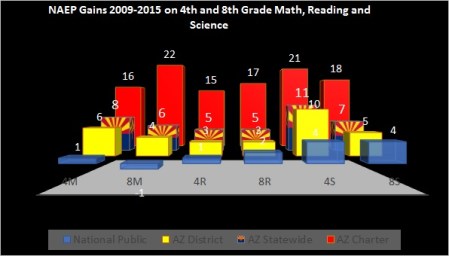
You’re either willing to take the steps necessary to drive gains or you can dream about kumbaya policies that don’t offend many. Arizona has thus far been willing to do what it takes. The very widespread process of families matching their kids to better than the zoned option fits is obviously driving this process. To think otherwise would require you to explain how Arizona has been leading the nation in gains despite all this choice business. And then there is the data:
Next let’s talk about facility funding. A murmur that has been coming out from the district folks in recent years has been “we’re double funding capital.” In other words, taxpayers paid for buildings that are sitting empty while charter schools keep building new space. Rumors of a fresh round of litigation against the state regarding district facility funding have been circulating for years. How much sense does it make to build Taj Mahal big box schools with a student population that is this mobile? Moreover much of the empty district space issue came from the state overbuilding facilities during the boom for schools that Arizona parents did not desire and desired district schools were the destination for a large percentage of these students.

In other words, this isn’t being done to districts in so much as by districts.

If we extrapolate this Maricopa data to Tucson, then Tucson Unified’s large number of empty school buildings are empty because of open enrollment more than charters or private choice, but ultimately they are empty because families chose to empty them. Yes it is an absurd waste to have people talking about converting schools into urban gardening centers in a relatively cash strapped state that has the second fastest growing student population. Yes we should find a way for someone who will run a school that parents desire to make use of those facilities.

In the end however those empty school buildings are accountability. Real accountability, not the watered down wrist-slap version of it. Choice is the only form of accountability that is decentralized and can get delightfully out of the control of central planners and into the control of families. In Arizona it has been driving academic improvement and, alas, this process causes angst. Far from shying away from responsibility, the district schools attracting the confidence of families should be proud to be driving choice and participating in the process of creating good fits and academic gains.

UPDATE: NPR interviews Ildi Laczko-Kerr of the Arizona Charter School Association and Center for Student Achievement on the data.

Share this:

  • Click to share on Facebook (Opens in new window) Facebook
  • Click to share on X (Opens in new window) X
  • Click to print (Opens in new window) Print
  • Click to email a link to a friend (Opens in new window) Email
Like Loading...

5 Comments | charter schools, Education Savings Accounts | Tagged: Arizona charter schools, Arizona Empowerment Scholarship Account, Arizona K-12, Center for Student Achievement, NAEP, Open Enrollment | Permalink
Posted by matthewladner


Broad ESA proposal out of committee in Arizona

February 14, 2017

(Guest Post by Matthew Ladner)

The Arizona House Education committee passed a four-year phase in of universal public school eligibility for the Empowerment Scholarship Account program, and a separate measure aimed at improving the administration of the program. Jonathan Butcher, Jason Bedrick and Sydney Hay all provided insightful testimony, as did a number of current ESA students and parents. One of the supporters of the bill noted in committee testimony last night that each expansion of choice in Arizona has been preceded by dire predictions of doom, but that in fact Arizona public school outcomes have improved rather than worsened. Quite right:

Arizona students have been leading NAEP cohort gains since 2009. The only two obvious things that stand out about Arizona K-12 in my mind have been larger than average budget cuts brought on my the Great Recession and parental choice. Arizona did change over academic standards during this period, but the national analysis of Hanushek and Loveless leads one with the unmistakable conclusion that this change had at most a modest amount to do with the improvement, likely less than that. I haven’t yet heard a plausible link between budget cuts and improving academic outcomes. In my book this leaves choice as, well:

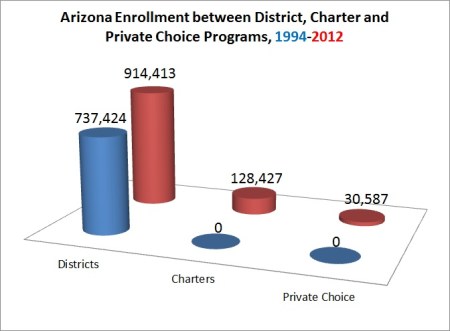
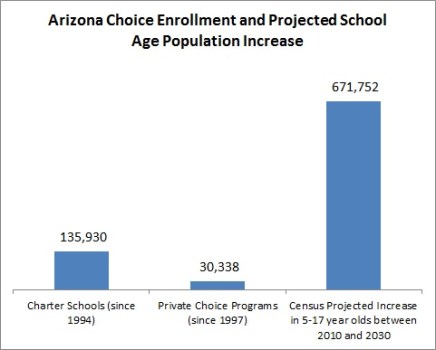
Opponents recited their litany against draining money from the public schools, noted teacher shortages, etc. A “student surplus” however is another way to express a teacher shortage. Arizona school districts simply cannot hire enough teachers to serve their current level of enrollment, and it is worth noting that things would have been far more dire without the advent of choice in 1994. Without out the advent of charter schools in 1994 and private school choice in 1997, it is not clear just how the districts would have managed to cope with an enrollment increase far larger than moving from 737k to 914k between 1994 and 2012 (see figure above).

District supporters don’t like to admit that they need help in coping with enrollment growth- they’ve got it all covered, allegedly. Hmmm…

Arizonans have been rewarded for their embrace of pluralism in education thus far. Let’s see what happens next.

Share this:

  • Click to share on Facebook (Opens in new window) Facebook
  • Click to share on X (Opens in new window) X
  • Click to print (Opens in new window) Print
  • Click to email a link to a friend (Opens in new window) Email
Like Loading...

4 Comments | Education Savings Accounts | Tagged: Arizona Empowerment Scholarship Account, Arizona ESA. Jonathan Butcher, Jason Bedrick, Sydney Hay | Permalink
Posted by matthewladner


ESA parents increase the bang for the education buck

September 4, 2014

(Guest Post by Matthew Ladner)

Great work by Lindsey Burke and Brittany Corona of the Heritage Foundation and (most of all) from our Arizona ESA parents and students in making their case.  Take special note of ESA parent Marc Ashton’s description of how he was able to get the his son educated in one of the very highest regarded schools in Arizona (Brophy Prep) and purchase Braille books and still save some money for college all on 90% of what the state would have provided a public school for his son’s education.

Marc Ashton’s comments reveal the opportunity cost of poorly utilized funds in public education. Mind you, districts have been complaining non-stop for decades that they don’t receive enough state and federal dollars for students like Max Ashton.  Special education is a terrible financial burden, requiring them to transfer their locally generated dollars out of general education and into special education. Lo and behold, the Ashton’s have taken 90% of the state funding and got an education for their son that they are wildly enthused about, bought needed educational supplies, and saved some money for Max to attend college. Hmmm, how can describe this? Maybe:

Or better yet:


Share this:

  • Click to share on Facebook (Opens in new window) Facebook
  • Click to share on X (Opens in new window) X
  • Click to print (Opens in new window) Print
  • Click to email a link to a friend (Opens in new window) Email
Like Loading...

3 Comments | Education Savings Accounts | Tagged: Arizona Empowerment Scholarship Account, Arizona ESA program, Brittany Corona, Heritage Foundation, Lindsey Burke, Marc Ashton, Max Ashton | Permalink
Posted by matthewladner


  • Visit Jay P. Greene's Blog on Facebook
  • Recent Posts

    • And the Winner of the 2023 “Al” is… Ali Ahmed Aslam
    • Jacqueline Keeler and Sam Dean for The Al
    • Re-Nominated for the Al Copeland Humanitarian Award: Chad Kroeger and JT Parr
    • For the Al: Ali Ahmed Aslam
    • For the Al: J. Gresham Machen
    • The Al Is Driving, and Is the Only One Not Driving Us Off a Cliff
    • From Passing the Policy to Parent Participation
    • And the Higgy Goes to… Peter Daznak
    • Peter Daznak for the Higgy
    • For the Higgy: Jennifer Dorow
  • Archives

  • Meta

    • Create account
    • Log in
    • Entries feed
    • Comments feed
    • WordPress.com


Create a free website or blog at WordPress.com.

  • Subscribe Subscribed
    • Jay P. Greene's Blog
    • Join 186 other subscribers
    • Already have a WordPress.com account? Log in now.
    • Jay P. Greene's Blog
    • Subscribe Subscribed
    • Sign up
    • Log in
    • Report this content
    • View site in Reader
    • Manage subscriptions
    • Collapse this bar
 

Loading Comments...
 

    %d