“Dr. Zaius, Dr. Zaius! Oh, Ohhhh, Dr. Zaius!”

July 24, 2014

(Guest post by Greg Forster)

Andy Smarick’s proposal for private choice school authorizers deserves a closer look. I can understand why at first it might prompt smart people like Jason Bedrick to cry out, as Matt put it, “get your charter law off me, you dirty ape!” But in the original report, Smarick doesn’t flesh out the idea in detail, and we all know who’s in the details. There are certainly some ways of designing such authorizers that would lead me to join Jason’s outcry against them. But there are also possible ways of designing them that would make me say, “I can siiiiiiiiiiiiiiiiiiiiiiiiiiiiiiiiiiiiing!”

Authorizers could improve rather than hinder the regulatory regime of private choice schools, if a few key points were observed:

  1. The creation of authorizers must be accompanied by the removal of the arbitrary, meaningless restrictions on school startups that currently prevail in many choice programs. In Louisiana, you have to have already been operating for three years before you’re eligible! Why not just stick a sign in the window that says “No Startups Need Apply”? These restrictions are put in choice programs to protect existing private school systems from healthy competition. They’re one of the worst problems with existing school choice programs, because the ability to attract educational entrepreneurs who create new kinds of schools, not just another iteration of the same mediocre systems we have now, is the real key to advancing education through choice. If there is any kind of sanity in the process (I know, I know) the creation of authorizers must be accompanied by the removal of all these outrageous restrictions. Protecting us from fly-by-night shysters is what we have the authorizers for.
  2. While we’re at it, if we create authorizers we should also be able to get, in return, programs that are more broadly designed to attract entrepreneurs rather than simply to service the existing private school system. No more $1,000 scholarships that do no more than grease the wheels for people to attend existing private schools.
  3. It would be critical to have multiple authorizers, the more the better. School startups that get turned down by one could go to another. Meanwhile, the blob would have great difficulty neutralizing or colonizing more than a handful of the authorizers, so the majority would remain free.
  4. Combining #1-3, there should be several authorizers whose specific mission is to attract entrepreneurs who want to create new kinds of schools. By all means, let the diocese be an authorizer. But there should also be authorizers tasked with attracting and approving responsible entrepreneurs.
  5. There should also be a process for creating new authorizers that doesn’t require new legislation. That way the pool can be regularly refreshed with new choice-friendly authorizers every time the friends of choice are in power. The optimal plan is not so much to prevent the authorizers from being neutralized or colonized, though we should do that if we can, as to make it easy for people who support choice to create a raft of new authorizers every time they’re in power.
  6. Authorizers should be a locus of brand identity, and thus choice-based accountability. Everyone should know which schools are authorized by whom, so parents can reward the good authorizers and punish the bad ones. The more we encourage that, the less coercive accountability we will need.

And, of course, there is no need for the authorizer route to be strictly alternative to the traditional route. It could be both/and – schools are admitted to choice programs in the traditional way if they meet the traditional (ridiculous) requirements, but authorizers are added on as an additional way to approve schools for participation if they don’t meet those requirements.


Bedrick: Get Your Charter Law Off Me You Dirty Ape!

July 15, 2014

(Guest Post by Matthew Ladner)

Okay so the title is a bit of an exaggeration but what the heck, there is a new Planet of the Apes movie out and we believe in giving our audience what they pay for around here at the Jayblog. What’s that you say? You guys read this blog for free? Oh yeah, that’s right. We write it just to entertain ourselves, I forgot.

Anyhoo, Cato’s Jason Bedrick raises questions worth debating about the new Friedman Foundation study by Andy Smarick over at Education Next.


The Disaggregation Era of K-12

February 10, 2014

Pay attention 007, and do try to keep up!

(Guest Post by Matthew Ladner)

Mike McShane hosted an event last week at the American Enterprise Institute, and I had the opportunity to serve on a panel with Mike, Andy Smarick and Kara Kerwin.  During the discussion, Andy confessed that what he found the “disaggregation” of K-12 unsettling. This came up in the context of a discussion of Arizona’s ESA program and students like Jordan Visser:

“How do you assign a teacher of record?” I recall Andy asking.  For Jordan, such a question is already antiquated. Should his tutor be classified as the teacher of record? Or the physical therapists? Mr. or Mrs. Visser?  What if Jordan is taking a MOOC from Stanford is a few years? Should the state of Arizona attempt to hold Stanford “accountable” for what Jordan learns?

Personally I choose “none of the above.”

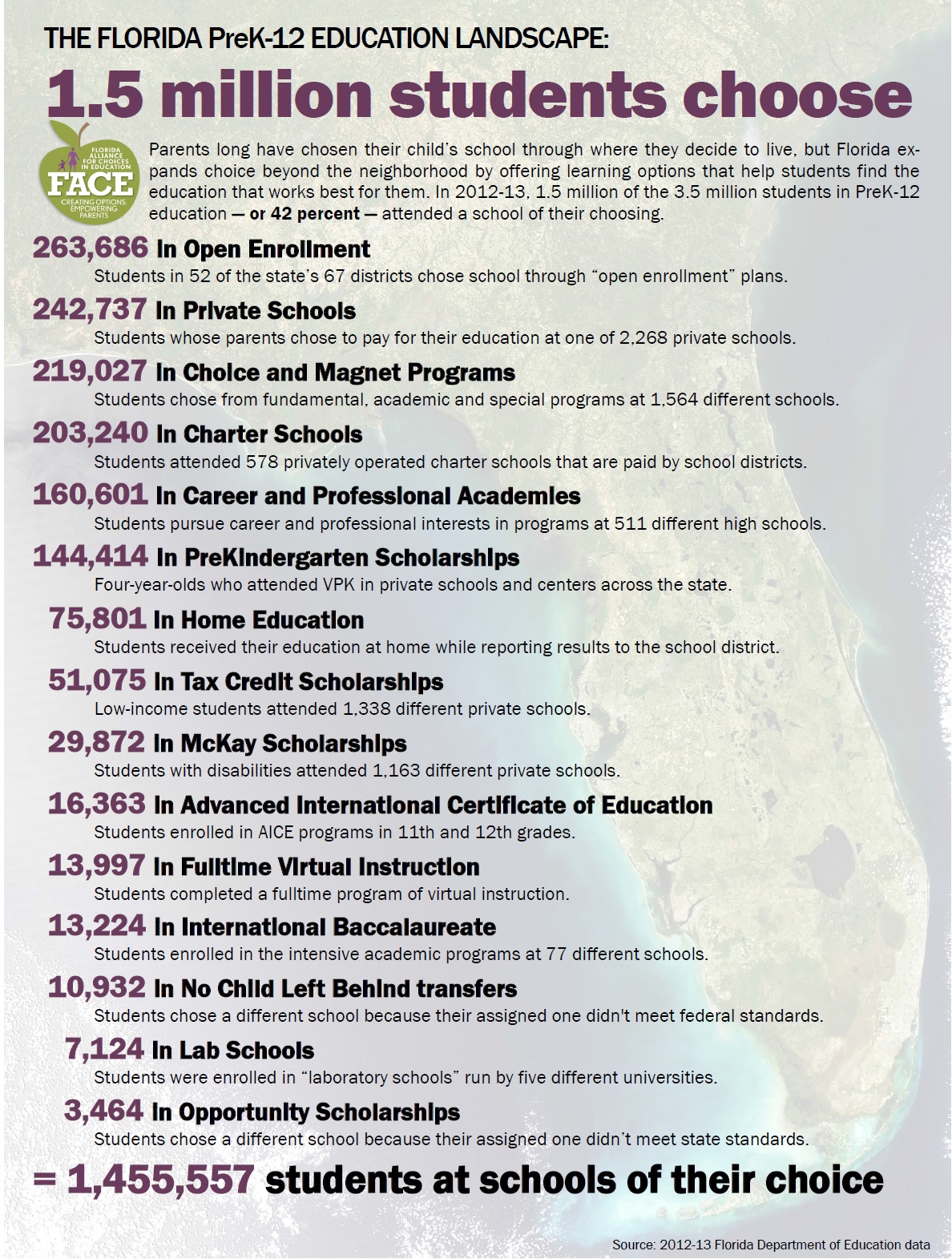
The trend towards disaggregation in K-12 predates Arizona’s still tiny ESA program.  The ESA program can in fact simply be viewed as the best vehicle for managing a customization trend as a quasi-market mechanism that gets us as close as possible to realizing the benefits of markets while preserving the public funding of K-12. The disaggregation trend however has been moving out into the bloodstream for decades. Consider the following program data from Florida:

Florida disagregation

This is a snapshot of traditional “school choice as you knew it at the end of the 20th Century.”  Most but not all of these choices are mutually exclusive such that they are something any one student does to the exclusion of others. You don’t expect to find many students for instance enrolled in a private school full-time and doing full-time virtual instruction, for instance. Most of these options are either/or propositions you are either sitting in this type of seat, or that type of seat. Major avenues of part-time education, such as dual college enrollment and virtual education, are not included, so we are just getting warmed up.

Let’s take virtual education on next:

FLVS Credits

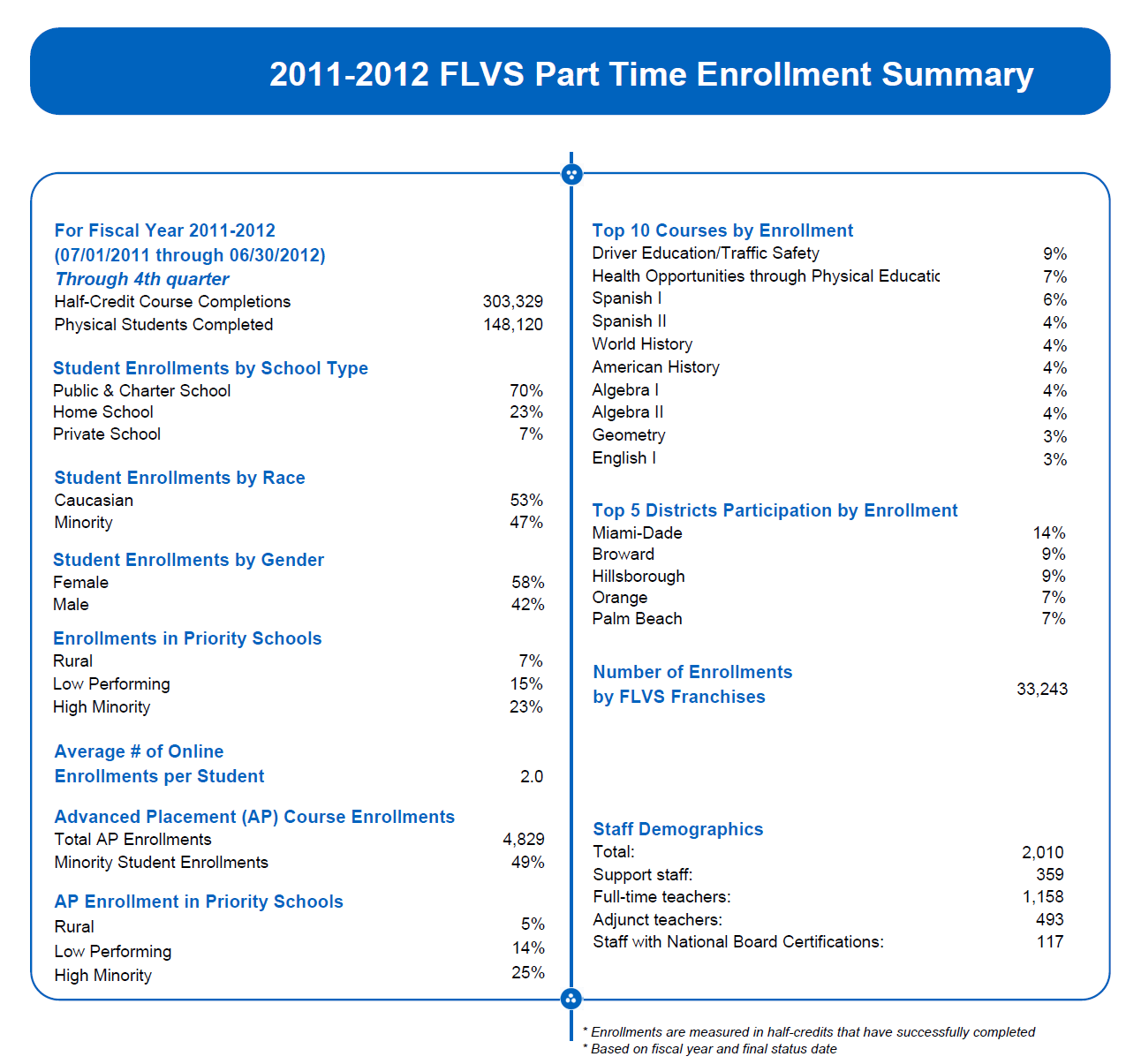
The Florida Virtual School is not the only supplier of accredited virtual courses in Florida, so the 148,000 or so courses they provided in 2011-12 underestimates the strength of the trend. Nevertheless FLVS long ago begged the question: if a child takes an online Mandarin course from an approved online provider, just what, if anything, does this have to do with the results on the host schools’ accountability scores?

“I’ll take ‘Absolutely Nothing at All’ for a Thousand, Trebek!

Needless to say, FLVS found it necessary to develop alternative methods for measuring student achievement related directly to course content.  High-school students have been taking classes at community colleges for decades with what appears to be an entirely understandable disinterest in sorting through just how much responsibility, if any, the Community College holds for what happens on the high-school students minimal skills accountability exam.

So what happens when we mix dual enrollment with virtual education?

MOOC 1

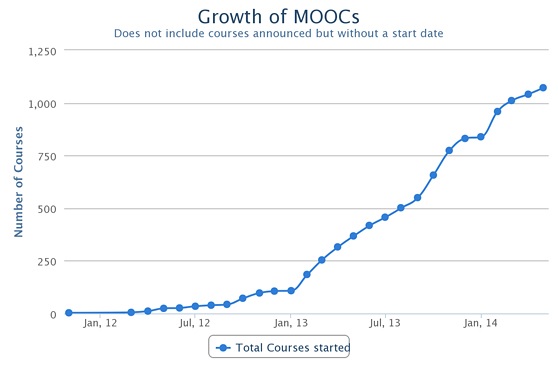
Since we live in an age of wonders, we have over a thousand Massive Open Online Courses provided by some of the finest universities in the world available for free. Oh and the number of courses keeps growing. Did I mention that it has already been worked out for MOOC students to take third-party proctored final exams and receive college credit for them? Yes, right, that too.  Has anyone thought through the fact that the $89 cost for a third-party end of course exam may prove incredibly attractive for both families but also to schools who don’t enjoy having a portion of their budget sent off to an online provider?

Let’s not get ahead of ourselves Trebek! I’ll take ‘Months that begin with Oct’ for five hundred…

So, let us imagine a 15-year-old taking a Calculus class from, say, the Massachusetts Institute of Technology. He or she successfully completes a third-party end of course exam, he or she either is or in the near future will be eligible for college credit from a large number of universities around the world. Obviously provision for this student to receive high-school calculus credit will need to be made as well if we are to maintain any semblance of sanity.  Should authorities in Arizona disallow this because MIT’s Calculus course doesn’t precisely fit the state of Arizona’s state standards?

I’ll take “Seriously, you have got to be kidding me!” for a thousand Alex.

In short, the disaggregation genie is out of the bottle, and the trend looks set to accelerate in the coming years. As our system of education evolves it will be necessary to update our thinking regarding transparency and accountability: they are already out of date and will be increasingly so moving forward.  It would be absurd to require Jordan Visser to take the AIMS test. The AIMS has nearly played itself out for the 19th Century factory model school system in Jordan’s home state and has nothing to do with Jordan.  Regarding the ESA program, the public’s interest in transparency would be better served by collecting national norm reference exam data and having them analyzed by a qualified academic researcher.  Regarding the broader education system, Texas has already moved to replace minimal skills tests with subject specific end of course exams at the high school level. If a student takes a Physics class, shouldn’t we be curious as to whether or not they learned any “Physics”?

Creative destruction usually kills outdated ideas before outdated organizations. Our notions about how to provide transparency in a changing K-12 world have been running behind schedule.


Common Core Is Having a Bad Week

July 26, 2013

locke-and-walt-LostBG

(Guest post by Greg Forster)

When Locke first meets Walt, he says something about Walt getting back to his mother soon, and Walt tells him that his mother died two weeks ago. Locke looks around at the deserted island where they’ve all just crash-landed and says, “you’re having a bad month.”

Common Core is having a bad week. Pop some popcorn and enjoy watching the excruciating downfall of civilization with your host, Andy Smarick. Line for the ages: Smarick links back to an old post of his where he predicted this would happen and then says, “I can’t help but wonder: If some dude blogging from a coffee shop could see this coming, why in the world didn’t Common Core’s and common assessments’ powerful, well-staffed, and deep-pocketed backers get ahead of this?” He should check out the latest medical literature on PLDD.

In the meantime, the argument that Common Core is bad for school choice seems to be getting some traction, to judge by the increased level of desperate insistence (unconnected to logic or evidence) that Common Core is really great for school choice. Hope you’ve got more popcorn, because master magician Jason Bedrick is here to cut those arguments in two. Unfortunately for CC supporters, he hasn’t learned the part of the trick where they go back together.

You still have more popcorn, and you’re tired of knock-down, drag-out knife fights for the fate of the world on the edges of slowly crumbling cliffs? Don’t worry – we have the lightsabers you’re looking for.


Mike Petrilli Buys into Hope and Change

May 13, 2009

Pollyanna

(Guest post by Greg Forster)

Yesterday, Mike Petrilli posted that he has “hope” some good will come from the giant geyser of money that the federal government is blindly spewing into the government school system under the “stimulus” bill.

I would let it slide, but I owe Mike a good ribbing for this. So . . .

Mr. Sulu, you have the bridge. Mr. Spock, Mr. Checkov, you’re with me. Set phasers to snark.

Mike’s “hope” comes from the fact that he attended a meeting with some state-based reform leaders and heard some stories about how states are going to do great things in order to qualify for some of the relatively tiny portion of stimulus funding that has been set aside to reward good behavior (the so-called “race to the top” funds).

He actually calls these tales “bona fide stories of state legislatures contemplating” reform. Amazing – they’re contemplating reform!

To substantiate his point, he says that because Arne Duncan said he “may” withhold some of the tiny race-to-the-top portion of stimulus funds from states that limit charter schools, Maine is “considering” enacting a charter law. What kind of charter law we might expect to get under such conditions is a question Mike doesn’t raise. Plenty of states have charter laws that effectively block the creation of any charters that might actually produce change. The purpose of the law is for state legislators to be able to claim they have a charter law. Such laws do much more harm than good, since they siphon off political capital for reform and create a few phony, lousy charters which can then be held up and pilloried to discredit further reform efforts. You think that might happen in Maine?

“Mr. Spock, is all this . . . what I think it is?”

“Tricorder readings confirm we are witnessing the phenomenon known as ‘kabuki,’ Jim. Judging by the crudity of the performance, I would estimate that this particular specimen is at a very low stage of development.”

I’ll agree with Mike on one thing, though. The stories he heard are ceratinly “bona fide stories.” That is, they clearly are stories. What kind of stories is a question worth pondering.

Ironically, Mike wrote his post in response to an earlier post yesterday from Fordham’s Andy Smarick, which adduces with devastating clarity just some of the many reasons why we have no right to even hope for good results from the edu-stimulus:

First, although the application requires the governor to sign assurances promising to make progress in four areas, remarkably, it requires neither a plan for accomplishing those goals nor details on how these billions of dollars will be spent.  The states that have applied so far have obliged, including none of this relevant information in their packages.

Second, the Department sent a letter to states on April 1 saying that states don’t have to demonstrate progress on the assurances to get the second batch (~$16 billion) of stabilization funds.  They only have to have systems in place to collect data.

Third, governors lack the power to require districts to use these funds wisely.  From the guidance released in April:

III-D-14.  May a Governor or State education agency (SEA) limit how an LEA uses its Education Stabilization funds?

No.  Because the amount of Education Stabilization funding that an LEA receives is determined strictly on the basis of formulae and the ARRA gives LEAs considerable flexibility over the use of these funds, neither the Governor nor the SEA may mandate how an LEA will or will not use the funds. 

Finally, the only leverage the Department seems to have is threatening to make states ineligible for Race to the Top funds if this money isn’t wisely spent.  But states, not districts, are the only eligible applicants for the Race to the Top funds, and, as the guidance makes clear, states can’t force districts to behave.  So the threat is misdirected.

Game, set, match – Andy.

Looks like we’re done here. Mr. Scott, three to beam up.