The super-geniuses have decided that ranked-choice is optimal because they believe it has the best properties in the various analyses they’ve conducted. Let’s leave aside whether they are correct in these technical claims given that a recent study noted that ranked-choice failed to produce a candidate supported by the majority of voters 61% of the time. The primary defect of ranked-choice voting and the broader technocratic orientation driving many foundations’ policy agendas is its failure to understand human beings and how they are served by public institutions.
People do not want what experts have deemed to be optimal arrangements. What they want are solutions that they can understand and trust. Public policy is not really about optimizing outcomes. It is about maintaining public confidence in civil society. If election systems are not governed by relatively simple rules that produce results quickly and unambiguously, people rightfully begin to lose confidence in those systems. They suspect cheating or manipulation and are frustrated by prolonged uncertainty. In some ways, who wins is less important than that someone wins clearly and quickly.
The super-geniuses at the Arnold Foundation don’t understand this because they really don’t understand human beings. Most of the people running foundations these days have training in technical fields and/or are inclined to devote their resources to people with technical backgrounds. Much of the wealth pouring into new foundations comes from technical fields. Backgrounds and interest in the humanities are noticeably absent in the foundation world.
While understanding history, philosophy, art, and literature are no guarantees of having good sense, these fields are our repositories of human wisdom. Consulting that wisdom may help us avoid election systems that have desirable technical properties but undermine what human beings actually need from elections. In the field of education, that wisdom would us avoid reform solutions that work much better in our working papers than in the actual arena of education policy.
Perhaps foundations, and not just schools, are in need of education reform.
Our very own Matt Ladner has been calling for these lousy and technocratic ratings put out by NACSA and National Alliance for Public Charter Schools (NAPCS) to be replaced by new measures that consider whether policies and laws are conducive to charter schools opening, lead to charters wither stronger outcomes, and contribute to improved outcomes among traditional public schools because of competitive pressure.
Ask and ye shall receive. Today, the Educational Freedom Institute (EFI) released a new charter ranking approach developed by Ben Scafidi and Eric Wearne at Kennesaw State University along the lines Matt proposed. It considers four factors:
(1) The percent of public school students in each state who are enrolled in charter schools
(2) The percent of public school students in each state who reside in a zip code with a charter school
Value-added learning gains for charter school students in (3) Reading and (4) Mathematics
The new EFI ranking does not yet capture the competitive effects Matt suggested, but it seems like a much more promising approach than those adopted by NACSA and NAPCS, especially if you care about the existing and availability of charter schools and some indicator of their performance. Now let’s see if organizations and foundations that claim to care about charter schools embrace this new approach.
Also, keep your eye on EFI. It’s a relatively new organization that is gaining steam and is slated to have a string of exciting new reports coming out over the next several months.
OCPA carries my article on secularization and schooling:
Our schools produce secularization because they are forced to educate students in a pluralistic society without allowing those students to integrate their education with the reality that human beings are religious creatures. We have a government school monopoly, which means one size has to fit all. But one size can’t fit all when it comes to the things that matter most.
Educating children without reference to religion produces secularization in multiple ways. Children learn from an early age that their own religion, whatever it is, is a private hobby, because it’s not part of what we teach them about in school. Children also learn that the parts of life that don’t actually happen in a religious setting should be organized without reference to religion, because the knowledge base upon which our social and cultural systems are based was taught to them in exactly that way.
Worst of all, while schools make major efforts to teach moral character to students, they can’t ground virtues like honesty, generosity and self-control in any adequate source. This leaves them either indoctrinating children in an essentially selfish morality (teaching students that “you’ll be happier in the long run if you don’t lie” also teaches them that “what makes you personally happy is the standard for judging what is morally good”), or just wagging their fingers and telling students to be good without telling them how or why. Neither approach actually forms students with the character and virtues that a free society needs.
Exercise your right to bring your whole self into the public square by letting me know what you think!
OCPA carries my article on a truly boring and esoteric topic, sure to put everyone straight to sleep – “critical race theory” in education:
Although it has been widely described as banning Oklahoma schools from teaching CRT, the text of the bill—which is very brief and easy to read, fortunately for those happy few who elect to read it before talking about it—does not even mention CRT. It prohibits schools from teaching that one race is inherently superior to others, that anyone ought to feel anguish or distress because of their own race, that anyone is inherently racist solely because of their race, that “meritocracy” as an idea is inherently racist, etc.
Now, it’s true that the ideas Oklahoma schools are prohibited to teach are core features of CRT as some important advocates of CRT define CRT. But the emphasis in that sentence is on “some.” Other advocates of CRT strenuously deny that CRT involves the view that white people should be ashamed to be white, or that all white people are racist, or that meritocracy is racist.
Rather than bicker about the definition of a term, why not step back and do some genuinely critical theorizing by asking which ideas are actually good and which are bad?
Academic subjects don’t grow on trees. They are disciplines of learning, created by human effort. Therefore they inevitably have blind spots – sometimes “a whole Seurat mural’s worth of blind spots” (yes, I’m proud of that line) – due to the prejudices of our ancestors. Discovering and exposing those blind spots is not just good, it’s essential. In the article, I mention some research I’ve been doing for a book on how our inherited understanding of 4th-century Christianity has been distorted in important ways by centuries of scholars who operated on the assumption that nothing intellectually or culturally important could possibly have happened in Africa.
The key question is whether we are really seeking to overcome error and get to the truth, or if we have given up on the idea of truth altogether. The more radical versions of CRT argue that the inherited blind spots in our academic disciplines prove that there is no truth, only socially constructed systems of power. At the end of that hallway is Room 101:
This means—necessarily, unavoidably—that there can be no common ground, no compromise and no reconciliation. There can only be endless war between power factions that have competing identity claims. On this view, we actually need to have an eternal war between factions competing for power, because the conflict between their identity claims is the only way we can know who we are. If there is no truth, our identities must depend on systems of power, and systems of power can’t be exercised without conflict.
As Orwell saw with such agonizing clarity, if there is no truth, the future is a boot stamping on a human face forever.
On that cheerful note, I will open the floor to hear your critical theory about my critical theory!
I’m really excited to be joining Lindsey Burke, Jonathan Butcher, and Jude Schwalbach as a Senior Research Fellow in the Center for Education Policy at the Heritage Foundation. I am incredibly proud of what my colleagues and I built at the University of Arkansas and will miss working in the same office with them every day, but look forward to continuing to collaborate with them from my new position.
There has never been a time in American history when the government school monopoly did voc-ed well. In the 19th century, when the system was created, the strategy was to provide everyone a very basic “three Rs” education in K-8 schools, then turn the kids over to various forms of apprenticeship and on-the-job training. (High school was only for the tiny minority who were destined for college.) So the actual vocational education was being handled by employers and others, not the government system.
It’s true that one of the justifications for creating the government monopoly in the first place was to prepare students better for the new careers of modern industry. Traditional schooling by tutors and church schools was thought to be insufficient for the modern world. But the contribution of the government schools was not to do the actual job training; that was for industry. The government schools were there to break the students’ spirits by subjecting them to rigorous regimes of rote monotony and obedience to tyrannical authority, which was thought to prepare the students well for the lives that the factory owners envisioned for them. (Whether something is good for the people it is imposed upon, as opposed to good for the rich and powerful who wish to exploit those people, is not a question Big Government typically asks.)
A series of 20th-century reforms aimed at doing better only did worse, especially because the government school monopoly used voc-ed programs as dumping grounds for children it viewed as too brown or too foreign to be worth actually educating. Now, parents and reformers distrust efforts to grow voc-ed programs, correctly fearing that both the programs and the students in them will be viewed as “second best” by the rulers of the government monopoly. “What would a good, solid high-school curriculum for a kid who wants a career in the trades look like?” is a question education reformers no longer ask.
But new programs in Oklahoma and West Virginia show there is a path to putting that question back on the agenda. It is flexibility and choice, putting adult students (in Oklahoma) and parents (in the new W.V. choice program, an ESA that includes industrial training as an eligible type of expense) back in the driver’s seat:
With parents and students in charge, it becomes possible to integrate the educational essentials everyone needs with real industrial training. Nobody is chained to some monopoly’s second-rate idea of what those people need. And of course, this flexibility not only ensures the individual student gets the training that is most needed and the best fit for that student, it also ensures the content of vocational education keeps up with the rapidly changing economy. No need to expect a sluggish government bureaucracy to constantly revise its central command-and-control curriculum to make sure it stays up to date!
It is time once again to (dis)honor the recipient of the William Higinbotham Inhumanitarian Award. This year we had a small set of nominees, but compensated for that lack of quantity with exceptional quality. The pandemic has affected everything, including the number of nominees as well as the deadline for selecting the winner (and filing our taxes).
We had two nominees to consider: Anthony Fauci, nominated by Matt, and Alison Collins, nominated by Greg. While they are both very (un)worthy nominees, our (dis)honoree this year is Alison Collins.
Fauci, along with other public health officials, did much to bring discredit to themselves. They cannot be blamed for failing to be prepared for a global pandemic (even though that is in their job description). The scale and uncertainty of the pandemic were just too great for even the most capable public official to have fully anticipated. Instead, what public health officials can be blamed for is failing to accurately convey that uncertainty to us as if we were adult citizens of a democratic republic. Instead, they chose to convey false confidence in an ever-changing set of mandates in the belief that we would be reassured by their confidence. This was both a political and a scientific catastrophe.
While this would make Fauci and other public health officials Higgy-worthy, giving any of them the award would be misdirecting our upset. The pandemic is largely a natural disaster. It is progressive-technocratic hubris to believe that humans are responsible for failing to prevent or mitigate every natural disaster. We are all imperfect and I suspect that most of us would have made similar or different errors if we had been in Fauci’s place. Even during Higgy season we should maintain some appreciation for regular human failings, even if they affected irregular events. I know what road good intentions puts us on, but let’s remember that Fauci probably thought he was reassuring us with his false and ever-changing confidence.
Alison Collins’ behavior is harder to explain with good but mistaken intentions. School boards are often a vanity project for their members, but the San Francisco School Board might inspire Carly Simon to burst into song. No sensible person imagines that spending over a half million dollars to destroy a mural of George Washington and then renaming 44 schools were the top priorities for improving the city’s academically struggling schools. Even if your politics incline you to perceive these acts as virtuous, you’d have to admit that the signal to virtue ratio is exceptionally high.
While helping orchestrate this Jacobin orgy of sending (mostly mistaken) racist symbols to the guillotine, Collins has her own racist tweets surface. Rather than gain some humility about human imperfection, Collins brings an $87 million lawsuit against the school board on which she serves for taking away her committee assignments for her “spiritual” and other imaginary injuries. Collins really puts the petty in petty little dictator, making her a particularly (un)worthy recipient of The Higgy.
We interrupt this year’s Higgyfest to let you know that OCPA carries my new article on school choice and the biblical summons to do justice:
Some pastors in Oklahoma are insisting that Christian faithfulness requires us to oppose school choice policies. As the state considers expanding school choice, it’s worth exploring why some people come to think this way. Theology can’t actually settle granular policy questions—the Bible doesn’t tell you what the tax rate should be—but a moral understanding of the social landscape, in light of what we believe is ultimately true and good, is a necessary part of anyone’s thinking about public policy…
The question we must ask is: Who are really the powerful in our educational system, and who are the oppressed?
The government monopoly is backed by literally the most powerful human institution ever created—the government of the United States. That institution is endlessly subservient to special-interest lobbyists, and as a result, its pet school system runs purely on power. Its lavishly paid administrative bosses prioritize not a good education for students, but delivering the goods to educational interests. This has become much more obvious to everyone during the pandemic, as the special interests have become increasingly isolated from the rest of society in terms of what they demand from education policy. But there has been no substantial change in the essential injustice of the system; we just see it more clearly now.
When strictly secular (and therefore circular and groundless) theories of “justice” from either the Right or Left become a substitute for authentically transcendent standards of what is just, we get endless dysfunction in both religious and civil communities. We won’t have our heads on straight until we ask what is just in light of some standard that is higher than the fickle and deceitful standards of human desire:
Biblically, justice centers on treating people with the dignity and respect due to them as creatures made in the image of God, both individually and in natural, authentic community relationships such as the family and the neighborhood. And although “love” is a much larger category than “justice,” given its role in the triune nature of God himself, nonetheless justice cannot rightly be done apart from a universal goodwill that orients our hearts toward what is good for others. Over the last thousand years, and especially in the last five hundred years, most Christians (not all) have increasingly found that the idea of human rights expresses most concisely both the requirements of respecting human dignity and the universal summons to do this impartially for all people.
If parents don’t have a human right to control the education of their children, the idea of rights is nonsense. The whole Christian ethical tradition makes no sense if parents are not the first and final authority over education. Even the United Nations recognizes parental control of education as a fundamental, prepolitical right in its Universal Declaration of Human Rights; shame on the church if it actually falls behind the world in recognizing and respecting human rights.
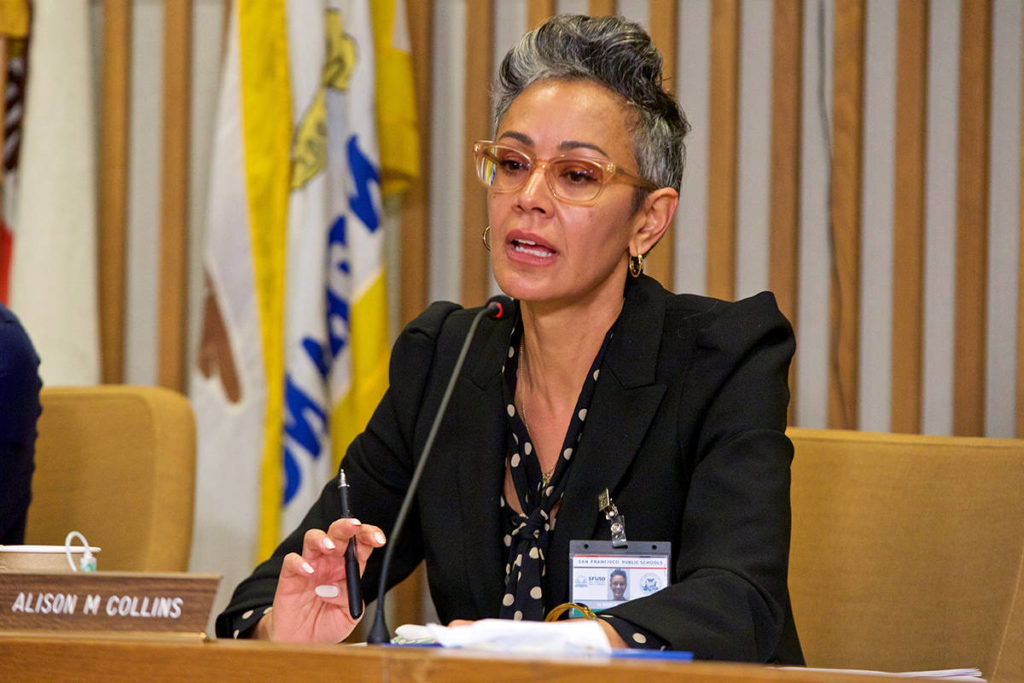
There have been a lot of crazy vibes radiating out of the San Francisco school board lately, but no one on that board is more radioactive than the board’s vice president, Alison Collins. After years of pushing the board’s most PLDDist tendencies, she recently revealed a little too much of the inhumane hatred that always lies behind such impulses – and after being faced with surprisingly mild consequences for her outrageous behavior, she has now turned on the board itself in a vain (in every sense) effort to extract $87 million for herself.
JPGBers will recall that in 2019, the Frisco school board paid $600,000 to destroy a mural, painted by a communist, depicting George Washington as a cruel slaveowner and oppressor. The school board did this not because it misunderstood or disagreed with the artist’s desire to destroy liberal democracy by equating it with slavery, but because portraying uncomfortable history is now considered a form of violence. Of the $600,000 spent to destroy the mural, $500,000 went to pay for an environmental impact statement (no, really).
In the past year, the big joke about the Frisco school board has been the board’s determination – in the midst of a system-shattering pandemic that might have been expected to secure the board’s attention and energies – to rename 44 of their schools (over a third of all their schools) in order to usher in a glorious Year Zero, removing any semblance of a trace of a notion of a hint that the United States has anything resembling a history. Never mind debates about George Washington! Even debates about Abraham Lincoln are so yesterday – of course Lincoln has to go. The school board went far beyond these woefully inadequate measures, removing such names as Robert Louis Stevenson (who among other things bore witness against colonial mistreatment of Pacific Islanders), John Muir and Diane Feinstein.
As that notorious right-wing propaganda rag The Atlantic documents, the renaming process represented the sheer bull-headed stupidity of PLDDism at its worst:
The decision process was a joke. The committee’s research seems to have consisted mostly of cursory Google searches, and the sources cited were primarily Wikipedia entries or similar. Historians were not consulted. Embarrassing errors of interpretation were made, as well as rudimentary factual errors. Robert Louis Stevenson, perhaps the most beloved literary figure in the city’s history, was canceled because in a poem titled “Foreign Children” in his famous collection A Child’s Garden of Verses, he used the rhyming word Japanee for Japanese. Paul Revere Elementary School ended up on the renaming list because, during the discussion, a committee member misread a History.com article as claiming that Revere had taken part in an expedition that stole the lands of the Penobscot Indians. In fact, the article described Revere’s role in the Penobscot Expedition, a disastrous American military campaign against the British during the Revolutionary War. (That expedition was named after a bay in Maine.) But no one bothered to check, the committee voted to rename the school, and by order of the San Francisco school board Paul Revere will now ride into oblivion.
The committee also failed to consistently apply its one-strike-and-you’re-out rule. When one member questioned whether Malcolm X Academy should be renamed in light of the fact that Malcolm was once a pimp, and therefore subjugated women, the committee decided that his later career redeemed his earlier missteps. Yet no such exceptions were made for Lincoln, Jefferson, and others on the list.
But this modern version of the Ride of Paul Revere came to an abrupt end for Collins recently, when 2016 tweets surfaced in which, referring to “most” Asian-Americans, she said they were “house n—–s” who had joined themselves to “white supremacy” because they embraced high academic standards. This revelation came after the recent highly-publicized murders targeting Asian-Americans. Of course, such conduct would be unacceptable anywhere, but it is especially inconsistent with leadership in a district that serves a huge population of Asian-American students.
Collins issued a weasel-worded non-apology (“whether my tweets are being taken out of context or not…”). She was not fired and did not lose her six-figure salary on the board. But she was stripped of her committee assignments.
And now the story gets really interesting!
Collins has sued – that’s right, sued – not only the board as a whole but five of its members as individuals, for a grand total of $87 million. The rambling, shoddily-written lawsuit (so shoddily-written that at first there was widespread confusion over exactly how much she was suing for) states that the five members must personally pay Collins millions each “to protect the public from the gross misuse of governmental power,” and because a mere $12 million damages from the board itself “will only tip the scale in the direction of injustice.”
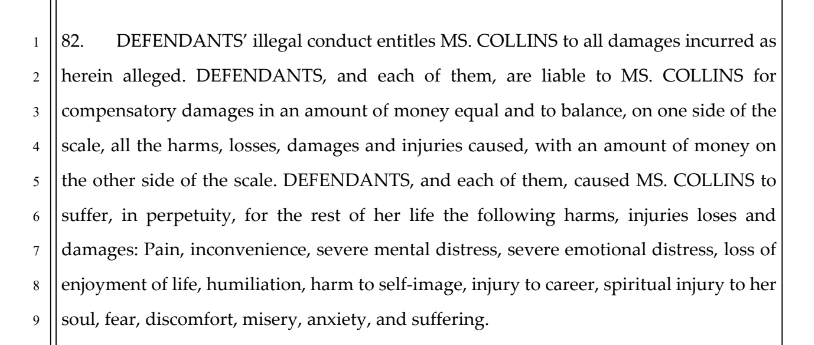
And what, exactly, is she suing over, given that she did not lose her job, nor a penny of her salary? Buckle up: Relieving her of her committee assignments is “illegal” and has caused Collins “spiritual injury to her soul” that will haunt her “in perpetuity, for the rest of her life.”
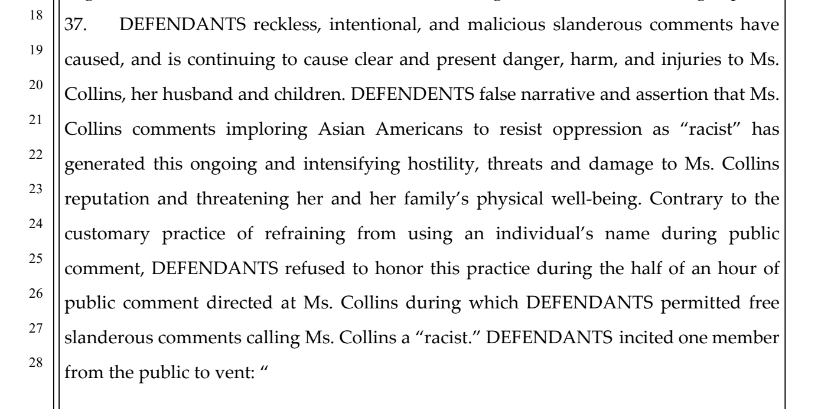
Also, allowing a 30-minute public comment period during a board meeting, in which some members of the public called Collins “racist,” caused Collins “clear and present danger, harm, and injuries.”
As Mason Hartman put it succinctly: “The complaint is essentially arguing that Alison Collins had a constitutionally-protected right to tweet racial slurs without (nonmonetary) impact to her employment, but that her fellow board members should have to compensate her for merely allowing the public to comment on them…I think Alison Collins might genuinely believe that it’s illegal to call her a racist.”
The suit also seeks additional damages from fifty unidentified defendants to be named later, for reasons to be determined later. No, really! It does! Gape at this amazing paragraph for yourself:
The suit dispassionately comments, in all caps: “JURY TRIAL DEMANDED.”
Have I mentioned that Collins, this tribune of the downtrodden seeking $87 million, is married to a wealthy real-estate developer who does tons of luxury condo and office development work in Frisco – work that requires approval from the same city government that employs her? Because she totally is.
Filing a crazy-eyed, off-the-wall lawsuit for $87 million against your own longtime partners in pernicious PLDDery, just because they refuse to let your bigoted tweets take them down with you?
I have only one thing to say to that: HIGGY DEMANDED.
We interrupt this year’s coverage of the ignominious “Higgy” Award to highlight a development Brother Ladner and I have been talking about for years: education malls. As I wrote back in 2017:
I’ve long thought that the big-box stores and, particularly, shopping malls might one day be replaced by “education malls.”
Imagine this: parents send their children via self-driving cars to the local education mall where there is a central administration that keeps track of a child’s location and well-being, along with her forms/transcripts, but otherwise her family chooses from among dozens of different providers located throughout the mall. At the food court, several different vendors offer their fares just as they do at the malls today, though most of the parking lot has been converted into athletic facilities.
For math, she chooses a Saxon Math workshop. For literature, it’s Great Books. She’s learning Mandarin Chinese via an online course at the language lab. For PE, she’s practicing kung fu. For art, she attends a rotating painting and pottery course this semester. She’s being tutored in the harp. Each course is offered by a different vendor and her parents pay for these various services with their ESA.
Might sound crazy, but with widespread use of ESAs (and declining shopping malls due to Amazon, Jet, Overstock, etc.), I think this just might be the future of education.
The self-driving cars are still a long way away (speaking of which, it looks very likely that I will soon owe Robert Pondiscio a beer), but schools are already starting to move into vacant shopping malls, as ABC reports:
BURLINGTON, Vt. — Students who once shopped at a downtown mall in Burlington, Vermont, are now attending high school in the former Macy’s department store, with gleaming white tile floors and escalators whisking them to and from classes.
The Downtown Burlington High School opened March 4, about six months after school administrators closed the existing school, just under 2 miles away, because toxic industrial chemicals known as PCBs were found in the building and soil during renovations. That left students stuck at home learning remotely for much of the school year during the coronavirus pandemic.
As school officials looked for space where students could attend school in-person, they eventually eyed the empty department store, which closed in 2018. They talked with architects and learned it was a possibility, said Superintendent Tom Flanagan. […]
The building underwent a $3.5 million retrofit supported by the state that added partial walls for classrooms while keeping some Macy’s remnants, like the sparkly white tile floors, bright red carpeting, and Calvin Klein and Michael Kors signs and a large-scale Levi’s jeans photo on a classroom wall. The library is housed in the former Macy’s china department, with books displayed on under-lit shelves, while the gym is in a former store’s warehouse and is still unfinished.


 Posted by Jay P. Greene





 Jay P. Greene's Blog