
Pass the Popcorn: Memento

August 21, 2009

memento2

(Guest post by Greg Forster)

Hey, remember Memento?

No you don’t. You remember a really clever novelty act where they put you in the shoes of a man who can’t remember things that happen to him by telling most of the story backward. But memory is unreliable, remember?
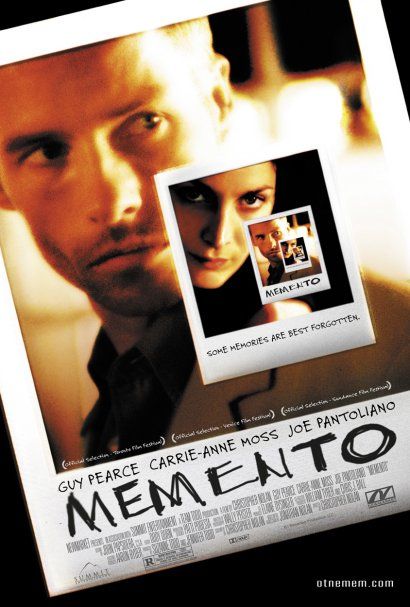
memento

Back when you saw it, you realized that it was – in addition to being a clever novelty act, which of course it was as well – a profound meditation on the nature of human identity – on the sources of knowledge, motivation, and “habit” or “instinct,” which together make up who we are.

But since then you’ve forgetten all that. What you retain all these years later is:

Okay, what am I doing? I’m chasing this guy.

memento17

No, HE’S chasing ME!

Which is just about the cleverest gag on film, I admit. But that’s a dog and pony show compared to this, which you don’t remember:

Just because there are things I don’t remember doesn’t make my actions meaningless. The world doesn’t just disappear when you close your eyes, does it?

memento21

You can question everything. You can never know anything for sure.

There are things you know for sure…Certainties. It’s the kind of memory you take for granted.

Of course, “earlier” (which is to say “later”) in the movie Leonard deprecates memory to Teddy. Memory is unreliable. You want facts, not memories. But now look at what Leonard tells Natalie – certainties are the kind of memory you take for granted. What is your knowledge of “the facts” but a bunch of memories? In which case, how can you know anything? As Augustine demonstrates at length in chapter 10 of the Confessions, memory comprises virtually all of the human personality.

memento11

It all comes down to whether or not you can take it for granted that there’s a real reality out there. Because if you can’t take it for granted, there’s no way to prove it. You can either assume it and be sane, or doubt it and go mad. That theme winds through everything in the movie. As Leonard tells Teddy at the “end” (which is to say at the “beginning”), whether or not he’s got the right John G. makes all the difference. It’s the only thing that matters.

But why? Teddy says we all just lie to ourselves to be happy. But Leonard knows that theory doesn’t hold water. If you really were lying to yourself, it wouldn’t make you happy. The fact that his quest for the killer does in fact motivate him proves that he’s not just interested in giving himself a purpose. He really wants to find the killer.

To Natalie, he simply asserts that the world doesn’t go away when you close your eyes. At the “end” (which is to say at the “beginning”) he pushes away the doubts Teddy has planted by insisting to himself that “I have to believe in a world outside my own mind.” That’s the rub. If you take that seriously – not “I have to believe” in the sense that I want to, so I’ll lie to myself to be happy, but “I have to believe” in the sense that my mind actually cannot function in any other way – it solves the problem.

To take a parallel example, no one can prove that two contradictory statements can’t both be true, for the simple reason that the activity of proving things itself assumes that two contradictory statements can’t both be true. The law of noncontradiction can’t be argued for or supported; we believe it because our minds simply will not function unless we do. You can either assume it unquestioningly or go mad; ultimately there are no other options.

But why, then, does the movie end (i.e. begin) the way it does? (For the sake of those benighted souls who may not have seen the movie, or for those who may have forgotten the details and may want to go back and see it again, I won’t spoil the central twist.) I think it’s simply that Leonard’s exchange with Teddy makes him realize that a man in his condition is unable to do what he’s trying to do, so he’ll do the next best thing – rid himself of the person who’s using him.

memento19

At any rate, I don’t think we’re meant to accept the claims we hear at the end about Leonard’s past. The movie itself undermines this in several ways. For starters, when those new “memories” start flashing into Leonard’s head, we get this image:

memento20

Which is obviously absurd and impossible. That’s the point – mere suggestion can produce new “memories” that feel accurate but can’t possibly be real. Which is why we have no reason to accept the new “memories” at the end.

Also, think about that pivotal image of Leonard lying on the bed when his wife says “ouch!” (If you don’t remember what I’m talking about, for goodness’ sake what more excuse do you need me to give you to go back and see this movie again!) If the new “memories” are real, then the revised version of this image must be the true one and the original version a construction. But the original version makes sense and the new one doesn’t. Why on earth would he do that in that contorted position? If he were going to [activity deleted to avoid spoiling the twist] he wouldn’t do it lying on the bed at a ridiculously awkward angle while she read a frikkin’ novel. But that’s exactly the kind of absurd image your mind would invent under a false suggestion.

Well, like my interpretation of the end or hate it, Memento is still one of the most profound movies out there, and it’s well worth a reviewing if you haven’t seen it since 2000.

Oh, and I hear Chris Nolan’s made some other interesting movies since then. Guess I should check those out.

HT Movie Images for most of these shots, Beyond Hollywood for the one at the top


Death Panels for College Kids!

August 21, 2009

Monopoly - Pennybags

(Guest post by Greg Forster)

Pardon me while I toot my horn that the editors of the Wall Street Journal have picked up on the story that federal student loans illustrate how a “public option” inevitably becomes a single-payer government monopoly. Remember, you read it here first! (Well, OK, not really. You read it on NRO first. But we had it before the Journal!)

And please please please do yourself a favor – read Andy McCarthy’s incisive NRO article today on the probability of, and implications of, an Obama victory on health care. It’s a sobering corrective to the undue optimism many of us (myself included) have begun to feel over the past few weeks.

The spectre of James Madison has been doing yeoman’s work in DC this summer. If you want to know why the Democrats had to neuter the early-year provisions of Cap and Trade and are now struggling so hard over health care, just read Federalist 10. Madison built the walls of the Constitution high and thick to repulse precisely this sort of assault. Thank God for that man!

But it’s all too easy to assume that justice must prevail when the facts and the rights are clear, and McCarthy’s analysis (though I don’t agree with every particular of it) has sobered me up.

People do, in fact, sell their freedom. It happens every day. And not just in far-flung corners of the globe but in your neighborhood, on your block. Why do you think the founders got so animated and hyperbolic about the monstrosity of selling your freedom every time the subject came up? Not because it couldn’t happen here, nor even because it could, but because it did. Repeatedly. To sell your freedom is the fundamental tendency of man’s fallen nature. (Read Federalist 8. Or Federalist 51. Or, for that matter, Federalist 4, 6, 10, 15…)

McCarthy is right: “We could still lose this thing.” And there is nothing to stop the consequences from being as dire as he foresees them being.


Ed Next Goes All 21st Century On Us

August 20, 2009

Education Next launched a blog to accompany their re-designed web site.  It looks great!

And yours truly has a post on the Ed Next blog about teacher burn-out.  Check it out!


Pat Wolf In Ed Next

August 20, 2009

Pat Wolf has an article summarizing and clarifying the latest evidence from the official evaluation of the D.C. voucher program newly posted at Education Next.

The part that struck me the most was how strong the DC voucher results are compared to the results of all of the other rigorous evaluations sponsored by the U.S. Department of Education:

The achievement results from the D.C. voucher evaluation are also striking when compared to the results from other experimental evaluations of education policies. The National Center for Education Evaluation and Regional Assistance (NCEE) at the IES has sponsored and overseen 11 studies that are RCTs, including the OSP evaluation. Only 3 of the 11 education interventions tested, when subjected to such a rigorous evaluation, have demonstrated statistically significant achievement impacts overall in either reading or math. The reading impact of the D.C. voucher program is the largest achievement impact yet reported in an RCT evaluation overseen by the NCEE. A second program was found to increase reading outcomes by about 40 percent less than the reading gain from the DC OSP. The third intervention was reported to have boosted math achievement by less than half the amount of the reading gain from the D.C. voucher program. Of the remaining eight NCEE-sponsored RCTs, six of them found no statistically significant achievement impacts overall and the other two showed a mix of no impacts and actual achievement losses from their programs.


The Onion Provides Tips on How to Help Kids Succeed

August 20, 2009

As always, The Onion is there to help us get our kids ready to do well as school starts.

 My favorite tip: “Develop a working model for a reformed educational system that addresses the needs of every child at a reasonable taxpayer cost. Then become powerful and implement that system.”


The Return of the Bogus “Excellence” Complaint

August 20, 2009

(Guest post by Greg Forster)

Fordham’s Fun Fact Friday feature, now in its sixth week, is a weekly one-minute video production that takes some fact about the education system and presents it using an interesting or unusual visual. The creators have been pretty consistently clever in coming up with ways to make obscure facts visually intuitive.

Unfortunately, the facts chosen to be presented are not always so cleverly chosen. When Fordham picks an important fact to visualize, such as the gap between spending and achievement growth or international comparisons of student-teacher ratios, the results are, well, superawesome. But when it chooses, say, a comparison of the US education budget with the GDP of some smaller countries, the visual presentation is still clever, but the result is kind of pointless. Is anyone really impressed by the point that a huge country like the US spends more on education than the GDP of, say, Indonesia? What does that prove? Some kind of argument or point was needed.

Last week they missed again. They decided to resurrect Fordham’s complaint from last year (dissected here and here) claiming that accountability systems make our schools more “equal” but less “excellent” because they create incentives for schools to increase the amount of attention they pay to low achievers, reducing the amount of attention they pay to high achievers. Never mind the fact that – according to Fordham in the very same report – the low achievers are benefiting from this diversion and the high achievers don’t seem to be losing any ground.

That would seem to me to be pretty clear evidence that schools were devoting too much attention to high achievers – perhaps because their parents are more likely to be influential – and that the incentives created by accountability were educationally healthy because they forced schools to focus their attention where they could create more improvement.

It’s obviously possible that in the long run accountability could push this too far and become counterproductive by focusing too much attention on low achievers at the expense of high achievers. That’s an argument for improving the design of accountability systems to preclude that result. But so far, on Fordham’s own evidence, we don’t seem to be having that problem.


Marines vs. Schools and Culture

August 19, 2009

(Guest Post by Matthew Ladner)

Today is the 26th anniversary of the publication of the report A Military at Risk which decried the racial combat effectiveness gap in the armed forces. You will of course recall the stark rhetoric of the report: “We face a rising tide of mediocrity in our armed services” and “Despite military spending that would stagger the imaginations of generals from previous decades, our armed forces today are do better at fighting than forces in 1970.” And who can forget: “If a foreign power had imposed this military system on us, we would view it as an act of war. As it is, we have done this to ourselves.”

Oh, you don’t remember that report, do you? That’s because it was never written. The United States military of today chew up the United States military of 1970 and ask for a real challenge, despite the fact that we had far more men in uniform in the past. 

It’s called “progress.” It would be great if we had more of it in K-12.

Furthermore, the reason you’ve never heard of a racial/ethnic combat effectiveness gap is because it doesn’t exist. The integration of the military went much more smoothly than that of schools and universities, and people of all racial and ethnic backgrounds have served their country with distinction.

In my view, “race” is a cultural phenomenon, and one that does not handicap organizations with strong cultures. Diversity is not a problem in the United States Marine Corps because everyone signing up becomes a United States Marine.

The Marine Corps, of course, is not everyone’s cup of tea, precisely why the concept of parental choice is so crucial in schooling. Although there are many high quality traditional public schools, the task of maintaining a strong academic culture is complicated by consumers who may have little more in common than a zip code. Keeping a strong focus is difficult in any organization.

Like the Marines, KIPP charter schools are not for everyone. Parents must sign contracts requiring a high level of commitment. Half days on Saturdays will be viewed as a burden by some, an opportunity by others. KIPP isn’t for everyone, but it seems to serve the willing quite well indeed.

Inner city Catholic schools serve as another example, with profound and well documented benefits for students.

In the big picture, while we and others love fighting over the gory details (charters vs. vouchers, vouchers vs. tax credits, online vs. Jurassic, etc.) the truth is that a bipartisan consensus over the importance of choice in education has developed. Greatschools.net is a much better resource than real estate agent for judging schools.

The days of the vast majority of students being taught in zip code based schools by teachers who graduated from the bottom third of their university class are numbered. It’s almost certainly a big number, but it’s not going to last forever.

The sooner the better.


Great Minds Think Alike

August 19, 2009

Just as we released our new study on special education vouchers in Florida, Marc Thiessen and Michael O’Hanlon have a piece in USA Today advocating for the policy, specifically to help students with autism. 

Thiessen is a Republican and fellow at the Hoover Institution and O’Hanlon is a Democrat and fellow at the Brookings Institution.  Special education vouchers clearly appeal across party lines.  And since disabilities are distributed roughly evenly across all racial and economic groups, the programs can have a broad base of political support to be adopted and protected from destructive regulation or roll-back efforts.  One thing we are learning from urban voucher programs targeted at disadvantaged populations is that they are very hard to sustain politically.  The targeted groups are also the most politically powerless.


Special Ed Vouchers Restrain Growth in Disabilities

August 18, 2009

Marcus Winters and I have a super-awesome study released today by the Manhattan Institute.  It shows that offering disabled students special education vouchers reduces the likelihood that public schools will identify students as disabled.

This isn’t what Andy Rotherham and Sara Mead expected.  They claimed in a 2003 report for the Progress Policy Institute that: “special education vouchers may actually exacerbate the over-identification problem by creating a new incentive for parents to have children diagnosed with a disability in order to obtain a voucher.”

It didn’t. The reason special education vouchers restrained growth in disabilities, rather than exacerbate it, is that the vouchers check public schools’ financial incentives to identify more students as disabled.  Public schools may get additional subsidies when they shift more students into special education, but if they then make students eligible for special education vouchers, they risk having those students walk out the door with all of their funding.  It makes the public schools think twice before over-identifying disabilities for financial reasons.

And outside of the DC bubble, schools control the process of whether students are identified as disabled — not parents.  So, if we can check the positive financial incentives that public schools have for over-identifying disabilities, we can significantly slow growth in special education.

Nearly 1 in 7 students nationwide is now classified as having a disability.  That’s 63% more than three decades ago.  It’s clear that this huge increase in disabilities was not caused by a true increase in the incidence of disabilities in the population.  No plague has afflicted our children over the last three decades to disable two-thirds more of them.

Instead, non-medical factors have been driving special education enrollments higher.  Chief among these is the financial incentives we offer schools in most states to shift more students into special education by providing additional subsidies for each student classified as disabled.

Some states have reformed their special education funding formulas to end these financial rewards for higher special education rolls.  Greg and I reported in a 2002 study that states that continued to pay schools per student identified as disabled had much higher rates of growth in special education than states that had reformed their funding formulas.  Elizabeth Dhuey of the University of Toronto and Stephen Lipscomb of the Public Policy Institute of California have confirmed these findings.

Julie Cullen of UC San Diego has found that “fiscal incentives can explain over 35 percent of the recent growth in student disability rates in Texas.”  And Sally Kwak, a student of David Card at UC Berkeley and now a professor at U of Hawaii, finds a significant slow-down in special education enrollments when California reformed its funding system.

The new study Marcus and I released today builds upon this growing research by showing yet again that public schools strongly consider non-medical factors when deciding whether to classify students as disabled.  I don’t mean to suggest that all school officials are conscious of these incentives or acting with evil intention.  But it is clear that the system in which they operate and their actions are shaped by these financial incentives.

If we discovered that hospitals were filling their beds with healthy people who just felt a little tired in order to obtain additional government subsidies, we would be outraged and demand dramatic reforms.  Public schools are doing the same and it is time we get outraged and demand reforms.


Super-Awesome Study About to Be Released

August 17, 2009

I’ve heard there is a super-awesome study about to be released by the Manhattan Institute on how special education vouchers affect the probability that students will be newly identified as having a disability.  I hear the study is fantastic and the authors are super-smart.

Stay tuned!

UPDATE:  Here’s the study.