
(Guest Post by Matthew Ladner)
Lance and Marcus enter a bar brawl over at the NYT on value added assessment. Watch out for the guy holding the pool stick upside down!
(Guest Post by Matthew Ladner)
Lance and Marcus enter a bar brawl over at the NYT on value added assessment. Watch out for the guy holding the pool stick upside down!
 Leave a Comment » |
  teacher quality | Tagged: New York Times, value added assessment |
  Permalink
 Posted by matthewladner

I was interviewed by Glenn Reynolds on Pajama Media’s Instavision.
1 Comment | money myth | Tagged: administrative bloat | Permalink
Posted by Jay P. Greene

(Guest Post by Matthew Ladner)
Check it out. To do this right (aka as best we can) schools need to have multiple tests to get much more data and thus much less error. The state of the art with this involves teachers drawing up their own common assessment items based on state academic standards, giving monthly assessments, and tracking student learning gains together as departments. Teachers can own this process, and either remediate or weed out ineffective instructors themselves.
Fantasy? Nope- it is already happening, and it is not rocket science.
Even improved scores should also be only a (big) part of an assessment, and the goals should be communal as well as individual.
All this reactionary hand-wringing about the measures not being perfect is a waste of time. We need to get these measures as close to perfect as we can and then run with them. Stringing together three crappy state tests in a row is NOT as close to perfect as we can get, but it is much better than nothing.
I’m not willing to settle for better than nothing. Rock star pay for rock star teachers or bust baby!
2 Comments | school accountability | Tagged: Los Angeles Times value added project, value added assessment | Permalink
Posted by matthewladner

(Guest Post by Matthew Ladner)
The American Legislative Exchange Council released the Report Card on American Education: Ranking State K-12 Performance, Progress and Reform today coauthored by yours truly, Andy LeFevre and Dan Lips. Follow the link and check out our rankings of state NAEP performance based on the overall math and reading scores and gains of general education low-income children, and our “poll of polls” grades for K-12 policy in each state.
Former Florida Governor Jeb Bush penned the foreward. After losing a bet Stanford Political Scientist Terry Moe gave the book a very kind endorsement:
Everyone interested in education reform should read this book. Using a method that—by focusing on the achievement of low-income children—allows for apples-to-apples comparisons across the states, the authors present a treasure trove of eye-opening performance data and arrive at a ranking of state performance that reveals both surprising success and shocking failure. The book is well worth reading for the data alone. But it also offers a good deal more, from research summaries to methodological clarifications to model legislation—and concludes with an insightful discussion of the high-powered reforms that have helped some states out-perform others, and that offer the nation a path to improvement. I should add, finally—and with genuine admiration—that the book is beautifully written and a pleasure to read: something I can rarely say about a data analysis.
JPGB readers will of course realize that this is quite a tribute to Andy and Dan, given your painfully intimate knowledge of my garbled writing. Thanks also to Jeff Reed and Dave Myslinski from ALEC (Jeff is now rocking and rolling at the Foundation for Educational Choice), Jay and my Goldwater Institute comrades.
Check it out and let me know what you think. Be nice though: today is my birthday, which makes me even more emotionally volatile than usual.
UPDATE: Here is a link to the PDF.
2 Comments | research reports | Tagged: American Legislative Exchange Council, Andy LeFevre, Dan Lips, Dave Myslinsk, Jeb Bush, Jeff Reed, Matthew Ladner, Report Card on American Education, Terry Moe | Permalink
Posted by matthewladner
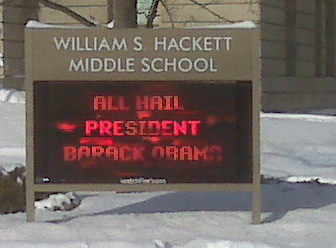
(Guest post by Greg Forster)
Neal notes the connection between Arne Duncan’s now-infamous embrace of Al Sharpton and the president’s continuing his new tradition of broadcasting a back-to-school message to America’s classrooms, coming up later this month.
Duncan didn’t just embrace Sharpton in his personal role as a citizen. He mobilized the U.S. Department of Education to support Sharpton by encouraging employees to attend Sharpton’s anti-Glenn-Beck rally.
Whatever you think of Glenn Beck, Sharpton cut his teeth as a professional purveyor of incitement to murder. During the Crown Heights race riots, with blood running in the streets, he said, “if the Jews want to get it on, tell them to pin their yarmulkes back and come over to my house.” He had to tone it back after the Freddy’s Fashion Mart murders, when people began making connections between Sharpton and the killings that kept following in his wake. But tone it back was all he did; he’s never repented.
Duncan spoke at Sharpton’s rally and urged his employees to attend.
A department spokesperson lamely tried to evade responsibility by saying “This was a back-to-school event.” Really? Here’s a sample of Al Sharpton’s back-to-school message for America’s youth, courtesy of the Washington Examiner:
[Conservatives] think we showed up [to vote for Barack Obama] in 2008 and that we won’t show up again. But we know how to sucker-punch, and we’re coming out again in 2010!
…and do your homework!
This is obviously intimately connected with the presdient’s decision to make it an annual tradition to use America’s government school monopoly to broadcast a message to the nation’s children. Other presidents have done so before, though none has made it an annual tradition. But it was equally wrong whoever did it, and this Duncan/Sharpton rally shows why.
Neal is trying too hard when he strains to describe Obama’s message to students as “politically charged material.” Joanne Jacobs rightly notes, “Last year’s speech raised a lot of fuss, culminating in a big fizzle as Obama told students to work hard in school.” No doubt this year the president will be equally anodyne.
[Update: Neal points out below that it was the accompanying materials sent to schools, not Obama’s message itself, that he described as “politically charged.” Fair enough! I read his post too quickly. Yet it’s worth noting that even those accompanying materials were focused on anointing Obama as a role model rather than pushing an overtly political agenda.]
The connection is rather that politics can’t be hermetically sealed. The president does have some role to play as the representative of the entire nation. But he is never just that; he is also a politician with an agenda. He will always stand for things that many Americans oppose; that’s just the nature of political life. And this president in particular seems to have more of a tendency than most presidents of associating himself with criminals and race-haters.
It doesn’t matter what Obama says. In fact, the less political his message, the worse it is. If Obama’s message really were “politically charged material,” many students would recognize it as such. The more anodyne he is, the more he gets what he really wants – to be anointed as a role model. With all that entails.
It’s wrong enough to have a government monopoly on schooling. To have the government monopoly anoint the president as a role model for our children is a hundred times more wrong. It would be wrong even if the president were relatively uncontroversial, because no president can avoid having many associations to which many parents will reasonably object. With this president – well, words just fail.
4 Comments | civic values | Tagged: Al Sharpton, Arne Duncan, Barack Obama, Greg Forster, Joanne Jacobs, Neal McCluskey | Permalink
Posted by Greg Forster

(Guest Post by Matthew Ladner)
From the Indy Star:
Daniels cited a national study released a few weeks ago by the Goldwater Institute in Arizona. It found the number of full-time administrators for every 100 students at 189 top U.S. universities had increased by 39 percent from 1993 to 2007.
The study blamed the administrative bloat on subsidies from federal and state governments and suggested that reducing subsidies would force schools to operate more efficiently.
“The role of trustee has never been so critical as it is today,” Daniels said. “But I don’t want to see you at the Statehouse asking for more money.
“Please stay back at the school and find ways to be more efficient with those dollars.”
5 Comments | higher education | Tagged: Administrative Bloat at American Universities, Brian Kisida, Goldwater Institute, Jay P. Greene, Jonathan Mills | Permalink
Posted by matthewladner
 (Guest Post by Matthew Ladner)
Later this week the American Legislative Exchange Council will release Report Card on American Education: Ranking State K-12 Performance, Progress and Reform written by yours truly, Dan Lips and Andy LeFevre.
As suggested by the title, we grade each state by their academic performance, their academic gains and their K-12 reform policies. On the later, we use a “poll of polls” technique and average the grades assigned for particular policy areas on academic standards, teacher quality, charter school laws, private choice, digital education etc.
Sneak peak: a B+ was the highest grade.
On the performance and progress, we utilize NAEP with an eye to maximizing comparability between states. After all, no one can be shocked that Connecticut has higher NAEP scores than Mississippi, given the huge disparities in income between the two states.
We therefore judge each state based on the scores of free and reduced lunch eligible general education students on all four main NAEP exams: 4th grade reading and math, 8th grade reading and math. We use the period for which all 50 states and the District of Columbia have participated in NAEP (2003-2009). Using free or reduced lunch eligibility keeps the income range of students under a known limit, whereas non-free and reduced lunch kids can vary in income from still relatively hardscrabble to billionaires.
We made no effort to control for race or ethnicity despite the well-known existence of racial achievement gaps. This is because we believe that such gaps can in fact be closed. We believe that the gaps exist due to policy and cultural factors, all of which can be changed. Schools in particular are in the business (or should be) of promoting a strong academic culture focused on learning-aka controlling the culture of the school.

You’ve never heard of a racial combat effectiveness gap in the United States Marines Corps because it doesn’t exist. The fact that the Marines are a well-led organization with a strong culture has a great deal to do with that, as does the fact that every Marine is a part of the Corps by choice.
In any case, we do not claim that our NAEP rankings provide perfect comparability just enormously better comparability than looking at raw NAEP scores.
So you are dying to know whether your state rocked or sucked wind in the rankings. Calm down- pace yourself!
All will be revealed later in the week.
5 Comments | research reports | Tagged: American Legislative Exchange Council, Andy LeFevre, Dan Lips, Matthew Ladner, Report Card on American Education | Permalink
Posted by matthewladner

(Guest Post by Matthew Ladner)
Brian Caulfield asks the question at Forbes: should Apple kill the university as we know it? Cites Jay, Brian and Jonathan’s bloat study.
Answer: yes. If they don’t, someone else will.
3 Comments | higher education | Tagged: Administrative Bloat at American Universities, Brian Kisida, Goldwater Institute, Jay P. Greene, Jonathan Mills | Permalink
Posted by matthewladner
1 Comment | higher education | Tagged: Administrative Bloat at American Universities, Brian Kisida, Goldwater Institute, Jay P. Greene, Jonathan Mills, Matthew Ladner | Permalink
Posted by Jay P. Greene

If you want to know why teachers are being laid off in California (even if teaching has remained one of the most secure jobs nationwide) you might want to check out this new $578 million high school in LA Unified School District. As we’ve written before on JPGB, buildings don’t teach kids, people do. Given the way school districts squander their resources, maybe they’ll soon need another $26 billion in Edujobs from Congress (read: taxpayers).
[CORRECTION — Oops. This is actually a photo of a different (and much less costly) high school in LA, the Visual and Performing Arts High School. I can only imagine that the new $578 million high school is plated in gold.]
Thanks to Stuart for finding a photo of the $578 million high school. It doesn’t look plated in gold so I guess the gold is on the inside:

9 Comments | money myth, politics | Tagged: Edujobs, school buildings | Permalink
Posted by Jay P. Greene


 Jay P. Greene's Blog