How Mission Creep Adds to Administrative Bloat

September 14, 2010

In case you need any examples of how mission creep in higher education contributes to administrative bloat, check out this story about the University of Central Arkansas.  UCA decided to contract with a company, called Snoozester, to provide a wake-up and reminder phone call service for students.  Students, at no additional cost to themselves, can arrange to have Snoozester call their cell phone to make sure they wake-up on time in the morning or to remind them of a test or appointment.  Never mind that almost all cell phones already have alarm functions.  We need the university to pay $11,000 to a company to make phone calls to students.

This doesn’t just contribute to administrative bloat by causing UCA to spend $11,000.  There also have to be administrators who write and approve the contract with Snoozester.  Administrators have to monitor the performance of the company.  Some administrator had to dream up the idea (perhaps his dream was interrupted by a sales call from Snoozester).

Of course, we have highly trained professionals recommonding the addition of this service.  From the Arkansas Democrat-Gazette:

Dr. Lynn Taylor, chief of psychiatry at Arkansas Children’s Hospital in Little Rock, said UCA’s program is “a great idea,” especially for freshmen, if the calls wake students up better than alarm clocks.

“That is a really hard time – the transition to college and being on your own,” she said.

This is a small example of mission creep contributing to bloat, but eventually all of this adds up.  And it reflects an attitude that there is no limit to the services students need.  And since students only pay for a fraction of the cost of all of these services, given high rates of public subsidy, and only do so indirectly, of course students don’t mind getting these extra services.

When will universities start offering the butt-wiping service?

For more on the administrative bloat report that I wrote with Brian Kisida and Jonathan Mills, see this post.


Mark Your Calendars

September 13, 2010

Mark your calendars.  September 9 was the date that Checker Finn and the Fordham Institute began to turn against the national standards movement they so enthusiastically championed.  We’ve been predicting this reversal on JPGB, but who knew it would happen so soon?

Last week Checker noticed that the Council of Chief State School Officers (CCSSO), which directs the current national standards push fueled by Gates Foundation money and financial rewards and threats from the U.S. Department of Education, is merging with P-21, the 21st century skills nonsense organization.  Checker noted that the incorporation of P-21 into CCSSO could provide “additional traction for the organization’s current agenda [which] would be bad for the country, bad for the new ‘Common Core’ standards and the assessments being developed around them, and possibly bad for CCSSO as well.”

Checker also suddenly became aware that even good standards may well be undermined by bad assessments:

Indeed, P-21 isn’t the only risk here. At least one of the two new assessment-development consortia could—probably in the name of “performance assessment” and “career readiness”—easily drown in the soft stuff, in which case the tests it is building may not do justice to the academic standards with which they are meant to be aligned. Which would also mean that implementation of the Common Core by states and districts could be distorted in the direction of the soft stuff that will be on the tests and for which schools and educators will be held to account.

And Checker has finally focused on the fact that the federal government might make mischief with the national standards machinery for which he and Fordham provided right-wing cover:

One hopes that Secretary Duncan is mindful of this risk, but his big assessment speech last week wandered all over the 21st century terrain. And those straying off the cognitive reservation can also invoke Duncan’s boss, whose March 2009 denunciation of “bubble tests” called for a new generation of assessments that would address not only “problem-solving and critical thinking” but also “entrepreneurship and creativity.” Yes, there is reason to believe that President Obama has drained more than a few steins of P-21 propaganda. Maybe his education secretary has, too.

Of course, Checker still holds out hope that vigilance could keep these negative forces at bay.  But he is clearly laying the groundwork for his complete reversal, which will come as these negative forces gain control over the national standards infrastructure that Checker and Fordham helped create by down-playing these very dangers.


RTTT Scoring is Distorted by Politics

September 12, 2010

No one should be shocked that the “peer-review” process for Race to the Top is distorted by political considerations, especially since we at JPGB (among others) have been warning about it for months.  But it is nice to see someone actually document the existence and magnitude of the distortion.

One of my students at the University of Arkansas, Dan Bowen, conducted an analysis that was featured in AEI’s Education Stimulus Watch.  It predicted each state’s RTTT “peer-review” score based on independent ratings of state reform efforts by Education Week’s Quality Counts and others.  It then also considered whether political considerations were systematically related to a state doing significantly better or worse in the “peer-review” process than would be predicted by those independent ratings.  Dan found that states with hotly contested Senate or gubernatorial contests received significantly higher scores:

…having a contested seat for the 2010 election increases round-one RTT scores by at least thirty-five points, and up to seventy-seven points (15 percent of the total available points) if a state has contested races for both governor and Senate. Second, the inclusion of a state’s political circumstances, along with its education-reform record, improves the model’s capacity to explain and predict round-one RTT scores.
Dan does not mean to suggest that the peer-reviewers consciously changed their scores to advance the Administration’s political agenda.  Political distortions can and do creep into these processes in subtle ways, such as the weighting of different criteria in the scoring rubric, the selection of who is a reviewer, the informal signals sent to the reviewers about what factors should be considered, etc…
Be sure to check out the full report.

Gov. Christie Gone Wild

September 10, 2010

BOOOOOOOOOOM!!!!!!!!!!!!!!!!!!!!!!!!


Pass the Popcorn: Machete

September 10, 2010

(Guest Post by Matthew Ladner)

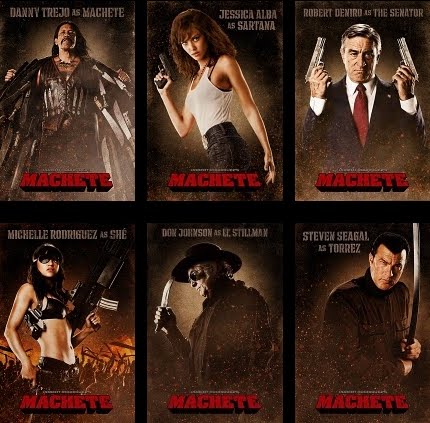
So the Rodriguez-Tarrantino Grindhouse double feature included some fake movie trailers before and between the two movies.  One of them was for a fake movie called Machete which looked like a Hispanic version of a 1970s Blaxploitation flick.

I know all of this because I was one of the 88 people who went to see Grindhouse in the theater. Okay, so I was the only person to see it twice. There- I admitted it- are you happy now?

Anyway, the Machete trailer was so over the top that Robert Rodriquez decided to make it into a full-fledged movie.  Of course, I was morally obligated to go see it.

My reaction: meh.

Oh, there are some very funny scenes, especially for someone living in Arizona. The theater laughed out loud when Robert DeNiro’s Senator McLaughlin character was introduced. The film was set in Texas, but there was some obvious spoofing of Arizona pols included (e.g. John McLaughlin for John McCain).

The standard Blaxploitation/James Bond formula of a protagonist who only takes brief breaks from being a killing machine to serve as a babe magnet is in full swing, sprinkled with an occasional explosion and/or observation about the illegal immigration issue. This is not Shakespeare, it is not even Black Dynamite.

It is however entertaining if you are willing to check your brain at the ticket booth. Even then, it runs out of steam.


The Lioness in the Winter?

September 9, 2010

(Guest Post by Matthew Ladner)

I’m seeing increasing eduland chatter that DC Mayor Adrian Fenty is trouble in his reelection bid.  Rick Hess provides an on the scene view of what is at risk:

When it comes to teacher evaluation, the teacher contract, textbook distribution, special education, scheduling, data systems, and much else, Rhee’s team has gotten DCPS to the point where it is functional. It isn’t yet an especially good school system, but it’s no longer broken and it’s positioned to be something much more.

I’m even a bit more bullish than this on DCPS. In our rankings of state NAEP performance for ALEC’s Report Card on American Education, DC came up with the second highest overall gains between 2003 and 2009, behind only Florida. The NAEP gains in the District predate Rhee’s tenure, but accelerated between 2007 and 2009.  If the Fenty/Rhee regime survives, an academic golden age of improvement lies within the grasp of the long-troubled district.

If not, it will likely take longer. The bottom-up pressure on DCPS in the form of a large and growing charter school sector will remain.  I have some hope that the union’s pillow smothering of the DC Opportunity Scholarship Program might be reversed after many of their minions are forced out of Congress.

That's my lobbying job! No MINE!!!!!

The path to reform is difficult. There have been and will continue to be bitter losses along the way. For the sake of the 56% of DC 4th graders who still can’t read at a Basic level despite the progress to date, I hope that prematurely losing Rhee will not be one of them.


Boards of Education That Approve “Inquiry-Based” Standards for ‎K-12 Students Need To Do Inquiry-Based Thinking Themselves

September 8, 2010

(Guest Post by Sandra Stotsky)

State boards of education are generally viewed as dull or weak citizen boards when compared with local school boards–which tend to be much livelier and far more involved with educational issues (often to the chagrin of local school administrators). There are many reasons why state boards do not have a reputation for being active or strong guardians of the public interest in their state. They tend to consist of people who work full-time and don’t have the time or energy to delve into the details of all the regulatory or policy matters that state boards must approve by statute.  They tend to meet only once a month–which doesn’t allow time for finding all the devils in the details of any important policy-laden issue. In addition, the recommendations of the commissioner or state superintendent of education are too easy to rely on if the person was appointed by the board on the basis of professional credentials, in contrast to being elected or a governor’s political appointment. And in many states, board members themselves are appointed by the governor and are often chosen for reasons other than having a reasonable familiarity with K-12 education or a reputation for asking enlightening questions instead of grandstanding, pontificating, obsessing over a few specific issues, or expressing stream-of-consciousness ruminations.

Yet, despite their flaws and weaknesses, there is a case to be made for revitalizing and strengthening state boards of education, especially at a time when efforts are being made to leave both local and state boards of education in the dust on vital matters of curriculum and instruction in the name of equalizing academic expectations for all students and obtaining comparable test scores across states.  These are desirable educational goals in themselves but not to the exclusion of goals that take cognizance of differences in students’ interests, talents, and abilities. At the least, we should not enfeeble state boards of education by structural changes that centralize educational decision-making and minimize the possibility of getting corrective feedback from informed public discussion of proposed or implemented policies. In what follows, I offer an analysis of how the Patrick administration in Massachusetts effectively silenced what was once known as a strong state board.

In November 2006, I was appointed by outgoing Governor Romney to the nine-member Massachusetts Board of Education. In January 2008, the legislature passed the bill Governor Patrick wanted establishing a cabinet-level position of secretary of education and expanding the board to eleven member–with almost no opposition registered.  My term of office was specifically shortened by a year and a half.  But, three and one-half years on the board was enough to discern the effects of these changes on statewide educational decision-making.

It is worth noting that in testimony at a 2003 hearing for an ultimately unsuccessful bill proposing a similar position for a different governor, Paul Reville, then director of the Center for Education Research and Policy at MassINC, warned that an education secretariat…seems to create “three masters” for the commissioner of education: the governor, the secretary of education, and the board of education including its chair.  How wrong Reville was. The position of secretary of education created in January 2008, to which the governor appointed Reville several months later, did not create confusion for the commissioner of elementary and secondary education.  It in effect created one new boss for him: the secretary of education, who was to oversee the budgets and coordinate the policies of the state’s three education agencies as well as serve as a voting member on their boards.

Expansion was the key to minimizing independent thinking on the K-12 board because it required alteration of all members’ terms of office. These changes were carefully spelled out in the 2008 bill to enable the governor to control the majority immediately and, by appointment, re-appointment, or non-re-appointment, all but the student member within a few years.

To reduce potential power plays between Secretary Reville and the board chair (whose appointment was already in the governor’s power), someone who could run meetings on time and had no political ambitions was needed and quickly found.  Indeed, the regular presence and seating of Secretary Reville at board meetings came to symbolize his role; newly appointed Commissioner Mitchell Chester was sandwiched between him and the chair, Maura Banta, at the head table. Banta, in turn, was flanked on her other side by the board’s union representative. Not much wiggle-room for Commissioner Chester.

The first clear sign that the governor’s office, not the board, was Commissioner Chester’s boss was his appointment of Karla Baehr, former Superintendent of the Lowell Public Schools, as a second deputy commissioner within two months after Chester’s appointment in 2008.  The governor had wanted her for commissioner of elementary and secondary education, but the board had selected someone else for other reasons. The board knew nothing officially about the addition of a second deputy commissioner to the department of elementary and secondary education until the media announced it.

Since spring 2008, the board has voted on very few significant policies for K-12.  Indeed, when asked to note for the 2009 summer retreat what important decisions they had made in the previous year, hardly anyone could think of even one. The bulk of the board’s time has been spent discussing (in excruciating detail) and voting on charter school applications or issues, as evidenced in its monthly agendas.

Almost all meeting agendas have been determined by the secretary of education and commissioner, with no board input desired.  Secretary Reville told the board directly at a 2008 summer retreat that meetings would be too long if every topic members wanted discussed became an agenda item.

Because the governor controlled a majority of board members from 2007 on, discussion was minimal on most, especially non-charter school, issues. The secretary of education rarely asked questions at board meetings because he didn’t need to; the chair usually asked none. Although the board regularly received brief updates on the Common Core initiative, there was clearly no need to waste time discussing the implications of national standards for Massachusetts or the quality of Common Core’s evolving standards. Patrick-appointed board members knew they were going to adopt these standards no matter what condition they were in. The draft copy placed in an appendix in its January Race To The Top application (explicitly noting the commissioner’s intention to consider adopting them in the future) was of such inferior quality that it had to be completely revised for the public comment version released in March. The chair was the only board member who saw that application before it was sent off,  and no board member raised a question about it after hard copies were sent to all board members in response to my request for a copy.

With the non-re-appointment in June 2010 of  the two board members appointed by former Governor Romney (Tom Fortmann and me) and their replacement by more Patrick appointees, the board has become little more than a facade satisfying a statute that requires a citizen board to provide oversight of the department of education.

The ostensible results of the 2008 legislation have been exactly as intended–complete control of the state’s educational agenda by the Executive Office of Education, with minimal public discussion of important matters.  But, by centralizing policy-making and appointing a politically partisan board with little understanding of K-12, the administration has prevented its own officials as well as the public from learning about flaws in the policies it proposes or adopts. The bill for that hubris will begin to come due when teachers in the Bay State start implementing the inferior national standards this year.  And what will the fallback explanation be to parents when high school students deemed “college-ready” by grade 10 or 11 state tests based on those standards go to college and fail some of their college courses?  Or will they not be allowed to fail?  These are questions that all state boards adopting Common Core’s standards  should discuss and need to be prepared to answer.


It Took So Long Because They Were Learning It in the Wrong Style

September 7, 2010

(Guest post by Greg Forster)

I had to laugh when I saw this New York Times story. They’ve discovered that the existence of multiple “learning styles” has no sound basis in empirical evidence:

Take the notion that children have specific learning styles, that some are “visual learners” and others are auditory; some are “left-brain” students, others “right-brain.” In a recent review of the relevant research, published in the journal Psychological Science in the Public Interest, a team of psychologists found almost zero support for such ideas. “The contrast between the enormous popularity of the learning-styles approach within education and the lack of credible evidence for its utility is, in our opinion, striking and disturbing,” the researchers concluded.

Wow, those daring journalists at the Times and scientists at Psychological Science in the Public Interest aren’t afraid to buck the conventional wisdom!

Imagine how daring they’d have been if they’d been reading Education Next . . . in 2004?

(Admittedly, the Ed Next article is framed in terms of “multiple intelligences” rather than “learning styles,” but when you come right down to it, “multiple intelligences” was just the fashionable early-aughts buzzword for the same cluster of fallacies that goes by “learning styles.”)

HT Joanne Jacobs


The Little Voucher Engine Keeps Chugging Along

September 7, 2010

Despite various reports of the death of vouchers, mostly from people wishing that the idea were in fact dead, voucher programs and supporters keep gaining steam.

Today in the WSJ we learn about how both Democratic and Republican candidates for governor in Pennsylvania are voucher supporters.   As the piece concludes:

The Obama Administration, which is phasing out a popular and successful school voucher program in Washington, D.C., at the insistence of teachers unions, refuses to acknowledge that vouchers can play a role in reforming K-12 education. But states and cities are the real engines of reform, and the Pennsylvania developments are another sign that the school choice movement is alive and well.


Obama Believes in Trickle-Down?

September 7, 2010

I know the Obama Administration is scrambling to do something about lackluster employment and growth figures to lessen gigantic Democratic losses in the mid-term election.  But I am completely puzzled about why their latest stimulus proposal involves granting large corporations tax breaks for new capital investment.  Does the Democratic Party now believe that the best way to stimulate the economy is to give big corporations tax breaks in the hopes that this will trickle-down to help the middle and lower classes?

I know that this is a targeted tax break, but they way in which it is targeted makes it all the less likely to spur job growth.  Most job growth comes come from small businesses.  Small businesses tend not to be capital intensive, so a tax break for capital investments should make little difference for them.  In addition, most of our economy is in the service sector, which also has relatively little capital investment.  A tax break for new capital investment shouldn’t make much of a difference there either.

The main beneficiary of a capital investment tax break would be large corporations in the manufacturing sector.  That’s a relatively small and shrinking sector of our economy, regardless of tax policy.  And fueling capital investment in the manufacturing sector may well reduce the number of jobs — rather than create more jobs — since the trend in that sector has been to substitute capital for labor.  As companies build new and improved manufacturing facilities they tend to need fewer people to operate those machines and build things.

If the Obama Administration thinks tax breaks lead to trickle-down benefits, how about if they focus on reducing capital gains and dividend taxes, which would broadly encourage investment in the service and manufacturing sectors?  This would also benefit small as well as large businesses and would reward the investment in people as much as machines.  Instead the Obama Administration seems determined to raise capital gains and dividend taxes.  Things that make you go hmmmm.