Checker’s Selective Memory

October 14, 2010


(Guest post by Greg Forster)

Checker just published a column on the incompetence of government. It’s a little bit weird; there’s not much connection to education policy here, and the piece doesn’t reach any conclusions or advocate any new policies. He just complains that government is really incompetent.

PEREGRUZKA: “OVERLOAD”

To which one can only reply: You’re just discovering this now?

Or is this one of those things like a coworker’s extension number, or your brother’s ZIP code – something you don’t need to know all the time, so you periodically remember it and forget it, remember it again and forget it again?

Like, say, you might remember it when conservatives are doing well in Washington, then forget it when liberals are doing well in Washington, and suddenly remember it again just before a wave election brings the conservatives back?


Rhee Resignation

October 13, 2010

(Guest Post by Matthew Ladner)

Robert Enlow, Greg, Virginia Walden Ford,  Lance Izumi, Lisa Snell and I weigh in on the Rhee resignation in School Reform News.

UPDATE:

The Cool Kids put on a brave face in the New York Times.

Rotherham wisely notes that if Gray is going to kill reform, he will do it later in a series of pillow-smotherings rather than in some obvious fashion.

WaPo columnist McCartney on the Rhee aftermath.

Finally, the WaPo produced this sobering “Man on the Street” reaction video showing DC residents having far more sympathy with ineffective teachers than the students in the schools.


They Can’t Help It

October 13, 2010

Politicians lie.  Bless their hearts, they just can’t help it.  There are things that they want and they’ve discovered that it is much easier to get those things if they don’t tell us the whole truth.  And on some level we don’t really mind their lies.  We want them to get things done and we’ve just grown accustomed to it.  Besides, we all lie — at least about small things to facilitate daily living.  So who are we to expect better from our politicians?

But maybe we should hold our politicians to a higher standard of truthfulness.  After all, they do have a legal and moral responsibility to us.  And their fibs have a much broader impact on other people than the lies of us regular people because they have power over the rest of us.

I’ve been thinking about all of this as I’ve been watching the machinations of local politics in Fayetteville.  If the politicians were honest they would just announce that they want to raise our taxes, reduce spending on the popular trail system, and don’t really advocate for the interests of most businesses.  But politicians can’t just tell us what they want.  They have to lie.

Earlier this year city officials asked us to approve a referendum allowing the portion of the HMR tax that was dedicated to the development of parks to no longer have that restriction.  They assured us that our parks won’t get cut.  They just wanted more “flexibility.”

At the time I predicted that the “flexibility” they were seeking was to cut park development spending, including for further construction of our wonderful trail system.  Sure enough, that is exactly what Alderman Bobby Ferrell proposed yesterday.  According to the Northwest Arkansas Times, “Ferrell suggested cutting money budgeted for trail improvements…”  I could have told you that they were lying when they said they only wanted “flexibility” over HMR tax proceeds, but then again I actually did tell you.

And no one should be fooled by the falsehood that Steve Clark, the head of the local Chamber of Commerce, advocates for the interests of businesses.  He doesn’t.  First, the Chamber only represents existing businesses, not future businesses.  Unfortunately, existing businesses often favor regulations and other barriers to entry that would protect them from competition from yet-to-be-created businesses.  There is no greater supporter of government-enforced monopolies than businesspeople.  So, no one should confuse the Chamber of Commerce for an organization that advocates free-market policies that facilitate business formation and growth.

Second, Steve Clark doesn’t even appear to represent the existing businesses in Fayetteville.  He and the Chamber clearly didn’t do a good enough job of advocating for local businesses to convince enough of them to pay the voluntary dues to keep him and the Chamber in the lifestyle to which they are accustomed.  So, they convinced the city to tax businesses to pay the Chamber. Yes, they called the tax a “business license fee,” but that is just part of the honesty-challenged pattern. Steve Clark doesn’t really work for local businesses.  He works for the city since a large chunk of his salary is paid by the city and not by voluntary dues to the Chamber.

If you don’t believe me that Steve Clark really represents the interests of city government and not business interests, just listen to what he said in support of the latest proposal to increase the city’s property tax. According to the Northwest Arkansas Times: “Steve Clark, president of the Fayetteville Chamber of Commerce, said avoiding major cuts in city services, such as fire, police and sanitation, are his main priorities when it comes to finding ways to balance the budget.” (emphasis added)

I thought that protecting city worker jobs was the main priority of their unions or the politicians beholden to those workers.  Advancing the interests of business is normally the main priority of the Chamber of Commerce, but I guess that changes when the Chamber staff effectively become city employees along with the police, firefighters, etc…

“Lie” is such a strong word that we have developed more polite terms for this regular behavior by politicians.  We call it “spinning” or “packaging.”  We have these more polite terms because it is probably unfair to expect politicians to avoid distorting or shading the truth altogether.  They have to do it to get what they want done.

The problem is when we no longer recognize what is spin and what is truth.  If we get fooled into believing that “flexibility” means something other than “cutting” and that the “Chamber of Commerce” necessarily means “business interests” we are the ones to blame, not the politicians.  It’s part of their job to lie (or spin) and it is our job to be suspicious.  Unfortunately, our local media and elites are overly credulous.


The Sustainability Craze at Universities

October 12, 2010

Peter Wood, the president of the National Association of Scholars, has an excellent piece in the Chronicle of Higher Education about how sustainability is displacing diversity as the campus craze du jour.

Here is the (vegetarian) meat of his piece:

I view this changing of the ideological guard with wariness. Diversity was pretty bad; sustainability may be even worse. Both movements subtract from the better purposes of higher education. Diversity authorizes double standards in admissions and hiring, breeds a campus culture of hypocrisy, mismatches students to educational opportunities, fosters ethnic resentments, elevates group identity over individual achievement, and trivializes the curriculum. Of course, those punishments were something that had to be accepted in the spirit of atoning for the original sin of racism.

But for its part, sustainability has the logic of a stampede. We all must run in the same direction for fear of some rumored and largely invisible threat. The real threat is the stampede itself. Sustainability numbers among its advocates some scrupulous scientists and quite a few sober facilities managers who simply want to trim utility bills. But in the main, sustainability is the triumph of hypothesis over evidence. Its scientific grounding is mostly a matter of models and extrapolations and appeals to authority. Evoking imminent and planet-destroying catastrophe, sustainatopians call for radical changes in economic arrangements and social patterns. Higher education is summoned to set aside whatever it is doing to help make this revolution in production, distribution, and consumption a reality.

Sustainability combines some astonishingly radical ideas with mere wackiness. Many sustainability advocates want to replace free markets (a source, as they see it, of unsustainable growth and exploitation) with some kind of pan-national rule with little scope for private property rights. On the other hand, sustainatopians also busy themselves with eliminating trays from cafeterias and attacking the threat of plastic soda straws. Sustainability thus unites vaunting political ambition and comic burlesque. Both are at odds with patient and open-minded intellectual inquiry.

The diversity movement has always been rife with contradictions. Seeking to promote racial equality, it evolved into a system that perpetuates inequalities. But whatever else it is, the diversity movement thirsts to be part of mainstream America. Its ultimate goal is to make diversity a principle of the same standing as freedom and equality in our national life. The sustainability movement, by contrast, has no such affection for the larger culture or loyalty to the American experiment. It dismisses the comforts of American life, including our political freedom, as unworthy extravagance. Sustainability summons us to a supposedly higher good. Personal security, national prosperity, and individual freedom may just have to go as we press on to our low-impact, carbon-free new order. In this sense, it goes beyond promising to redeem us from social iniquity to redeeming us from human nature itself.

Many campus adherents to sustainability may eventually tire of its puritanical preachiness and its unfulfilled prophecies, but for the moment, sustainability has cachet. Diversity, meanwhile, has aged into a static bureaucracy, and diversicrats increasingly spend their energy polishing the spoons…


So Put All the Blame on VCR…

October 11, 2010

(Guest Post by Matthew Ladner)

Interesting read from James Surowiecki on how Netflix killed Blockbuster, and how Netflix itself could be next. Blockbuster’s “Clicks and Mortar” strategy turned out to work about as well as “balanced literacy.”

I suspect however that “Clicks and Mortar” has a brighter future in education if we can get the education market to reflect a small fraction of the dynamism of the movie rental market.


Khan Explains Yet Another Reason to Distrust the French

October 9, 2010

(Guest Post by Matthew Ladner)

Alec Baldwin and other Hollywood types were going to move to France after Dubya won the 2000 Presidential election. While they are there, perhaps they could start a campaign to have France pay back Haiti for the outrageous payment which it extracted by embargo for “lost property” (e.g. slaves) after the Haitian Revolution.

Thirteen billion dollars would do the trick, unless you want to charge interest, in which case the French might need to sell Versailles and the Riviera to raise capital. The French could put the money into a micro-finance outfit to help Haitian entrepreneurs, and call it even. It’s not like the money is going to create any new products, jobs or services in France after all.


Al Copeland Humanitarian Nominee: Herbert Dow

October 8, 2010

(Guest Post by Matthew Ladner)

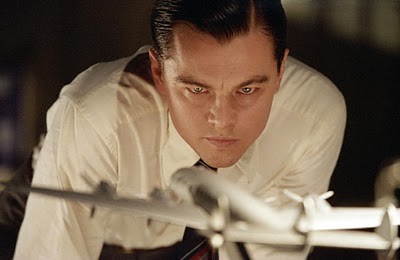
So I remembered reading the Mackinac Center’s book Empire Builders. The book featured stories of entrepreneurs that made Michigan great.  Years later when I watched The Aviator it reminded me of one of the stories from Empire Builders.

Herbert Dow is certainly worthy of a posthumous Al Copeland award. This 1997 piece from the Mackinac Center explains why:

Herbert Dow, the Monopoly Breaker

By Dr. Burton W. Folsom | May 1, 1997

Today, the Dow Chemical Company is an industrial giant, famous for its plastics, Styrofoam, and Saran Wrap. But when the company first went into business 100 years ago, in May 1897, almost no one took it seriously. The occasion of the company’s centennial offers a timely opportunity to retell an important economics lesson.

Herbert Dow, the founder, had already started two other chemical companies: one went broke, and the other ousted him from control. “Crazy Dow” was what the folks in Midland, Michigan, called him, as he pursued his entrepreneurial vision of an American chemical industry. Like David fighting Goliath, he actually believed he could throw stones at the large German chemical monopolies and topple them from world dominance.

In the story of Herbert Dow, not only do we see the spirit of freedom that helped America become a world power, we also learn how a small company can overcome the “predatory price cutting” of a large cartel.

Dow invented a process to separate bromine from the sea of brine underneath much of Michigan. He then sold bromine to other firms, which made it into sedatives and photographic supplies. With gusto, Dow sold it inside the U. S., but not outside—at least not at first.

The Germans had been the dominant supplier of bromine since it first was mass-marketed in the mid-1800s. No American dared compete overseas with the powerful German cartel, Die Deutsche Bromkonvention, which fixed the world price for bromine at a lucrative 49 cents a pound. Customers either paid the 49 cents or they went without. Dow and other Americans sold bromine inside the U. S. for 36 cents. The Bromkonvention made it clear that if the Americans tried to sell elsewhere, the Germans would flood the American market with cheap bromine and drive them out of business.

By 1904, Dow was ready to break the unwritten rules: He was so strapped for cash that he decided to sell in Europe. Dow easily beat the cartel’s 49 cent price and courageously sold America’s first bromine in England. After a few months of this, Dow encountered an angry visitor in his office from Germany—Hermann Jacobsohn of the powerful Bromkonvention. Jacobsohn announced he had “positive evidence that [Dow] had exported” bromine. “What of it?” Dow replied. “Don’t you know that you can’t sell abroad?” Jacobsohn asked. “I know nothing of the kind,” Dow retorted. Jacobsohn was indignant and left in a huff.

Above all, Dow was stubborn and hated being bluffed by a bully. When Jacobsohn stormed out of his office, Dow continued to sell bromine to countries from England to Japan. Before long, the Bromkonvention went on a rampage: It poured bromine into America at 15 cents a pound, well below its fixed price of 49 cents, and also below Dow’s 36 cent price.

The imaginative Dow worked out a daring strategy. He had his agent in New York discreetly buy hundreds of thousands of pounds of German bromine at the cartel’s 15 cent price. Then Dow repackaged the German product and sold it in Europe—including Germany!—at 27 cents a pound. “When this 15-cent price was made over here,” Dow said, “instead of meeting it, we pulled out of the American market altogether and used all our production to supply the foreign demand. This, as we afterward learned, was not what they anticipated we would do.”

Indeed, the Germans were befuddled. They expected to run Dow out of business; and this they thought they were doing. But why was U. S. demand for bromine so high? And where was this flow of cheap bromine into Europe coming from? Was one of the Bromkonvention members cheating and selling bromine in Europe below the fixed price? Powerful tensions surfaced from within the Bromkonvention. According to Dow, “the German producers got into trouble among themselves as to who was to supply the goods for the American market . . . .”

The confused Germans kept cutting U. S. prices—first to 12 cents and then to 10.5 cents a pound. Dow meanwhile kept buying the stuff and reselling it in Europe for 27 cents. Even when the Bromkonvention finally caught on to what Dow was doing, it wasn’t sure how to respond. As Dow said, “We are absolute dictators of the situation.” He also wrote, “One result of this fight has been to give us a standing all over the world . . . . We are in a much stronger position than we ever were . . . .”

When Dow broke the German monopoly, all users of bromine around the world could celebrate. They now had lower prices and more companies to buy from. This victory propelled the remarkable Dow to challenge the German dye trust, and, after that, the German magnesium trust. His successes in these industries again lowered prices and helped liberate the American chemical industry from its European stranglehold.

Those who value the spirit of freedom and the rise of America as a world power can thank Herbert Dow for what he started in Midland, Michigan, 100 years ago.

BOOOOOOOM!!!!!!!!!!!!!!!!!


David Bell on the Myth of American Decline

October 7, 2010

(Guest Post by Matthew Ladner)

David Bell crushes a Thomas Friedman column in the New Republic.

Bravissimo!


Khan Academy ROCKS

October 7, 2010

(Guest Post by Matthew Ladner)

So here is what I have learned so far from Khan Academy.

First, my son Benjamin and I reviewed the French Revolution, the rise of and fall of Napoleon the sordid history of France in Haiti in this series of videos.

Next, I learned more about the housing bubble in this series of videos.

My son Jacob, who is in 3rd grade, reviewed two digit multiplication in this video.

Khan Academy covers hundreds of topics, and is adding more. The main menu is here.

A bedrock assumption for any system of schooling, whether public or private, is that knowledge is scarce and must be imparted by trained specialists to students. Knowledge is no longer scarce, and our methods for communicating it have been evolving. Our training of specialists and pairing them with students leaves much to be desired.

I don’t know where all of this is going, but I am anxious to find out.


Donovan and Mills for Al Copeland Humanitarians of the Year

October 6, 2010

(Guest post by Greg Forster)

It’s taken me a week to think of it, but I have come up with what I believe is the ultimate nominee for the Al Copeland Humanitarian of the Year award this year. Or rather, two nominees.

Yes, the most interesting man in the world is . . . very interesting! I love the ads, but does he really represent the spirit of “The Al”? He certainly has done a lot of things – but what has he actually accomplished?

I propose that the true spirit of “The Al” is what you find inside . . . diapers.

Marion Donovan and Victor Mills’ diapers, to be exact.

Just spend a moment thinking about what life was like during the endless centuries when a diaper was nothing but a piece of cloth – one you had to wash and reuse, because manufactured goods couldn’t yet be made cheap enough for disposability. Contemplate, for a moment (but no longer than that!) how many diapers were changed from the first human beings technologically sophisticated enough to make clothing down through the middle of the twentieth century – and what was involved in changing each and every one of those diapers.

When Martin Luther wanted to illustrate the point that joyfully worshipping God was not a special activity that you did by going to church or performing other “religious works,” but something that had to infuse every single solitary human activity, even the most unpleasant, he was shrewd to choose diaper changing as an example:

Now observe that when … our natural reason … takes a look at married life, she turns up her nose and says, “Alas, must I rock the baby, wash its diapers, make its bed, smell its stench, stay up nights with it, take care of it when it cries, heal its rashes and sores, and on top of that care for my wife, provide for her, labour at my trade, take care of this and take care of that, do this and do that, endure this and endure that, and whatever else of bitterness and drudgery married life involves? What, should I make such a prisoner of myself? O you poor, wretched fellow, have you taken a wife? Fie, fie upon such wretchedness and bitterness! It is better to remain free and lead a peaceful. carefree life; I will become a priest or a nun and compel my children to do likewise.”

He went on to focus on diaper-changing as the representative activity encompassing all these unpleasant duties. Luther knew that by sticking up for the honor of the married estate, he was sticking up for getting poop on your hands. Daily.

But having a family doesn’t mean daily poop-scrubbing anymore.

Born in 1917, Donovan spent much of her childhood hanging around the Ft. Wayne factory run by her father and uncle. They were inventors in their own right – having invented, among other things, an industrial lathe for making automotive gears and gun barrels – and she absorbed their entrepreneurial spirit.

Her first invention was a waterproof diaper cover, made out of a shower curtain, to contain the small leaks that were endemic to diapers in the pre-Donovan era. Rubber baby pants were already on the market, but they weren’t widely used because they caused diaper rash and pinched the skin. The plastic “changing pads” we use today are a distant descendant of Donovan’s innovation.

For good measure, she put snaps on her diaper cover instead of using safety pins, which at the time were the universal fastening technology in the diaper sector. Today we use velcro, but the original quantum leap away from the use of dangerous and labor-intensive pins was Donovan’s.

None of the big manufacturers would even consider marketing her invention, so she went into business for herself. Her product was an overnight success, debuting at Saks Fifth Avenue in 1949. After two years she sold it to one of those super-smart manufacturing companies that had been too dumb to give her the time of day back when it would have counted.
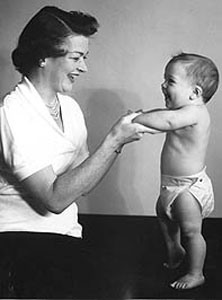
Like any good entrepreneur, she didn’t rest on her laurels but plowed her success into the next innovaiton – this time, disposable diapers. The challenge was significant; she needed to make the interior out of paper (so it would be cheap enough to manufacture in large numbers) but make it durable and absorbant.

She produced what she thought was a workable solution, but once again she couldn’t get the manufacturers interested. They were already working on the same idea – and Victor Mills, a chemical engineer at Proctor & Gamble, had a better solution than hers. (Those are the breaks! “The Al” celebrates the tough life of entrepreneurial struggle.)

 In 1956, P&G had acquired a new paper pulp plant, and it asked Mills and his team what they could do with it. Lots of companies were working on disposable diapers, but nobody had solved the problem yet. Mills, a grandfather at the time, had a pretty strongly vested interest in coming up with a solution. And the new plant yeilded just enough durability and absorbancy to solve the problem. Using his grandchild to test the prototypes, Mills developed the disposable diaper that ultimately became Pampers in 1961.
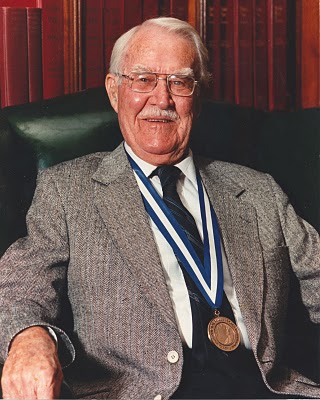
Well earned

So if you have kids, thank Donovan and Mills for their contribution to your well-being – and vote for them for Al Copeland Humanitarians of the Year.

HT Thomas Frey, Women Inventers and Chemical Engineering World for images, Famous Women Inventors and Jon Marmor for info