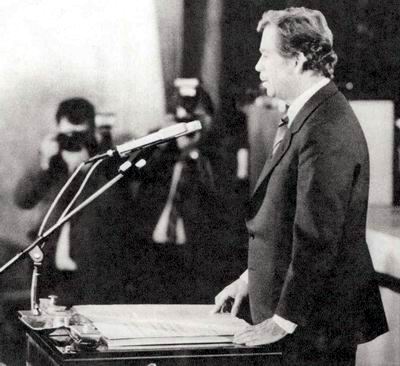
It’s a busy couple days for death posts. Vaclav Havel is dead at 75.
I’ve already written my tribute to this hero of freedom – and what education reformers can learn from him – here.
If you want a great laugh and also a poinient deconstruction of the absurdity of trying to rule people by force, do yourself a huge favor and read The Memorandum. (Bonus: It’s short!)
Supporters of digital learning, many of whom were among the strongest supporters of national standards, have organized in opposition to the imposition of a single test on the nation’s schools. As it stands, the federal government is dumping several hundred million dollars on two testing consortia to develop assessments based on the federally “incentivized” Common Core standards. A choice of two tests is not the same as a single test, but it is darn close. It’s like the old joke where you have a choice between death or roo-roo.
Create a dynamic testing ecosystem, not another one-size-fits-all assessment. Rather than a single common test, the federal-funded opportunity offers the potential to create a vibrant assessment ecosystem comprised of multiple platforms, open-item banks, and multiple testing options that encourages deeper learning. An assessment ecosystem, rather than a single common test, will give states the flexibility to take advantage of innovations in digital learning over time while maintaining interoperability and comparability.
Signatories to this anti-national testing statement include Clayton M. Christensen, Michael B. Horn, Gisele Huff, Terry Moe, Tom Vander Ark, Bob Wise, and Julie. E. Young in addition to dozens of others.
I’m not sure why backers of digital learning have taken so long to recognize the threat posed by the nationalization movement. And I really can’t understand why some of them have been ardent supporters of national standards. The adoption of national standards only has the possibility of having an effect if it is tightly connected to national testing and curriculum.
The “tight-loose” idea that we can nationally impose standards but allow a wide range of assessments, curricula, and teaching methods is just an empty slogan used to conceal the inevitability of nationalizing all of these aspects of the education system if the standards are to mean anything. If we don’t have a common way of assessing, how can we be sure that everyone is adhering to the national standards? And if the national standards are more than vague generalities, they inevitably drive what is in the curriculum and how it must be taught. You can have a little bit of nationalization about as much as you can be a little bit pregnant.
Despite the intellectual incoherence of some of these digital learning backers of national standards but opponents of national testing, it is nice to see the nationalization train starting to go off the tracks. As the train moves further along and the full implications of nationalizing key aspects of the education system become more obvious to everyone, more and more people will jump that train. Without significant coercion it will be very hard to keep everyone on board until they reach the station where standards, assessments, and curriculum are all centrally imposed.
…there is another essential element in the arsenal of liberty — ridicule. Tyrants of all stripes, in addition to being monstrously cruel and evil, are also almost always laughably, pathetically, and outrageously ridiculous.
Charlie Chaplin realized this when he mocked Hitler in The Great Dictator. In Dr. Strangelove, Stanley Kubrick portrayed the communist leader as a weepy drunk and the war-mongering general as a paranoid suffering from ED. South Park has portrayed Osama Bin Laden as the slapstick LooneyTunes villain, Wile E. Coyote. The Daily Show and Colbert Report make their living off of puncturing the pomposity of politicians. Humor may not be the best weapon against tyrants, crooks, fools, and all other kinds of politicians, but it is a very important one.
Who knows? Maybe spot-on ridicule weighs heavily on the heart of vicious tyrants.
I was sad to hear that Christopher Hitchens had died. He may have gotten many things wrong, but he got the one big thing of his era right — the danger posed by radical Islam to human freedom and dignity. Check out the video above for a sample.
All of us are deeply flawed and make many mistakes. But great intellectuals and leaders get the big things of their time right and focus their energy on that big thing. Abraham Lincoln made many mistakes, but he recognized the evils of slavery and the threat it posed to our Union. Franklin Roosevelt made more than his share of blunders with the economy, but he recognized the threat posed by fascism and did everything he could to defeat it. And of course, Christopher Hitchens’ role model, George Orwell, was mistaken about many things but he correctly identified the evils of Communism and the Totalitarianism it brings.
Hitchens was a great man in the tradition of these other great men. May his warnings about Islamic Radicalism be heeded.
As predicted, Big-10 country led the nation in expanding school choice this year. Just to recap, Indiana created the what will become the nation’s largest voucher program and expanded their tax credit. Wisconsin expaned the Milwaukee Parental Choice Program and created a new program for Racine. Ohio expanded their failing school voucher and created a new voucher program for special needs students. Michigan removed the cap on university sponsored charter schools after a decade plus long struggle.
Pennsylvania had proposed vouchers, a large expansion of their tax credit program and an expansion of their charter school law. It appears however that the PA legislature will choose to do nothing to expand parental options.
Over a decade ago, I wrote a study for Mackinac looking at public choice policies in Michigan, focusing on the Detroit area. It proved to be an interesting project. I interviewed a number of suburban superintendents, and they laid out a pattern whereby districts began participating in open enrollment once they felt an enrollment pinch from charter schools. District participation in open enrollment then put pressure on neighboring districts to participate, and so it started a bit of a domino effect.
I’ll never forget interviewing a superintendent from an elite inner-ring suburban district who told me quite boldly that in his district, private schools constituted his true competition, and that he wasn’t worried about charter schools or open enrollment. When I asked him why his district chose not to make seats available through open enrollment, he paused and thoughtfully said “I think the feeling historically around here has been that we have a good thing going on, and there has been a desire to keep the unwashed masses out.”
I appreciated his honesty, but I found myself stunned nevertheless. I mean there was no way to see this statement in some sort of racial context.
Personally, I am very happy that the cap has been lifted on charter schools in Michigan. I hope that the day will come when complacent check-book choice districts might reconsider their decision not to admit students whose parents happen not to be able to afford a $400,000 mortgage. Likewise I hope that increased competition will result in closure of some poorly performing charter schools.
The only sad note is that Michigan’s Blaine amendment will continue to prevent any sort of private school choice, and that Catholic schools in Detroit, which have already been disappearing, may very well go extinct entirely, perhaps along with other private schools. Catholic schools can survive, but the outlook in Detroit is grim indeed. These schools stood as nearly the only high quality options in a once great city for many decades, and is a pity to lose them. If anyone is ever going to develop new low-cost high quality private school models, Detroit seems likely to be a greenfield in the future.
The bigger picture however is that Michigan parents will be gaining new school options. Hopefully the Michigan legislature will continue to pursue additional measures to improve K-12 education outcomes in addition to choice, but today the are to be congratulated for this important step.
Commenters on Jay’s outstanding post seem to be under the impression that the only alternative to national standards is chaos. If the national government doesn’t impose standards, there will be no standards at all. I think this is really what lies behind a lot of people’s support for that policy.
But, as we’ve discussed at some length here on JPGB, there are two ways to create order. One is to impose an order by raw power. The other is to allow people to organize their own orders around what they think works best (within just boundaries – your order isn’t allowed to include killing me, for example). Some forms of order need to be imposed – theives need to be locked up, not permitted to construct an alternative theiving order.
But content standards ought to follow the choice model. Currently, schools can’t create any kind of order or standards because they have to accomodate a great number of contituencies who don’t choose to be there. If every school were a school of choice, each school would have not only the freedom, but also the social support, to organize around a clear standard and impose it in every classroom. All the constituencies would be aligned.
Different schools would select different standards, of course. But that is not chaos. That is what ordered freedom looks like. The pretense that there is one clearly correct best approach to education, such that any deviation is illegitimate, looks a lot like religious fundamentalism – and that’s because it is religious fundamentalism. And it has the same dangerous tendency toward political authoriarianism that religious fundamentalism often creates.
People need to be persuaded to adopt reform as part of their truth – something they experience as legitimate, necessary, and empowering.
“But wait!” I hear you cry. “That’s what we’ve been trying for decades, and it hasn’t worked!”
That’s right, so let’s ask why it hasn’t worked. I mean, isn’t it a little odd that 1) the system is so overwhelmingly dysfunctional that it’s destroying millions of children’s lives, 2) the people in the system are normal people, not psychotic or anything, people who by all accounts care about children’s education at least as much as the average person if not, you know, a lot more, and yet 3) the people in the system can’t be brought by any means to see reform as necessary?
What is it about the system as currently constituted that ensures reform is never embraced as something legitimate, necessary and empowering?
The system is moribund because it is a monopoly. When any institution has a captive client base, support for innovation vanishes. Reform requires people and institutions to do uncomfortable new things. Thus it won’t happen unless people are even more uncomfortable with the status quo than they are with change. So we need institutional structures that make the need for change seem plausible and legitimate. A captive client base ensures that such structures never emerge. An urgent need for change never seems really plausibile. An institution with captive clients can – or at least it will always feel like it can – continue to function, more or less as it always has, indefinitely. So why change, when change is uncomfortable, even painful?
This is why even small reforms that seem like they would be easy to implement have consistently failed to scale, and the attempt to impose such reforms through national command structures will fail even more spectacularly. Institutional culture in the existing system is hostile not just to this or that reform, but to reform as such, because it excludes the only institutional basis for making the need for change seem plausible and legitimate: the prospect of losing the client base.
This is what school choice advocates are talking about when they talk about the value of competition. “Competition” does not mean a cutthroat, ethics-free environment where individuals and institutions seek their own good at the expense of the good of others. Rather, competition is the life-giving force that drives institutions to become their best and continuously innovate, because it is the only way to hold institutions accountable for performance in a way that is both productive (because it aligns the measurement of institutional performance with people’s needs) and humane (because it creates accountability in a decentralized way rather than through a command-and-control power structure)…
This is the most important reason school choice has consistently improved educational outcomes for both the students who use it and for students in public schools. Studies of school choice programs consistently find that students using choice have better outcomes, and also that public schools improve in response to the presence of school choice. The explanation is simple: school choice puts parents back in charge of education, freeing the captive client base and creating an institutional environment in schools that makes the need for change seem plausible and legitimate.
Educators experience the urgency of the need for change when families not being served can leave for other schools – and they will never experience it any other way. Discomfort with change is also reduced for parents, because school choice restores their control over their children’s education.
In the current issue of the Education Gadfly and on the Education Next blog Checker Finn offers an unusual argument for adoption of K-12 national standards. He likens opposition to national standards to rooting for the Euro to fail:
If you hope the Euro crashes, that this week’s Brussels summit fails, and that European commerce returns to francs, marks, lira, drachma, and pesetas, you may be one of those rare Americans who also seeks the demise of the Common Core State Standards Initiative in U.S. education.
It’s odd that Checker should pick the Euro as a way to make the case for national standards since the Euro’s difficulties wonderfully illustrate the problems with national standards. The Euro is in trouble because it was an attempt to impose a common currency on countries that were too diverse in their economic needs and political traditions. The Euro is too strong of a currency for countries with un-competitive labor forces and undisciplined budget deficits, like Greece, Italy, and Spain. But if the European Central Bank significantly loosens the currency to bail out these countries, it will create serious inflation problems in countries like Germany and others with more skilled labor forces and reasonable deficits.
The Euro is not in trouble because some people “hope the Euro crashes.” It’s in trouble because it is a centralized institution that does not fit the diversity of its members.
Similarly, national standards will fail because it is not possible to have a centrally determined set of meaningful standards that can accommodate the legitimate diversity of needs, goals, and values of all of our nation’s school children. To have an effect national standards inevitably drive the assessments that are used to measure student achievement as well as the methods of instruction that are used to produce that achievement. “Tight-loose” is just an empty slogan (or part of a drinking game). In reality standards, assessments, and instruction are closely connected unless they are just irrelevant things.
In a country as large and diverse as ours there is no single, right set of knowledge for all students to possess, no single, best way to assess that knowledge, and no single, best method for teaching it. The attempt to impose a nationalized system onto this diversity is doomed to fail just as the Euro is doomed to fail in imposing a common currency on such diverse economies and political systems.
The fact that the Euro is in such trouble and creating such political and economic turmoil ought to scare us away from trying to impose a centralized solution on too much diversity. The Euro crisis is an argument against national standards, unless we are eager to have similar difficulties here.
No one is rooting for those failures, per se. Some of us just recognize that reality is not created by repeating slogans to each other over catered lunches at DC think tank conferences. Reality actually exists out there in the world and no matter how many chardonnays I’ve had while listening to the keynote speaker and no matter how many grants the Gates Foundation sprinkles on me and my friends, centrally imposing institutions on too much diversity is doomed to fail.
Of course, there is a way to overcome that diversity and improve the chances for centrally imposed institutions to succeed — force. If European countries relinquish power to make their own budgets to a central authority, the Euro might work. Similarly, if individual schools, school districts, and states relinquish power over daily operations to a central authority, the nationalized education movement might succeed.
But achieving that type of centralization in the face of diversity requires an enormous amount of coercion. People who disagree have to be suppressed, or at least denied the ability to do anything about their dissent. Local folks no longer get to make the meaningful decisions. They can just implement the decisions that are centrally made.
This could work but it would be awful. Some people say they would favor a World Government if only it were possible to do it. I’m not one of those people. World Government would be awful because it would require an enormous amount of coercion to overcome local diversity. To a much lesser degree, a nationalized education system in the US could be done but it would run roughshod over the needs and legitimate interests of many individuals.
But some people are nevertheless attracted to centralized solutions. I think Tears for Fears has a song that might explain why.
Sara Mead takes issue with my recent post that puts misconduct by some McKay schools in perspective. I noted that those reacting to reports of misconduct by calling for the elimination or heavy regulation of McKay do not similarly react to incidents of misconduct in traditional public schools. She likens this to a misbehaving child saying “he did it first.” Sara urges us to be tough parents who don’t accept such weak excuses:
I was a very naughty child. When I was inevitably caught misbehaving, I often tried to justify it by saying “So-and-so (usually my sister or a classmate) did it first!” Not surprisingly, that argument never won the day or kept me from being punished.
I was reminded of this by Jay Greene’s recent blog post about reports of malfeasance and fraud by operators participating in Florida’s McKay Scholarship program for children with disabilities. Jay cites a series of examples of abuses in public school districts–basically a grown-up “he did it first!”–before stating that “existence of misconduct in traditional public schools in no way excuses the misconduct that has been uncovered in the McKay program.”
Glad we agree on that one!
Let’s ignore that I clearly said (in the comment she quoted!) that misconduct by McKay providers is inexcusable. And let’s ignore that she mis-characterizes my call for perspective. And let’s ignore my argument that the direct operation of schools by the government or heavy regulation of private providers unfortunately does not eliminate misconduct.
Instead, I would like to offer some parenting advice of my own. When I was a child I sometimes tried to persist in making an argument, even when the evidence contradicted it. My parents correctly taught me that when you are wrong, you should admit it.
I was reminded of this when thinking about Sara Mead’s repeated claim that the McKay Scholarship program provides incentives to increase the over-identification of students as disabled. In 2003 she and Andy Rotherham released a report that made a series of speculative allegations against McKay, including:
special education vouchers may actually exacerbate the over-identification problem by creating a new incentive for parents to have children diagnosed with a disability in order to obtain a voucher. In fact, if special education identification led to funding for private school attendance, it would be unusual if this did not create an incentive to participate in special education in many communities, particularly those with low-performing public schools.
Offering vouchers to children with disabilities—and only children with disabilities—creates an incentive for parents to seek out a special education diagnosis in order to get a voucher. Anecdotal evidence suggests that some parents seek out diagnoses of learning disabilities or attention deficit hyperactivity disorder (ADHD) to get their children additional help and accommodations on tests. McKay’s offer of a voucher for students with disabilities creates an even stronger incentive for parents to “game the system.” And Florida psychologists who diagnose youngsters with ADHD and other disabilities have told reporters that they see some Florida parents who are seeking these diagnoses just so they can get a McKay voucher.
Nowhere has Sara Mead said that she was mistaken. And last week Education Sector responded to reports of misconduct in McKay by urging people to read the 2007 report with this (and other) false or unsubstantiated claims. People shouldn’t persist in repeating false claims.


 Posted by Greg Forster
 (Guest Post by Matthew Ladner)
 (Guest Post by Matthew Ladner)


 Jay P. Greene's Blog