Bipartisan Contempt for Unconditional Tenure

January 24, 2012


(Guest Post by Matthew Ladner)

From President Barack Obama’s 2012 State of the Union address:

At a time when other countries are doubling down on education, tight budgets have forced States to lay off thousands of teachers. We know a good teacher can increase the lifetime income of a classroom by over $250,000. A great teacher can offer an escape from poverty to the child who dreams beyond his circumstance. Every person in this chamber can point to a teacher who changed the trajectory of their lives. Most teachers work tirelessly, with modest pay, sometimes digging into their own pocket for school supplies – just to make a difference.

Teachers matter. So instead of bashing them, or defending the status quo, let’s offer schools a deal. Give them the resources to keep good teachers on the job, and reward the best ones. In return, grant schools flexibility: To teach with creativity and passion; to stop teaching to the test; and to replace teachers who just aren’t helping kids learn.

Indiana Governor Mitch Daniels Republican response:

The status of ‘loyal opposition’ imposes on those out of power some serious  responsibilities: to show respect for the Presidency and its occupant, to  express agreement where it exists.  Republicans tonight salute our  President, for instance, for his aggressive pursuit of the murderers of 9/11,  and for bravely backing long overdue changes in public education.

The moral isolation of K-12 reactionaries continues to grow…


Friedman Foundation Releases 2012 ABCs

January 24, 2012

HT Brandon Peat Design

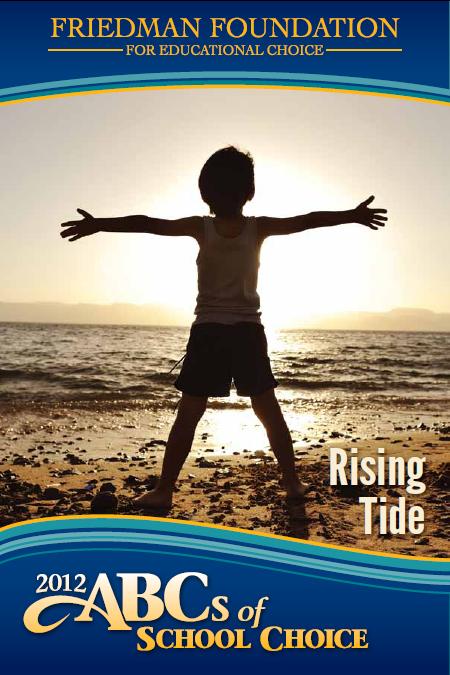
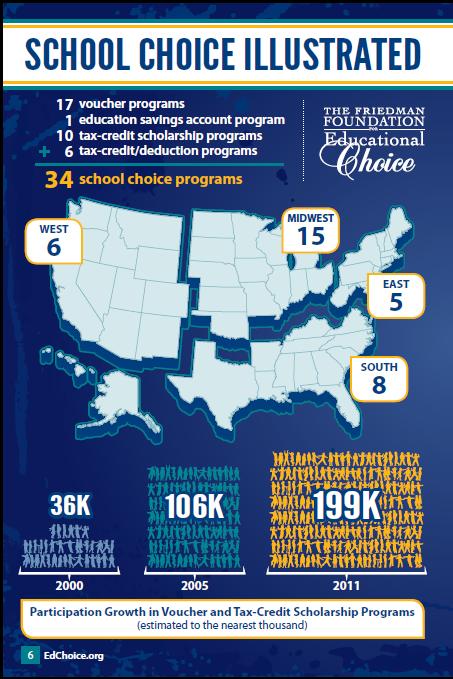
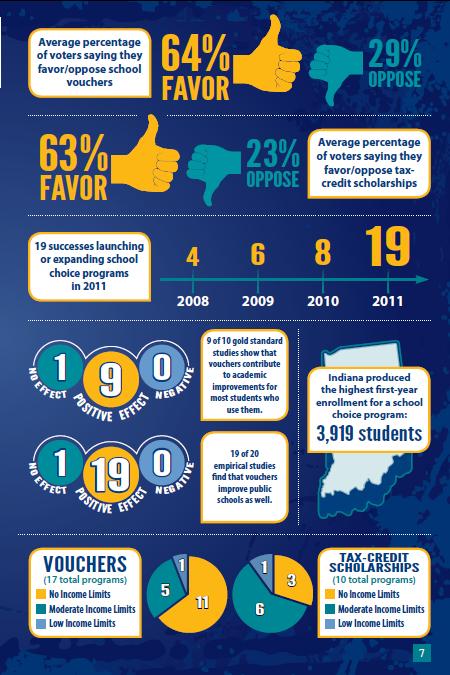
The Friedman Foundation has just released the 2012 edition of its annual publication ABCs of School Choice. It’s a busy week for releases!

There’s much to celebrate this year:

Milton and Rose D. Friedman envisioned a true revolution in American education. Their ideal was simple but powerful: give every parent the power and freedom to choose their children’s education. Unquestionably, 2011 was a breakthrough year in the quest to see that vision achieved in the United States. Thirteen states enacted school choice programs (this includes Washington, D.C., and Douglas County, Colorado). A total of 19 programs were enacted or improved—including the creation of eight new programs and the expansion of 11 existing ones.

Appropriately, this year’s report is subtitled Rising Tide. Check it out!

That’s a pretty big improvement over the plain text and little silhouettes of states it used to consist of when I edited it. Kudos!


Are Charter Schools Models of Reform for Traditional Public Schools?

January 24, 2012

Yes, answers Roland Fryer in an amazing study released this month.  Based on earlier work, he identified 5 features of charter schools that helped them produce strong results: “increased time, better human capital, more student-level differentiation, frequent use of data to inform instruction, and a culture of high expectations.”  Fryer then somehow convinced the superintendent and school board in Houston to pursue these five reforms in a serious way in 9 struggling traditional public schools.  (CORRECTION — the Houston folks report that they were eager to pursue some promising reforms and required no convincing.  They should be commended for that.)  Here, in brief, is what they did:

To increase time on task, the school day was lengthened one hour and the school year was lengthened ten days. This amounts to 21 percent more school than students in these schools obtained in the year pre-treatment and roughly the same as successful charter schools in New York City. In addition, students were strongly encouraged and even incentivized to attend classes on Saturday. In an effort to significantly alter the human capital in the nine schools, 100 percent of principals, 30 percent of other administrators, and 52 percent of teachers were removed and replaced with individuals who possessed the values and beliefs consistent with an achievement-driven mantra and, wherever possible, a demonstrated record of achievement. To enhance student-level differentiation, we supplied all sixth and ninth graders with a math tutor in a two-on-one setting and provided an extra dose of reading or math instruction to students in other grades who had previously performed below grade level. This model was adapted from the MATCH school in Boston – a charter school that largely adheres to the methods described in Dobbie and Fryer (2011b). In order to help teachers use interim data on student performance to guide and inform instructional practice, we required schools to administer interim assessments every three to four weeks and provided schools with three cumulative benchmarks assessments, as well as assistance in analyzing and presenting student performance on these assessments. Finally, to instill a culture of high expectations and college access for all students, we started by setting clear expectations for school leadership. Schools were provided with a rubric for the school and classroom environment and were expected to implement school-parent-student contracts. Specific student performance goals were set for each school and the principal was held accountable for these goals.

And the result:

In the grade/subject areas in which we implemented all five policies described in Dobbie and Fryer (2011b) – sixth and ninth grade math – the increase in student achievement is dramatic. Relative to students who attended comparison schools, sixth grade math scores increased 0.484σ (.097) in one year. In seventh and eighth grades, the treatment effect in math is 0.125σ (.065) and is statistically significant. A very similar pattern emerges in high school math: large effects in ninth grade and a more modest but statistically significant effect in tenth and eleventh grade, which suggest that two-on-one tutoring is particularly effective. The results in reading exhibit a different pattern. If anything, the reading scores demonstrate a slight decrease in middle school, though not statistically significant, and a modest increase in high school. Impacts on attendance – which are positive and statistically insignificant – are difficult to interpret given the longer school day and longer school year.

Strikingly, both the magnitude of the increase in math and the muted effect for reading are consistent with the results of successful charter schools. Taking the treatment effects at face value, treatment schools in Houston would rank third out of twelve in math and fifth out of twelve in reading among charter schools in NYC with statistically significant positive results in the sample analyzed in Dobbie and Fryer (2011b).

Using data from the National Student Clearinghouse, we investigate treatment effects on two college outcomes: whether a student enrolled in any college (extensive margin) and whether they chose a four-year college, conditional on enrolling in any college (intensive margin). Calculated at the mean, students are 6.2 percentage points less likely to attend college, though the effect is not statistically significant. Conditional on attending college, however, treatment students are 17.7 percentage points more likely to enroll in a four-year institution, relative to a mean of 46% in comparison schools – a 40% increase.

Traditional public schools can get results like a KIPP school without having to actually become KIPP schools.  They just have to imitate a few of the key features employed by KIPP and other successful charter schools.  This is incredibly encouraging news.  It means that traditional public schools are really capable of making significant progress if only they become more open to learning from successful charter schools.  They can make that progress without having to cure poverty and all other social ills (although I’m sure that would be nice too).

Of course, there are serious concerns about bringing these reforms to scale, which Fryer considers in his conclusion.  He dismisses union opposition as a serious obstacle based on the fact that the unionized school system in Denver is pursuing a similar reform strategy.  I’m not so easily convinced that unions nationwide will jump aboard a plan that involves huge turnover in staffing and significantly more hours and days per year.  Cost is another barrier to bringing this reform strategy to scale, but he notes that the marginal cost is only $1,837 per student and the rate of return on that investment would be roughly 20%.

But the most serious concerns seem to be fidelity to implementation and shortages of quality labor.  We could all be heart surgeons if we just did what heart surgeons do.  But there are only so many people capable of doing that work and not every office building can be re-organized as a hospital.  Then again, successful teaching isn’t exactly heart surgery (although it can be just about as important), so perhaps there is real hope of bringing this to scale.  We won’t know until we try it in more places with more schools.


ALEC Releases New Report Card on American Education

January 23, 2012

(Guest Post by Matthew Ladner)

The American Legislative Exchange Council has released the 17th edition of the Report Card on American Education: Ranking State K-12 Performance, Progress and Reform. This edition has a forward by Indiana Governor Mitch Daniels and was coauthored by yours truly and Dan Lips.

Dan and I have updated the rankings of state academic performance based upon general education low-income students to reflect the 2011 NAEP and the rankings of state policy based upon the latest available rankings available.

Dan and I build the case that the historic changes seen in K-12 reform in 2011 represent “the end of the beginning” in the battle for K-12 Reform. Far, far, far more remains to be done than has been done of course, but from tenure reform to parental choice, reformers began to hold their own in 2011 for the first time on a widespread basis.

Chapter 2 is a formalized thought experiment on state academic achievement. Loyal Jayblog readers will recognize it from prototype arguments that were tested here in the blogosphere proving grounds. Chapter 3 provides a detailed ranking of state learning gains by student subgroups on the combined NAEP exams.

The book features state pages providing a wealth of information on each state, like this:


Finally, the fourth chapter discusses trends in technology based learning. You can download your copy for free here. If you would like a paper copy, email me and I’ll see what I can do.


Oh No…There Goes Tokyo…

January 21, 2012

(Guest Post by Matthew Ladner)

So my children have acquired a taste for cheesy pop culture. It’s in their DNA. Last summer my son Benjamin watched the epic battle between Captain Kirk and the Gorn from the original Star Trek series and pronounced it as “Kirk versus the Halloween Costume.”

Last week I allowed them to watch a couple of Godzilla flicks, which led to the reactment on the piano bench you see above.

Go, Go Godzilla!!


A Green Revolution for K-12 Education

January 20, 2012

 (Guest Post by Matthew Ladner)

The remarkably successful effort to introduce improved agricultural technologies into developing world agriculture stands as one of the most underrated technological and philanthropic achievements. India is now a major rice exporter, and the average calories consumed per person in the developing world has increased by 25 percent. If you were hoping that I was referencing an effort to put solar panels on schools, go ahead and stop reading now.

The Green Revolution in the developing world extended a similar pattern established in the Industrial Revolution in substituting technology for labor. Producers making continually improving products at steadily falling prices drives material improvement improving quality of life and reducing poverty.

Substituting technology for labor causes serious social disruption. China’s decades long mass migration of subsistence farm workers into the coastal urban centers for instance holds broad similarities to share croppers moving to industrial areas of the United States decades ago.

We humans have a perfectly understandable desire for stability, and we are easily made victim to nostalgia. Think for instance of Willie Nelson’s “Farm Aid” project aimed at protecting the family farm. The sad fact of course is that many family farms had been made obsolete and were no longer economically viable despite considerable government support. Many cling to the reactionary notion that the world was a better place back during some happy golden age, but certainly from a material standpoint this is just silly. Would anyone in their right mind wish for a world in which Bill Gates and Steve Jobs (and you) would have died at the age of 30 as a subsistence farmer? Why not yearn for the days of living in a cave? China doesn’t need as many people to produce far more food. Rather than bewailing the closing of the coal mine like U2 or Sting, these people have moved into other activities to make a much better life for themselves.

Education which has remained exempt from the productivity improvements experienced by most other human activities. Higher education costs have been racing ahead of even health care inflation for decades, and yet we lack even a drop of evidence to suggest that the average college student of today is meaningfully better educated than his or her peers from 1980. Likewise, after the emergence of education unions as major political powers in the 1960s, American K-12 schools have suffered from an efficiency implosion, with average achievement scores rising at a profoundly slower rate than the inflation adjusted spending per pupil.

Philanthropists played a leading role in bringing the Green Revolution to the developing world- a fantastic and frankly underappreciated success. The focus of philanthropists in American education should likewise be in researching models that can successfully substitute technology for labor in order to produce a better service for a lower cost. They should invest not just in developing the products, but also in the means to bring them to scale through things such as charter school, voucher and digital learning statutes. They should as Jay put it attempt to build new rather than to reform old.

Charter schools have become the skunk works for new school models- taking the lead in both digital and blended learning models. These experiments are very young, and will experience a number of failures. Encouraging and expanding this primordial soup of innovation, however, is of the utmost importance. My only disappointment at this point is that we don’t see more attempts at innovation in the private school sector like Christo Rey. If someone can develop a high quality, low-cost private school model which can survive and thrive outside of public subsidy, the battle for education reform will be much closer to finished.

The  ability to substitute technology for labor in education may have opened the door to such a possibility. We are in only the earliest stages of such experiments, and they are happening with considerable public subsidy, but if India can go from famine in 1961 to a major agricultural exporter today, anything is possible. Clayton Christensen warned that organizations cannot disrupt themselves, often even when they recognize a dire need to do so, so new entrants will likely be necessary.


School Choice on Learning Matters TV

January 19, 2012

(Guest post by Greg Forster)

And now, for a change of pace, JPGB is proud to present a post that doesn’t need to be shipped in a plain brown wrapper.

Learning Matters TV just posted an online forum on school choice, building on a segment they did for PBS NewsHour back in November. Eight experts got to lay down 300 words each on school choice. Your humble servant makes an appearance, as well as perennial school choice faves Andrew and Clint, plus Jay’s U.Ark. colleague Mike McShane.

I feel cleaner already.

Our new sponsor!

NCLB Blamed for Ruining Teen Oral Sex

January 18, 2012

HT to Sara Mead for finding this incredible piece of research.  It is written in a language other than English, but if I remember how to translate properly stupid BS, this study appears to be claiming that an emphasis on individual academic achievement in school “crowds out” “the pleasure, choice, and mutuality” of teen fellatio and replaces it with an emphasis on “competence and skill usually associated with achievement and schooling.”  They know this from interviews with 98 girls between the ages of 12 and 17.

Here’s the abstract:

Young women’s narratives of their sexual experiences occur amid conflicting cultural discourses
of risk, abstinence, and moral panic. Yet young women, as social actors, find ways to make meaning of their
experiences through narrative. In this study, we focused on adolescent girls’ (N=98, age 12–17 years) narratives of their first experiences with oral sex. We document our unexpected findings of persistent discourses of performance which echo newly emergent academic achievement discourses. Burns and Torre (Feminism & Psychology 15 (1):21–26, 2005) argue that an extreme and high stakes focus on individual academic achievement in schools impoverishes young minds through the “hollowing” of their sexualities. We present evidence that such influence also works in the opposite direction, with an achievement orientation invading girls’ discourses of sexuality, “crowding out” possible narratives of pleasure, choice, and mutuality with narratives of competence and skill usually associated with achievement and schooling. We conclude with policy implications for the future development of “positive” sexuality narratives.

UPDATE — This is the abstract of the article, “‘It’s Like Doing Homework’  Academic Achievement Discourse in Adolescent Girls’ Fellatio Narratives” published in the journal Sexuality Research and Social Policy by professors from CUNY and University of Virginia.


SNL Parodies Progressive Ed

January 18, 2012

For a higher quality version that I cannot embed, click here.


Tennessee Teachers Ignore 20 years of Tennessee K-12 Research to Demand Status-Quo

January 17, 2012

 (Guest Post by Matthew Ladner)

This would be funny if it weren’t sad.