(Guest Post by Matthew Ladner)
Some colorful language here….not sure about the numbers discussed….ummm….if anyone can find serious fault with the logic, let me know in the comment section. I’m struggling:
(Guest Post by Matthew Ladner)
Some colorful language here….not sure about the numbers discussed….ummm….if anyone can find serious fault with the logic, let me know in the comment section. I’m struggling:
 6 Comments |
  Uncategorized | Tagged: Penn Jillette, Penn Jillette drug policy rant |
  Permalink
 Posted by matthewladner
(Guest Post by Lindsey Burke)
In the most recent administration of the Florida Comprehensive Assessment Test (FCAT) – the state’s criterion-referenced assessment of student achievement – Florida students were asked to pay a little more attention to punctuation, grammar, and spelling in order to get a passing grade on the writing assessment. FCAT cut scores were to reflect that, with proficiency status awarded to those students who could meet the requirements of the new grammar-sensitive assessment.
This rather trivial change has set off a firestorm in the Sunshine State, which just released this year’s FCAT scores, graded under the more rigorous standards.
In 2011, a whopping 81 percent of Florida’s fourth graders scored a 4 or better on the writing portion of the FCAT. Just 27 percent of the youngsters scored proficient under the more rigorous standards this year. Eighth and tenth graders saw similar declines.
The dramatic drop prodded the state board of education to revise the cut scores downward, temporarily dropping the passing mark from 4 to 3 (out of a possible 6 points).
Over the past decade, Florida has made dramatic gains in academic achievement. Florida skyrocketed from 5th worst in reading performance on the NAEP in 1998 to 8th best by 2007, significantly increased the number of students who take and pass AP exams, and began to narrow the achievement gap between white and minority students (Black and Hispanic students in Florida had twice the reading gains of the national average from 1998 to 2009). But evidence suggests that progress the Sunshine State had begun to taper out, with students plateauing on recent assessments.
Keen to ensure student achievement continued apace, Florida proactively raised the rigor of the FCAT – something they’ve done every other year or so since Gov. Jeb Bush’s A-PLUS plan was implemented. According to Commissioner Gerard Robinson, the board of education “asked scorers to grade essays more strictly, with an eye to punctuation, grammar and the quality of word choice and relevance.”
As Florida reels under the draconian requirements of – gasp! – punctuation awareness in a writing assessment, there’s a lesson to be learned for federal and state policymakers eager to adopt national standards and tests.
The backlash against Florida’s efforts to improve the rigor of the FCAT begs the question: what is the correct level of rigor for the 46 states that have adopted Common Core national standards that will not elicit similar reactions? We have yet to learn where the Common Core central planners will set their cut scores, or how they plan to go about setting passing marks on which both Alabama and Massachusetts will agree.
It is a cautionary tale for national standards proponents. Much of Florida’s success over the past decade can be attributed to the state continuously improving its standards and tests. With rigid national standards in place, that flexibility would be lost. And if mistakes are made in the standards, they’re here to stay.
Florida will likely succeed, as it has over the past few years, at striking the right balance on the FCAT. But being able to define what Florida students should know and be able to do, and crafting standards and tests to reflect that, will be lost if the state goes through with Common Core adoption.
Florida strengthened state tests to make sure kids could spell, apply punctuation, and grasp other grammar concepts. These are nuances the state will no longer be able to enjoy come 2014, when national standards and tests are to be fully implemented. The Sunshine State wants to continue its march to the top of the NAEP, and has been working to strengthen standards to achieve that goal. But that ability will soon be lost, which is the ultimate lesson that should be gleaned from the FCAT controversy.
(edited to fix a typo)
10 Comments | National Standards, school accountability | Permalink
Posted by Jay P. Greene
 (GuestPost by Matthew Ladner)
The New York Times published an overtly hostile front page story on tuition tax credits yesterday. Others will doubtlessly pick apart the story in terms of accuracy and there are a number of obvious distortions that I spotted in a single casual reading. It’s lazy journalism to quote a school choice opponent as suspecting malfeasance, for instance, when that same person could turn such an organization in to state authorities to face an organization death sentence. If that is of course if such person had any evidence rather than mere idle speculation.
But I digress. I find myself largely in agreement with John Kirtley’s reaction– which is to say that design features in a tax credit program are very important. I however wish to be a bit more direct than John. If school choice supporters don’t pay close attention to design features, especially regarding financial accountability and academic transparency, they leave enough dots lying around for someone to draw the following picture:
Whether this picture is “fair” or not (it certainly isn’t) is beside the point. The point is that parental choice supporters ought not to leave themselves open to such attack.
Caesar’s wife must be above suspicion.
Leave a Comment » | Uncategorized | Tagged: John Kirtley, New York Times private school tax credits, tuition tax credits | Permalink
Posted by matthewladner
Another video from ChoiceMedia.TV:
3 Comments | Uncategorized | Permalink
Posted by Jay P. Greene
I recently saw the Israeli film, Footnote, which was nominated for best foreign film in last year’s Oscars. It reminded me of a movie from the 90s that I thoroughly enjoyed, called Big Night. In both films we encounter a character who is committed to the truth of his craft.
In Footnote we meet the elder Prof. Eliezer Shkolnik, a philoligist whose painstaking, scholarly analysis of words in the Talmud led him to discover that the current version of the Talmud differs from the one that was in common use centuries ago. Before he can publish his findings, he is scooped by a competing scholar who stumbles upon an ancient copy of the Talmud in an archive, thus proving the same point without the careful scholarship. Eclipsed by this chance discovery, Prof. Eliezer Shkolnik, toils away in obscurity, bitter that his dedication to his craft remains unrecognized while flashy, lucky, and shallow scholars earn the laurels he believes he should be receiving.
One of those flashy, lucky, shallow scholars is Prof. Eliezer Shkolnik’s son, Prof. Uriel Shkolnik, who writes popular books about the Talmud and is a celebrity on TV and the lecture circuit (only in Israel could a Talmudic scholar be a celebrity, but think of him as an Israeli version of Malcolm Gladwell). The simmering animosity and resentment between the elder and younger Prof. Shkolnik boils into a crisis when the father accidentally receives a prestigious award that was meant to be given to the son. The father falsely believes that he has finally been recognized for his commitment to the truth of his craft and the son, who lacks his father’s zealous pursuit of the truth, would rather engineer a falsehood to save his father’s honor than take the prize himself.
Besides the painfully (and hilariously) accurate depiction of the pettiness and self-importance of much of academia, the movie raises difficult questions about how important the pursuit of truth really is. Is it more important than family, harmony, or love?
The movie Big Night raised very similar questions. Two brothers, Primo and Secondo, own an Italian restaurant that is completely committed to the truth of their craft. The only problem is that they have no customers. People don’t seem to appreciate the truth. Watch this perfect scene in which a rare customer wants a side of pasta with her risotto to see the tension between giving the customer what she wants and remaining committed to the truth of their craft:
Meanwhile a competing Italian restaurant owner, Pascal, violates every truth of Italian cuisine but his restaurant is packed with customers. He’s flashy and crude, but the customers seem to love it. Pascal offers to help Primo and Secondo by bringing a celebrity to their restaurant for a Big Night, which he promises will put their place on the map. The brothers pour every cent they have and all of their craft into the Big Night, but when the celebrity doesn’t show they are ruined. Their hopes are raised and they throw the best party with the best Italian food, hoping to remain true to their craftwhile also succeeding, but then they are left with nothing — or nothing except the truth of their craft and the love of each other. This is the morning after their Big Night. (It’s long and without dialogue, but watch the whole thing since it’s incredibly powerful and touching, at least it was after seeing the whole movie):
After watching Big Night I was persuaded that remaining true to one’s craft was of primary importance. Remaining true may cost us dearly, but it is all that we have. After watching Footnote I’m not so sure about this anymore. Truth at the expense of all else can be incredibly destructive. In Big Night they kept both truth and love. In Footnote truth comes at the expense of love. Maybe it is love that is of greater importance. Or maybe the singular pursuit of any virtue is dangerous. We need truth and love, but neither completely.
2 Comments | Pass the Popcorn | Tagged: Big Night, Footnote | Permalink
Posted by Jay P. Greene

(Guest Post by Matthew Ladner)
The RedefinED team asked me to write a response to my friends Howard Fuller and Andrew Coulson regarding the means-tested vs. universal choice debate. Andrew and Howard, for different reasons, support a means-tested approach but I lay out my case as to why I think choice must be universal in scope and how we should approach equity and third-party payer concerns.
The issues raised by Howard and Andrew ultimately beg the question: just where is it that we are going with the parental choice movement? Success in passing some broad programs simply increases the stakes for being thoughtful about the details.
9 Comments | Uncategorized | Tagged: Andrew Coulson, Howard Fuller, Matthew Ladner, RedefinED blog, universal school choice | Permalink
Posted by matthewladner

(Guest Post by Matthew Ladner)
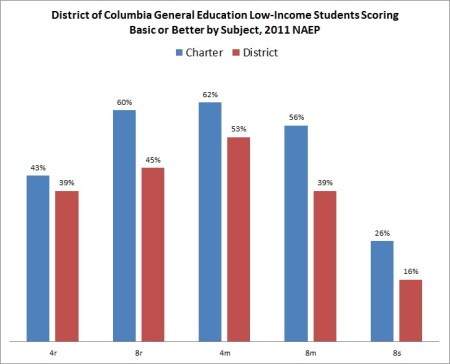 DC’s NAEP numbers allowed for some additional controls to be introduced when comparing charter and district schools than I was able to do with the Milwaukee comparison. The following chart shows the percentage of general education program students who qualify for a free or reduced lunch scoring “Basic or Better” on the 2011 NAEP exams. Special education students, ELL students and middle/high income students are not included in order to get a quick closer to apples to apples comparison.
Now of course for a real apples to apples you need a random assignment study, but those have been done and find results favorable to charter schools. This chart doesn’t address the topic of valid stastical significance, but rather whether the differences are meaningful.
Considering that charters get far less money that DCPS per pupil and show higher levels of academic achievement, this looks to be a success, albeit both the blue and the red columns leave much to be desired. The red columns leave much more to desired however, especially when you consider that that they are wallowing in money.
3 Comments | charter schools | Tagged: charter schools, DCPS, DCPS charter schools, NAEP | Permalink
Posted by matthewladner

(Guest Post by Matthew Ladner)
Arizona Governor Jan Brewer signed the expansion of the Education Savings Account program. The first year program provides students with 90% of the funds that would have gone to their public school into an account with multiple possible uses-including private school tuition, private tutoring, online program and saving for future college/university expenses, among other options.
The bill signed today expands eligibility to children attending D and F rated schools and school districts, the dependents of active duty military personnel and children that have been through the foster care system. The law also moves to a system of formula funding, making it one of the largest private choice laws in the nation with funded eligibility, behind only the new Indiana and Louisiana voucher laws on a percentage basis. The Arizona program now resembles an expanded combination of the Florida McKay and Opportunity Scholarship programs with the 21st Century twist of broadening the options of parents and requiring the consideration of opportunity costs (what you spend now cannot be saved for later).
I want to thank Rep. Debbie Lesko and Senator Rick Murphy for their steadfast and dedcated sponsorship of the bill and our in-state and national allies. Governor Brewer is building an impressive K-12 reform legacy that includes not only expanding parental choice, but also improving public school transparency, curbing social promotion and modernizing the teaching profession. In the not so distant future, we will be able to look at the trends in NAEP scores and identify Governor Brewer’s term and a half as a turning point for the better.

We have many miles to go in Arizona, but we are on our way!
8 Comments | Education Savings Accounts | Tagged: Governor Jan Brewer, Rep. Debbie Lesko, Senator Rick Murphy | Permalink
Posted by matthewladner
(Guest Post by Matthew Ladner)
Last year John Witte, Pat Wolf, Alicia Dean and Devin Carlson found evidence of significantly stronger academic gains for charter school students over district students in Milwaukee using the state data. This got me to wondering what the 2011 Trial Urban NAEP scores would look like between MPS and Milwaukee charter schools. Now, mind you that this chart doesn’t control for much, only comparing FRL eligible students in the charters and the districts. That’s okay with me, as Witte, Wolf, Dean and Carlson have admirably performed that task on three years of data with a promise of a fourth year in 2012 report. Also there is always at least a bit of sampling error with NAEP, yadda yadda ectera.
Do the NAEP tests tell the same broad story as the Witte et. al study? Judge for yourself:
 Those look like differences likely to survive the introduction of a whole bunch of control variables.
Leave a Comment » | Uncategorized | Tagged: Alicia Dean, Devin Carlson, John Witte, Patrick Wolf | Permalink
Posted by matthewladner
Enjoy
5 Comments | National Standards | Permalink
Posted by Jay P. Greene

 Jay P. Greene's Blog