We interrupt this Higgython to bring you an opportunity to enjoy making fun of nationalism for just $10. Isn’t spontaneous social coordination awesome?
I’ve spent the last two years designing a card game, Presidents versus Trump. It’s an action-packed, fun-filled, 30-minute game for 1-4 players. The American presidents, from George Washington to Barack Obama, are so offended by Trump sitting in their chair that they’ve all come back together to kick him out. But while the portal to the past was open, a rogue’s gallery of villains from American history, from Benedict Arnold to Bull Connor, have come back to defend Trump. The battle for the honor of the American presidency is on!
The game is designed and ready; check it out here. What it needs now is amazing art, like the sample cards from our artist that you see here. This game won’t be what it should be until we get this kind of art on all 130 cards. That’s where we need your support.
Head on over to Kickstarter now to check it out, click that button and support us today. Spread the word and let’s make this game happen together. Thanks for your support!
We now return you to your regularly scheduled Higgython.
A few years ago a friend of mine asked one of the Arizona Republic’s reporters why they were engaging in so much of what many former/potential Republic subscribers regard advocacy journalism. He reported to me that she shrugged her shoulders and said “it wins you awards.”
So it’s bad when newspapers go into full advocacy mode, worse still when folks at an Ivy League University can’t see through their tricks and hand them what perhaps used to be prestigious awards. Recently the Harvard Kennedy School gave the Arizona Republic, USA Today and the Center for Public Integrity an award for Copy, Paste, Legislate. The story made clever use of plagiarism detection software to selectively document the use of model bills by state lawmakers. The American Legislative Exchange Council (ALEC) serves as the bete noire in their story. “This fantastic reporting sheds light for the public and local media on the origins of legislation that gets passed in statehouses across the country” the above video proclaims from the judges of the Goldsmith Prize with what sounds like a string quartet playing somber music in the background.
Okay so what should the Harvard folks have been able to see through with this story? Well, not long after the publication of the piece Harvard Kennedy School graduate Pat Wolf noted on twitter:
@USATODAY spreads the deception that copycat legislation is an epidemic. Source of the problem is that @azcentral hid the fact that 99% of the bills they examined were NOT copycats. 1% is a rounding error, not a crisis.
That’s just the beginning of the problems with this story- but it’s a big problem. A few others: Trent England from the Oklahoma Council of Public Affairs helpfully noted that model legislation has been around since 1892, and all kinds of groups create model bills. The story authors airbrushed the largest center-left source of model legislation (the National Council of State Legislatures) out of their analysis, comparing the right of center ALEC to a couple of very young and very small progressive model bill groups. TA-DA! Most of the model bills become right wing! If you are keeping score at home, so long as you are willing to ignore the 99% of bills that don’t come from models and also a large majority of groups who do model legislation, this looks scary to a left of center reader.
Unless…unless you pause to think for a moment and realize that model bills go through exactly the same legislative process that any other bill goes through. Either it passes through committees and chambers and receives the assent of the governor, or it doesn’t. Since anyone and everyone can and often do write model bills and they go through the normal democratic process so:
There are other problems, including factual errors which remain uncorrected, which you can read about here. I’ve simply had to accept that much of journalism has gone down the road of overt advocacy. It’s unfortunate, but as the Arizona Republic’s readership has continued to decline they seem to be attempting to play to the predispositions of their remaining subscriber base. It doesn’t seem to be working as a sustainability strategy: Arizona’s population continues to grow, the Republic’s subscriber base continues to shrink and the handwriting is on the wall. As a long time Republic subscriber who admires the work of multiple people at the paper, this is very sad. It feels more than a bit like watching Nick Cage drink himself to death in Leaving Las Vegas.
Which brings us back to the Higgy. “Don’t hate the player, hate the game,” the expression goes. I guess I can’t be too upset with USA Today and the Arizona Republic if they fall prey to the temptation to engage in sensationalism when they get rewarded for it. It would not have been past the analytical powers of a mildly skeptical Harvard sophomore to have spotted the flaws in this reporting, given a study of pluralism and policy diffusion. You know-the kind of things you ought to study at the Harvard Kennedy School as a sophomore. Figuring this out alas seems well beyond the power of the Harvard Kennedy School’s Shorenstein Center on Media, Politics and Public Policy and their judges. I don’t know a thing about Nancy Gibbs other than what is in the above youtube video, but if newspapers are going to go they should die as they once lived- as something reasonably close to a neutral community institutions. The newspapers have more than enough problems without grandees tempting them to do slanted work with prizes.
My nominee for this year’s Higgy follows on the same theme as Greg’s nominee. For China to be the BSDD that people are increasingly recognizing it to be, it requires the complicity and active assistance of PLDDs. Just as the Soviets needed accomplices like the Rosenbergs or Alger Hiss to supply them with information to fuel their global ambitions, China has recruited its own cadre of willing stooges. Exhibit A of these stooges is Charles Lieber, the recently indicted chair of the Chemistry Department at Harvard.
It wasn’t enough that Lieber was at the top of his field, serving as the head of the Chemistry Department at an Ivy League institution, holding an endowed professorship that likely paid him several hundred thousand dollars. He needed more. So he accepted an offer from the Chinese as part of their Thousand Talents Plan to be paid as a professor at a university in, of all places, Wuhan. According to the Wall Street Journal:
As part of the Thousand Talents program, Wuhan University of Technology gave Mr. Lieber more than $1.5 million to set up a research lab in China, according to the complaint.
The school also agreed to pay him a $50,000 monthly salary and offered about $150,000 in annual living expenses for “significant periods” from 2012 to 2017, it said.
In exchange, Mr. Lieber was required to work for WUT at least nine months a year by “declaring international cooperation projects, cultivating young teachers and Ph.D. students, organizing international conference[s], applying for patents and publishing articles in the name of” the Chinese school, the complaint said.
So what’s the problem with this? Well, Lieber’s work has also been supported by significant funding from various U.S. government agencies, including the Office of Naval Research, the Defense Advanced Research Projects Agency, the Air Force Office of Scientific Research, and the National Institutes of Health. Those agencies understandably require researchers to disclose foreign funding to avoid national security risks and conflicts of interests. Lieber is alleged to have failed to disclose his Chinese support to his US government funders as well as his primary employer, Harvard. When investigators asked him directly about this support, Lieber is accused of lying to them and concealing his Chinese funding, which would be a crime.
The Chinese motivation for the Thousand Talents program is fairly obvious. They are essentially engaging in national security and industrial espionage by paying US researchers a fraction of what the US government pays them to share insights derived from that US funded research. In addition, if American researchers conceal their foreign pay, the Chinese are collecting kompromat that could be used later if they want leverage over US researchers to perform other illicit tasks for them. Lastly, the Chinese are buying powerful and influential friends in high status positions who might be able to advance Chinese talking points and propaganda.
More puzzling is what Lieber’s motivation would be for doing this. An adjunct appointment at Wuhan University of Technology could hardly enhance the professional status of the head of Harvard’s Chemistry Department. Of course, Lieber might be attracted by the millions he could make from the Chinese, but that is probably not sufficient given how many opportunities someone like Lieber has to make money from American universities and companies. In addition to the money, Lieber and previous cohorts of willing stooges have often been motivated by the PLDD belief that sharing information with foreign powers is actually helping the world. They can tell themselves that the Chinese and US should be friends and that friendship is not helped by keeping secrets from each other. They can say that they are helping the world by advancing science through the sharing of knowledge.
Some other researchers and media outlets have repeated these rationalizations. For example the NPR coverage of Lieber’s indictment notes:
These kinds of cases are not always straightforward, especially when fundamental research is involved. In spring 2015, Xi Xiaoxing, a physicist at Temple University in Philadelphia, was arrested and accused of sharing sensitive technology with his collaborators in China.
It later emerged that he never did. What’s more, he says, everything he did share was already public, because the findings of basic research aren’t secret. They’re published in scientific journals.
“Academic espionage is a contradiction,” Xi says. “There’s nothing to steal, you can just sit there and read your paper.”
Before you get too moved by these defenses, you should remember that Lieber was paid to a large extent IN CASH. As the Wall Street Journal reports: “his contact at Wuhan discussed how Mr. Lieber would be paid, with some of the funds from Wuhan to be deposited for him in a Chinese bank account and some provided in cash. ‘Our university has put your salary in your…[bank] card and we will help you change the cash for you when you come to Wuhan,’ the Wuhan contact wrote in one January 2017 message.”
Famous scientists tend not to be paid in cash and with foreign bank cards for their research when that work is above board. And they tend not to lie to their employer and federal investigators when that work is clean. Lieber must have known that what he was doing was dirty. Self-delusion is not that strong. And the Chinese were not paying famous scientists in cash because of their love of science. They knew what they were buying.
When the plague under which we currently suffer is lifted, I expect that we will find ourselves in a new Cold War with China. And Lieber will likely be remembered as one of the early traitors to his country in that struggle. No PLDD delusions of sharing knowledge to promote mutual understanding, peace, and science will rescue him. For that, Charles Lieber is worthy of The Higgy.
For this year’s Higgy, in the spirit of previous Higgy winner Pascal Monnet and Al winner Pete DeComo, I had been planning to nominate the culprits in this story. It was initially reported that volunteers were being sued by a medical device manufacturer because, to keep breathers at a hospital in Italy working (and thus patients alive) under emergency conditions where there were no other options, they used $1 of materials to 3-D print replacements for valves that normally cost $11,000. But the story fell apart when the reporters followed up.
I was glad that it turned out the company had not in fact sued, or even threatened to sue, the volunteers. But I’ll admit I was also a little disappointed. I wondered whether I could possibly find another Higgy nomination as good as that one would have been.
I needn’t have worried!
Radio Television Hong Kong Reporter Yvonne Tong: Will the WHO reconsider Taiwan’s membership?
WHO Useful Idiot of Durantyesque Proportions Bruce Aylward: [Excruciatingly long embarrassed silence]
Tong: [Waits patiently]
Aylward: I’m sorry, I couldn’t hear your question, Yvonne.
Tong: Okay, let me repeat the question.
Aylward: No, that’s okay, let’s move to another one then.
Tong: I’m actually curious in talking about Taiwan as well, on Taiwan’s case…
Aylward: [Leans forward and looks down at his keyboard, as if searching for the Escape key]
[Screen freezes, signal disconnects]
[Tong calls him back]
Tong: I just want to see if you can comment a bit on how Taiwan has done so far in terms of containing the virus.
Aylward: Well, we’ve already talked about China. And you know, when you look across all the different areas of China, they’ve actually all done quite a good job. So with that, I’d like to thank you very much for inviting us to participate, and good luck as you go forward with the battle in Hong Kong.
Here’s the original source, but thanks to the magic of YouTube, you can watch the whole thing in all its majestic glory right here, without even leaving the comfort of your own JPGB. And really, you must watch it to appreciate it in full:
Now, don’t cry “BSDD!” until you hear the punchline.
Punchline? You mean this story gets better? You bet your Escape key it gets better. In fact, the more you know about this story, the better it gets.
For instance: Five days before he became a global laughingstock, Aylward gave an interview to Time in which he said we need to look not only at “places that are recently getting infected [and] places that aren’t infected” but especially at “the places where it all started.” He then immediately mentioned “Europe, North America, the Middle East.”
For instance: The day after he became a global laughingstock, Aylward was still telling Canadian television that China was one of the few countries that had contained the virus. Why learn lessons from your experience when you can just keep charging mule-headedly forward along the same path? What would become of the grand project of a centrally planned society, which is our only hope of salvation, if we learned lessons from experience? (What’s the definition of insanity, again?)
For instance: On March 4, the New York Times ran an interview in which Aylward not only praised the Beijing regime’s handling of the crisis, but said that the number of cases had already peaked in China. The number of people asking for tests daily declined from 46,000 to 13,000. “Hospitals had empty beds.” On March 4.
The Times managed to rouse itself to ask, of the supposedly stellar job the Beijing regime was doing, “isn’t it possible only because China is an autocracy?” Which shows a lot of credulity in accepting the claims about the regime’s performance at face value, as well as an unconscious admiration for autocratic regimes. Thankfully, Aylward was on hand to assure the Times that the Beijing government is not “some evil fire-breathing regime that eats babies.”
The reference to eating babies is especially rich. And in case you wondered, yes, there is a connection between the millions of murdered babies in China’s past and the two million Uighurs awaiting execution in concentration camps in its present. The connection is this.
Headline of Aylward’s Times interview: “Inside China’s All-Out War on the Coronavirus.”
Appropos of absolutely nothing, I will choose this moment to note that the Times’ statement on Walter Duranty admits frankly that his reporting was a pack of lies designed to whitewash communist mass murder, but it does not contain an apology. The Times also primly notes that the Pulitzer committee has repeatedly declined to withdraw the award, and links prominently to the Pulitzer committee’s statement – which, with titanically inhuman irony, actually absolves Duranty of lying. I can’t decide which is worse.
So at this point you’re all yelling “BSDD!” Right?
For one thing, Aylward’s not making policy. He only has “arrogant delusions of shaping the world.”
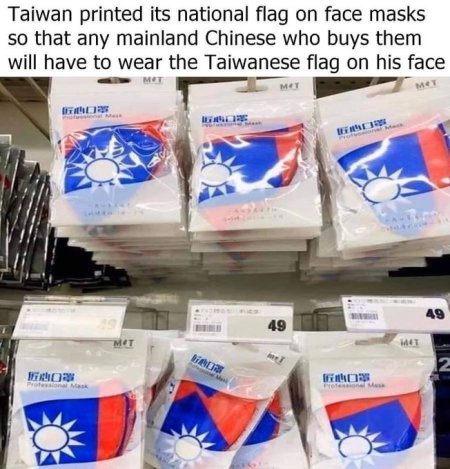
For another, it hardly counts as BSDD to help keep Taiwan out of the WHO when Taiwan is actually far better off outside the WHO than in it! They have the spirit of freedom we had when we were a young nation, and seem to be doing just fine without the WHO’s help. They’re actually printing their flag on the masks they produce, so anyone (say, on the mainland) who buys them will have to walk around wearing the Taiwanese flag.
Taiwan is the Tom Doniphon of Asia; the oppressor has more men, and has more guns, and has subverted the legal authorities, and Taiwan just does not give a rat’s ass – not about the oppressor’s bullying swagger, and not about hoity-toity, pointy-headed “civilized” people who talk about peace and justice but disappear when the oppressor walks into the room.
And we’re better off with Taiwan out of the WHO, too. On January 14, WHO parroted Beijing’s claim that there had been no human transmission of the virus, but Taiwan was openly telling the world otherwise as early as December 31. We’re the suckers, for listening to the WHO instead of Taiwan.
But that’s not the best part.
Punchline: Just hours after the exchange with Tong was posted, his employers at the WHO panicked and deleted Aylward from their website.
Bruce who? Bruce WHO? We’re the WHO, and we’ve never heard of him!
You’ll be reassured to know that Aylward is back on the WHO website, and the WHO has issued a statement responding to Tong’s questions. Determining how much credibility the WHO’s answers have is left to the reader as an exercise. But I do believe we can trust the message that they’re sending loud and clear when they decline to say whether Aylward hung up on Tong.
The bloodthirsty tyrants of Beijing are BSDD. The WHO, which has submitted to the control of the Beijing regime and spreads its lies, is BSDD.
But this moron freaks out and melts down the moment he’s asked a question he should obviously have been prepared for – he was one of the WHO’s point people for media on China and Coronavirus, and he gave an interview to a Hong Kong journalist, and he wasn’t prepared for this? – and he ends up scrubbed from his employer’s website. That’s PLDD if anything ever was.
It’s that foolish time of year again! And we’ve had a bumper crop of bad behavior in just the past couple months, so I can’t think of a better moment to launch the 2020 season of the William Higinbotham Inhumanitarian of the Year Award! There hasn’t been this big and competitive a field in years.
There are plenty of good options, so don’t be shy. Remember that The Higgy has a shorter season than The Al, launching on April Fool’s and closing on Tax Day, so you only have two weeks. With so many fools to choose from, you’ll want to get your nomination in early before someone else takes it!
Remember, although we are now living through a festival of foolish behavior, your nominations are not limited to recent or Coronavirus-related instances of idiocy. Feel free to let your fancy flow far and wide when fetching feasible fools to nominate for this distinguished award.
And please do remember that we are looking for PLDD, not BSDD. (Here is your field spotter’s guide to knowing the difference.) So kindly shelve your nominations for the bloodthirsty communist dictators who ordered doctors to stop testing and destroy their lab samples, announced that human transmission of the virus was impossible when in fact they knew it was already happening, murdered a series of people who tried to tell the world the truth, quietly stocked up on vital medical supplies while telling the world there was no threat, used their iron control of the WHO to reinforce their deadly lies, and sold defective tests and masks to nation after nation after nation.
(If you’re behind on all this, start here. Unless you think “it couldn’t happen here,” in which case start here. Or if you think it’s not worth clicking the links because even communists can’t possibly be that evil, start here.)
To guide your selection process, I’ll carry on immemorial Higgy tradition and reproduce the text of Jay’s original post launching the Higgy award.
Get your nominations in by Tax Day, and happy hunting!
********************
As someone who was recognized in 2006 as Time Magazine’s Man of the Year, I know a lot about the importance of awards highlighting people of significant accomplishment. Here on JPGB we have the Al Copeland Humanitarian Award, but I’ve noticed that “The Al” only recognizes people of positive accomplishment. As Time Magazine has understood in naming Adolf Hitler, Joseph Stalin, and Ayatullah Khomeini as Persons of the Year, accomplishments can be negative as well as positive.
Where were we? Oh yes. It is important to recognize negative as well as positive accomplishment. So I introduce “The Higgy,” an award named after William Higinbotham, as the mirror award to our well-established “Al.”
Just as Al Copeland was not without serious flaws as a person, William Higinbotham was not without his virtues. Higinbotham did, after all develop the first video game. But Higinbotham dismissed the importance of that accomplishment and instead chose to be an arrogant jerk by claiming that his true accomplishment was in helping found the Federation of American Scientists and working for the nonproliferation of nuclear weapons. I highly doubt that the Federation or Higinbotham did a single thing that actually advanced nonproliferation, but they sure were smug about it…
I suspect that Al Copeland, by contrast, understood that he was a royal jerk. And he also understood that developing a chain of spicy chicken restaurants really does improve the human condition. Higinbotham’s failing was in mistaking self-righteous proclamations for actually making people’s lives better in a way that video games really do improve the human condition.
So, “The Higgy” will not identify the worst person in the world, just as “The Al” does not recognize the best. Instead, “The Higgy” will highlight individuals whose arrogant delusions of shaping the world to meet their own will outweigh the positive qualities they possess.
We will invite nominations for “The Higgy” in late March and will announce the winner, appropriately enough, on April 15. Thanks to Greg for his suggestions in developing “The Higgy.”
Ok so you need distraction from this global pandemic business, so I’ll share some stuff I’ve been up to at the Arizona Charter Schools Association. Pop quiz hot-shot! Based on the Stanford Opportunity Project data who has the higher quality education system-Arizona or Massachusetts? Sean F. Reardon linked state tests across the country and gave proficiency and growth scores for most of the public schools in the country. Each dot in the above chart is an individual public school.
On paper this is no contest- Massachusetts lead the nation in NAEP scores for many years, AZ has below average 4th grade scores and kind of average 8th grade NAEP scores. This is reflected on the horizontal axis- the vast majority of MA schools land on the right side of the zero line meaning they are above average grade level proficiency. Keep in mind however that proficiency is highly correlated with student demographics, and Massachusetts is a socio-economically advantaged state. Growth on the other hand is much less correlated with student demographics and Arizona students show more of it than any other state during this period (2008-2016). And by the way, you don’t need to squint to see blue in what Keith Jackson called “hallelujah-land” (Keith of course referred to the end zone, where as I am referencing the upper right quadrant- high growth and high proficiency) and that disappointing quadrant below it (high proficiency low growth) is looking pretty bright orange. Those two super high growth schools at the top of the chart are charter schools in South Phoenix and Nogales-Ruiz Leadership Academy and Mexicayotl Academy, respectively.
Massachusetts is the highest proficiency state and Arizona the highest growth state, so beauty is in the eye of the beholder.
Second pop quiz hot shot!
Which state does the best on a productivity basis? Here’s a hint:
I thought JPGBers following the saga of Higgy winner Kosoko Jackson might be interested to see my new post over on HT, on the latest controversy over an author’s book being cancelled.
He can even self-publish his book! Publish it under the label Woody Allen Is Totally Innocent and Also All the Teen Girls Love Him Books and Industrial Waste, Inc.!
“But wait,” I hear you cry, “aren’t you the same Greg Forster recently seen driving donuts in Kosoko Jackson’s front yard?”
Yes, so for the slower students, I shall hereby Break If Down (stand back):
For the record, yes, this does constitute an amendment to my earlier statement here on JPGB that “At bare minimum, if the publisher initially judged the book publishable, it should come out so we can all evaluate it based on what’s actually in it. Publishers aren’t obligated to publish anything and everything, but they do need to show some spine once they’ve made a judgement – especially given that they’ve actually read the book and the critics who are Angry Online almost never have.”
That statement neglected to include a caveat to the effect that in some cases, the initial publication decision was so foolish that it’s right to reverse it. I had in mind potentially hard cases, open to interpretation, where mob rule threatened to make informed judgment impossible – not colossal errors of prudence on the publisher’s part, where informed judgment unambiguously supports cancellation. Judging each case on the merits is the overall principle here.
Some researchers and journalists have become very excited about a new set of studies that claim to find a causal relationship between increasing school spending and improving student outcomes. These folks acknowledge that the vast majority of earlier research found no relationship between additional resources and stronger results, but that research was purely observational. Perhaps school systems with weaker outcomes tend to get a larger share of increased spending, creating the false impression that more money doesn’t help. That is, perhaps bad outcomes often cause more money, not the other way around.
There is a new wave of research that claims to find the causal relationship between school spending and student outcomes and those new results are much more positive. The problem is that the new research pretty clearly falls short of having strong causal research designs. Instead, the new research just seems to be substituting different non-causal methods with a different potential direction of bias for the old ones.
The new “causal” studies generally come in two types — regression discontinuity (RD) studies of bond referenda and instrumental variable (IV) analyses of court-ordered spending increases. While RD and IV designs can produce results that approximate a randomized experiment and can be thought of as causal, the RD and IV studies in this new literature generally fail to meet the requirements for those designs to effectively approximate randomized experiments. That is, the new “causal” research on school spending is not really causal.
To illustrate the problem with the use of RD to study bond referenda, let’s look at the study that was just published in the Journal of Public Economics (JPE), a very high-status journal. A working paper version of this study that is not behind a pay wall can also be found here. The idea of this RD, like others in the new school spending literature, is that bond referenda that barely pass and those that barely fail can be treated as approximating a randomized experiment. That is, there is a large element of luck in whether a bond barely passes or not, so by chance some schools get extra money and others do not. If those that get that extra money by luck produce better student outcomes over time than those that don’t get the extra money by chance, then we can say that money — and not other factors — caused the change in outcomes.
The JPE study, like most of the other RD studies in this new literature, falls short of approximating a randomized experiment in two ways. First, we can only view RD results as causal if the set of observations examined is sufficiently narrow that we can plausibly think that it is effectively chance whether the treatment is received or not. But the JPE study defines bond referenda as “near the threshold” for passing if they are withing 20 percentage points of the percent required for passage of the referendum. That is, if 50% is needed to pass a referendum, the JPE study would define the election as “near the threshold” if the bond received between 30% and 70% of the vote. This bandwidth is so wide that it includes almost two-thirds of all bond referenda in the states they examine. To call this “near the threshold” is misleading. And it is simply implausible to think of any outcome between receiving 30% and 70% of the vote as a matter of luck.
Second, we can only view RD results as causal if actors have no control over whether they fall on one side or another of the threshold. In the case of bond referenda that requirement is clearly violated. Districts choose whether and when to hold a referendum and they do so based on their estimated likelihood of prevailing. In addition, districts try to have a finger on the pulse of the campaign and can alter the effort by them and their allies to improve the chances of victory. In sum, whether districts win or lose referenda is partially a function of their political competence and resources, which are qualities that the researchers cannot observe or control and yet are likely to be associated with changes in student outcomes over time.
The IV studies in this new literature are no better at approximating randomized experiments. For IV research designs to produce causal results, they need to have an exogenous instrument — something that predicts whether schools get more money or not, but which is uncorrelated theoretically and empirically with later student outcomes. While the details vary across study, the general approach of the IV studies in this literature is to treat court-ordered spending increases as exogneous. That is, they have to believe that legislatively adopted spending increases, which past studies primarily relied upon, risk reverse causation, but court-ordered spending increases are fundamentally different. Court-ordered spending has to be thought of as manna from heaven, dropping on schools as if at random. At the very least we have to believe that court-ordered spending differs from the regularly legislative kind in that it has nothing to do with factors that contribute to improved student outcomes.
It is clear that court-ordered spending increases are not exogneous and are not fundamentally different from the regular legislative kind. Courts are political actors, just like legislatures, and whether and when the courts order spending increases is at least partially a function of a broader political conviction in a state that more resources are available and should be devoted to schools. That conviction is just as likely to be associated with future improvement in student outcomes if it is expressed by the courts as if it is expressed by the legislature.
Both RD and IV studies in this new literature attempt to justify that their efforts are causal with empirical claims about the similarity of treatment and control groups before spending is increased. But they can only compare on observable qualities, which is precisely the same thing that prior observational studies do. These studies need to be able to justify theoretically that their approaches approximate random assignment, but they cannot do so persuasively. Whether bond referenda pass or fail, especially by large margins, is not random. And whether and when courts order spending increases is also not random — at least no more or less so than when legislatures do it.
If these new RD and IV studies cannot persuasively argue that their approach approximates randomization, then their results are not more causal than the prior observational literature that showed no relationship between spending increases and improved student outcomes. The promoters of this new school spending research are right to note the flaws of earlier studies, but they are insufficiently aware of flaws in the new research as well.
Given the causal weakness of both literatures, we should probably take a step back and see if either better conforms with our non-rigorous observation of the world. As Rick Hanushek has noted, if the new research is right in its causal claims about more money improving outcomes, why have huge spending increases over decades not been associated with the kinds of improvements the “causal” research claims to find?
The U.S. Department of Education recently announced that it was investigating Harvard and Yale Universities for receiving at least $6.5 billion from foreign governments without properly disclosing and receiving approvals. This follows on the heels of several arrests of prestigious academics, including the chair of the chemistry department at Harvard, for receiving payments from foreign governments even as the U.S. government funded their research and prohibited these foreign ties. U.S. authorities are attempting to block efforts by China, Iran, Russia, and others to steal U.S. research secrets or otherwise obtain the benefits of U.S. funded research on the cheap.
It dawned on me that I hadn’t heard anything about the Chinese, Iranians, or Russians attempting to steal our education policy secrets. I checked with my sources (of whom I have none) deep within the U.S. Department of Education (DOE) to find out why investigations were being announced involving chemistry and computer science, but not education policy research. The highly classified plot I discovered was that DOE was declining to investigate the stealing of education policy secrets because those secrets were being slipped to foreign governments by our own double-agents. The plan was to bring down China, Iran, and Russia by tricking them into adopting our latest education policy ideas.
As it turns out, the education reform movement is actually an elaborate front organization designed to lure foreign governments into seeking our education policy insights and adopting them. “It’s not as if we can get education reform successfully implemented in the U.S.,” the head of the Common Core Coalition confided to me. “Common Core was a ruse to see if we could fool the Chinese, Iranians, and Russians into imitating it. And given their penchant for centralized control, it just might work!”
Everything is now beginning to make sense. It’s as if the scales have fallen from my eyes. “Portfolio management!” the Chief Learning Officer of the Metro Fund laughed. ‘Haven’t you wondered why we can’t manage to get the idea to stick just about anywhere? It’s because we’re not trying. Denver? We had to make it look real, but thank goodness we lost the election and pulled the plug on it. We’ve let things go on a bit too long in New Orleans, but transferring control back to the district should fix that soon enough. But those Chinese, Iranian, and Russian agents have no idea. They think we’re serious when we say that all schools sectors should be managed by a single authority.”
“All of those papers and professional trainings on regulating school discipline, bathroom use, and unconscious bias have been part of an elaborate hoax,” admitted the director of Harvard’s Center for Equitable Education for Everybody (CE3). “If my chemistry colleagues hadn’t blown it, the Chinese, Iranians, and Russians would have never suspected what we’ve been up to. But now they have to wonder why other departments at the university are being investigated when we are not.”
A statement from the Chinese education authorities, suggests that they have discovered the plot. It reads: “If an unfriendly foreign power had attempted to impose on China the mediocre educational performance that reforms promote today, we might well have viewed it as an act of war. As it stands, we have allowed this to happen to ourselves.”
More on these shocking revelations as they develop…
Looks like I picked the wrong week to quit dousing piles of cash with gasoline and lighting them on fire. OCPA carries my second new article of the week, this one on a theme all too familiar to JPGBers:
This January, the Tulsa World suggested a new year’s resolution for Oklahoma’s state legislature: “fund public schools adequately.” The paper declares that “we’ve never actually tried it, or at least not for long enough to make a difference.” So “let’s make 2020 the year.”…
From 1970 to 2016, current spending per student in Oklahoma public schools shot up from $3,637 to $8,426, in today’s dollars (adjusted for inflation). Are the schools twice as effective? Or let’s make this even easier. As spending doubled, did educational outcomes improve at all—by any amount? No. And the Tulsa World would seem to agree, since it asserts that the spending increase from $3,637 to $8,426 was not “enough to make a difference.”
How much money would be enough for the schools to finally provide the quality of education we have a right to expect of them? Curiously, The Blob always talks as if there were an objectively correct answer to that question (if what we spend now is “not enough,” they must know how much “enough” is), yet we never learn that answer.
Could it be that they themselves don’t know the answer? If not, why not?
Since my previous OCPA article this week had a Russia connection, I thought I’d find one for this article, too. And this time, I decided to class up the joint with some highfalutin literature:
Leo Tolstoy once wrote a short story called “How Much Land Does a Man Need?” Pahom, a peasant, is convinced that he would be completely happy and content with his life—and thus immune to temptations from the devil—if he only had enough land. But each time he acquires more land, he discovers that it isn’t enough; he always needs more. His quest for “enough” land destroys him.
Something like that has happened to the government school monopoly. Generations of demanding more and still more funding, promising to deliver results as soon as they have “enough” money, have slowly eroded the system’s cultural prestige and middle-class political support. The rising star of school choice can be traced, ultimately, to the monopoly’s stubborn refusal to ask itself Tolstoy’s question. How much money does a school system need?
How much feedback does an edu-pundit need? Let me know what you think!


 Posted by Greg Forster




 (Guest post by Greg Forster)



 Jay P. Greene's Blog