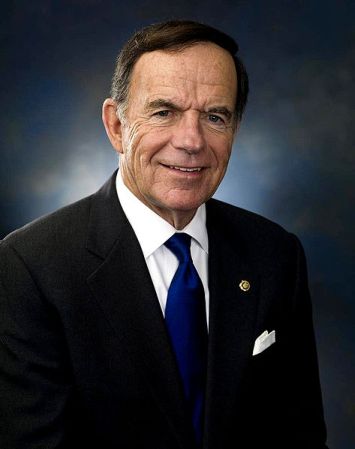
And the Higgy Goes to… Paul G. Kirk, Jr.

April 18, 2014

We have had another excellent (that is, horrible) group of nominees for the William Higinbotham Inhumanitarian Award.  It is more than a bit disconcerting that both this year and last we have had a plethoria of compelling nominees.

My own nominee, Paul Ehrlich, was a strong candidate.  His modern Malthusian warnings about how humans were exhausting natural resources and needed to control pupilation to avoid an imminent catastrophe helped justify the oppressive and disastrous Chinese One-Child Policy.  Ehrlich would have won The Higgy were it not for the fact that folks are already recognizing the dangers of declining birth rates, especially when coerced by the government.  Even the Chinese are starting to back away from their policy.  The demographic problems of more retireees dependent on fewer workers is becoming a big topic of discussion throughout Europe, Japan, and America.  And even the developing world is producing dramatically lower birth rates.  The highly influential Higgy does not appear necessary to discredit Ehrlich’s ideas.

Barney Frank is also a very worthy nomination.  Frank not only personally contributed to the causes of the Great Recession by  championing policies that pushed and subsidized lenders to provide houses to everyone, regardless of the ability to pay, but also has the chutzpah to assert “The private sector got us into this mess. The government has to get us out of it.”  But Frank falls short of The Higgy because he was far from alone in the governmental recklessness that nearly destroyed private credit.  Politicians on both sides of the aisle favored a house in every pot (they had to up the ante from chickens).  Politicians will always be tempted to promise free money and we’re to blame if we take them up on their offer by electing them.

A reader in a comment suggested John Maynard Keynes, who is also a compelling candidate for The Higgy.  But the reader did not make a full case, so it is hard for me to fully judge the merits of this nomination.  In addition, I’m inclined to believe that governments did not need Keynes to believe that they should actively meddle in the economy.  They were doing it plenty  well before Keynes came along.

This year’s winner of The Higgy is Paul G. Kirk, Jr. for inventing the pernicious notion of a “free speech zone.”  Even with a constitutional guarantee, free speech is always under seige because the government and other powerful folks would rather not be undermined by it.  People often wrongly cite the decision in Schenck v. United States as proving that the government would only restrict speech if it posed a “clear and present danger.”  What those people forget is that even while articulating the clear and present danger standard, the Supreme Court upheld Schenck’s conviction for passing out leaflets in front of a draft office during the Great War.  If a guy on the street corner handing out leaflets can be interpreted as a clear and present danger, then clearly the government will be inclined to restrict speech whenever it can.

The essential check on government control over speech is the popular backlash that would occur if the government over-reaches.  The accountability of the government to people in elections (and if bad enough, in the form of revolution) is essential to making the words in the Constitution protecting free speech real.  In the face of popular protection of free speech, censoring authorities have to find sneakier ways to control speech.  They have to find indirect and less obvious ways, like creating free speech zones.

For contributing to this sneaky infringement on our liberty, Paul G. Kirk, Jr. is deserving of the dishonor of the William Higinbotham Inhumanitarian Award.


The Empire Strikes Back in 2014

April 18, 2014

(Guest Post by Matthew Ladner)

Score another 2014 win for the bad guys, who defeated an attempt to expand the Arizona ESA program to high-poverty areas of the state yesterday.

The debate on the floor revealed that we choice advocates have a lot of work to do. A pernicious and false idea that came up is one that we are guilty of helping to spread- that we “already have school choice in Arizona.”  Arizona scores relatively well on choice when compared to most other states. We have inter-and intradistrict choice, one of the strongest charter school laws, tuition tax credits and the ESA program.  Arizona is parental choice nirvana, right?

Wrong.

A few years ago I tried to help a woman who lived in south Phoenix find a different school for her children, two of whom had been sent to the hospital as the result of brutal attacks by fellow students.  I put her in touch with a person who has helped parents in her situation for many years.  It was an eye-opening experience.

Let’s start with open enrollment.  This mother found the doors shut in her face.  Let’s just say that it seemed that the fancier districts were not overly interested in kids from south Phoenix and leave it at that.

What about charter schools?  Even South Phoenix charter schools with lousy academics, but where you might hope your daughter might avoid getting a pencil stabbed through the back of her neck, had long waiting lists.  The Great Hearts charter schools alone had a wait list of 10,000 kids last year.

Well you can always apply for a tax credit scholarship.  Except…scholarship groups have thousands more applicants than they can possibly help.

For this mother, it almost may as well been 1993- the year before Arizona passed its charter school law.

The ESA expansion that failed yesterday would have made students living in areas like south Phoenix and south Tucson eligible to participate in the ESA program. The expansion would not have cured the world’s pain nor dried every crying eye, but it could have provided a lifeline to thousands of families like the one described above.

It would be easy to be angry at the people who voted against this expansion, but the truth is that people like me need to look in the mirror and ask how we can do a better job of explaining why this is so important.


WSJ on ESA and Jordan Visser

April 17, 2014

(Guest Post by Matthew Ladner)

The Wall Street Journal has a news story on the Arizona Empowerment Accounts program today. Notice especially the intellectual incoherence of the Scottsdale official trying to explain how it hurts the finances of the district to lose special needs students:

School districts say that even though state funding doesn’t cover the costs of special-needs students, they don’t necessarily save that money if a student leaves the district. The Scottsdale district says it pays about $10 million to $12 million more than it gets from the state and federal government to educate its special-needs students.

“If every student with special needs left, then maybe we would save that $12 million, but at the same time, it’s pretty implausible,” said Daniel O’Brien, chief financial officer of the Scottsdale district. He added that the schools would still have students with all kinds of other needs who may not qualify for ESAs, and they would still need to educate those students.

Did you follow that?  Scottsdale says that they use $10m to $12m in general education funds above and beyond what it receives in state and federal funding for special needs children.  I certainly agree that it is utterly implausible that all special needs students will choose to leave the Scottsdale district, but that whole line of thought misses the most important point: if a child leaves with their “inadequate funding” then you have no cause to cry about it.  You still have the $10m to $12m in the bank- now you just have more options with what to do with some of it- you might want to spend more on your remaining special needs kids, you may want to do a slightly smaller transfer from general ed to special ed, but either way the district wins.

Notice also that 90% of what the Scottsdale Unified would have received for Jordan Visser seems to be serving his needs quite well.

For the past three years, Ms. Visser has educated her son, Jordan, who has cerebral palsy, at their Scottsdale, Ariz., home. He has a packed schedule of one-on-one instructional sessions with a specialist, physical-education classes, music lessons, horse-riding therapy and other programs—all of which she pays for through a state-funded program informally known as the “education debit card.”

BOOOOOOOOOOOOOOOOOOOOOOOOM!!!!!!!!!!!!!!!!!!


The Paradoxical Logic of Ed Reform Politics (Part 2)

April 17, 2014

In my last post I suggested that “In education, as in military and political strategy more generally, the most direct and definitive path to victory often lays the foundations for defeat.  Instead, the indirect and less definitive solution is almost always more effective.”

The paradoxical logic of military and political strategy is a result of the fact that in the strategic world one’s opponent is able to react to your efforts with counter-moves.  Technocrats seem to think that effective policy-making just consists of identifying the optimal solution and then imposing it on everybody.  Strategists understand that the other side of a policy battle has interests and values that lead them to different policy preferences. Even if the technocrat can identify the optimal solution and manage to get that solution adopted as policy (and this is a huge if), the other side doesn’t go away no matter how much the technocrats just want them to shut up and disappear.

Technocrats have an authoritarian streak that makes them expect the losing side to surrender permanently in deference to what “science” and “experts” have decided is best.  But in a diverse, decentralized democracy, people don’t have to accept what you claim based on your science and expertise (and they might be right in doing so).  They can subvert effective implementation of your policy and bide their time until they can re-open the debate and regain control over policy.

The more completely and directly you try to prevail in a policy dispute the more you mobilize the other side to oppose you — if not at the time of adoption, then later in implementation or when the debate is re-opened. Seeking total victory often lays the foundations for defeat.  In  Dred Scott v. Sandford Chief Justice Taney seemed to hand supporters of slavery a total victory, but it led to their ultimate defeat.  As Wikipedia summarizes it:

Although Taney believed that the decision represented a compromise that would settle the slavery question once and for all by transforming a contested political issue into a matter of settled law, it produced the opposite result. It strengthened Northern slavery opposition, divided the Democratic Party on sectional lines, encouraged secessionist elements among Southern supporters of slavery to make bolder demands, and strengthened the Republican Party.

In a diverse, decentralized democracy you can’t settle contentious issues once and for all.  In policy-making there is no total and final victory, only perpetual struggle.

Technocrats are inclined to seek total and final victory.  If science or the experts have shown something to be wrong, why should that wrong be allowed to continue anywhere?  This produces a tendency to over-reach.  Technocrats can’t tolerate the notion that a solution won’t cover everybody and improve things for everyone.  If things are bad in Mississippi it just ruins their whole day.

But trying to fix everything, everywhere usually leads to fixing nothing anywhere — or sometimes to making things much worse.  In the end the technocrat doesn’t seem as motivated by helping as many people as possible, as much as motivated by the unreasonable feeling of responsibility for “allowing” something bad to continue for someone.  But addressing your inner angst about someone still suffering somewhere at the expense of making progress toward helping more people is egotistical.  It isn’t about you.  You are not the Master of the Universe who “allows” bad things to happen.  You’re just a person trying to work with others to make progress.

People sometimes think that I’m a radical because of my preference for parental control over the education of their children.  But I think I’m really the moderate in education debates.  The extremists are the ones who are trying to devise fixes for everyone else’s problems.  They’re radical because they (falsely) believe they can identify optimal solutions and successfully impose them on everyone.  My approach is moderate because I accept that gradual progress toward better outcomes (even if some people  might make the “wrong” choices and not experience improvement) is more realistic and productive.

Even if you are a standards and test-based accountability person, you are better off not seeking total victory as the Common Core people have.  Yes, some states had lousy standards.  And yes, some tests were poorly designed or had low thresholds for passing.  But trying to fix all standards and tests, everywhere, all at once is the wrong approach.  Seeking this total victory has more fully mobilized the opponents of all standards and testing.  In response to a more heavy-handed and top-down national effort, more previously un-involved people have flocked to the anti-testing side.  Not only will these folks undermine effective implementation of Common Core, but in their counter-effort to roll back national standards, they will destroy much of what was good about state standards and tests.  The whole idea of standards and test-based accountability is being undermined by the imprudent over-reach of Common Core.

I apply the same cautiousness to my approach to parental choice in education.  I would never recommend adopting nationwide school choice programs.  The truth is we don’t know how best to design choice programs.  Is it best to have vouchers, tax-credit funded scholarships, individual tax credits, ESA’s, etc…?  What kind of regulatory framework should we have?  Should testing be required?  What test?  I have my guesses about what would be good, but I don’t have the technocrat’s confidence that I can identify the right solution and impose it everywhere.  Let’s let different localities try different kinds of programs and gradually learn about what seems to be working and what doesn’t.

Whether your preferred policy solution is based on standards and accountability, parental choice, instructional reform, or something else, the better approach to reform is gradual and decentralized so that everyone can learn and adapt.  Your reform strategy has to be consistent with the diverse, decentralized, and democratic country in which we live.  You won’t fix everything for everyone right away, but you should avoid Great Leaps Forward. Seek partial victories because with the paradoxical logic of ed reform politics total victory ultimately leads to total defeat.


There are in Fact “Dinosaurs” on this “Dinosaur Tour”

April 15, 2014


(Guest Post by Matthew Ladner)

A local Arizona political news service, the Yellow Sheet Report  just happened to stumble across an obscure spreadsheet and discovered that parents have not spent all the money in the ESA program.  Tim Ogle, executive director of the Arizona School Boards Association, told the Yellow Sheet “Now we have these individuals whose education is not being accounted for by the state, and also you’ve got over $2 million of public money unaccounted for, so both educational lack of oversight and financial lack of oversight [exist], and that’s why the empowerment account idea is so flawed philosophically.”  

The Yellow Sheet did note that parents have a number of options in how to spend ESA funds, including rolling funds over from year to year.  The blurb even noted that in the end if you graduate from high-school and fail to spend the funds in a timely fashion on higher education expenses, that the funds revert back to the state. Why they persisted to write about this story at this point might have something to do with an admiration for Mr. Ogle, or his point of view, or might have something to do with the fact that there are only a few days left in the session with some ESA bills still under consideration. Or some combination thereof.  I’m just not sure. In any case, these funds are hardly “unaccounted for” in any sense. They simply have not been spent yet.

Rather than some sort of deep, dark secret uncovered by a sleuthing alphabet souper, Lindsey Burke openly discussed the use of funds in a Friedman Foundation study in August of 2013.  Alphanauts don’t read FF stuff as much as they should, so I’ll try to help out.  The study linked to above has a section called Do Parents Consider Opportunity Costs with ESA Funds? on Page 13. Burke wrote:

Enabling families to save unspent Empowerment Scholarship Account funds provides a powerful financial accountability feature. Whereas traditional school vouchers must be spent in their entirety, ESAs foster demand-side pressure for education providers to offer more cost-efficient educational services by creating an incentive for parents to shop for education services based in part on cost. During the first quarter of Fiscal Year 2013 (the 2012-13 school year), 244 students were awarded ESAs. Of those, 115 students were active ESA participants from the 2011-12 school year, and 187 were active during the first quarter of Fiscal Year 2013, bringing total student ESA enrollment to 302 during the first quarter of the 2012-13 school year. Arizona awarded $1,302,863 to ESA recipients during the first quarter of 2013, of which parents spent $964,991 and saved $337,871. The ADE notes that $1,239,057 will be distributed to participating families during the second quarter of 2013, and estimates total ESA spending to be just short of $5.2 million for the year.

During Fiscal Year 2012, $671,012 in ESA funds remained unspent; during the first quarter of Fiscal Year 2013, approximately $337,871 in ESA funds was unspent. This suggests families are saving and rolling over a significant portion of the ESA funds, in anticipation of either near-term or long-term future education-related expenses.

The law allows parents to save funds in two different ways- first by making a contribution to a Coverdell Savings Account, which can be invested and earn interest under federal guidelines. Second, parents can roll unused funds over, and use them for the child’s K-12 or higher education expenses.  All the allowable uses of ESA funds relate to either K-12 or higher education, all funds are accessed through a use-restricted debit card, and all receipts have been monitored and approved by the Arizona Department of Education officials.  If a parent makes an inappropriate purchase with funds, they can be required to refund the money, find themselves kicked out of the program, or referred to the authorities for criminal prosecution. As mentioned earlier, unused funds eventually revert back to the state.  The program had technical challenges to allowing parents to invest funds in a college savings account program in the first year, but those were eventually overcome, and the amount rolled over from year to year declined.

So if parents “saving” in their “Education Savings Account” is some sort of faux pas, then the fund balances run by Arizona school districts represent an epic level crime against humanity.  The AZ Superintendent of Public Instruction puts out a handy financial report every year, and if you are really nerdy and find the second volume online you’ll find hundreds of millions of dollars of unspent funds in school district accounts.  It appears for instance that the Tucson Unified District received $522 m in the year covered, only spent $507m, and had $80m or so sitting in the bank.

!!!Quelle Horreur!!!

Tucson received $522m in revenue and only spent $126m on teacher salaries.  Plus the reading scores down there deserve to be put on trial in the Hague. Now that I think about it, the state’s preschool program famously had piled up $400 million in the bank before they started furiously buying billboards to tell everyone how great they were when state lawmakers proposed using the money to keep the state’s lights turned on during the housing meltdown. Hmmm, but wait must stay focused could….write….about…this…for…hours!

Policymakers designed the ESA program to allow parents to save money for future education expenses, whether K-12 or higher education related. It’s silly to cry foul when they do so.


Paul G. Kirk, Jr. for the Higgy

April 15, 2014

473px-Paul_Kirk_Official_Photo

(Guest post by Greg Forster)

A good Higgy nomination is a tough target to hit. As we found out last year, your pick can be rejected for being too powerful and thus being more a case of BSDD (Big Scary Dictator Disorder) than PLDD (Petty Little Dictator Disorder), as happened to my nomination of David Sarnoff. But your nomination can also be rejected for being not powerful enough, and thus not making a sufficiently large contribution to the worsening of the human condition to merit the award; this was the rationale given by the judges for not selecting Jay’s nomination of Louis Michael Seidman.

So the big behind-the-scenes bigshots who pull the real strings of power are out, and TV blowhards who just talk about what the bigshots do are also out. The core value of the Higgy is “arrogant delusions of shaping the world”; the bigshots are not deluded in thinking they can shape the world, whereas the blowhards don’t really even try to shape the world so much as describe those who do.

With all that in mind, I nominate Paul G. Kirk, Jr. for the Higgy, for inventing the “free speech zone,” also known as the “First Amendment area.”

Free-Speech-ZonesImage HT

As you can see from the image above, the basic idea of free speech zones is that “constitutional first amendment rights” are only to be exercised in government-designated areas. They are now used in virtually all major events, such as national political conventions; they are also set up anywhere something controversial is happening that attracts protests. They’ve been in the news lately in connection with the Bureau of Land Management’s dispute with the Bundy family in Nevada. As Mark Steyn comments, “The ‘First Amendment Area’ is supposed to be something called ‘the United States.'”

Gone is the old idea of America as the one country on the face of God’s earth where literally anyone can just stand there on the sidewalk talking to anyone who will listen, or where people can organize to protest the actions of the powerful in genuinely public spaces. The pseudo-genius of the free speech zone is that government doesn’t forbid you from speaking per se, it simply designates the zone in a secluded, out of the way place, destroying the public nature of your speech.

Yes, everyone agrees that there have to be some limits on the use of public space; if ten different groups all want to have huge rallies in the town square at the same time, you’ll run into problems. But, again, the pseudo-genius of the free speech zone is that it shifts us from dealing with that kind of coordination problem to the removal of free speech from public spaces entirely. It’s a transition from “speak as you will, unless your activities get in other people’s way, and then we have to find some accommodation for competing claims,” to “you may not speak in public places, lest you get in other people’s way.”

But of course the real motive behind the creation of free speech zones is not to avoid coordination problems. It is to prevent protests from besmirching the public image of big events and other things that powerful officials want to run smoothly. These zones are intended to isolate “free speech” from actual public participation, in order to create the appearance that all is smiles and unicorns in the sun-kissed lands of modern America, under the benevolent rule of our lords and masters, whose benevolence is proven by the fact that they generously grant us free speech zones.

Kirk’s actions in inventing the free speech zone exemplify the core value of the Higgy exceptionally well. He was chairman of the Democratic party during its 1988 national convention, which seems to be generally agreed upon as having pioneered the use of these zones. And it’s pretty clear that Kirk’s goal was to silence free speech in public places. Consider this contemporary account:

But even those groups that are cooperating with the system are upset that the official “free-speech zone” is too far from the convention arena (in fact, it’s about 500 yards away, down a hill, around a corner and hidden by a hotel-and-shopping complex). “You can’t be seen by delegates in the ‘free- speech zone,’ ” complained Peterson.

“The city keeps telling us that the buses bringing delegates will let them off right across from the protest area, so they’ll have to see us,” said Paul Cornwell, chief organizer of Alternative ’88. “But you know how that’ll go. It’s going to be about 100 degrees out there and all the delegates are going to zoom into the air conditioning as fast as they can.”…

Protesters also were angered to learn – during a hearing on the suit – that the city plans to use the street that separates the “free-speech zone” from the Omni Center to park the delegates’ buses.

“In addition to putting us out of sight, they’re going to form a barricade of parked buses,” Peterson said.

Kirk seems to have drawn his inspiration from the Planning Office in Hitchhiker’s Guide:

The tradition has continued in the use of free speech zones ever since.

If this were effective in silencing speech, Kirk might not qualify for the Higgy on grounds that he’s a case of BSDD. But in fact free speech zones don’t silence free speech. Protestors ignore them; note that the quote above begins with “But even those groups that are cooperating with the system . . .” There were a number of groups that didn’t cooperate with Kirk’s system in 1988. The public image of the event was even more effectively spoiled than it would have been by a peaceful public protest.

By contrast, when Communist authorities in China copied our model of free speech zones (read those words again: Communist authorities in China copied our model of free speech zones) during the 2008 Olympics, it had few difficulties. Over in China, free speech zones are BSDD. Here in America, they’re PLDD.

True to form, today the rallies in Nevada were not held in the designated free speech zone, and protesters got into nasty conflicts with authorities. Ultimately the authorities – who were actually in the right as regards the merits of the case, but who had blown everything out of proportion and were more concerned with swaggering around with guns than with settling the dispute in a reasonable way – had to back off in humiliation.

Huge shock: people who are highly motivated enough to turn out for a protest do not simply bow their heads and do as they’re told when they’re told that free speech is no longer allowed in genuinely public spaces. If you deny them a legitimate opportunity to make their voice heard, that only makes them more angry and more determined to make their voices heard. So even when the lawful authorities are in the right, their efforts to silence dissent only make them look wrong and undermine their ability to enforce the rules.

Talk about arrogant delusions of shaping the world! I’m proud to nominate Paul G. Kirk, Jr. for The Higgy.


Hess and McShane: Oppose CC if You Want but Please Grow Up

April 14, 2014

(Guest Post by Matthew Ladner)

Heh, what they said.  Money quote:

Common Core critics must keep in mind that policy debates are won by proposing better solutions. The Core standards were adopted with a big federal boost and little public debate, but adopted they were. Teachers and school leaders have been implementing the standards since 2010, and opponents can’t wish this away any more than Obamacare critics can wish away the new landscape produced by the Affordable Care Act.


Granting an Extension on The Higgy

April 14, 2014

April 15 is known nation-wide as the day when your taxes are due and when the winner of the William Higinbotham Inhumanitarian Award is announced.   But sometimes April 15 falls on a weekend or a holiday and the tax deadline is extended.  This year Passover starts tonight and observant Jews refrain from work through Wednesday.  While the US government does not care enough about Passover to delay the tax deadline, I will delay the announcement of The Higgy until the end of this week to allow some people to complete and submit their nominations while they observe the ultimate Freedom Holiday.  Chag Sameach.


The Texas K-12 Testing Debacle

April 14, 2014


(Guest Post by Matthew Ladner)

So Texas once had a system of testing and accountability that was the envy of the nation. Texas boasted the highest Hispanic scores on NAEP in the nation not so long ago for instance. The Texas system served as the basis for the No Child Left Behind Act that required testing in grades 3-8 and once in high-school in return for federal education dollars.

Hanuskek 4

The Texas system grew long in the tooth over time.  Other states developed better standards and better testing systems and embraced more parental choice while Texas seemed to rest on its laurels. The Houston Chronicle revealed statistical hocus pocus that greatly inflated the number of highly rated schools committed by the Texas Education Agency. Gnomes in the basement of your state education agency can wreak havoc with any centralized system. Still, a system that gets you into the upper-left quadrant of the above chart (relatively low spending increase per pupil, relatively high gains on NAEP) was probably doing something right, especially if you are absorbing a Wyoming public school system sized cohort of additional students every year.

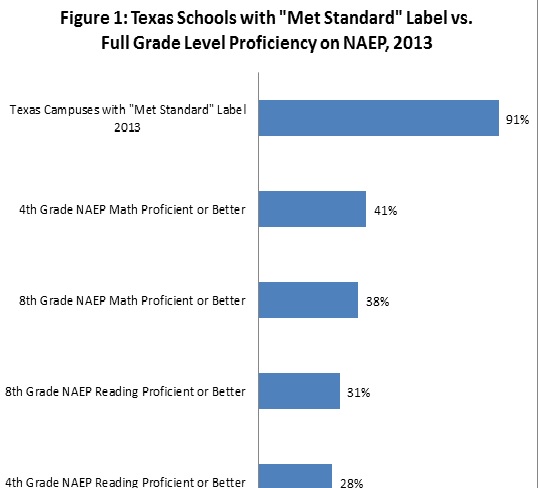
A toxic mixture of reformer overreach, devious alphabet soup group plotting and populist uprising has left this once proud system as a complete train-wreck.  I will attempt to summarize this wreck in a single chart:

Texas 1

So only a large minority of Texas students can do grade level work on NAEP in any given subject, 91% of schools got a “met standard” label under the new “pass/fail” accountability system currently used during this brave new world of accountability chaos.  This is an accountability system the reminds me of:

These labels are supposed to be transitional, but there will doubtlessly be efforts to codify them into statute during the 2015 legislative session.  I could go on at some length about what a mess that the high-school end of course exam system has become, but I will spare you.  Go and read the Dallas Morning News series linked to in the previous post if you’d like a detailed blow-by-blow on who all is to blame on this, but my own take is that there is plenty of blame to go around on both the reformer and alphabet soup side.  The parents involved had genuine grievances regarding the testing system, but also must share in the blame for what is now a bad joke of a system.

Texans need to engage in a vigorous debate over what it is that they desire out of their system of academic testing and transparency. If the answer is “nothing really we just want to go through the motions of having such a system” then the legislature can codify pass/fail and further dummy down the high-school testing system. Trophies for everyone, a long era of academic stagnation awaits.

If not, then reformers might need to persuade parental activists to exercise greater responsibility to go along with their influence.   Hopefully the Texas reform tribe has grown sadder and wiser as well.


The Paradoxical Logic of Ed Reform Politics

April 14, 2014

Ed reform has been going through a bad stretch lately.  Currently dominant reform theories are the result of technocratic thinking.  They seek to identify (and impose) “optimal” topics to be taught, ways to teach those subjects, methods for training teachers, strategies for evaluating and motivating teachers, etc…  An army of economists or economist-wannabes have seized the reins of reform organizations with the hope that their next regression will tell everyone what to do to solve the mystery of improving schools.  They pay little heed to history, which might alert them to the failure of past efforts similar to their brave new undertakings.  And they are unfamiliar with basic lessons from political science on the dangers and failures of technocratic central planning.

Let me offer one political science lesson for ed reformers that I learned from reading Edward Luttwak’s book, Strategy: The Logic of War and Peace.  Luttwak argues that there is a paradoxical logic to strategy.  In the realm of strategy what often seems good turns out to be bad and vice versa.  This is why strategists often say things like: “If you want peace, prepare for war;” “A buildup of offensive weapons can be purely defensive;” and “The worst road may be the best route to battle.”

Both military and political strategy have this paradoxical logic because they involve opponents who can observe your efforts and make counter-moves.  You can’t just run a regression to find the optimal solution and then expect everyone to thank you for discovering what you claim to be better methods.  Education is a political system that involves competing interests and values.  For the most part our problems are not caused by ignorance of optimal solutions, but by these clashing interests and values embedded in dysfunctional systems.

To fix these problems we need to address people’s competing interests and values and not just impose a technocratic solution from above.  In education, as in military and political strategy more generally, the most direct and definitive path to victory often lays the foundations for defeat.  Instead, the indirect and less definitive solution is almost always more effective.

Before turning to education, let’s consider the paradoxical logic of strategy with respect to another policy — gay marriage.  Opponents of gay marriage pursued the most direct and definitive approach to securing the victory of their policy view.  In 1996 they managed to get a bipartisan and veto-proof majority in Congress to pass the Defense of Marriage Act (DOMA), which became law with the signature of President Bill Clinton.  DOMA “barred same-sex married couples from being recognized as ‘spouses’ for purposes of federal laws, effectively barring them from receiving federal marriage benefits.”  Opponents then managed to get 31 states to adopt constitutional amendments forbidding those states from recognizing same-sex unions.

By banning gay marriage at the federal level and in a majority of state constitutions one might have thought that opponents of gay marriage had scored a decisive victory.  But, by seeking to impose their policy view with a direct and definitive approach, the opponents of gay marriage planted the seeds of their own defeat.  Big losses for supporters of gay marriage motivated them to organize and develop inventive strategies for reversing those defeats.  They focused heavily on influencing popular culture and the media.  They went to the courts.

Meanwhile, opponents of gay marriage failed to continue efforts aimed at influencing mass opinion and neglected the debate.  They thought they had won, so why keep debating?  In a diverse, decentralized, and democratic country, there are no permanent political victories or defeats.  Winning a legislative battle or ballot initiative does not make the other side change its mind or go away.  They’re still there, devising ways to come back and win in future rounds.

Supporters of Common Core have made some of the same political mistakes that opponents of gay marriage did.  They figured if they could get the US Department of Education, DC-based organizations, and state school chiefs on board, they would have a direct and definitive victory.  And at first blush it looked like they had achieved it, with about 45 states committing to adopt the new set of standards and federally-sponsored standardized tests aligned to those standards.  Like opponents of gay marriage, the Common Core victory seemed so overwhelming that they hardly felt the need to engage in debates to defend it.

But in the rush to a clear and total victory, supporters of Common Core failed to consider how the more than 10,000 school districts, more than 3 million teachers, and the parents of almost 50 million students would react.  For standards to actually change practice, you need a lot of these folks on board.  Otherwise Common Core, like most past standards, will just be a bunch of empty words in a document.

These millions of local officials, educators, and parents often have reasons for holding educational preferences that are different than those dictated by Common Core.  Common Core may call for things like more focus on “informational texts”  and delaying Algebra until 9th grade, but there are reasons why that is not already universal practice.  It’s not as if local officials, educators, and parents are unaware of the existence of informational texts or just waiting to be told by national elites about when they should start teaching Algebra.  They have interests and values that drove them to the arrangements that were in place prior to Common Core.

Having the Secretary of Education, state boards, and a bunch of DC advocacy groups declare a particular approach to be best and cram it into place in the middle of a financial crisis with virtually no public debate or input from educators or parents did not convince local officials, educators, and parents to change their minds.  These are the folks who need to be on board to make the implementation of Common Core real.  And these are the folks who are organizing a political backlash that will undo or neuter Common Core.  A direct path to victory by Common Core supporters sowed the seeds of  its own defeat.

The unraveling of Common Core makes this flop the most obviously ill-conceived and doomed-to-fail reform effort since the Annenberg Foundation threw $500 million away in the 1990s.  I assure you that while the money was flowing from Annenberg that effort had plenty of defenders, just as Common Core does today.  After Common Core fails, everyone will say how they knew it was flawed, just as they currently do with Annenberg.  Victory has a thousand fathers while defeat is an orphan.

But some of us have been warning of the political naivite of the Common Core effort for some time now.  Rick Hess and Mike McShane at AEI have also done an admirable job of describing the political weakness of Common Core, regardless of what one thinks of the merits of the standards themselves.

Supporters of Common Core may draw the wrong lesson from this post and increase efforts to convince the public and train educators to love the Common Core.  Not only will these re-education efforts be too little, too late, but they fail to grasp the inherent flaw in reforms like Common Core.  Trying to change the content and practice of the entire nation’s school system requires a top-down, direct, and definitive victory to get adopted.  If input and deliberation are sought, or decisions are truly decentralized, then it is too easy to block standards reforms, like Common Core.  Supporters of CC learned this much from the numerous failed efforts to adopt national standards in the past.

But the brute force and directness required for adopting national standards makes its effective implementation in a diverse, decentralized, and democratic country impossible.  This can’t be solved by more professional development and a belated marketing campaign.  Even the Chinese re-education camps couldn’t make the Cultural Revolution reailty — and they invested a whole lot more energy and resources in trying to do so than the Common Core folks ever could.

There is a better, more indirect and less definitive approach to education reform.  In the next post I’ll discuss what that looks like.