A Modest Proposal for B.B.

August 18, 2008

The advocates of B.B. (Broader, Bolder; or is it Bigger Budgets? or is it Bloated Behemoth?) have yet to muster the evidence to support widespread implementation of their vision to expand the mission of schools to include health care, legal assistance, and other social services. They do present background papers showing that children who suffer from social problems fare worse academically, but they have not shown that public schools are capable of addressing those social problems and increasing student learning.

And if you dare to question whether there is evidence about the effectiveness of public schools providing social services in order to raise achievement, you are accused of being opposed to “better social and economic environments for children.” Right. And if you question the effectiveness of central economic planning are you also then opposed to a better economy? And if you question the effectiveness of an untested drug therapy are you then opposed to quality health-care?

To help the B.B. crowd generate the evidence one would need before pursuing a reform agenda on a large-scale, I have a modest proposal. How about if we have a dozen large-scale, well-funded pilot programs of the “community school” concept advocated by B.B.? And, at the same time let’s have a dozen large-scale, well-funded pilot voucher programs. We’ll carefully evaluate the effects of both to learn about whether one, the other, or both are things that we should try on an even larger scale.

I’m all for trying out new ideas and carefully evaluating the results. I can’t imagine why the backers of B.B. wouldn’t want to do the same. So as soon as Larry Mishel at the union-funded Economic Policy Institute, Randi Weingarten of the AFT, and Leo Casey of the AFT’s blog, Edwize, endorse my modest proposal, we’ll all get behind the idea of trying new approaches and studying their effects — “community schools” and vouchers.

Wait, my psychic powers are picking something up. I expect that some might say we’ve already tried vouchers and they haven’t worked. In fact, Randi Weingarten just wrote something very much like that when she declared in the NY Daily News that vouchers “have not been shown by any credible research to improve student achievement.” Let’s leave aside that there have been 10 random assignment evaluations (the gold-standard in research) of voucher programs and 9 show significant positive effects, at least for certain sub-groups of students. And let’s leave aside that 3 of those analyses are independent replications of earlier studies that confirm the basic positive findings of the original analyses (and 1 replication does not). And let’s leave aside that 6 of those 10 studies have been published in peer-reviewed journals (including the QJE, the Journal of the American Statistical Association, and the Journal of Policy Studies), three in a Brookings book, and one in a federal government report (even if Chris Lubienski somehow denies that any of this constitutes real peer-review). And let’s leave aside that there have been more than 200 analyses of the effects of expanding choice and competition, which Clive Belfield and Henry Levin reviewed and concluded: “A sizable majority of these studies report beneficial effects of competition across all outcomes… The above evidence shows reasonably consistent evidence of a link between competition (choice) and education quality. Increased competition and higher educational quality are positively correlated.”

Let’s leave all of that aside and ask Randi Weingarten how many random-assignment studies of the community school concept she has. Uhm, none. How many evaluations of community schools, period? Uhm, still none. But that doesn’t stop her from drawing the definitive conclusion: “Through partnerships with universities, nonprofit groups and other organizations, community schools provide the learning conditions and resources that support effective instruction and bring crucial services to an entire community.” How does she know?

But I’m eager to help her and all of us learn about community schools if she is willing to do the same to learn about vouchers. Better designed and better funded voucher programs could give us a much better look at vouchers’ full effects. Existing programs have vouchers that are worth significantly less than per pupil spending in public schools, have caps on enrollments, and at least partially immunize public schools from the financial effects of competition. If we see positive results from such limited voucher programs, what might happen if we could try broader, bolder ones and carefully studied the results?

And if community schools really deliver all that is being promised, great, let’s do that too. But if our goal is to do what works, why not give both ideas a real try?

(Link added)


Tuition Datum Mystery Solved!

August 6, 2008

(Guest post by Greg Forster)

In this recent post, I noted that a blogger had cited a datum for private school tuition levels in the U.S. in 2003-04, attributing it to NCES. Since I knew that tuition levels aren’t collected in the Private School Universe Survey, and that the most recent datum I’d seen from NCES was from 1999-2000, I wondered whether the blogger had mistakenly used an old datum, or if NCES was putting out new private school tuition data and I missed it.

Turns out it was neither! Well, not really.

I’ve been offline for a few days while moving, and when I got back I discovered a very nice note from Bill Evers at IES. He says NCES does indeed still collect private school tuition data, but in the Schools and Staffing Survey, not the Private School Universe Survey. (You can’t tell your surveys without a scorecard.) It’s collected every four years.

But I don’t have to feel bad about missing it, because the updated data haven’t been incorporated into the NCES web tables yet. If you know exactly where to click, though, you can access it.

Many thanks to the good people at IES for 1) collecting the data we need, which is a huge job that they do very well, and 2) taking a minute to straighten me out on this question. I’ve said some hard things about IES’s recent misadventure publishing that HLM study of private schools, but I hope nobody doubts my respect for their work in all other regards.


Best. Choice. Argument. Ever.

August 6, 2008


 Brilliant.


(HT, Stuart Buck and Lydia McGrew at http://www.whatswrongwiththeworld.net/2008/08/great_video_clip_on_government.html#comments )


PJM Column on the Education Agenda

August 2, 2008

(Guest post by Greg Forster)

I have a column up on Pajamas Media noting that education just flared up in the presidential race recently, and then asking (and answering) the question: Just what can a president do about education, anyway, given that it’s primarily an area of state authority rather than federal?

It’s a question worth asking, because education is going to come up again before this campaign is over. Well, here are five things the next education president (they’re all “education presidents” these days) can do to improve the nation’s schools without expanding federal authority over education beyond its current level.


Where Did You Get That Marvelous Datum?

July 31, 2008

(Guest post by Greg Forster)

NRO blogger Jim Geraghty has a good post today about Obama and school choice. But what I particularly want to point out is this, which he notes in passing:

These numbers from the Department of Education’s National Center for Education Statistics for the 2003-2004 school year put average tuition paid by private elementary school students at $5,049

It looks to me like the word “these” was supposed to have a link, but there’s no link. I wasn’t aware NCES had collected any private school tuition data since 1999. And that figure looks a whole lot like the figure NCES was reporting back in 1999. Did Geraghty find the tuition number and assume it came from the most recent iteration of the Private School Universe Survey? (Actually the PSS has just released its 2005 data, but we’ll overlook that for the moment.) Or does NCES still collect private school tuition data, and somehow I missed it?

I’m not sure which outcome to root for.


Private Choice and the Disruptive Technology Model

July 24, 2008

(Guest Post by Matthew Ladner)

Christensen has made the case that online learning is a disruptive technology: competing against non-consumption, filling niches, and on the way to becoming a much more prevalent practice. I have been thinking lately that a similar model may apply to the private school choice movement.

One big difference: private choice often competes against demonstrable failure in the public system rather than non-availability of schooling at all. Inner city students in Cleveland, for example, have access to public schools. The problem isn’t that they don’t have access to schools at all; it is that the schools they do have access to often perform outrageously poorly.

Thus we experience political difficulty in promoting private choice. It would be much easier to compete against non-consumption. Ironically enough, a Democratic State Senator in Texas proposed just this sort of bill last year: a school voucher bill for dropouts.

The modern choice movement began in Milwaukee in 1990 when a group of frustrated inner-city Milwaukee Democrats teamed with Republican Governor Tommy Thompson to create the Milwaukee Parental Choice Program.

Since 1990, we’ve seen the creation of Milwaukee-like programs in Cleveland and Washington DC, failing school vouchers in Louisiana, Ohio and Florida. Lawmakers have created broad eligibility tax credit programs in Arizona, Illinois, Georgia and means-tested tax credit programs in Arizona, Florida, Iowa, Minnesota, Pennsylvania and Rhode Island. Voucher programs for children with disabilities have passed in Arizona, Florida, Georgia, Ohio and Utah, and Arizona passed the nation’s first and (as yet) only voucher program for foster care children.

Some in the movement would look at this list and say the movement needs to refocus on inner city programs. Some resentment towards the success of the special needs programs (5 and counting) has been expressed. These sentiments reflect deeply held value preferences.

I however disagree with them.

The passion of the progressive private choice movement is to provide the opportunity for low-income inner city children to have the chance to attend a high quality school. This is a passion I share, obsessively. Low-income inner city children are too often trapped in schools so dysfunctional that no one reading this would even think having their own children attend. Using the Rawls criteria of justice- if those schools aren’t good enough for your children in theory, then they aren’t good enough for disadvantaged children in practice.

Children with disabilities, however, have an equally compelling case for choice, and may in fact be the most poorly served children and frustrated parents in the public school system. Pop quiz: would you rather be born to a low-income family in an inner city, or the son of a billionaire with autism? The current IDEA system promises an “Individualized Education Plan” for children with disabilities, but all too often involves simply filing out the paperwork to prevent a successful lawsuit. Children- especially minority children- are often mistakenly shunted into special education due to poor reading instruction and effectively if not purposely left to rot academically in the most blatant and vivid example of the bigotry of low expectations imaginable.

In case for foster children is also compelling- having already rolled snake-eyes in their opening roll in life, children in foster care bounce from home to home, and thus because of attendance boundaries, from school to school. Ultra-frequent transfers between schools effectively destroy any chance they have to make academic progress.

Anyone for giving these kids a chance to attend a stable set of schools over time free from the disruption of attendance boundaries? Good- me too.

Thinking again of the disruptive technology model- inner city poor children are a niche that we should passionately seek to aid through parental choice. They do not however constitute the entirety of students extremely poorly served by the public school system. Children in failing schools, dropouts, English language learners, foster care children, free and reduced lunch children, functional illiterates, and special needs children are all demonstrably poorly served in the public school system.

One argument made used to be that special needs programs could not demonstrate systemic effects on public schools. This is no longer true. Nor is the case for the failing schools model. Don’t get me wrong: I prefer larger and broader programs to smaller ones, every day of the week. I’m most interested in helping as many poorly served children to get as much access to a broad array of school choices as fast as possible.

The passage of special needs bills were followed by choice bills with a broader set of eligibility in both Utah and Georgia. From a disruptive technology perspective that is a good thing.

From a disruptive technology perspective, the problem with say, Wisconsin would be that they haven’t moved on to new aid disadvantaged children in different niches. There are low-income children in places like Racine, for example, moving through dropout factory schools. Children with disabilities around the state could benefit enormously from a special needs voucher bill.

Ohio, on the other hand, started with a means-tested bill focused on Cleveland, and then moved on to a bill for children with autism and a statewide failing schools bill. Choice efforts in the state now focus on moving to a full blown McKay bill. Bully for them.

Florida’s programs focused on free and reduced lunch eligible children (Step Up for Students Tax Credit), special needs students (McKay Scholarship Program) and students in failing schools (Opportunity Scholarships). That’s a good start to build on, and Florida has overcome a very contentious debate on choice to develop bipartisan support and strong statewide public school improvement.

Once again: I’ll have what Florida is having.

(edited to correct typo)


Eduwonk: Vouchers Boring, Bus Service Consolidation Fascinating

July 23, 2008

(Guest post by Greg Forster)

One of Eduwonk’s most important contributions to the education blogosphere is the snarky comment. Snark is frowned upon in these parts (don’t leave a snarky comment on this post, or you’ll be violating site policy). But if I may register a minority report on behalf of the loyal opposition, I think snarky comments do for the marketplace of ideas what short sellers and speculators do for the stock market: they’re not classy or respectable, but they perform an indispensable price-discovery function. (Another similarity is that the people who do them make tons of money – right, Andy? Andy?)

Of course, not all brokerage houses are interested in having their services used by short sellers, and there may be some sense in declaring some education blogs as snark-free zones. The short sellers can always take their business to other brokers – just like I post all my snarky comments on Pajamas Media.

But if Eduwonk is going to dish out snark, he’d better be able to take it. So check out what I found while scrolling through Eduwonk this morning.

In response to John McCain’s big education speech at the NAACP:

If this campaign turns into a debate about vouchers please just shoot me now. I’d prefer a debate that ignores education than that tired fight again.

Two days earlier:

Shouldn’t we be . . . trying to get school districts out of the busing business altogether? Big school districts like to boast about how they bus more passengers each day than Greyhound. That’s true, but also sort of insane if you think about it and consider that their primary mission is teaching and learning. Besides, today’s buses are horrendous polluters even when greener technology is available, control over transportation means control over parental decision-making, and school districts often aren’t even very good at designing efficient transportation schemes or adapting to changing circumstances like $4 gas, which was not exactly an unforeseen issue in the transportation world…Student safety means that, especially for younger students you want to be careful about how you merge transportation schemes, but having local or regional agencies that handle transportation would pay a lot of dividends if was approached with the dual principles of being greener and more parent- and civic-friendly at the front-end.

Got that? A debate about the policy that represents the most fundamental break from the existing system, is most consistently supported by empirical evidence, and is currently the most politically successful movement in the education world is boring enough to induce suicide. But the prospect of transferring control of bus services from school districts to local or regional transportation agencies is fascinating.

Supply your own snarky comment; I’m not allowed.

But before leaving the subject, I will note that if you’ve seen the new Batman movie, you already know whom to call for all your school bus operation needs:

You know how I got these scars? I was in an accident caused by an incompetent school bus driver, because educational transportation is controlled by school districts whose core mission is teaching and learning rather than by local or regional transportation agencies!


John Rawls and Education Reform

July 9, 2008

(Guest Post by Matthew Ladner)

Matthew Miller’s book The 2% Solution utilizes the philosophy of John Rawls to make the case for parental choice in education. I’m more of a Nozick guy myself, but let’s follow the Rawls rabbit-hole down to the bottom.

John Rawls’ hugely influential work A Theory of Justice argued that societal ethics ought to be decided as if we were behind a theoretical “veil of ignorance.” Behind the veil, no one would be aware of what his or her position would be in a forthcoming society. You would not know whether you would grow up the child of a billionaire or poor in the inner city. The veil creates an incentive to leave a path out of the latter scenario. While many contest Rawls’ philosophy, it is hugely influential in left of center thinking. Does today’s system of public education remotely approach the Rawlsian ideal?

No, not even close. In fact, today’s public education system closely resembles the opposite. Today’s system systematically disadvantages the poor.

Consider the expanding body of research on teacher quality. Researchers have shown that the effectiveness of individual teachers plays a huge role in student learning gains. Examining test scores on a value added basis (year-to-year gains) has revealed that some teachers are hugely effective, while others are much less so.

What we have not had before is quantifiable evidence regarding just how important high quality teachers are in driving outcomes. Researchers examined the differences between teachers succeeding in adding value (the top 20% of teachers) and the least successful teachers (the bottom 20%). A student learning from a low quality teacher learns fifty percent less than a similar student learning from an effective teacher during the same period.

The question then quickly becomes: how do we get more teachers that are effective into the classroom? Only by making big systemic changes. Teaching is a profession with many rewards, but which has been tragically divorced from any recognition of merit. The teacher who works effectively and tirelessly is paid according to a salary schedule that will treat them identically to someone who does neither.

Job security and summers off are not big lures for the capable and ambitious sorts of people we need to attract into teaching in droves. To be sure, we have such people in our teaching ranks now, but the system treats them poorly. Our public schools do not pay them according to productivity- no rewards for success, no sanctions for failure. In short, we treat teachers not as professionals, but as unionized factory workers.

Most of our capable teachers will leave the profession frustrated, or go into administration. Those that we do keep in the classroom cluster in leafy suburbs far from the children who need them most.

What does the public system do for those children losing the Rawls lottery, who find themselves growing up in poor urban school districts? All too often, it assigns them to schools with decades long histories of academic failure. These children will serially suffer ineffective instructors.

Frighteningly high percentages of these students will never learn to read at a developmentally appropriate age. Many will never learn to read. Such students fall further and further behind each year. Unable to read their textbooks, never envisioning themselves advancing on to higher education, they will begin to dropout in large numbers in late middle school.

Fortunately, it is not hard to envision a better system. Public schools today are spending beyond the dreams of avarice for administrators from previous decades. We simply need to get a much better bang for our buck. A captive audience of students sponsors and promotes adult dysfunction in our schools. We should radically expand parental choice options for parents, especially for those for disadvantaged students.

More broadly, our students desperately need a complete overhaul of the entire system of human resource development and compensation for teachers. The system we have today largely reflects the preferences of the education unions. The education unions oppose parental choice, merit pay for teachers, alternative certification or differential pay based on teacher shortages. All of these positions are rational for a union boss, but detrimental to children.Progressives have traditional ties with organized labor, including the education unions. This marriage will not last.

Ask yourself if you would risk today’s education system from behind Rawls’ veil. There’s a good chance of being forced to go to school in the Dallas, DC, Detroit, Los Angeles, Newark or the_________ (fill in the blank with the closest large city) inner city public schools.

That sickening feeling in your stomach is telling you that those schools would not equip you with the skills you need to succeed in life. Rawls would say if those schools are not suitable for you in theory, then they are not suitable for inner city children in practice. Liberals should work closely with the education reform community in order to secure equality of opportunity for all children. Progressives can either have progress, or they can have an alliance with educational reactionaries, but they cannot have both.


Another Special Ed Post on Pajamas Media

July 5, 2008

Greg Forster and I continue the discussion of financial incentives and special education over at Pajamas Media.  This piece responds to a PJM column by Laura McKenna, which was a response to an earlier PJM column we wrote.

All of this builds on special education posts on this blog here, here, here, and here.


Another Order of Florida Reforms, Please

July 3, 2008

(Guest Post by Matthew Ladner)

In 2007, a family of four needed to earn less than $20,650 to qualify for a free lunch. In Arizona, the median family income for a family of four is over $65,000.

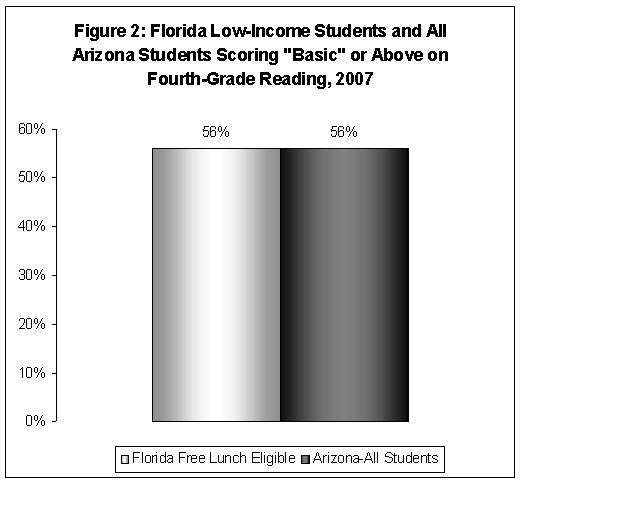
Here’s the surprising news: Low-income students in Florida—namely, those who qualify for free lunches—outperform all students in Arizona. That’s the insight to be gleaned by sifting through the treasure trove of data generated by the National Assessment of Educational Progress (NAEP), known as the Nation’s Report Card.

Figure 1 shows fourth grade reading scores for Florida students whose family income qualifies them for free lunch compared to all students in Arizona.

Figure 2 shows the percentage of Florida’s low-income children scoring basic or above on fourth grade reading and all Arizona students scoring at the same level.

You don’t need to take my word on these scores. You can go to the National Center for Education Statistics website and see them for yourself.

The point here is not to bash the underperformance of Arizona schools. Sadly, they have plenty of company. Rather, these data point to the enormity of the opportunity for improvement which we can and must achieve. Florida has found a way to significantly boost the performance of low-income students. Others should examine how and borrow everything we can.