(Guest Post by Matthew Ladner)
The Wall Street Journal weighs in here.
Coulson in the New York Post.
(Guest Post by Matthew Ladner)
The Wall Street Journal weighs in here.
Coulson in the New York Post.
 2 Comments |
  vouchers | Tagged: D.C. vouchers, DC Opportunity Scholarship Program |
  Permalink
 Posted by matthewladner
(Guest post by Greg Forster)
In case you haven’t heard, it’s been discovered that the Democrats snuck a provision into the “stimulus” “omnibus”* bill that assassinates the D.C. voucher program.
Dan Lips and Robert Enlow have the story on NRO today; the link on the front page is broken as of this writing, but you can get the story here.
I’m not sure what’s most disgusting – that the Dems are putting union politics ahead of children’s lives, that they’re doing it in this cowardly way, or that the president broke his promise to make the text of the bill available to legislators and the public with plenty of time to review the contents and justified his decision by saying that we had to pass the bill immediately to avert a catastrophe.
What did the president know, and when did he know it? Seems like there’s no answer to that question that makes him look good.
*UPDATE: Thanks to the commenters for correcting my mistake. How could I possibly mix up the “stimulus” bill with the “omnibus” bill? I mean, other than the fact that they’re both nothing but special interest porkapaloozas, they’re so completely different! Even so, I’m leaving in my comment about the president having broken his word on making the text of the stimulus bill available, because he did break his word and it was wrong. And the question of what the president knew about the voucher assassination attempt and when he knew it still seems 1) relevant and 2) not to admit of answers that make him look good.
4 Comments | politics, vouchers | Tagged: D.C. vouchers, Dan Lips, Greg Forster, NRO, Robert Enlow | Permalink
Posted by Greg Forster

(Guest post by Greg Forster)
On Friday, the Friedman Foundation released my new report, “A Win-Win Solution: The Empirical Evidence on How Vouchers Affect Public Schools.” It goes over all the available empirical evidence on . . . well, on how vouchers affect public schools.
Here’s the supercool graphic:
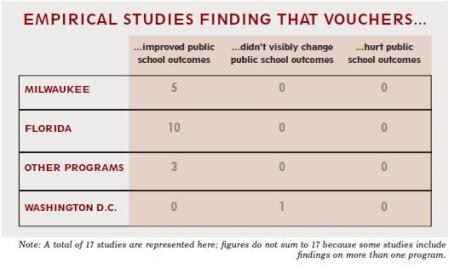
Worth a thousand words, isn’t it? I mean, at what point are we allowed to say that people are either lying, or have been hoodwinked by other people’s lies, when they say that the research doesn’t support a positive impact from vouchers on public schools?
There’s always room for more research. What would we all do with our time if there weren’t? But on the question of what the research we now have says, the verdict is not in dispute.
Here’s the executive summary of the report:
This report collects the results of all available empirical studies on how vouchers affect academic achievement in public schools. Contrary to the widespread claim that vouchers hurt public schools, it finds that the empirical evidence consistently supports the conclusion that vouchers improve public schools. No empirical study has ever found that vouchers had a negative impact on public schools.
There are a variety of explanations for why vouchers might improve public schools, the most important being that competition from vouchers introduces healthy incentives for public schools to improve.
The report also considers several alternative explanations, besides the vouchers themselves, that might explain why public schools improve where vouchers are offered to their students. It concludes that none of these alternatives is consistent with the available evidence. Where these claims have been directly tested, the evidence has not borne them out. The only consistent explanation that accounts for all the data is that vouchers improve public schools.
Key findings include:
- A total of 17 empirical studies have examined how vouchers affect academic achievement in public schools. Of these studies, 16 find that vouchers improved public schools and one finds no visible impact. No empirical studies find that vouchers harm public schools.
- Vouchers can have a significant positive impact on public schools without necessarily producing visible changes in the overall performance of a large city’s schools. The overall performance of a large school system is subject to countless different influences, and only careful study using sound scientific methods can isolate the impact of vouchers from all other factors so it can be accurately measured. Thus, the absence of dramatic “miracle” results in cities with voucher programs has no bearing on the question of whether vouchers have improved public schools; only scientific analysis can answer that question.
- Every empirical study ever conducted in Milwaukee, Florida, Ohio, Texas, Maine and Vermont finds that voucher programs in those places improved public schools.
- The single study conducted in Washington D.C. is the only study that found no visible impact from vouchers. This is not surprising, since the D.C. voucher program is the only one designed to shield public schools from the impact of competition. Thus, the D.C. study does not detract from the research consensus in favor of a positive effect from voucher competition.
- Alternative explanations such as “stigma effect” and “regression to the mean” do not account for the positive effects identified in these studies. When these alternative explanations have been evaluated empirically, the evidence has not supported them.
13 Comments | competitive effects, research reports, vouchers | Tagged: Friedman Foundation, Greg Forster | Permalink
Posted by Greg Forster

(Guest post by Greg Forster)
Randi Weingarten explained this week that, contrary to the outrageous slander that the unions are against education reform, she’s actually in favor of having the federal government create rigorous national academic standards for public schools, and will remain in favor of it as long as the Democrats are in power. (I’m paraphrasing.)
She writes: “Should fate, as determined by a student’s Zip code, dictate how much algebra he or she is taught?”
So the AFT now endorses the principle that a child’s education should not be determined by Zip code? When did that happen?
And if a child’s Zip code shouldn’t determine how much algebra he or she is taught, why should that determination be made in Washington instead? Apparently the amount of algebra you learn should be determined not by your Zip code, but by your international dialing code.
At least with Zip codes, some families can exercise school choice by moving to a different neighborhood. Yes, it’s an unfair system, since not all families are equally mobile; apparently Weingarten thinks the fair thing to do is to take away the freedom now enjoyed by some parents, so that there will be an equality of unfreedom.
Here we see the real modus operandi of the Left – achieve equality by leveling downward.
1 Comment | politics, residential school choice, school accountability, teacher union, vouchers | Tagged: Greg Forster, national standards, Randi Weingarten | Permalink
Posted by Greg Forster

One of the great things about these here inter-web thingies is their ability to hold newspapers accountable when they make mistakes. And the editorial by Maureen Downey that the Atlanta Journal Constitution ran last week on vouchers was very much mistaken. In it Downey claimed “in the handful of states that have conducted experiments with vouchers, the results contradict claims of improvement by Johnson and other voucher advocates… Yet, in return for zero impact, Johnson proposes to dismantle public education in Georgia.” She also described “vouchers as a threat to the bedrock American belief that public education is critical to the health of the democracy and should not be sacrificed to political agendas.”
To support her overwrought claims she cites a newspaper article on Ohio’s voucher program, studies of the voucher programs in DC and Milwaukee conducted by my colleague Pat Wolf, and a review of the literature by Barrow and Rouse. Unfortunately she cites all of them selectively or misinterprets their findings as showing “zero impact.” Fortunately, Pat Wolf noticed her incorrect interpretation of his work and sent a letter, which the AJC ran today.
But letters are limited in length and less salient than the editorials they attempt to correct. In the old days when newspapers were the only game in town, it was very difficult to hold newspapers accountable for editorials that were factually inaccurate. They might have run letters, like the one Pat Wolf submitted, but they wouldn’t even have to do that if they didn’t want to.
With the inter-webs we not only have Pat Wolf’s letter in the AJC, we can also circulate it by posting it on blogs, like I just did. And we can add additional material, for which there would have been no space in the letters section. So let me add that here is a complete list of random-assignment studies of the effects of vouchers on students who use them. Here is a summary of the effect of vouchers on the public school system. And here is random-assignment research on the effect of charter schools on participants. And if she thinks choice destroys democracy, here is a review of that literature showing that she is mistaken about that as well.
If Maureen Downey and the Atlanta Journal Constitution want to say that evidence shows “zero impact” from vouchers, then they have to explain away all of this evidence. And if they don’t want to justify their claims in the pages of their paper, we can hold them accountable on the web.
(edited for typos)
1 Comment | vouchers | Tagged: Jay Greene, Jay P. Greene, Maureen Downey, Patrick Wolf | Permalink
Posted by Jay P. Greene
(Guest post by Greg Forster)
On Saturday the Cincinnati Enquirer ran a story on how Ohio is sitting on a bunch of student outcome data for the EdChoice voucher program and neither doing anything with them nor releasing them to researchers who could do something with them. I’m told it was picked up by AP.
The story is generally good. Transparency is always preferable. Student privacy concerns do limit the extent to which the state can release data to the general public, but the state ought to be able to release a lot more than it has, and it also ought to license private researchers to use more sensitive data on a restricted basis, just as NCES does.
The story’s author, naturally enough, wanted to provide what little data are available. So she provided the number of EdChoice students who failed the state test in each subject.
Readers of JPGB probably already know this, but any outcome measurement that just takes a snapshot of a student’s achievement level at a given moment in time, rather than tracking the change in a student’s achievement level over time, is not a good way to measure the effectiveness of an education policy. A student’s achievement level at any given moment in time is heavily affected by demographics, family, etc. Growth over time removes much of the influence of these extraneous factors (though obviously it doesn’t remove absolutely all the influence, and further research controls or statistical techniques to remove these influences more are preferable).
Moreover, EdChoice program is specifically targetd to students in the very worst of the worst public schools. These are students who are starting from a very low baseline. We should expect these students’ results to remain well below those of the general student population even if vouchers are having a fantastically positive effect. So the need to track students over time rather than simply take a snapshot of their achievement levels is especially acute here. Only a rigorous scientific study can examine whether the EdChoice voucher program is improving these students’ performance – and to do that we’d need the data that the state is sitting on.
Also, a binary measurement of outcomes (pass/fail) is never as good as a scale. The state is sitting on scale measurements of the students’ performance, but from the Enquirer story it appears that it won’t release them.
And the Enquirer was only able to obtain these pass/fail results for 2,911 students out of about 10,000 served by the program.
All that said, I don’t blame the Enquirer for reporting what few data were available. The story is focused on the state’s stinginess with data, not the performance of the program as such.
But what headline did the paper put on the story?
“Ed Choice Students Failing.”
Of course the story’s author doesn’t choose the headline. And the person who did choose the headline almost certainly had to do so under intense deadline pressure, without much space to work with, and with no knowledge about the issues other than what could be gleaned from a very quick and superficial reading of the story. Still, since the story clearly focuses on the issue of the state’s sitting on valuable data without using them, you would think they could come up with something like “Voucher Data Not Used.”
3 Comments | journalism, vouchers | Tagged: Cincinnati Enquirer, EdChoice, Greg Forster | Permalink
Posted by Greg Forster

(Guest post by Greg Forster)
Since we’re on a money kick this week, let’s combine that theme with education (this blog is still about education, right?) and note that our friend Marcus Winters has an article on NRO today on how vouchers save money.
For those looking to dig deeper, here’s an analysis of the fiscal impact of every school choice program from 1990 through 2006. Every program was at least fiscally neutral, and most saved money.
3 Comments | school funding, vouchers | Tagged: Marcus Winters | Permalink
Posted by Greg Forster
My colleague Pat Wolf released today a new study of the DC voucher program based on focus group interviews of families. It found high levels of parental satisfaction with the program, even among families that returned to the public system. People appreciated having the choices and felt more involved in their children’s education.
Of course, these satisfaction outcomes don’t usually move the debate very much. Opponents of voucher programs tend not to be persuaded by parental reports of satisfaction because they doubt the judgment of parents. That’s why they are skeptical about choice. And supporters of vouchers view satisfaction outcomes as important, but they are already inclined to trust parental assessments.
But the report provides plenty of contextual information that is useful and interesting even if it is not decisive. A new test score analysis of the DC voucher program is expected sometime this Spring.
Leave a Comment » | vouchers | Tagged: Jay Greene, Jay P. Greene, Pat Wolf, school choice, vouchers | Permalink
Posted by Jay P. Greene

(Guest post by Greg Forster)
A while back, I posted this to help people find comprehensive lists of the research on various subjects related to school vouchers. It’s a list of lists – in case you’re looking for a list of all the available research on whether vouchers improve education for the kids who use them, or whether they improve public schools, and so forth. Some of the lists are more scholarly and contain a lot of technical information, while some are presented in a more easily accessible format.
Well, here’s a big update on the list-of-lists front: the Friedman Foundation has released a set of “myth buster” guides to the research on the six most common school choice myths. For each myth they’ve provided a brief, handy reference sheet and a slightly longer, more detailed guide to the research. Even the detailed version of each myth buster is still less technical than the other lists on my “meta-list” page, compiled by Jay and other scholars, but it does go over the most important technical issues (how do we distinguish the impact of vouchers from the impact of other factors like family influence?) and provides the references you’ll need to dig further if you wish.
Myth: Vouchers hurt public schools and take the best and brightest.
Research: Short version, detailed version.
Myth: Private schools aren’t really better than public schools.
Research: Short version, detailed version.
Myth: Vouchers will lead to increased segregation.
Research: Short version, detailed version.
Myth: Private schools are hostile to tolerance and democratic values.
Research: Short version, detailed version.
Myth: Vouchers are costly and drain money from public schools.
Research: Short version, detailed version.
Myth: Private schools exclude difficult students.
Research: Short version, detailed version.
Take note that these are true comprehensive lists, including all high-quality studies on each of these questions. I’ve noticed that it’s always voucher supporters who are willing to discuss all the evidence, while voucher opponents typically cherry-pick the evidence, mischaracterize the evidence they’ve cherry-picked, and then falsely accuse voucher supporters of cherry-picking evidence.
So I would say Jay’s theory about why school vouchers keep winning against impossible odds is well supported by the empirical evidence – although in this case I haven’t compiled a comprehensive list.
What stronger breastplate than a heart untainted!
Thrice is he armed that hath his quarrel just,
And he but naked, though lock’d up in steel
Whose conscience with injustice is corrupted.
Henry VI, Part II, Act 3, Scene 2
2 Comments | civic values, competitive effects, money myth, school funding, special ed, vouchers | Tagged: Friedman Foundation, Greg Forster, myth busters | Permalink
Posted by Greg Forster
It’s getting to be that time when people make lists of good and bad things that happened during the preceding year. Here’s mine from an interview with Michael F. Shaughnessy of EducationNews.org:
What were the 5 most important developments during 2008 that contributed to reform of K-12 education?
1) Barack Obama strongly endorsed the idea that expanding choice and competition is an important part of improving public schools. He limited his support to expanding choice and competition through the introduction of more charter schools, but the theory is not fundamentally different than doing the same with vouchers. Whether Obama follows through on this campaign position or not, it is now clear that it is considered politically desirable among both Democrats and Republicans to support choice and competition. Holdouts from this view, including the teacher unions on the left and curriculum-focused reformers on the right, are being increasingly marginalized.
2) Sarah Palin, in her only major policy speech, pushed the idea of special education vouchers. Like Obama embracing choice and competition, Palin embracing special ed vouchers is a symbol of the political attractiveness of the policy. Special ed voucher programs already exist in Florida, Georgia, Ohio, Utah, and Arizona (pending the resolution of a court case). I’d expect the idea to spread to several more states in the next four years regardless of Sarah Palin’s political prospects.
3) Reform ideas, including choice, merit pay, curbing teacher tenure, and promoting alternative certification, are gaining mainstream acceptance in the Democratic Party largely thanks to the efforts of Democrats for Education Reform. An important indication of this political shift was an event at the Democratic National Convention organized by the Democrats for Education Reform at which an audience of about 500 cheered speakers denouncing the teacher unions and embracing reform ideas. The Democratic supporters of reform largely (but not exclusively) consist of urban minority leaders, including Michelle Rhee, Joel Klein, Adrian Fenty, Cory Booker, Kevin Chavous, Al Sharpton, and Marion Barry. Go ahead and make all the Sharpton and Barry jokes you like, but this (mostly) minority defection of urban Democrats from union orthodoxy is like a political earthquake that will have important implications for future reform politics. And it’s true that some conservatives have begun backtracking on reform ideas, including Sol Stern, Diane Ravitch, and depending on the day of the week, Checker Finn and Mike Petrilli. But if the reform movement has traded some conservatives for the new generation of minority Democratic leadership, I think we’ve come out ahead.
4) We saw a string of new or expanded school choice programs in 2008. Georgia adopted a universal tax-credit supported voucher program. Louisiana adopted a voucher program for New Orleans as well as a personal tax deduction for private school tuition. Florida expanded and decreased burdensome regulation on its tax-credit supported voucher program. And Utah increased and secured a source of funding for its special ed voucher program. For a movement declared dead more times than Generalissimo Francisco Franco, school choice continues to grow.
5) I’ll take the privilege of the final development to brag about the launch of the new doctoral program in education policy in the Department of Education Reform at the University of Arkansas. It may not have been among the 5 most important developments in the whole country, but it was a big development in my little world. With the first cohort of students starting in the Fall of 2009 (supported by a pool of generous fellowships) and a collection of outstanding faculty, we have the potential to significantly increase the number of reform-oriented researchers in academia, think-tanks, and foundations.
What were the 5 most important developments during 2008 that hindered reform of K-12 education?
1) The reform movement lost two great champions this year with the passing of John Brandl and J. Patrick Rooney. Brandl, who had been the Democratic leader of Minnesota’s state senate and Dean of the University of Minnesota’s Hubert Humphrey School of Public Policy, contributed significantly to the argument that choice was not only efficient, but also enhanced opportunities for the disadvantaged. He helped create the state’s pioneering charter school law and other choice programs. Brandl also served as mentor to many of today’s leading choice researchers. Rooney, who had always been active in the civil rights movement, personally sponsored scholarships for disadvantaged students to attend private schools. His privately financed program became a model for publicly funded voucher and tax-credit supported scholarship programs.
2) In 2008 we saw a number of “implementation” problems undermine otherwise promising reform initiatives. For example, Georgia adoption a social promotion policy that required students to pass a test or follow a formal exemption policy to be promoted in certain grades. My research with Marcus Winters on a similar policy in Florida suggested that it would improve student achievement. But in several districts around Georgia more than 90% of students were promoted without passing the test and without following the formal exemption procedure. They simply disregarded the law on a large scale with no consequences for any district or school employee. Another promising idea undermined by implementation was Reading First. There is a lot of rigorous science to support a phonics-based reading approach, but getting public schools to do it well is a completely different matter. Implementation also appears to have done-in a promising teacher mentoring program. I could go on, but the point is that there is no shortage of clever reform practices out there. The problem is that without addressing the lack of proper incentives in the public education system to improve, we regularly see these clever practices fall flat. We need incentive-based reforms along with reform of educational practices.
3) Earlier this year an Arizona court struck down voucher programs for students with disabilities and students in foster care on the grounds that the state constitution forbids aid to private schools. This month defenders of the program argued on appeal to the state Supreme Court that the program aids students, not schools. And the state already sends disabled students to private schools when it is determined that the public schools are unable to provide adequate services. That practice may also be in jeopardy, even though it is actually required by federal law (IDEA). Who knows how this will all be resolved, since courts can adopt any interpretation they like, reasonable or unreasonable. But court action has prevented these beneficial programs from operating and threatens to kill them.
4) A Florida court struck down the ability of a state commission to approve charter schools. If upheld by the (notorious) Florida Supreme Court, only school districts could approve charters and existing charters approved by the state commission may have to be closed. Giving districts the exclusive power to grant charters essentially allows the districts to decide with whom they will have to compete. It’s like giving McDonalds the exclusive power to approve the opening of all new restaurants. The state Supreme Court used the same narrow interpretation of clauses in the state constitution to strike down the Opportunity Scholarship voucher program, so the prospects for a vibrant and competitive charter sector in Florida are not good.
5) And finally the most disappointing development of 2008 is that we spent another half trillion dollars on public education without significantly altering the dysfunctional system that fails to teach a quarter of 8th grade students to read at a basic level or get them to graduate from high school. Results for minority students are significantly worse. The economic bailout may be a $700 billion enterprise, but the public school system spends almost that much each and every year. Every year that we spend that money without fundamentally altering how we operate public education is another fortune wasted and another year lost for millions of students.
(Note: corrected spelling of Marion Barry’s name)
3 Comments | politics, social promotion, vouchers | Tagged: Jay Greene, Jay P. Greene, Michael F. Shaughnessy | Permalink
Posted by Jay P. Greene
You are currently browsing the archives for the vouchers category.

 Jay P. Greene's Blog