(Guest Post by Matthew Ladner)
Reason TV on DC vouchers. BOOOOOM!
(Guest Post by Matthew Ladner)
Reason TV on DC vouchers. BOOOOOM!
 1 Comment |
  vouchers | Tagged: D.C. vouchers, Reason Foundation, Reason TV |
  Permalink
 Posted by matthewladner
This one is from the ranking minority member of the House Committee on Oversight and Government Reform, Rep. Darrell Issa. Rep. Issa wants to know who at the U.S. Department of Education knew what and when did they know it concerning the D.C. voucher evaluation released weeks after a crucial vote to kill the program.
Here is the press release from Issa’s office in full:
WASHINGTON. D.C.– House Committee on Oversight and Government Reform Ranking Member Darrell Issa (R-CA) sent a letter today to Education Secretary Arne Duncan questioning the timing of a study evaluating the District of Columbia Opportunity Scholarship Program (OSP) which revealed that participants in the program outperformed those not in the program with regard to reading tests and other key measurements.
“Prior to the release of the OSP evaluation, the Omnibus Spending Bill was passed by Congress and signed by the President on March 11, 2009. The bill contained a thinly disguised “poison pill” which had the effect of terminating the OSP, threatening to force those students with these scholarships back into dangerous, academically-underperforming schools, and preventing others from being offered such scholarships in the future,” Issa wrote. “I am puzzled by the timing of the release of the positive OSP evaluation; just three weeks after Congress de facto killed the program on March 11. It is highly possible that Congress might not have terminated the OSP if my colleagues, not to mention the White House, had known that this positive evaluation was about to be issued.”
Issa notes that Oversight Committee Republicans have received credible information that DOE officials were aware of the positive report but kept quiet until after Congress had acted to kill the program. The letter asks Sec. Duncan to provide a response to key questions by May 13thbefore the Senate Committee on Homeland Security and Government Affairs is scheduled to hold a hearing on the OSP.
Specifically, Issa asks the Secretary to provide the following:
Leave a Comment » | vouchers | Permalink
Posted by Jay P. Greene
(Guest Post by Matthew Ladner)
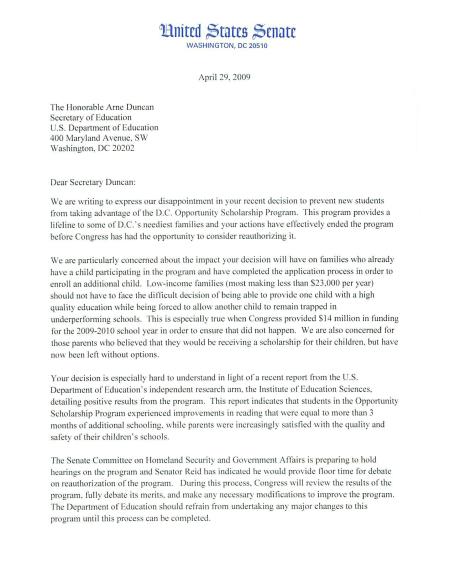

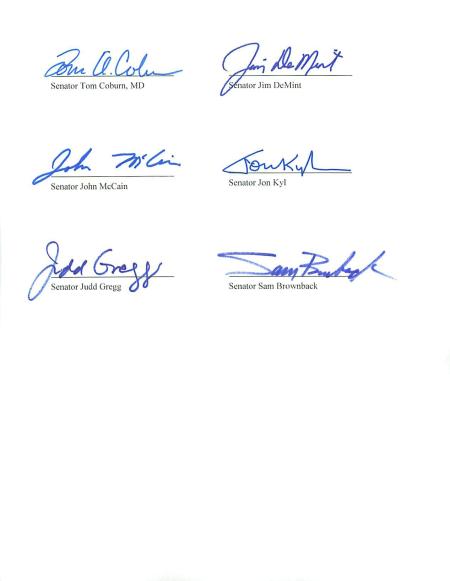
Leave a Comment » | vouchers | Tagged: Arne Duncan, D.C. vouchers, Diane Feinstein, George Voinovich, Jim DeMint, Joe Lieberman, John Cornyn, John Ensign, John McCain, Jon Kyl, Judd Gregg, Lamar Alexander, Robert Byrd, Sam Brownback, Susan Collins, Tom Coburn | Permalink
Posted by matthewladner
(Guest Post by Matthew Ladner)
The MacIver Institute, Wisconsin’s new think-tank, released a report today by yours truly comparing the NAEP scores of Wisconsin and Florida. Let’s just say that UW-Madison would have probably fared better against the national champion Florida Gators in football last year.
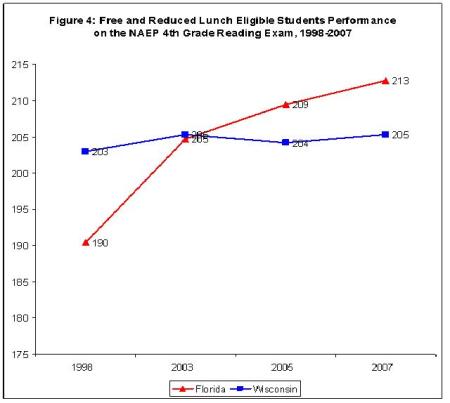
Florida spends considerably less per student than Wisconsin and has a student profile considerably more challenging. Despite that fact, Florida surpassed Wisconsin overall on 4th grade reading (although within the margin of error) on 4th Grade Reading scores in 2007.
Most impressively, this gain was driven by much larger gains among traditionally underperforming student groups. The figure above shows the progress among Free and Reduced lunch kids in Florida and Wisconsin. In 1998, Florida’s low-income students were an average of 13 points behind their peers in Wisconsin. In 2007 however they had raced 8 points ahead.
Among African American students, Florida and Wisconsin once shared space near the bottom in reading achievement. Wisconsin is still there. Florida’s African Americans students now outscore their peers in Wisconsin by 17 points.
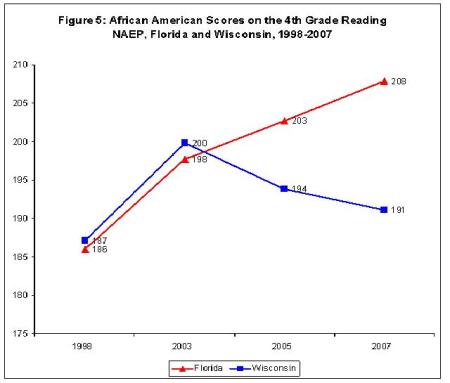 One finds the same pattern among children with disabilities. In 1998, Wisconsin students with disabilities scored 18 points higher than those in Florida. In 2007, it was 4 points lower.
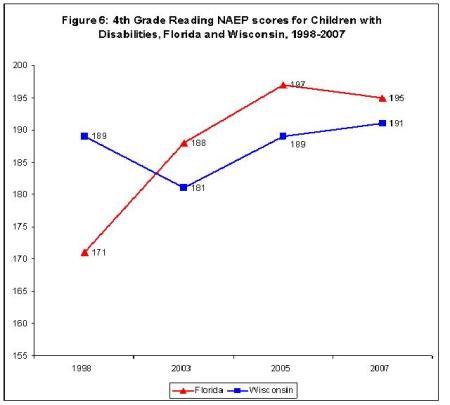
The problem isn’t that Wisconsin’s scores are low, it is that they are flat. When the Fordham Foundation found that Wisconsin had the lowest NCLB standards in the country it hinted that the state had not been vigorous in pursuit of broad K-12 reform.
Wisconsin of course was a trailblazer in parental choice with the Milwaukee Parental Choice Program. The learner has surpassed the master however with two statewide parental choice programs- one for low-income children, and one for children with disabilities. If anyone can explain why a low-income child in Milwaukee deserves an opportunity to attend a private school, but a similar child in Racine does not, I’d love to hear why. Florida also has a stronger charter school law.
Rather than sporting the lowest NCLB standards in the country, Florida doggedly pursued top-down accountability with the FCAT and grading schools A to F, and creating real consequences for school failure.
Florida embraced genuine alternative teacher certification, Wisconsin has not.
I am open to correction by my Cheesehead friends, but my distant view from the far-away desert leads me to wonder if Wisconsin may have become complacent when it comes to education reform. Coasting on their demographics, avoiding the tough calls and controversy necessary to improve public schools.
If so, perhaps inspiration can be drawn from the state song:
On, Wisconsin! On, Wisconsin!
Grand old Badger State!
We, thy loyal sons and daughters,
Hail thee, good and great.
On, Wisconsin! On, Wisconsin!
Champion of the right,
“Forward”, our motto,
God will give thee might!
Time will tell whether progressive Wisconsin will take this lying down. Will “Forward” or “comfortably stalled” be a better fitting motto for Wisconin in the next decade?
3 Comments | school accountability, vouchers | Tagged: MacIver Institute, Matthew Ladner | Permalink
Posted by matthewladner
(Guest Post by Matthew Ladner)
The Washington Post editorial page weighs in again on choice, this time in the context of the Forest Grove vs. T.A. case pending before the United States Supreme Court.
The WaPo raises an interesting question: if special needs students have a right to a private school remedy in cases where the public schools have failed to provide an appropriate education, why shouldn’t other children poorly served by public schools enjoy the same right? Kids like those attending DC public schools. A strong case can be made that public schools have horrendous track record in educating both inner city children and children with disabilities.
Of course you wouldn’t want to clog the courts with lawsuits like the special needs law created. A voucher program with a voucher amount less than the total spending per pupil would be far more equitable and efficient.
Leave a Comment » | vouchers | Tagged: D.C. vouchers, DC Opportunity Scholarships, Forest Grove vs. T.A., Washington Post | Permalink
Posted by matthewladner
(This is an update of a post I wrote on August 25, 2008. It now includes the new Milwaukee study.)
In an earlier post I listed all analyses of the effects of U.S. vouchers on program participants using random-assignment experiments. Those studies tell us about what happens to the academic achievement of students who receive vouchers. But we all recognize that expanding choice and competition with vouchers may also have significant effects on students who remain in traditional public schools. Here is a brief summary of the research on that question.
In general, the evidence on systemic effects (how expanding choice and competition affects the performance of traditional public schools) has more methodological limitations than participant effects studies. We haven’t been able to randomly assign school districts to increased competition, so we have more serious problems with drawing causal inferences. Even devising accurate measures of the extent of competition has been problematic. That being said, the findings on systemic effects, like on participant effects, is generally positive and almost never negative.
Even in the absence of choice programs traditional public schools are exposed to some amount of competition. They may compete with public schools in other districts or with nearby private schools. A relatively large number of studies have examined this naturally occurring variation in competition. To avoid being accused of cherry-picking this evidence I’ll rely on the review of that literature conducted by Henry Levin and Clive Belfield. Here is the abstract of their review, in full:
“This article systematically reviews U.S. evidence from cross-sectional research on educational outcomes when schools must compete with each other. Competition typically is measured by using either the HerfindahlIndex or the enrollment rate at an alternative school choice. Outcomes are academic test scores, graduation/attainment, expenditures/efficiency, teacher quality, students’ post-school wages, and local housing prices. The sampling strategy identified more than 41 relevant empiricalstudies. A sizable majority report beneficial effects of competition, and many report statistically significant correlations. For each study, the effect size of an increase of competition by one standard deviation is reported. The positive gains from competition are modest in scope with respect to realistic changes in levels of competition. The review also notes several methodological challenges and recommends caution in reasoning from point estimates to public policy.”
There have also been a number of studies that have examined the effect of expanding competition or the threat of competition on public schools from voucher programs in Milwaukee and Florida. Here are all of the major studies of systemic effects of which I am aware from voucher programs in the US:
Milwaukee
Rajashri Chakrabarti, “Can Increasing Private School Participation and Monetary Loss in a Voucher Program Affect Public School Performance? Evidence from Milwaukee,” Federal Reserve Bank of New York, 2007; (forthcoming in the Journal of Public Economics)
Caroline Minter Hoxby, “The Rising Tide,” Education Next, Winter 2001;
Florida
Rajashri Chakrabarti “Vouchers, Public School Response and the Role of Incentives: Evidence from Florida“ Federal Reserve Bank of New York Staff Report, Number 306, October 2007;
Jay P. Greene and Marcus A. Winters, “Competition Passes the Test,” Education Next, Summer 2004;
Martin West and Paul Peterson, “The Efficacy of Choice Threats Within School Accountability Systems,” Harvard PEPG Working Paper 05-01, March 23, 2005; (subsequently published in The Economic Journal, March, 2006)
Jay P. Greene and Marcus A. Winters, “The Effect of Special Education Vouchers on Public School Achievement: Evidence From Florida’s McKay Scholarship Program” Manhattan Institute, Civic Report Number 52, April 2008. (looks only at voucher program for disabled students)
Every one of these 9 studies finds positive systemic effects. It is importantto note that Rouse, et al are ambiguous as to whether they attribute the improvements observed to competition or to the stigma of Florida’s accountability system. The other three Florida studies perform analyses that support the conclusion that the gains were from competitive pressure rather than simply from stigma.
Also Carnoy, et al confirm Chakrabarti’s finding that Milwaukee public schools improved as the voucher program expanded, but they emphasize that those gains did not continue to increase as the program expanded further (nor did those gains disappear). They find this lack of continued improvement worrisome and believe that it undermines confidence one could have in the initial positive reaction from competition that they and others have observed. This and other analyses using different measures of competition with null results lead them to conclude that overall there is a null effect — even though they do confirm Chakrabarti’s finding of a positive effect.
I would also add that Greg Forster and I have a study of systemic effects in Milwaukee and Greg has a new study of systemic effects from the voucher program in Ohio. And Greg also has a neat study that shows that schools previously threatened with voucher competition slipped after Florida’s Supreme Court struck down the voucher provision. All of these studies also show positive systemic effects, but since they have not undergone external review and since I do not want to overstate the evidence, I’ve left them out of the above list of studies. People who, after reading them, have confidence in these three studies should add them to the list of studies on systemic effects.
The bottom line is that none of the studies of systemic effects from voucher programs finds negative effects on student achievement in public schools from voucher competition. The bulk of the evidence, both from studies of voucher programs and from variation in existing competition among public schools, supports the conclusion that expanding competition improves student achievement.
(edited to add study by Greg on post-voucher FL and Jay’s study on McKay vouchers for disabled students)
(Updated 4/27/09 to include the new Milwaukee study)
5 Comments | competitive effects, vouchers | Tagged: vouchers; school choice | Permalink
Posted by Jay P. Greene
(This is an update of a post I originally wrote on August 21. I’ve included the new DC voucher findings.)
Here is what I believe is a complete (no cherry-picking) list of analyses taking advantage of random-assignment experiments of the effect of vouchers on participants. As I’ve previously written, 9 of the 10 analyses show significant, positive effects for at least some subgroups of students.
All of them have been published in peer reviewed journals or were subject to outside peer review by the federal government.
Four of the 10 studies are independent replications of earlier analyses. Cowen replicates Greene, 2001. Rouse replicates Greene, Peterson, and Du. Barnard, et al replicate Peterson and Howell. And Krueger and Zhu also replicate Peterson and Howell. All of these independent replications (except for Krueger and Zhu) confirm the basic findings of the original analyses by also finding positive effects.
Anyone interested in a more complete discussion of these 10 analyses and why it is important to focus on the random-assignment studies, should read Patrick Wolf’s article in the BYU Law Review that has been reproduced here.
I’m eager to hear how Leo Casey and Eduwonkette, who’ve accused me of cherry-picking the evidence, respond.
Greene, Jay P. 2001. “Vouchers in Charlotte,” Education Matters 1 (2):55-60.
Greene, Jay P., Paul E. Peterson, and Jiangtao Du. 1999. “Effectiveness of School Choice: The Milwaukee Experiment.” Education and Urban Society, 31, January, pp. 190-213.
Wolf, Patrick, Babette Gutmann, Michael Puma, Brian Kisida, Lou Rizzo, Nada Eissa, and Marsha Silverberg. March 2009. Evaluation of the DC Opportunity Scholarship Program: Impacts After Three Years. U.S. Department of Education, Institute of Education Sciences. Washington, DC: U.S. Government Printing Office. (In the fourth year report the sample size shrunk so that the positive achievement effect barely missed meeting a strict threshold for statistical significance — p < .06 just missing the bar of p < .05. But this new report was able for the first time to measure the effect of vouchers on the likelihood that students would graduate high school. As it turns out, vouchers significantly boosted high school graduation rates. As Paul Peterson points out, this suggests that vouchers boosted both achievement and graduation rates in the 4th year. Read the 4th year evaluation here.)
This 1 study concludes that no sub-group of student participants experienced achievement gains from the voucher:
(Update: For a review of systemic effect research — how expanded competition affects achievement in traditional public schools — see here.)
17 Comments | vouchers | Permalink
Posted by Jay P. Greene

What gives? A second Friday has passed without another sneaky political trick to rob low-income minority students of educational opportunities while attempting to attract as little media attention as possible. It’s almost like Obama and Duncan have stopped trying — like they are just phoning it in.
Or are they deterred by all of the media attention they did get?
Leave a Comment » | vouchers | Tagged: D.C. vouchers, Duncan, Obama | Permalink
Posted by Jay P. Greene

(Guest Post by Matthew Ladner)
In a bipartisan appeal, Senators Joe Lieberman and Susan Collins wrote a letter to Secretary Duncan asking him to reverse the Departments decision to rescind Opportunity Scholarships to 200 DC school children (HT Whitney Tilson).
The letter reads:
Dear Secretary Duncan,
We are following up on our letter dated March 17, 2009, asking that you refrain from making any administrative rules or policies that would disrupt the D.C. Opportunity Scholarship Program (OSP) or prevent the grantee from accepting applications and students for the 2009-2010 school year. Prior to a response to our inquiry, we were disappointed to learn that you subsequently made the choice not to allow new students to enroll in the program.
By preventing new scholarships from being awarded, you are effectively ending a program before Congress has had the opportunity to consider reauthorizing it. Therefore, we respectfully request that you consider reversing your decision.
As we noted in our letter to you, the future of the OSP is presently under consideration by the Senate Committee on Homeland Security and Governmental Affairs. We will be holding hearings on the program in May, and Majority Leader Reid has promised floor time to consider a reauthorization proposal. We respectfully request that you refrain from implementing significant changes to the program until we have an opportunity to review the program’s results, hold public hearings, and have a thoughtful debate about the future of the program.
Your recent decision to suspend the program for new entrants will hurt families who are searching for other options for their children. We understand that many of these parents had been notified that they would, in fact, receive scholarships for their children. Now that the DC Public School’s out of boundary process has been completed and the majority of public charter school deadlines have passed for the 2009-2010 school year, the suspension decision will leave these families with little or no opportunity to explore viable alternatives.
We will continue to support the D.C. Public School System in its efforts to improve outcomes for all students. However, in the interim, we must continue to provide options such as the OSP and provide families real choices in ensuring access to a quality education for their children.
We thank you for your immediate attention to this matter.
Sincerely,
Joseph I. Lieberman
Susan M. Collins
1 Comment | vouchers | Tagged: Arne Duncan, D.C. vouchers, DC Opportunity Scholarships, Joe Lieberman, Susan Collins | Permalink
Posted by matthewladner
 (Guest Post by Matthew Ladner)
Will Democrats live up to their ideals when it comes time to reauthorize DC Opportunity Scholarships, or shamefully repudiate those ideals with their actions? With a series of damning indictments piling up, none have been more accurate or pointed that this one by George Will:
As the president and his party’s legislators are forcing minority children back into public schools, the doors of which would never be darkened by the president’s or legislators’ children, remember this: We have seen a version of this shabby act before. One reason conservatism came to power in the 1980s was that in the 1970s liberals advertised their hypocrisy by supporting forced busing of other people’s children to schools the liberals’ children did not attend.
I predicted that a growing number of Democrats would not stand for this outrage, and today I am happy to say that the list is growing. Linked here is a letter sent by the chairmen of Democrats for Education Reform and the Black Alliance for Educational Options to Secretary Arne Duncan. As you’ll see, Kevin Chavous and Howard Fuller also address the subject of hypocrisy:
The one thing we know about both of you is that neither of you are hypocrites. But, by being unwilling to take a strong stand for these children and their families you are allowing yourselves to be placed in that category. It pains us to see you and the President being attacked this way. But, to be truthful it pains us more to see these children being denied the educational opportunity that the Opportunity Scholarship Program affords them.
If it has feathers, walks like a duck and quacks like a duck, chances are it’s a duck.
It’s still not too late for Obama and Duncan to redeem themselves. If however they choose to repeat the shameful practice of busing for other people’s children with choice for me but not for thee I believe they will find a growing number of Democrats actively opposing them on behalf of these children.
(edited for typos)
Leave a Comment » | vouchers | Tagged: Arne Duncan, BAEO, Black Alliance for Educational Options, DC Opportunity Scholarships, Democrats for Education Reform, DFER | Permalink
Posted by matthewladner
You are currently browsing the archives for the vouchers category.

 Jay P. Greene's Blog