Correcting a WSJ Error

July 23, 2009

White out

(Guest post by Greg Forster)

Today I sent the following letter to the Wall Street Journal:

To the Editor:

I wish to correct a factual error in your otherwise outstanding editorial “Bashing Career Colleges” (July 22). You erroneously state that “Pell grants and other public aid can be used like a voucher for public or private colleges and universities.” In fact, Pell grants and other government-sponsored college scholarships cannot be used “like” school vouchers because they are school vouchers.

As long as we’re asking why school vouchers are wonderful for students at non-profit colleges but deplorable for students at for-profit colleges, let’s also ask why they’re wonderful for students at non-profit colleges but deplorable for students at non-profit high schools!

Greg Forster

Senior Fellow, Friedman Foundation for Educational Choice


The Heathers Think-Tanks

July 15, 2009

DC-based think tanks run the risk of being obsessed with the latest policy fashion rather than searching for the best long-term solutions.  In the DC bubble, sticking to one’s principles and the evidence is difficult when there are no near-term prospects for advancing policies that are supported by those principles and evidence.  It’s tempting instead to switch one’s policy focus so that it is line with the the current administration and congressional majority.

I was reminded of these hazards of DC think tanks when I received an invitation to the latest Thomas B. Fordham Institute event: “With charter schools ascendant, is there still a future for vouchers?” 

There’s nothing wrong with organizing a panel to consider the relative policy merits of charters and vouchers.  What’s weird is the suggestion that if one policy is currently popular, another might not have a future.  It’s like having a panel that addresses the question:  With Democrats ascendant, is there still a future for the Republican Party? 

Things change.  The current dominance of the Democratic Party won’t last forever.  It may not even last more than a few years.  Similarly, the current popularity of charters relative to vouchers may not last very long.  Rather than assessing the future of policies based on their current popularity, shouldn’t we assess their substantive merits so that we can advocate for the policies that are the most effective?

And if we must obsess on the political prospects of policies rather than their substantive merits, it’s weird to pit the two policies against each other.  Wouldn’t it seem more reasonable to think that as school choice becomes more common, whether with charters or with vouchers, all forms of choice will become more politically palatable?  As I’ve argued before, vouchers have helped make the world safe for charters, so the two policies may work well together. 

Just because the current congressional majority is hostile to vouchers doesn’t mean that the idea has no future or that we have to pit it against other, similar policies that are currently more in fashion.  Dismissing policies because they aren’t on the agenda of the current majority is like the type of argument heard in the 1988 film, Heathers:  “Grow up Heather, bulimia’s so ’87.”


Why Should We Let People Vote?

July 14, 2009

Normally I’m a big fan of Dan Willingham’s ideas but he does have some blind spots.  In particular, Dan seems to miss the point on school choice.  His argument is that for school choice to work, parents have to be rational in making choices:

The logic of school choice seems obvious. If parents selected their children’s schools, they would not choose bad ones, so bad schools would not be able to survive. Schools would have to improve or close, just as a store that offers poor service will lose business to a store that offers better service.

Here’s my problem with that logic: I think it’s highly likely that many parents will choose bad schools.

People often make irrational decisions.

Dan is mistaken in that choice does not require perfect rationality on the part of parents.  All that it required is that parents, on average, will do better at picking schools for their children than the bureaucrats who design schools and compell children to attend those schools.

We all understand that human beings are imperfect and often make mistakes.  Even all of the research on systematic irrationality produces results that are familiar to most people.  The point is that the distant bureaucrat who assigns students to schools controlled by the bureaucrat also suffers from all of these same human foibles. 

Nor can we simply assume that the distant bureaucrat will be focused on academic quality more than parents are.  The distant bureaucrat, even more than parents, has interests that distract from the focus on academic quality.  For example, the bureaucrat might be more concerned about protecting the jobs and incomes of the adults working in schools because those people influence the bureaucrat’s own job status and income.  Just consider whether superintendents are free to do whatever works for kids regardless of the effect on adults working in the schools.

Some might counter that at least the bureaucrats are highly-trained and have access to a lot of information, while parents lack the expertise and information necessary to assess academic quality.  If we really believed this made the bureaucrats superior at making educational choices, we should ask ourselves:  why do we let people vote?

Rather than have individuals make choices about their leaders and policies, shouldn’t we let highly trained experts with superior access to information select our leaders for us?  Regular people may be prone to systematic irrationality when they vote.  In fact, there is a lot of research to support such a conclusion.  For example, people are more likely to vote for more attractive candidates.  Why should people be allowed to vote when: “it’s highly likely that many [voters] will choose bad [candidates]? ”

Of course, the reason why we have democracy despite our awareness of human irrationality is the same reason why we should have schools choice:  on average, people are better at making decisions that affect their own interests than are others.  Even poorly-educated people lacking information are likely to have more knowledge of their interests and how to pursue them than are others making decisions on their behalf.


DC Vouchers: One Step Up, Two Steps Back

July 13, 2009

Durbin

As Matt wrote on Friday, a majority of the DC City Council Members wrote a letter to Arne Duncan expressing their strong support of the DC voucher program, including expansion of the program beyond those currently using scholarships.  The WSJ has yet another great editorial on the topic.  It says, in part:

Earlier this year Illinois Senator Dick Durbin added language to a spending bill that phases out the D.C. Opportunity Scholarship Program after next year. The program provides 1,700 kids $7,500 per year to use toward tuition at a private school of their parents’ choosing. Mr. Durbin’s amendment says no federal money can be spent on the program beyond 2010 unless Congress reauthorizes it and the D.C. Council approves.

The D.C. Council’s letter shows that support for these vouchers is real at the local level and that the opposition exists mainly at the level of the national Democratic Party. Mr. Durbin has suggested that he included the D.C. Council provision in deference to local control. “The government of Washington, D.C., should decide whether they want it in their school district,” he said in March. Well now we know where D.C. stands. We will now see if the national party stands for putting union power and money above the future of poor children.

Will others who’ve offered DC local control as a reason for opposing the voucher program now come out in support of it?  (I’m looking at you, Kevin Carey.)

Unfortunately, even as vouchers benefited from the support of the DC City Council, Senator Durbin was busy introducing new, onerous regulations on the program in an appropriations bill last week.  In particular, his measures would require participating private schools to take the DC public school test rather than a nationally-normed standardized test, even though they may not have the same curriculum as DCPS.  His measures would also require the Secretary of Education to prohibit voucher students from attending any private school that was not deemed “superior” to DC public schools.  The language is unclear as to whether that means the average DC public schools, the best, the worst, or what. 

You know, this may not be such a bad idea.  Maybe no DC public school students should be forced to attend a public school that is worse than average.  How about if we offer them vouchers?

Wait, I’m sure that was not the intent of the new Durbin measures.  The clear purpose is to strangle the program with reasonable-sounding but truly crippling regulation while the entire program is eventually eliminated. 

Senator Feinstein attempted to remove the Durbin measures in the full committee and Senators Landreau and Byrd joined her in that effort.  But they failed on a tie vote.  It was particularly disappointing to see Senator Mark Pryor vote with Durbin.  Pryor has to be careful not to move further left than his Arkansas constituents as he follows the national leadership or he could finally face a serious challenger for re-election.


DC Council: Continue Opportunity Scholarships

July 10, 2009


(Guest Post by Matthew Ladner)

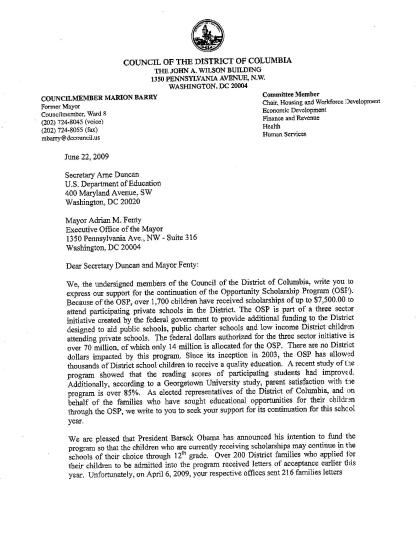
Yet another BOOOOOM! Now a majority of the DC City Council weighs in for DC Opportunity Scholarships!

Read the letter at the DC Children First website here.

Or read it below:DC letter 1 


DC letter 2 


WaPo: A Plea to Mr. Duncan

July 10, 2009

(Guest Post by Matthew Ladner)

The Washington Post brings it again on behalf of the victims of Department of Education’s slavish decision to deny over 200 children access to the DC Opportunity Scholarship Program.

Seven council members — including those who represent the poorest sections of the city — wrote to Mr. Duncan on June 22 challenging his decision not to admit new students to the D.C. Opportunity Scholarship Program. The federally funded program provides vouchers of up to $7,500 so that low-income students can attend schools of their choice. Because the program’s future is uncertain, Mr. Duncan decided — disappointingly to our mind — to rescind scholarships awarded to 216 families for this upcoming school year.

Ooops, there goes the local control argument. Perhaps Mr. Duncan and company would like to stand up and confess “We’d like to help these kids, but sadly, we toil as the servile minions of teacher union thugs. Please don’t pay attention to what we do, but rather to what we say. Move along, nothing to see here…”


PJM on School Choice’s Political Wins

July 8, 2009

(Guest post by Greg Forster)

This morning, Pajamas Media carries my column on the upside of the political picture for school choice:

Some people think it’s been all bad news for school choice this year. Well, it’s all bad news if you follow the standard procedure of only paying attention to the bad news. But last month, the movement scored a big win: Indiana enacted a $2.5 million choice program, the state’s first. And if you take a broader view, you’ll see there was other good news for school choice along with the bad in the 2009 legislative season.

This is important because we’ve seen some people occasionally seize on any piece of bad news as an excuse to declare vouchers politically dead. It’s an easy way to avoid taking a stand on the issue, and in some of the more egomaniacal cases, to show the world how amazingly cool and above it all you are.


UK Tories Propose Vouchers for Developing Countries

July 6, 2009

This is great news forwarded from Pauline Dixon, who with James Tooley, have done amazing work on the breadth and quality of private schooling in developing countries.  Here is part of the article in the Guardian:

Aid vouchers will be given to millions of people in the poorest parts of the world so they can shop around for the best schools and services, under Tory plans to inject free-market thinking into development policy.

A Conservative government would also spend part of the £9.1bn overseas aid budget on funding for private schools across the developing world, which it believes would achieve better results than state schools and drive up standards overall. The controversial plans are in a draft Tory policy document leaked to the Observer before publication this week of the government’s white paper on development.

Andrew Mitchell, the shadow international development secretary, confirmed last night that the Tories were “investigating” using aid vouchers “to empower people in developing countries”. He also said his party had no objection to supporting the growth of the private education and health sectors in the developing world.

“Governments have a responsibility to guarantee access to health and education for everyone, particularly the poorest,” Mitchell said. “We stand ready to work with public, private and not-for-profit sectors to help make that happen. I don’t have any ideological hang-ups about whether it’s private provision or public provision: I’m interested in what works.”

In his bid to promote compassionate Conservatism, David Cameron pledges to match Labour’s plans to increase development spending to 0.7% of GDP by 2013. The budget in 2010-11 will be £9.1bn. But the policy has not proved universally popular in the party, particularly on the right, where many believe too much aid money is wasted. A survey of Tory candidates found only 4% thought international development should be the policy most protected from cuts.

Cameron’s critics believe he is promoting Thatcherite policies for aid to appease the right and reassure them the money will be well spent. The draft document suggests planning for a voucher scheme is well advanced.

“The vouchers would be redeemable for development services of any kind with an aid agency or supplier of their choice,” it states. The paper also says that a Conservative government would “embrace the potential of the private sector, not treat it with suspicion” when administering the aid budget.

As a result it makes clear the Tories would support private education in countries such as Nigeria, Ghana, Kenya, India and China, where it claims it has delivered better results than state-run schools “even adjusting for children’s backgrounds”.

The paper states: “We will stand ready to work with the public, not-for-profit and private sectors. We will consider funding insurance schemes, bursaries or targeted vouchers for the poorest children to attend a school of their choice.”


Why Random Assignment is Important

July 2, 2009

Bill Evers has an excellent post over on his Ed Policy blog about how unreliable observational studies can be and how important it is to test claims with random-assignment research designs. 

Observational studies (sometimes called epidemiological or quasi-experimental studies) do not randomly assign subjects to treatment or control conditions or use a technique that approximates random-assignment (like regression discontinuity).  Instead they simply compare people who have self-selected or otherwise been assigned to receive a treatment to people who haven’t received that treatment, controlling statistically for observed differences between the two groups.  The problem is that unobserved factors may really be causing any differences between the two groups, not the treatment.  This is especially a problem when these unobserved factors are strongly related to whatever led to some people getting the treatment and others not. 

The solution to this problem is random assignment.  If subjects are assigned by lottery to receive a treatment or not, then the only difference between the two groups, on average, is whether they received the treatment.  The two groups should otherwise be identical because only chance distinguishes them.  Any differences between the two groups over time can be attributed to the treatment with high confidence.

If you don’t believe that research design makes a big difference, consider this table that Bill Evers provides on how much results change in the field of nutrition when random assignment (or clinical) studies are done to check on claims made by observational studies:

If we want to avoid the educational equivalent of quack medicine, we really need more random-assignment studies and we need to give the random-assignment studies we already have significantly greater weight when forming policy conclusions.

As I’ve written before, we have 10 random-assignment studies on the effects of vouchers on students who participate in those programs. Six of those ten studies show significant academic benefits for the average student receiving a vouchers and three studies show significant academic benefits for at least one major sub-group of students.  One study finds no significant effects.  

I believe that there are more random-assignment studies on vouchers than on any other educational policy and there are certainly more studies with positive results.  The depth of positive, rigorous studies on voucher participant effects is worth keeping in mind each time some new observational or (even descriptive) study comes out on school choice, including the most recent report from Florida.  Our opinion shouldn’t be based entirely on the latest study, especially if it lacks the rigorous design of several earlier studies.


The Rush to Judgment

June 30, 2009

David Figlio’s latest report on Florida’s Corporate Tax Credit (CTC) Scholarship program was released yesterday.  I can’t find the report online but Ron Matus of the St. Pete Times sent it to me and you can read about it in his article

(UPDATE:  Here’s a link to the study.)

I agree with almost everything said in the article.  I even agree with Mark Pudlow, the spokesperson for the teacher union when he said: “There is no quick fix for struggling students.” 

The problem is that the standard for success when it comes to school choice is that it has to produce a quick fix or critics deem it a failure and declare: “we really ought to reconsider why we’re doing it.”  No one demands that every other education policy produce huge gains in a single year or they should be “reconsidered.”  Yes, promoters of policies may make unrealistic promises to get them adopted, but the standard for success should be long-term progress, not promises made by politicians.

So let’s slow the rush to judgment and review what we really know about the CTC program.  First, Figlio finds that 92.7% of all CTC students in private schools provided a usable standardized test to the evaluation.  This shows widespread compliance with the legal requirements for those students to be tested to satisfy political concerns for accountability.

Second, Figlio finds that the CTC program has largely targeted students who are significantly more disadvantaged than students remaining in Florida’s public schools — even significantly more disadvantaged than public school students receiving subsidized or free lunch.  So, concerns that the program would cream off the best students appear unfounded.

Third, and most importantly, Figlio’s report does not make any claims about whether students benefited academically from participating in the CTC program.  He simply provides descriptive information on the academic achievement of CTC students as well as subsidized lunch students in Florida public schools.  But we know that CTC students are even more disadvantaged than those public school students and Figlio makes no attempt in this report to control fully for those disadvantages.

Figlio makes these points explicitly and repeatedly in the report: “it is important to recognize that they are not causal estimates of the effect of program participation on student outcomes. Causal comparisons require more complete modeling of the selection decisions into the scholarship program and fuller data from a baseline than is afforded using the 2006-07 school year test score collection. More compelling causal estimates of program participation will be possible following the collection of the 2008-09 school year’s test score data. The comparisons in this subsection should be interpreted as purely descriptive in nature.”

Unfortunately, most people never pay attention to these warnings and rush ahead as if descriptive information is causal.  Folks wrongly conclude that if CTC students make year to year test score gains that are about the same as subsidized lunch public school students, then they must not be benefiting from the program.  Nothing in Figlio’s report supports that conclusion. 

To know whether CTC students are benefiting we would have to know how they would be doing had they remained in public schools.  The best way to judge that is with a random-assignment study where students admitted to the CTC program by lottery are compared with students who lose the lottery and remain in public schools.  Unfortunately, that research design is not possible because there was no lottery.  The next best thing would be to use a research design that approximated random-assignment (like a regression discontinuity) or a rigorous quasi-experimental design that controlled for all observed differences between the two groups.  But Figlio didn’t do that in this report.  He just provided descriptive statistics while promising a more rigorous research design next year.

Of course, we might wonder why Figlio bothered reporting this descriptive information without a more rigorous analysis.  I suspect that he was required to produce a report each year by the legislature, so he complied even though he didn’t have the information he needed for a causal analysis. 

And the descriptive information is useful.  It suggests that choice was no miracle cure since the raw differences between CTC and public students in academic progress were not huge.  Again, miracle cure is the wrong standard for judging a program’s success. 

The CTC program may well have attracted students who had been on a downward trajectory before they switched to a private school.  And the CTC program may well helped those students level-off and may, over time, enable them to make significantly greater progress than they would have made had they remained in public schools.  This is what we’ve seen from rigorous evaluations of other choice programs, including the most recent evaluation of the DC voucher program.  But these things require careful research designs and time to show themselves.  Let’s give David Figlio more time to use a better research design so that we can actually say something about the academic effects of the CTC program.

(edited for typos)