Iowa Legislature Lines Up Another Enactment

June 30, 2011

(Guest post by Greg Forster)

Last night, Iowa’s House and Senate passed a budget that expands funding for the state’s tax-credit scholarship program. If the governor signs, as expected, that will bring us to fifteen school choice enactments and officially put us not just at, but over the benchmark for Matt’s “double down challenge”  in my bet with Jay Mathews.

And from what I hear, the next question isn’t whether we’ll get to sixteen. The question is, which state will get to fifteen first, and which will have to settle for sixteen – or seventeen, or eighteen . . .


Louisiana Doubles Down

June 28, 2011

Sorry, I couldn’t find “Louisiana Hold ‘Em”

(Guest post by Greg Forster)

Two Wisconsin enactments while I was travelling a week ago – expanding Milwaukee vouchers and creating a new voucher program in Racine – brought my ongoing humiliation of Jay Mathews to a total of 13 school choice enactments (new programs or expansions of existing programs). And that’s not even counting Oklahoma’s “expansion” of its special ed voucher program (the program was “expanded” to include students who were eligible to participate but were being illegally denied access by rogue school districts).

Governor Jindal just doubled us down by signing into law Lousiana’s expansion of its educational tax deduction, bringing us to 14 enactments on a bet that we wouldn’t reach seven.

Here’s the tally so far:

  1. UT Carson Smith expansion
  2. Douglas County, CO new voucher
  3. AZ new ESA
  4. DC voucher expansion
  5. IN new voucher
  6. IN new tax deduction
  7. IN tax-credit scholarship expansion
  8. OK new tax-credit scholarship
  9. FL tax-credit scholarship expansion
  10. FL McKay voucher expansion
  11. GA tax-credit scholarship expansion
  12. WI Milwaukee voucher expansion
  13. WI new Racine vouchers
  14. LA tax deduction expansion

Matt wants to know if there’s a mercy rule for wonk bets. As Ned Flanders once said, “Mercy is for the weak!”


Wisconsin Expands MPCP and Creates Choice for Racine

June 17, 2011

(Guest Post by Matthew Ladner)

Is there a mercy rule for wonk bets?

Greg continues to pound away on Jay Mathews even though JM is already lying on the canvas comotose. I’ve lost count, and we aren’t finished yet. Yesterday the Wisconsin legislature sent a budget to Governor Scott Walker that expands the Milwaukee Parental Choice Program in three important ways: removing the participation cap, lifting the income cap to include some middle income families, and allowing students to attend suburban private schools.

In addition, a new voucher program for Racine will come online next school year. Here are the details from the American Federation for Children.


Sell Outs

June 13, 2011

(Guest Post by Brian Kisida)

It’s truly a sad situation when once respectable organizations become so intertwined with the corrupting influence of party politics and the ulterior motives of other interest groups that they abandon their core principles.  Last week Matt referenced the newly invigorated war against charter schools in New York undertaken by the NAACP.  Also last week in Milwaukee the ACLU filed yet another lawsuit against a school choice program.

On the surface, the NAACP’s ongoing opposition to school choice just seems bizarre.  The overwhelming majority of school choice programs in the U.S., whether it be in the form of urban charter schools or means-tested voucher programs like those found in Milwaukee and D.C., serve distinctly minority and disadvantaged populations by design.  If there’s a rational argument out there that can explain why the NAACP, according to its own principles, should stand in opposition to school choice, I haven’t heard it.  And I’ve done plenty of searching.

But the NAACP supported rally that was held down in Harlem last week does provide the necessary connect-able dots to at least consider their motives.  Who was there?  Well, New York City Council member Robert Jackson spoke out against charter schools, and he invoked the long hard plight of the NAACP’s battle against discrimination in the process:

“NAACP has stood for over 100 years to fight discrimination. And we stand united, right here on 125th Street and Lenox Avenue and Malcolm X Boulevard to say we will fight all people, all people, that want to discriminate against us or our children.”

Of course, he failed to mention that before he became a council member in 2001, he was a Director of Field Services for the New York State Public Employees Federation.  And, while it may be unfair for me to insinuate that his close ties to public employee unions motivate his opposition to school choice, it isn’t unfair to say that his claims are fundamentally false.  Charter schools are open to all students, regardless of residential location.  By definition, freely chosen charter schools are less discriminatory than residentially-assigned schools.  Unless, somehow, you think a randomly chosen lottery ball is capable of discriminating.

Also in attendance was United Federation of Teachers President Michael Mulgrew.  He also played the equity card:

“The children from the charter school will get the science labs, and not the children from the public school…the children from the charter school will get the playground, and not the children from the public school.”

Of course, charter schools are public schools, and they are open to all students who apply.  Moreover, if Mulgrew really thinks that charter schools are so superior to “public” schools, then wouldn’t the proper thing to do–if one really cared about giving every child the best education possible–be to make every school a charter school?  Then they’d all get the science labs and new playgrounds, right?

I imagine this is how organizations like the NAACP will inevitably die.  They become so resistant to change and so corrupted by bad influences that eventually they become irrelevant.  The NAACP is squandering what little credibility it has left by opposing policies that are near and dear to the hearts of the people who should be their core constituents.  So it goes.

Up in Milwaukee, the ACLU is also doing its best to betray its own principles by fighting the expansion of Milwaukee’s Parental Choice Program (MPCP).  Like the NAACP, the American Civil Liberties Union is no friend of school choice.  Their own director, way back in 1994, agreed that school vouchers, if properly administered, were no more a violation of the First Amendment than were Pell Grants (which means they aren’t a violation at all).  But in the ensuing years, the ACLU has become one of the most vocal opponents of expanding individual liberty through school choice.  And it’s not exactly clear why.  At the very least, it’s worth noting that the word “liberty” doesn’t regularly appear in any of the ACLU’s public statements against school choice.

Last week, the ACLU filed a lawsuit claiming that the MPCP discriminates against children with disabilities and asked the Department of Justice to delay Governor Walker’s planned expansion of the program.  To make their case, they cite flawed statistics generated by the politically minded state Department of Public Instruction (DPI) that claim that nearly 20% of students in Milwaukee’s public schools have a disability, but only 1.6% of the students in the MPCP have the same condition.

Of course, the claim is misguided in multiple ways.  Independent research by Patrick Wolf from the University of Arkansas and John Witte from the University of Wisconsin does confirm an asymmetry with regard to disabled students, but not nearly as high as the one claimed by DPI and the ACLU.  In their analysis, they concluded that:

“Public schools have both strong incentives to classify students as requiring exceptional education, because they receive extra funding to teach such students and well-established protocols for doing so. Private schools have neither. A student with the same educational needs often will be classified as exceptional education in MPS but not so classified in the choice program.”

“Nine percent of choice parents said their child has a learning disability, compared to 18% of the parents of the carefully matched public school students in our sample. The proportion of students with learning disabilities in the choice program is about half that of MPS, but it is certainly not less than 1%, as the state Department of Public Instruction recently reported.”

In addition, the lawsuit brought by the ACLU completely ignores the funding disparity that exists between Milwaukee public schools and the voucher program.  Currently, students in Milwaukee’s public schools receive more than $15,000 in per-pupil funding, while students in the choice program receive $6,442.  If the ACLU were truly concerned about the liberties of disabled students and their families, wouldn’t it make the most sense to argue for an increase in the voucher amount for disabled students?  Wouldn’t that be the most liberty-maximizing course of action?

Like the NAACP, the ACLU has veered far from its own principles as an organization whose stated purpose is to “defend and preserve the individual rights and liberties guaranteed to all people in this country.”  And, like the NAACP, it’s largely because they’ve sold out.  They’ve gone from being an organization founded on certain principles to being simply another political hack-unit heavily influenced by party politics and the agendas of other interest groups.  Unless they can find a way to change, they’ll continue to slide towards complete and total irrelevance.

Prologue to Christie the First

June 10, 2011

(Guest Post by Matthew Ladner)

O for a Muse of fire, that would ascend
The brightest heaven of invention,
A state for a stage, governors to act
And lobbyists to behold the swelling scene!

Then should the warlike Christie, like himself,
Assume the port of Mars; and at his heels,
Leash’d in like hounds, should vouchers, sword and outsourcing
Crouch for employment. But pardon, and gentles all,
The flat unraised spirits that have dared
On this unworthy scaffold to bring forth
So great an object: can this cockpit hold
The vasty gardens of New Jersey? or may we cram
Within this wooden O the very debates
That did affright the air at Trenton?

O, pardon! Since a crooked figure may
Attest in little place a million;
And let us, ciphers to this great accompt,
On your imaginary forces work.
Suppose within the girdle of these walls
Are now confined two mighty forces,

One an immovable union blob and the other
an irresistible gubernatorial force
Piece out our imperfections with your thoughts;
Into a thousand parts divide on man,
And make imaginary puissance;

Think when we talk of vetoes, that you see them
Printing their proud script i’ the receiving bill;
For ’tis your thoughts that now must deck our policymakers,
Carry them here and there; jumping o’er times,

Turning the accomplishment of many years
Into an hour-glass: for the which supply,
Admit me Chorus to this history;

Who prologue-like your humble patience pray,
Gently to hear, kindly to judge, our play.


Why America Needs School Choice — Pre-Order Now

June 8, 2011

I have a mini-book making the case for school choice coming out on June 28.  You can pre-order it now at Amazon.


Special Ed Voucher Research

June 7, 2011

Marcus Winters and I have done a few studies on the effects of Florida’s McKay voucher program for disabled students.  These studies were published as Manhattan Institute reports:

“How Special Ed Vouchers Keep Kids From Being Mislabeled as Disabled,”  Manhattan Institute, Civic Report No. 58, August 2009.

“Evaluating the Impact of Special Education Vouchers on Public Schools,”  Manhattan Institute, Civic Report No. 52, April 2008.

It took a while, in fact a couple years, but a revised version of those two studies combined into one article has been published in the peer-reviewed journal, Educational Evaluation and Policy Analysis, which is the leading empirical publication sponsored by the American Educational Research Association.

You can read the full article on the EEPA web site here.

And here is the title and abstract:

Public School Response to Special Education Vouchers

The Impact of Florida’s McKay Scholarship Program on Disability Diagnosis and Student Achievement in Public Schools

Marcus A. Winters, University of Colorado at Colorado Springs

Jay P. Greene, University of Arkansas

Abstract

The authors expand on research evaluating public school response to school choice policies by considering the particular influence of voucher programs for disabled students—a growing type of choice program that may have different implications for public school systems from those of more conventional choice programs. The authors provide a theoretical framework to show that special education vouchers could influence both school quality and the likelihood that a school will choose to identify the marginal child as disabled. Using a rich panel data set from Florida, the authors find some evidence that competition from a voucher program for disabled students decreased the likelihood that a student was diagnosed as having a mild disability and was positively related to academic achievement in the public schools.


Freedom and School Choice

June 7, 2011

(Guest post by Greg Forster)

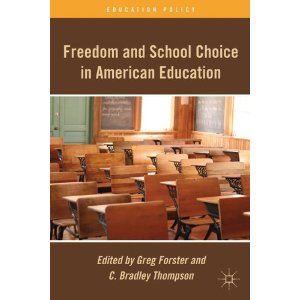
Today is the release of Freedom and School Choice in American Education, a new collection of essays on the purpose and direction of the school choice movement. Your JPGB favorites – Jay, Matt and myself – along with Andrew Coulson, George Clowes, Sheldon Richman, Pauline Dixon & James Tooley, and Brad Thompson lay out our diverse viewpoints on what we think the guiding vision for educational freedom in America ought to be, and what the school choice movement ought to do as a consequence. Paul Peterson provides the foreword.

What’s particularly valuable about this book, I think, is how it gives expression to the very different paths by which people come to hold educational freedom as an aspiration, and then connects those aspirational paths to the practical issues that face the movement in the short term. Jay comes to educational freedom with an emphasis on accountability and control; against the Amy Gutmanns of the world who want to set up educational professionals as authority figures to whom parents must defer, Jay wants to put parents back in charge of education. Matt comes to educational freedom with an emphasis on alleviating unjustified inequalities; against the aristocrats and social Darwinists of the world who aren’t bothered by the existence of unjustified inequalities, Matt wants social systems to maximize the growth of opportunities for those least likely to have access to them. And I come to educational freedom with an emphasis on the historical process of expanding human capacities, especially as embodied in America’s entrepreneurial culture; agaisnt all forms of complacency, I want America to continue leading the world in inventing ever better ways of flourishing the full capacities of humanity. And each of the other contributors has his or her own aspirational path.

This leads to an interesting constellation of agreements and disagreements about short-term tactics. Matt and I both emphasize the role of school choice in empowering entrepreneurs to invent new models. Matt emphasizes this because he knows it’s the only way to deliver better services to underserved populations; for me it’s about inventing the future for the nation as a whole. Matt wants to deliver a better education to kids now sitting in educational warehouses in Compton because he’s outraged at the injustice of a system that keeps kids in educational warehouses; my strongest motive for delivering a better education to those kids is because I want to unlock their potential to make a productive contribution to everyone.

Of course I share Matt’s outrage at injustice, and I’m sure he shares my aspiration to unlock the constructive potential of kids in Compton. Yet in important ways we end up coming down differently on tactics because we give primacy to different motives. Matt wants the school choice movement to focus on models targeted to underserved populations; he argues this is not only more just, but also has the greatest potential to demonstrate to a watching world how school choice can transform seemingly hopeless situations. But I argue agaisnt moving in that direction, preferring instead to push for more universal programs, because I’m worried school choice is getting trapped in a tiny niche that will, in the long run, undermine its ability to serve the larger goal of helping everyone flourish – not only because the programs end up being poorly designed, but because it isolates them from the mainstream of American culture.

On the other hand, Jay shares my orientation toward universal vouchers as the desirable model; he doesn’t seem to see anything special in targeted vouchers the way Matt does. Yet Jay strongly dissents from my desire to move forcefully toward universal vouchers in the short term; tactically, Jay is with Matt in that he wants to stick with narrow programs. That’s because Jay is a gradualist; he’s worried that trying to win too much too fast will do more harm than good. At the risk of some interpretive strech, I think this is ultimately because, as I’ve noted above, Jay is fundamentally worried about power. He wants to overthrow the Gutmann dictatorship, but he knows that overthrowing it rapidly would require us to become (or to make common cause with) revolutionaries. And revolutionaries are notoriously difficult to constrain. Jay doesn’t want to overthrow the Gutmann dictatorship by setting up a Forster dictatorship in its place. (Yeah, I know, it’s bizarre – but hey, it takes all kinds to make a world.)

Special thanks to the Foundation for Educational Choice and the Clemson Institute for the Study of Capitalism for co-sponsoring the conference that led to the book, and to Brad, who runs the Clemson Institute and co-edited the book with me.

If you’re going to be in Seattle for the Aug. 23-26 meeting of the State Policy Network, join us on Aug. 23 before the SPN meeting starts for a special event featuring Paul Peterson and the Freedom and School Choice contributors. It promises to be a lively time and well worth your attendance – and not just for the free food:

Kick off your SPN experience with the leading national figures in this year’s most successful policy movement – school choice and parental control of education. The Foundation for Educational Choice invites you to a half-day event on Aug. 23, with lunch provided. Featured speaker Paul Peterson of Harvard University will equip you with the latest research findings, and our panel of experts will provide up-to-the-minute discussion of political trends, innovative policy approaches, and the strategic and tactical issues every school choice advocate needs to know about. Plus, get a peek at the groundbreaking new book from Palgrave, Freedom and School Choice in American Education, co-sponsored by the Foundation for Educational Choice and the Clemson Institute for the Study of Capitalism.

The event is free – and hey, did I mention there’ll be food? (Don’t ask me how an organization founded by Milton Friedman ended up serving people a free lunch; it’s the mystery of market economics.)

The event will start at 12:00 so you have plenty of time to fly in beforehand, and we’ll be done with plenty of time to get over to SPN to register before it starts. To register for the pre-SPN event, contact Keri Hunter at keri@edchoice.org.


Oklahoma “Expands” Its Special Ed Vouchers

June 6, 2011

(Guest post by Greg Forster)

I missed this when it was signed into law a couple weeks ago, because it’s not what you traditionally think of as “expanding” a school choice program. But in addition to its new school choice program, Oklahoma has (ahem) “expanded” its existing voucher program for special needs students:

House Bill 1744 by State Rep. Jason Nelson (R-Oklahoma City) and State Sen. Patrick Anderson (R-Enid) changes the law so school districts will no longer administer the program. Instead, the Department of Education will administer it.

“Last year, several school districts failed to provide scholarships to eligible special needs students, flagrantly violating the law,” said Nelson. “Thanks to the modifications in this bill, the State Department of Education will administer the program rather than local school districts. This will provide consistency and certainty for students and parents who choose to participate in the program.”

Last year, lawmakers voted allow a student with a disability (such as those with Down syndrome or Autism) who has an individualized education program (IEP) to receive state-funded scholarships to attend a private school. The scholarships come from the amount of money already designated for the education of those children.

After the program went into effect last August, several Tulsa-area schools voted to break the law, leading lawmakers to adjust the program this year. [ea]

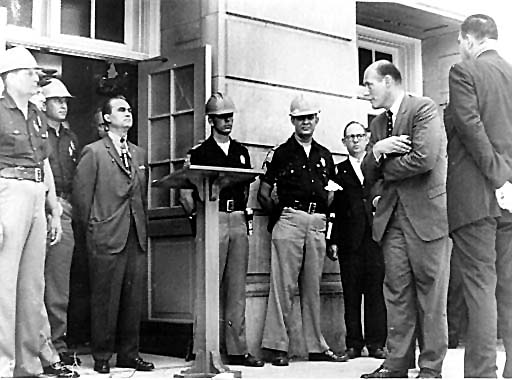
A little bit like Eisenhower sending federal troops to “expand eligibility” for schools in Little Rock.

Does this bring me to twelve enactments in my bid to run up the score on poor Jay Mathews? Alas, no. In the set of definitions we agreed to for purposes of the bet, “expanding” a program means “increasing the eligible student pool, or increasing the amount of funds available to support the program (on either a per-student or global basis).” As I wrote to Mathews at the time: “That’s in your favor because I’m agreeing not to count, say, relaxation of burdensome restrictions on participating schools as an expansion.”

It also means sending in the cavalry to force the powers that be to obey the frikkin’ law also doesn’t count.

Stay tuned! The year’s not done yet…


MPS Takes “Standing in the Schoolhouse Door” to a Whole New Level

May 31, 2011

(Guest post by Greg Forster)

Over the weekend, John Witte and Pat Wolf had a compelling article in the Milwaukee Journal Sentinel summarizing the real (as opposed to media-reported) results of the Milwaukee voucher program research being conducted by the School Choice Demonstration Project.

And then they dropped a bomb:

Recently, our research team conducted site visits to high schools in Milwaukee to examine any innovative things they are doing to educate disadvantaged children. The private high schools of the choice program graciously opened their doors to us and allowed us full access to their schools. Although several MPS principals urged us to come see their schools as well, the central administration at MPS prohibited us having any further contact with those schools as they considered our request for visits. We have not heard from them in weeks.

Our report on the private schools we visited, which will offer a series of best practices regarding student dropout prevention, will be released this fall. Should MPS choose to open the doors of their high schools to us, we will be able to learn from their approaches as well. [ea]

MPS opposition to vouchers takes standing in the schoolhouse door to a whole new level.