Wolf and McShane in NRO

February 1, 2013

(Guest Post by Matthew Ladner)

A few years ago, a rookie quarterback named Michael Bishop was brought into a game to perform a last second desperation bomb before the end of the half. It was his first pass as an NFL player, and against the odds it resulted in a long touchdown. Commenting on the pass for ESPN, Chris Berman said something to the effect of “Completion rate-100%. Pass to touchdown ration also 100%. QB Rating = INFINITY!!!!!”

This came to mind when reading this great piece by Wolf and McShane in that had Congress redirected money from the bloated and ineffectual DCPS for the Opportunity Scholarship Program, then  the cost of the program would have been nothing and the benefits substantial, meaning ROI = INFINITY!!!”

!!!BOOOOOOOOOOOOOOOOOOOOOOOOOM!!

[Note: This is based on their peer reviewed article that is in the current issue of Education Finance and Policy.]


The 123s of the ABCs

January 28, 2013

ABCs of School Choice 2013 Milton & Rose

(Guest post by Greg Forster)

My colleagues at the Friedman Foundation have released this year’s ABCs of School Choice, which you can find here – but only if you want the very latest and best data on school choice.

Just inside the cover is this striking photograph of Milton and Rose, which I had never seen before. Coming up on seven years after his passing, I’m tremendously heartened by the progress school choice has made. Right up until his death Milton was boldly predicting that he would live to see one state enact a universal voucher. As I’ve said on numerous occasions, it was a gutsy thing to say for a man who had seen the far side of 90 and was cracking jokes about having outlived the actuarial tables.

Next to the photo appears this statement, which first ran in The School Choice Advocate in 2004:

Government is committed to assuring that all children receive a minimum education. It currently does so by setting up and running schools, assigning students within a designated catchment area to each school. Students are thereby deprived of choice. They go to the designated school or else they do not benefit from the government commitment and their parents must pay twice for their education—once in the form of taxes, again in tuition.

Equally important, government is deprived of the benefits of competition. It is as if the government decided that the automobiles it uses must be built in government factories. What do you think the quality and cost of government cars would be? Or, to take another example, it is as if recipients of food stamps were required to spend them in a specified government-run grocery store.

It is only the tyranny of the status quo that leads us to take it for granted that in schooling, government monopoly is the best way for the government to achieve its objective.

A far more effective and equitable way for government to finance education is to finance students, not schools. Assign a specified sum of money to each child and let him or her and his or her parents choose the school that they believe best, perhaps a government school, perhaps a private school, perhaps homeschooling. Let the schools in turn, whether government or private, set their own tuition rates, and control their own operating procedures. That would provide real competition for all schools, competition powered by the ultimate beneficiaries of the program, the nation’s children.

ABCs of School Choice 2013 Milton signature

Check it out.


Amid Talk of Gun Control, Don’t Forget School Reform

January 22, 2013

(Guest Post by William Mattox)

Amid all the talk about gun control and mental health reform, one important question begged by last month’s tragedy in Connecticut has gone unasked:  Is there anything we can do about the structure of education that might help lower the risk of another school massacre?  I believe there is – and a poignant story (and some very interesting research data) will help explain why.

Two of my children once attended a small private school in a town where we had just moved.  Early in the fall semester, another new kid at that school – a boy with Asperger’s Syndrome who would now be 19 or 20 years old – had several emotional “meltdowns” as he sought to adjust to his new routine.  This unsettling behavior caused some school officials, and a number of concerned parents, to wonder if our school was equipped to handle the challenges presented by this student (whom I’ll call “Bradley”).

Bradley’s teachers rallied to his cause.  They appreciated his keen intellect.  And they were reluctant to give up on him – partly because Bradley had had a rough childhood.  (His condition had been misdiagnosed for years, causing household stress that contributed to his parents’ divorce).  But there was an even greater reason for the teachers’ reluctance: Since this was a Christian school, the teachers felt they had a special responsibility to “go the extra mile” with social outcasts like Bradley.  Even if this was, at times, difficult.

So, Bradley remained a part of our school.  And the teachers who’d had experience working with Asperger’s students helped those who’d had none.  And they all sought to teach their students some important “life lessons” about dealing with people who are different from you.

Apparently, some of these lessons got through.  One day, I chaperoned a dance at the school.  When it came time for the first number, I saw one of the most popular teen girls in the school maneuver into a position where she could be the first girl Bradley asked to dance.  This girl didn’t have a romantic interest in Bradley.  But she did have a heart of compassion – and a maturity beyond her years.  And she recognized that no girl would be apt to dance with Bradley unless someone like her saw past his social awkwardness and validated his worth.  As a human being.  As a child made in the image of God.

After the dance, Bradley got into his mother’s van and made a peculiar announcement.  “Today, I placed my hand on the hip of four different girls,” he said.  These odd words brought tears to his mother’s eyes, for she understood them to mean that her socially-awkward son’s yearning for human connection, for some measure of normal acceptance, had been met in a most meaningful way that day.

Now, I don’t want to insinuate that an episode like this could have only occurred at a Christian school – or that it would have happened at every faith-based private school.  But when I consider how their Christian faith affected the way these teachers and students treated Bradley, I can’t help but affirm the Florida policymakers who created the McKay scholarship program that made it possible for Bradley to attend a private school of his family’s choosing.  Especially since a recent research study suggests that Bradley’s experience at that school was not that unusual.

According to a Manhattan Institute study, 47 percent of McKay scholarship recipients had been picked on often at their local public school – and 25 percent had been victimized physically. At their new schools, chosen for them by their parents, only 5 percent of these special needs students experienced frequent harassment and only 6 percent were physically mistreated.

In view of all this, I think every state ought to adopt programs like Florida’s McKay scholarships (or Arizona’s Educational Savings Accounts) which give families of special needs students the freedom to choose learning options for their children beyond those available at their local public school.  For many Asperger’s children (and other students with special needs) yearn for human connection and social acceptance – and delight when others affirm their worth in the eyes of God.

William Mattox is a resident fellow at the James Madison Institute and a Florida Voices columnist.  His four children have all attended public high schools.


Wolf and Witte Slam Ravitch on Milwaukee School Choice

January 18, 2013

Dwight Howard winning the 2008 Slam Dunk Contest.

As I’ve said before, I’m trying to avoid writing about Diane Ravitch because I think it’s now clear to all sensible people that she has gone completely nuts, lacks credibility, and was probablnever much of a scholar.  But I just can’t resist posting a link to the editorial my colleagues Pat Wolf and John Witte wrote today in the Milwaukee Journal Sentinel.  Wolf and Witte are responding to an earlier op-ed by Ravitch in which she declares:

Milwaukee needs one public school system that receives public dollars, public support, community engagement and parental involvement.

Vouchers and charters had their chance. They failed.

Wolf and Witte actually review the evidence on Milwaukee’s choice programs, including their own research.  They conclude:

Our research signals what likely would happen if Ravitch got her wish and the 25,000 students in the Milwaukee voucher program and nearly 8,000 children in independent charter schools were thrown out of their chosen schools. Student achievement would drop, as every student would be forced into MPS – the only game in town. Significantly fewer Milwaukee students would graduate high school and benefit from college. Parents would be denied educational choices for their children.

That’s not a future we would wish for the good people of Milwaukee.

There’s no point in trying to persuade Ravitch or her Army of Angry Teachers, since they abandoned rationality a long time ago.  But Wolf and Witte have done an excellent job of equipping sensible people with evidence that could help inform their views about school choice in Milwaukee.  Angry blather and bold (but false) declarations cannot compete with actual facts.

[Edited to correct typo in title.]


Shanker Institute Scholar Bounded in a Nutshell but Counts Himself a King of Infinite Space

January 15, 2013

(Guest Post by Matthew Ladner)

Matthew DiCarlo of the Shanker Institute has taken to reviewing the statistical evidence on the Florida K-12 reforms. DiCarlo reaches the conclusion that we ultimately can’t draw much in the way of conclusions regarding aggregate movement of scores.  He’s rather emphatic on the point:

In the meantime, regardless of one’s opinion on whether the “Florida formula” is a success and/or should be exported to other states, the assertion that the reforms are responsible for the state’s increases in NAEP scores and FCAT proficiency rates during the late 1990s and 2000s not only violates basic principles of policy analysis, but it is also, at best, implausible. The reforms’ estimated effects, if any, tend to be quite small, and most of them are, by design, targeted at subgroups (e.g., the “lowest-performing” students and schools). Thus, even large impacts are no guarantee to show up at the aggregate statewide level (see the papers and reviews in the first footnote for more discussion).

DiCarlo obviously has formal training in the statistical dark arts, and the vast majority of academics involved in policy analysis would probably agree with his point of view. What he lacks however is an appreciation of the limitations of social science.

Social scientists are quite rightly obsessed with issues of causality. Statistical training quickly reveals to the student that people are constantly making ad-hoc theories about some X resulting in some Y without much proof. Life abounds with half-baked models of reality and incomplete understandings of phenomena, which have a consistent and nasty habit of proving quite complex.

Social scientists have developed powerful statistical methods to attempt to establish causality techniques like random assignment and regression discontinuity can illuminate issues of causality. These types of studies can bring great value, but it is important to understand their limitations.

DiCarlo for instance reviews the literature on the impact of school choice in Florida. Random assignment school choice studies have consistently found modest but statistically significant test score gains for participating students. Some react to these studies with a bored “meh.” DiCarlo helps himself along in reaching this conclusion by citing some non-random assignment studies. More problematically, he fails to understand the limitations of even the best studies.

For example, even the very best random assignment school choice studies fall apart after a few short years. Students don’t live in social science laboratories but rather in the real world. Random lotteries can divide students into nearly identical groups with the main difference being that one group applied for but did not get to attend a charter or private school. They cannot however stop students in the control group from moving around.

Despite the best efforts of researchers, attrition immediately begins to degrade control groups in random assignment studies. Usually after three years, they are spent. Those seeking a definitive answer on the long-term impact of school choice on student test scores are in for disappointment. Social science has very real limits, and in this case, is only suggestive. Choice students tend to make small but cumulative gains year by year which tend to become statistically significant around year three, which is right around when the random assignment design falls apart. What’s the long-term impact? I’d like to know too, but it is beyond the power of social science to tell us, leading us to look for evidence from persistence rates.

So let’s get back to DiCarlo, who wrote “The reforms’ estimated effects, if any, tend to be quite small, and most of them are, by design, targeted at subgroups (e.g., the “lowest-performing” students and schools). Thus, even large impacts are no guarantee to show up at the aggregate statewide level.”  This is true but fails to recognize the poverty of the social science approach itself.

DiCarlo mentions that “even large impacts are no guarantee to show up at the aggregate statewide level.” This is a reference to the “ecological fallacy” which teaches us to employ extreme caution when travelling between the level of individual and aggregate level data. Read the above link if you want to know all the brutally geeky reasons why this is the case, take my word for it if you don’t.

DiCarlo is correct that connecting the individual level data (e.g. the studies he cites) to aggregate level gains is a dicey business. He however fails to appreciate the limitations of the studies he cites and the fact that the ecological fallacy problem cuts both ways. In other words, while generally positive, we simply don’t know the relationship between individual policies and aggregate gains.

We know for instance that we have a positive study on alternative certification and student learning gains. We do not and essentially cannot know however how many if any NAEP point gains resulted from this policy. The proper reaction for a practical person interested in larger student learning gains should be summarized as “who cares?” The evidence we have indicates that the students who had alternatively certified teacher made larger learning gains. Given the lack of any positive evidence associated with teacher certification, that’s going to be enough for most fair minded people.

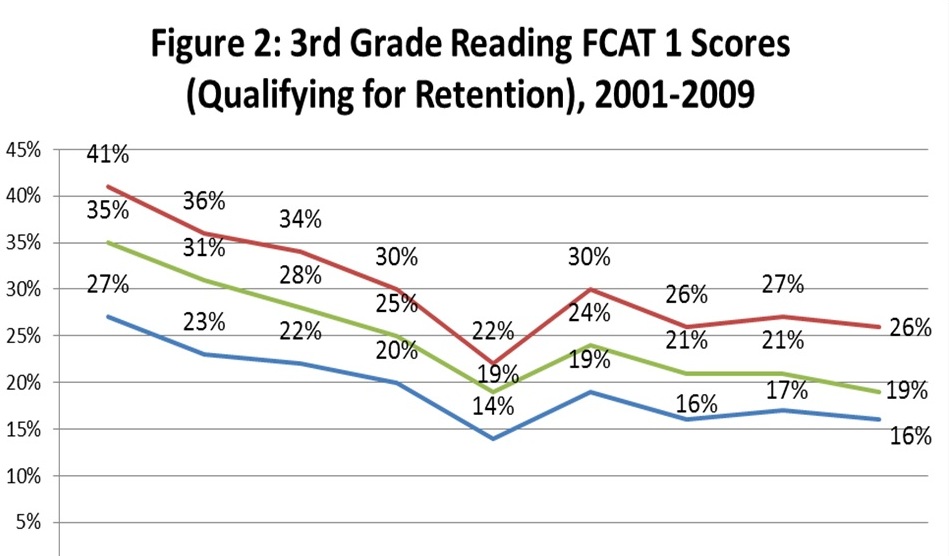
FCAT 1

The individual impact of particular policies on gains in Florida is not clear. What is crystal clear however is the fact that there were aggregate level gains in Florida. You don’t require a random assignment study or a regression equation, for instance when considering the percentage of FCAT 1 reading scores (aka illiterate) above. When you see the percentage of African American students scoring at the lowest of five achievement levels drop from 41% to 26% on a test with consistent standards, it is little wonder why policymakers around the country have emulated the policy, despite DiCarlo’s skepticism.

I could go on and bomb you with charts showing improving graduation rates, NAEP scores, Advance Placement passing rates, etc. but I’ll spare you. The point is that there are very clear signs of aggregate level improvement in Florida, and also a large number of studies at the individual level showing positive results from individual policies.

The individual level results do not “prove” that the reforms caused the aggregate level gains. DiCarlo’s problem is that they also certainly do not prove that they didn’t. It has therefore been necessary from the beginning to examine other possible explanations for the aggregate gains. The problem here for skeptics is that the evidence weighs very much against them: Florida’s K-12 population became both demographically and economically more challenging since the advent of reform, spending increases were the lowest in the country since the early 1990s (see Figure 4) and other policies favored by skeptics come into play long after the improvement in scores began.

The problem for Florida reform skeptics, in short, is that there simply isn’t any other plausible explanation for Florida’s gains outside of the reforms. They flailed around with an unsophisticated story about 3rd grade retention and NAEP, unable and unwilling to attempt to explain the 3rd grade improvement shown above among other problems. One of NEPC’s crew once theorized that Harry Potter books may have caused Florida’s academic gains at a public forum. DiCarlo has moved on to trying to split hairs with a literature review.

With large aggregate gains and plenty of positive research, the reasonable course is not to avoid doing any of the Florida reforms, but rather to do all of them. In the immortal words of Freud, sometimes a cigar really is just a cigar.


Happy New Year

January 2, 2013

(Guest Post by Matthew Ladner)

Ed Week’s Sean Cavanaugh looks back at the school choice world of 2012 and looks ahead to 2013. Well worth a read.


Once Again, Dr. Mathews…

November 26, 2012

(Guest post by Greg Forster)

At what point does refuting Jay Mathews’ lame rationalizations of his politically chosen position become bad sportsmanship? Well, I suppose I left that exit behind miles back, having shamelessly run up the score on him during last year’s humiliating wager, and then followed up with this.

So if he were flogging the same old lame arguments in his recent column, I’d leave it alone. But he’s not. He’s got all new lame arguments!

The main thing I want to point out is that Mathews isn’t even pretending that vouchers are politically dead. That used to be his main argument (see Wager, Last Year’s Humiliating for more information). Now he doesn’t even gesture towards it.

See this?

That’s the trophy case I just bought because I ran out of room to store all the arguments my opponents stopped making.

So now that he’s abandoned his old lame rationalization for his politically selected position, what’s his new one? Apparently, a shocking Washington Post article recently “revealed” that parents, not the corrupt D.C. school bureaucracy, are in charge of deciding whether schools taking vouchers are doing well. No, seriously, that’s his argument.

In other news, a shocking post here on JPGB recently “revealed” that water runs downhill.

Mathews goes on at some length about one (1) voucher school that isn’t up to snuff. As opposed to the D.C. public school system! Mathews himself opens the column by admitting that “if I were a D.C. parent with little money and a child in a bad public school, I would happily accept a taxpayer-supported voucher to send my kid to a private school.” So that’s pretty much the only answer I need for that.

He also waves around some big dollar figures trying to create the impression that vouchers cost a lot of money, never comparing them to the amount we spend on D.C. public schools – twice as much (or more, depending on whose figures you use). Arrest that man for flagrant violation of the Denominator Law.

And he argues that if vouchers ever got big enough to serve lots of kids, they’d have no choice but to accept government control over voucher schools comparable to what charter schools have now. Tell that to Indiana and Louisiana, which just enacted gargantuan new voucher programs. Honestly, you would think by now he’d learn to check first.

Once again, Dr. Mathews, we see there is no lame rationalization for your politically chosen position you can possess which I cannot take away.

HT to unofficial honorary Al recipient George Mitchell


Brother Bob Smith Retires from Messemer

November 16, 2012

(Guest Post by Matthew Ladner)

Citing health issues, Brother Bob Smith has announced that he is stepping down from Messemer schools. Brother Bob was a leading light of the Milwaukee school voucher movement in addition to being a successful educator and school leader. Keep Bob in your thoughts and prayers as he faces additional surgery.


School Choice Expanding

October 11, 2012

Jonathan Butcher, my former colleague and an occasional guest blogger on JPGB, has an interesting new piece in Education Next on the flurry of expanding school choice over the last few years.  It begins with a bang:

One year ago, the Wall Street Journal dubbed 2011 “the year of school choice,” opining that “this year is shaping up as the best for reformers in a very long time.” Such quotes were bound to circulate among education reformers and give traditional opponents of school choice, such as teachers unions, heartburn. Thirteen states enacted new programs that allow K–12 students to choose a public or private school instead of attending their assigned school, and similar bills were under consideration in more than two dozen states.

With so much activity, school choice moved from the margins of education reform debates and became the headline. In January 2012, Washington Post education reporter Michael Alison Chandler said school choice has become “a mantra of 21st-century education reform,” citing policies across the country that have traditional public schools competing for students alongside charter schools and private schools.

But Jonathan goes on to warn that legal challenges are taking some shine off of the choice victories:

We must wait to see which laws will survive legal challenges and whether students will enroll while judges consider the programs’ constitutionality. While school-choice laws arrived en masse in 2011, and the laws that passed are bolder than ever, lawsuits keep the systemic change reformers hope for just out of reach.

As Terry Moe has warned, our political system is designed to offer many opportunities for organized interests to block new programs.  Then again, the courts are the establishment’s last ditch effort to block a program.  And the more they have to go to the courts the more they are losing, even if they occasionally halt a program with a legal challenge.


Progressives for School Choice

October 3, 2012

(Guest post by Greg Forster)

There was a time when Jack Jennings posed as a nonpartisan voice of apolitical wisdom. That was then! It was always a thin disguise, but the mask is really off now:

The Republicans’ talk about giving parents the right to choose is a politically expedient strategy … Just beneath the surface of the education rhetoric are political motivations to thwart integration, weaken the Democratic coalition, and cripple the teachers’ unions.

Over on RedefineED, Doug Tuthill responds with a really amazing history of progressive support for school choice. Go take a look! Even if you think you know this history, you’ll learn something.

Actually, Tuthill leaves two major figures off his list. Thomas Paine proposed school vouchers for England, justified as a way to advance the well being of the poor, in the appendix to the second edition of The Rights of Man. And J.S. Mill supported vouchers as a blow against socially conservative cultural dominance, writing that “A general State education is a mere contrivance for moulding people to be exactly like one another.”

(via Bill Evers)