Media Coverage of Field Trip Research

September 20, 2013

The Research

The Education Next Article on the Effects of Field Trips to Crystal Bridges

The Education Next Article on the Long-Term Effects of Field Trips to the Walton Arts Center

Commentaries

New York Daily News

The Huffington Post

Art Museum Teaching

Radio

NPR Affiliate in Arkansas, “Ozarks at Large

NPR Affiliate in Los Angeles, “Airtalk”

NPR Affiliate in New Hampshire, “Word of Mouth”

CBS Affiliate in San Francisco

TV:

KATV ABC

KFTA FOX

KFSM CBS

News Stories:

USA Today, State-by-State page (no link available)

The Atlantic

Education Week

Education Week (Walt Gardner)

Real Clear Arts

Politico

Deseret News

Tulsa World

The City Wire

Students First

District Administration

Podcasts

Gadfly Podcast (starting at 14:26)

Heartland Podcast

American RadioWorks

AP Coverage

Albany Times Union

Anchorage Daily News

Arkansas Online

Atlanta Journal Constitution

Austin American Statesman

Banner News

Belleville News Democrat

Beaufort Gazette

Beaumont Enterprise

Blytheville Courier News

Bradenton Herald

Centre Daily News

Dallas/Fort-Worth

Dayton Daily News

Fort Mill Times

Greenwich Time

Herald Online

Houston Chronicle

Idaho Statesman

Kansas City Star

Kentucky.com

KTBS

Ledger-Enquirer (Columbus, GA)

Miami Herald

Myrtle Beach

News Observer

San Antonio Express

San Francisco Chronicle

Seattle Post Intelligencer

Star Telegram

Sun Herald

Texarkana Gazette

The Bellingham Herald

The Daily Citizen

The Gazette (Colorado Springs)

The Modesto Bee

The News Times

The News Tribune

The Oklahoman

The Olathe News

The Olympian

The Republic (Columbus, IN)

The Sacramento Bee

The Telegraph

The Wichita Eagle

THV 11 CBS Little Rock

Tri-City Herald

Westport News

WRAL.com (North Carolina)

WSB TV Atlanta

(HT: Brian Kisida)

(UPDATED 10-1-13)


Discussing Field Trip Study Results

September 17, 2013

In case you missed it yesterday, you can view the event at Crystal Bridges at which we presented the results of our field trip study published in Education Next:

You can also listen to this interview that aired on the local NPR affiliates’s show, Ozarks at Large.


Beyond the Lamp Post

September 16, 2013

There’s an old joke about the social scientist who was searching for his keys at night under a lamp post.  His student came along to help and asked him where he last remembered having his keys.  He said he thought he dropped them further down the block.  “Well, why are you looking here?” asked the student.  “Because the light is better under the lamppost,” replied the social scientist.

This joke tells us a lot about education policy research.  Scores of researchers are slicing and dicing math and reading standardized test results in every way imaginable, and their policy recommendations are focused on how these outcomes can be maximized.  While important, those standardized test results don’t capture every outcome we expect from our education system.  We also expect our schools to prepare students to become civilized human beings by making them aware of our cultural heritage, teaching them to think critically, and instilling tolerant and empathetic values.  But because we don’t have readily available measures of these outcomes, education researchers generally don’t examine whether schools are successful in producing them.  We prefer to look only under the lamp post.

In a new study published today in Education Next, my colleagues Brian Kisida, Dan Bowen, and I look down the block from the lamp post.  We experimentally analyze the extent to which culturally enriching field trips to an art museum and a performing arts theater produce benefits for students.  We find that they do.  Students assigned by lottery to receive field trips learn academic content, increase critical thinking, become more tolerant and empathetic, and are more likely to become cultural consumers who seek these enriching experiences on their own in the future. In short, they become a little bit more civilized.

The benefits for disadvantaged students (minority, low-income, or rural) are generally two to three times larger than the average effect.  Schools appear to play a critical role in exposing disadvantaged students to culturally enriching experiences, which they may not get if schools do not take them.

Our main study focuses on a randomized controlled trial involving almost 11,000 students who were awarded field trips by lottery to see the Crystal Bridges Museum of American Art or to have their tour deferred.  We also have a brief sidebar summarizing a natural experiment in which attendance zone boundary changes caused about 1,300 students to experience more or fewer field trips to see live performances at the Walton Arts Center.  Both studies produce very consistent results.

The advantage of the Walton Arts Center study is that it shows that the benefits of culturally enriching field trips compound and endure over time.  But the identification of causation in the Crystal Bridges study is more airtight.  Together, they tell a powerful story about important educational outcomes that can be discovered when we look beyond the lamp post.


Charter Schools Push Out Their Students?

September 11, 2013

(Guest Post by Collin Hitt)

Charter schools push out students who fall behind academically – that’s how they achieve superior results, right?* This is one of the main claims of charter school opponents, a claim that calls the moral character of charter school employees into question.

Charter schools – especially “no excuses” schools – thrive off of promises to recruit and educate students who would otherwise be left behind. Poor kids. Minority kids. Kids with low test scores who can’t read. A movement that promises to educate these kids only to slyly turn them away in favor of their higher-performing peers, is a movement of charlatans.

A forthcoming article looks at the issue. Ron Zimmer and Cassandra Guarino,in Education Evaluation and Policy Analysis, examine the transfer-out patterns in a large urban school district with nearly 60 charter schools. It is by far the largest, high-quality study to ever look at the issue.

Their main finding:

The coefficient estimates suggest that low-performing students at TPS schools are 1% to 5% more likely (at statistically significant margin) to transfer than above-average students, although the statistical significance may be achieved in part due to the large sample size. Low-performing students are neither more nor less likely to transfer out of charter schools.

They find no evidence that charter schools are pushing out their lowest-performing students. But wait – did anybody else catch that? – what did they write about traditional public schools? From the next paragraph of their study (emphasis added):

This suggests that low-performing students are more likely to transfer out of a [traditional public school] than a charter school. But again, the differences are relatively small—about 5%. Overall, the results across all models provide no evidence that low-performing students are more likely to exit a charter school than a high-performing student or a low-performing student in a TPS.

This study shows that in one very large urban district, there’s no evidence that charter schools are pushing out their bottom performers. The same cannot be said of the district’s traditional public schools. Let’s be charitable to the traditional public schools in that district; perhaps the findings that their lower-performers are more likely to leave is a result of the fact that those parents are seeking to leave for charter schools. Or perhaps this finding is just a fluke with Zimmer and Guarino’s model, and there’s really no difference at all in the exit rates of low performers in the district’s charter and traditional schools. Those are plausible ways to interpret the findings. (Can anyone think of plausible, less charitable ways to view these findings?)

Now ask yourself, had Zimmer and Guarino instead arrived at the opposite results – charter schools are more likely than traditional public schools to see their lowest performing students leave – would charter opponents be this generous in their interpretation? My guess is that the web would be somewhat more atwitter about this study, which deserves better coverage than it’s getting.

* The most rigorous research on charter schools uses random assignment. In the intent-to-treat components of these studies, students are considered charter students if they’re ever offered a seat in a charter school. Regardless of whether the students accept the offer, and regardless of whether students transfer out of charter schools at a later date, they are still considered charter school students in the ITT analysis. Yet random assignment studies consistently find positive results for charter schools, especially in urban areas where they are most likely to encounter disadvantaged students. Even if charter schools were pushing out their students – which apparently they’re not doing, according Zimmer and Guarino – it couldn’t explain these gains.


Fix Schools by Not Fixing Schools

September 10, 2013

The title of this post seems like the traditional zen koan asking “What is the sound of one hand clapping?”  How are we supposed to fix schools without fixing schools?  The answer to this question may not require Buddhist reflection.  We can fix schools — that is, traditional public schools — by going around them.  We can expand access to other educational options, including charter schools, voucher schools, tax-credit schools. ESAs, digital schooling, home-schooling, and hybrid schools.  We can also expand access to enriching non-school activities, like museums, theaters, historical sites, summer camps, and after-school programs.  Reformers should concentrate their energy on all of these non-traditional-school efforts and stop trying so hard to fix traditional public schools.

The main reason we should stop focusing on fixing traditional public schools is that, for the most part, they don’t want to be fixed.  The people who make their living off of those schools have reasons for wanting schools to be as they are and have enormous political resources to fend off efforts to fundamentally change things.  Trying to impose reforms like merit pay, centralized systems of teacher evaluation, new standards, new curriculum, new pedagogy, etc… on unwilling schools is largely a futile exercise.  They have the political resources to block, dilute, or co-opt these efforts in most instances.

Trying to impose these reforms despite fierce resistance from traditional public schools usually does not improve outcomes for students but it does produce a series of negative side-effects.  First, attempting to impose reforms on a politically powerful and unwilling school system generates an enormous amount of strife and hostility.  Teachers and their friends hate it.  Reformers waste energy and resources.  Little is changed but everyone walks away hurt, drained, and distracted from more productive activities.

Second, attempting to impose reforms on traditional public schools requires a significant increase in centralized political control.  Reformers can’t possibly fight their battles in thousands of individual school districts, so they favor centralizing power in the hands of big city mayors, state departments of education, and the federal government.  They see it as one-stop-shopping.  If they can cram their preferred reforms through those centralized authorities, then they think they will have won the battle in each district and school controlled by that centralized authority.   But they are likely to lose even when they can concentrate their fire on the centralized authority.  And even if they prevail at the centralized level, traditional public schools are usually able to subvert and render inert most reforms through poor implementation.  The reforms usually fail but the centralization remains, which is harmful in a variety of ways, such as generally undermining our long-standing and effective system of federalism and reducing access to educational alternatives through Tiebout choice.

Third, even in the rare cases where centralized reforms are adopted and implemented, the very nature of reforms that can jump those hurdles usually makes them ineffective or counter-productive.  Centralized reforms that can be adopted and implemented have to be watered-down enough to gain broad support for passage and implementation, rendering them mostly impotent.  And to the extent that they have some bite, they have to impose that bite uniformly on a large set of schools and circumstances, producing policies that are one size fits none.  Such reforms have to be crude things lacking in subtlety or nuance that could make them appropriate and effective in highly varied contexts.

Fourth, even if by some miracle an effective and appropriate centralized reform with bite is adopted and properly implemented, there is no natural political constituency to preserve the integrity of that reform over time.  These reforms may be adopted with support from business or taxpayer groups, but those political interests cannot sustain their focus on maintaining reforms over time.  They have to get back to their businesses and regular lives.  Meanwhile the angry teachers who had a reform crammed down their throats are still working in those schools and remain well-organized, ready to eviscerate reforms as soon as the temporarily-focused winning coalition moves on to other matters.  Centralized reforms to fix public schools do not create a constituency to protect them over time.  The coalition supporting centralized reforms is strongest at the moment of passage and steadily weakens over time, while opposing forces in traditional schools can bide their time and repeal or weaken reforms later.

The beauty of fixing schools by not fixing schools is that it generally avoids or reduces all of these problems.  Yes, traditional public schools resist the creation of alternatives, but they do not do so with the same ferocity that they oppose reforms that directly effect their daily working life.  Focusing on alternatives to traditional public schools also does not require any political centralization.  In fact, it generally encourages decentralized control over education.  Alternatives to traditional public schools do not impose one size fits none type solutions.  They let a thousand flowers bloom.  And alternatives to traditional schooling create their own political support that grows over time as more people benefit from those choice and non-school educational offerings.

I understand that urging reformers to focus on fixing traditional schools by not fixing traditional schools sounds like abandoning the millions of children who remain in those schools, but that is simply not the case.  The best hope for improving the situation of those children in traditional public schools is by expanding access to alternatives and enriching out-of-school experiences.  If we succeed in expanding access to quality alternatives, more and more of those children will benefit by being able to take advantage of those alternatives.  In addition, traditional public schools may be more willing and able to adopt reforms that are appropriate for their circumstances as they learn about what alternative providers are doing and feel some pressure to take steps to attract and retain their students.

Of course, expanding access to alternatives and improvements in the traditional system will likely be very gradual.  Some reformers are impatient and demand solutions now.  But there are no effective quick-fix reforms available.  It’s better to make gradual progress than inflict considerable damage in a rush to fix everything now.  And remember that just as starving children in Africa are not helped by our finishing all of the food on our plates, our futile efforts to impose centralized quick-fixes do not actually help those millions in traditional public schools.  The measure of a desirable reform should not be the extent to which it makes us feel like at least we are trying, even if those efforts are counter-productive.  We need to achieve the Buddhist serenity of fixing schools by not fixing schools.  Then we will understand what the sound of one hand clapping really is.


More Camp Liberty

September 9, 2013

Last month I had a post, “Camp Liberty,” in which I wrote:

At the time my fellow counselors and I used to joke that “boys day”resulted in an anarchic state like Lord of the Flies, with the only exception being that we didn’t kill Piggy.  But looking back on it, I see that summer camp was probably the closest thing to true liberty that our kids had experienced.  It was certainly more conducive to liberty than school, which gave almost exclusive emphasis to obedience to authority.  School was where kids were trained to obey the state and become cogs in a giant corporate machine.  Camp was where they learned to be free….

I’ve argued before that schools might have a lot to learn from camps.  They are both engaged in the activity of trying to prepare young people for adult life.  But I think camps are much more effective at preparing young people to be free adults.  I even think camps are remarkably effective at conveying traditional academic content.  And they do so at much lower cost. 

Continuing this theme I want to draw your attention to a great essay by Mark Slouka in the Wall Street Journal a few weeks ago describing his memories of summer camp.  Be sure to follow the link and read the whole piece but here is a good snippet:

How do you describe bliss for a sixth-grade boy? We ate what we wanted, slept when we wanted. Nobody cared. There were ponds. Older girls, their hair shining in the afternoon sun, lay out naked on floating rafts. This was scary. And not….

And so it went, a blur of mud and glory. When problems appeared, solutions—both eloquent and effective—were right behind. After listening to me argue with a kid named Scotty Steinberg for a week, Don went to the barn and came back with two pairs of boxing gloves. We should “figure it out,” he said. Everybody made a circle around us (something boys are hard-wired to do) and Scotty and I banged away at each other. I won. I think. After that we were friends and talked about it a lot….

During our last week, Don drove us to a rock climbing place near New Paltz, N.Y., where he introduced us to a guy named Tray who knew about climbing. Tray, as I recall, was very strong and didn’t wear underwear, and his girlfriend, who lived with him in the tent next to ours, often didn’t wear anything at all. Every now and then the screen door would unzip and Tray or his girlfriend would emerge from a cloud of smoke that didn’t smell at all like my father’s cigarettes.

Did we climb a cliff and risk our lives? Why, yes, we did. When another camper named David Mosher and I proved we could do 10 pull-ups on a tree branch (this was the qualifying test), Tray escorted us up a 250-foot cliff. I can vouch for the fact that 250 feet is very high. The pine trees between my sneakers looked about an inch tall. David started to cry. I was too scared to cry. When we came down, though, we told everybody it was fun. And it was. By God, it was.

When my father picked me up at the end of that month, he hardly recognized the feral, grinning creature that gave him a quick kiss and crawled into the back seat of the car. Or maybe he did, having been 12 once himself.

Yep.  Camp Liberty.


McGee and Winters Find and Then Eat the Pension Free Lunch

September 4, 2013

Building upon the work of Costrell and Podgursky, University of Arkansas alums, Josh McGee and Marcus Winters, have a fascinating report out today on how teacher retirement plans could be restructured in a cost-neutral way that would:

  • Raise teacher salaries, in some cases substantially;
  • Give teachers more retirement security than they now have;
  • Make teaching a more attractive option for people who are unsure that they will work for decades in the same school district; and
  • Offer teachers more control over when they stop working.

Of course, there is no such thing as a free lunch, but McGee and Winters have found something close.  The current system of back-loading teacher compensation to provide large pension benefits only to teachers who remain in their profession in the same state transfers wealth from more mobile or short-term teachers.  Smoothing out the spike in pension wealth and making some shift from deferred to current compensation would produce the benefits described above.  Some teachers might lose but the vast majority would come out ahead.  And the resulting system would be simpler, fairer, and more likely to attract quality people to teaching.

Here’s how McGee and Winters put it:

This paper examined the effect of cost-neutral changes to the structure of teacher compensation that, compared to current practices, would both increase teacher take-home salaries and offer a more secure retirement savings path for the majority of teachers.

Those who support the traditional DB pension systems that predominate across U.S. public schools correctly argue that such systems offer teachers a higher potential maximum retirement wealth than can be achieved under a cost equivalent smooth accrual system. However, our analysis makes clear that the higher maximum offered by the current system comes at a cost to a large share—often the heavy majority—of the teaching workforce: those who do not remain in their school systems for some three decades to become eligible for the maximum payout. In fact, these plans are explicitly designed to pay higher retirement benefits to long-career employees by reallocating wealth from teachers who exit the system earlier in their careers. As the detailed results for each of the 10 largest school systems provided in the final section of this paper demonstrate, in many systems these plans anticipate that the vast majority of teachers will not remain employed long enough to benefit from the traditional DB. Some long-serving teachers do well, but overall, this policy harms teachers’ retirement security.

This paper has also demonstrated the effect on teacher salaries of rebalancing the proportions of compensation that go to current salary versus retirement benefits. Our results demonstrate that such a reform would substantially improve teacher take-home salaries in some major school systems (though not in others). Of course, teachers require adequate retirement wealth; however, the heavy investment in retirement—only acquired by those teachers who remain in the classroom until the plan’s arbitrary normal retirement eligibility threshold—has artificially reduced teacher salaries in many school systems. If offered the opportunity, many teachers would likely prefer a system in which they took home a larger portion of their compensation than they do today.


Theater Field Trip Experiment

September 4, 2013

Continuing my effort to study how cultural experiences affect students, I am conducting an experiment in which school groups can win free tickets to see live theater performances.  Since I expect that there will be more demand for these free tickets than supply, the school groups will be awarded the tickets by lottery — allowing for a rigorous random-assignment analysis that compares outcomes for students whose groups won the tickets by lottery to those who did not.  The purpose of this experiment is to learn about how seeing live performances with their school may affect student understanding of great works of dramatic literature as well as influence their values (particularly tolerance and empathy) and their taste for future cultural consumption (e.g., going to the theater in the future, going to art museums, participating in theater, choir, etc…)

The project was announced today in conjunction with TheatreSquared, a nationally recognized theater company based in Fayetteville, Arkansas.  TheatreSquared will be adding 8 weekday matinees of its performances this season of A Christmas Carol and Hamlet, allowing almost 1,400 students to see these plays on school field trips.  To apply for these free tickets, school groups can complete the online application found here.  My students, Collin Hitt and Anne Kraybill, and I will study the impact of these performances on students.

This theater experiment follows on a study my colleagues, Brian Kisida and Dan Bowen, and I conducted on the effects of field trips to the Crystal Bridges Museum of American Art.  We similarly conducted lotteries to determine which school groups could visit the museum and studies how the experience affected students.  It also follows a natural experiment we examined in which students affected by the redrawing of school attendance zone boundaries were essentially randomly assigned to schools that went on more or fewer field trips to see live performances at the Walton Arts Center.  The results of those experiments will be published by Education Next on September 16.


The Future of School Choice – Today

August 29, 2013

(Guest Post by Lindsey Burke)

Second grader Nathan is the beneficiary of the new frontier of school choice: education savings accounts. “Two years ago, before the ESA program, Nathan spoke with a lot of jargon and mixed responses,” says his mother Amanda. “Two years ago we weren’t even sure if we were ever going to have a conversation with him. The only reason this is possible is because we could find programs that meet his needs with ESA funds.”

Thanks to Arizona’s pioneering Empowerment Scholarship Account program, which began in 2011, children with special needs like Nathan, as well as children from active duty military families, foster care, and children in underperforming schools can exit the public system and have 90 percent of what the state would have spent on their education deposited into an education savings account. Funds are deposited onto a restricted-use debit card, and parents are then able to direct spending to any education-related service or provider of choice.

Parents can use ESA funds, deposited into their accounts quarterly, to pay for a variety of education services and providers, including private-school tuition, private tutoring, special education services, homeschooling expenses, textbooks, and virtual education. Parents may also roll over funds from year to year, and can use the money to invest in a college savings plan to pay for college tuition in the future.

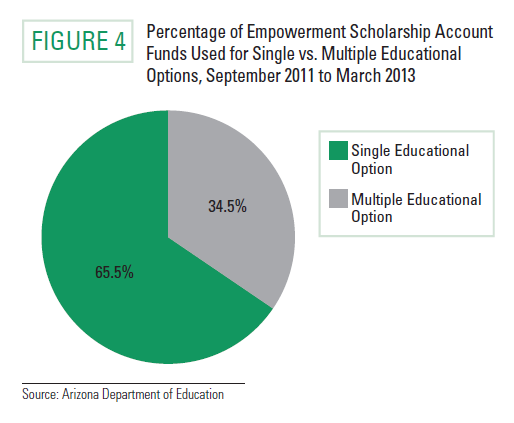
I recently evaluated Arizona’s ESA program for the Friedman Foundation to determine the extent to which parents were using their ESAs to actually customize their children’s educational experience. Using data provided by the Arizona Department of Education, I found that more than one third of families used their ESAs to tailor their child’s education, purchasing multiple services and products.

 Burke Figure 4

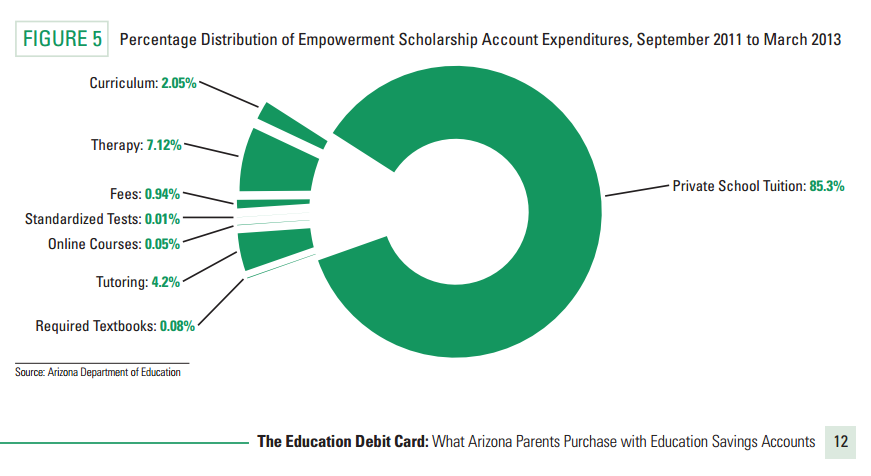
Families use their ESAs to finance a variety of education-related services from a range of providers. One family used roughly 60 percent of their ESA funds for educational therapy, 30 percent for private tutoring, and the remainder of their ESA for curricula. Another family put three-quarters of their ESA dollars toward private school tuition and invested the remaining 25 percent in a college savings fund. A third family divvied up their ESA spending on private school tuition, tutoring, curricula, and online learning.

While most families use their ESAs like a school voucher to attend a single private institution that they have chosen, approximately 34 percent use their ESAs to finance multiple education options in a given day. ESAs move beyond the worthwhile goal of choice among schools to choice among education service providers, courses, teachers, and methods—not limited to one brick-and-mortar location.
Burke Figure 5


ESAs are unique in another way: whereas traditional school vouchers must be spent in their entirety, ESAs foster demand-side pressure for education providers to offer more cost-efficient educational services by creating an incentive for parents to shop for education services based in part on cost. Parents are taking opportunity costs into account, saving ESA funds in anticipation of future education-related expenses, including college tuition. During the first quarter of the 2012-13 school year, parents rolled-over 26 percent of their ESA funds.
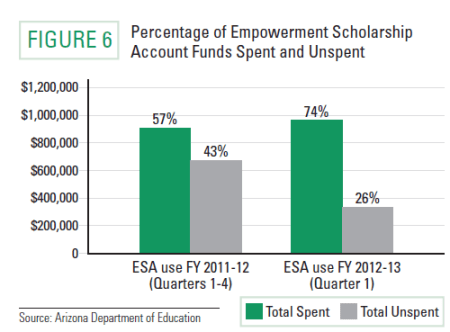
Burke Figure 6

Arizona has created a model that other states should consider: funding children instead of physical school buildings and allowing funds to follow children to any educational provider of choice. Jonathan Butcher and I also recently detailed how state policymakers could transition more traditional voucher and tuition tax credit programs into flexible education savings accounts. They could:

  • Create public school education savings accounts. Parents could use a public school education savings account for traditional school classes, public charter school offerings, public virtual schools such as the Florida Virtual School, community colleges, or state universities.
  • Shift existing school voucher or scholarship tax credit funds to an education savings account. States with existing voucher programs or scholarship tax credit programs should allow parents to deposit voucher or scholarship funds into an education savings account in order to gain more flexibility with their child’s funds.
  • Expand the approved expenses covered by a voucher or private school scholarship. This would include expanding the uses of a school voucher or scholarship, transitioning the program into an education savings account.

We are entering a new frontier of school choice. Education savings accounts represent an advance and refinement of Friedman’s original voucher concept. Through ESAs, Arizona is moving beyond school choice to education choice.  Kym Wilber, whose son Zach is an ESA recipient, explains:

“I use Zach’s ESA funds for other things than just tuition.  Because Zach is more on the moderate to severe functioning level [in terms of special needs], his funding can be used more broadly. I have a private tutor for Zach, and I can use the (ESA) funds for that. With the ESA, I can actually go out and buy things for our home program, such as additional speech tools.”

Providing that level of customization to every child would bring American K-12 education into the 21st century and ensure no child is relegated to the existing monopolistic system in which limited effectiveness is all too prevalent in states across the country.


In Defense of A-Rod

August 19, 2013

Alex Rodriguez is one of the highest paid athletes of all time.  He also has to be one of the most despised.  But this is precisely why the Yankees and MLB officials are getting away with a blatant effort to cheat A-Rod out of money for activities from which they benefited financially.

Yes, it is obvious that A-Rod has used performance enhancing drugs (PEDs) that are banned by baseball.  Yes, A-Rod often behaves like a jerk.  But being a jerk who cheats with drugs does not explain why the MLB is seeking much higher punishment of A-Rod than other baseball players who are also PED-using jerks.

The explanation is money.  If A-Rod is suspended for using banned substances the Yankees do not have to pay him during his suspension.  Given A-Rod’s sky-high salary, that saves the Yankees a large chunk of change.  It also lowers the Yankee’s payroll enough to avoid the “luxury tax” imposed on big spending teams.  And given that A-Rod has been injured and a sub-par player recently, losing his availability is a minor inconvenience to the Yankees relative to their enormous potential savings.  The Yankees are rooting for a big penalty.

I know that it is hard to feel bad for A-Rod.  He gets paid so much and has been such a disappointing player.  But the Yankees were dumb enough to sign a contract for his outrageous salary.  They shouldn’t be able to sneak out it by exploiting A-Rod’s unpopularity.  Justice is not achieved by cheating the disliked.  Justice requires that people get what they are owed, even if they are unpopular.

And for all those fans who despise A-Rod and other professional athletes for their high salaries, remember that the owners have even higher salaries and are making profits off of the players even after promising them enormous sums.  The professional athletes have extraordinary talents for which we, the fans, voluntarily pay large amounts of money to team owners who voluntarily offer high salaries to players.  Those players deserve every penny they are promised.  Hating talented people who earn large amounts of money is nothing but petty jealousy.

A system where team owners don’t have to pay players who are caught using PEDs unreasonably benefits the owners and encourages cheating.  Owners offer enormous salaries for higher-performing players, which provides incentives to players to use PEDs.  The owners benefit from those cheating players because of their higher performance.  If the players are caught, only the player suffers.  The owner, who benefited from the cheating, is off the hook financially and experiences no other loss from the cheating other than the loss of the availability of that player.

A better system of incentives would require owners to pay players even if they are suspended for PEDs.  This would provide a strong incentive to owners to avoid signing players who they strongly suspect to be cheating.  In turn, it would discourage players from using PEDs in the hopes of getting a better contract.  And it would encourage teams to monitor their own players more tightly to make sure they were not using PEDs.  If we want to drastically reduce the use of PEDs in baseball we can’t let the owners off the hook financially when players are caught.