Checking Privilege is Bad Politics

May 27, 2014

Recently I described the political advantage of choice over top-down reforms.  Choice creates its own constituency to protect and expand it because people will fight to keep choice once they have it.  Top-down reforms, by contrast,  are the most popular on the day they are adopted and decline after that, leaving them vulnerable to being blocked, diluted, co-opted, or repealed.  Who will protect and expand a system that imposes consequences for test performance?  The people who are punished by it know who they are and are well organized.  The beneficiaries (if any) are dispersed and disinterested.  Where is the “test our kids more rally” being held?  Nowhere.

It’s a basic political science insight that many well-financed education reformers somehow lack — concentrated and organized interested tend to prevail over dispersed and unorganized interests.  Choice is consistent with this basic lesson while top-down reform runs contrary to it.

An important corollary of this basic lesson is that people with more money tend to be better organized and effective at protecting their interests than poor people.  So, designing a program to stick it to wealthy people is generally a bad idea.  If you are pushing for the expansion of choice, don’t exclude wealthy people.  A s the old saying goes, “Programs targeted for the poor tend to be poor programs.”  If wealthy people are included among those who can benefit from a choice program, they can organize to protect and expand that program.  If a choice program only offers benefits to the most disadvantaged, those beneficiaries are not well-positioned to fight for it politically.  You need to include more advantaged people as beneficiaries so they can fight for a program that also benefits the poor.

If you need an example of the political logic of how universal programs are actually more effective at helping the poor than targeted programs, just compare Social Security and WIC.  Social Security is generous, paying recipients much more on average than they paid in.  It pays cash which recipients can use in any way they want.  It comes automatically; you don’t have to wait in a long line in a dank office to apply to a surly bureaucrat to get it.  It is also indexed to inflation, so it never loses value over time. And — most importantly — it is extremely effective at alleviating poverty among seniors.

WIC, on the other hand, provides meager food assistance to low income families.  It can only be used for certain foods and not other things that poor families might want.  This jerk with a blog in the New York Times is actually outraged that WIC might change its rules to allow poor families to buy white potatoes:

I have nothing against potatoes, either. But there’s almost no one in America, WIC recipients included, who isn’t getting enough potatoes. And that’s what the Institute of Medicine (I.O.M.) was thinking when it excluded potatoes from the WIC program. Because everyone knows that in the United States, “potatoes” equals “fries.”

And if it isn’t degrading enough to be told what to eat by Mr. Bossy Pants in the New York Times, you have to wait in long  lines and engage in endless self-disclosure in forms before you can get WIC assistance at all.

Because Social Security is universal in its benefits — the checks go to the rich and poor alike — the program is politically very well protected, long enduring, and provides fantastic benefits.  Because it targets the poor, programs like WIC are always politically vulnerable, are constantly being replaced (remember AFDC?), and provide lousy benefits.  If you don’t want your education reform to look like WIC, don’t exclusively target the poor.

Even when choice programs target their benefits to the poor, they usually have the good sense not to take something away from the rich.  Rich suburbanites are no worse off if poor kids in Milwaukee have some extra choice.  Of course, the program would be less politically vulnerable, provide more generous benefits, and would be even larger if it also offered benefits to people with more money.

But top-down reforms often take something important away from wealthy families — control over their child’s education.  When a wealthy suburban mom wants her child taught standard algorithms for math in 2nd grade, she doesn’t want to be told that Common Core requires that those algorithms not be introduced until 4th grade.   Even if Common Core actually requires no such thing, the fact that the local district tells her that there is nothing that she or they can do about it, makes that mom feel like she has no control and no recourse.  At least if she were told something like this in the past, she would know which school board member to call or which state legislator to mobilize in her defense.  But to whom does she complain to change what is required by Common Core (or what is alleged to be required by Common Core — whether it really is or not makes no difference)?

Wealthy moms also tend not to like their children being given a bunch of dumb tests and told (again, perhaps wrongly) by their school that they can’t learn more interesting and diverse material because test-based reforms require it.  They especially get annoyed when they believe that their child could pass the test regardless of what is taught.  So they see virtually no benefit from test-based reforms and see significant impingement on control over their child’s education.

It does no good for defenders of top-down reforms to complain about “white suburban moms” as Education Secretary Arne Duncan did.  You can’t guilt wealthy folks out of wanting to protect what they believe is in the best interests of their children.  And it may feel good to self-absorbed reformers to declare that they are pushing top-down reforms to check white privilege, but it is lousy politics.  If your goal is to actually do something to help poor people rather than feeling righteous about sticking it to the wealthy, avoid top-down reforms and push universal choice instead.


School Choice Is The Answer

May 22, 2014

(Guest Post by James Shuls)

Lately, I have had a number of people say to me, “School choice is not the answer.” For those that make this claim, I’m really not sure what question they are asking.

Opponents of school choice like to claim that choice just puts a Band-Aid on a problem or that it simply misdirects resources from struggling public schools. This is a fundamental misunderstanding of how school choice works and the implications it has for the education system. Below, I highlight several questions and I show that school choice is the only answer to the most vexing problems in education. At least it is the only answer that solves issues without government compulsion and unintended negative consequences as a result of government action.

How do we get schools to have high learning standards for students without relying heavily on standardized tests? School Choice.

Most people agree that schools should be held accountable. That is, we established public schools to educate students; therefore, schools should educate students. Our current method of ensuring that schools have rigorous standards and that students are learning is through test based accountability. We set learning standards, mandate standardized tests, and impose penalties or sanctions for schools that fail to achieve.

There are concerns that this model has led to a narrowing of the curriculum and an overreliance on standardized tests. The strongest complaints against this system come from educators themselves.

School choice changes the dynamic. Rather than being accountable to perform on standardized tests, schools in a choice system are expected to meet the needs of their students and parents. Enabling parents with the power to choose empowers them to be the direct enforcers of accountability. If a school is not educating students, parents can choose to send their children somewhere else. Choice is accountability.

How do we improve the quality/respect of teachers in the classroom? School Choice.

Currently, the education system treats teachers like widgets with no respect for performance. In most schools, great teachers have no ability to be rewarded for their efforts. They are paid almost exclusively based on years of experience and their credentials. More importantly, there is little competition for a teacher’s labor. It is rare for schools to actively recruit excellent teachers from other schools and offer financial incentives for them to move. This is the exact opposite of nearly every other sector, including the professions with which teachers aspire to be considered.

When schools are held accountable to parents through school choice, they have an incentive to seek and reward excellent teachers. The end effect is that choice breaks up the monopsony of the public school system and creates a market for talented teachers.

Demand for good teachers is how you improve the quality and respect for professional educators. We have tried and have been unsuccessful in achieving as much through stringent licensing requirements, pensions, and a host of other measures.

How do we overcome problems of poverty in urban school districts? School Choice.

Throughout the country schools in urban settings are struggling. Many are considered drop out factories, where half of the students fail to graduate. Stalwarts of the traditional public education system like to say, “Teachers and schools aren’t the problem, poverty is the problem.”  They are right.

Poverty and all that it entails is the single biggest obstacle to students achieving excellence in education. Poverty is a problem everywhere, even in rural schools, but it is particularly pronounced when schools have a high-concentration of poverty. In many urban schools, nearly 90% of the students qualify for free or reduced price lunches – a common metric of poverty status.

School choice does not lift people out of poverty, but it does help ameliorate the effects.

First, it is important to recognize that schools with high concentrations of poverty are the product of residential zoning of traditional public schools. When we create artificial barriers around school districts, we lock housing values to the quality of schools. Over time, this results in wealthier families sorting into better school districts and pricing out the poor families. In many ways, good public schools are a lot like my private neighborhood swimming pool – you can get in if you can afford a house in the neighborhood.

Choice also gives low-income families the ability to advocate for their children – something many parents lack – and it gives schools the incentive to improve. If poverty is the problem, the answer is more choice, not less.

I could go on.

School choice is not a magical fix. It will not result in miraculous improvements tomorrow, but Chubb and Moe were right when they wrote:

…choice is not like the other reforms and should not be combined with them as part of a reformist strategy for improving America’s public schools. Choice is a self-contained reform with its own rationale and justification. It has the capacity all by itself to bring about the kind of transformation that, for years, reformers have been seeking to engineer in a myriad of other ways.

If you are asking the right question, school choice is most definitely the answer.

——————————

James Shuls is the Director of Education Policy at the Show-Me Institute. Follow on Twitter @shulsie


How People Hate Jews, The ADL Counts the Ways

May 13, 2014

The Anti-Defamation League (ADL) released today an amazing global survey measuring anti-Semitism.  Researchers interviewed 53,100 people in over 100 countries using an index that the ADL has been using for 50 years to track hatred of Jews.  A person is considered anti-Semitic if they said that at least 6 of the following 11 statements is “probably true”:

ANTI-SEMITIC STEREOTYPES

1) Jews are more loyal to Israel than to [this country/the countries they live in].
2) Jews have too much power in the business world.
3) Jews have too much power in international financial markets.
4) Jews don’t care about what happens to anyone but their own kind.
5) Jews have too much control over global affairs.
6) People hate Jews because of the way Jews behave.
7) Jews think they are better than other people.
8) Jews have too much control over the United States government.
9) Jews have too much control over the global media.
10) Jews still talk too much about what happened to them in the Holocaust.
11) Jews are responsible for most of the world’s wars.

You really should read the Executive Summary to learn about what they found, but here are some of the highlights (or should I say lowlights):

  • 26% of respondents globally thought that at least 6 of these 11 anti-Semitic statements is probably true.
  • In the Middle East and North Africa (MENA) 74% met this threshold of anti-Semitism.
  • Muslims reported the highest levels of anti-Semitism (49%), followed by Christians in Eastern Orthodox countries (36%), Catholics in majority Christian countries (25%), people with no religion (21%), Hindus (19%), Budhists (17%), and Protestants in majority Christian countries (15%).
  • Region seemed to trump religion.  Christians in MENA had rates of anti-Semitism (64%) that were closer to the average in their region and very different from Christians elsewhere.  Conversely, Muslims in W. Europe and the Americas had lower rates of anti-Semitism (29%) than Muslims in MENA (75%).
  • Only 54% globally were aware of the Holocaust.  Of those who were aware, 32% believed that the Holocaust was a “myth” or “exaggerated.”  These answers on the Holocaust are strongly related to rates of anti-Semitism

There were, however, some positive signs:

  • Younger people (under 25) are less anti-Semitic (18%) than older people (34% for those over 65).  Perhaps more positive views will gain traction as the older generation of Jew-haters dies out.
  • People living in countries with more Jews have lower rates (22%) than those in countries with few or no Jews (28%).  Of the 26% reported as anti-Semitic, 70% had never met a Jew.  Familiarity reduces hatred.
  • In the Americas, W. Europe, and Oceania, higher education levels are associated with lower rates of anti-Semitism.  But in MENA the opposite is true.  Education can reduce hatred, but it depends on what is taught.

You can see all of this and much more in the Executive Summary and on the cool web site.  I was particularly struck by some of the results for individual countries.  Residents of the West Bank and Gaza top the list of countries with a 93% anti-Semitism rate.  Greece tops the list among countries outside of MENA at 69%.  South Korea, which has a grand total of about 100 Jews, has the highest rate in Asia (53%).  The US has one of the lowest rates (9%), which is down from 29% in 1964.


The Political Virtue of Choice

May 13, 2014

We’ve been offering much strategic advice to ed reformers on this blog lately.  I’ve warned about the dangers of over-reach, recommending instead an incremental and decentralized approach.  Greg has warned that a national system of standards without control over implementation provides license to every quack, crackpot and anti-Semite to un-accountably pursue their own agendas while claiming that national standards made them do it.  Matt has nicely documented how heavy regulation of private choice programs, especially requiring private schools to administer the state test, defeats the very purpose of  expanding choice by driving 2/3 of private schools out of the program while forcing the remaining 1/3 to teach the state curriculum.  You can choose any McDonalds franchise you like and they will compete to make the best burger — too bad if you are a vegetarian.  And Matt has balanced my call for incrementalism with a warning that reforming too slowly fails to land a winning blow.

All of this is, I think, very sound advice.  But these may all be smaller pieces of what I believe is the big advice ed reformers need to hear — there is political virtue in pursuing choice as a reform strategy over top-down reforms, including standards, accountability, curriculum, and pedagogy.

Choice does not depend on policymakers being brilliant or benevolent.  With top-down reforms the people selecting the standards, designing the tests, setting the cut-scores, devising consequences for performance, writing the curriculum, and picking the instructional methods have to get it just right.  They also have to be right for many different kinds of kids who may need different approaches.  And they have to be right over and over again as circumstances and information change.  Oh — and they have to somehow ignore their own interests and pressure from other interested groups of adults that may pull them away from making the right decisions for kids.

People will also make mistakes in choice systems.  But when they do, those mistakes do not affect thousands or millions of kids.  They are also less likely to make those mistakes because the people choosing, usually parents, are closer to the children and more likely to know what those children need.  Parents have interests that are also more likely to be aligned with those of their own children and interested groups are incapable of capturing all of them to influence decisions.

More importantly, from a political perspective, choice has the virtue of creating its own constituency.  As families get the ability to choose, they develop an interest in keeping that ability.  So, they will fight efforts to roll-back or restrict choice.  As more people get to choose, the constituency for choice grows and the ability to protect and expand those programs gets stronger.

Top-down reforms, on the other hand, are the most popular on the day they are adopted and steadily lose their constituency over time.  To get adopted, top-down reforms usually have to maintain some level of ambiguity about what they will do to attract a winning coalition.  As they get implemented they have to make more clear what will and won’t be taught, who will and won’t experience consequences, etc….  The losers discover who they are and begin to organize against top-down reforms once they are implemented.

Elites outside of the education system may support accountability testing, merit pay, or mandated curriculum, when they are abstractions being considered for adoption.  But once they are put into place and opposition grows stronger, who remains as the champions of these top-down reforms?  This is why top-down reforms are so easily blocked, diluted, and co-opted.  They have no natural constituencies and gain none as they are implemented over time.

Choice does, however, have three major political vulnerabilities.  First, choice program may be easier to protect once they are adopted, but they are harder to adopt in the beginning.  Their opponents are fully mobilized against them when they are proposed and their potential beneficiaries do not yet know who they are.  This is why the expansion of choice has been relatively gradual.  But each new victory gets easier as the constituency of choosers grows.  And setbacks are very rare because only un-elected judges have repealed programs — politicians won’t cross the swelling ranks of empowered parents.

Second, even if choice tends to be a one-way ratchet where victories are permanent and defeats are temporary, the programs are vulnerable to slow-motion strangulation by regulation.  Rick Hess and Mike McShane had an excellent piece in USA Today recently warning about this.  But again, the natural and growing constituency of choice parents and schools can provide a useful check on excessive regulation.  This is not perfect — sometimes people are too willing to trade away their liberty for the promise of security — but freedom is very attractive and people tend to fight to keep it once they have it.

The third vulnerability is that when people get to choose, some of them will make mistakes and some providers will be bad actors.  Opponents will seize upon these bad outcomes, even if they are rare, and use them to argue for strangling regulation or even repeal.  Of course, top-down systems contain plenty of mistakes and bad actors — in fact they are more likely to have them for the reasons discussed above.  Because choice grows its own constituency, it can generally hold back calls for strangling regulation or repeal stemming from individual cases of bad decisions or bad actors.

The central political virtue of choice over top-down reforms is that choice gains more supporters as it grows while top-down reform lose supporters as they grow.


As if guided by Greg’s Invisible Hand…

May 8, 2014
(Guest Post by Jason Bedrick)
First George Will stole Greg’s money as a movie star, and now it appears that Jonah Goldberg — in the very same Fox News segment! — had intended to make the same point that Greg made earlier this week.
Here’s Greg:

Folks, from the moment you set yourself up as the dictator of the system,you officially own everything that happens in the system. This is not a new phenomenon. This is simply what you get when you announce that you have set a single standard for a huge, sprawling, decentralized system with literally millions of decision-makers, very few of whom have much incentive to do what you want, but very many of whom have some pet project they’d like to push through using your name to do it.

And here’s Jonah:

One of the problems the Obama administration faces with regard to Obamacare is that basically any adverse changes to health care will be blamed on Obamacare, even if the law has little to nothing to do with it. That’s because Obama and the Democrats vowed that Obamacare would transform the entire health-care sector. As a result any changes in that sector can be chalked up to Obamacare. In other words, Obama broke it, now he owns it. At least for public schools in 45 states, the same will likely hold true for Common Core. Not every stupid decision by a school administrator should be laid at the feet of Common Core, but because Common Core is transforming public education it will be easy to blame it for any bad decisions.

Not only that, but they both used the same example to buttress their point: California superintendent Mohammad Z. Islam blaming the Common Core for the ridiculous decision to have students write a paper taking sides on the question of whether the Holocaust occurred.
Greg, there is yet hope for your future as a talking head!

The Ultimate Portland Photo

May 5, 2014

Yup.  He’s wearing a Darth Vader costume and a kilt while riding a unicycle and playing the bag pipes with fire coming out of it.

But as Andrew Coulson noted: “Vader would never wear short sleeves. How inauthentic!”

A belated May the 4th to everyone.

(H/T Keep Portland Weird)


Show Them the Money!!!

April 30, 2014

(Guest Post by Patrick J. Wolf)

In the 23 years since the first charter school law was passed in Minnesota, charter schooling has gained substantial public legitimacy and support. Public charter schools enrolled more than 2 million school children in over 6,000 schools in 41 states plus the District of Columbia in the 2012‒13 school year.  The three most recent U.S. presidents and their respective Secretaries of Education all have been vocal supporters of charter schooling. When the popular new mayor of New York City, Bill De Blasio, recently threatened to exclude public charter schools from space they shared with traditional public schools in the city, his popularity plummeted, leading him to beat a hasty retreat from the proposal.

Since public charter schools are becoming increasingly popular politically and therefore common in the U.S., we might expect that they would be funded at levels comparable to traditional public schools. We would be mistaken. An expert research team that I organized and Larry Maloney led systematically collected and reviewed audited financial statements from the 2010‒11 school year for the 30 states and the District of Columbia with substantial charter school populations. We carefully tracked all the revenues committed to public charter and traditional public schools from every source, public and private.

We identified a funding gap of 28.3 percent, meaning that the average public charter school student in the U.S. is receiving $3,800 less in funding than the average traditional public school student. Since the average charter school enrolls 400 students, the average public charter school in the U.S. received $1,520,000 less in per-pupil funding in 2010‒11 than it would have received if it had been a traditional public school. The gap is even higher in major cities where charter schools are more commonly found.  Kudos to the Volunteer State of Tennessee, however, as it is the only state that provides equity in charter school funding.

The fact that some students attending public schools receive less funding than others, merely because the word “charter” is in the school’s name, may seem shocking. Isn’t all public school funding within a state or locality based on a common student formula? Actually, no. As detailed in our study, both public charter schools and traditional public schools receive much of their revenue from sources outside of per-pupil state allocations. These include federal categorical aid programs that can include both public charter schools and traditional public schools or just one and not the other, plus local funding raised through property taxes, as well as private sources such as philanthropies and bank interest.

Of the four major sources of revenue for public schools, local funding, or rather the lack of it, is the largest factor in the charter school funding gap. Public charter schools receive only an average of $1,819 per pupil from local government sources while traditional public schools receive a whopping $5,222. On average, charters get somewhat more state money than traditional public schools, while receiving somewhat less federal money. Although there is a perception that public charter schools are handsomely funded by private sources, our research shows that traditional public schools received slightly more private funds per-pupil in 2010‒11 than public charter schools.

The first systematic study of charter school funding equity, Charter School Funding: Inequity’s Next Frontier, conducted by the Fordham Institute in 2005, revealed that per-pupil funding was 21.7 percent lower in public charter schools relative to traditional public schools. A follow-up study, Charter School Funding: Inequity Persists, by Ball State University in 2010, found a funding gap of 19.2 percent remained. Many of the same researchers who conducted those pioneering studies were re-assembled for this latest project and discovered to great surprise that the inequity in public charter school funding has actually grown of late.

This is a careful study of the documented sources and amounts of revenue received by public charter and traditional public schools nationally, within individual states, and in major cities within states. It is a descriptive report of the financial realities in the two public school sectors. Although the report tells us conclusively that public charter schools tend to receive less money, and local government funds are most clearly responsible for the inequity, it cannot tell us in all cases exactly why local governments provide students in public charter schools with so much less money for their education than they provide students in traditional public schools.  Still, policy makers need to confront the reality that public school students are getting short-changed, financially, if they happen to attend public charter schools.  Charter students are superstars just like district students.  Show them the money!


You Must See “Short Term 12”

April 28, 2014

Short Term 12 may be the best movie released in 2013 and I had never heard of it before watching it over the weekend.  It’s a great story, wonderfully acted and beautifully filmed.  You must see it.

Short Term 12 is the name of a temporary group foster home.  The trailer may feel a bit like an after-school special, but the movie is deeper and more authentic than that.  The ensemble cast has a host of great performances, including Brie Larson as the head staffer who is barely one step ahead of the troubled children for whom she works, John Gallagher, Jr. as her co-worker and boyfriend,  and Keith Stanfield as a young man about to “age out” of the system.

The movie is story-telling at its best.  There are no explosions, no chase scenes (well, except for the opening and closing parts), no futuristic dystopia — only real human drama.  If only the Weinsteins had produced the film or it had been done with British accents, it would have received an Oscar.  Instead, you have to hear of this one through the grapevine.  And you’ll be very glad you did.

File:Short Term 12.jpg

(edited for accuracy and to add the image)


Bo Bartlett

April 25, 2014

Bo Bartlett


Last night I met Bo Bartlett and Betsy Eby at a Crystal Bridges dinner.  They are great American artists who are in town to screen their film, SEE: An Art Road Trip, at Crystal Bridges tonight.  Bo’s painting, The Box, was the one we used to measure critical thinking on our field trip study.  Bo was very supportive and gave us permission to use the image of his painting.  And both he and Betsy were very interested in discussing the study and what we learned.

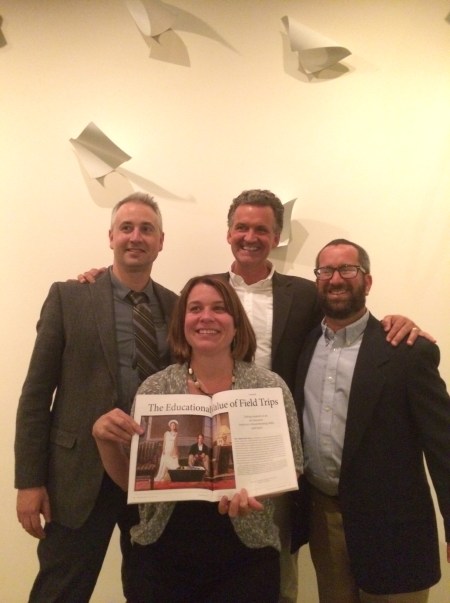
Pictured above you can see Bo posing with me, Brian Kisida, and Anne Kraybill, who is holding up a copy of the Education Next article featuring The Box.  We’re sorry we didn’t have our other co-author, Dan Bowen, with us.


Shakespeare’s Birthday and the Death of Humanities

April 23, 2014

Today is being recognized as the 450th anniversary of Shakespeare’s birth.  Harold Bloom helpfully suggests that our continued interest in Shakespeare has something to do with Shakespeare’s particular insight into what it means to be a human being: “Shakespeare not only invented the English language, but also created human nature as we know it today.”

This may also help explain the declining interest in Shakespeare in schools and among some of the more prominent ed reform movements — they don’t really care about teaching children about what it means to be a human being (otherwise known as “the humanities”).  They increasingly view school as a mechanism for improving students’ economic prospects.  And of course, training students to earn a living is an important component of school, but it is not the only or even most important element of education.

We aren’t gorillas, for whom zoo-keepers seek to optimize food, shelter, and longevity.  Unlike gorillas we are inclined to reflect on what our existence means and try to give that existence purpose.  Education should help guide us in doing that, not just train us to optimize food, shelter, and longevity by becoming the best future workers we can be.  To reflect on what it means to be a human being we need to learn the humanities, including history, literature, and art.

Who is against the humanities?  Few will say it out loud, but it is the dominant thrust in the 21st Century Skills movement, which is backed by the same people who gave us Common Core, with its shift away from literature to “informational texts.”  When confronted with their manifest disinterest in the humanities, 21st Century Skills folks tend to respond that of course they are also for art, history, and all that stuff.  But I challenge you to find where the humanities are in their “framework for 21st century learning.”  See if you can find it in this graphic they say represents the “key elements of 21st century learning“:

p21_rainbow_id254

Did you find the humanities?  Is it in in “Life and Career Skills”?  Does poetry fit in “Information, Media, and Technology Skills”?  It can’t be in the “4Cs” or “3Rs” because history doesn’t start with an R or C.  Anyone who thinks that alliteration constitutes a persuasive argument is likely to be an uncultured barbarian.

Remember that Microsoft and the Gates Foundation are important supporters of the “Partnership for 21st Century Skills.”  And Bill Gates himself seems to have a low opinion of the art and humanities, or at least museums devoted to those subjects:

“Quoting from an argument advanced by moral philosopher Peter Singer, for instance, [Gates] questions why anyone would donate money to build a new wing for a museum rather than spend it on preventing illnesses that can lead to blindness. ‘The moral equivalent is, we’re going to take 1 per cent of the people who visit this [museum] and blind them,’ he says. ‘Are they willing, because it has the new wing, to take that risk? Hmm, maybe this blinding thing is slightly barbaric.'”

To which Terry Teachout, the Wall Street Journal’s art and theater critic, replied masterfully.  Let me take the liberty of quoting him at length:

Where to start sifting through the nonsense? For openers, Mr. Gates would do well to find a better guru than Mr. Singer, whose greatest-good-for-the-greatest-number approach to moral philosophy (if you want to call it that) has led him to advocate, among other horrific things, what he politely calls “permissible infanticide.” It strikes me that Mr. Gates might possibly want to be a bit more careful about the intellectual company that he keeps.

More to the point, though, it seems clear to me that Mr. Gates thinks it immoral for rich people to give money to museums instead of medical projects, presumably those that have received the official Bill Gates Seal of Moral Approval. To be sure, he deserves full credit for putting his own money where his mouth is: The Bill & Melinda Gates Foundation gives away some $4 billion a year, much of which is used to support health-related initiatives in developing countries, including a world-wide initiative to stamp out polio.

Good for him—but when it comes to art, he’s got it all wrong, and then some.

It almost embarrasses me to restate for Mr. Gates’s benefit what most civilized human beings already take to be self-evident, which is that art museums, like symphony orchestras and drama companies and dance troupes, make the world more beautiful, thereby making it a better place in which to live. Moreover, the voluntary contributions of rich people help to ensure the continued existence of these organizations, one of whose reasons for existing is to make it possible for people who aren’t rich to enjoy the miracle that is art. If it weren’t for museums, you wouldn’t get to see any of the paintings of Rembrandt and Monet and Jackson Pollock (and, yes, Francis Bacon). Instead they’d be hanging in homes whose owners might possibly deign to open their doors to the public once a year. Maybe.

As long as folks who have little appreciation for the arts and humanities are dominating ed reform discussions, we are unlikely to make much progress in reviving those topics in schools.  We may be celebrating Shakespeare’s birth, but what he stood for is dying.