Watching the Media Watchmen: NYT Edition

June 30, 2016

watchmen-4444

(Guest Post by Jason Bedrick)

Yesterday, Jay took apart the factually challenged hit piece the Gray Lady ran on charter schools in Detroit. Matt added his two cents and I piled on as well. Additionally, Tom Gantert of the Mackinac Center for Public Policy identified another dozen or so errors, distortions, or omissions of key facts.

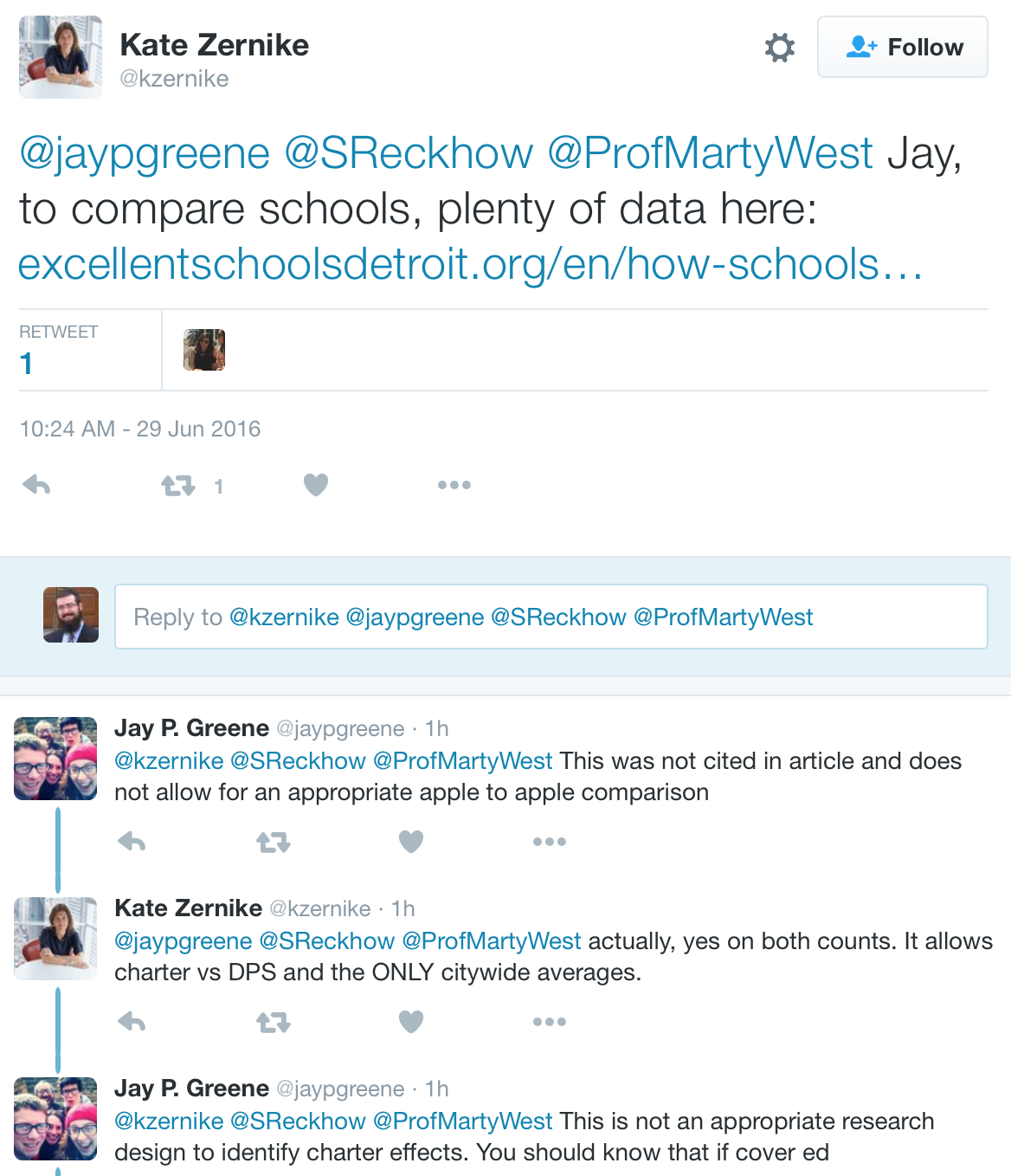
But the most illuminating part of this whole imbroglio was the following Twitter exchange with the NYT reporter:

Screen Shot 2016-06-30 at 8.51.32 AM.png

Jay and others, including Prof. Martin West of Harvard, explained how the article misrepresented the findings of CREDO’s research on charter schools. The NYT reporter, Kate Zernike, defended her piece by noting that she contacted CREDO about the charter she highlighted, which CREDO had found to be low performing. However, Jay pointed out that she cherry-picked that one bad charter and failed to note that CREDO found overall positive results.

Screen Shot 2016-06-30 at 8.54.08 AM.png

Zernike  apparently forgot the First Law of Holes: when you find yourself in one, stop digging.

Jay also took her to task for relying only on “claims and anecdotes” instead of data, so she cited data from Excellent Schools Detroit.

Twitter exchange over NYT's misleading reporting on charter schools

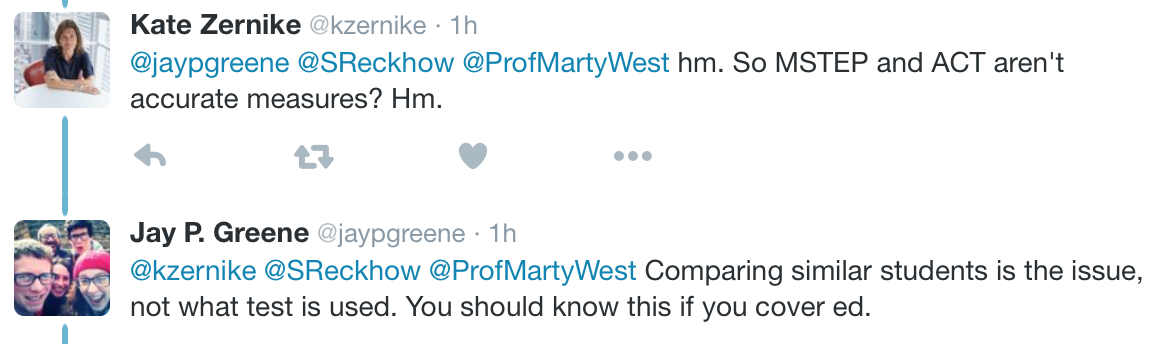
However, as Jay explained, those data do not allow for direct comparisons. Zernike is right that the data show the citywide averages in each sector, but looking at the averages is misleading. Zernike seemed to think Jay was objecting to the standardized tests, but the real problem he identified was not the tests themselves but rather how she tried to compare the students taking those tests.

Twitter exchange over NYT's misleading reporting on charter schools

As I noted in my blog post:

The charter schools tend to be mission-based schools that open in the toughest areas and serve the most at-risk students. Comparing city-wide averages fails to take that into account. It would be like comparing the New England Patriots against a championship high school team and concluding that the teenagers are superior athletes because they scored more touchdowns per game.

The appropriate comparison is between the charters and the district schools that serve the same or similar student populations. That is what the CREDO study attempted to do by matching students with similar characteristics and initial test scores in each sector, then tracking and comparing them.

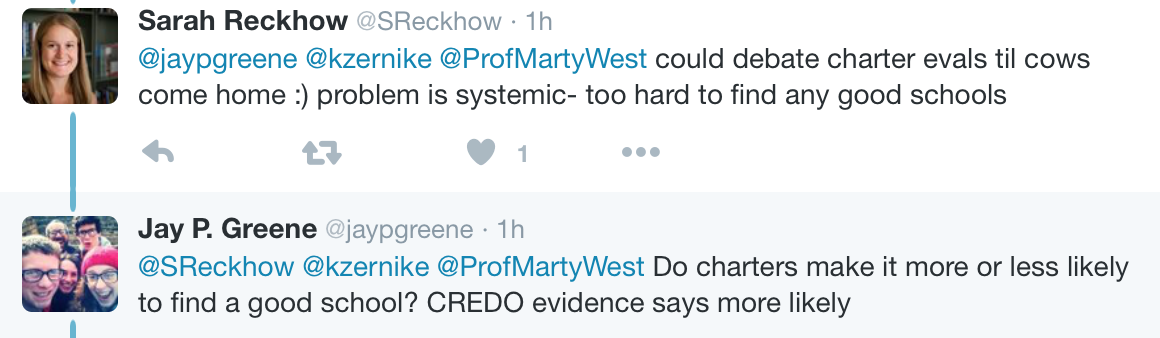
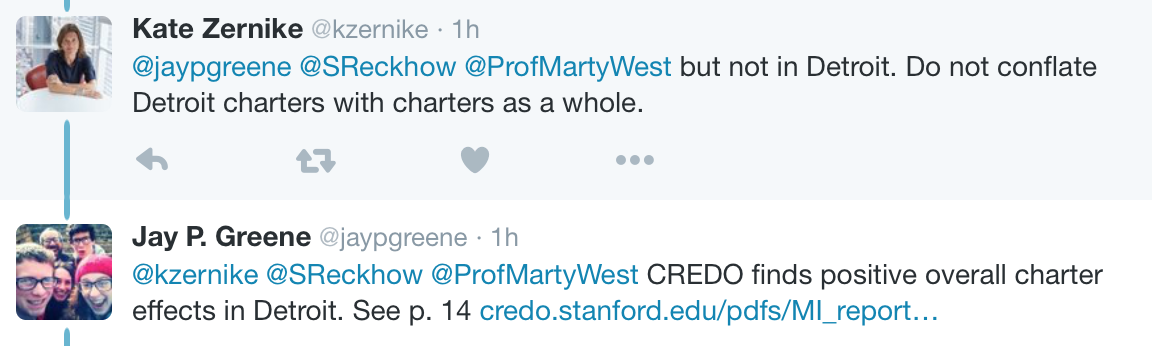
Amazingly, Zernike then claimed that CREDO did not find that Detroit charters had a positive effect overall. In fact, that’s exactly what CREDO found in both its 2013 report on charters in Michigan and its 2015 nationwide charter report.

Twitter exchange over NYT's misleading reporting on charter schools

Twitter exchange over NYT's misleading reporting on charter schools

As Matt noted, the 2013 CREDO study on Michigan found: “on average, charter students in Michigan gain an additional two months of learning in reading and math over their [traditional public school] counterparts. The charter students in Detroit gain over three months per year more than their counterparts at traditional public schools.” [emphasis added]

Nevertheless, Zernike persisted in claiming that CREDO found results that it didn’t find.

Screen Shot 2016-06-30 at 9.07.53 AM.png

That’s right. Zernike says CREDO “does not consider Detroit stellar” — but page 33 of the 2015 CREDO report calls Detroit’s charter sector “a model to other communities.” See for yourself:

Screen Shot 2016-06-30 at 9.10.05 AM.png

“models to other communities”

But apparently some reporters don’t like it when people point out that what they wrote is factually incorrect. Here was her response to my Tweet correcting her:

Screen Shot 2016-06-30 at 7.21.32 AM.png

Blocked!

If the New York Times has any integrity, it will issue a correction.


Is Political Control Over Charter Schools Wise?

June 29, 2016

democracy-is-two-wolves-and-a-sheep-voting-on-whats-for-dinner

(Guest Post by Jason Bedrick)

In a recent essay, Andy Smarick proposed democratically controlled charter authorizers:

If a city has a large charter sector, state government could create a new authorizer with an elected board (or require existing authorizers to move to elected boards). That democratically controlled authorizer would then have a performance contract with each of the city’s public schools, including those operated by the district.

Smarick’s “middle path” approach is an interesting idea that’s worth consideration, but education reformers should have serious reservations about it. In particular, it’s not clear what the problem is that this approach is trying solve or why this approach wouldn’t lead to the same problems that political control over traditional district schools has caused.

Smarick’s case rests on the claim that “communities” are “demanding more democratic control.” But are they? Which communities? Or, more precisely, which voices in those communities? After all, it’s exceedingly rare that everyone in a given community speaks with one voice. And what are these voices saying? Smarick name-checks a few cities but cites no evidence that would answer any of these questions. He merely asserts that “authority that is both local and democratic has also been in demand.” Okay, sure, maybe. But it’s still not clear why ed reformers should accede to these (anonymous) demands.

Smarick continues:

A community’s voters want to have a say over what types of schools exist, what constitutes “good schools,” who runs them, how an area’s culture and traditions are passed on, and much more. Decisions are more reflective of the public’s will when these issues are litigated through the democratic process. Additionally, we can have faith that the discussion is transparent, that people feel agency, and that the results—even if imperfect—will be durable and respected.

Are any of these claims necessarily true?

  • Is it true that democratic control is necessary for communities to pass on their culture and traditions? Aren’t most mediating institutions — churches, private schools, non-profits, sports leagues, museums, farmer’s markets, small businesses, professional organizations, etc.  — decidedly not subject to political control? And to the extent that some of these organizations employ some measure of democratic decision-making, isn’t it only the members of those organizations (and not the community at large) that have the right to vote?
  • Is there such a thing as “the public will”? At best, this means merely the will of the majority, which often comes at the expense of the will of the minority (or several types of minorities). Moreover, as Terry Moe and others have detailed, political control often means control by well-organized special interests like teachers unions. In any case, political control entails citizens fighting against each other to have their preferences reflected rather than each being able to have their preferences met in a market. To the extent that a “public will” exists,  it is multi-faceted, hence a system of decentralized choices better reflects the public will than a centralized system.
  • Is it true that there is more transparency when institutions are subject to political control? Forget Clinton’s emails — elected school boards regularly lack transparency.
  • Do people feel more agency in political systems? Perhaps the majority does, but do the minorities? Wouldn’t those minorities prefer options that weren’t subject to majority control?
  • Is it true that political decisions are “more respected and durable”? 2016 is an odd year to be making that argument.

On Twitter, Smarick claimed that a democratically controlled charter board’s “incentives [and] ability to interfere [with] schools drop dramatically when board authorizes but does not operate schools.” Possibly. But as Jay pointed out yesterday, traditional school boards don’t “operate” the district schools either, yet there is plenty of room for mischief. After all, Smarick himself argued that these boards should decide what “types” of schools exist and what constitutes a “good” school. That’s an awful lot of control.

As Smarick himself recognizes, elected boards shift power away from families to “the community” (i.e., whichever group can seize political control). As he explained:

Today’s decentralized systems of choice empower families and enable a wide array of options, but they inhibit the community’s ability to shape the contours of the local school system.

It seems that Smarick — who is generally quite conservative — is embracing the progressives’ preference for political control over mediating institutions that Yuval Levin has so insightfully described:

Progressives in America have always viewed those mediating institutions that stand between the individual and the government with suspicion, seeing them as instruments of division, prejudice, and selfishness or as power centers lacking in democratic legitimacy. They have sought to empower the government to rationalize the life of our society by clearing away those vestiges of backwardness and putting in their place public programs and policies motivated by a single, cohesive understanding of the public interest. This clearing away has in some cases consisted of crowding out the mediating institutions by taking over some of their key functions through direct government action. In other cases, it has involved turning elements of civil society and the private economy into arms of government policy — by requiring compliance with policy goals that are foreign to many civil-society institutions or consolidating key sectors of the economy and offering protection to large corporations willing to act as public utilities or to advance policymakers’ priorities.

I hope that Smarick will reconsider his support for empowering the government at the expense of school autonomy and families’ preferences. Perhaps the angel on his right shoulder will whisper Yuval Levin’s counsel into his ear:

Conservatives have always resisted such gross rationalization of society, however, and insisted that local knowledge channeled by evolved social institutions — from families and civic and fraternal groups to traditional religious establishments, charitable enterprises, private companies, and complex markets — will make for better material outcomes and a better common life. The life of a society consists of more than moving resources around, and what happens in that vital space between the individual and the government is at least as much a matter of character formation as of material provision and wealth creation.

As I noted above, I do believe that Smarick’s proposal merits serious consideration. Although I don’t think he has made a strong case for a democratically controlled charter board, I do think he’s onto something when he says that there is strong demand for democracy, at least in some quarters. That said, I think the more viable “middle path” is down a different road. There are numerous mediating institutions in society that engage in democratic decision-making, but only members have a vote. Instead of giving a vote to everyone in the community — wolves and sheep alike — perhaps charter schools could give a vote to parents of students who are enrolled there. This way, parents who want democratic agency can enroll their children in democratically run charters, while other parents can choose schools that have different missions, and in no case will outside special interests be able to seize control.

I’m sure there are other arrangements that could also achieve the balance that Smarick seeks. But please: don’t give power to the wolves!


Ed Reform is Animal Farm

June 28, 2016

“The creatures outside looked from pig to man, and from man to pig, and from pig to man again; but already it was impossible to say which was which.”

When I became involved in education reform more than two decades ago, the movement was about empowering parents to make choices for their own children rather than having choices made for them by well-meaning but distant bureaucrats and professionals.  At its heart, ed reform was about decentralization of control.

In the last quarter-century this effort to expand choice in education has been amazingly successful.  We’ve gone from the first charter school in 1990 to more than 4% of all students enrolled in charters.  We’ve gone from two, century-old voucher programs in Maine and Vermont to having private school choice in more than half of the states.  And the beauty of expanding school choice is that it generates its own advocates as families that benefit from these programs lobby to protect and expand their choices.We are almost at the point where ed reform organizations don’t have to do very much other than to coordinate choice families pushing for more choices.

But just as choice is achieving escape velocity, a groupthink gang of petty little dictators are grabbing the reins of ed reform organizations to advocate for greater restrictions and regulations on choice. They are beginning to make arguments and advocate policies that are essentially the same as the ones favored by the traditional education establishment. Like their rivals in the traditional ed establishment, this new ed reform establishment mistrusts parents to make choices.  Parents, in their view, are not capable of making good choices without the guidance and restrictions imposed by experts and policymakers. And children need to be protected by regulations and bureaucrats against the errors and abuses of their parents or schools.

It has gotten to the point where, like in Animal Farm, it is difficult to tell the difference between the nanny-statism of the old ed establishment and the new ed reform establishment.  The new ed reformers are no longer fighting for parental empowerment, they are just struggling with the old establishment over who will be in control.  Will it be the smart and righteous reformers, as they imagine themselves, or the stupid and self-interested old establishment, as they imagine the unions and their allies? The reformers are convinced they can do it better, but the arrangements they favor are not all that different from those championed by the old guard.

Reformers are currently gathered in a groupthink frenzy over the need to regulate how charter schools discipline their students.  You know who else issues detailed policies on school discipline? Traditional school districts.  Last year they were in a frenzy over the need to force charter schools to “backfill” so that they can take more students in more grades that are assigned to them. You know who else is pre-occupied with filling seats in schools with assigned students? Traditional school districts.

It is currently the fashion among reformers to favor portfolio management, in which a single super-regulator would control which schools open, which close, and issue policies regarding transportation, special education, discipline and other matters.  We’ve even heard proposals recently to have the entity responsible for opening, closing, and regulating schools be elected democratically.  Let’s see if you can guess what all of this sounds like.  That’s right — traditional school districts.  They are also democratically elected.  They also decide which schools should open and close.  They also issue policies regarding transportation, special education, discipline and other matters.  I have looked from portfolio management to districts, and from districts to portfolio management, and from portfolio management to districts again; but already it is impossible to say which is which.

The advocates of portfolio management or democratically elected authorizers say that the difference is that traditional districts actually operate schools, while their proposed entities only concern themselves with opening, closing, and regulating while avoiding interference in operational matters.  We were assured that things would be fine with portfolio management in New Orleans despite the takeover of that role by the Orleans Parish School Board because the district is prohibited from interfering with school operations.

I may not be able to read the continually revised commandments on the barn wall much better than Boxer, but I’m pretty sure that issuing policies with respect to school discipline, special education, admissions, and transportation necessarily interfere with school operations.  And it is only a hop, skip, and jump from telling schools whether they can suspend kids to telling them which methods best teach reading or how many minutes they should be on the playground.  Anyone who is not hypnotized by the reform groupthink would recognize that school boards do not “operate” schools any more than portfolio managers do.  Boards just develop policies to govern schools, just like portfolio managers do.  They contract with others to operate schools under those regulations, just like portfolio managers do.  And they decide which schools should be opened and which should be closed, just like portfolio managers do.

The ed reform crowd enamored with portfolio management and issuing a host of regulations dictating how schools must operate and what parents may choose has become almost indistinguishable from the traditional education crowd with whom they are vying for control.  I say a pox on both their houses.  I got into this line of work because I was excited about empowering parents to make decisions, not imposing my superior brand of control on them.

(edited for typos)


Paul Peterson on Parents over Bureaucrats

June 24, 2016

In today’s Wall Street Journal  Paul Peterson makes a personal and compelling argument for why deference should be given to parents over the false-expertise of distant bureaucrats.

Paul’s adult son is autistic and sometimes engages in potentially life-threatening self-injurious behavior, such as banging his head and shoving his hands down his throat.  After many years and much searching, Paul and his family found an effective intervention that checks this self-injurious behavior and enables his son to live a better and safer life. The intervention involves skin electric shocks, which essentially grab his son’s attention and interrupt his self-injurious activities.

The shocks do hurt, but the pain is relatively mild and fleeting relative to the serious harm his son might do to himself otherwise.  And his son receives plenty of positive rewards for avoiding self-injury.  The shocks are a back-stop when things get out of control.

But bureaucrats at the FDA think they know better and want to prohibit the type of intervention benefiting Paul’s son.  They believe that there are drug therapies that are more effective.  Unfortunately, even if those drug therapies work on average, there is a distribution of results and Paul’s son has tried the drugs without success. No matter, declares the FDA, everyone should get what we think works best for the average person even if your circumstances differ.

You should read Paul’s entire piece.  When doing so keep in mind that this isn’t just about the FDA and people with autism.  This is about who knows best.  Should families and care-providers who possess more contextual information decide what to do or should distant bureaucrats impose on everyone.  And, of course, this is the heart of my support for choice in education.  Who should decide what is best for children — their families and the educators they select or regulators, portfolio managers, and other over-bearing bureaucrats?


People Don’t Like to be Meddled With

June 23, 2016

(Guest Post by Matthew Ladner)

So it’s official- Brexit passed. It looks to me that there were villains and heroes on both sides of this debate, and it will cause a huge amount of disruption. In the end it seems to me that you would much rather be ruled by people you can turn out of office in “elections” rather than distant meddlers who never face the voters- no amount of fear should dissuade anyone from this position. Difficult days lie ahead but perhaps Britons never will be slaves after all.


Daily Facepalm: Choice “Clogs Our Roads”

June 21, 2016

us-roads-are-more-clogged-than-ever

The problem: too many choices?

(Guest Post by Jason Bedrick)

The abundance of choices among competing grocery stores is “clogging” our roads, according to an Australian academic who advocates assigning people to government-run grocery stores based on the location of their home:

Almost 60 per cent of Melbourne shoppers are bypassing their local grocery store, according to world-renowned academic John Hattie.

Professor Hattie said ‘food choice’ had led to a “clogging of the motorways” as shoppers avoided their neighbourhood grocery store in pursuit of alternatives.

Food choice has also fuelled unhealthy competition between grocery stores, he told a packed lecture theatre at the University of Melbourne on Tuesday evening.

“Nearly all this choice is based on hearsay, the flavor of the food, and rarely on whether the food is or isn’t adding nutritional value to the shoppers’ health,” he said.

All right, all right. If you’re a regular reader of the JPG blog, you’ve probably already deduced that I changed the words “school” and “students” to “grocery stores,” “food,” and “shoppers.” Here’s what Professor Hattie actually argued:

Almost 60 per cent of Melbourne students are bypassing their local school, according to world-renowned academic John Hattie.

Professor Hattie said school choice had led to a “clogging of the motorways” as students avoided their neighbourhood school in pursuit of alternatives.

School choice has also fuelled unhealthy competition between schools, he told a packed lecture theatre at the University of Melbourne on Tuesday evening.

“Nearly all this choice is based on hearsay, the nature of the students, and rarely on whether the school is or isn’t adding value to the students’ learning,” he said.

Frankly, it’s no less absurd than the modified version.

So-called “experts” demonstrate their own hubris and contempt when they proclaim from their ivory towers that they know better than the little folks below, despite lacking any local knowledge about a particular student’s aptitude, interests, or learning needs. Aside from the fact that the best international evidence suggests that school choice boosts student outcomes (i.e., on average, the parents outperform the central planners), educational choice is an end in and of itself.

Moreover, although I don’t think education policy should be used as a lever to promote environmental goals, research from Professor Bart Danielson suggests that school choice policies are more environmentally friendly than district-based systems. Countless parents have fled urban areas to rescue their children from failing district schools–the “white flight” that Hattie decries–which contributes greatly to suburban sprawl. According to Danielson’s research, parents are more likely to remain in urban areas when they have more educational options, thereby reducing their carbon footprint.

In short: the “clogged roads” argument against choice is as spurious as it is silly.


Jaws on the Water Brought to You by the Alamo Drafthouse

June 16, 2016

(Guest Post by Matthew Ladner)

Yes please!


Rick Hess Crushes the Ball

June 15, 2016

(Guest Post by Matthew Ladner)

Go read this Rick Hess post. Like right now! “Ed Reform, I’d like to introduce you to 1990s Ed School. Oh- so….you two are already acquainted?”

Another Rick once noted “He who fights with monsters might take care lest he thereby become a monster. And if you gaze for long into an abyss, the abyss gazes also into you.”


Will the Ed Reform Band Continue to March into the Alley?

June 14, 2016

(Guest Post by Matthew Ladner)

Robert Pondiscio’s now famous piece on ed reform’s leftward drift brought to mind the above scene from the masterpiece of American juvenile cinema Animal House. It’s hardly impossible to imagine ed reform going off course as, well, it happened before and in the recent past. Tom Loveless for instance argues that the entire Common Core effort has been worth less than a single NAEP point (on a 500 point scale) and that this gain is already reflected in the 2015 exams. I would not bet my left foot that Tom is absolutely correct about that, in fact I hope he’s wrong and the entire effort has some sort of delayed reaction since it is a sunk cost. I have yet to see anyone attempt to muster a credible refutation, and Tom’s analysis finds support from Hanushek’s work as well.  The could be mistaken, but calling the question as of now makes it look like:

Well yes maybe that has not worked out as well as hoped, but the teacher evaluation systems pushed by Race to the Top are going to close the achievement gap by…oh wait watch out….gahhhgh my trombone!!!!!!

Not all such diversions are of recent vintage. Some are more of a persistent folly sort of phenomenon. For instance, it is fairly clear that the school voucher movement never would have launched in Milwaukee without a strange bedfellows coalition of liberals and conservatives. This was terribly exciting at first, but with the benefit of hindsight…

It now seems painfully obvious that the means testing of private choice programs has served to politically marginalize private choice vis-a-vis charter schools, district schools, magnet schools, digital learning and/or **fill in the blank here** because almost nothing else in K-12 education funding has adopted the view that actively discriminating against the children of the people who pay the highest rates of tax constitutes an inspired political strategy.

This is not at all to say that equity issues are anything less than vitally important or that we should not engage in an ongoing and thoughtful discussion about how best to reflect them in a system of private choice. The means testing fetish however has persisted so long that some very prominent charter school supporters for instance failed to recognize the rich irony of their criticism of the Nevada ESA program for being universal in nature when in fact every charter school law also involves universal eligibility by income.  Come to think of it, I don’t know of many charter school laws that give additional state dollars to low-income kids, but the NVESA does provide additional state funds to low-income students….

Anyhoo, means testing for thee, but not for me won’t do- wake me up when our friends on the left means test district or charter schools. Otherwise the worthy conversation lies in settling upon the level of additional resources should be provided to disadvantaged children. All of which leads to Paul Peterson’s great valedictory piece as Editor in Chief of Education Next making the case that the regulatory approach to school reform led us down a blind alley reached its ceiling. Peterson calls on reformers to double down on parental choice as an improvement strategy. This approach, while promising, requires a level of modesty notably lacking from today’s would be technocrats. I’m happy to pass the ed reform baton to those who can snatch this particular pebble, as my next career creating Rhino Record compilation cds of Dean Martin and punk rock classics awaits (Martinis in the Mosh Pit, Volume 7!!!) and would be even more fun than anything in ed reform, other than jayblogging.

Ooops, day dreaming again, so getting back on track the above sort of issues deserve deliberation and debate in my view. I could be in the grips of an enormous folly that is invisible to me, just as my friends in the charter school movement seem oblivious to their means testing double standard. I’ve been wrong before, and I will be wrong again so have at it if you disagree. I’d rather debate these sort of issues than endure any further virtue signalling in the form of therapy sessions where Ivy League ed reformers work out their guilt from lacking an urban Horatio Alger story in public.  Such burdens are best born in private with a determined stoicism, terrible though they may be, as they seem lacking in utility.


The Disconnect Between Changing Test Scores and Changing Later Life Outcomes Strikes Again

June 14, 2016


I’ve written several times recently about how short term gains in test scores are not associated with improved later life outcomes for students.  Schools and programs that increase test score quite often do not yield higher high school graduation or college attendance rates.  Conversely, schools and programs that fail to produce greater gains in test scores sometimes produce impressive improvements in high school graduation and college attendance rates, college completion rates, and even higher employment and earnings.  I’ve described at least 8 studies that show a disconnect between raising test scores and stronger later life outcomes.

Well, now we have a 9th.  Earlier this month MDRC quietly released a long-term randomized experiment of the effects of the SEED boarding charter school in Washington, DC.  Because SEED is a boarding school, there was a lot of hope among reformers that it might be able to make a more profound difference for very disadvantaged students by having significantly more time to influence students and structure their lives.  Of course, boarding schools also cost significantly more — in this case roughly twice as much as traditional non-residential schools.

While the initial test score results are very encouraging, the later life outcomes are disappointing.  After two years students admitted to SEED by lottery outperformed those denied admission by lottery by 33% of a standard deviation in math and 23% in reading.  If we judged the quality of schools entirely based on short term changes in test scores, as many reformers would like to do, we’d say this school was doing a great job.

In fact, SEED may be doing a great job in a variety of ways, but when we look at longer term outcomes for students on a variety of measures the evidence demonstrating SEED’s success disappears or even turns negative.  Of the students accepted by lottery to SEED 69.3% graduate from high school after four years compared to 74.1% for the control group, a difference that is not statistically significant.  And when asked about their likelihood of attending college, there was no significant difference between the two groups.  SEED students also score significantly higher on a measure of engaging in risky behavior and lower on the grit scale.

We’ve seen this pattern before.  Research by Marty West and colleagues of no excuses charter schools in Boston found large gains in test scores but also significantly lowered student performance on noncognitive measures.  And Josh Angrist and colleagues found that those schools actually decrease four year high school graduation rates despite large gains in test scores.  In their words:

Perhaps surprisingly given the gains in test score graduation requirements reported in column 2 of table 4, the estimates in column 4 of this table suggest not. In fact, charter attendance reduces the likelihood a student graduates on time by 14.5 percentage points, a statistically significant effect.

It’s time that people start paying a lot more attention to this pattern of a disconnect between short term test score gains and long term life outcomes.  We can’t just dismiss this pattern as fluke.  And the reduction in noncognitive skills may be important for explaining this pattern.  Reduced grit scores may not just be the product of reference group bias.  It appears that certain types of charter schools that are able to produce large test score gains also lower character skills and fail to yield long term improvements in life outcomes.  Conversely other types of charter and private schools in choice programs fail to improve test scores but yield large gains in later life outcomes.

If we think we can know which schools of choice are good and ought to be expanded and which are bad and ought to be closed based primarily on annual test score gains, we are sadly mistaken.  Various portfolio management and “accountability” regimes depend almost entirely on this false belief that test scores reveal which are the good and bad schools.  The evidence is growing quite strong that these strategies cannot properly distinguish good from bad schools and may be inflicting great harm on students.  Given the disconnect between test scores and later life outcomes we need significantly greater humility about knowing which schools are succeeding.