Study Shows Louisiana Voucher Cuts Are Penny Wise, Pound Foolish

August 19, 2016

Penny Wise, Pound Foolish

(Guest Post by Jason Bedrick)

ICYMI, Corey DeAngelis of the University of Arkansas wrote a blog post at Education Next today summarizing the results of a study he conducted with Julie Trivitt on the fiscal effects of the Louisiana Scholarship Program (LSP). The post is worth reading in full, but the main point is this: their study found that the LSP saves taxpayers money.

Governor John Bel Edwards recently cut the voucher program, supposedly in order to save money. However, the new study finds that the cuts actually increase state expenditures. DeAngelis concludes that if Louisianan officials wish to save money, instead of cutting it, they should expand it.

[Note: I initially omitted the “e” in Corey’s name. This is in keeping with the Law of Conservation of Es known to fans of Drs. Green and Wolfe.]


Lawsuit Losers’ Ostrich Act

August 17, 2016
headinsand

Anti-school choice plaintiffs pretending that the court didn’t reject their arguments on the merits.

(Guest Post by Jason Bedrick)

As I reported on Tuesday, a Florida appellate court threw out a challenge to the state’s tax-credit scholarship program. In response, one of the plaintiff groups, Americans United for Separation of Church and State (AU), published a disingenuous and factually challenged blog post whining about the case being dismissed and pretending that the court didn’t actually address the merits of the case. I’ll address their assertions in order:

A Florida court just threw out an appeal brought by Americans United and its allies challenging a school-voucher-like program that provides taxpayer support for religious organizations. As disappointing as that outcome is, it’s doubly frustrating to see a second Sunshine State court fail to even consider the merits of the case.

The program provides tax credits for donations to scholarship organizations that help students attend any private school, religious or secular, so that’s not quite an accurate description of the program.

Moreover, as I will explain below, the court did consider the merits of the case. Although courts often avoid addressing the merits of a case when rejecting the plaintiffs’ standing to bring the case, here the court directly addressed the central issues in the process of dismissing the case on standing.

In case you’re not familiar with tuition tax credits, they are a type of voucher scheme that allows individuals or corporations to donate money to a middle-man “scholarship” organization in exchange for a generous tax credit. The “scholarship” group then writes a check for tuition at a private school. It’s essentially a way to launder government funds through a private entity.

What an odd use of scare quotes. Are these somehow not scholarships? Let’s consult the dictionary. Merriam-Webster defines a “scholarship” as “an amount of money that is given by a school, an organization, etc., to a student to help pay for the student’s education.” So yes, AU scare quotes notwithstanding, these are bona fide scholarships.

But are they “laundered government funds”? According to the unanimous Florida appellate court, the U.S. Supreme Court, and every state supreme court to address the question, the answer is a resounding “No.” The courts all held that a private individual or corporation’s money is their own, and not the government’s, until the government has actually collected it. When people keep their own money through tax deductions, tax credits, or tax exemptions, it remains exactly that: their own money.

Does the AU believe that all churches run on “laundered government money” because their donors receive tax deductions or because they receive 100% property tax exemptions? No? Interesting.

The overwhelming majority of private schools participating in the tax credit program are religious, which goes against the Florida Constitution’s “no-aid” clause, which says: “No revenue of the state or any political subdivision or agency thereof shall ever be taken from the public treasury directly or indirectly in aid of any church, sect, or religious denomination or in aid of any sectarian institution.”

Again, as the court ruled, it’s not government money, so the historically anti-Catholic Blaine Amendment (“no-aid” clause) is not implicated. Moreover, the percentage of schools that are religious versus secular is constitutionally irrelevant. The law is religiously neutral. What matters is only that families may choose either religious or secular schools. It makes no constitutional difference whether the majority select one type or the other, or whether the market (responding to demand) supplies more of one type or another.

The U.S. Supreme Court has repeatedly rejected AU’s religious bean counting, including in the landmark Zelman v. Simmons-Harris decision more than a decade ago:

Respondents and Justice Souter claim that even if we do not focus on the number of participating schools that are religious schools, we should attach constitutional significance to the fact that 96% of scholarship recipients have enrolled in religious schools. They claim that this alone proves parents lack genuine choice, even if no parent has ever said so. We need not consider this argument in detail, since it was flatly rejected in Mueller, where we found it irrelevant that 96% of parents taking deductions for tuition expenses paid tuition at religious schools. Indeed, we have recently found it irrelevant even to the constitutionality of a direct aid program that a vast majority of program benefits went to religious schools. See Agostini, 521 U.S., at 229 (“Nor are we willing to conclude that the constitutionality of an aid program depends on the number of sectarian school students who happen to receive the otherwise neutral aid” (citing Mueller, 463 U.S., at 401)); see also Mitchell, 530 U.S., at 812, n. 6 (plurality opinion) (“[Agostini] held that the proportion of aid benefiting students at religious schools pursuant to a neutral program involving private choices was irrelevant to the constitutional inquiry”); id., at 848 (O’Connor, J., concurring in judgment) (same) (quoting Agostini, supra, at 229). The constitutionality of a neutral educational aid program simply does not turn on whether and why, in a particular area, at a particular time, most private schools are run by religious organizations, or most recipients choose to use the aid at a religious school. As we said in Mueller, “[s]uch an approach would scarcely provide the certainty that this field stands in need of, nor can we perceive principled standards by which such statistical evidence might be evaluated.” 463 U.S., at 401. [emphasis added]

The SCOTUS majority goes on to note that the other side’s obsession over how many private schools have a religious affiliation ignores that they are but a tiny slice of all the available school choices, including the secular district schools that the vast majority of students attend. Students do not lack secular options.

Returning to the AU blog post, the author claims:

The program also violates the state constitution by taking money away from public schools.

No, the appellate court specifically and repeatedly rejected this argument, noting that any reduction in aid to the district schools is entirely speculative. As the appellate court detailed at length, the AU and their allies proved unable time and time again to demonstrate any harm that the district schools incur from the scholarship program.

Despite those problems, two Florida courts have now kicked the case on standing – that is, the right to sue – saying that the plaintiffs, which include interfaith religious leaders as well as educators, don’t even have the right to bring this case. As a result, neither court weighed in on the actual facts of the case.

Incorrect. As noted above, like the district court before it, the appellate court addressed the main issues that plaintiffs raised:

  1. Does the scholarship program violate the Blaine Amendment? A: No, it relies on private funds so the Blaine Amendment is not implicated.
  2. Does the scholarship program unconstitutionally create a parallel system of public schools? A: No, this is a privately funded and privately administered program, not a separate government school system.
  3. Does the scholarship program harm the district school system? A: No, there is no evidence of any harm to the district schools.

The AU and their union allies don’t like the answers that the appellate and district court gave, so they simply pretend that they didn’t give them.

Since the court didn’t weigh in on the facts, here are some other things to consider: Sometimes “school choice” advocates claim low-income students need government assistance to escape “failing” schools. But here, some parents openly admitted that the public school options available to them are actually good.

Here we have a straw man argument. The question isn’t whether the district schools are “good” but rather whether they’re the best fit for all the kids who happen to live nearby. Even a school that performs very well on average can’t be all things to all students, which is why the system should empower parents to choose the schools that align with their values and work best for their children.

So why do they want help paying private school tuition? The short answer is that many of them want education infused with their faith. […] That’s perfectly fine. But Florida taxpayers should not be forced to contribute to the religious education of any child.

Again, as the court ruled, these are private funds. No taxpayer is forced to contribute to a scholarship organization. If a taxpayer doesn’t want to support religious education, they need only refrain from donating to the scholarship organizations, which is certainly their right.

By contrast, all taxpayers are forced to pay into the district school system, even if they have moral objections to what is taught there. If the AU really cared so much about coercion, they should support entirely privatizing education so that no one is forced to subsidize an education with which they disagree.


Case Dismissed Again: Another Victory for School Choice in Florida

August 16, 2016

case-dismissed

(Guest Post by Jason Bedrick)

It seems Friday’s update on pending school choice lawsuits came a few days too soon. Today, a three-judge panel of appellate court judges in Florida has unanimously dismissed the teachers’ union’s lawsuit against the Florida Tax Credit Scholarship Program, holding that the plaintiffs lacked standing because they were unable to prove that they were harmed by the program and because the program is privately (not publicly) funded.

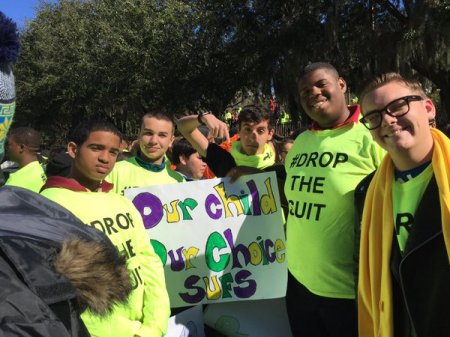
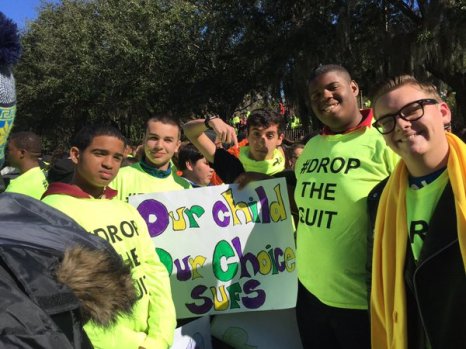
No doubt the thousands of parents and students who rallied earlier this year, calling on the union to #dropthesuit, are smiling today.

czgxhzjweaahmvc

Three out of three appellate judges agree with these scholarship kids: #dropthesuit.

I expanded upon the decision at Cato-at-Liberty, but I’ll leave you with the the judges’ conclusion:

Appellants failed to allege that they suffered any special injury as a result of the operation of the Florida Tax Credit Scholarship Program and failed to establish that the Legislature exceeded any constitutional limitation on its taxing and spending authority when it authorized the program. At most, Appellants quarrel with the Legislature’s policy judgments regarding school choice and funding of Florida’s public schools. This is precisely the type of dispute into which the courts must decline to intervene under the separation of powers doctrine.

BOOOOOOOOOOOOOOOOOOOOOOM!!!!!!!

tumblr_m6uv60m4ur1rqpx0x

[h/t Travis Pillow at RedefinED.]

UPDATE (Aug. 17, 2016): See here for my discussion of one plaintiff group’s response to the ruling.


School Choice Lawsuits Update: Summer 2016 Edition

August 12, 2016
czgxhzjweaahmvc

Some of the 10,000 protesters who rallied earlier this year to support Florida’s tax-credit scholarship program and ask the teachers union and their allies to #dropthesuit.

(Guest Post by Jason Bedrick)

As school choice wins in the court of public opinion, opponents have resorted to fighting it in the courts of law. Here are a few brief updates regarding pending lawsuits against school choice programs around the country.

Colorado: Douglas County’s School Choice Grant Program

Last summer, the Colorado Supreme Court struck down Douglas County’s school voucher program with a plurality ruling that it violates the state’s historically anti-Catholic Blaine Amendment, which forbids public money from being used at religious schools. District officials responded to the ruling by creating a new voucher program that excludes religious schools, which drew lawsuits from both opponents and supporters of school choice.

The Institute for Justice, which had previously defended the school voucher program, sued the county for unconstitutionally discriminating against religious groups. According to IJ, the “exclusion of religious options from the program violates the Free Exercise, Establishment, Equal Protection, and Free Speech Clauses of the United States Constitution, as well as the Due Process Clause, which guarantees the fundamental right of parents to control and direct the education and upbringing of their children.” IJ contends–correctly, in my view–that the First Amendment requires the government to be neutral both among religions and between religion and non-religion, but it may not actively favor nor discriminate against either religious or non-religious groups or institutions. This case is still pending.

In a separate lawsuit, opponents of school choice contended that the new voucher program was not materially different than the old one. Earlier this month, a district court agreed, striking down the program yet again. Although by excluding religious schools, the new program appears to be in compliance with the Colorado Supreme Court’s ruling, the district court explained that the state supreme court did not rule on the merits of several other alleged violations of state constitutional provisions under which the district court had previously invalidated the program. This case is likely going to return to the state supreme court for resolution.

Florida: Tax-Credit Scholarships

There are currently two lawsuits pending against Florida’s tax-credit scholarship program. As RedefinED reports, a judge recently denied an attempt to fast-track one of the two suits, which primarily concerns the adequacy of the state’s funding of district schools. A judge dismissed the portion of the suit related to the tax-credit program but plaintiffs filed an appeal and asked for the case to skip the appellate court and go straight to the state supreme court. That request has been denied, so the case will go before the appellate court first. That means the program is likely to serve more than 100,000 students by the time it comes before the state supreme court.

Nevada: Education Savings Account

As I noted a few weeks ago, the Nevada Supreme Court held oral arguments in two lawsuits against the state’s education savings account (ESA) program. RedefinED provides a nice summary of the arguments from each side.

Meanwhile, a new poll finds that nearly half of Nevada voters (48%) support the ESA program compared to 37% who oppose it. Some are making hay of the fact that wealthier families are more likely to support the program, but the law’s legislative sponsor explains that the poor are likely to benefit the most in the long run:

Support rose to 69 percent for voters with an income above $200,000, compared to just 40 percent for those earning less than $30,000.

“That might be true right now,” [state senator Scott] Hammond said. “But like anything else, when new technologies and innovations come down, it does seem like the rich take advantage of those.”

He compared the favorability of ESAs to the adoption of smartphones and other electronics: Wealthy individuals can afford to pay for the cost of research and development for a new product before the price drops for everyone else.

If the Supreme Court rules in favor of ESAs, Hammond predicted the cost of private school tuition and other services will fall and build support for the program.

“The price point will decrease. The knowledge also will increase among groups of people who may not even know what an ESA is,” he said. “And then you’ll start to see more participation.”

Exactly so. As I noted last year, the iPhone was initially something that only wealthier folks could afford, but now Walmart carries a smartphone that has better specs than the original iPhone that costs just $10. Likewise, a market for education will require the participation of higher income families to bring needed capital, but over time the greatest benefit will redound to the poor. As we’ve seen in Arizona, it is the lowest-income families who were the least satisfied at their district schools and who were the most satisfied with the ESA.

New Hampshire: Croydon’s Town Tuitioning Program

The village of Croydon, New Hampshire (population 651) is too small to run its own K-12 school system, so it has long contracted with a neighboring town to educate its students. However, a few years ago, village officials decided to cover the tuition costs of students attending any school their parents chose, up to the amount they had been paying in their previous agreements. Unfortunately, state officials didn’t like the town bucking the government education monopoly:

Croydon had been spending about $12,000 per pupil to place them in Newport’s district school. The town would cover tuition at a family’s chosen school up to the amount Newport charged, and the parents would make up any difference. On the other hand, if a school charged less than that, then the town would reap the savings. This year, Croydon paid for four students to attend Newport Montessori School, a private school where tuition is $8,200 a year.

Although the taxpayers save money and, most importantly, the students’ parents believe that school is the best fit for their children, the New Hampshire Department of Education ordered Croydon to immediately cease paying for students attending private schools.

The DOE argues that Croydon does not have the statutory authority to pay for students to attend private schools. The Croydon School Board’s attorney, former New Hampshire Supreme Court Justice Charles Douglas III, disagrees, pointing to a statute authorizing districts to contract with other public or non-public educational institutions, which, in fact, some other districts already do.

Sadly, a district court recently ruled against Croydon, which is now considering an appeal. Because the town is so small, raising the funds necessary to mount a successful legal appeal is challenging, so some village officials have created a GoFundMe page for a legal defense fund. (Yes, my libertarian friends, they do take Bitcoin!) For more information on the case, see the School Choice for New Hampshire blog.


Online Courses May Not Be the Way of the Future

August 12, 2016

Ed reformers, including path-breaking scholars Terry Moe and Paul Peterson, championed digital instruction as the way of the future.  Teaching courses online has enormous potential appeal.  Instruction could be better customized to match student needs, abilities, and learning-speed.  Online courses could achieve greater economies of scale, producing desperately needed efficiencies.  Online instruction could address critical shortages in quality teachers, substituting capital for labor.  And online instruction could politically circumvent and undermine the teacher unions and their allies by opening the door to multiple, competing education providers for each student.

Some of these benefits may hold true, at least for some students, but the dream of revolutionizing education with online instruction appears to have over-stated its prospects.  The edtechnophiles may have missed the central task in education: motivating students to learn by creating social communities in which failure to learn would disappoint people with whom students have authentic relationships.  The problem of learning is not how to provide information to students.  Almost all of human knowledge is available to students at virtually no cost — it’s called the internet.  Students could look up and learn anything they want right now.  The trick is motivating students to acquire that knowledge.

Online courses appear to be less effective in getting the average student to learn and I suspect the problem is that teaching online is less able to create social communities and authentic relationships that are necessary to motivate students.  Having a human being in front of students who would be disappointed if students did not learn the material seems important and something that online instruction has not been able to simulate.  Students appear to be better motivated to learn when they have an in-person, authentic relationship with a teacher and when they try to please that teacher by working hard to learn.  Digital instruction or a human being on the other side of the internet may not be able to create that same relationship and motivation.

There has been a fairly consistent string of studies with disappointing results from online instruction.  The most of these studies, which also contains a useful literature review of past research, is by   Cassandra M.D. Hart, Elizabeth Friedmann, and Michael Hill at the University of California, Davis. They examine the effects of online course-taking in California’s Community College system. Rather than summarize, I’ll let them describe their results:

Using a series of fixed effects techniques, we find patterns that are strikingly similar to those found in past literature. We find that online course-taking is negatively associated with contemporaneous course performance in terms of course completion, course passing, and the likelihood of receiving an A or a B. We subject our analyses to several novel tests to determine whether selection into online courses biases these fixed effect estimates, and find that the results are likely not biased….

We find that contemporaneous student performance in online courses is generally weaker than in [Face to Face] FtF classes. The results hold whether we use college-course fixed effects, student fixed effects, or instructor fixed effects. Our results are consistent across multiple ways of measuring student performance, for students with different characteristics, and across different subject Online Course-taking and Student Outcomes 29 areas. The consistency of these results across different methods of specification and for different groups adds credence to our findings. Our results are close in magnitude to results from similar studies conducted in multiple states (Xu & Jaggars, 2011; Xu & Jaggars, 2013; Johnson & Cuellar Mejia, 2014). In addition, the coefficients’ stability and the fact that the coefficients become more negative as we add controls suggests that the degree of selection on unobservables (Altonji, Elder, Taber, 2005; Oster, 2013) would have to be substantial and in the opposite direction from selection on observables to invalidate the fixed-effect results for our contemporaneous course-taking outcomes….

We find more modest evidence that online course-taking is associated with some negative downstream outcomes as well. Our findings that online course-taking is positively associated with course repetition and negatively associated with subject persistence are stable across a number of estimation techniques; like the contemporaneous course performance results, these are consistent whether we use student, college-course, or instructor fixed effects. The subject persistence results are largely stable across student subtypes, but are non-significant for AfricanAmerican students. There is more heterogeneity across subject types; while subject persistence gaps are negative for math, humanities, and social science classes, the gap is non-significant for business classes and is actually positive for information technology courses. In all cases, however, the subject persistence gaps are much smaller in magnitude than the estimates for the contemporaneous outcomes.


Political Science for Ed Reform Dummies

August 8, 2016

Despite the fact that they imagine themselves to be politically sophisticated, the leadership of the ed reform movement seems to be badly in need of some basic lessons in political science.  Political failures like Common Core, Portfolio Management in New Orleans, electoral defeats (like those recently in Tennessee), and repudiations of the entire ed reform agenda by Black Lives Matterthe NAACP, and the DNC despite extensive courting by left-leaning ed reformers suggest that ed reform might benefit from learning a thing or two about how politics works.

Lesson #1 — Concentrated interests have an advantage over dispersed interests

This is one of the most well-established and older insights from political science articulated most clearly in James Q. Wilson’s book, Political Organizations.  In education, the unions and others who benefit from the status quo system are concentrated interests.  They know how proposed changes would help or hurt them and they can easily be mobilized to donate, agitate, and vote to protect their concentrated interests.  Parents and taxpayers may be more numerous, but they are dispersed.  Each proposed change is likely to help or hurt them less than employees of the school system and parents/taxpayers (unlike school employees) do not all work in the same place and regularly share information.  This makes parents/taxpayers more dispersed and much harder to organize politically.

The political implications are that reformers will rarely be able to defeat the unions in a direct political assault nor can reformers expect to maintain control over boards or other centers of power over the education system.  Even with large campaign war-chests, as reformers had in the recent Tennessee elections, the unions and their allies will tend to prevail because they have a larger number of concentrated beneficiaries who campaign and vote.  Even with an army of DC organizations endorsing Common Core, the unions and their allies have more boots on the ground in each state to neuter or repeal standards-based reforms. Even with the financing and support of major reform foundations, the unions and their allies could hijack Portfolio Management in New Orleans, returning control to the local school board whose elections they dominate.  All of these failures could have been avoided if reformers understood this first lesson.

Despite the advantage that the concentrated interests of the unions and their allies have, reformers can achieve political victories if they keep two thing in mind. First, they shouldn’t build centralized institutions for controlling education because inevitably the unions and their allies will gain control over those institutions and use them to promote their own interests.  Don’t build a national system of standards with aligned tests because the edublob will gain control over it if they do not first block or repeal it. Don’t build Portfolio Managers governing all schools because inevitably  the unions and their allies will grab control over that. If reformers understand that they do not have concentrated interests on their side, they should prefer decentralizing control so that it’s hard even for the unions to seize all of the levers of power in one fell swoop.  If there are multiple authorizers, multiple and independent schools, and the revenue and policies of those schools are determined more by parents than bureaucrats, the unions and their allies can’t control all of it.

Second, reformers need to generate their own concentrated interest groups that have a better chance of competing politically with the unions.  The best way to do that is to expand choice so that the beneficiaries of those programs have an interest in protecting those programs.  And families at a choice school are more concentrated physically so that they can be better informed and organized for political action.  The way to fight the organized interests of traditional school employees is by creating organized interests of choice parents.

Reformers have had a bad habit of being attracted to policies that do not generate constituents to protect or expand those programs.  No one ever held a rally to test kids more.  No one ever held a rally to support test-based evaluations of teachers and schools. No one ever held a rally to increase the share of informational texts in reading standards or to ensure that uniform tests are aligned with a particular set of standards.  No one ever held a rally to regulate choice schools more closely so that the range of options is restricted or schools are more constrained.

Whatever merits these policies may have (and their merits are dubious), they are all political losers.  Eventually all of these policies will be blocked, diluted, or co-opted by concentrated interests. But the great political virtue of school choice is that it generates its own constituents who can then be mobilized to protect and expand choice.  Once parents have expanded choices it is extremely difficult to take that away politically and it rarely happens. The same cannot be said for top-down accountability and regulation reforms.

Lesson #2 — Higher income people have more political power than lower income people

As much as reformers may be motivated to promote equity, a basic lesson about political reality is that more advantaged people tend to have more political power.  Rather than lament this fact, reformers should try to use it to advance their goals.  The old political adage that programs for the poor tend to be poor programs is all too true.  Reformers have made horrible political mistakes in concentrating programs in disadvantaged areas, means-testing participants, and focusing on options that are mostly of interest to lower income families.  Not only do these program tend to be less-well funded, overly regulated, and generally of lower quality, but they are always highly vulnerable to being weakened further or eliminated.

To increase the odds of having better quality programs that are more generously funded and more reasonably regulated, reformers should be sure to include higher income families as potential beneficiaries.  And those wealthier families are more likely to be mobilized politically to protect and expand programs.  If reformers should seek to organize concentrated interests of beneficiaries, it would really help if they did not exclude higher income families that tend to have better resources, networks, and experience to participate more effectively in politics.

Lesson #3 — Winning requires 51% of the legislature

Most significant education reforms have been championed by Republican governors and state legislators with relatively little support from the other side of the aisle.  Reformers have invested an enormous amount of time, rhetoric, and money in trying to convince more Democrats to support meaningful reform, but these efforts have made few in-roads.  Reforms continue to be passed largely by Republican governors and legislators.

The problem is that elected Democrats continue to rely heavily on the concentrated interests of the unions and their allies for political support.  Reformers can’t peel away Democratic officials with targeted campaign donations because the unions and their allies can match or exceed those donations.  In addition, the unions can bring an army of campaign volunteers and voters to each election in a way that reformers generally cannot, especially in Democratic districts.  In addition, reform arguments about equity or social justice cannot shame Democrats into supporting their cause.  The unions have their own arguments about equity and social justice that, regardless of their merits, provide a sufficient fig-leaf to Democratic office-seekers.

Rather than chasing Democrats who mostly cannot be won over, reformers should remember that it only takes 51% of the legislature to win.  In states with Republican control of the legislature and/or governor’s mansion (which is currently most states), reformers can make policy entirely or largely with the support of Republicans.  Reformers should craft policies and adopt rhetoric that appeal to the Republicans they need to reach 51%.  Increasingly hyperbolic rhetoric about equity and social justice not only fails to win over Democrats, but it turns away some Republican reformers.  When Republicans are already the majority, reformers should concentrate on keeping all of them on board rather than chasing Democrats they don’t need or can’t get.

Lesson #4 — Helping your political enemies hurts you

This may seem too obvious to need articulating, but in an age where we ship $400 million in cash to the Iranians, this lesson apparently requires emphasis.  Certain groups are allied with the unions and their friends, so reformers shouldn’t provide them with money, a platform for advocating their ideas, or political rhetoric to support them.

In a fit of political naivete, the Gates Foundation actually gave money to the teacher unions in the belief that they could secure support from the unions for Common Core.  The unions happily took the money, made empty promises about support, and promptly betrayed Common Core as soon as it was convenient.  The New School Venture Fund gave a platform to Black Lives Matter at its national conference only a few months before that organization repudiated charter schools and the rest of the traditional reform agenda.

The Uber Model

The political strategy adopted by Uber provides a useful model for ed reformers.  Uber understood that taxi companies were concentrated interests in each market and therefore better positioned to block regulatory changes that would allow Uber to operate more freely.  Rather than attempting a futile direct political assault, Uber focused on creating beneficiaries of its services who could then be organized politically to fight against the taxi companies.  And while low income people are among the greatest beneficiaries from Uber’s services, Uber was determined not to exclude higher income people from its services.  They understood that once wealthier urbanites experienced Uber, they could be mobilized more easily and effectively to fight for it.  The poor benefit by having the rich fight for policy changes that benefit the rich and poor alike.

Uber does not chase the support of politicians who are determined to oppose them.  And Uber does not give money to taxi companies in the false hope that they will come around to seeing the virtues of greater competition with Uber.  In short, Uber seems to understand these 4 basic lessons of political science in a way that reformers have not.

If reformers adopted a political strategy more akin to what Uber is doing, they would enjoy far greater success.  Reformers should avoid building centralized systems of control that the unions will eventually dominate.  Reformers should focus on policies that generate their own constituents, like expanding school choice, rather than policies that only technocrats could love.  And  reformers should be sure that higher income families are among the beneficiaries of those choice programs so that their greater political power could be mobilized to more effectively fight to protect and expand programs.  Reformers should also craft policies and adopt rhetoric that appeal more to the legislators they are likely to get to reach 51%.  And it should go without saying that reformers should avoid providing support to groups that are are fundamentally opposed to the reform agenda.


How to Improve Alabama’s Schools

August 8, 2016

(Guest Post by Dr. Williamson M. Evers)

Improving education is a combination of (1) teachers effectively conveying to students certain essential information; (2) getting a better match between schools (with different strengths and teaching talents) and students (with different capacities, needs, and interests); and (3) creating learning environments where teachers are motivated to engage the students’ intellects and emotions and students are motivated to learn challenging subject-matter — and learning in a way that embeds it and puts it into practice beyond the level of learning facts that could be looked up on the web. The classroom should be a kind of theater of high-morale learning. In that shared theater of learning, the important components of civilization are passed on, teachers are role models for students, and students’ character is formed.

Curriculum should promote patriotic and liberty-loving citizenship (without ruling out exposure in high school to our country’s problems.) We should always remember that the family is the site and source of the most important education that a child receives. The public school system should avoid undermining the family and related social institutions like churches, charities, and voluntary associations.

There are steps that Alabama should consider to improve student performance:

Reading improvement. The Alabama Reading Initiative (ARI) was a professional development program (started in 1998) with school-level reading coaches. It took a few years to plan and put into place. It was based on the scientific research literature on the teaching of reading and therefore took a phonics-first approach.

By 2007, Alabama’s grade 4 reading score on the National Assessment of Educational Progress (NAEP), a nationwide examination that tests a sample of students, had risen significantly – an eight-point jump from 2005 (almost a grade level). The grade 4 students made another four-point jump in 2011, catching up with the national average. In 2009, Alabama’s grade 8 reading score on NAEP rose three points, and in 2011, it rose another three points. The grade 8 gains were slower and less sharp than the gains for grade 4 and remained  five to six points below the national average. Even the less dramatic grade 8 gains did constitute considerable improvement.

The official history of the ARI says:

“From 2003 to 2011, with a state-funded reading coach in every elementary school, Alabama’s 4th graders made more progress in reading on the National Assessment of Educational Progress (NAEP) than students from any other state in the nation. Alabama met the national average in 4th grade reading for the first time, and Alabama is one of only four states in the nation (second only to Maryland) to show increases in 4th grade reading from 2009 to 2011. The number of Alabama students reading below grade level has been reduced by half.”

Since the coming of Common Core, the State Superintendent has directed the funds for the reading initiative and the STEM initiative to coaches for Common Core. Subsequently, grade 4 reading scores on NAEP in Alabama have declined eight points, to below the national average. Grade 8 reading scores remain stagnant.

I don’t like to made pronouncements about policy issues without talking to a range of people and looking into the details of what changes could be made. But my working hypothesis would be that the reading initiative needs to be restored.

STEM (science, technology, engineering, and mathematics) improvement. Alabama also had a long-running math, science, and technology initiative. In contrast with the reading initiative, it seems to have produced no noticeable effects on student achievement. I think it makes sense for Alabama to look into why there has been such a sharp difference in results between the two initiatives, and make appropriate adjustments.

In both STEM and reading, the Alabama State Department of Education should consider certifying Professional Development programs that are based on science – based on empirical research with control groups and the like. A State superintendent should seek to make sure that districts know about good Professional Development and should nurture the growth of such programs.

Graduation rate and academic attainment. To boost academic attainment, Alabama should put in place a 3rd grade test (Florida currently retains students who cannot pass its 3rd grade reading test) and a 10th-grade/graduation test. Alabama discarded its High School Exit Examination (AHSGE – Alabama High School Graduation Exam) in 2013 and replaced it with ACT/CCRS (College- & Career-Ready Standards).

The 11th grade ACT cut scores in Alabama are 18 for English; 22 for math and reading; and 23 for science. The ACT scores are the standard current national “college readiness” scores. So they are, in fact, quite demanding and above the 10th grade level.

ACT is basically used in Alabama for federal reporting purposes to comply with the federal Elementary & Secondary Education Act.  Graduation is currently based on area requirements and seat-time (measured in Carnegie units).

Alabama should restore its exit exam, but it should operate in a multiple second-chances way, with many opportunities to retake the tests and offering a variety of exemptions and special categories.  The idea is to create a focus and a shared goal, not to deny some large number of students a diploma.  Alabama should also reconsider its One Diploma policy.  Since there are a wide variety of students with different capacities, interests, and needs, there should probably be a variety of diplomas.

Tom Loveless of the Brookings Institution estimates that all the prep time and all the millions spent on the Common Core national curriculum-content standards boosted achievement in the U.S. by only a tiny amount: one scale-score point. The new Every Student Succeeds Act does much to protect against future federal interference with curriculum. When it comes to testing, Alabama is not now with PARCC or SmarterBalanced, but has instead affiliated with ACT. Yet Alabama has a set of state standards largely based on Common Core. It is time, I would think, to revisit those current state standards to see what needs fixing. (I participated in California’s line-by-line review of the Common Core in 2010, and I participated in creating the late-1990s California State Academic Content Standards, judged best in the nation by the Thomas B. Fordham Foundation and the American Federation of Teachers.)

Career and technical education. Students, because they are different individuals, should have different educational pathways in high school. Blouke Carus — a leading children’s magazine publisher (including Cricket, Ladybug, Cobblestone), math and reading textbook developer, and chairman emeritus of the Carus Corporation (a company producing manganese compounds) — has said: “Our schools need to offer each student a choice among six or more challenging and rigorous high school curricula, as do other, higher-performing countries.”

As I and my colleagues wrote in a 2013 manifesto entitled “Closing the Door on Innovation”: “There is no evidence to justify a single high school curriculum for all students. A single set of curriculum guidelines, models, or frameworks cannot be justified at the high school level, given the diversity of interests, talents, and pedagogical needs among adolescents. American schools should not be constrained in the diversity of the curricula they offer to students. Other countries offer adolescents a choice of curricula; Finland, for example, offers all students leaving grade 9 the option of attending a three-year general studies high school or a three-year vocational high school, with about 50% of each age cohort enrolling in each type of high school. We worry that the ‘comprehensive’ American high school may have outlived its usefulness, as a [2011] Harvard report [Pathways to Prosperity] implies.”

Because vocational education has a reputation for being a dumping ground and a place where minority children were channeled because of racial bias, education policy has neglected vocational education and sometimes even eliminated it. Alabama’s “Essentials/Life Skills Pathway” is a separate vocational-education pathway.  For example, instead of English 9, the student would take English Essentials 9. This is intended to prep students for community college or the workforce, not for entry to 4-year colleges.

Alabama needs to avoid a situation which the only high school available for a student is a college-prep comprehensive or, alternatively, vocational-only.  The state should incentivize local districts (through waivers) to create a variety of career-tech program alternatives (including a variety of mission-oriented schools), but these should include an academic component (as they do now). In general, Alabama should look carefully at Arizona where the process of school creation is highly decentralized, and the results have been fruitful.

Teacher Quality. As the 1999 manifesto “The Teachers We Need” (of which I was a co-signer) says, “the surest route to quality is to widen the entryway [and] deregulate the processes.” This would expand the pool of potential teachers. It would open the doors to highly-qualified, but non-traditional recruits who want to become teachers and thereby improve overall quality. New York State currently has a relatively open process allowing alternative certification.  In Arkansas, almost half the incoming teachers come in under alternative certification.

But Alabama gets only a C- from the National Council on Teacher Quality for the extent to which the state’s teaching pool has been expanded by alternative certification and the like. Alabama should also be open to non-traditional teacher training programs like the Relay Graduation School of Education in New York City.

Michael McShane of the American Enterprise Institute has written:

“Recently, I have been influenced by the work of Northwestern University economist Kirabo Jackson, whose fascinating NBER working paper calls into serious question policy’s recent overreliance on math and reading scores as the primary measure of the ‘goodness’ of schools and teachers. As it turns out, teachers have important and measurable impacts on both the cognitive and non-cognitive development of students. While it’s certainly true that test scores can tell us something important about a teacher, what is troubling for the test-score types is that it looks like (1) non-cognitive scores are better predictors of later life success (completing high school, taking the SAT, and going to college) and (2) that it is not the same set of teachers that is good at raising both cognitive and non-cognitive measures.

“Such has to be the same for schools, right? If there are teachers that are increasing non-cognitive, but not cognitive skills, surely there are schools that are doing the same. As a result, trying to assess if a school is ‘good’ or ‘bad’ relies on a complex web of preferences and objective measures that, quite frankly, cannot be taken into account in a centralized accountability system. We need something more sophisticated, and something that can respect a diverse conception of what ‘good’ and ‘bad’ means.”

In citing Michael McShane and Kirabo Jackson, I am suggesting a goal for the future, while not saying that there should be no accountability. We should consider a change in providers of accountability because Alabama has a variety of school districts, localities, and other groupings. As Jason Bedrick of the Cato Institute and Andrew Smarick, chair of the Maryland State Board of Education, have separately pointed out, accountability doesn’t have to be in conformity with One Best Way. School evaluation can be pluralistic and rivalrous and doesn’t have to be solely governmental. Churches could do it, neighborhood associations could do it, chambers of commerce could do it.   As Bedrick writes: “Parents can then evaluate the quality of education providers based on their own experience and the expert evaluations of appropriate external providers, and the entire system evolves as parents select the providers that best meet their children’s needs.”

Currently if a teacher is educated in Alabama teachers colleges and receives bad evaluations during the first three years, the teacher can go back to college for free. This seems like a smart program worth retaining.

Education Next magazine surveyed teachers nationwide and the teachers themselves said that about 5% of teachers deserve an “F” and 8% deserve a “D.” But we should be cautious about grandiose projects to improve teacher quality. The “highly qualified teacher” provisions of the No Child Left Behind law were never successfully put into effect. The elaborate new teacher-evaluation systems put in place (at the cost of millions) in about 20 states have reduced the percentage of teachers rated “satisfactory” from 99% to 97%.

Currently teacher-certification testing is under court supervision. Alabama has low passing scores on the PRAXIS II tests that it expects of teachers. When court supervision is over, the state could slowly raise passing scores (as Texas has). Teachers do need to know the subject-matter they are teaching. But the most important thing is to increase the inflow of good prospects into the teaching pool (from which districts and schools can select), rather than reducing the size of the pool.

Economic growth and student attainment. Both policymakers and the civically active public underestimate the economic gains from school improvement. The differences in rates of growth among states can be matched to the education of the workers in the various states. A multiplicity of causes affect economic growth, but nothing is more influential in the long run than school improvement. Although it is certainly difficult to improve schools, it is easier to improve schools than it is to change other factors that figure in increased productivity.

Equated to PISA international test results, Alabama is currently below Turkey.

Some people think that Alabama’s low results are because of demographics. But the only state whose whites do worse currently is West Virginia.

For Alabama, which is educationally at the bottom of the lowest quartile in the United States, the present value of bringing the state to the level of Kentucky – in the next quartile — would be three times Alabama’s current Gross Domestic Product (according to my Hoover Institution colleague Eric A. Hanushek). Other states at the Kentucky level are Florida, Arizona, Oklahoma, and Rhode Island. To get to the level of Kentucky would mean for Alabama over 6% annual growth in GDP and about 12% annual growth in salaries.

Conclusion: A State Superintendent should not be a Caesar, lording it over local districts and local superintendents. State superintendents should not act as if they are progressive technocrats with coercive utopian powers. It will be harmful to learning communities if state superintendents act that way.  Where sensible, they should devolve much of the responsibility over academic content, teaching methods, and instructional materials to the local districts. The different districts can – and should — try different things. Parallel learning communities will sometimes arise.  If districts and schools endeavor to conscientiously do their best, Alabama can climb out of the cellar and surpass states like Kentucky academically. The State of Alabama will prosper, and Alabama’s children will have more fulfilling lives.

—————————————————————

Williamson M. Evers, Ph.D., is a Research Fellow at Stanford University’s Hoover Institution and a former U.S. Assistant Secretary of Education for Planning, Evaluation, and Policy Development. He is a finalist for the position of Alabama State Superintendent of Education.


The Past is Never Dead. It’s Not Even Past.

August 3, 2016

(Guest Post by Matthew Ladner)

One of my favorite trends I have spotted in reading history is when an author skillfully makes an allusion to current events without once making any explicit reference to contemporary circumstances. Or perhaps I am just reading too much into things, but try this quote on for size from the opening chapter of Max Hastings’ book Catastrophe 1914: Europe Goes to War:

1.

‘A Feeling that Events Are in the Air’

1 Change and Decay

One day in 1895, a young British army officer lunched in London with the old statesman Sir William Harcourt. After a conversation in which the guest took, by his own account, none too modest a share, Lt. Winston Churchill-for it was he- asked Harcourt eagerly, ‘What will happen then?’ His host replied with inimitably Victorian complacency: ‘My dear Winston, the experiences of a long life have convinced me that nothing ever happens.’ Sepia-tinted photographs exercise a fascination for modern generations, enhanced by the serenity which long plate exposures imposed upon their subjects. We cherish images of old Europe during the last years before war: aristocrats attired in coronets and ball gowns, white ties and tails; Balkan peasants in pantaloons and fezzes; haughty, doomed royal family groups.

Only a man or woman who chose to be blind to the extraordinary happenings in the world could suppose the early years of the twentieth century an era of tranquility, still less contentment. Rather they hosted a ferment of passions and frustrations, scientific and industrial novelties, irreconcilable political ambitions, which caused many of the era’s principals to recognize that the old order could not hold. To be sure, dukes were still attended by footmen wearing white hair powder; smart households were accustomed to eat dinners of then or twelve courses; on the continent duelling was not quite extinct. But it was plain that these things were coming to an end, that the future would be arbitrated by the will of the masses or those skilled at manipulating it, not by the whims of the traditional ruling caste, even if those who held power strove to postpone the deluge.

Sound vaguely familiar?


The Next Accountability: What Do We Want from Schools?

August 3, 2016

Little-sprouts_-Grow-bean-sprouts-in-your-back-garden

(Guest post by Greg Forster)

Today the newly renamed EdChoice launches Part 1 of my series of articles on The Next Accoutability, previewed with an introduction a few weeks ago.

I argue that the education reform coalition is coming apart because we don’t agree about what we want from schools:

The movement was well served in many ways by its various edifying impulses: to “close the achievement gap,” to “put parents in charge,” etc. But it has been haunted for decades by a growing awareness that these moral impulses do not always cohere easily.

The question, “What do we do if putting parents in charge doesn’t, by itself, close the achievement gap?” has been debated at every education reform conference I’ve attended. Such debates were lively and interesting intellectual exercises, so long as not much hung on them.

We lack consensus on what we want from schools because in a pluralistic society with religious freedom, we want to respect diverse opinions about the highest questions in life. But this leaves us with an incoherent education policy:

Our freedom to disagree about transcendent things does not mean that public policy can escape the responsibility to ask what is good, true and beautiful. In fact, the very assertion that it is good to have the freedom to disagree about transcendent things is itself an assertion about what is good, i.e. about transcendent things.

The challenge of pluralism is also an opportunity for us to discover a fresh vision of human potential that embraces the freedom to disagree about the highest things:

School accountability should be grounded in an understanding of human potential aimed at building up free communities, open to pluralism under the rule of law and respect for human rights, where people achieve and appreciate the good, the true and the beautiful in the midst of their differences over those very things.

I outline how we can understand educational goals for the head, the hands and the heart in ways that point toward the possibility of coherence in a pluralistic society.

Coming in two weeks: Part 2, looking at how teachers and schools actually carry out the task of educating students in the midst of our uncertainty about the highest goals of education. It is here, I will contend, that we will find clues to how we can hold schools accountable more effectively. Stay tuned!

As always, your comments and feedback are greatly appreciated.


Pass the Popcorn: The Best Films of the Summer

August 3, 2016

The summer of 2016 did not have much to offer in terms of summer movie blockbusters.  We had another avalanche of super-hero sequels that are becoming mind-numbing in their predictable plots and exhausting action sequences.  It’s almost enough for you to root for the villain to finally destroy the world and save us from having to watch more of this dreck.  There were some cute animated films, like Zootopia and Finding Dory, but neither of these stood out as being significantly better than past summer animated movies.

I’d argue that the best films of the summer of 2016 were a trio of small, independent films: Sing Street, Maggie’s Plan, and Love and Friendship.

Sing Street comes from writer/director John Carney who previously made Once and Begin Again.  Sing Street is even better than those prior two, excellent movies.  All three films are about trying to capture the purity and innocence of making music, but Once and Begin Again are about trying to recapture those qualities while Sing Street is about discovering that purity and innocence for the first time.  The movie is set in economically depressed Ireland in the 1980s.  A teenager sent to a new school tries to find his place and (most importantly) impress a girl by forming a band.  The newly formed band tries every genre of 80s pop music, providing a nostalgic tour de force of the music of that era.  No school band was ever this good or versatile, but you just need to let go and enjoy the fantasy.  In addition to music, and youthful romance, the movie offers a touching picture of the relationship between brothers, a topic that deserves more attention in modern movies.  So grab your eye liner, synthesizer, and sensible brown shows and be sure to see Sing Street.

Maggies’s Plan by writer/director Rebecca Miller is like one of Woody Allen’s sophisticated relationship comedies, but even better.  The basic plot is that Maggie, played by Greta Gerwig, is a sweet and nerdy university administrator in New York City who is perhaps a little too capable at managing things.  She meets a fellow-academic played by Ethan Hawke who is a star in his field of ficto-critical anthropology but wants to be a novelist.  He’s already married to an even more accomplished academic, but is drawn to Maggie’s ability to manage his life and boost his ego.  At first Maggie is attracted to Hawke’s character, but eventually tires of him.  So, she comes up with her Plan, which is an even more elaborate attempt to manage everyone’s lives.  Maggie’s Plan exceeds its typical Woody Allen counterpart by more accurately capturing the perspective and voice of the women characters.  It also portrays the crappy apartments and chaotic lives of New York pseudo-intellectuals much more accurately.  It’s dry comedy but darn funny.

Love and Friendship is an adaptation of a Jane Austen novel by writer/director Whit Stillman.  Unlike prior films of Austen novels, this one departs severely from realism.  The characters and dialogue are so over-the-top that it comes off more as a farce.  And Whit Stillman’s direction and use of on-screen character descriptions really make this farce work.  Stillman’s earlier films, which include Metropolitan (one of my all-time favorites), Barcelona, and The Last Days of Disco are all like Austen films in that they feature a declining upper-class. But I think some may misunderstand Stillman in those films and in this new one as pining for a return to those old, aristocratic days.  Far from it, I think Stillman is really a champion of the rising and enterprising bourgeoisie in all of these movies.  What may seem like the manipulative villain in this movie is actually the practical and enterprising new class, while the aristocrats are generally buffoons who are easily fooled and generally deserve the decline they are experiencing.

All three of these movies may be out of theaters, but should soon appear on the small screen via, Netflix, Amazon, Hulu, or whatever.  Pop some popcorn and enjoy these small, indy hit of the summer of 2016.