Arizona’s New School Grades Lack Face Validity

October 6, 2017

(Guest Post by Matthew Ladner)

Reviewing Arizona’s ESSA plan the Fordham event the other day inspired a growing sense of dread as I trudged through page after page of extreme complexity regarding the state’s plan to grade schools A-F. “If Jurassic Park scientists spliced the DNA of a Franz Kafka nightmare with a Rube Goldberg machine, it would look something like this…” I recall thinking to myself six or so pages in (less than halfway) through the description of the formula.

When we discussed the concept with Arizona lawmakers originally, the idea was a straightforward mix of 50% proficiency rates, 25% gains for all students, and 25% gains for the students who scored at the bottom 25% on the previous year’s test. This formulation is both easily understood and provides an incentive for schools to avoid having students falling hopelessly behind. Why settle for something tried, true and elegant when you can develop your own new and improved version?

An ultra-complex formula provides opportunity for things to go wrong. Grades were released today, they are almost entirely based on AZMerit scores, and the grades failed the very first check of face validity I tried from schools in my own neighborhood. The above charts show AZ Merit scores from Ingleside Middle School (Scottsdale Unified) and Archway Veritas. Respectively these are the closest and the second closest schools to where I live.

Greatschools gives Archway Veritas a 10 out of 10 ranking and Ingleside an 8 out of 10. Hard to quibble with that- Ingleside’s scores are above state averages while Veritas scores are far above state averages.

Under the newly released Arizona grades, Ingleside received a “B” from the state, while Archway Veritas received a “C.”  Despite the fact that Archway students had a 30% proficiency advantage in math, and a 24% proficiency advantage in ELA, they received a lower grade. Hmmm. This alas is simply the first test of face validity I ran, which lasted all of two minutes. If I were to spend a bit more time, I’m confident I could find even more inexplicable results.

Arizona suspended letter grades years ago due to the introduction of new tests. I know many of the people involved in the effort to revise the formula to be outstanding people who care deeply about improving Arizona K-12. Nevertheless, these grades lack face validity in my book and ought to be revised using a straightforward formula. Failing that, the legislature should adopt new school labels along the lines of “Blue” “Green” and “Poka Dot” to satisfy the feds and leave the task of ranking schools to private platforms such as Greatschools and others, which is where the eyeball traffic resides already. The state, alas, seems unequal to this task.

Anyone from either districts or charter schools will find plenty of things to complain about with a bit of examination. They will be upset. They will have a right to be upset. Fortunately Arizona’s nation leading academic progress is being driven from the bottom up.


Advice to the Arnold Foundation

October 3, 2017

The Laura and John Arnold Foundation is impressive for its intellectual honesty and curiosity.  They have an education reform strategy with which I have some important differences, but they are nevertheless interested in hearing criticism of their approach, so they invited me to present my critique to their board.  Below is the essence of what I prepared for that meeting.  I don’t expect that this will cause them to alter course, nor should it.  It’s their money and they should do whatever they think best.  But the amazing thing about the Arnolds and the head of their education effort, Neerav Kingsland,  is that they are at least open to the possibility of being wrong and want to hear criticism in case they would like to reconsider any aspects of their strategy.

The heart of the Arnold reform strategy is Portfolio Management, which is a term with which they are not enamored, but is essentially a rapid expansion of choices across different sectors with a centralized and muscular system for engaging in quality control.  The Portfolio Manager would govern schools of all types in a location — traditional, charter, and perhaps private — and select which schools should be allowed to operate, which should be closed, and police certain aspects of their operations, including admissions, transportation, and perhaps special education, discipline, and other issues.  I’m a fan of the rapid expansion of choices, but I believe that the centralized and muscular quality control system produces significant educational and political damage.  I am not suggesting that the Arnold Foundation (or the charter movement in general ) abandon all quality control efforts, but I think quality is best promoted by relying heavily on parent judgement and otherwise relying on a decentralized system of authorizers with the most contextual information to make decisions about opening and closing schools if parents seem to have difficulty assessing quality on their own.  The problem with Portfolio Management is the centralized and overly-active nature of a single quality-control entity.  Here is my case in 7 points:

  1. Conceptually, Portfolio Management is no different from School Districts, so there is no reason to expect it to be any better at quality control than School Districts are.  People often claim that PM is different because its mission is only to maintain the quality of the portfolio of schools, not interfere in their operations.  But social scientists think about organizations based on their powers and incentives, not their mission.  Regardless of what PM is supposed to do, we should focus on what it can do and what is in its interest to do.  There is nothing that a PM can do or should want to do, given its organizational interests, that is not also the case for a School District.  PMs can open and close schools, just like  School Districts do.  PMs can set policies that affect school operations, just like School Districts do.  Remember that PMs have already crept into setting policies about admissions, transportation, special education, and discipline — all of which affect school operations.  And the types of schools they decide to let open or force to close shape the curriculum and pedagogy of those schools.  Also remember that School District boards do not actually operate schools, just like PMs don’t.   School District boards just set policies and decide which schools should open and close, just like PMs.  Given that they have the same powers and organizational interests, the only difference I can see between PM and School District boards is that the PM is imagined to be a good guy, who will properly be motivated by quality and avoid interfering unproductively in school operations, while School District board members (even if appointed) are imagined to be bad guys who are more concerned with satisfying special interests and following procedures than with school quality.
  2. Even if you can manage to get a PM system in place (and there are very few), and even if you manage to get “good guys” in charge of it, the good guys won’t stay in charge for very long.  The poster boy for PM, New Orleans, with its exceptional hurricane origin and large charter sector to advocate on its behalf, reverted to control by the previously reviled and inept locally elected school board in about a decade.  Yes, there is a law that swears that the school board now serving as PM will not interfere in charter operations, but these oaths of non-interference hardly provide any protection.  As discussed in 1., PMs already take actions that affect school operations by regulating their admissions, transportation, special education, and discipline.  And their ability to open and close schools can effectively control any other aspect of school operations that they wish.
  3. Even if you can get PM and keep the “good guys” in charge for longer than a decade, the PM is unable to effectively control quality because it has no tools that reliable identify quality.  Basically, the only tool available is the level of test scores.  We all fantasize about a world in which student learning growth on math and reading tests is calculated and used by central authorities to judge quality, but the reality is that very few school systems actually rely heavily on value-added measures (VAM).  In New Orleans, for example, only 5% of the school quality grade is based on VAM.  The rest is based on the level of student performance.  No reasonable person believes that the level of student performance is a reliable proxy for school quality.  Instead, the level of performance is largely a function of the severity of disadvantage among the students.  And yet the PM in New Orleans is making judgments about school closure based on a flawed measure that effectively punishes schools for trying to serve a high concentration of kids who are too disadvantaged.  And even in the imaginary world in which VAM is used, learning growth on math and reading tests only captures a narrow portion of school quality, which is why those measures are not consistent predictors of later life outcomes, like graduation, college attendance, and earnings.  As I’ve written before, you can’t manage quality if you can’t predict it, and PM does not possess any tools to reliably predict school quality.
  4. Even if we thought test score levels or the imaginary future of VAM were good enough for PMs to manage the quality of their portfolio, the heavy reliance on those measures distorts schools in ways that are educationally harmful.  To avoid the risk of being judged low quality, schools will tend to narrow their curriculum to tested subjects and even within those subjects focus more narrowly on tested items.  Other subjects and non-tested material can produce important benefits for students, but PM provides incentives for schools to neglect those benefits.  The result is that we get a homogeneous set of schools that are narrowly focused on improving test outcomes.  That kind of school might be good for some kids, but is certainly not good for all.
  5. The homogeneous set of school options that results from PM is very unlikely to offer anything that appeals to more advantaged families.  It basically results in a charter movement that is designed to serve certain urban students with no-excuses-type schools.  Suburban and more advantaged families have no interest in this kind of schooling for their own children.  By failing to offer more advantaged families any benefits, the charter movement then loses their political support, and advantaged families have much more political power than disadvantaged families.  PM advocates seem to have forgotten that politics is driven largely by self-interest manifested in organized groups.  The crushing defeat of the charter referendum in Massachusetts is at least partially explained by the political foolishness of narrowly focusing the charter movement on a certain type of school to serve disadvantaged students.  No matter what science you present to prove that those schools are good and no matter what appeals to justice you make, advantaged families will not support a movement that poses any risks to their own children and offers them no benefits.
  6. In addition to alienating advantaged, mostly white, families, PM has also alienated minority community leaders.  First, a centralized and muscular system of quality control, like PM, that is only established in urban districts clearly communicates to minority communities a lack of trust in their ability to judge quality as parents or even to judge it as decentralized charter authorizers.  It effectively says that suburbanites can choose whatever they like, but folks in big cities can’t be trusted.  Even worse, raising the barrier to entry for operating a charter school (without actually improving quality, as we already discussed) disproportionately excludes minority community leaders from operating charter schools.  It is the same principle as occupational licensure.  Things that make it hard to enter and have nothing to do with quality typically have the effect of keeping minorities and more disadvantaged people out.  Not surprisingly, we get a charter sector that is largely developed and run by white folks from elite college.  If Rev. Johnson would like to open a charter school in the classrooms he uses for Sunday school, he will have a particularly hard time completing the 700 page application in a way that satisfies the PM’s rubrics and his educational background may not appear as impressive.  But he may know his community well and his political support could be helpful.  Centralized and muscular quality control, like PM, tends to turn these folks away.
  7. The Arnold Foundation invests heavily in another initiative that promotes rigorous science for medical and policy decision-making, yet they do not seem to apply that same standard of proof to their own education strategy.  When pressed, the main evidence they point to in support of PM is a study by Doug Harris that shows that New Orleans made significant gains post-Katrina that cannot fully be explained by changes in the composition of students in the district.  Even if true, however, that study cannot tell us what New Orleans did to produce this improvement.  Perhaps the huge expansion in school choice deserves the credit and the muscular quality control added no benefit or even hurt.  Perhaps New Orleans produced gains because it imported a small army of elite college kids, greatly increasing human capital in the school system.  Maybe the large increase in spending in New Orleans deserves some of the credit.  The point is that attributing the gain to PM is unscientific, since Harris’ research was not designed to address this question.  Saying that we should pursue PM nationwide because New Orleans has it and has improved is roughly the equivalent of saying that you should wear copper bracelets because I wore them and my arthritis feel much better.  If someone made the later claim, the Arnold Foundation would (rightly) scoff at them as quacks.  I understand that foundations cannot have rigorous evidence to support all steps in their reform theory, but before pursuing a reform strategy that promises to close a bunch of schools that parents want and alienating both advantaged suburbanites and minority community leaders, they might want more evidence for the strategy than they have.

Fordham Debate on Future State Gains

October 2, 2017

(Guest Post by Matthew Ladner)

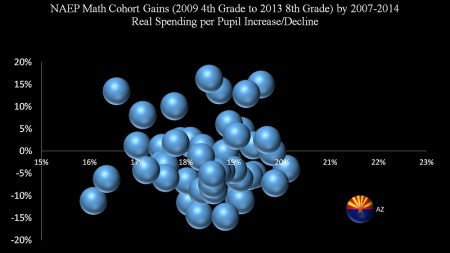
So you’re hanging out in DC, sad because you can’t get your wonk on, when suddenly you remember that Fordham is hosting a debate on whether Arizona, California, Louisiana or Tennessee have the best prospects for academic gains going forward at 3 pm! !!Spoiler alert!! Special nerdy sneak preview chart above.


Somin: Choice Is More Democratic Than Political Control

October 2, 2017

sheep-on-voting-for-a-lion-or-a-wolf-on-election-day

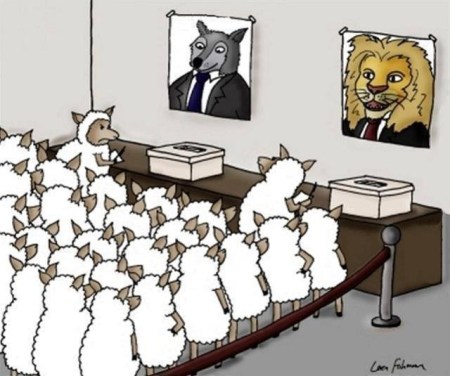
(Art work by Loren Fishman.  This and his other work can be found at https://humoresquecartoons.com )

(Guest Post by Jason Bedrick)

Critics of school choice frequently argue that schools are a “public good” that requires public control via democratic institutions (i.e., school boards and state legislatures). Proponents of choice generally respond that school board elections are too easily captured by special interests, that private schools tend to do a better job of inculcating civic knowledge and values, and that school choice better respects the high value our society places on freedom and pluralism.

In a recent blog post, law professor Ilya Somin argues that if we understand democracy more broadly as “people having a say in the decisions that affect their lives” rather than mere majoritarianism (“one person/one vote”), as some modern democratic theorists argue, then school choice is also more democratic:

Much depends on exactly what it means for people “to have a say in the decisions that affected their lives.” If it merely means having some minimal opportunity to participate in the decision-making process, then African-Americans in 1950s Topeka had enough “say” to qualify. After all, they, like whites, could vote in local elections that decided who would get to direct education policy. True, they rarely actually prevailed on issues related to segregation. But repeated defeats are a standard part of the political process, especially for unpopular minorities.

Blacks living in Topeka under segregation had the right to vote, but how much of a “say” did they really have over the public policies affecting their lives? Somin continues:

But perhaps “having a say” means more than just the right to participate, but actually requires people to have a substantial likelihood of influencing the outcome. In that sense, blacks in Topeka obviously did not enjoy true “democracy.” But their painful situation was just an extreme case of a standard feature of electoral processes. In all but the smallest and most local elections, the individual voter has only an infinitesimal chance of actually influencing the result, about 1 in 60 million in a US presidential election, for example. A small minority of citizens have influence that goes well beyond the ability to cast a vote – politicians, influential activists, pundits, powerful bureaucrats, important campaign donors, and so on. But the overwhelming majority do not.

If having a say means having substantial influence over the content of public policy, most of us almost never have a genuine say. Obviously, most voters are not as dissatisfied with the resulting policies as African-Americans in the 1950s had reason to be. But that is largely because their preferences and interests happen to line up more closely with the dominant political majority, not because they actually have more than infinitesimal influence.

Perhaps you “have a say” if enough other voters share your preferences that the government is forced to follow them. But in that event, the government is still enacting your preferred policies only because powerful political forces advocate for them, not because you have any significant influence of your own. In the same way, a person who agrees with the king’s views might be said to “have a say” in the policies of an absolute monarchy. And if, as Glickman suggests, the goal is to give “all people” a say (emphasis added), then any electoral process will necessary leave many people out. There are almost always substantial minorities who strongly oppose the status quo, but have little prospect of changing it.

In short, in a majoritarian system — even one that has significant protections for minorities — you only “have a say” when a significant number of other people agree with you (either to enact your preferred policy or at least to affect whatever policy is ultimately enacted against your will).

The powerlessness of the individual voter is one of the reasons why many libertarians favor making fewer decisions at the ballot box and more by “voting with your feet.” When making choices in the market and civil society, ordinary people generally have much greater ability to make decisive choices than at the ballot box. When you decide what products to buy, which civil society organizations to join, or where you want to live, you generally have a far greater than 1 in 60 million chance of affecting the outcome. Whether or not it is more “democratic” than ballot box voting, foot voting gives individuals greater opportunity to exercise meaningful choice.

Taking the “having a say” standard seriously also entails cutting back on the powers of government bureaucracies. The latter wield vast power over many important aspects of people’s lives, often without much constraint from either foot voting or ballot box voting.

In other words, for people to truly “have a say,” then we must shift the locus of control away from politicians and bureaucrats toward individuals and families.

If having a meaningful say is the relevant criterion, it also turns out that […] school choice […] is more “democratic” than conventional public schools. In the case of the latter, most individual parents have very limited ability to influence the content of the public education available to their children. They can only do so in the rare case where they can exercise decisive influence over education policy, or by moving to a different school district. By contrast, school choice enables them to choose from a wide range of different options, both public and private. And they can do so without having to either move or develop sufficient political clout to change government policy.

If we truly want the most disenfranchised and powerless among us to have a say over their own lives, we should favor an education system that empowers them to make choices about where and how their children are educated. It’s the democratic thing to do.


Can School Choice Reduce Bullying and Save Lives?

September 29, 2017

(Guest Post by Jason Bedrick)

Yesterday, the New York Times told the tragic story of a student tormented for his ethnicity and sexual orientation who stabbed to death another student who had been harassing him and punched him in class:

“He was constantly taunted at school,” Ms. Hornback said. “I guess he felt his only way out of it was to resort to what he did.”

Ms. Hornback said Mr. Cedeno’s family was not trying to diminish what he did. But she said Mr. Cedeno’s mother had pleaded with staff members at the school for help protecting her son and had met with a guidance counselor there.

“There was no action from the school,” Ms. Hornback said.

Of course, it is impossible to say what would have happened in a different situation. But it’s also not far-fetched to imagine that things would have played out differently had Cedeno’s family had other educational options. Perhaps they could have used a voucher, tax-credit scholarship, or education savings account to place him in a safer learning environment. Alternatively, perhaps just knowing that parents had such options, the school might have taken the situation more seriously and intervened before reaching the boiling point.

Sadly, bullying is all too common. Can expanding school choice options help reduce bullying? That is the question Dr. Kevin Currie-Knight and I addressed in a recent blog post for EdChoice:

It appears that private schools have more robust anti-bullying programs, have students who are more likely to report bullying and fewer reported instances of bullying.

Why do bullying rates appear lower and responsiveness to bullying higher in private schools? We can speculate that when schools are selected by their students, they are more responsive to their needs and to family feedback. We do know for a fact that parents and students who are using the K–12 voucher program in Washington, D.C., believe their private schools are much safer, and parents often list safety as a top reason for choosing a private school.

Obviously, no parent wants to send her children to a school where they feel unsafe, and we are certain public school employees want the best for their students. But at the end of the day, a school system where students are assigned by geographic boundaries simply cannot have all the right answers for every child—and the results can be heartbreaking.

We are not here to pit public schools against private schools against other schooling types. We take a different approach: What might our communities’ schools—whether public, private or otherwise—learn from one another?

There’s no policy intervention that can possibly eliminate all bullying, but expanding educational options would create stronger incentives for schools to address instances of bullying and — if and when schools fail to address it — give bullied students a way out.


Florida Scholarships Boost College Enrollment

September 27, 2017

ednext_20111_figlio_open

(Guest Post by Jason Bedrick)

Florida’s tax-credit scholarship program is the largest in the country, serving more than 100,000 students. Those students tend to be among the most disadvantaged–nearly 70 percent are black or Hispanic and their average household income is only about $25,000.

New research from the Urban Institute finds that participating in the program boosts college enrollment:

Participation in the FTC program increased college enrollment rates by 6 percentage points, or about 15 percent, for students who participated in the FTC program at some point during their education. Of students who entered FTC in elementary or middle school, 45 percent enrolled in college, compared with 39 percent of their non-FTC counterparts. For students who entered FTC during high school, college enrollment rates were 48 percent for FTC students and 42 percent for non-FTC students.

Of course, opponents of choice are straining mighty hard to dismiss these findings.

Samuel Abrams, director of the National Center for the Study of Privatization in Education at Teachers College, Columbia University, criticized the study’s methodology as flawed, saying that students who had the energy and motivation to get accepted and remain at private schools may already have an edge compared to their peers in public schools. Abrams said the American education system must be improved by addressing income inequality, accessible childcare and health care and teacher pay in public schools and not by putting more students in private schools.

“This is a solution for some kids, but it can hurt other kids because it concentrates underperformers in their default neighborhood public school,” Abrams said.

Actually, every claim Abrams made is flatly contradicted by previous research.

False Claim #1: Scholarship Students Were More Advantaged

Annual studies by Dr. David Figlio and later by researchers at Florida State University found that participating students were more disadvantaged before entering the program. The most recent study found:

[C]ompared to eligible non-participant students, new FTC students had poorer test performance both in ELA and math before entering the FTC program.

Contrary to Abrams, the scholarship students did not “have an edge compared to their peers in public schools” — they were behind those peers.

False Claim #2: Scholarships Concentrate Poor Performers in District Schools

As noted above, rather than “concentrate underperformers in their default neighborhood public school,” the program gave the most disadvantaged students the opportunity to attend new schools where they caught up to their peers academically (indeed, the FSU research shows that they were competitive with the national average, outperforming their low-income peers), and then were more likely to go to college.

False Claim #3: Scholarships Hurt Nonparticipants

Abrams claimed that the supposed concentration of underperformers in district schools would then hurt those students, presumably via peer effects (as he alluded on Twitter). However, not only was there no such concentration of underperformers, an earlier study by Dr. Figlio and Dr. Cassandra Hart found in that competition from the choice program improved the performance of district school students. Far from hurting them, as Abrams claims, the research shows that increased choice and competition helped everyone.

And on top of it all, the tax-credit scholarship program achieves all this while saving taxpayers money.

That’s a win-win-win situation if there ever was one.

[Note: This blog post was edited slightly for clarity.]


First Prize a Cadillac El Dorado, Second Prize a set of steak knives

September 27, 2017

(Guest Post by Matthew Ladner)

Please join me at the Fordham Institute on Oct. 3 for a debate between three very distinguished panelists but also one sketchy panelist and yours truly to debate which state has the best prospects for achievement gains in the four years ahead: Arizona, California, Louisiana and Tennessee.  Wonkery with light refreshments to follow so come out and cheer for the Cactus Patch!


Diversity and Community on Campus

September 15, 2017

IMG_1869

(Guest post by Greg Forster)

Just in time for the Ben Shapiro non-Ragnarok in Berkeley, OCPA’s Perspective carries my article on diversity and community on campus:

The dominant group, on the political Left, learns from these episodes that getting offended brings power. Stigmatizing people and destroying their lives pays off. By crushing their victims, they establish themselves as the people who must be kept happy if peace is to be maintained.

The oppressed minority group, on the political Right, is also incentivized to escalate the conflict. Increasingly, conservative students conclude that they are desperately besieged, and fighting back with equally divisive tactics is the only realistic response to their oppressed state. Worse, conservative websites and activists make big bucks circulating stories of on-campus outrage for clicks and donations.

I dissent from criticism of Harvard’s “black graduation” on the Right:

It was a student-run, unofficial event that took place two days before the official ceremony, and thus did not affect it. Anyone was permitted to attend the event.

In other words, a private student group held its own event on campus, celebrating something it wanted to celebrate—its positive sense of its own identity and achievements. That’s a perfect example of what happens in real communities. It’s no more a threat to the solidarity of the broader, multiethnic university than a “Kiss me, I’m Irish” button.

Thankfully Harvard hasn’t done anything monumentally stupid in the meantime that might make me regret defending them.

I also offer thoughts on how colleges can strengthen both community and free speech. Your free speech in response is welcome!


The Play’s the Thing

September 4, 2017

What do students learn from field trips to see live theater?  As it turns out, quite a lot.  That’s the finding of my new working paper co-authored with Heidi Holmes Erickson, Angela Watson, and Molly Beck that was posted on SSRN this week.

We randomly assigned groups of students to receive free tickets to see a play or to remain in their school to serve as the control. We repeated this experiment for five different plays over a period of two years.  For two of the plays we added a second treatment condition in which students left school to see a movie comparable to the play, while some were randomly assigned to see the play and the rest remained in school as the control.

Across all five plays we found that students randomly assigned to see live theater scored significantly higher than the control students on measures of tolerance and social perspective taking as well as a test of their knowledge of the play’s plot and vocabulary.  For the two plays in which there was also a movie treatment, we found no difference between students who saw the movie and those who remained in school as the control.  Seeing live theater produces important social and cognitive benefits for students that are not realized by showing them a movie instead.

This experiment cannot tell us the exact mechanisms by which these benefits are produced.  Our best guess is that leaving school to see a play exposes students to a broader world, which helps them gain greater understanding and acceptance of that broader world.  For many students, theater is a window to different people, places, and ideas.  Movies may not have the same effect because they lack the personal interaction of live theater.  Perhaps students are more intellectually and emotionally engaged when there are people acting out a story in front of them than when they see that story on a screen.  The relative novelty of theater may also be a factor.

Dan Bowen, Brian Kisida, and I saw similar tolerance and knowledge benefits in a previous experiment in which students were randomly assigned to go on field trips to see an art museum.  There appears to be something about the in-person exposure to cultural activities that affects student values and knowledge of that material.

The new working paper builds on and improves upon an earlier article that presented the results from the first two of the five play experiments we conducted.  With significant help from Cari Bogulski, Hunter Gehlbach, and Thalia Goldstein we revised the original study design to collect pre-treament measures of outcomes, add the movie treatment condition, and to include social perspective taking as an outcome.  The new study presents the results of all five plays combined although the estimated effects are remarkably consistent for each play separately.

Our research of both art museums and theater shows that out of school arts experiences produce significant benefits for students.  Much may be lost if we continue abandoning these activities as schools narrow their focus on math and reading test results.


Illinois Enacts School Choice / Forster-Mathews Bet Update

August 29, 2017

(Guest Post by Jason Bedrick)

The big school choice news today is that Illinois has become the 18th state to enact a tax-credit scholarship program. Here’s the press release from EdChoice’s CEO, Robert Enlow:

This new program is an outstanding example of what happens when elected officials, advocates, state partners and community leaders work together on behalf of families. The Governor, lawmakers and local groups such as One Chance Illinois deserve credit for putting politics aside and students first.

We couldn’t be more excited to welcome Illinois to the school choice family, and we look forward to thousands of families having access to educational equity and options that previously were out of reach.

This is a good opportunity to revisit the famous bet JayBlog’s own Greg Forster made with Jay Mathews of the Washington Post.  Back in 2011, after Mathews had predicted that the school choice movement was basically spent, Forster challenged him:

Tell you what, Jay. Let’s make a bet. You say there won’t be “a wave of pro-voucher votes across the country”…[W]e’ll set a mutually agreed on bar for the number of voucher bills passing chambers this year. If we hit the bar, you have to buy me dinner at a Milwaukee restaurant of my choice. But if we don’t hit the bar, I buy you dinner at a DC restaurant of your choice. That’s pretty lopsided in your favor, dollar-wise. How about it?

They agreed that Forster would win if at least 10 legislative chambers passed bills in 2011 to create or expand a private school choice program. Greg has won that bet every year since, and this year is no exception. Below is the list of bills that were actually signed into law (or, in the case of Illinois, are about to be). Note that this list omits all the bills that passed one legislative chamber but either died in the other or haven’t been passed into law yet ([cough] New Hampshire! [cough cough]).

  • Arizona: expanded education savings account program to near-universal eligibility
  • Arkansas: expanded eligibility for voucher
  • Florida: expanded funding and eligibility for ESA, expanded funding for tax-credit scholarship program
  • Kansas: expanded eligibility to receive tax credits for donations to scholarship organizations to individual taxpayers in addition to corporate taxpayers
  • Illinois: new tax-credit scholarship program
  • Indiana: increased funding for tax-credit scholarship program
  • Maryland: increased funding for voucher program
  • Mississippi: expanded special-needs ESA
  • New Hampshire: new town tuitioning program
  • North Carolina: new special-needs ESA
  • Ohio: increased funding for Cleveland Scholarship Program, expands phase-in of Income-Based Scholarship Program another year
  • Oklahoma: expanded eligibility for special-needs voucher
  • South Carolina: increased funding for the tax-credit scholarship program
  • Tennessee: expanded eligibility for special-needs ESA

I think that calls for a GIF from Greg’s favorite movie:

harry-potter-excited

UPDATE: Although it’s not a state, Patrick Wolf noted in the comments section below that Congress also re-re-authorized and expanded the D.C. Opportunity Scholarship Program.