Debunking the “Michigan Charters Stink” Canard

November 30, 2017

(Guest Post by Jason Bedrick)

In The Detroit News, JayBlog’s own Matt Ladner and Max Eden of the Manhattan Institute highlight further evidence that the narrative painting Michigan charter schools as uniquely awful. Actually, as Ladner and Eden show, studies consistently find that they are outperforming Michigan’s district schools:

The first shot fired came from the opinion pages of the New York Times, where Tulane University professor Doug Harris declared that DeVos’ nomination represented, “a triumph of ideology over evidence.” He held her responsible for charter schools in Detroit, which he called “the biggest school reform disaster in the country.”

Oddly, Harris linked his claim to a Stanford study showing that Detroit’s charter schools significantly outperform its traditional public schools. He, and the rest of Michigan charter critics, also ignored studies from the Mackinac Center and Excellent Schools Detroit that also showed a substantial charter edge.

But no matter. The narrative was set. The Atlantic, the Washington PostPoliticothe New RepublicNewsweek, and others piled on: it’s the Wild West out there, there aren’t enough regulations, there isn’t enough accountability, there are too many for-profit operators. Never mind the best evidence at the time, from another Stanford study, that showed that Michigan’s charter schools outperform its traditional public schools on 52 of 56 metrics.

Add to this pile of evidence the results of the NAEP exam, showing that Michigan’s charters consistently outperform Michigan’s district schools, and a new random-assignment study finding that students enrolled in major for-profit charter network in Michigan scored higher in state math exams and reading exams than the control group.

Will the technocrats care about the empirical evidence? Ladner and Eden suspect not:

Some reformers, who claim to care solely about evidence, have already and will likely continue to ignore the evidence of Michigan’s charter school success. The reason has less to do with data, and more to do with the fact that Michigan’s charter sector isn’t tightly controlled by “experts.”

In addition to Michigan, technocratic reformers have a difficult time explaining charter school success in states like Arizona, California, Colorado, Idaho, New Mexico and Oregon. Whereas pro-regulation charter advocates give these states low grades for policy, charter schools in these states show either very high NAEP scores, very high rates of academic progress, and sometimes both. Maybe that’s because parents and teachers, given the freedom and flexibility, can do more to open good schools and close bad ones than the self-proclaimed experts. The “experts” who claim to follow the “evidence” may claim that Michigan is a failure. But the “evidence” of success makes you wonder whether these “experts” aren’t actually just ideologues.

Indeed.


That’s No Way to Run a Railroad, Subway or School System

November 20, 2017

(Guest Post by Matthew Ladner)

I’d suggest reading this fascinating article from the New York Times about how New Yorkers spend an obscene amount of money but get a subway system that is trending towards barely functional. The story is basically that the system has been mismanaged and plundered by various politicians and political interests and safety and reliability is in steep decline. The problems go much deeper than the below excerpt, but in the end the below excerpt encapsulates the overall problem:

According to a former union president, John Samuelsen, the organization has secured better deals over the past eight years than any other public labor group in New York.

“I look back with satisfaction on what, together, we have accomplished,” Mr. Samuelsen said in a September letter announcing that he was becoming the union’s international president.

Each of three deals signed from 2009 to 2017 cost more than the M.T.A. anticipated, forcing it to take money from other parts of the budget. The 2014 deal, which cost $525 million, was funded by tapping into a pay-as-you-go account that was intended to pay for capital work, former officials said.

Subway workers now make an average of $170,000 annually in salary, overtime and benefits, according to a Times analysis of data compiled by the federal Department of Transportation. That is far more than in any other American transit system; the average in cities like Boston, Chicago, Los Angeles and Washington is about $100,000 in total compensation annually.

The pay for managers is even more extraordinary. The nearly 2,500 people who work in New York subway administration make, on average, $280,000 in salary, overtime and benefits. The average elsewhere is $115,000.

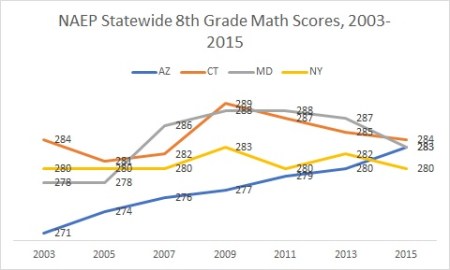
Nearly 2,500 people make $280,000 per year for administering a system in deep decline. Nice work if you can get it. So if you run your school system too much like MTA runs the subway, and other states do less of that, slowly but surely you might see something like this, even if you spend twice as much per pupil:


More Regulation and Less Diverse School Options

November 14, 2017

(Guest Post by Corey A. DeAngelis and Lindsey Burke)

The first experimental evaluation to find negative impacts of a voucher program on student achievement was released to the public over two years ago. Since then, education scholars and public officials have debated whether the initially large negative effects in Louisiana could be explained by the program’s burdensome regulations. While some education policy analysts argued that the state-testing mandates and open-admissions policies deterred higher-performing private schools from participating, others contended that the program might have performed even worse without the rules in place to ensure that parents only chose high-quality educational institutions.

The discussion heated up again three months ago with the release of the Louisiana Scholarship Program’s (LSP) third-year reports showing that students using a voucher caught up to their public school peers on test scores. Just after the public release, John White, Louisiana’s superintendent of education, reasoned that “it may very well be the regulation itself – the accountability system – that is the thing that has promoted the performance.”

However, one of the third-year reports released by researchers at the University of Arkansas addressed this very issue and concluded that the heavy regulatory environment in Louisiana may have driven away higher-quality private schools from participating in the program at all.

Likewise, we just released an analysis examining whether school voucher environments in Louisiana, D.C., and Indiana affected the specialization of the private school market overall. We found that when individual private schools switch into highly-regulated voucher environments such as Louisiana, they are less likely to self-identify as specialized or nontraditional educational institutions.

Theory

Since the voucher programs in question are funded by taxpayers, the public has a legitimate interest in understanding the impact of regulations on private school function and structure. When publicly funded private school choice programs are introduced, most public officials have good intentions when attempting to guarantee that families have access to high-quality educational institutions. In a well-meaning attempt to control levels of school quality and institutional equity, policymakers require that private schools comply with regulations associated with academic quality, financial viability, and access.

Nonetheless, efforts to ensure “accountability” through regulations mirror the various policies governing traditional public schools. If government officials decide to regulate private schools operating within a voucher environment in the same way traditional public schools are regulated, the supply of schools in the private market is expected to become similar to public schools over time. Obviously, private schools that participate in a voucher program will behave more like public schools if they are required to do many of the same things: focus on state standardized tests, fill out supplementary paperwork, and conform admissions processes to the government model.

We expect that private schools in the most-heavily regulated program, the LSP, will be the most likely to experience reductions in specialization. After all, only a third of the private schools chose to participate in the LSP, while between 70 and 78 percent of private schools participated in the programs in D.C. and Indiana. The unusually low LSP participation rate may be because the program is targeted to the least advantaged children in Louisiana and requires students to take the state’s standardized tests and schools to have an open-admissions process.

Results

Every other year, private school leaders provide information about their institutions using the nationally representative Private School Universe Survey (PSS). For our analysis, we examine changes in responses to question eleven which asks school leaders to check one box that best describes their private institution. We examine whether switching into voucher program environments influences the relative likelihoods that private school leaders report that their institutions are regular, specialized, or alternative schools.

As shown in our study, three out of the four effects that were statistically different from zero were in Louisiana. After switching into the voucher program environment in Louisiana, individual private school leaders were around 4-percentage points, or about a tenth of a standard deviation, more likely to identify as regular schools. Furthermore, private school leaders in Louisiana were around 2-percentage points, or about a fifth of a standard deviation, less likely to identify as schools with a “special program or emphasis,” and about 2-percentage points, or around a tenth of a standard deviation, less likely to identify as “schools that offer a curriculum designed to provide alternative or nontraditional education.”

In addition, we found that private school leaders in the nation’s capital were about 10-percentage points, or over a half of a standard deviation, less likely to report that they were alternative schools. This may be because the D.C. voucher program was the only one that required teachers in core subjects to have a bachelor’s degree. It may be that D.C. private schools that provided a nontraditional or alternative education relied more heavily on a robust supply of diverse teachers.

No statistically significant impacts were detected in Indiana, the more lightly regulated voucher program of the three. Although Indiana private schools participating in the state voucher program are required to take the state test, the fact that most did so prior to the introduction of the voucher program in order to be eligible for the high school athletics association may have mitigated the effect such a regulation would have otherwise had on school participation.

But why does this matter? What does this mean for the education of children going forward?

Since individual student needs, learning abilities, interests, and desires are all unique, specialized services ought to lead to improved outcomes. Conversely, access to schools that mimic the district system may not offer much additional choice at all. Consequently, homogenization in the supply of schooling options could have led to the recent negative experimental impacts revealed in Louisiana.

While a hearty set of program regulations may be tempting to policymakers, especially since they give well-intentioned public officials the illusion of quality-control, the disheartening result may be a less meaningful set of choices for parents and their children.

Our results suggest that burdensome packages of regulations likely limit schooling choices in an unfortunate way. Policymakers and school choice advocates interested in establishing a robust universe of education options that are responsive to family needs and preferences should limit red tape and enable private schools to retain their unique identity and character.

###

Corey A. DeAngelis is an Education Policy Analyst at the Cato Institute’s Center for Educational Freedom.

Lindsey Burke is the Director of the Heritage Foundation’s Center for Education Policy.


How Soon Will Self-Driving Cars Take Kids to School?

November 13, 2017

Waymo’s self-driving cars are now driving through the Phoenix metro area without anyone in the front seat.

(Guest Post by Jason Bedrick)

Waymo recently announced that it will launch a fleet of self-driving taxis within the next 18 months. I can personally attest that I’ve seen self-driving cars from Waymo, Intel, Uber and others passing my house with great regularity over the last two years (thanks, in large part, to Arizona’s solidly pro-innovation governor, Doug Ducey).

Self-driving cars are going to dramatically change society. The question is no longer “if” but “when.” Some changes will be obvious: fewer accidents, fewer deaths, faster travel, more productive use of commute time, etc. Some second order effects are less obvious but highly likely. For example, once it becomes cheaper to order a Waymo or Uber whenever needed than to own a vehicle, people will be able to convert garages into usable living space and businesses will be able to get rid of parking garages and most parking lots.

Self-driving cars will also change how we get our kids to school. As I wrote a few years ago, self-driving cars will eventually make it safe and efficient to send multiple children to multiple different schools — and with cars able to travel faster, the number of schools within a commutable distance will dramatically increase. That would greatly expand the educational options available to families.

How soon should we expect this change? That’s not clear. As Robert Pondiscio has noted, the technology is changing faster than the culture. It might be a while before families feel comfortable putting their child in a vehicle with no adult supervision. On the other hand, advances in GPS, video monitoring, and even bracelets that detect medical episodes can make future rides in self-driving vehicles safer than anything we grew up with.

In the spirit of the Forster-Mathews bet, Robert and I are putting our money where our mouths are. Although I expect that in five years, few people will be sending their kids to school in autonomous vehicles, I predict that at least 25 percent of children in the Phoenix area will get to school via a self-driving car by the 2022-23 school year. This may sound overly exuberant, but with self-driving cars already on the Phoenix streets and Waymo launching its taxi service, I expect high demand for the safety that self-driving cars offer. Moreover, the autonomous vehicle companies are already branching out into services like trucking — it won’t be long before they’re operating school buses as well. Unlike bus drivers, self-driving cars don’t get drunk, lose their temper, get distracted, fall asleep, or not show up for work. As soon as it is safer and more cost-effective for school districts to switch to self-driving vehicles, I expect the shift to be rapid.

The loser owes the winner a beer. And if I’m right, we’re taking a self-driving car to the bar.


Parents With Choices Seek More Information

November 8, 2017

(Guest Post by Jason Bedrick)

We’ve all heard the argument that parents can’t be trusted with educational choice because they don’t have enough information. But as my new EdChoice colleague Mike McShane explains, it’s all a matter of incentives:

[P]arents don’t have a strong incentive to look for information about school options if they don’t have the ability to take advantage of the information. If they don’t have choices, why search for information?

This creates a terrible chicken-and-egg problem. We shouldn’t give parents choices because they don’t have enough information to make good decisions, but they don’t have enough information because we haven’t given them choices!

Fortunately, new research by Michael F. Lovenheim and Patrick Walsh sheds light on how parents seek out and consume relevant information when given the incentive to do so (i.e., the ability to choose). As McShane explains:

Lovenheim and Walsh’s paper offers a path forward. They find that parents respond to expansions of school choice options by seeking out new information. The researchers were able to link more than 100 million (yes, you read that right) individual searches on the school information website GreatSchools to geographic areas that either had school choice expanded or restricted during the almost three years of their study to see how parents respond to changes in the options available to them.

They found that expansions of school choice drove increases in searches for school information. They also found that restrictions of school choice drove decreases in searches for school information.

As it turns out, parents, whose time is valuable, don’t waste their time learning about school options that they can’t take advantage of. But, when they have options made available to them, they work to find out which one is best for their child.

For more on the implications of this research — and what choice proponents can do to help parents get access to relevant information, read the rest of McShane’s blog post here.


District School to 5th Grader: “Snitches Get Stitches”

November 1, 2017

s-l300

(Guest Post by Jason Bedrick)

It has only been a few hours since Jay awarded the the 2017 Al Copeland Humanitarian Award posthumously to Stanislav Petrov (honestly, Matt, how were we expected to top “man who saved the world”?), but already I have an early nominee for the Higgy: Florida district school principal Traci Wilke of Samuel Gaines Academy.

In 2015, a 5th-grade student surreptitiously recorded her teacher bullying and threatening violence against a fellow student (e.g. “I will drop you!”). Following the “if you see something, say something” and “zero tolerance for bullying” policies that officials drill into our heads, 11-year-old Brianna Cooper handed the video over to another teacher. Although the school fired the bully teacher, school officials also decided to suspend Brianna for one week claiming that she “violated” the teacher’s “expectation of privacy.”

Apparently Brianna had violated one the school’s unwritten policies: “snitches get stitches.”

It was only after local and state media outlets picked up the story that the superintendent intervened and the suspension was lifted. A string of emails uncovered by the website Photography Is Not a Crime show other district school officials complaining to each other about the principal’s poor decision and lack of responsiveness.

“Did you get a response from Traci?” asked Assistant Superintendent John Lynch. “No sir! Did you think I would?” responded Superintendent Genelle Yost, “I do not believe she truly understands the magnitude of the decision.”

Later, after telling Principal Wilke that it would be “in the best interest of all, district included, to lift the suspension.” Lynch then sent a private email to Yost lamenting, “I was hoping after some time for reflection, Traci [Wilke] would come to the conclusion to lift the suspension on her own.”

Although the suspension was eventually lifted, it is outrageous that any school official would think it appropriate to punish a student for whistleblowing about physical threats made against other students. Doing so sends a clear message that the principal puts the interests of adults working at the school ahead of the physical safety and wellbeing of students enrolled there.

Such warped priorities are deserving of the Higgy.


And the Winner of the 2017 “Al” is… Stanislav Petrov

November 1, 2017

The hardest thing to do, quite often, is just choosing to do the right thing.  It’s easy to posture, to proclaim, and to promote the idea that one is striving to fix the world or to achieve justice.  If you really want to repair the world and promote justice, just try to do something good… and then another good thing… and then another.

Focusing on grand goals, like saving the world or realizing justice, tends to produce little good in the world and can often do the opposite.  We are too small and the world is too big for us to understand how to map a path toward saving it.  And if we focus on building an unknowable path to reach distant objectives, we are more tempted to ride roughshod over good things and people along the way.  If you want to promote good in the world, start by doing one good thing without a plan for saving the entire world.

But very rarely, choosing to do one good thing can save the world.  In the case of Stanislav Petrov it actually did.  When Petrov, who was a Lt. Colonel in the Soviet Air Defense Forces, received a signal indicating that the US had launched nuclear missiles, he chose not to follow established procedures and inform his superiors.  Rather than risk a nuclear war, he chose to assume that the signals of a US launch were faulty.  He didn’t have a plan to save the world.  He didn’t take to the 1980s equivalent of Twitter or Facebook and declare his intentions to save humanity from nuclear self-destruction.  In the midst of a stressful and confusing moment, he just chose to do the right thing, even when he had orders to do otherwise.  For making that one fateful good choice, Petrov is clearly worthy of the Al Copeland Humanitarian Award.

Just as an aside, the Petrov story that Matt recounts is a reminder of how weak and stupid authoritarian systems really are.  There is a bad habit among Western observers to believe that free societies are weak and vulnerable because they are divided and riddled with conflict among groups each seeking their own interests.  Authoritarian systems are admired, even among some who say they oppose them, for their unity of purpose and speed of action.  This was a common view during the Cold War (even held by fellow Al nominee, Whittaker Chambers) who feared the West would lose if it didn’t shed some of its freedoms for the sake of prevailing over a more menacing threat to freedom.  Joseph Kennedy and the Duke of Windsor were fascinated by the Nazis and leaned toward appeasement in part because they thought authoritarianism had an edge over free societies.  Previous Al nominee, Bill Knudsen, shows how wrong they were, specifically with respect to the superiority of the free US war mobilization over the Nazi effort.  This belief that we need to sacrifice freedom to prevail over an authoritarian advantage is also a common reaction to Islamic terrorism.

Even in the world of education reform, I’m old enough to remember people urging us to imitate educational practices from Japan and more recently China because of the imagined greatness to be achieved by suppressed individualism.  These are some of the same people who push national standards, like Common Core, increased centralized control over education, etc… But that is a post for another day.

As the Petrov story makes clear, authoritarian systems are actually quite weak because they have difficulty obtaining accurate information and avoiding self-destructive groupthink.  Once they get it into their collective head that the US is preparing a first-strike, they can’t consider all of the evidence showing that is wrong, nor can they avoid interpreting all actions from the faulty assumption that they are part of an imminent attack.  We see this time and again with dictators.

Whittaker Chambers also made a fateful choice to do one good thing by (we now know truthfully) accusing Alger Hiss and others in senior government positions of being Soviet agents.  But Chambers’ accusations also fueled the McCarthyite over-reaction, which was based on this false belief in an authoritarian advantage that required we had to become less free to defeat bigger threats to freedom.  And Chambers is not really lacking in recognition for the good choice he did make, having received the Medal of Freedom, which is the highest award for civilians, in 1984.

My own nominees, Justin Roiland and Dan Harmon, who are the creators of the Rick and Morty animated TV show, as well as Jason’s nominee, Russ Roberts, who hosts a popular podcast, also fall short.  While promoting decency among those who assume nihilism and promoting honest intellectual inquiry are both worthy accomplishments, they just can’t compare to avoiding nuclear war.  We need more Stanislov Petrovs, who just choose to do the right thing.  And some of those good choices might really save the world.


For the Al: Whittaker Chambers

October 30, 2017

78660-004-F7B14FDF

(Guest post by Greg Forster)

The Al does not go to people who are already widely recognized. However, I submit that today, in spite of the intense public attention he endured in 1948, Whittaker Chambers is not at all widely recognized. Since I read Witness for the first time early this year, I have begun mentioning him to people and am stunned to discover that almost nobody even knows his name today.

The first thing to understand about Whittaker Chambers is that he allowed his life to be destroyed rather than tell a small lie. He lost his job as senior editor of Time and never held another job in mainstream American journalism; he went home and became a full-time farmer, which is not a life that allows a man like Chambers to do what he was obviously made to do, which is journalism. He couldn’t even make the farm go – it failed.

He made this sacrifice in part to arouse the nation to face a totalitarian threat that its guilty conscience wouldn’t allow it to acknowledge (more about that in a moment) but at least as much to honor the dead whom he had helped kill. Unable to go back and undo his years of work building up Soviet communism, all he could do for its victims was tell the truth about what he had done, no matter what it cost him. And it cost him all.

The second thing to understand about Whittaker Chambers is that all the forces of American civilization were arrayed to destroy him. This is why his testimony cost him everything.

Before the Hiss Case in 1948, virtually no one with any position in American civilization viewed communism as totalitarianism. It is very difficult for us to recapture an awareness of this, in light of subsequent history. But in 1948, the consensus was that communism was illiberal or authoritarian, but not totalitarian. It was not genocidal. There were no gulags, no starving millions in Ukraine who were being put to death intentionally for the sake of the great project. (The New York Times still has not given back the Pulitzer it won for coverage of the glories of communist agriculture, or even run a correction, in spite of the fact that its reporter knew about the mass murder and covered it up intentionally.)

Whittaker Chambers and John Slater

Chambers’ testimony about his work as a Soviet spy implicated high-ranking American leaders. Reading through Alger Hiss’ defense of himself, I’m amazed that it really does all boil down to this: “I helped build the New Deal, negotiate the Yalta agreement and design the United Nations. If even a man like me can be a traitor, American society must be so utterly bankrupt that its entire leadership class would be implicated in bottomless moral corruption. Therefore a man like me could not possibly be a communist spy – and every leading politician, journalist and professor had better get busy testifying in my defense, lest the bankruptcy of American leadership – and hence his own bankruptcy – be exposed.”

He did not put it in precisely those words, but close enough.

The president called Chambers a liar on campaign stops. Two justices of the Supreme Court testified as character witnesses for Hiss. Rumors flew around the Washington press corps that Chambers was a drunkard, that he was mentally ill, that he had slept with Hiss’ wife, that he had sexually abused his own brother as a child and had then abused Hiss’ stepson.

All baseless, of course – but a ruling class believes what it hears from its own. It will believe any lie, however outrageous, about a commoner before it believes any uncomfortable truth about itself.

If you doubt this, consider: James Reston, the legendary DC correspondent for the New York Times, had recommended Hiss for his job as head of the Carnegie Endowment. If Hiss was a traitor, what did that say about Reston? So naturally Reston did all in his power to destroy Chambers, including inventing lies about him.

When Chambers went on the radio show Meet the Press, Reston “moderated” the panel of journalists dedicated to destroying him. Obviously there was no acknowledgement of Reston’s conflict of interest. After the broadcast, Chambers’ son asked him: “Papa, why do those men hate you so?”

Chambers replied: “We are in a war, and they are on the other side.”

Nor was it only journalism that was corrupted. The chair of the Harvard psychiatry department testified in court that he had diagnosed Chambers as a dangerous lunatic, solely on the basis of reading his journalism in Time. Upon cross-examination, however, the good Harvard doctor recanted his testimony and admitted that he had in fact gone around to former co-workers with stories of Chambers’ depravity, and tried to wheedle them into affirming them. (Rules of evidence for “expert” testimony are a little tighter now than they were then.)

Chambers had indeed exposed the corruption and bankruptcy, not of Alger Hiss, but of the entire ruling class of the nation.

He had known this would be the effect of his testimony from the beginning. He had seen how the narrative of inevitable and government-led secular progress, to which the entire ruling class of the nation in both parties was wedded, was not very far removed from the totalitarianism of communism.

The issue was not safety-net programs. The issue was a society that had decided comfort and safety were the only really necessary elements of a good human life. This, not the role of government as such, is the deep corruption of the narrative of inevitable secular progress. It is this materialistic view of life that is the real cause of the endless creeping expansion of government.

51u6w06E-sL__SX331_BO1,204,203,200_

As he put it in Witness, the great question in our time is “God or Man?” The communist east had answered “Man,” and embraced totalitarian mass murder because it had the courage of its conviction. The capitalist west has also answered “Man,” but it lacks the courage of this conviction. So far.

Communism is not immorality. Communism is morality without God. It is not a quest for injustice, it is a quest to achieve justice for all people – accomplished by purely human means. Its vision is that “the destiny of man is in the hands of man.” But “without God man cannot organize the world for man; without God man can only organize the world against man.”

Hence the hammer and sickle insignia on Antifa paraphanalia; hence Che Guevara and Fidel Castro on the t-shirts of so many well-meaning moral crusaders seeking justice for all. The neo-Nazis of the alt-right, meanwhile, are non-communist only because they do not strive toward justice for all, but only justice for their own people and causes. The difference between Antifa and the alt-right is that the former is universalistic and the latter parochial, and this is always the difference between communism and fascism.

And today, as in 1948, a morally sick society does not want to see what communism is.

Chambers is also famous for thinking that by defecting from communism to freedom, he was joining the losing side. What is less well known (I found it in his letters to William F. Buckley, published posthumously in Odyssey of a Friend) is the reason Chambers gave for his pessimism about the future of freedom.

There is, he said, no political remedy for spiritual decay in a society.

But to say there is no political remedy is not to say there is no remedy. One of the things we can do to remedy spiritual decay is honor those who do what Chambers did – sacrifice themselves so that others may enjoy freedom.

There is much more to his story, and if you want to know it, you can read the first chapter of Witness, entiteld “Introduction in the Form of a Letter to my Children.” If you read that and don’t then want to read the rest of the book, I don’t know what to tell you.

What matters most for The Al, I think, is the long-term impact of Chambers’ exposure of the threat of communism, which forced the nation for the first time to recognize communism as a totalitarian threat rather than merely just another variation on the old-fashioned authoritarian Great Power game. Without Chambers’ willingness to give up everything for the sake of telling the truth, there would have been no mass mobilization against communism until much later, by which time it may have been too late – or at least it would have been too late for millions who were saved because Chambers forced the nation to wake up when he did.

Yes, Chambers has been recognized in the past. But those recognitions (including the Medal of Freedom given him posthumously by Reagan) have been almost entirely on the political Right. The nation at large has never honored Chambers as it ought.

And now, even the Right forgets. Few of my friends even on the Right are familiar with Chambers’ name. And just recently, George Will blamed Chambers for the success of Donald Trump; one might just as easily blame the doctor who diagnoses a cancer with the madman who seeks to avoid dying of cancer by drinking poison.

Let’s give Chambers his due. Let’s give him The Al.


Hawaii and Arizona made the most academic progress with students with disabilities 2011 to 2015

October 29, 2017

(Guest Post by Matthew Ladner)

Ok so here is what is going on in this chart: NAEP Math and Reading tests are timed and scaled in such a way as to allow for the calculation of cohort gains. In this case, we’ve tracked the statewide gains for students with disabilities from 4th graders in 2011 to 8th graders in 2015. Both the 2011 and 2015 measurements are a population estimate, and NAEP of course is not tracking the same students over time but rather are sampling both populations. The calculation used here is a straightforward 2015 8th grade scores for students with disabilities minus the 4th grade 2011 scores for students with disabilities, and then calculated as a percentage of improvement between 4th and 8th grade.

Students move in and out of states over time, but this sort of error should be largely random and cancel itself out in the absence of some (relatively implausible) systematic bias (like in this case higher performing students with disabilities fleeing Maryland to live in Hawaii). Given the standard errors, there isn’t much reason to fuss over exactly where you stand if you land say in the middle of the blue blob in the chart above, although one might take an interest in the states landing in the top right or bottom left.

Congrats to Hawaii and Arizona. Bad look for Maryland if taken at face value- having one of the nation’s highest spending per pupil figures but failing to teach students with disabilities much of anything about math and reading over a four years is, ah, terrible. Maryland is a state that had in earlier years flouted the NAEP’s inclusion standards for children with disabilities. It is possible that if they stopped doing so in 2015 that it may explain part of their place on this chart. If I lived in Maryland I would get to the bottom of this, but it’s time to get out of my pajamas.

For Hawaii and Arizona:

We’ll circle back and see how this goes when the new NAEP data is released in January.


TFA goes hillbilly nuts

October 19, 2017

(Guest Post by Matthew Ladner)

This has been an open secret for a long time now, but now a TFA alumni has gone and spilled the beans.

If, as implied in the article, the organization adopted the habit of lefty virtue signalling in the hope of immunizing itself from criticism from Dianne Ravitch and the pool of AFT interns being whipped with a cat-o-nine tails to run her twitter feed, they chose poorly. Going hillbilly nuts in response to criticism from someone who has herself gone hillbilly nuts does not leave you as fellow hillbillies. It leaves you as both nuts.

How can she expect us to tweet any faster?

The interests of Ravitch’s puppet-masters remain in crushing alternative paths to reaching the classroom and talent pipelines for charter schools. So long as she continues to yearn for AFT’s adulation and receives enough cigarettes and pizza to keep the intern pool tweeting around the clock with a manageable level of grumbling, Ravitch seems unlikely to even pause to take notice of TFA press releases on freeing Mumia or the various lefty cause du jour.

Alienating yourself from most others however is a much easier task than getting AFT to stop pursuing what they believe to be in their interest. TFA’s leadership might want to think a little harder on the cost-benefit analysis of this “strategy.”